A data-driven roadmap for Beginner to Intermediate players (Chess.com 800–1500) looking to bridge the gap between their online rating and their Over-the-Board (OTB) potential.
For years, the chess community has debated the relationship between online ratings and official Over-the-Board (OTB) ratings. Does a 1200 on Chess.com mean you are a 1200 in real life? Are online ratings inflated, or do the unique pressures of OTB chess simply depress performance?
To answer these questions definitively, we conducted a large-scale data analysis. We extracted a sample of 27,606 Lichess profiles, identifying 2,325 active players who publicly link their accounts to official FIDE, USCF, or ECF ratings. By mapping their online performance to Chess.com equivalents, we built the first rigorous dataset comparing online and OTB ratings across formats, rating bands, and geographies.
This article serves as a roadmap for improvement. We will break down the data by rating band (focusing on the Chess.com 800 to 1500 range), highlight the specific mistakes that cause the online-to-OTB gap, and provide actionable advice for translating your online success to the physical board.
The Big Picture: Formats Matter
The most striking finding from the data is that the "rating gap" is highly dependent on the time control you play online.
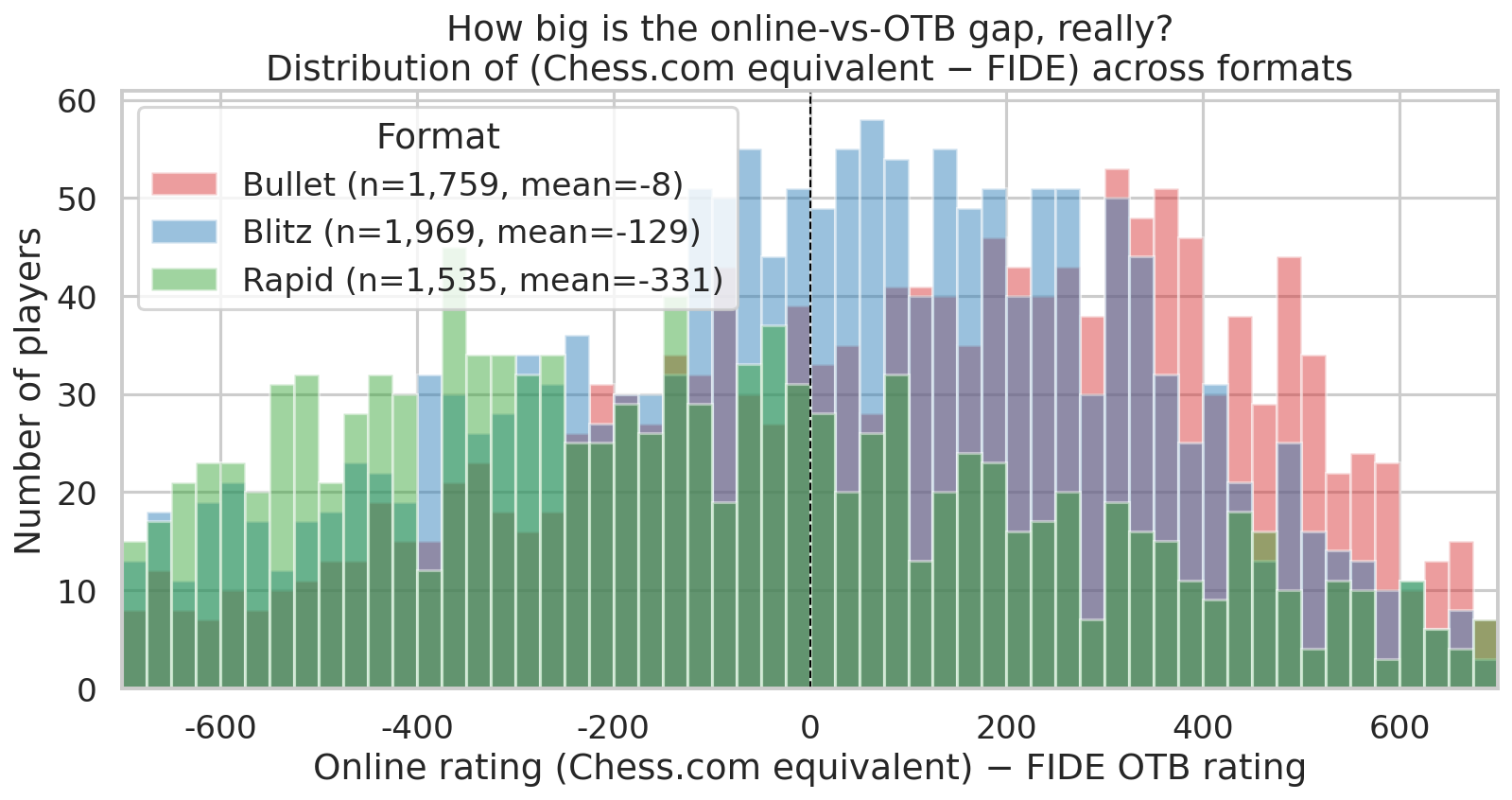
When we subtract a player's FIDE OTB rating from their Chess.com equivalent rating, we see three distinct distributions:
- Blitz is the closest proxy. The mean gap for Blitz is −129 points. This means that, on average, a player's Chess.com Blitz rating is about 130 points lower than their FIDE rating. Furthermore, Blitz shows the strongest Pearson correlation (r = 0.414) with OTB performance.
- Rapid ratings are systematically lower than OTB. The mean gap for Rapid is −331 points. If you are rated 1200 in Chess.com Rapid, your OTB strength is likely significantly higher (closer to 1500 FIDE).
- Bullet is chaotic. Bullet ratings average very close to OTB ratings (mean gap −8), but the variance is massive. Bullet performance is a poor predictor of classical OTB strength.
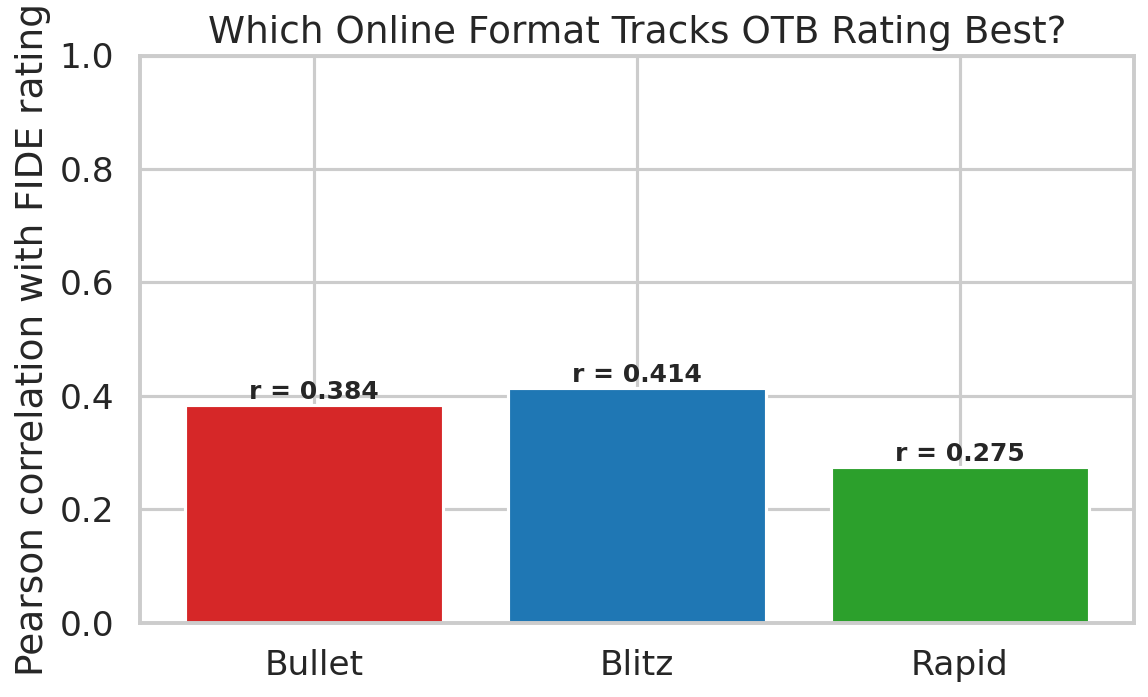
The Roadmap: Bridging the Gap by Rating Band
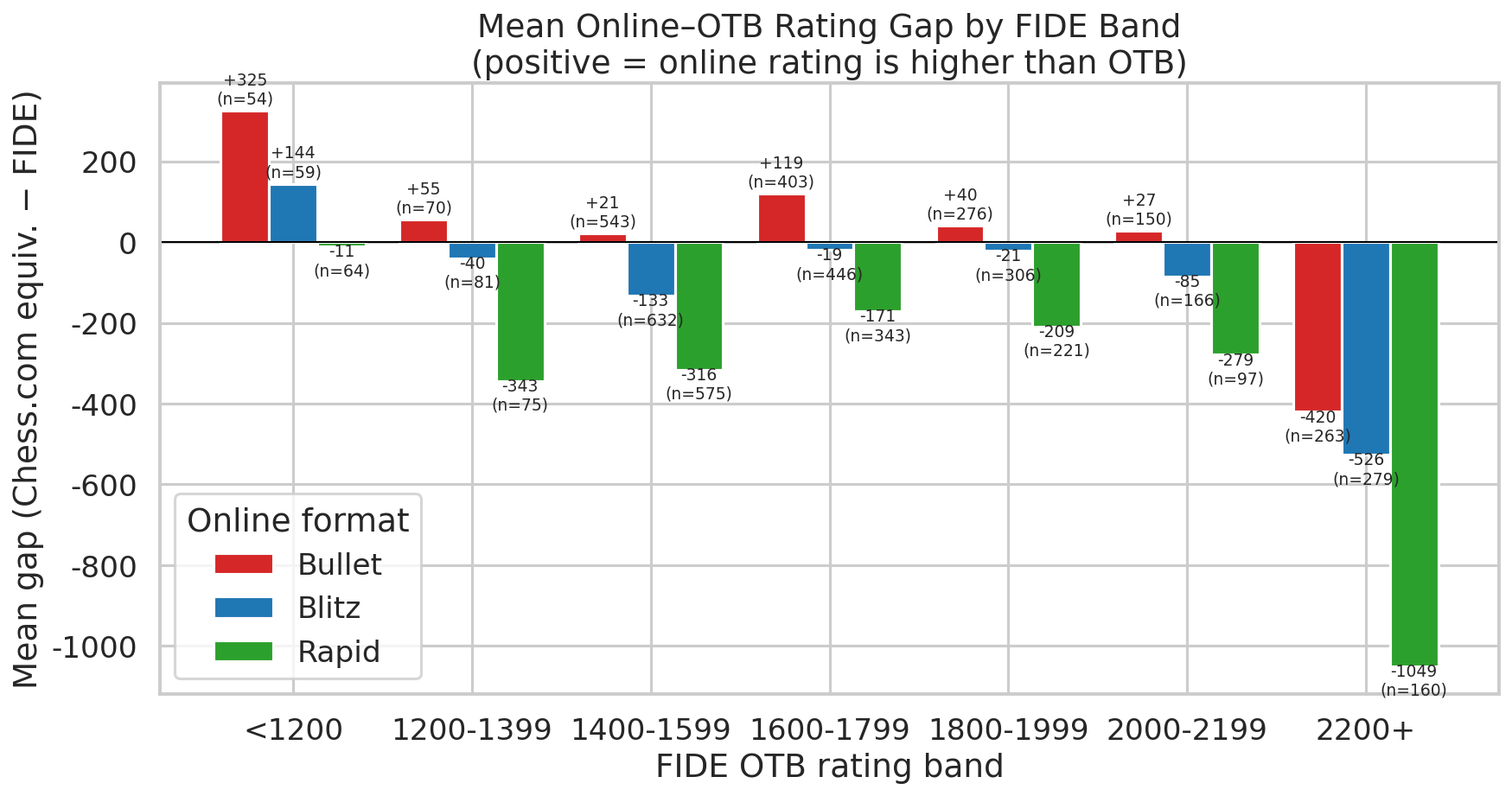
The relationship between online and OTB ratings is not linear. As players improve, the nature of the gap changes. Let us examine the data in 200-point bands (using Chess.com Blitz/Rapid equivalents) and identify the actionable steps needed to progress.
The 800–1000 Range (Chess.com)
Approximate FIDE equivalent: <1200
In this band, we observe a fascinating anomaly: online Bullet ratings are actually higher than OTB ratings (by an average of +325 points), while Rapid ratings lag slightly behind (−11 points).
The Data Story: Players at this level often rely on "hope chess" and cheap tactical tricks that work brilliantly in 1-minute online games but fail miserably when an OTB opponent has 90 minutes to think. The inflation in Bullet ratings reflects a mastery of the mouse, not the board.
The Visual Evidence:
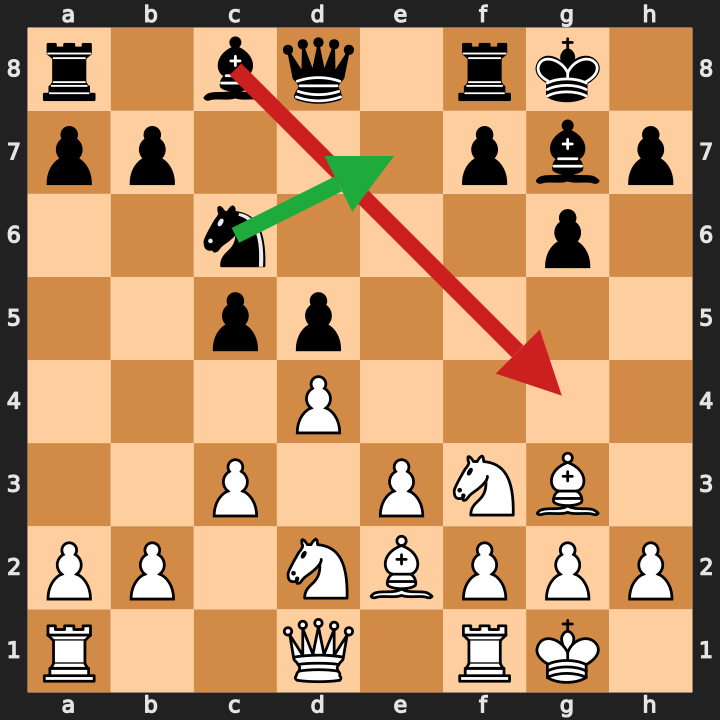 In online speed chess, players often play autopilot moves like Bg4 (red arrow), ignoring the board state. OTB, with time to think, the correct retreat Ne7 (green arrow) is much easier to find.
Actionable Advice:
- Stop playing Bullet. It is actively harming your OTB board vision by reinforcing superficial pattern recognition.
- Play longer online games. Shift your focus to 15+10 Rapid. Treat these games seriously, sitting at a physical board and transferring the moves if possible, to build 3D board vision.
- Focus on blunder-checking. OTB games at this level are decided by one-move blunders. Before touching a piece, ask: "Are any of my pieces undefended? What is my opponent threatening?"
The 1000–1200 Range (Chess.com)
Approximate FIDE equivalent: 1200–1399
Here, the online ratings begin to lag behind OTB ratings across the board. The Rapid gap widens dramatically to −343 points.
The Data Story: Players in this band are beginning to understand positional concepts, but they struggle with the transition from 2D screens to 3D boards. They often play online Rapid games too quickly, treating a 15-minute game like a 5-minute Blitz game. Their OTB rating is higher because the physical environment forces them to slow down and calculate.
The Visual Evidence:
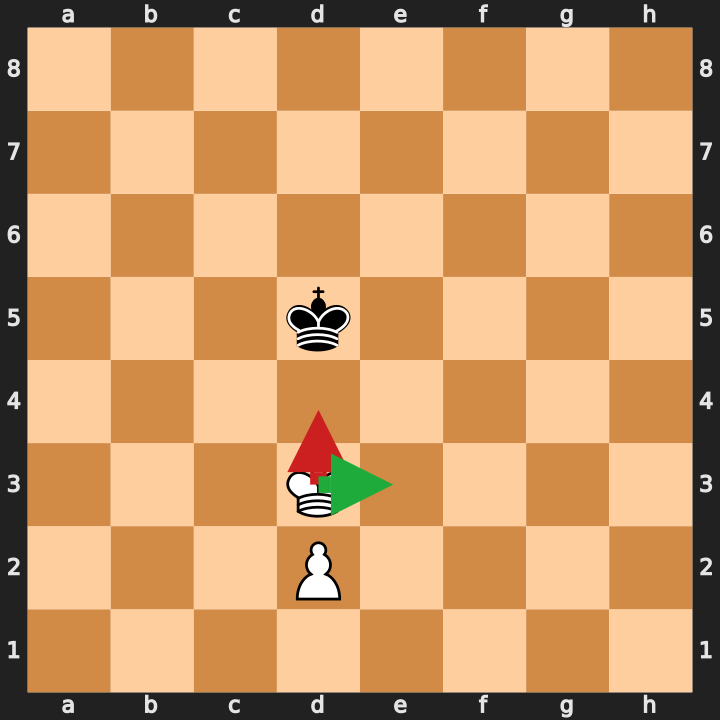 A classic online slip: premoving a pawn push (d4, red arrow) in a drawn endgame, losing the opposition. OTB, players take the time to find the correct King move (Ke3, green arrow).
Actionable Advice:
- Manage your clock. If you finish a 15-minute online game with 12 minutes left on your clock, you are playing too fast. Force yourself to use your time.
- Study basic endgames. Online players often flag or blunder in simple endgames because they rely on premoves. Learn the rule of the square and basic opposition.
- Analyze your losses. Use an engine to review your games, but only after you have annotated them yourself. Identify whether your mistakes were due to a lack of knowledge or a lack of calculation time.
The 1200–1400 Range (Chess.com)
Approximate FIDE equivalent: 1400–1599
The gap remains significant here, with Blitz at −133 and Rapid at −316.
The Data Story: This is the "intermediate plateau." Players here have decent tactical vision and opening knowledge, but they lack the deep calculation skills required for OTB success. The online environment, with its immediate feedback and lack of physical consequences, encourages superficial calculation.
The Visual Evidence:
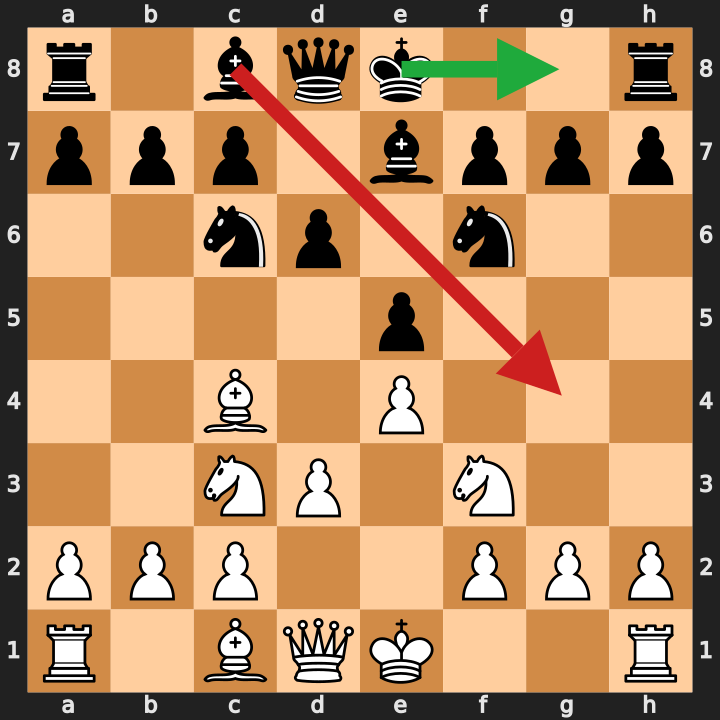 Reflexive, superficial moves like the Bg4 pin (red arrow) are common online. OTB players are more likely to calculate the consequences and choose the solid 0-0 (green arrow).
Actionable Advice:
- Calculate deeper. When you see a good move, look for a better one. Force yourself to calculate lines 3-4 plies deep before moving.
- Expand your opening repertoire. You can no longer rely on trap openings. Build a solid, principled repertoire that leads to playable middlegames.
- Play OTB tournaments. The only way to get comfortable with the pressure, the physical board, and the long time controls is to experience them regularly.
The 1400+ Range (Chess.com)
Approximate FIDE equivalent: 1600+
As players move toward 1500 Chess.com and beyond, the Blitz gap narrows (approaching parity at the 1600-1799 FIDE band), while the Rapid gap remains wide.
The Data Story: At this level, Blitz ratings become a highly accurate reflection of a player's intuitive strength and tactical sharpness. The persistent Rapid gap suggests that strong OTB players simply do not play much online Rapid, preferring Blitz for practice and OTB for serious classical chess.
Actionable Advice:
- Use Blitz for opening preparation. Play 3+2 or 5+0 games specifically to test new opening lines and get a feel for the resulting middlegame structures.
- Focus on positional understanding. Tactics will always be important, but games at this level are increasingly decided by pawn structure, piece activity, and long-term planning.
- Study master games. Review annotated games by strong grandmasters to understand how they evaluate positions and formulate plans.
Regional Variations
Our analysis also revealed interesting geographic variations in the rating gap.
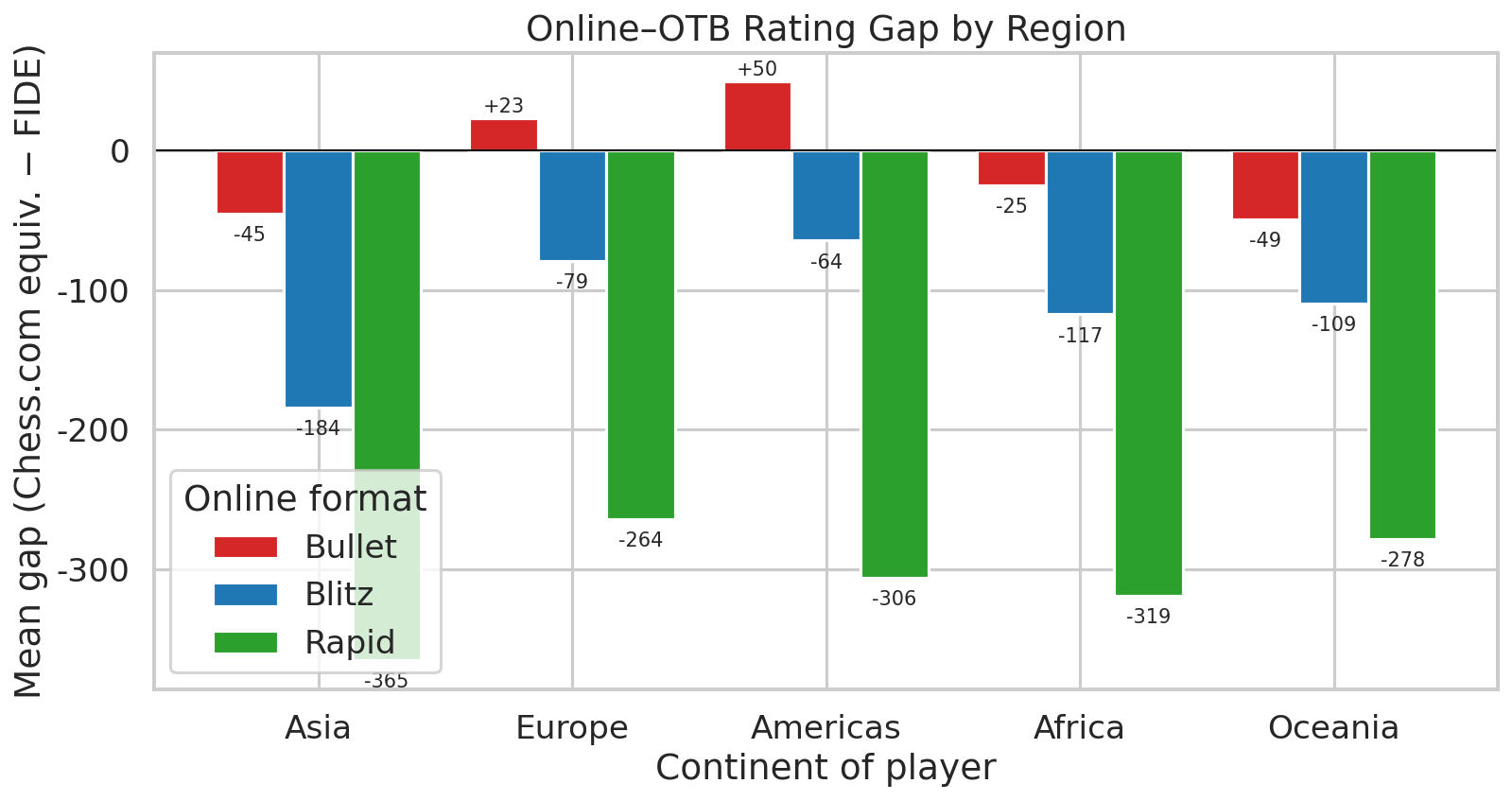
Players from Asia (particularly India) show some of the largest negative gaps, meaning their OTB ratings are significantly higher than their online equivalents. This likely reflects the intense, highly competitive scholastic OTB culture in these regions, where young players develop immense classical strength that isn't fully captured by their casual online play. Conversely, players from the Americas show a smaller gap, perhaps reflecting a culture where online play is more central to a player's development.
Data and Methodology
This research is based on a dataset of 27,606 Lichess usernames collected from public leaderboards and major team rosters (e.g., national federations, FIDE clubs). We enriched these usernames using the Lichess API to retrieve full profiles, including self-reported FIDE, USCF, and ECF ratings.
The data was cleaned to remove inactive accounts, TOS violators, and accounts with fewer than 30 games in a given time control. To make the findings accessible to the broadest audience, Lichess ratings were converted to approximate Chess.com equivalents using a standard community mapping scale.
The underlying data files and analysis scripts are available for review:
View full data →username title country continent bullet_rating blitz_rating rapid_rating cc_bullet_rating cc_blitz_rating cc_rapid_rating fideRating uscfRating ecfRating otb_fide_equiv otb_source gap_cc_bullet_minus_fide gap_cc_blitz_minus_fide gap_cc_rapid_minus_fide gap_lichess_bullet_minus_fide gap_lichess_blitz_minus_fide gap_lichess_rapid_minus_fide bullet_games blitz_games rapid_games SindarovGM GM UZ Asia 3295.0 2828.0 3000.0 2968.5714285714284 2659.0 2659.0 FIDE 341.0 309.57142857142844 636.0 169.0 5768 3426 65 muisback GM AZ Asia 3273.0 2809.0 3000.0 2941.4285714285716 2659.0 2659.0 FIDE 341.0 282.42857142857156 614.0 150.0 12717 1825 0 Mishka_The_Great IM PL Europe 3232.0 2677.0 3000.0 2774.285714285714 2395.0 2395.0 FIDE 605.0 379.2857142857142 837.0 282.0 93786 2394 40 chess-art-us GM HT Americas 3200.0 2871.0 3000.0 3000.0 2521.0 2521.0 FIDE 479.0 479.0 679.0 350.0 32662 2891 43 Tuzakli_Egitim FM AZ Asia 3169.0 2922.0 2725.0 3000.0 3000.0 2966.6666666666665 2334.0 2334.0 FIDE 666.0 666.0 632.6666666666665 835.0 588.0 391.0 15435 5601 1609
View full data →username title country createdAt seenAt bullet_rating bullet_games bullet_prov blitz_rating blitz_games blitz_prov rapid_rating rapid_games rapid_prov classical_rating classical_games classical_prov puzzle_rating fideRating uscfRating ecfRating cfcRating rcfRating realName bio_len totalPlayMin tosViolation disabled mraquariyaz67 GM TL 1761521396115 1776639563501 3469 4587 False 2928 409 False 2743 13 True 1500 0 True 3002 23 797579 False False nihalsarin2004 GM IN 1505668328682 1776636592928 3336 18012 False 2905 1333 True 1500 0 True 1500 0 True 2429 Nihal Sarin 0 3533838 False False Ediz_Gurel GM 1678897786697 1776645935820 3306 17326 False 3009 244 False 1500 0 True 1500 0 True 3203 0 1969964 False False We_Are_Groot08 CN 1641810618778 1776627865140 3300 4013 False 2470 3791 False 2326 58 False 2433 18 True 2491 福林 19 1119519 False False SindarovGM GM UZ 1585480542622 1776626778161 3295 5768 False 2828 3426 False 2204 65 True 1500 0 True 2696 2659 Javohir Sindarov 82 1581909 False False
View full data →fide_band n_players mean_gap_bullet median_gap_bullet n_bullet mean_gap_blitz median_gap_blitz n_blitz mean_gap_rapid median_gap_rapid n_rapid <1200 83 324.6327374545469 323.57894736842104 54 144.33487068855965 146.8888888888889 59 -10.680555178517132 -42.166666666666686 64 1200-1399 102 55.11143244194992 80.0 70 -40.03550788237884 -29.333333333333258 81 -343.4217847530891 -442.52173913043475 75 1400-1599 769 21.080517115543543 29.0 543 -132.63044683919125 -102.92857142857144 632 -316.0451871925596 -333.0 575 1600-1799 504 119.2547400980227 146.6470588235295 403 -19.304765473716827 30.0 446 -170.74102897426513 -139.33333333333326 343 1800-1999 351 40.32108034585095 110.35294117647061 276 -21.4577931883337 47.0 306 -208.9718949095996 -161.0 221
View full data →continent n_players mean_gap_bullet n_bullet mean_gap_blitz n_blitz mean_gap_rapid n_rapid Asia 840 -45.03672324704308 611 -183.8657335622615 687 -365.0283466474627 585 Europe 628 23.33530142162887 499 -78.91325164454594 567 -263.8759056653409 399 Other 415 -20.019396978570683 309 -155.30294203921136 337 -375.01543438268186 288 Americas 290 49.56591313004799 225 -64.48160881174692 247 -306.15289342494685 177 Africa 123 -25.076948087163096 91 -117.28197071249075 111 -318.659604189975 72
Chess Coach
April 20, 2026