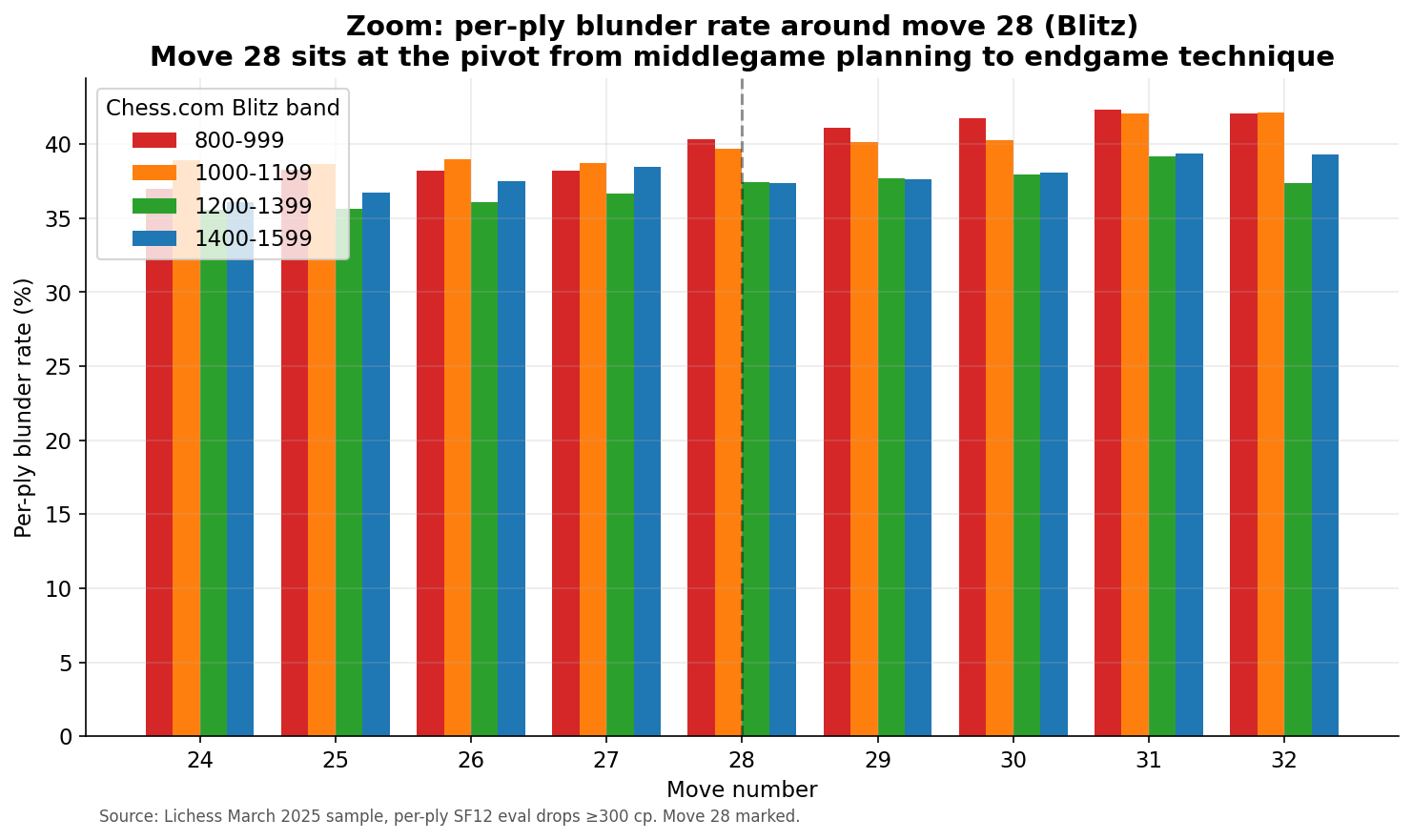
If you play Blitz chess on Chess.com and your rating is between 800 and 1500, you are likely losing games in a very specific window: the late middlegame. While much of chess literature focuses on opening traps or endgame technique, our data analysis reveals a striking phenomenon. Around move 28, blunder rates spike to their highest sustained levels of the game.
To understand why this happens and how you can fix it, we analyzed over 6,000 Blitz games played by players in this rating range. By tracking engine evaluation swings ply-by-ply, we mapped the exact moments when games slip away.
This guide serves as a roadmap for improvement, breaking down the data and providing actionable advice for each rating band to help you navigate the "Move 28 Danger Zone."
The Anatomy of the Move 28 Blunder
In chess, move 28 typically represents a critical transition phase. The opening is long gone, the initial middlegame plans have either succeeded or failed, and the board is often characterized by high tension, low time on the clock, and the looming prospect of an endgame.
Our analysis defines a blunder as a move that worsens the player's position by at least 300 centipawns (the equivalent of losing a full piece), and a mistake as a drop of at least 200 centipawns.
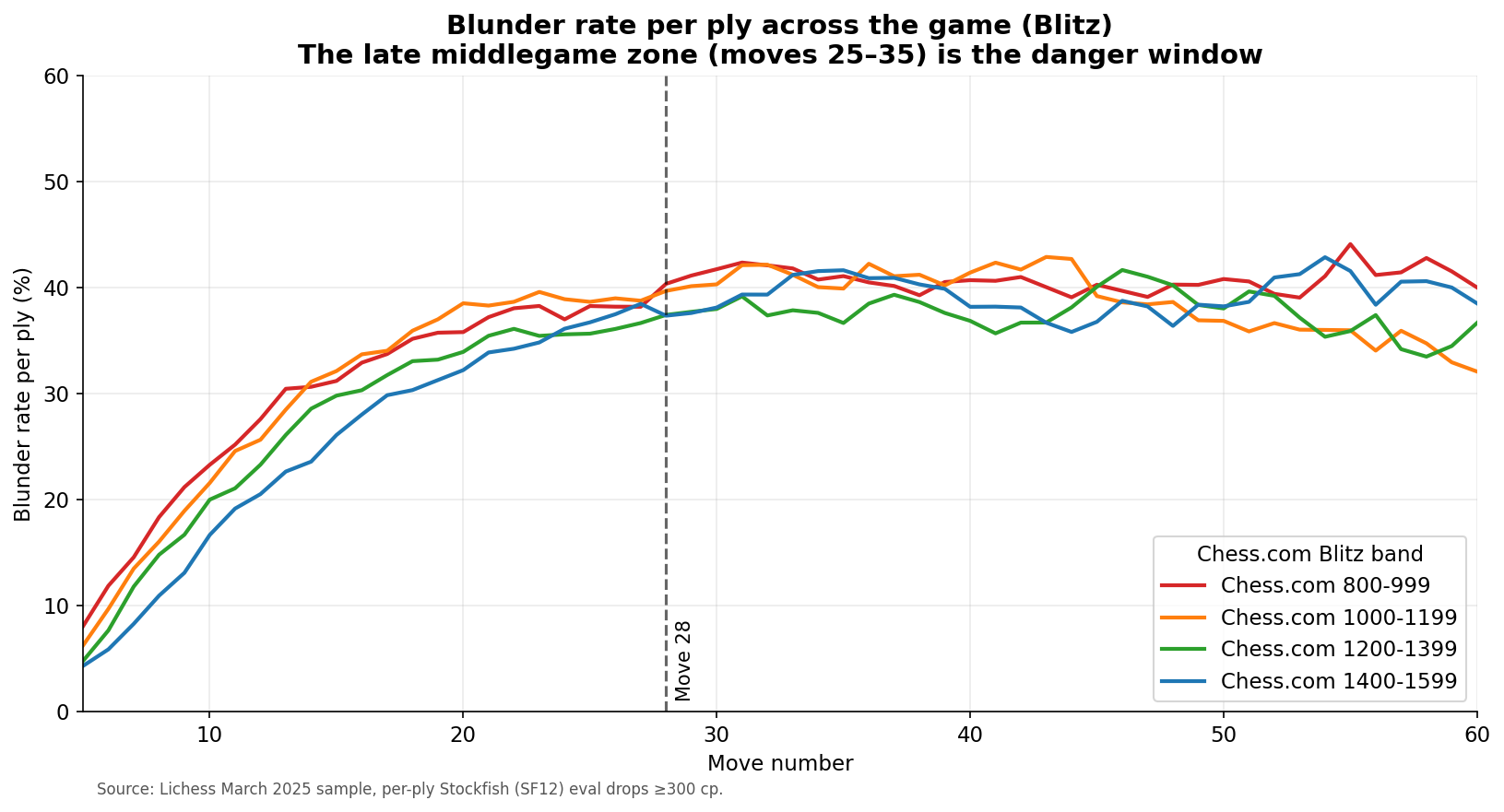
As the chart above illustrates, the blunder rate per ply climbs steadily during the opening, plateaus during the complex middlegame, and remains perilously high right through the move 25–35 window. At move 28 specifically, the per-ply blunder rate hovers around 37% to 42% depending on your rating.
Who Blunders More?
A common misconception is that one color is inherently harder to play in the late middlegame. However, the data shows that the trap is symmetric.
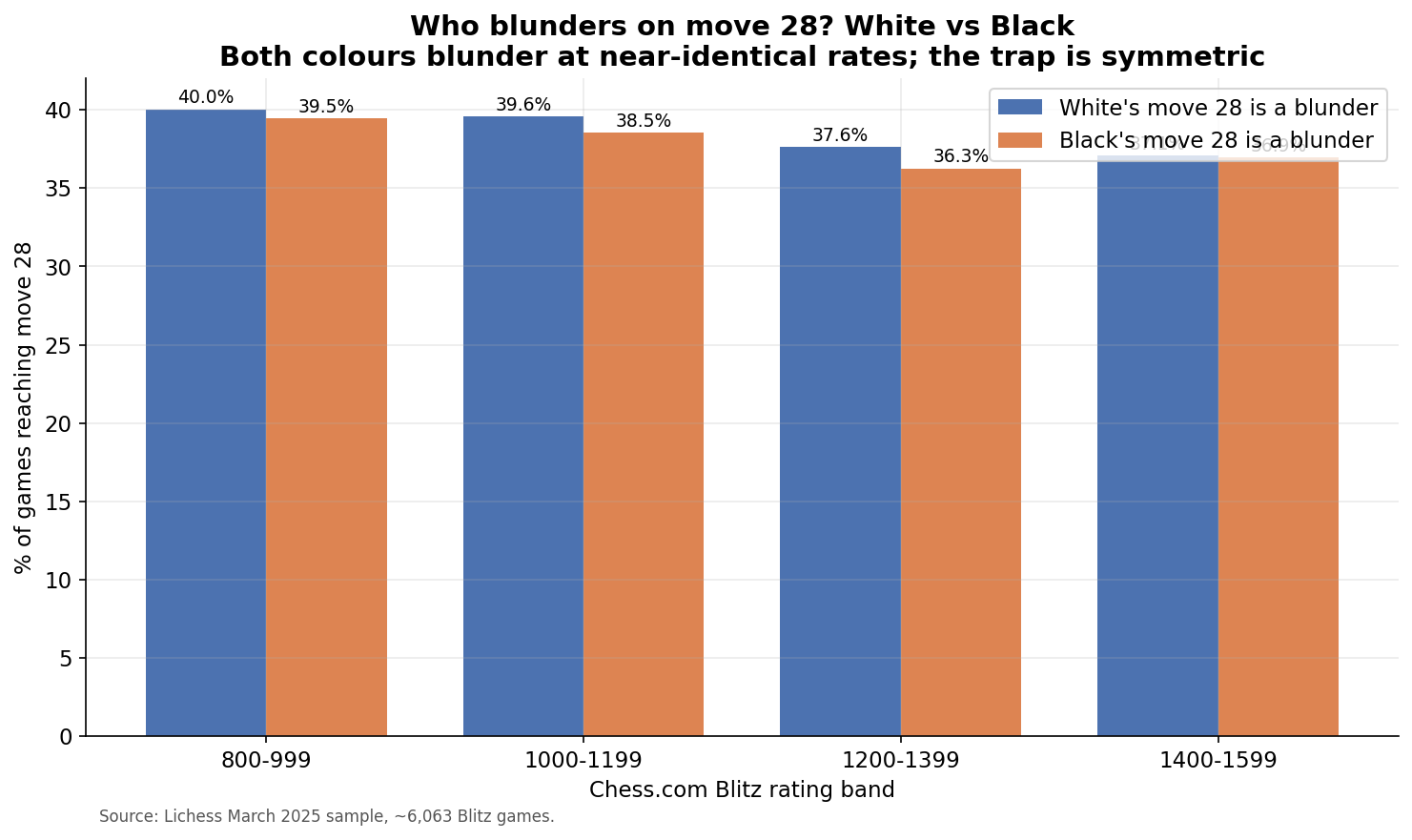
Whether you are playing White or Black, the cognitive load of the late middlegame affects both players equally. If you can maintain your composure around move 28, you have a massive statistical advantage, because your opponent is highly likely to crack.
Rating Band Breakdown and Actionable Advice
We divided the player pool into four 200-point bands based on Chess.com Blitz ratings (with corresponding Lichess Blitz ratings used for the raw data collection, typically 200-300 points higher).
The 800–999 Band: The Chaos Zone
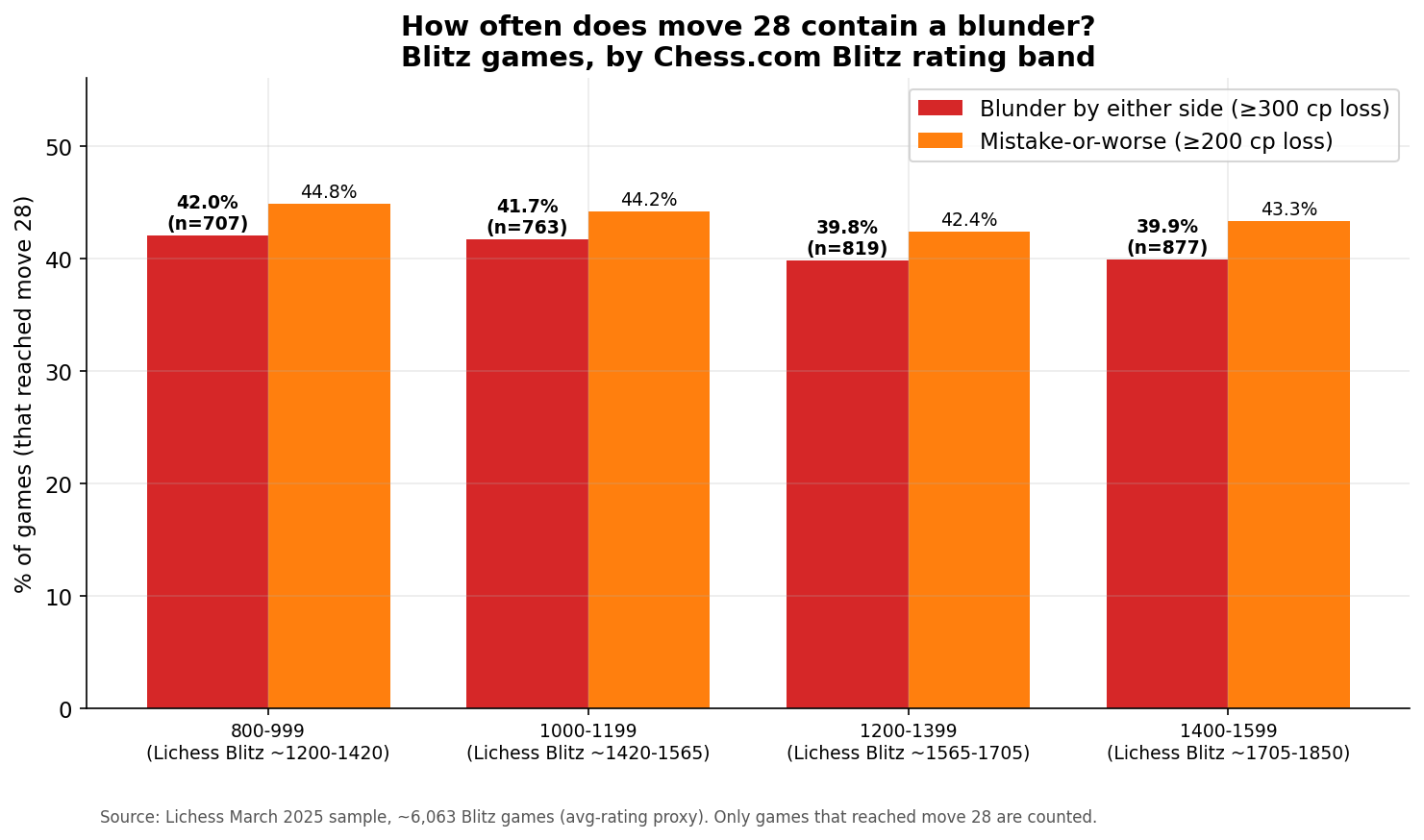
At this level, games are highly volatile. Only about 46% of games even reach move 28, as many are decided earlier by opening blunders or quick checkmates. However, for the games that do reach this stage, the blunder rate is staggering.
In our sample, 42.0% of games that reached move 28 featured a massive blunder (≥300 cp loss) on that exact move by either White or Black.
The Typical Move 28 Blunder: Players at this level often miss simple one-move tactics or fail to recognize that a previously defended piece is now hanging due to a recent exchange.
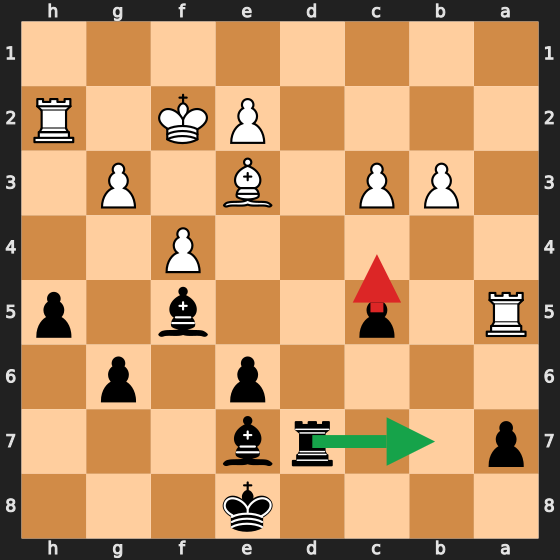 In this example from an 800-999 rated game, Black played c4 (red arrow), completely missing the immediate threat. The engine prefers Rb7 (green arrow) to maintain the defense.
Actionable Advice for 800–999:
- Do a "Hanging Piece" Check: Before you make your move, scan the entire board. Are any of your pieces undefended? Are any of your opponent's pieces undefended?
- Manage Your Clock: Blunders here are often time-induced. If you reach move 28 with 10 seconds left, you are playing the lottery. Aim to play the opening faster so you have time to think when the board gets complicated.
The 1000–1199 Band: The Transition Phase
Players in this band have stopped hanging pieces on move 5, which is why more games (50.5%) reach move 28. However, the late middlegame remains a massive hurdle. The blunder rate on move 28 drops only slightly to 41.7%.
The Typical Move 28 Blunder: Here, blunders often involve missing two-move tactical sequences, such as forks, pins, or discovered attacks that arise as the center opens up.
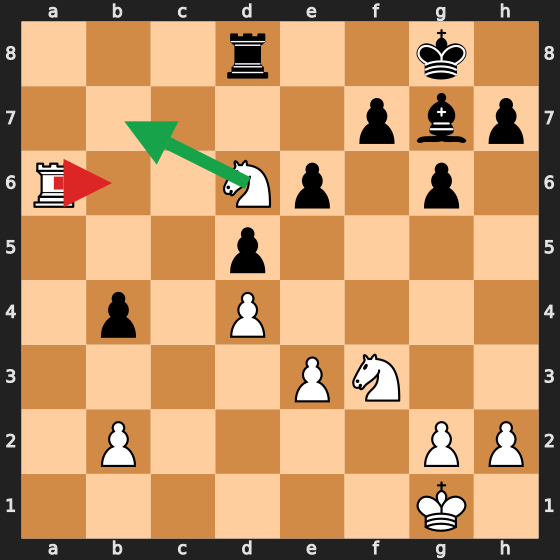 In this 1000-1199 game, White played Rb6 (red arrow), a severe miscalculation. The engine's choice, Nb7 (green arrow), was necessary to hold the position together.
Actionable Advice for 1000–1199:
- Look for Forcing Moves: Always calculate Checks, Captures, and Threats (CCT) for both yourself and your opponent.
- Simplify When Ahead: If you have a material advantage by move 28, stop looking for complicated attacks. Trade pieces (not pawns) and transition into a winning endgame.
The 1200–1399 Band: The Positional Trap
At this level, 53.7% of games reach move 28. Players are tactically sharper, bringing the move 28 blunder rate down below the 40% mark (to 39.8%).
The Typical Move 28 Blunder: Blunders here are less about dropping full rooks and more about severe positional misjudgments—allowing a devastating passed pawn, ruining king safety, or trading into a lost endgame.
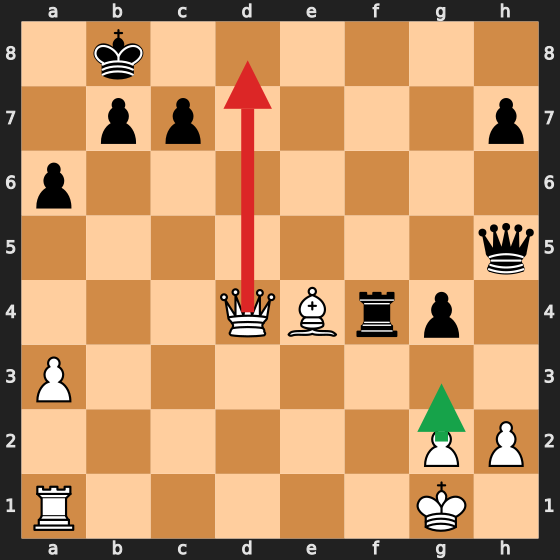 Black played Qd8+ (red arrow), a seemingly active move that actually loses the thread of the position. The engine prefers the solid g3 (green arrow).
Actionable Advice for 1200–1399:
- Evaluate the Endgame: Before making a major trade around move 28, ask yourself: "Does this trade help my endgame?"
- King Safety First: As pieces come off the board, the king often needs to become active, but premature king exposure in the late middlegame is a common source of 300+ centipawn swings.
The 1400–1599 Band: The Fatigue Factor
Players approaching 1500 are solid. Nearly 60% of their games reach move 28. Yet, the blunder rate remains stubbornly high at 39.9%. Why? Fatigue and time pressure.
The Typical Move 28 Blunder: At 1500, move 28 blunders are often the result of "tunnel vision"—focusing so hard on a specific plan on one side of the board that a threat on the other side is completely ignored.
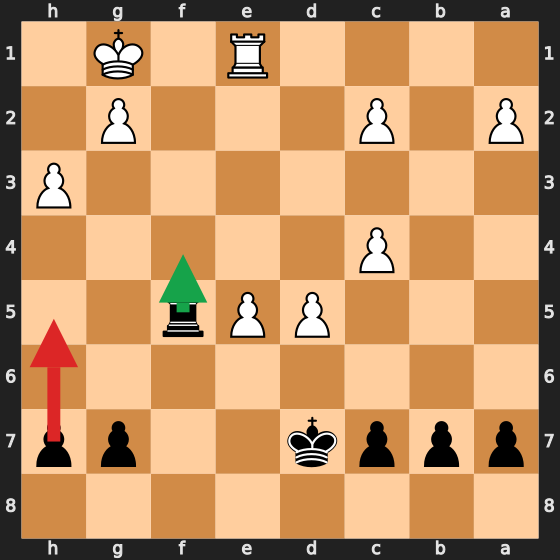 In this 1400-1599 game, Black pushed h5 (red arrow), ignoring the critical tension in the center. The engine demands Rf4 (green arrow) to address the immediate positional requirements.
Actionable Advice for 1400–1599:
- Break Tunnel Vision: Force yourself to look at the entire board every 3-4 moves.
- Prophylaxis: Ask yourself, "What is my opponent's plan?" Stopping their idea is often more important than advancing your own in the late middlegame.
Conclusion
The data is clear: move 28 is a statistical minefield for club players. It represents the exact moment when the complexity of the middlegame collides with the reality of the clock.
By recognizing this "Danger Zone," managing your time effectively in the opening, and maintaining tactical vigilance as the board simplifies, you can turn move 28 from a liability into a weapon. Let your opponent be the one who falls into the 40% blunder statistic.
Data and Methodology
This research was conducted using a dataset of ~6,063 Blitz games sourced from the Lichess open database (March 2025 sample).
- Rating Calibration: Games were queried using Lichess ratings. Because Lichess ratings are generally higher than Chess.com ratings at the club level, we applied a standard conversion mapping (e.g., Chess.com 1000 ≈ Lichess 1420) to categorize the data into Chess.com-equivalent bands.
- Evaluation: Every ply in the dataset was evaluated using Stockfish 12 (SF12). A "blunder" was strictly defined as a move that worsened the player's evaluation by ≥300 centipawns (capped at mate scores). A "mistake" was defined as a drop of ≥200 centipawns.
- Engine Verification: Showcase board examples were verified using the Theoria NNUE engine at depth 14 to determine the objective "best move" (green arrows) compared to the played blunder (red arrows).
Raw Data Files:
summary_move28_by_band.csv: High-level summary of move 28 blunder rates by rating band.blunder_rate_by_move_and_band.csv: Granular per-ply blunder rates from move 1 to 60.move28_blunder_examples.json: Metadata and FENs for the showcase examples.
Chess Coach <2026-04-21>