A Data-Driven Guide for Chess.com Players (800–1500)
For beginner and intermediate chess players, the transition from the opening to the middlegame is a notorious danger zone. In Bullet chess, where time is scarce and intuition must replace calculation, this transition frequently occurs around move 20. But just how dangerous is this specific moment in the game?
To answer this, we analyzed over 5,200 Lichess Bullet games (representing roughly 9,000 individual move-20 decisions) across rating bands equivalent to Chess.com 800–1500. By evaluating every position with Stockfish 17, we tracked the exact frequency and severity of blunders—defined as a centipawn loss (CPL) of 200 or more—at the critical 20th move.
The data reveals a stark reality: Move 20 is a blunder minefield, but the way players navigate it changes dramatically as they climb the rating ladder.
The Blunder Curve: A Roadmap of Mistakes
Before zooming in on move 20, it is helpful to understand the broader landscape of mistakes in a Bullet game. As players leave their opening preparation, the complexity of the position increases, and so does the blunder rate.
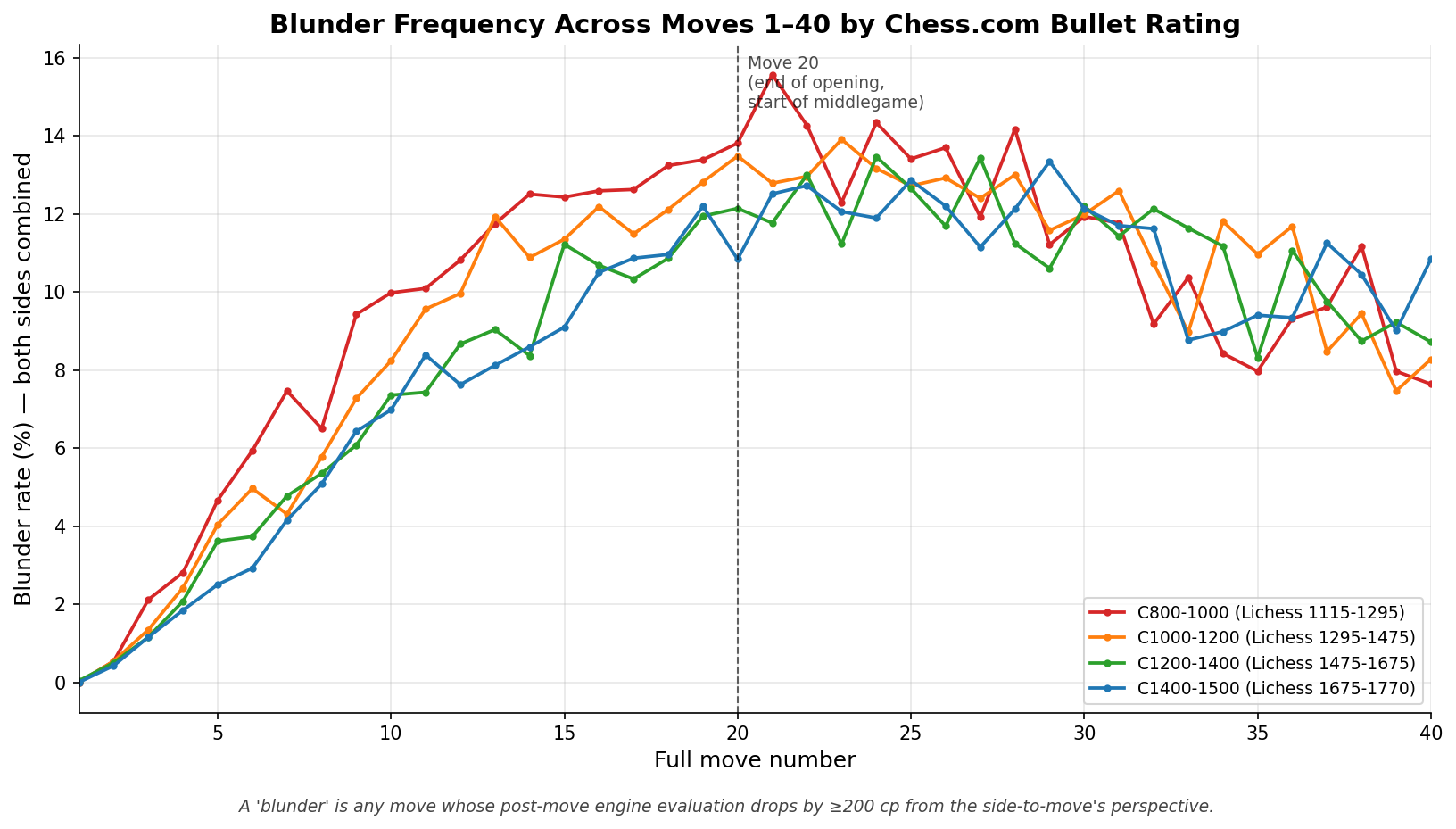
As the chart above illustrates, the blunder rate climbs steadily from move 1, peaking precisely in the move 20–25 window. This is the "edge of the middlegame"—the point where pieces are fully developed, tension is high, and players must formulate original plans under severe time pressure.
Notice how the red line (Chess.com 800–1000) remains elevated throughout this phase, while the blue line (Chess.com 1400–1500) begins to stabilize and even dip slightly. Higher-rated players are better equipped to handle the sudden spike in complexity.
Move 20 in Focus: The Rating Divide
When we isolate move 20, the difference between rating bands becomes clear. The frequency of game-losing mistakes drops significantly as players improve.
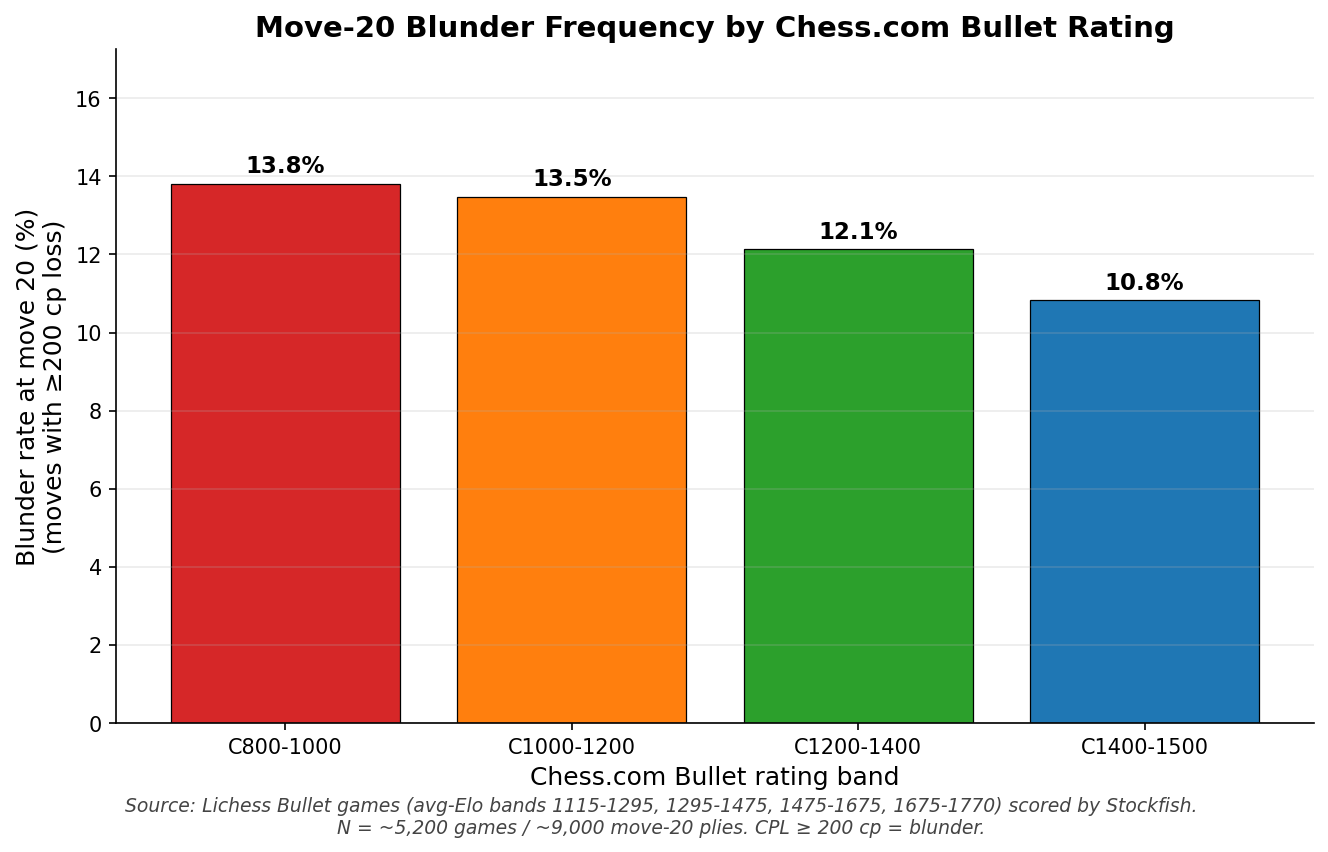
At the 800–1000 level, nearly 14% of all 20th moves are blunders (dropping at least 2 pawns of evaluation). By the time a player reaches 1400–1500, that rate drops to 10.8%. While a 3% absolute difference might seem small, it represents a roughly 20% relative reduction in catastrophic errors at a critical juncture of the game.
Does Color Matter?
Interestingly, the data shows a slight but consistent bias: Black tends to blunder slightly more often than White at move 20 across almost all rating bands.
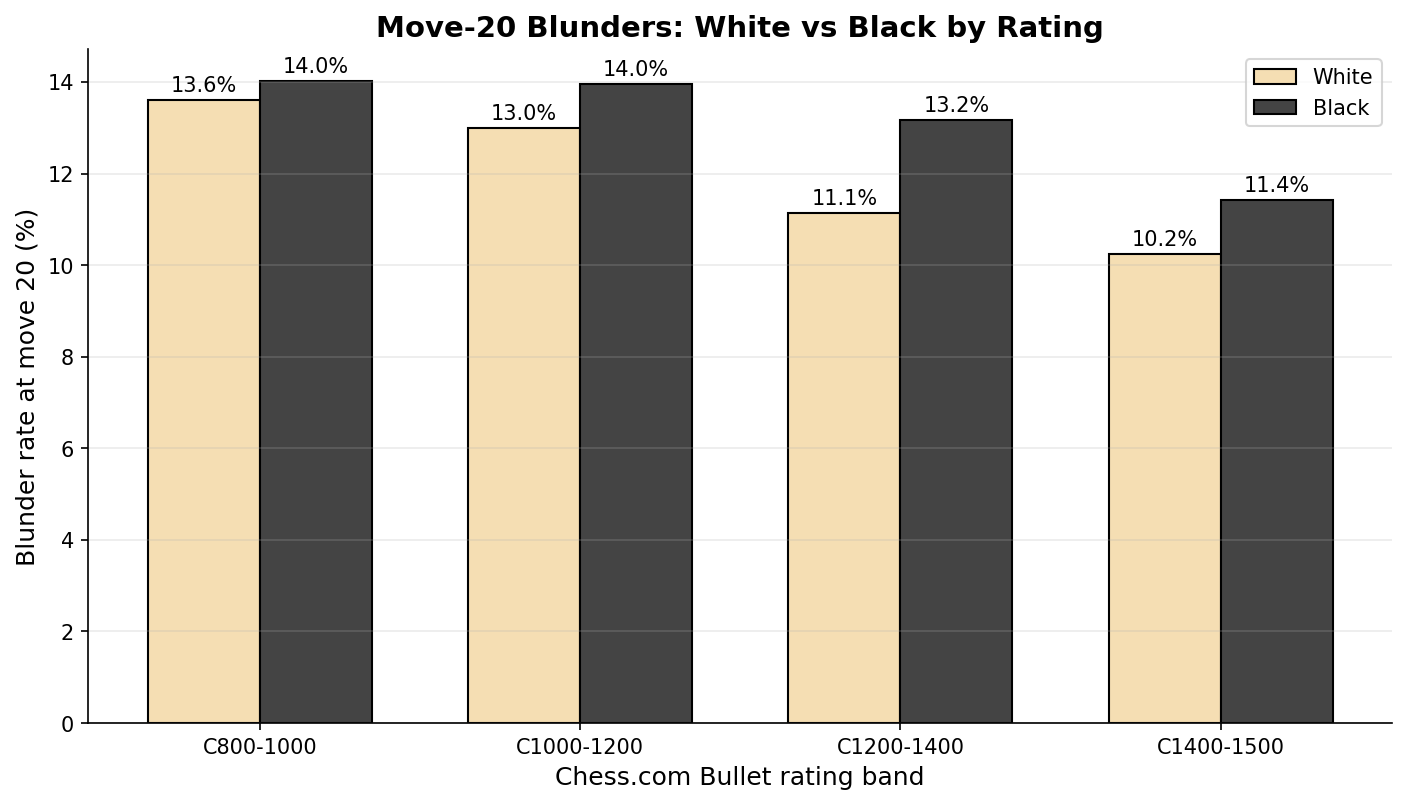
This likely stems from White's inherent first-move advantage, which often translates to a space advantage or the initiative by move 20. Black is frequently the side defending or reacting to threats, making their decisions inherently more difficult and error-prone in time scrambles.
The Severity of Mistakes
It is not just the frequency of blunders that decreases with rating; it is also their severity.
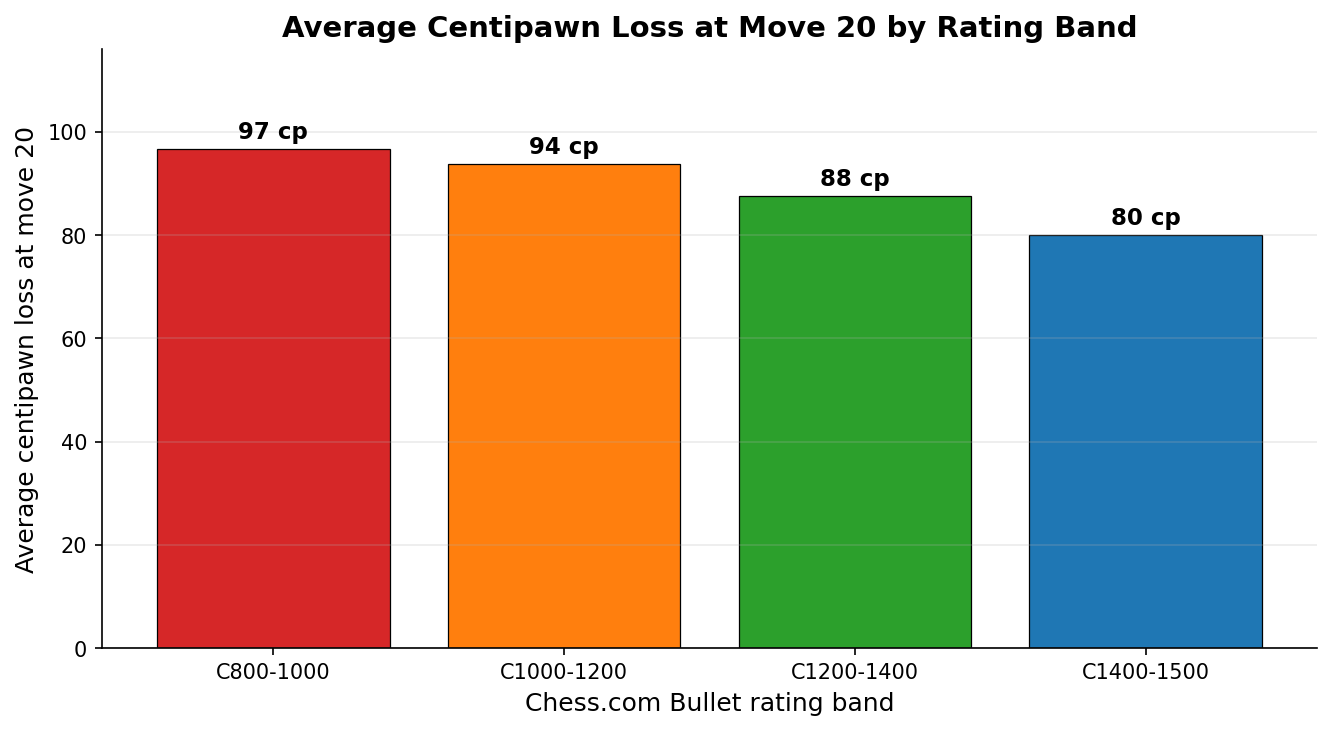
The average centipawn loss (CPL) on move 20 drops from 97 cp for the 800–1000 group to 80 cp for the 1400–1500 group. Lower-rated players are not just making more mistakes; they are making worse mistakes, often hanging full pieces or missing simple mate-in-one threats.
Visual Evidence: Anatomy of a Move 20 Blunder
To understand what these statistics look like on the board, let's examine real examples from our dataset. In the images below, the red arrow indicates the blunder played in the game, while the green arrow shows Stockfish's recommended best move.
Example 1: The 800–1000 Bracket
In this bracket, blunders often involve ignoring direct threats or creating self-inflicted weaknesses.
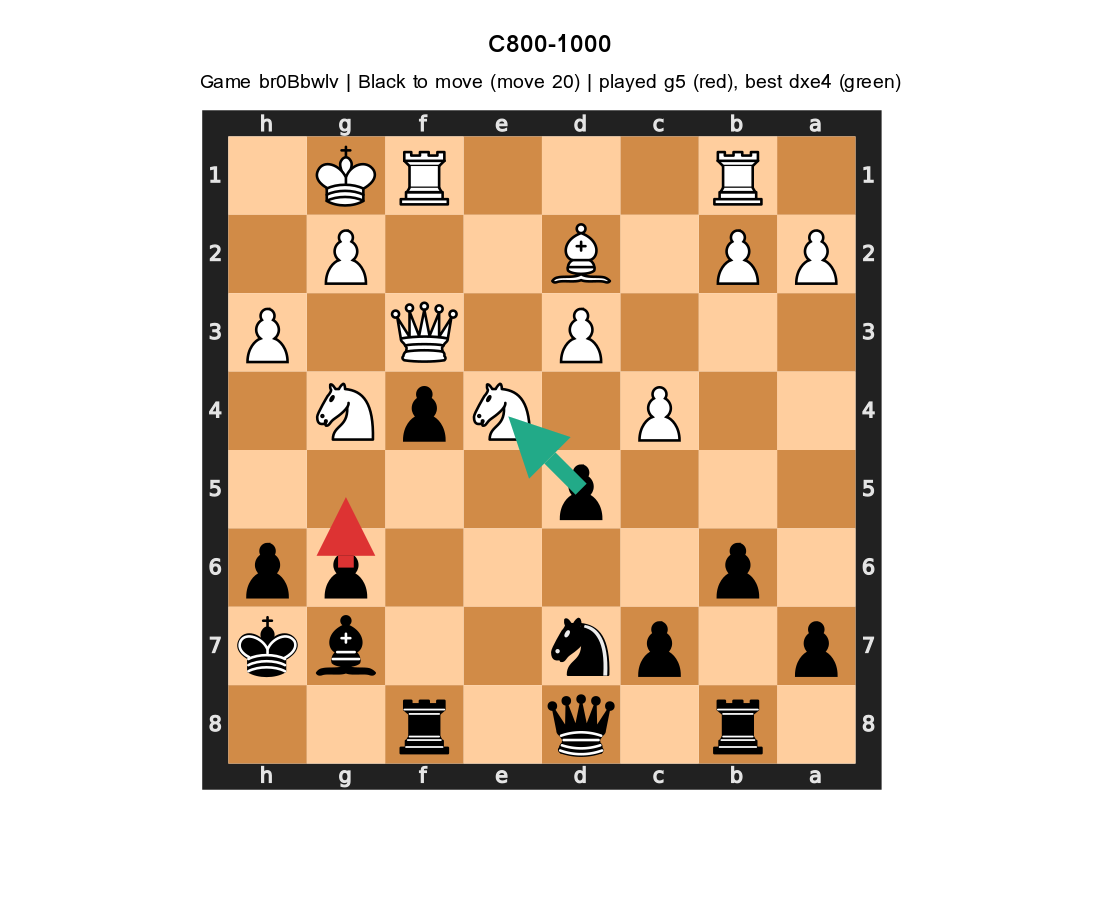
Here, Black plays g5, completely ignoring the tension in the center and allowing White a devastating advantage. The engine prefers dxe4, resolving the central tension and simplifying the position. The played move resulted in a massive 701 cp evaluation drop.
Example 2: The 1400–1500 Bracket
At higher ratings, blunders are often more subtle positional errors or miscalculations in complex tactical sequences.
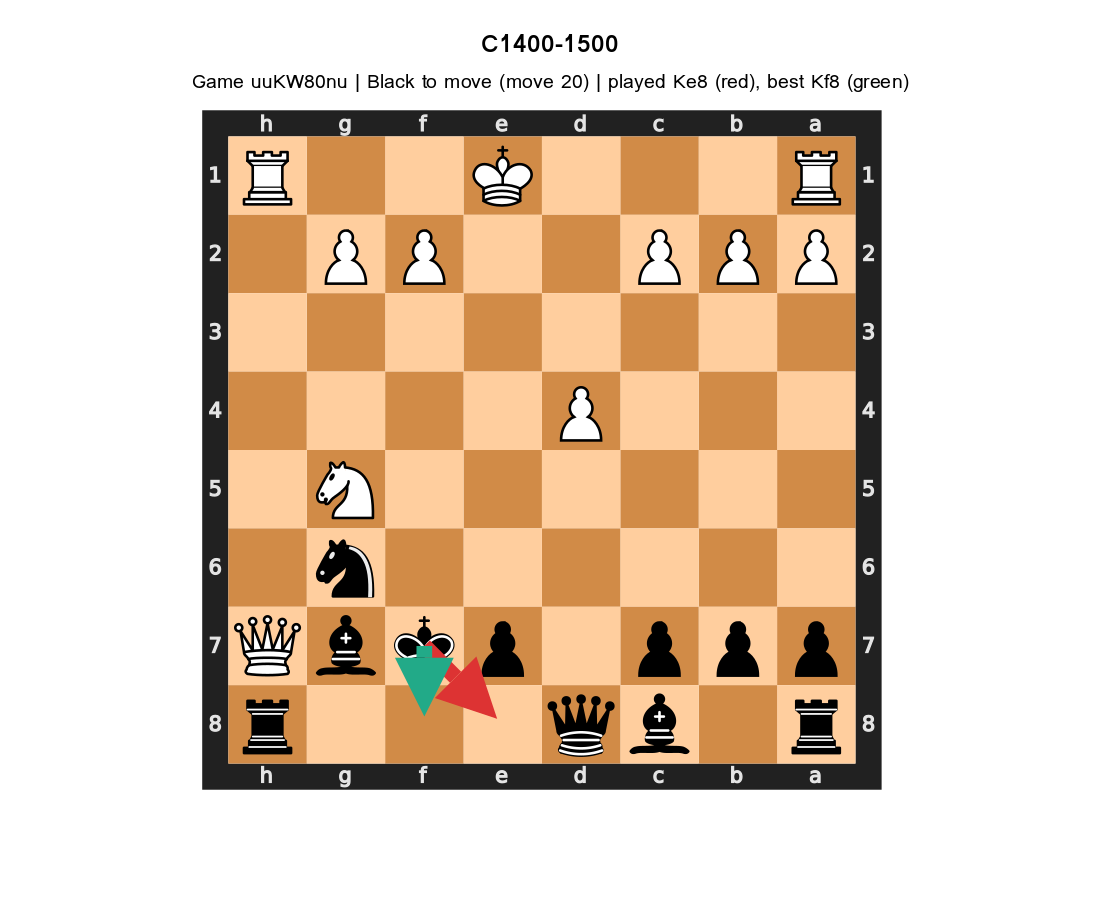
In this position, Black plays Ke8, stepping into a passive and dangerous square. The engine prefers Kf8, keeping the King slightly safer and maintaining coordination. While less obvious than hanging a piece, this mistake still cost Black 681 cp in evaluation, turning a manageable position into a lost one.
Actionable Advice for Climbing the Ranks
Based on this data, how can you improve your Bullet performance and survive the move 20 danger zone? Here is a roadmap tailored to your current rating:
For the 800–1000 Player
- The Goal: Stop the bleeding.
- Actionable Advice: At this level, 14% of your 20th moves are game-losing blunders. Your primary focus should be on board awareness. Before making a move in the early middlegame, do a rapid "blunder check": Are any of my pieces undefended? Is my opponent threatening a one-move tactic? Simply avoiding one-move piece hangs will instantly elevate your rating.
For the 1000–1200 Player
- The Goal: Manage the transition.
- Actionable Advice: You are blundering slightly less (13.5%), but the transition from opening to middlegame is still rocky. Focus on completing development and securing your King before move 15. If your King is safe and your rooks are connected by move 20, you are far less likely to stumble into a tactical minefield.
For the 1200–1400 Player
- The Goal: Handle the tension.
- Actionable Advice: Your blunder rate has dropped to 12.1%. At this stage, mistakes often happen when the position becomes highly complex and tension is at its peak. Practice calculating forcing moves (checks, captures, threats) quickly. When the board is on fire around move 20, the player who calculates the first two plies accurately usually wins.
For the 1400–1500 Player
- The Goal: Maintain the initiative.
- Actionable Advice: You have reduced your move 20 blunder rate to 10.8%. To push higher, focus on prophylaxis and positional understanding. The blunders at this level are often structural (like the
Ke8example above). Try to anticipate your opponent's plans and avoid creating long-term weaknesses, even when playing at Bullet speeds.
Data and Methodology
This research was conducted using a sample of 5,200 Lichess Bullet games. To ensure relevance for Chess.com users, Lichess ratings were mapped to approximate Chess.com equivalents using established community conversion tables (e.g., Chess.com 1000 ≈ Lichess 1295).
- Data Source: Lichess game database, accessed via the Grandmaster Guide MCP.
- Engine: Stockfish 17 was used to evaluate positions and calculate Centipawn Loss (CPL).
- Definition of Blunder: A move resulting in a CPL of ≥ 200 from the side-to-move's perspective.
- Sample Size: ~5,200 games, yielding ~9,000 evaluated plies exactly at move 20 (ply 39 for White, ply 40 for Black).
Raw Data Files:
- Move 20 Blunder Rates (Combined)
- Move 20 Blunder Rates (By Side)
- Blunder Rates by Move (1-40)
- Notable Move 20 Examples
Chess Coach April 20, 2026