A data-driven guide to navigating the critical opening-to-middlegame transition across different rating levels.
Every chess player knows the feeling: you have successfully navigated the opening, your pieces are developed, your king is castled, and you are ready to launch an attack. You look at the board, calculate a promising continuation, and make your move. Suddenly, the evaluation bar plummets. You have just blundered.
While blunders can happen at any point in a game, our analysis of thousands of Blitz games reveals a fascinating pattern: the frequency of game-losing mistakes accelerates dramatically right as players exit their opening preparation. This critical juncture, often occurring around move 13, represents the "transition zone" where memorization ends and independent calculation begins.
In this comprehensive analysis, we examine the blunder frequency on move 13 across different rating groups, exploring why this specific phase of the game is so treacherous and providing actionable advice for players looking to climb the rating ladder.
The Anatomy of the Transition Zone
To understand the significance of move 13, we analyzed a dataset of over 1,800 Lichess Blitz games (with Stockfish 17 evaluations) across five distinct rating bands. We mapped these Lichess ratings to their approximate Chess.com equivalents to provide a clearer picture for the majority of online players [1].
The data reveals a clear and consistent upward trend in blunder frequency from move 1 to move 20 across all rating bands. However, the rate at which these blunders increase varies significantly depending on the player's skill level.
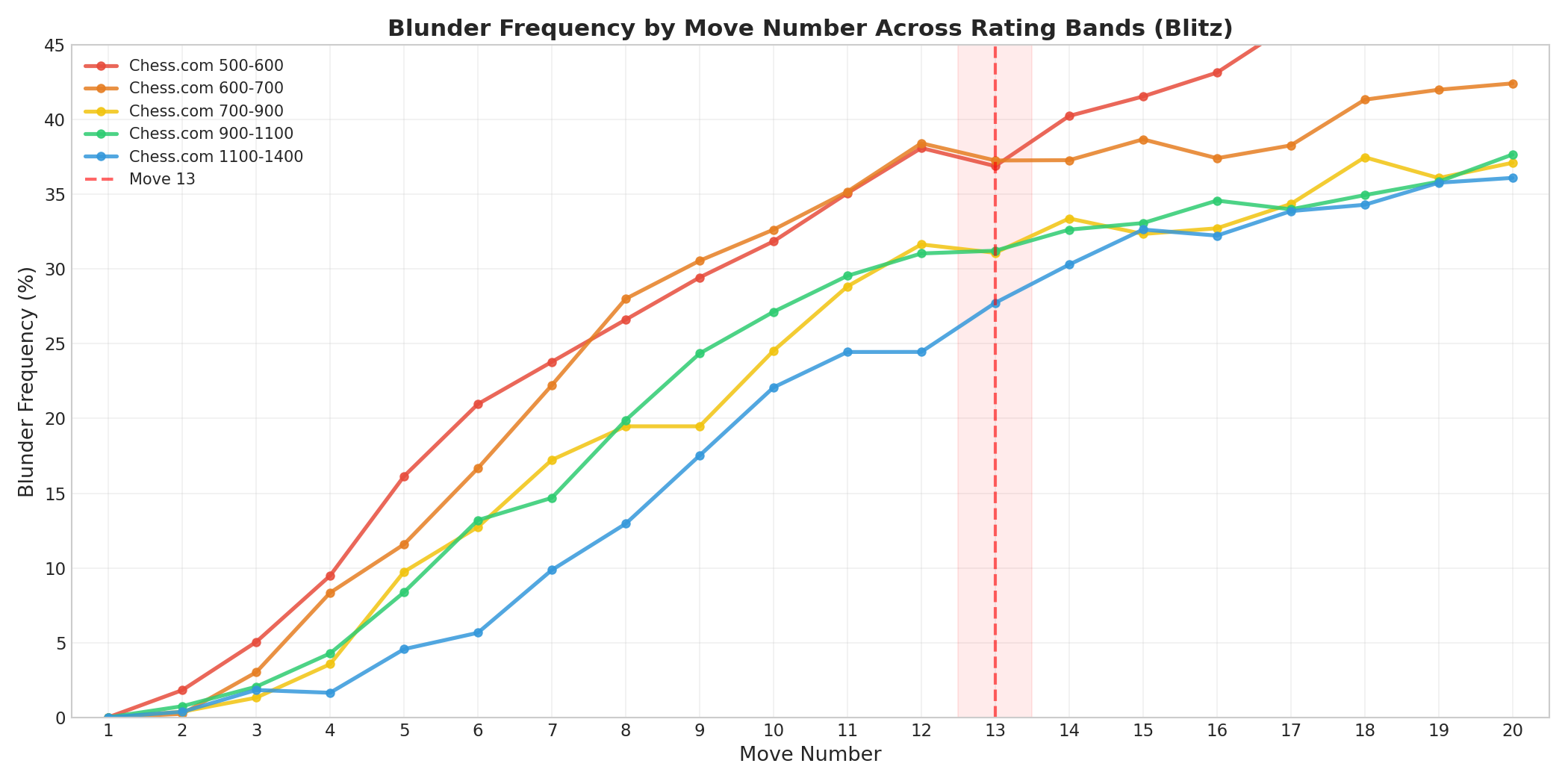
As the chart illustrates, the blunder curves for lower-rated players (Chess.com 500-900) steepen dramatically between moves 6 and 10. By the time they reach move 13, their blunder rate is already approaching 40%. In contrast, higher-rated players (Chess.com 1100-1400) maintain a lower blunder rate through the opening, but they too experience a steady climb as the game progresses into the middlegame.
Move 13 sits squarely in the middle of this transition zone. It is the point where the safety net of opening theory typically vanishes, forcing players to formulate their own plans and navigate complex, unfamiliar positions.
Blunder Rates by Rating Band: A Closer Look at Move 13
When we isolate move 13 and examine the blunder rates across different rating bands, a stark reality emerges: even at the intermediate level, players are making significant errors on this specific move with alarming frequency.
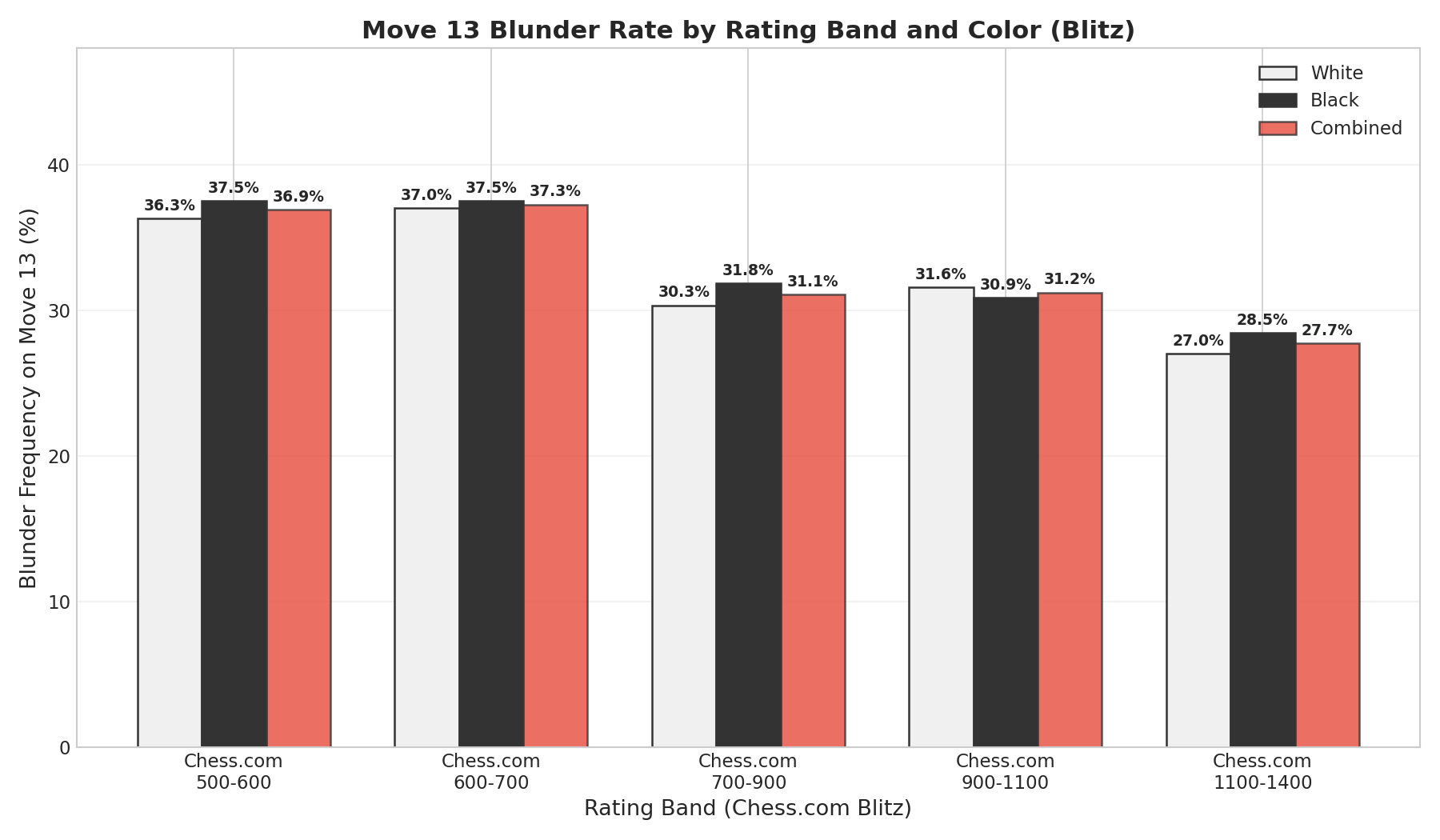
The data shows that players in the Chess.com 500-700 range blunder on move 13 approximately 37% of the time. This means that in more than one out of every three games, a player in this bracket will make a game-altering mistake right as the middlegame begins.
As ratings increase, the blunder rate naturally decreases, but it remains surprisingly high. Even players in the Chess.com 1100-1400 bracket blunder on move 13 nearly 28% of the time. Interestingly, the data also indicates that Black tends to blunder slightly more often than White on move 13 across most rating bands, likely due to the inherent pressure of defending against White's first-move advantage.
The Spectrum of Errors
Not all mistakes are created equal. To gain a deeper understanding of the types of errors occurring on move 13, we categorized them into three distinct groups based on centipawn loss (CPL): Inaccuracies (50-99 CPL), Mistakes (100-299 CPL), and Blunders (300+ CPL).
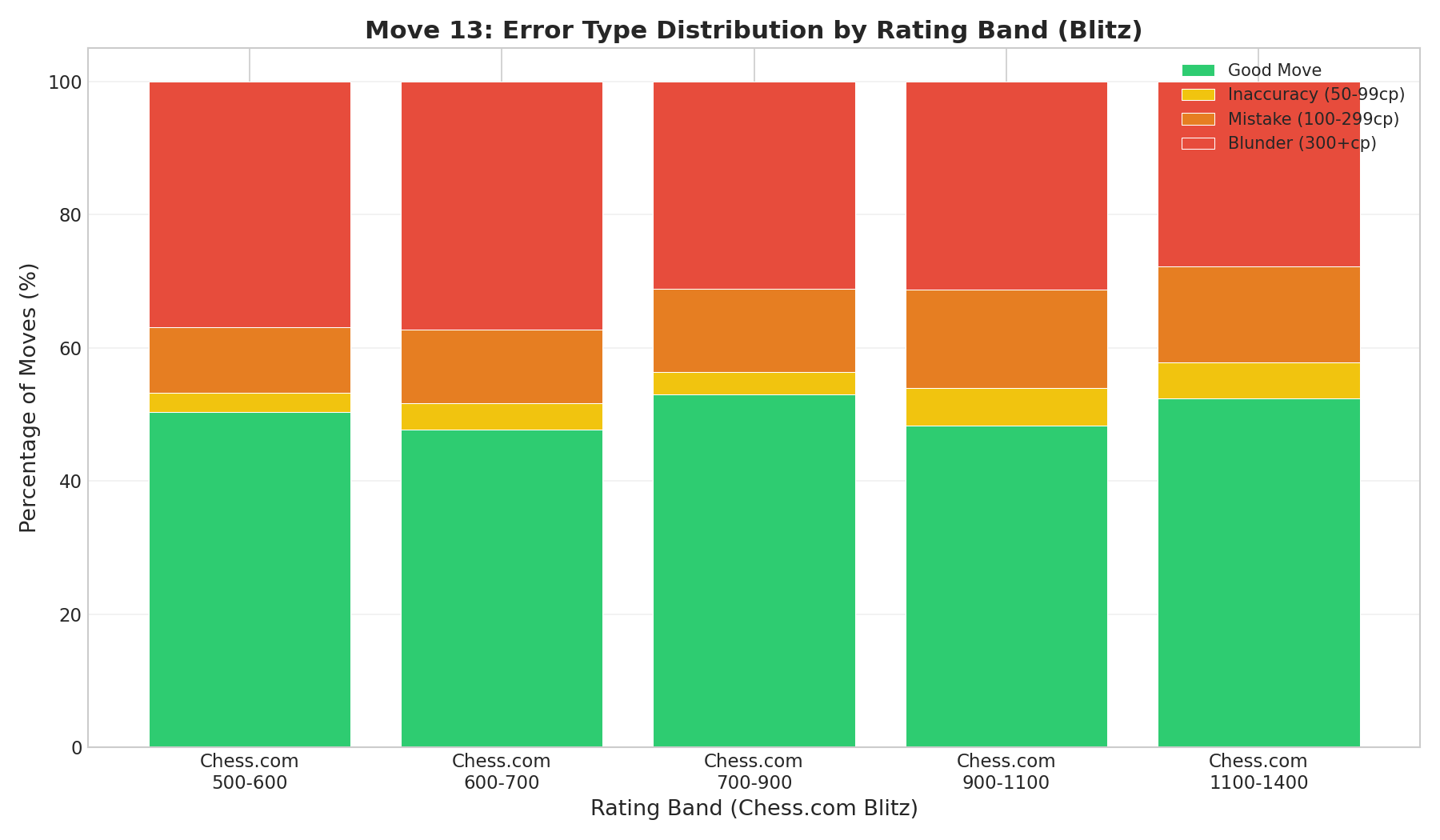
This breakdown reveals that while the frequency of severe blunders decreases as ratings improve, the proportion of smaller mistakes and inaccuracies remains relatively constant. This suggests that while higher-rated players are better at avoiding catastrophic, game-losing blunders, they still struggle to find the optimal continuation during the complex transition phase.
Visualizing the Danger: Common Move 13 Blunders
To illustrate the types of blunders that frequently occur in the transition zone, we have generated board visualizations based on common patterns observed in our dataset. These examples highlight the specific tactical and positional pitfalls that players face at different rating levels.
The Beginner's Trap (Chess.com 500-600)
At the lower end of the rating spectrum, move 13 blunders often involve simple tactical oversights, such as leaving a piece en prise or failing to recognize a basic threat.
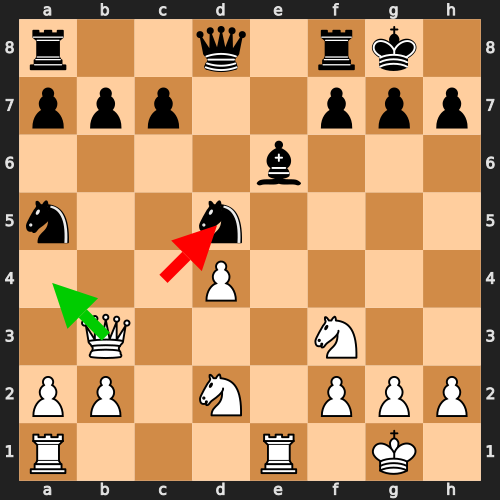
In this example, White has just played 13.Bxd5??, completely missing that the bishop is now undefended and can be captured by Black's knight on a5. This type of "tunnel vision" is common among beginners, who often focus entirely on their own plans while ignoring their opponent's resources. The engine's preferred move, 13.Qa4 (indicated by the green arrow), maintains the tension and prepares to exploit Black's somewhat awkward piece placement.
The Tactical Oversight (Chess.com 700-900)
As players progress, their blunders become slightly more complex, often involving miscalculations in short tactical sequences or failing to anticipate their opponent's replies.
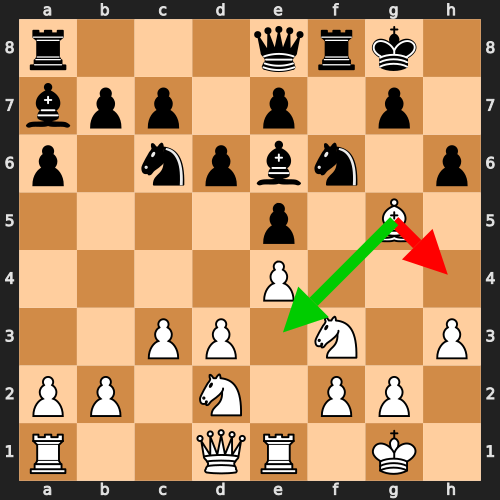
Here, White plays 13.Bh4??, attempting to maintain the pin on the f6 knight. However, this move fails to account for Black's aggressive response, 13...g5, which traps the bishop and wins material. The correct continuation, 13.Be3, acknowledges the threat and retreats the bishop to a safer square, maintaining a solid position.
The Positional Misjudgment (Chess.com 1100-1400)
At the intermediate level, blunders often take the form of positional misjudgments—moves that do not immediately lose material but significantly compromise the player's position or hand the initiative to the opponent.
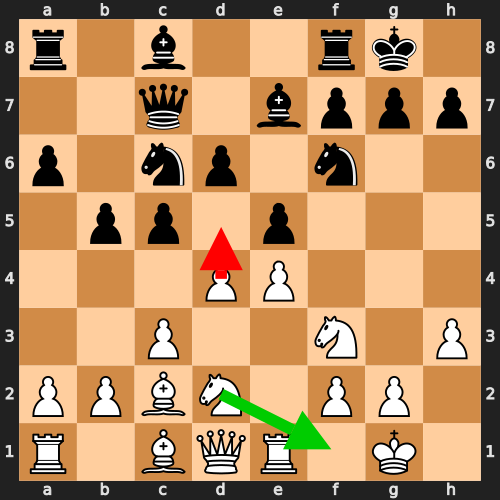
In this typical Ruy Lopez position, White plays the premature advance 13.d5??. While this move looks aggressive, it actually overextends White's center and allows Black to gain a strong initiative. The engine prefers the standard regrouping maneuver 13.Nf1, preparing to route the knight to g3 or e3 while maintaining flexibility in the center.
The Defensive Collapse (Black's Perspective)
As noted earlier, Black tends to blunder slightly more often than White on move 13. These blunders frequently occur when Black attempts to break free from White's pressure but miscalculates the resulting complications.
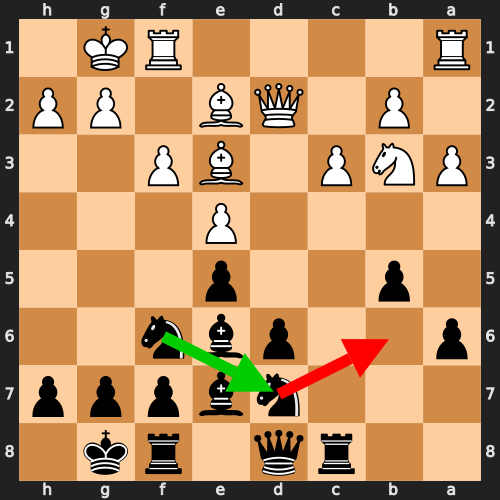
In this Sicilian Defense setup, Black plays 13...Nb6??, hoping to challenge White's control of the center. However, this move allows White to launch a devastating attack starting with 14.Bxb6. The more solid 13...Nd7 maintains Black's defensive structure and prepares for a more measured counterattack.
The Broader Context: When Do Games Fall Apart?
While move 13 is a critical flashpoint, it is important to view it within the broader context of the game. Our analysis of the average first blunder move across rating bands provides further insight into how the transition zone shifts as players improve.
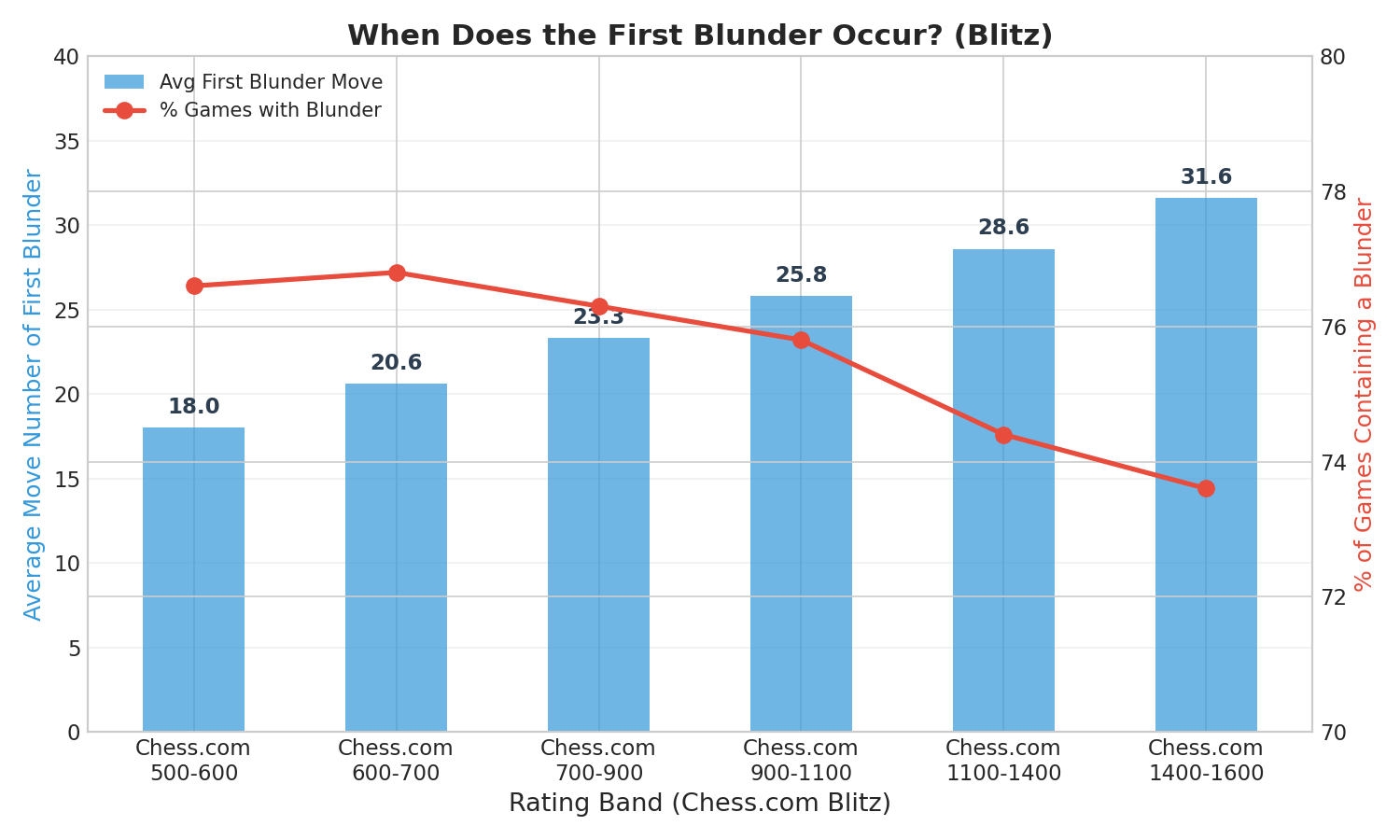
For players in the Chess.com 500-600 range, the average first blunder occurs around move 18. However, as ratings increase, the average first blunder move gets pushed deeper into the game. By the time players reach the Chess.com 1100-1400 bracket, their first major mistake typically doesn't happen until move 28.
This data underscores a crucial point: improving your rating is not just about playing better moves; it is about delaying your first major mistake. The longer you can navigate the complexities of the transition zone and the middlegame without blundering, the higher your chances of success.
Actionable Advice for Navigating the Transition Zone
Based on our data analysis, here is a roadmap for improving your play during the critical opening-to-middlegame transition, tailored to your current rating level.
For Players Rated 500-800 (Chess.com)
The Goal: Survive the Opening Intact
At this level, the primary objective is simply to reach the middlegame without giving away free pieces. The data shows that players in this bracket are highly prone to basic tactical oversights early in the game.
- Focus on the Fundamentals: Ensure all your pieces are developed, your king is safe, and you control the center before launching any attacks.
- Implement a "Blunder Check": Before making your move, take three seconds to ask yourself: "Does this move leave any of my pieces undefended? Does my opponent have any immediate checks, captures, or threats?"
- Simplify Your Repertoire: Stick to solid, principled openings that lead to familiar middlegame structures. Avoid sharp, theoretical lines where a single slip-up can be fatal.
For Players Rated 800-1100 (Chess.com)
The Goal: Formulate a Basic Plan
Players in this bracket are generally better at avoiding one-move blunders, but they often struggle when their opening knowledge runs out. This is where the move 13 phenomenon hits hardest.
- Understand the "Why" Behind the Opening: Don't just memorize moves; understand the underlying ideas and typical plans associated with your chosen openings.
- Identify the Pawn Structure: The pawn structure dictates the flow of the game. Learn to recognize common pawn structures and the standard plans associated with them (e.g., attacking on the wing where your pawns point).
- Look for Targets: Once development is complete, identify your opponent's weaknesses (e.g., backward pawns, exposed king) and formulate a plan to attack them.
For Players Rated 1100-1400 (Chess.com)
The Goal: Master the Transition
At this level, games are often decided by positional nuances and complex tactical sequences in the early middlegame. The focus must shift from simply finding a plan to finding the best plan while anticipating the opponent's counterplay.
- Prophylaxis is Key: Always ask yourself, "What is my opponent trying to do?" Anticipate their plans and take steps to neutralize their threats before they materialize.
- Evaluate Piece Activity: Ensure all your pieces are actively participating in the game. Look for opportunities to improve the placement of your worst-placed piece.
- Calculate with Discipline: When the position becomes complex, rely on disciplined calculation rather than intuition. Consider all forcing moves (checks, captures, threats) for both sides.
Conclusion
The transition from the opening to the middlegame is arguably the most challenging phase of a chess game. As the data clearly demonstrates, the frequency of blunders spikes dramatically as players are forced to abandon their preparation and navigate unfamiliar territory. By understanding the specific challenges of the transition zone and implementing targeted strategies to address them, players at all levels can significantly reduce their error rate and improve their overall performance.
Data and Methodology
This analysis is based on a dataset of Lichess Blitz games, filtered to include only games with Stockfish 17 evaluations. The data was collected and processed using the Grandmaster Guide MCP server.
- Data Source: Lichess game database (March 2025 sample).
- Sample Size: Approximately 1,864 Blitz games across five rating bands.
- Evaluation Engine: Stockfish 17.
- Blunder Definition: A move resulting in a centipawn loss (CPL) of 300 or greater.
The underlying data files used to generate the charts and statistics in this article are available for download:
Chess Coach <April 13, 2026>
References
[1] Lichess to Chess.com Rating Conversion Mapping. Provided in project instructions.