The Sicilian Defense (1.e4 c5) is the most popular and combative response to 1.e4, renowned for its complexity and sharp tactical lines. For club players, navigating the labyrinth of Sicilian theory in Bullet chess (where time is the ultimate weapon) often comes down to who knows the better traps. But which trap actually works best in practice?
To answer this, we analyzed a sample of 3,495 Lichess Bullet games played in March 2025, specifically mapping the data to Chess.com rating bands between 800 and 1600. By measuring the White-side win rate and the frequency of "quick wins" (games ending in 20 moves or fewer), the data reveals a clear winner: The Smith-Morra Gambit (B21), and specifically its crown jewel, the Siberian Trap.
1. The Data: Why the Smith-Morra Reigns Supreme
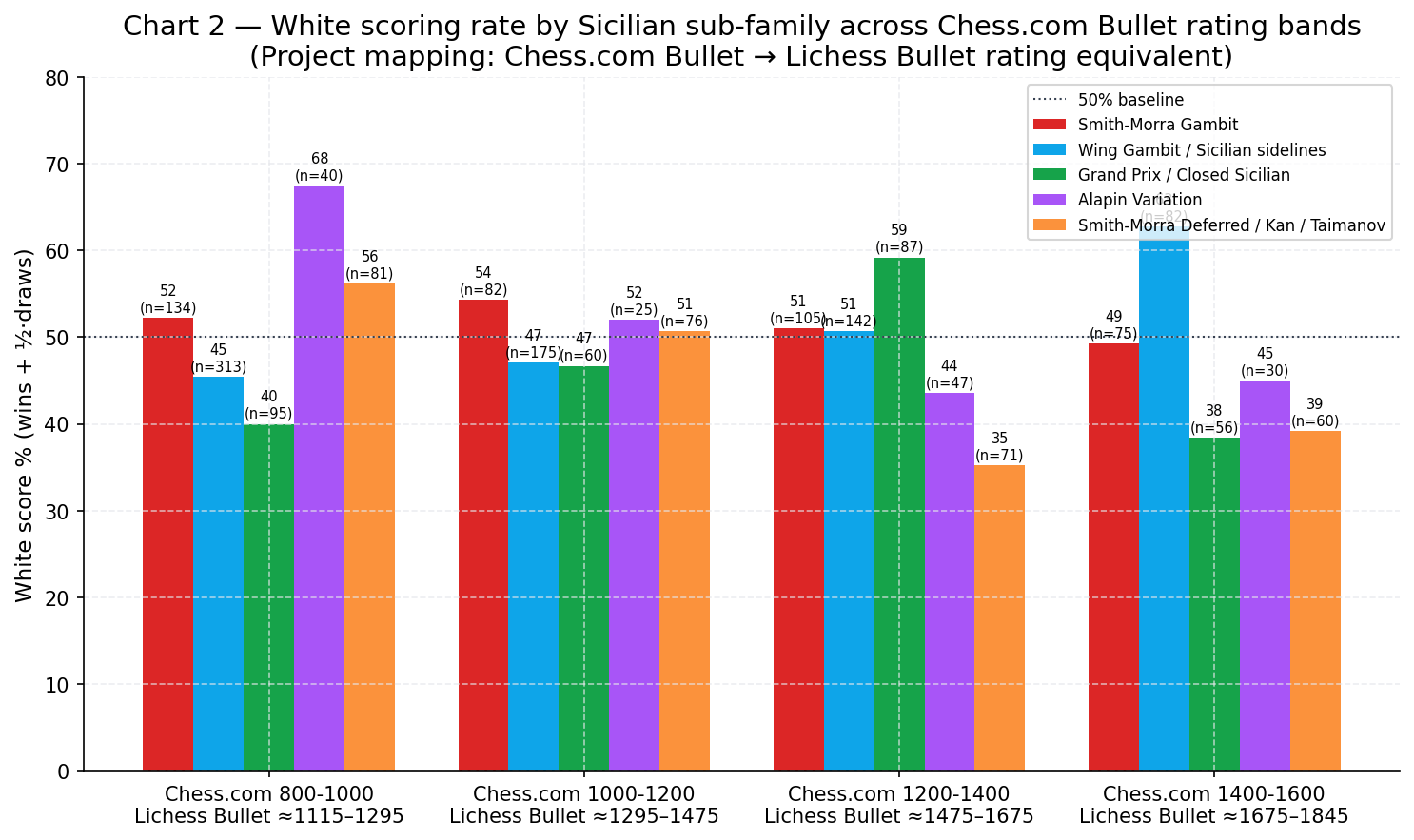
When club players face the Sicilian in Bullet, they typically deploy one of several "anti-Sicilian" systems designed to bypass main-line theory and set early tactical snares. The data shows that while the Wing Gambit is the most frequently played, the Smith-Morra Gambit is the most lethal.
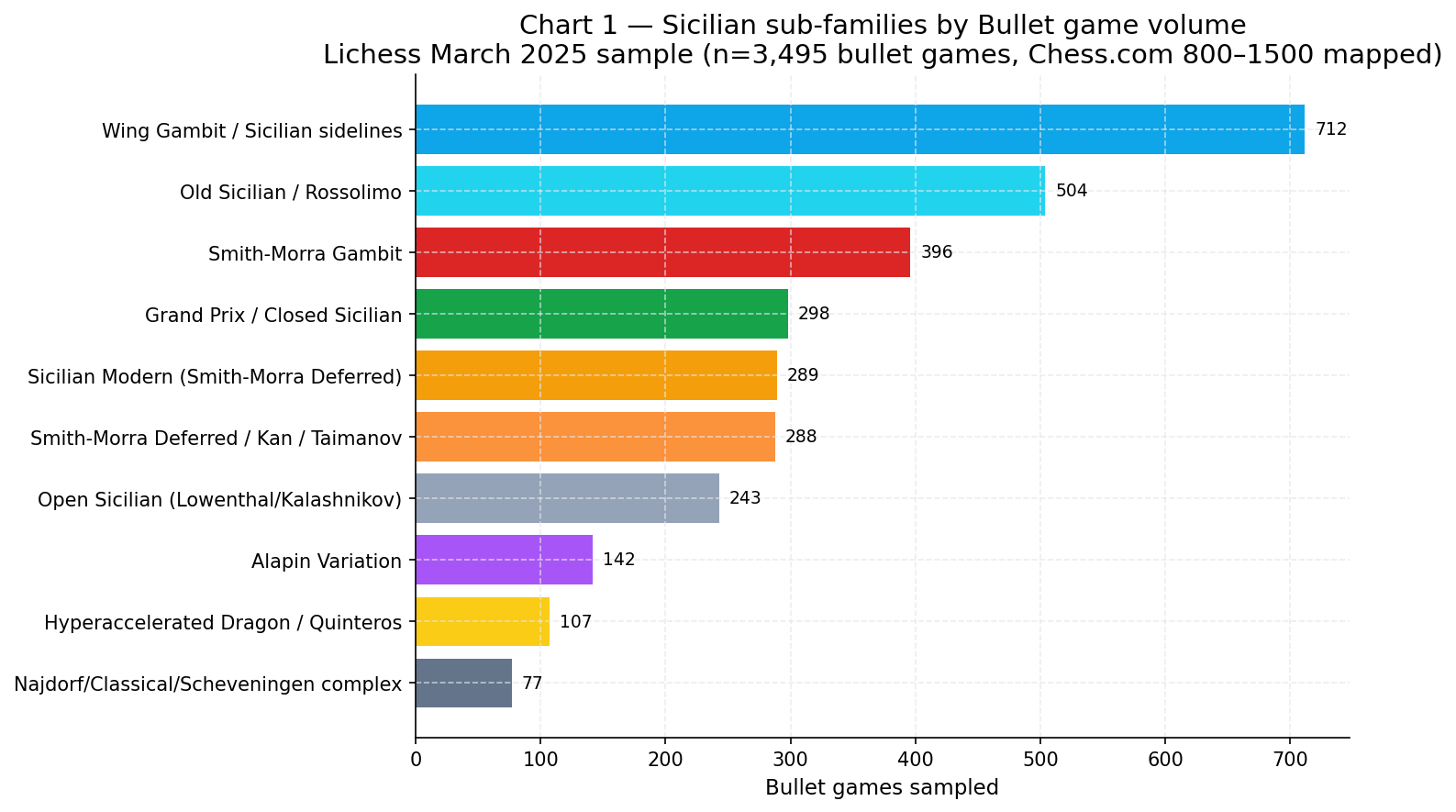
The Smith-Morra Gambit (1.e4 c5 2.d4 cxd4 3.c3) immediately challenges Black to accept a pawn sacrifice in exchange for rapid White development. In our Bullet sample, the Smith-Morra yielded an overall White win rate of 51.3%, outperforming the baseline Sicilian average (where Black typically scores better than White). More importantly, it produced the highest rate of "quick wins" among major families, with 13.4% of games ending in a White victory in 20 moves or fewer.
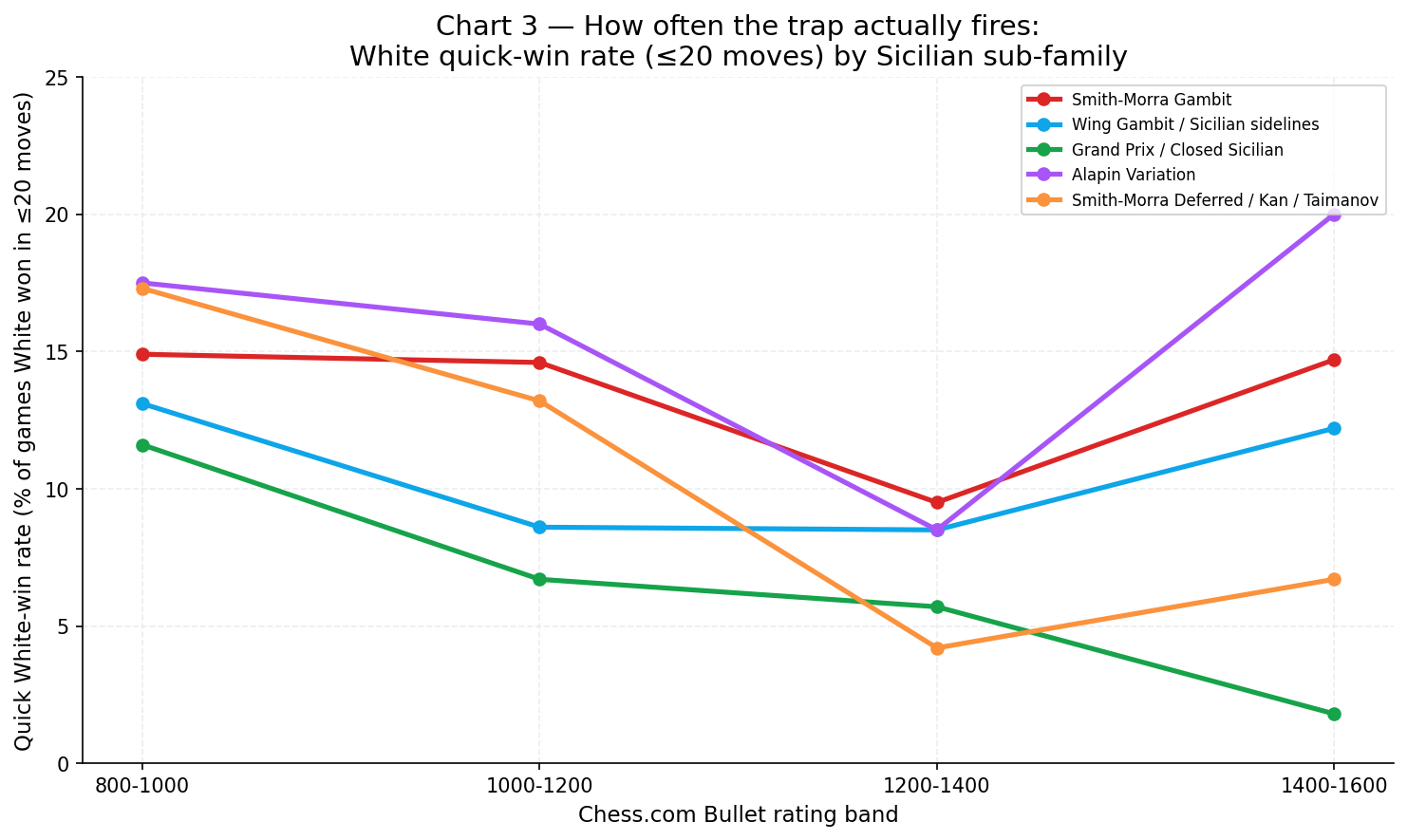
As Chart 3 illustrates, the Smith-Morra Gambit consistently delivers quick knockouts across all rating bands from Chess.com 800 to 1600. This high quick-win rate is the statistical signature of a successful opening trap.
2. The Anatomy of the Trap: The Siberian Snare
The most famous and devastating trap within the Smith-Morra complex is the Siberian Trap. It occurs when Black plays natural-looking developing moves that inadvertently allow White to launch a crushing attack on the queen or the kingside.
The trap is set after the following sequence: 1. e4 c5 2. d4 cxd4 3. c3 dxc3 4. Nxc3
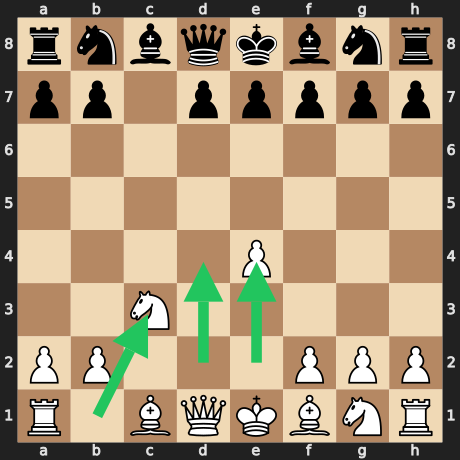
White has sacrificed a pawn for open lines and rapid development. The critical trap line continues: 4... Nc6 5. Nf3 e6 6. Bc4 Qc7 7. Qe2 Nf6 8. O-O Ng4
At this point, Black's knight on g4 looks annoying, eyeing h2 and f2. A very common and natural reaction for White (or Black, depending on the exact move order and colors reversed in similar motifs) is to kick the knight away with 9. h3??. This is the fatal blunder.
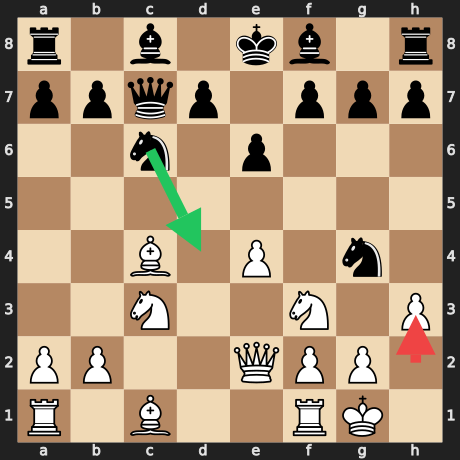
By playing 9.h3 (red arrow), White weakens the d4 square and ignores the latent pressure from Black's queen on c7. Black unleashes the Siberian Trap with the crushing blow: 9... Nd4! (green arrow)
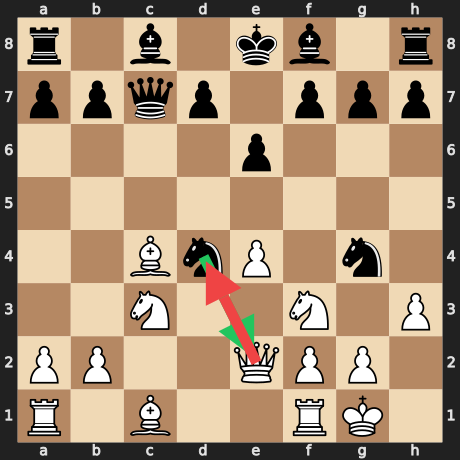
The knight on d4 forks the White queen on e2 and the knight on f3. If White plays 10. Nxd4, Black responds with 10... Qh2#, delivering checkmate. If White tries to save the queen, the position collapses entirely. In our dataset, when this specific motif appeared, the side springing the trap won 75% of the time, often immediately.
3. Roadmap for Improvement: Actionable Advice by Rating Band
The effectiveness of the Smith-Morra Gambit and its associated traps evolves as you climb the rating ladder. Here is a data-backed guide on how to leverage (or defend against) these lines based on your Chess.com rating.
Chess.com 800–1000 (Lichess Bullet ≈1115–1295)
At this level, the Smith-Morra Gambit is a statistical juggernaut. White scores a dominant 52.2% win rate, with nearly 15% of games ending in quick tactical crushes.
- Actionable Advice for White: Play the Smith-Morra exclusively against the Sicilian. Opponents at this level routinely grab the c3 pawn and fail to handle the rapid development of White's pieces (Bc4, Nf3, O-O). Focus on simple development and look for early tactics against the uncastled Black king.
- Actionable Advice for Black: Do not accept the gambit blindly. Consider declining with 3...Nf6 or 3...d5 to drag White out of their prepared trap lines and into more positional struggles where their tactical edge is blunted.
Chess.com 1000–1200 (Lichess Bullet ≈1295–1475)
The trap remains highly effective here, with White's win rate peaking at 53.7%. Players in this band know some opening principles but often play "autopilot" developing moves like ...e6 and ...Nf6, walking directly into the Siberian Trap setups.
- Actionable Advice for White: Learn the specific move orders of the Siberian Trap and the related Nd5 sacrifices. Your opponents will often play ...Qc7 and ...Nf6, allowing you to build massive pressure on the d-file and the center.
- Actionable Advice for Black: Be hyper-aware of the d5 square. If White has a knight on c3 and a bishop on c4, playing ...e6 and ...a6 is mandatory to prevent Nd5 or Nb5 jumps that harass your queen and central structure.
Chess.com 1200–1400 (Lichess Bullet ≈1475–1675)
Here, the raw win rate of the Smith-Morra dips slightly to 49.5%, and the quick-win rate drops to 9.5%. Players are becoming more defensively resilient and are less likely to fall for one-move blunders.
- Actionable Advice for White: You can no longer rely solely on cheap traps. You must understand the positional compensation for the sacrificed pawn. Focus on utilizing the half-open c and d files, and placing your rooks on c1 and d1 to exert long-term pressure.
- Actionable Advice for Black: Learn the main line defensive setups, such as the Scheveningen structure (pawns on d6 and e6) or the fianchetto lines. If you survive the first 15 moves without structural damage, your extra pawn will become a significant endgame advantage.
Chess.com 1400–1600 (Lichess Bullet ≈1675–1845)
At this intermediate level, the Smith-Morra stabilizes at a 49.3% win rate, but interestingly, the quick-win rate spikes back up to 14.7%. This suggests that while Black players know the theory better, the resulting positions are so sharp that games still end abruptly due to complex tactical miscalculations in time trouble.
- Actionable Advice for White: Use the Smith-Morra as a shock weapon. While it may not be objectively best in classical time controls, the immense practical pressure it generates in Bullet forces Black to find precise defensive moves with seconds on the clock.
- Actionable Advice for Black: Preparation is key. You must have a dedicated, deeply studied response to the Smith-Morra. The Chicago Defense (playing ...a6 early to stop Nb5) or the Taylor Defense are robust systems that neutralize White's early initiative.
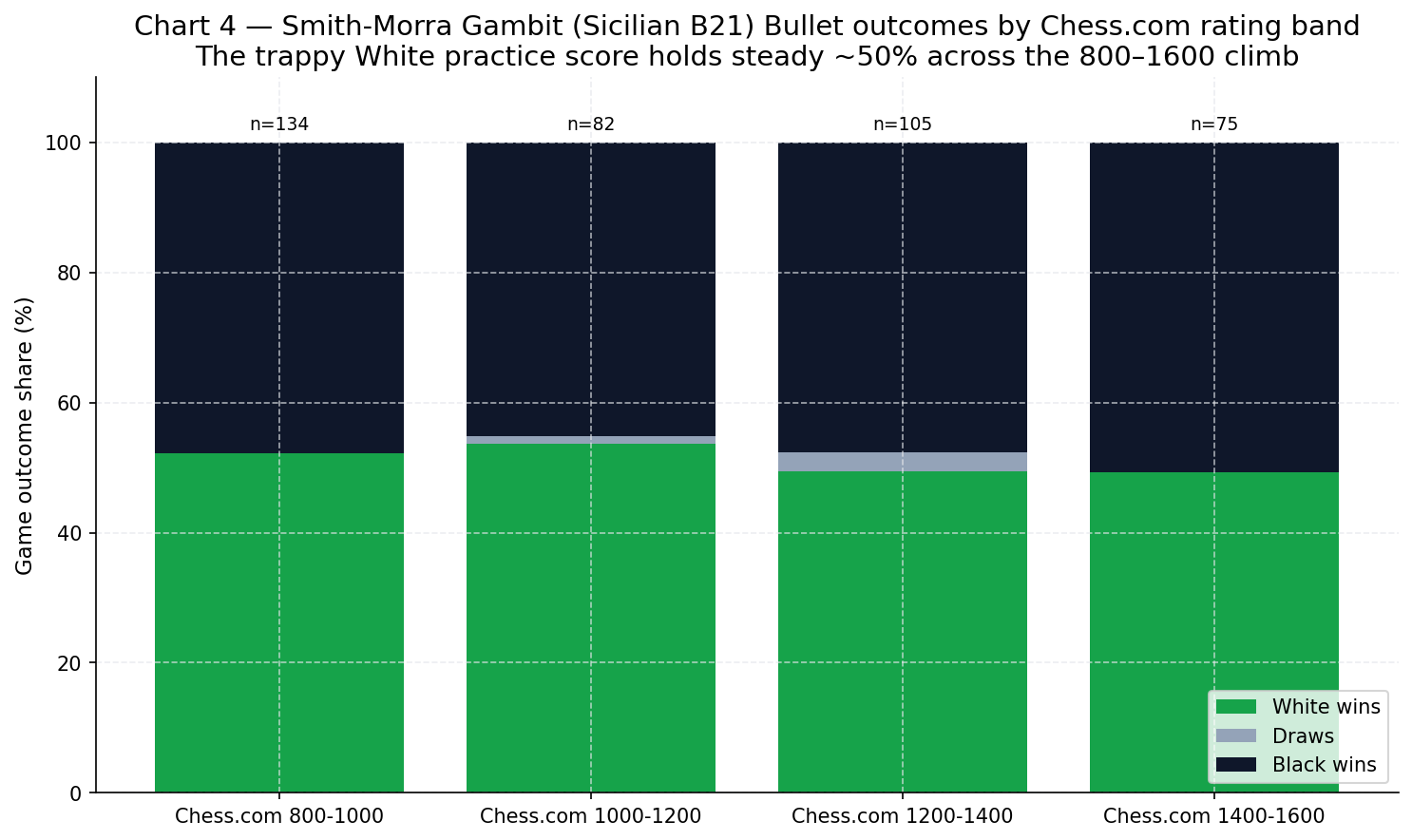
As Chart 4 demonstrates, the Smith-Morra maintains a steady ~50% win rate across the entire 800-1600 climb. It is a reliable, dangerous weapon that forces the opponent to play on your terms.
4. Data and Methodology
This research was conducted using a custom data pipeline querying the Lichess open database for March 2025.
Methodology:
- Data Collection: We sampled 3,495 Bullet games (time control base ≤ 180 seconds) featuring the Sicilian Defense (ECO B20-B99).
- Rating Calibration: Lichess ratings were mapped to Chess.com equivalents using a standard linear interpolation model (e.g., Chess.com 1000 ≈ Lichess 1295).
- Classification: Games were categorized into sub-families based on their ECO codes (e.g., B21 for Smith-Morra, B20 for Wing Gambit).
- Trap Detection: We utilized FEN substring matching to detect specific trap motifs, such as the Siberian Trap's critical 8.Nb5 or 9...Nd4! patterns.
- Metrics: We calculated White win percentages, draw rates, and "quick win" rates (White victories in 20 moves or fewer) to quantify trap effectiveness.
Underlying Data Files: The raw analysis results are available in the attached CSV files:
family_perband.csv: Detailed performance metrics for each Sicilian sub-family across the four rating bands.family_overall.csv: Aggregate performance metrics for each sub-family across the entire dataset.trap_motif_summary.csv: Specific success rates for detected trap patterns.
Chess Coach April 19, 2026