A data-driven roadmap for prioritizing your endgame study, based on 10,000 real Lichess bullet games.
For decades, chess coaches have repeated the mantra: "Rook endgames are the most common endgames." But does this classical wisdom hold true in the chaotic, low-time environment of online bullet chess? And more importantly, how should a club-level player (Chess.com 800–1500) prioritize their limited study time?
To answer these questions, we analyzed a random sample of 10,000 Lichess bullet games played by users whose ratings correspond to the Chess.com 800–1500 range. We categorized the deepest, simplest endgame reached in each game, tracked the final material on the board, and measured the actual outcomes of specific endgame types like Opposite-Colored Bishops (OCB) and Queen endings.
Here is the data-backed truth about club-level bullet endgames, and actionable advice on how to climb the rating ladder.
1. The Big Picture: Do We Even Reach Endgames?
Before studying endgames, it is worth asking how often bullet games actually reach one. The data shows a clear trend: as rating increases, games get longer and endgames become more frequent.
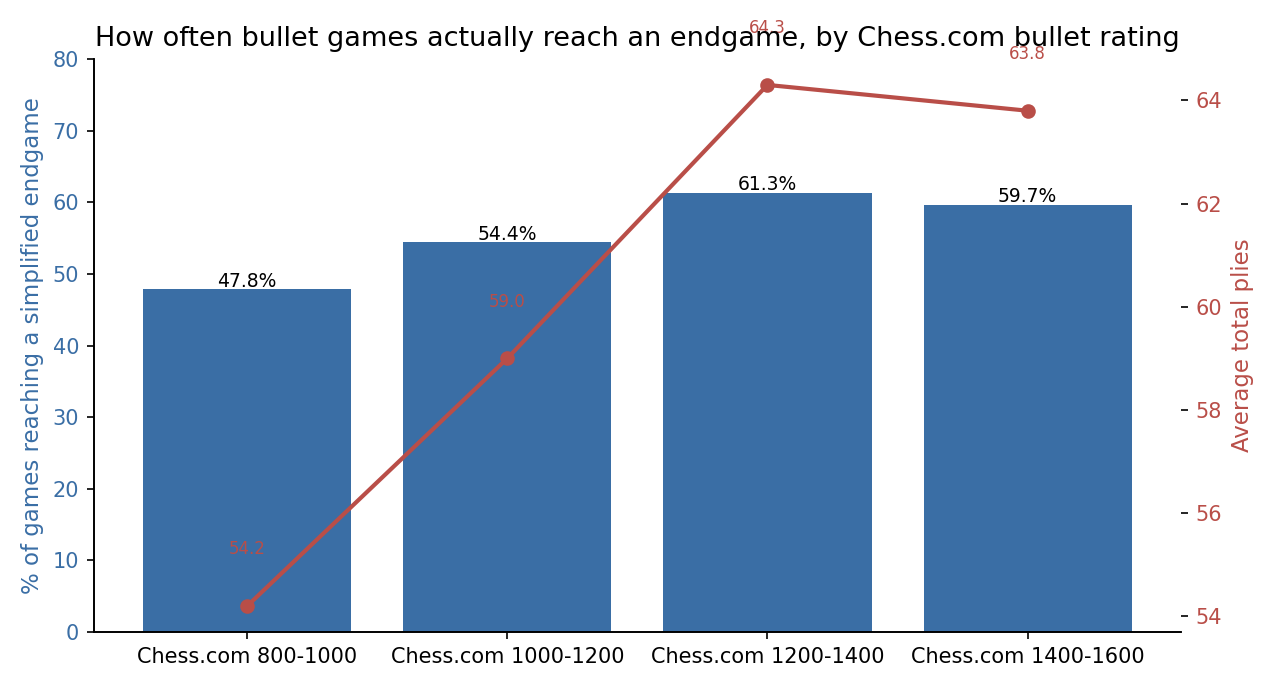
At the Chess.com 800–1000 level, only 47.8% of games ever reduce to a simplified endgame (defined as 3 or fewer non-pawn pieces per side). The majority of games end in middlegame checkmates, blunders leading to resignation, or time-outs with heavy material still on the board. By the time players reach the 1200–1400 band, over 61% of games reach an endgame, and the average game length extends by 10 plies.
Actionable Advice (800–1200)
If you are below 1200, do not over-invest in complex endgame theory. More than half of your games are decided while queens and multiple minor pieces are still on the board. Focus on tactics, board vision, and playing quickly to avoid time trouble.
2. The Endgame Mix: Are Rook Endgames Really #1?
When games do simplify, what do they simplify into? We categorized every game by the "simplest stable endgame" it reached.
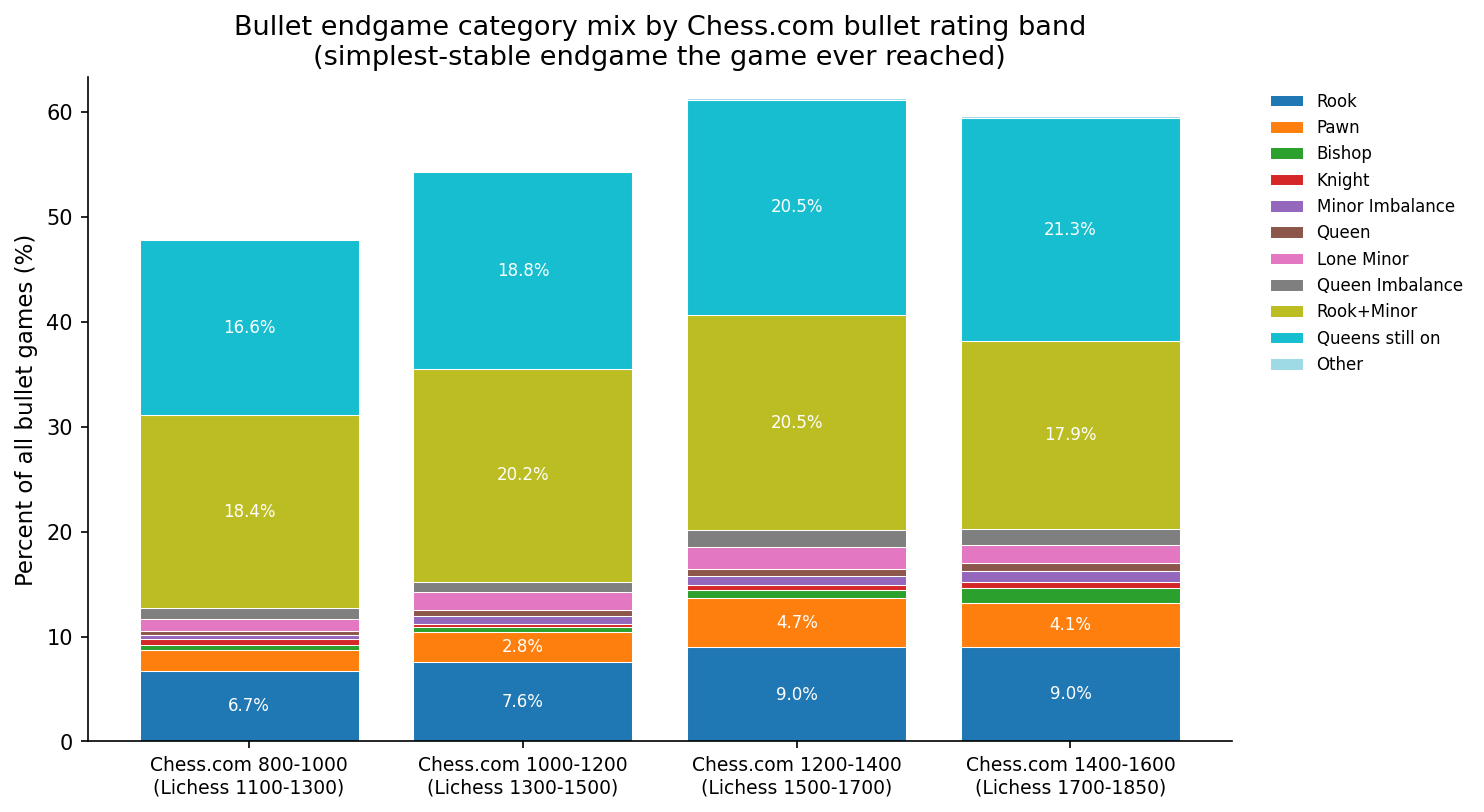
The data confirms the classical wisdom, but with a major caveat: Rook endgames are indeed the most common pure endgame, but "Queens still on" and "Rook + Minor" are the most common actual endgames.
Among pure piece-class endgames, the frequencies across all bands are:
- Rook Endgames: 6.7% to 9.0% of all games
- Pawn Endgames: 2.0% to 4.7%
- Bishop Endgames: 0.5% to 1.4%
- Queen Endgames: 0.4% to 0.8%
However, notice the massive teal and yellow blocks in the chart above. Between 16% and 21% of all bullet games end in a "Queens still on" endgame (e.g., Queen + pawns vs Queen + pawns), and another 18% to 20% end in "Rook + Minor" imbalances.
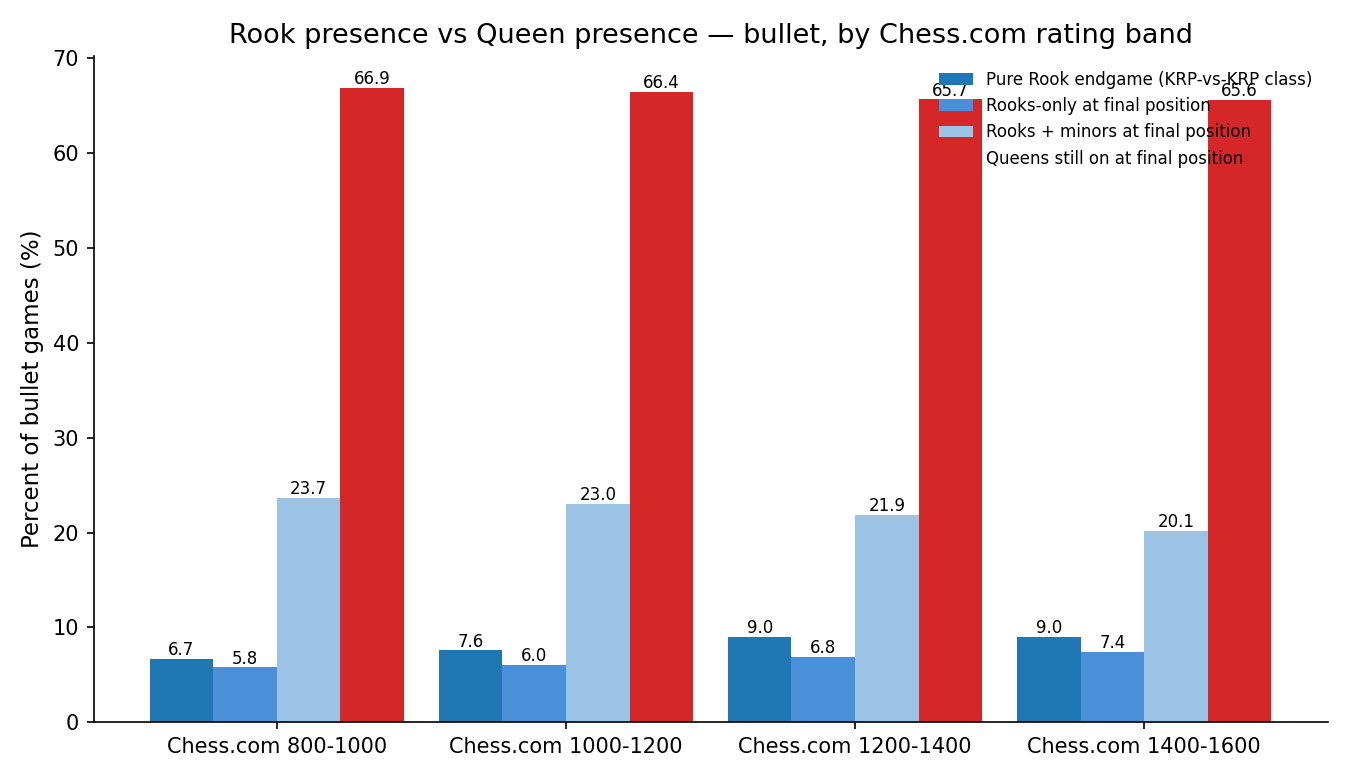
To further illustrate the dominance of the rook, we looked at the final position of every game. Rooks (without queens) are present on the board at the end of 27% to 29% of all bullet games.
Actionable Advice (1200–1500)
- Master the Rook: Since pure rook endgames occur in nearly 1 in 10 games, and rooks are present in almost 30% of final positions, basic rook endgame principles (active rook, cutting off the king, pushing passed pawns) are the highest-ROI study topic.
- Practice Queen Endgames... with Minors: Pure queen endgames are incredibly rare (<1%), but endgames where queens are still on the board alongside other pieces are the most common scenario of all. Practice playing with your queen when time is low—focus on king safety and perpetual check threats.
3. The Truth About Rook Endgame Outcomes
We know rook endgames are common, but how do they actually play out?
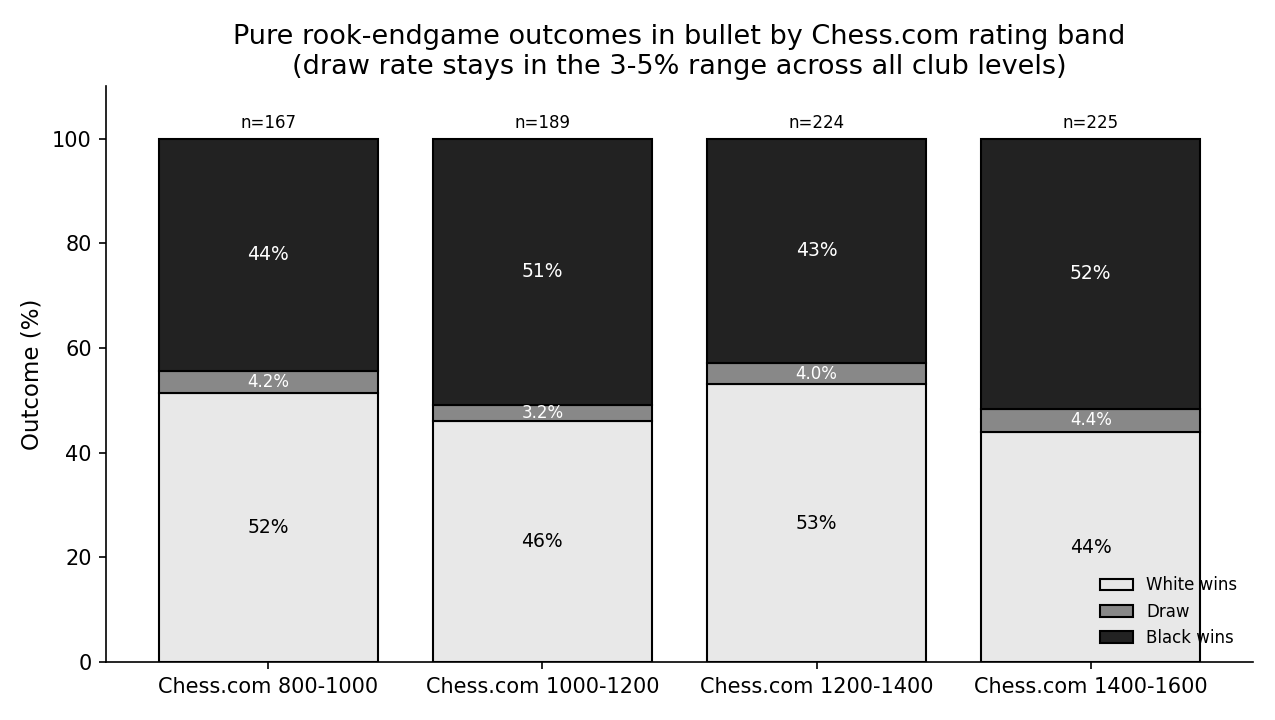
At the master level, rook endgames are notoriously drawish. But in club-level bullet, draws are almost non-existent. Across all rating bands from 800 to 1600, the draw rate in pure rook endgames hovers between 3.2% and 4.4%. Over 95% of these games end decisively.
In bullet, players simply do not have the time to calculate precise Philidor or Lucena positions. They push pawns, blunder rooks, or flag.
Visual Evidence: The Club-Level Rook Endgame
Consider this position reached in a Lichess 1100–1300 (Chess.com 800–1000) game.
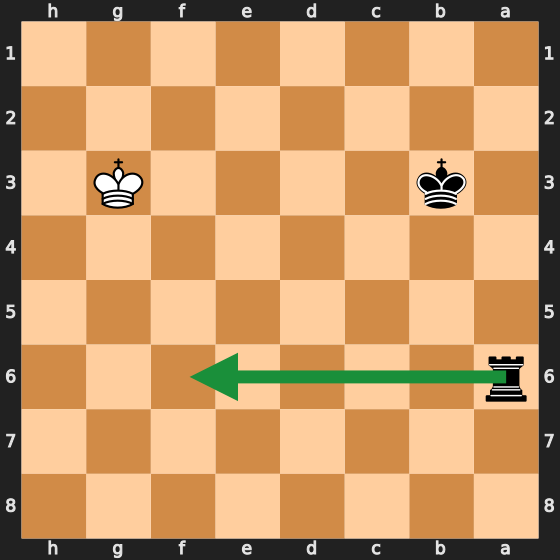 White to move. The engine recommends bringing the rook to f6 (green arrow) to cut off the king or prepare checks. In the actual game, time pressure and lack of technique led to a draw.
Actionable Advice (All Levels)
Do not study the Lucena or Philidor positions expecting to use them frequently in bullet. Instead, practice practical rook endgames:
- Always keep your rook active, even at the cost of a pawn.
- Push your passed pawns as fast as possible.
- Pre-move your king to safety.
4. The Myth of the Opposite-Colored Bishop Draw
Another famous chess maxim is that Opposite-Colored Bishop (OCB) endgames are highly drawish, often resulting in draws even when one side is up a pawn or two. Does this hold up in bullet?
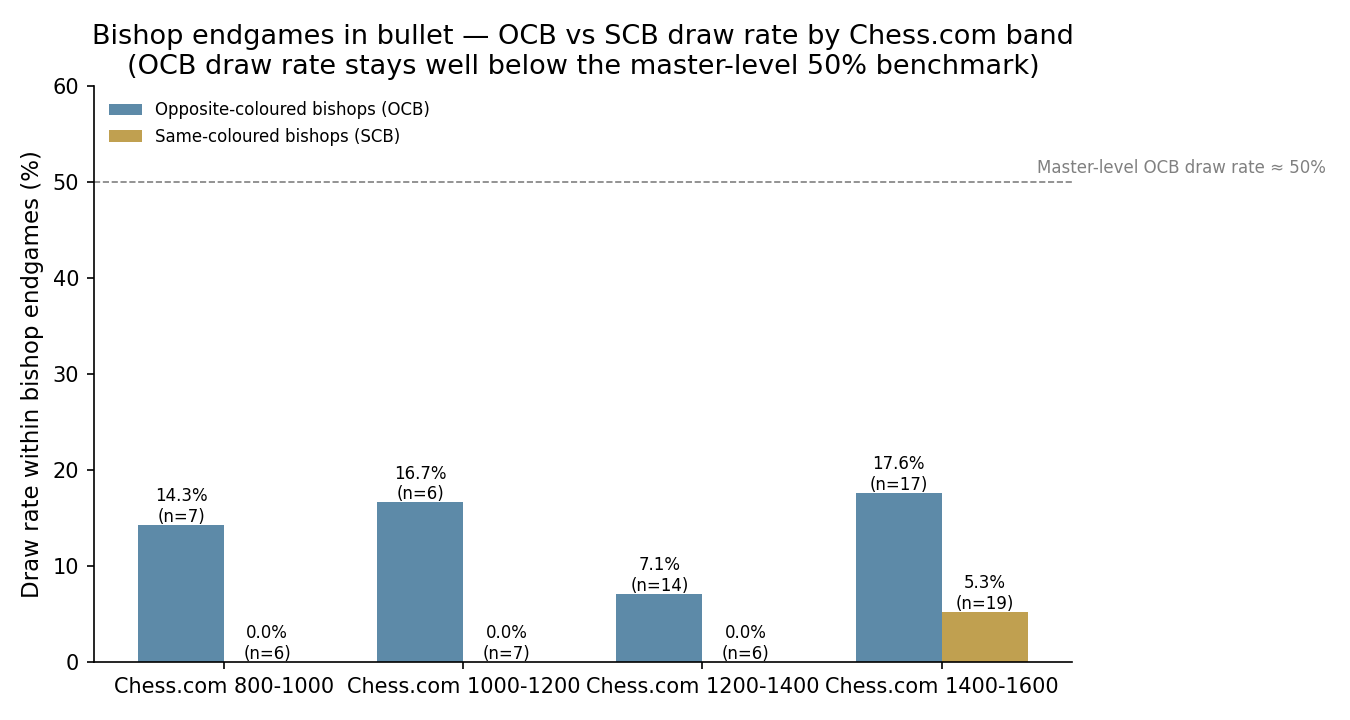
The data shatters this myth for club players. While master-level OCB endgames draw roughly 50% of the time, the draw rate in our sample never exceeded 17.6% (and was as low as 7.1% in the 1200–1400 band).
Why? Because defending an OCB endgame requires constructing a fortress and shuffling the bishop perfectly—a task that is practically impossible with 15 seconds on the clock. The attacking side simply pushes pawns until the defender blunders or runs out of time.
Visual Evidence: The OCB Reality
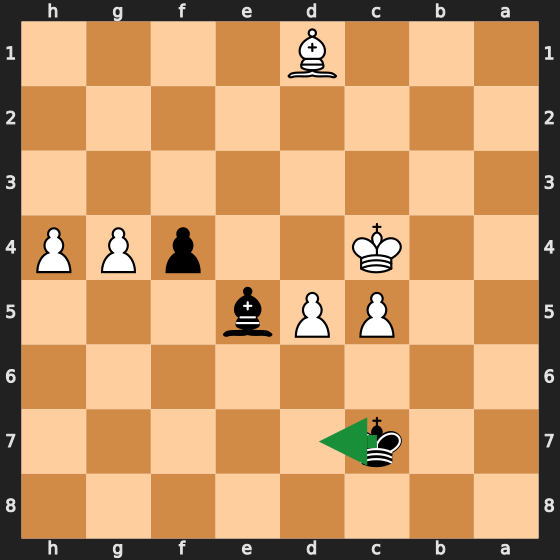 Black to move in a Chess.com 1400-1600 equivalent game. While objectively a draw with perfect play, Black won this game. The engine suggests bringing the king to d7 (green arrow) to blockade, but in bullet, the passed pawns usually overwhelm the defender.
Actionable Advice (1300–1500)
If you are losing and transition into an OCB endgame hoping for an easy draw, you will likely be disappointed. Conversely, if you are winning, do not fear the OCB endgame—your opponent will almost certainly crack under time pressure. Just push your pawns on the color of your bishop.
5. Queen Endgames: Rare and Decisive
Finally, we looked at pure Queen endgames (Queen + pawns vs Queen + pawns).
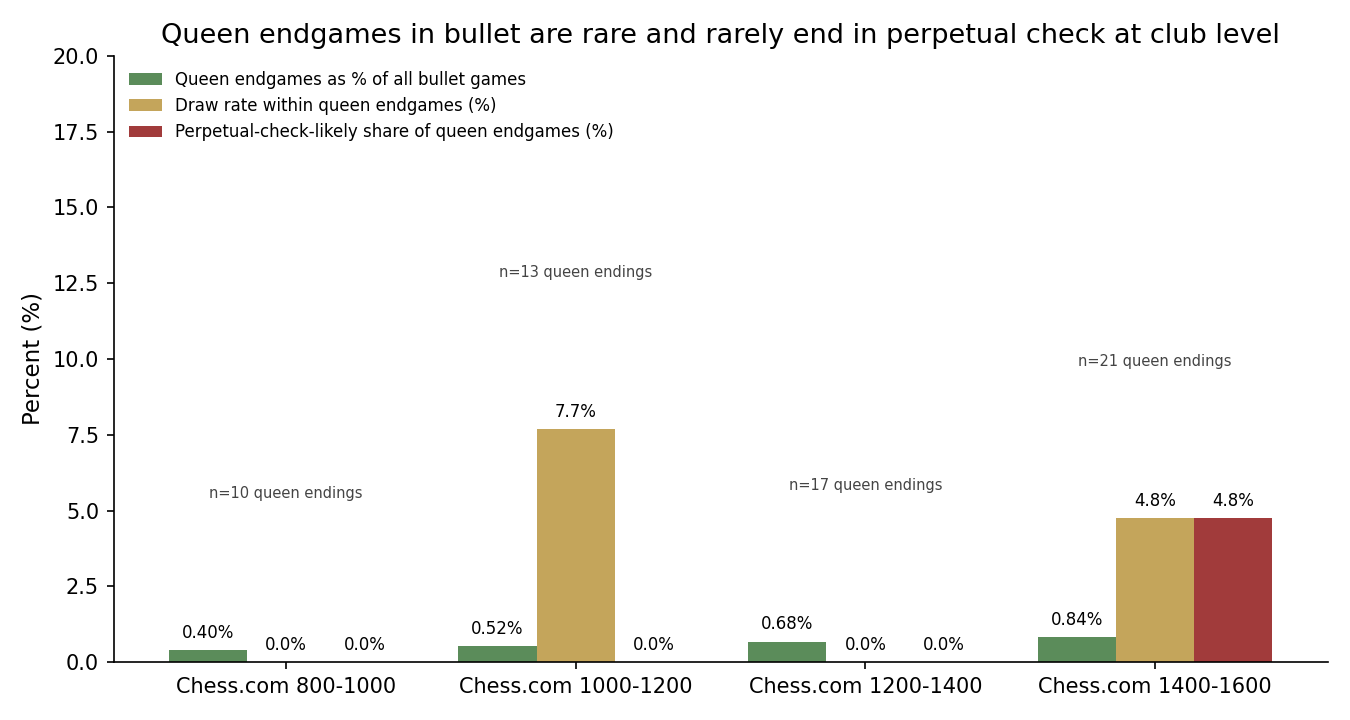
These are the rarest of the fundamental endgames, occurring in less than 1% of games. When they do occur, they are bloody. The draw rate is extremely low, and perpetual checks are almost never found.
In our entire sample of nearly 10,000 games, our heuristic flagged exactly one queen endgame that likely ended in a perpetual check, and it occurred in the highest rating band (1400–1600).
Visual Evidence: The Elusive Perpetual
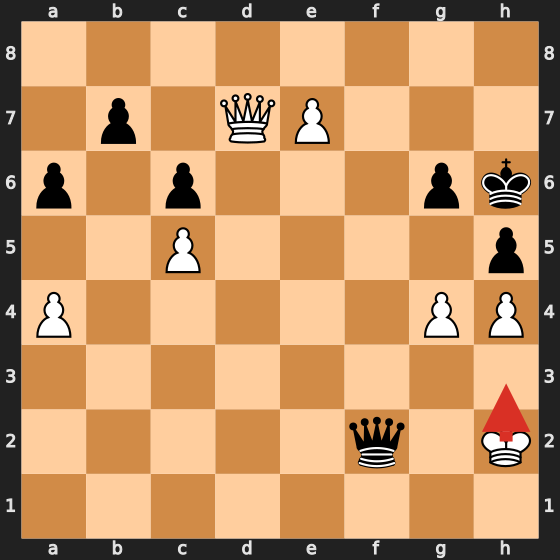 White to move. One of the very few examples of a likely perpetual check found in the dataset. The engine suggests h3 (green arrow) to secure the king, but the game ended in a draw.
Actionable Advice (All Levels)
Do not spend time studying complex queen endgame theory or perpetual check patterns for bullet. If you find yourself in a queen endgame, prioritize king safety above all else. The player whose king is exposed will get skewered, lose their pawns, and lose the game.
Conclusion: Your Bullet Endgame Roadmap
Based on 10,000 real games, here is how you should allocate your endgame study time for bullet chess:
- Priority 1: Playing with Queens On. Most of your games will end with queens on the board. Practice king safety and fast tactical vision.
- Priority 2: Practical Rook Endgames. Rooks are the most common piece left in the endgame. Focus on rook activity and pushing passed pawns quickly.
- Priority 3: Pawn Endgames. These occur in 2-4% of games. Knowing basic opposition and the rule of the square will win you free points.
- Do Not Prioritize: Complex OCB fortresses, Lucena/Philidor positions, or pure Queen endgame theory. These simply do not occur or do not function as expected in low-time scrambles.
Data and Methodology
- Source: 9,983 randomly sampled Lichess bullet games (60+0, 120+1, etc.) fetched via the Lichess API.
- Rating Calibration: Lichess ratings were mapped to Chess.com bullet ratings using established community conversion tables (e.g., Chess.com 800 ≈ Lichess 1115).
- Classification: Games were parsed using
python-chess. The "endgame category" was defined as the simplest, most pure material imbalance reached during the game (e.g., if a game went from Rook+Minor to pure Rook, it was classified as a Rook endgame). - Engine Analysis: Example positions were evaluated using the Theoria NNUE engine via the grandmaster-guide MCP.
Raw Data Files:
View full data →band_lichess band_chesscom n_games_analyzed n_games_reaching_endgame pct_reaching_endgame avg_total_plies L1100_1300 800-1000 2495 1193 47.82 54.2 L1300_1500 1000-1200 2499 1359 54.38 59.0 L1500_1700 1200-1400 2497 1531 61.31 64.3 L1700_1850 1400-1600 2492 1487 59.67 63.8
View full data →band_lichess band_chesscom endgame_category count pct_of_total_games pct_of_games_reaching_endgame L1100_1300 800-1000 Rook+Minor 460 18.44 38.56 L1100_1300 800-1000 Queens still on 415 16.63 34.79 L1100_1300 800-1000 Rook 167 6.69 14.0 L1100_1300 800-1000 Pawn 50 2.0 4.19 L1100_1300 800-1000 Lone Minor 28 1.12 2.35
View full data →band_lichess band_chesscom n_rook_endgames white_win_pct draw_pct black_win_pct decisive_pct L1100_1300 800-1000 167 51.5 4.19 44.31 95.81 L1300_1500 1000-1200 189 46.03 3.17 50.79 96.83 L1500_1700 1200-1400 224 53.12 4.02 42.86 95.98 L1700_1850 1400-1600 225 44.0 4.44 51.56 95.56
View full data →band_lichess band_chesscom bishop_type n_endgames white_win_pct draw_pct black_win_pct pct_of_total_games L1100_1300 800-1000 OCB 7 85.71 14.29 0.0 0.28 L1100_1300 800-1000 SCB 6 33.33 0.0 66.67 0.24 L1300_1500 1000-1200 OCB 6 83.33 16.67 0.0 0.24 L1300_1500 1000-1200 SCB 7 28.57 0.0 71.43 0.28 L1500_1700 1200-1400 OCB 14 57.14 7.14 35.71 0.56
View full data →band_lichess band_chesscom n_queen_endgames white_win_pct draw_pct black_win_pct perpetual_likely_pct_of_queen_endgames perpetual_likely_pct_of_queen_draws pct_of_total_games L1100_1300 800-1000 10 60.0 0.0 40.0 0.0 0 0.4 L1300_1500 1000-1200 13 38.46 7.69 53.85 0.0 0.0 0.52 L1500_1700 1200-1400 17 35.29 0.0 64.71 0.0 0 0.68 L1700_1850 1400-1600 21 52.38 4.76 42.86 4.76 100.0 0.84
View full data →band_lichess band_chesscom final_position_bucket count pct_of_total_games L1100_1300 800-1000 Queens + others 1622 65.01 L1100_1300 800-1000 Rooks + minors 591 23.69 L1100_1300 800-1000 Rooks only (no minors) 144 5.77 L1100_1300 800-1000 Queens only 48 1.92 L1100_1300 800-1000 Pawns only 25 1.0
Chess Coach April 20, 2026