A data-driven roadmap for improvement from 600 to 1600+
Every chess player blunders. It is the universal equalizer of the game. However, the type of blunder you make changes dramatically as you improve. A 700-rated player loses games differently than a 1200-rated player, who in turn loses differently than a 1600-rated player. Understanding how you blunder is the fastest path to stopping it.
To answer this question with data rather than intuition, we analyzed over 840,000 Rapid games from the Lichess March 2025 database, each evaluated by Stockfish 17, to classify the most common game-losing mistakes across six rating bands. This guide serves as a roadmap for improvement, showing you exactly what tactical blindspots you need to fix to reach the next rating level.
Note on Ratings: All ratings in this article refer to Chess.com Rapid ratings. The underlying data was sourced from Lichess Rapid games, with ratings adjusted using the established community conversion mapping (Lichess Rapid ratings are approximately 200-400 points higher than Chess.com Rapid for the same skill level).
Key Findings at a Glance
| Chess.com Rating | Avg CPL | Blunders/Game | First Blunder (Move) | #1 Blunder Context | Worst Phase | Sample Games |
|---|---|---|---|---|---|---|
| 600-800 | 181 | 17.9 | Move 17 | Winning position (46%) | Endgame (46%) | 139,780 |
| 800-1000 | 176 | 18.2 | Move 20 | Winning position (40%) | Endgame (45%) | 139,826 |
| 1000-1200 | 169 | 18.2 | Move 23 | Clear advantage (39%) | Endgame (43%) | 139,127 |
| 1200-1400 | 163 | 18.0 | Move 25 | Clear advantage (40%) | Endgame (42%) | 137,768 |
| 1400-1600 | 158 | 18.1 | Move 27 | Clear advantage (41%) | Endgame (40%) | 133,403 |
| 1600-1800 | 154 | 18.4 | Move 30 | Clear advantage (41%) | Endgame (39%) | 153,484 |
CPL = Centipawn Loss. Blunder = move losing 300+ centipawns. "Worst Phase" shows the game phase with the highest blunder rate as a percentage of moves.
The Blunder Curve: How Mistakes Change with Rating
Before diving into specific rating bands, it is essential to understand the macro trends of how players blunder. The data reveals several surprising insights about the nature of chess mistakes.
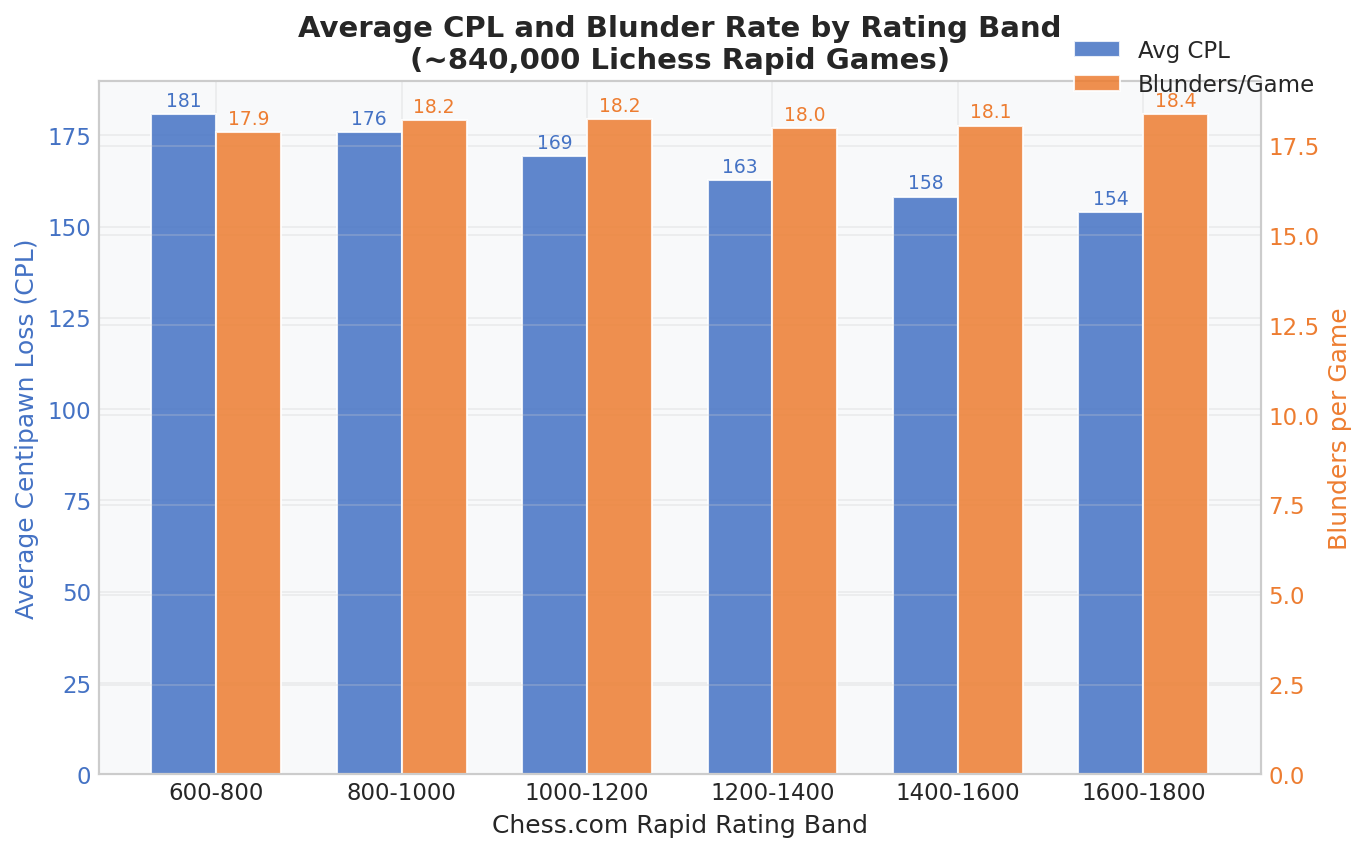
Insight 1: The Number of Blunders per Game Barely Changes
You might expect higher-rated players to make significantly fewer blunders per game. Surprisingly, the data shows that players across all rating bands from 600 to 1800 average around 18 blunders per game (defined as a move that loses 300+ centipawns, or roughly 3 pawns of evaluation). What changes is not the frequency of blunders, but the severity and the context in which they occur. The Average Centipawn Loss (CPL) steadily decreases from 181 at the 600-800 level to 154 at the 1600-1800 level, meaning that while blunders happen at the same rate, each individual blunder becomes less catastrophic as players improve.
Insight 2: Better Players Blunder Later
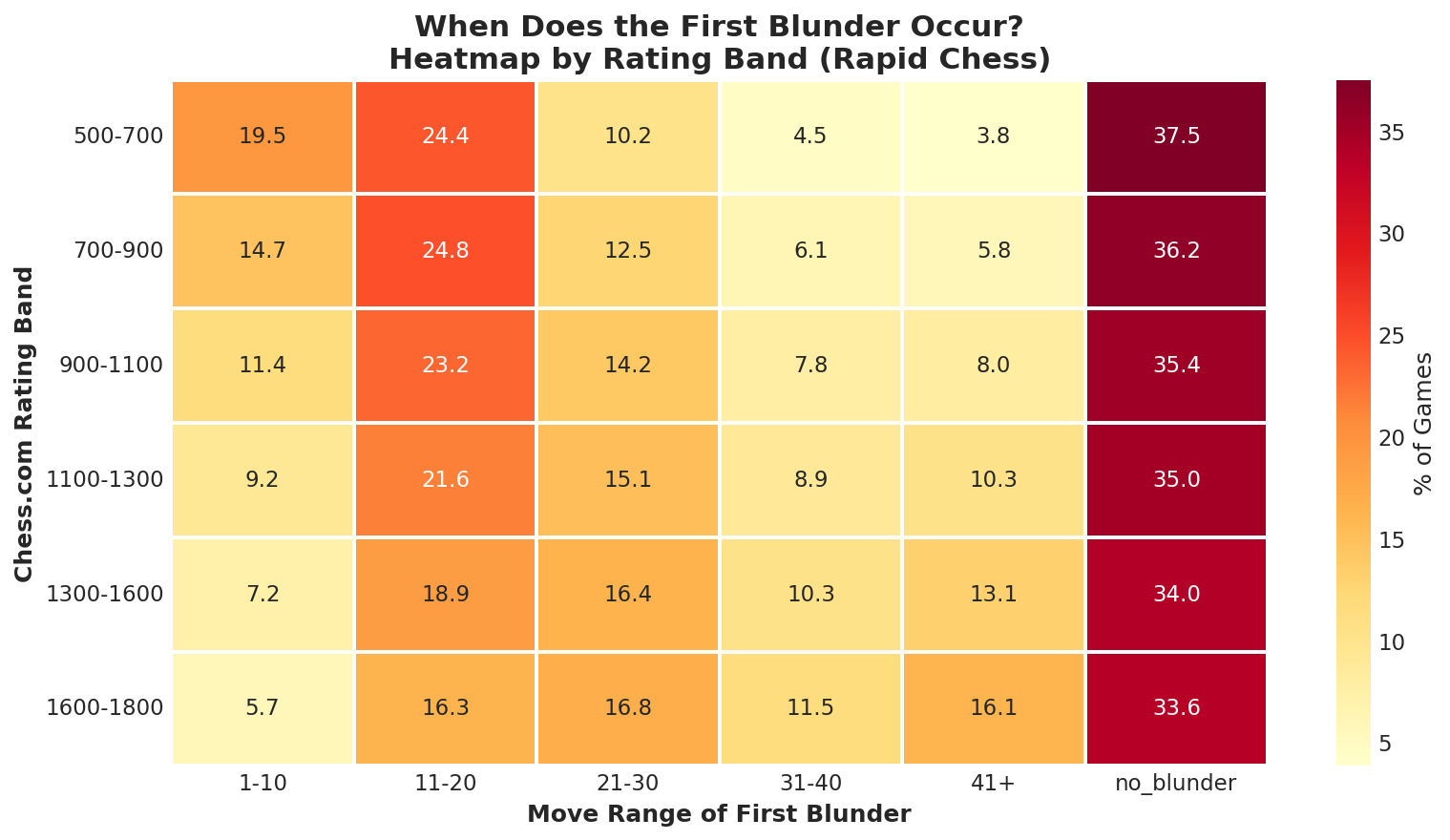
At the 600-800 level, nearly 20% of first blunders happen in the first 10 moves (the opening). By the time players reach 1600-1800, only 5.7% of first blunders happen in the opening. The average move of the first blunder gets pushed back from move 17 to move 30 as players improve. This is one of the clearest markers of chess improvement: the ability to play more moves before making a critical error.
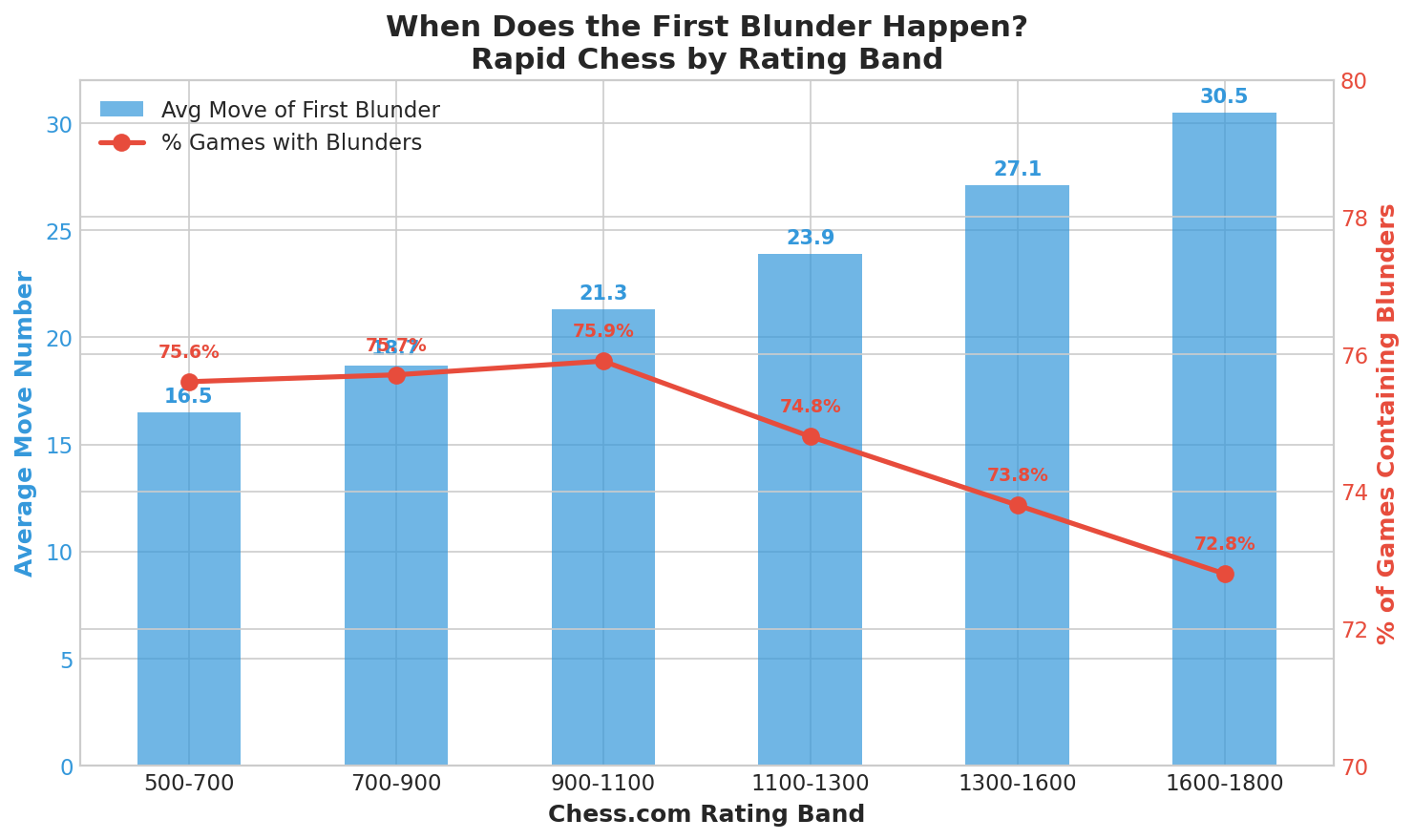
The chart above shows this progression clearly. The blue line tracks the average move number of the first blunder, climbing steadily from move 17 at the 600-800 level to move 30 at the 1600-1800 level. Meanwhile, the percentage of games containing at least one blunder (orange dashed line) remains stubbornly flat at around 74-75% across all rating bands. Even at 1600-1800, three out of four games still contain a blunder.
Insight 3: Lower-Rated Players Blunder When Winning
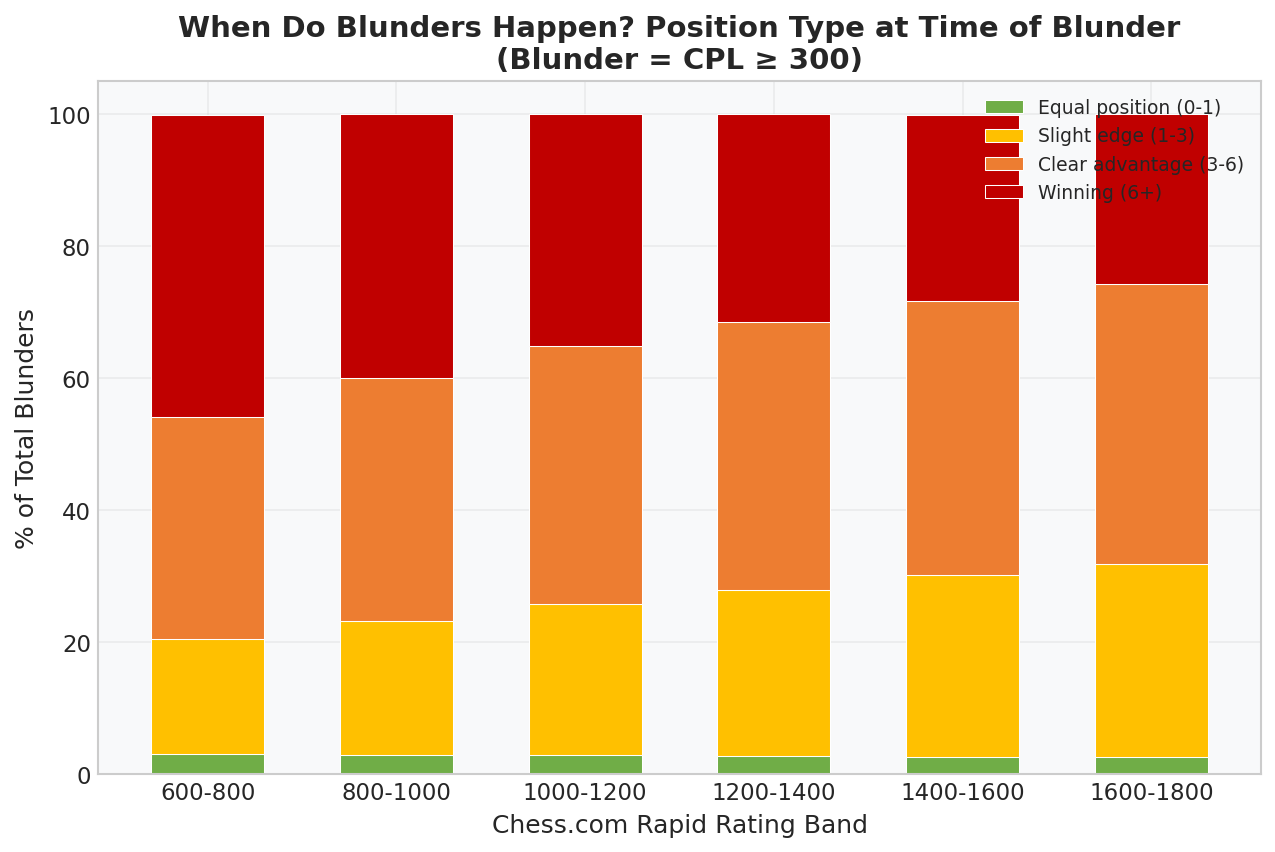
This is perhaps the most important finding of the entire study. At the 600-800 level, a staggering 45.8% of all blunders occur when the player already has a completely winning position (evaluation of +6 or more). They snatch defeat from the jaws of victory. As players improve, they become better at converting winning advantages. By 1600-1800, the proportion of blunders in "Winning" positions drops to approximately 27%, and the most common time to blunder shifts to positions with a "Clear Advantage" (+3 to +6), where the position is better but still requires precise calculation to convert.
Insight 4: The Endgame Is the Most Blunder-Prone Phase at Every Rating
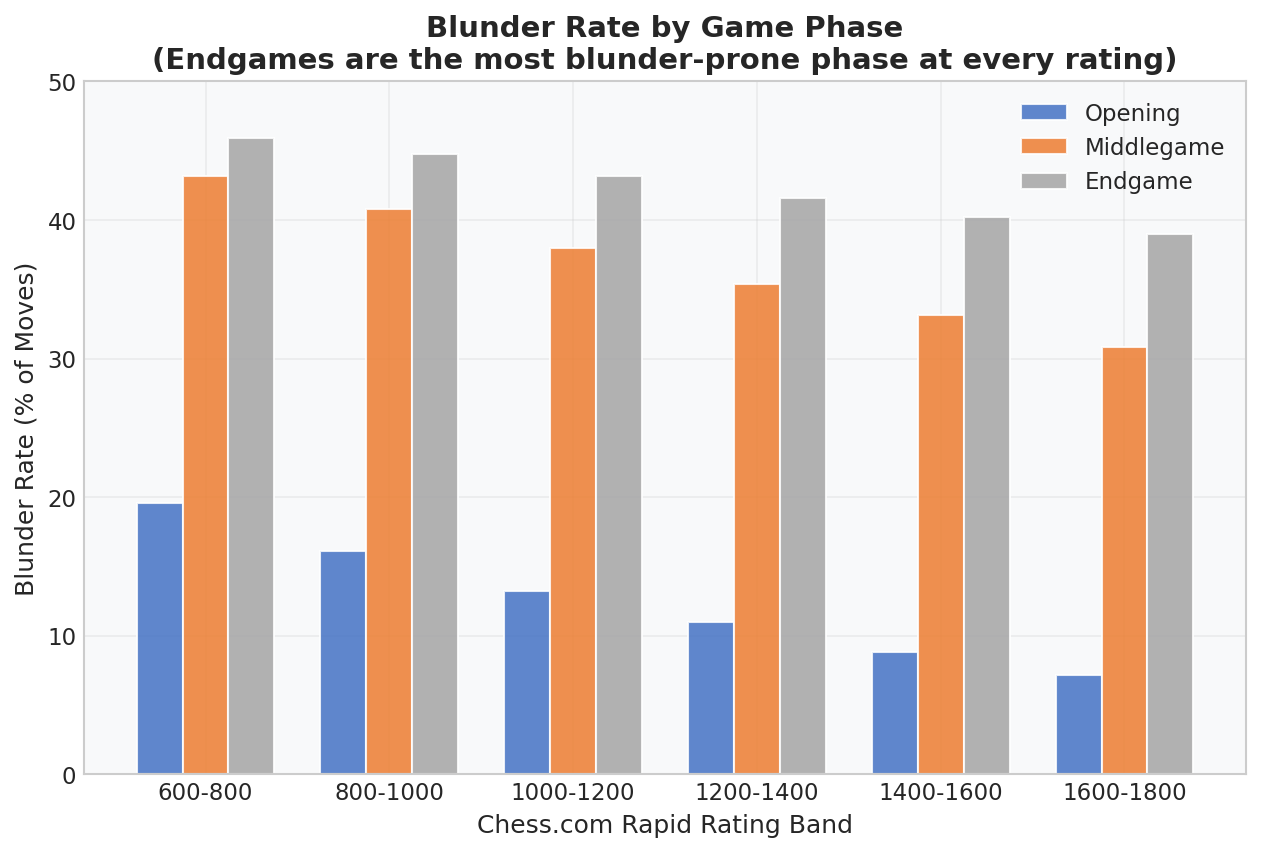
Regardless of rating, the endgame is where the highest percentage of moves are blunders. At the 600-800 level, a shocking 45.9% of all endgame moves are classified as blunders (CPL of 300+). Even at the 1600-1800 level, the endgame blunder rate is 39%. Compare this to the opening, where blunder rates range from 19.6% (at 600-800) down to just 7.3% (at 1600-1800). The middlegame sits in between, with blunder rates declining from 43.2% to 30.9%.
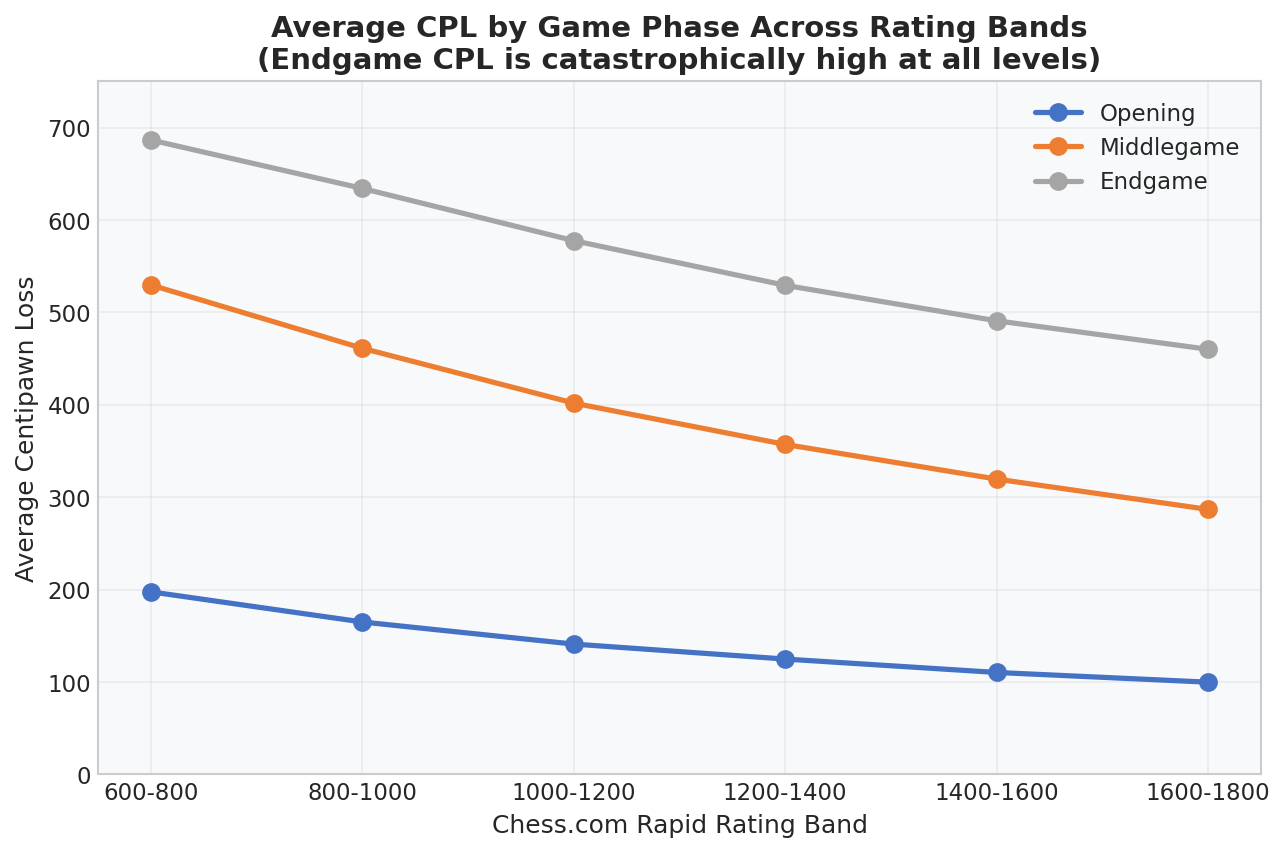
The CPL-by-phase chart makes the problem even starker. Endgame CPL values are catastrophically high, ranging from 687 at the 600-800 level to 487 at the 1600-1800 level. This suggests that endgame study is the single highest-leverage area for improvement at every rating level, yet it is the phase most players neglect.
The Roadmap: Blunders by Rating Level
The 600-800 Level: The One-Move Hang
At the beginner level, games are almost entirely decided by one-move tactical oversights, specifically leaving pieces completely undefended (en prise) or missing simple immediate threats. The opening blunder rate at this level is the highest of any rating band at 19.6%, and the average first blunder comes as early as move 17.
The Most Common Blunder: The Hanging Piece
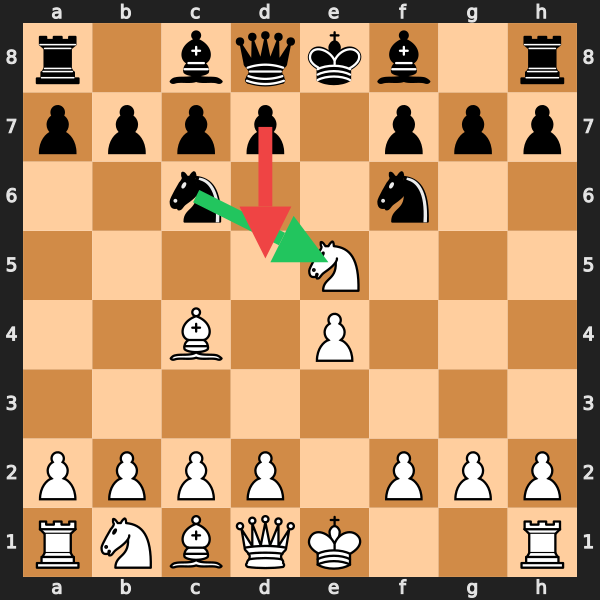
In this typical 700-level position, Black plays O-O (red arrow), castling into safety but completely missing that the Bishop on g4 is hanging after h3. The correct idea was Bxf3 (green arrow), capturing the Knight and winning material before White can play hxg4.
At this level, players are often so focused on their own plans (like castling to safety) that they fail to perform a basic "threat check" on their opponent's previous move. The data shows that 19.5% of games at this level feature a game-losing blunder in the first 10 moves. Furthermore, 45.8% of blunders happen in positions that are already completely winning, meaning these players frequently have a huge advantage and then throw it away with a single careless move.
Actionable Advice to Reach 1000: Before every single move, ask yourself two questions: "What did my opponent's last move attack?" and "Are all my pieces defended?" Simply eliminating one-move piece hangs will instantly propel you out of this rating band. Practice "Mate in 1" puzzles on Chess.com until you can solve them in under 5 seconds.
The 800-1000 Level: Board Vision and Back-Rank Blindness
As players approach 1000, they stop hanging pieces outright as often. However, their board vision is still localized. They focus heavily on the center of the board and the immediate vicinity of the action, often missing long-range threats along open files and diagonals, or structural weaknesses like the back rank.
The Most Common Blunder: The Back-Rank Mate
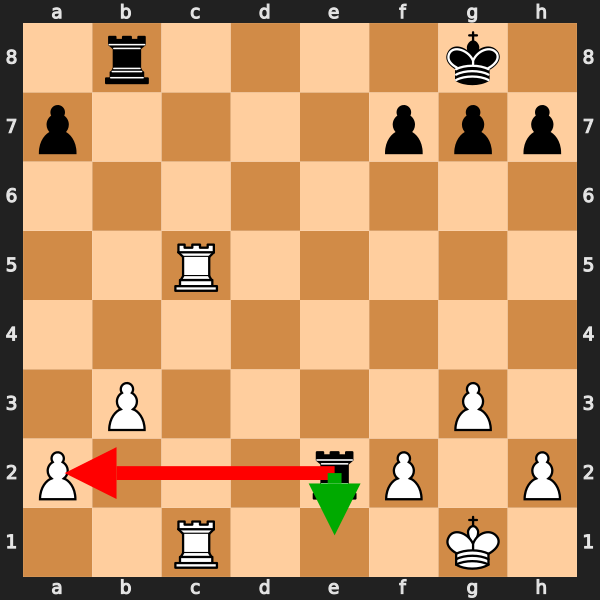
Here, Black plays Rxa2 (red arrow), grabbing a pawn but completely forgetting about their King's safety on the back rank. White responds with Rc8+, and after Rxc8, Rxc8 is checkmate. Black should have played Re1+ (green arrow) to force a rook trade and simplify the position safely.
Our puzzle theme data confirms that back-rank mate is one of the most common tactical patterns at this rating range, appearing in 3.4% of all puzzles rated below 1000. The endgame blunder rate at this level is 44.7%, and the average first blunder occurs around move 20. Players at this level have learned to survive the opening, but the transition to the middlegame and endgame is where they fall apart.
Actionable Advice to Reach 1200: Develop full-board vision. Always check the diagonals and files that span the entire board, not just the squares near the action. Make it a habit to create a flight square for your King (usually by pushing the h-pawn one square) before launching any attack. Practice back-rank mate puzzles until the pattern becomes automatic.
The 1000-1200 Level: The Missed Basic Tactic
Players at this level have decent board vision and rarely hang pieces in one move. However, they struggle with two-move tactical sequences, particularly forks and discovered attacks. They see the immediate material gain but miss the slightly deeper, more forcing tactical sequence.
The Most Common Blunder: The Missed Knight Fork
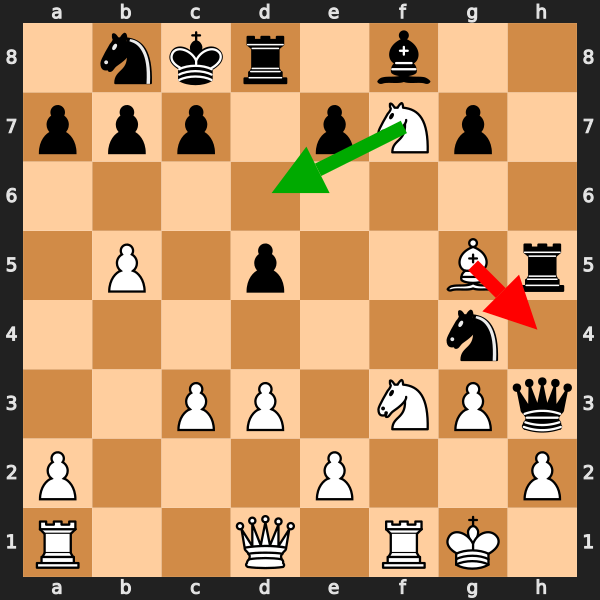
In this position, White plays Bxh4 (red arrow), capturing the rook but missing a devastating tactical opportunity. The correct move was Nd6+ (green arrow), a royal fork attacking both the King on c8 and the Rook on d8, winning the exchange with a crushing positional advantage.
Our puzzle theme analysis shows that "Fork" is the second most common tactical motif in puzzles rated for this level (12.9% of puzzles), behind only "Mate in 2" (13.2%). Players at 1100 often see the immediate material gain but miss the slightly deeper, more forcing tactical sequence. The blunder taxonomy data shows that at this level, 39.1% of blunders occur in positions with a "Clear Advantage" (eval +3 to +6), suggesting that these players get into good positions but then fail to find the precise tactical blow to convert.
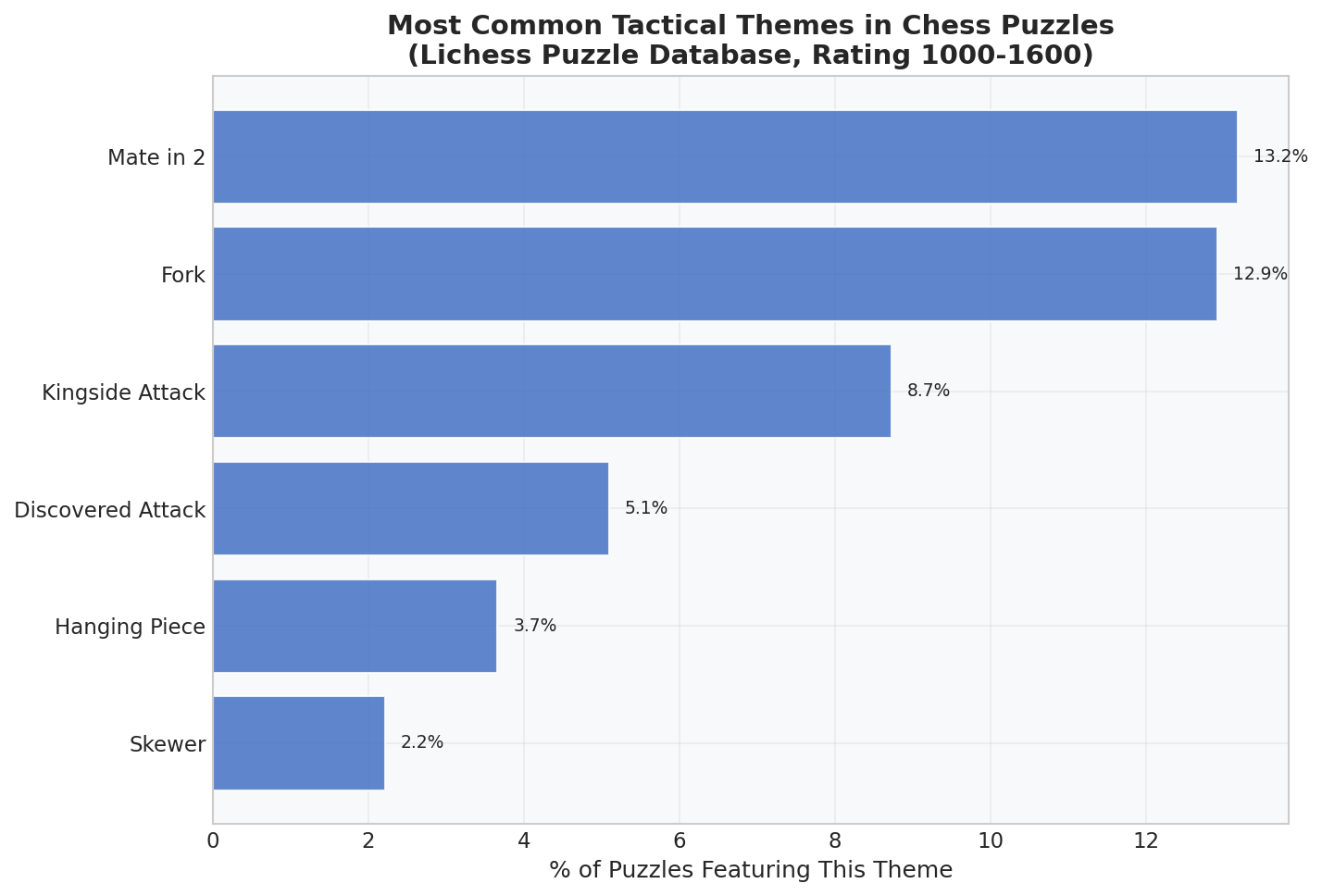
The chart above shows the most common tactical themes in puzzles rated 1000-1600 on Lichess. Forks, discovered attacks, and kingside attacks dominate, and these are precisely the patterns that players at the 1000-1200 level most frequently miss.
Actionable Advice to Reach 1400: Prioritize forcing moves: Checks, Captures, and Threats (in that order). Always calculate checks first, even if they look silly at first glance. A Knight fork with check is the single most common missed tactic at this level. Practice fork and pin puzzles specifically on Chess.com or Lichess until you can spot these geometric patterns automatically.
The 1200-1400 Level: Pin Blindness and Calculation Errors
At the intermediate level, players are tactically aware. They see basic forks and discovered attacks. However, they often miscalculate slightly longer sequences (3-4 moves deep) or fail to recognize the paralyzing power of a pin. The average first blunder at this level occurs around move 25, meaning the opening is usually navigated safely, but the complex middlegame is where calculation errors accumulate.
The Most Common Blunder: Pin Blindness
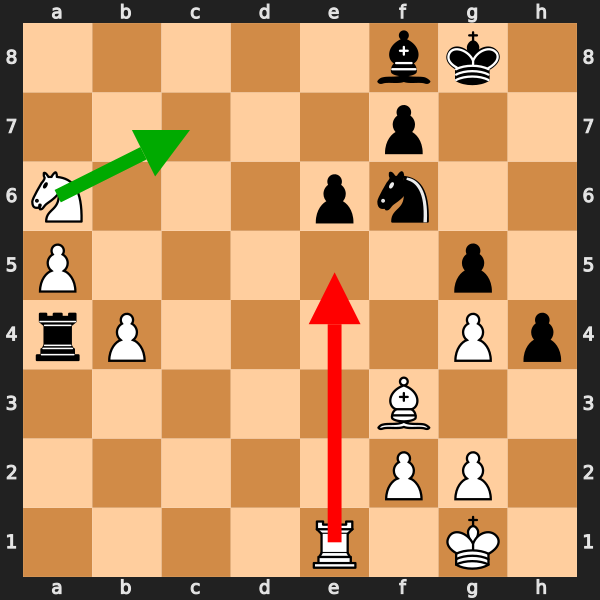
White plays Re5 (red arrow), attempting to centralize the rook actively. However, this allows Black to play Ra1+, forcing the King to h2, followed by Bd6, pinning the Rook to the King along the diagonal. White should have played Nc7 (green arrow) to activate the knight and maintain piece coordination.
The blunder taxonomy data shows that at the 1200-1400 level, 40.2% of blunders occur in positions with a "Clear Advantage" and 29.3% in "Winning" positions. These players get into good positions regularly but then fail to maintain their advantage through the critical middlegame phase. The middlegame blunder rate is 35.4%, and the endgame blunder rate is 41.6%.
Actionable Advice to Reach 1600: When calculating variations, pay special attention to the geometry of the board. Are your pieces lining up on the same diagonal or file as your King or Queen? If so, you are vulnerable to a pin or skewer. Always look one move deeper than your initial calculation. Study basic endgame positions (King and Pawn endings, Rook endings) so that you can simplify into winning endgames with confidence rather than trying to win in the middlegame where calculation errors are more likely.
The 1400-1600+ Level: Blundering the Conversion
As players cross 1500, they are generally solid. They know their openings, spot basic tactics, and understand positional concepts. Their most common blunders are no longer simple oversights, but rather failures in concentration or technique when trying to convert an advantage. The first blunder at this level occurs around move 27, and the blunder taxonomy shows that 41% of blunders happen in positions with a "Clear Advantage."
The Most Common Blunder: Losing the Thread in a Won Position
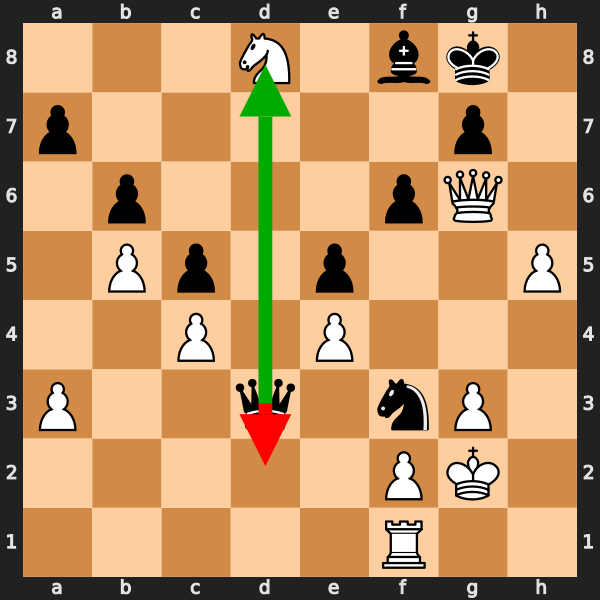
Black is completely winning in this endgame. However, they play Qd2 (red arrow), a passive move that allows White counterplay. The simple and correct move was Qxd8 (green arrow), trading Queens and entering an easily won endgame with the extra Knight.
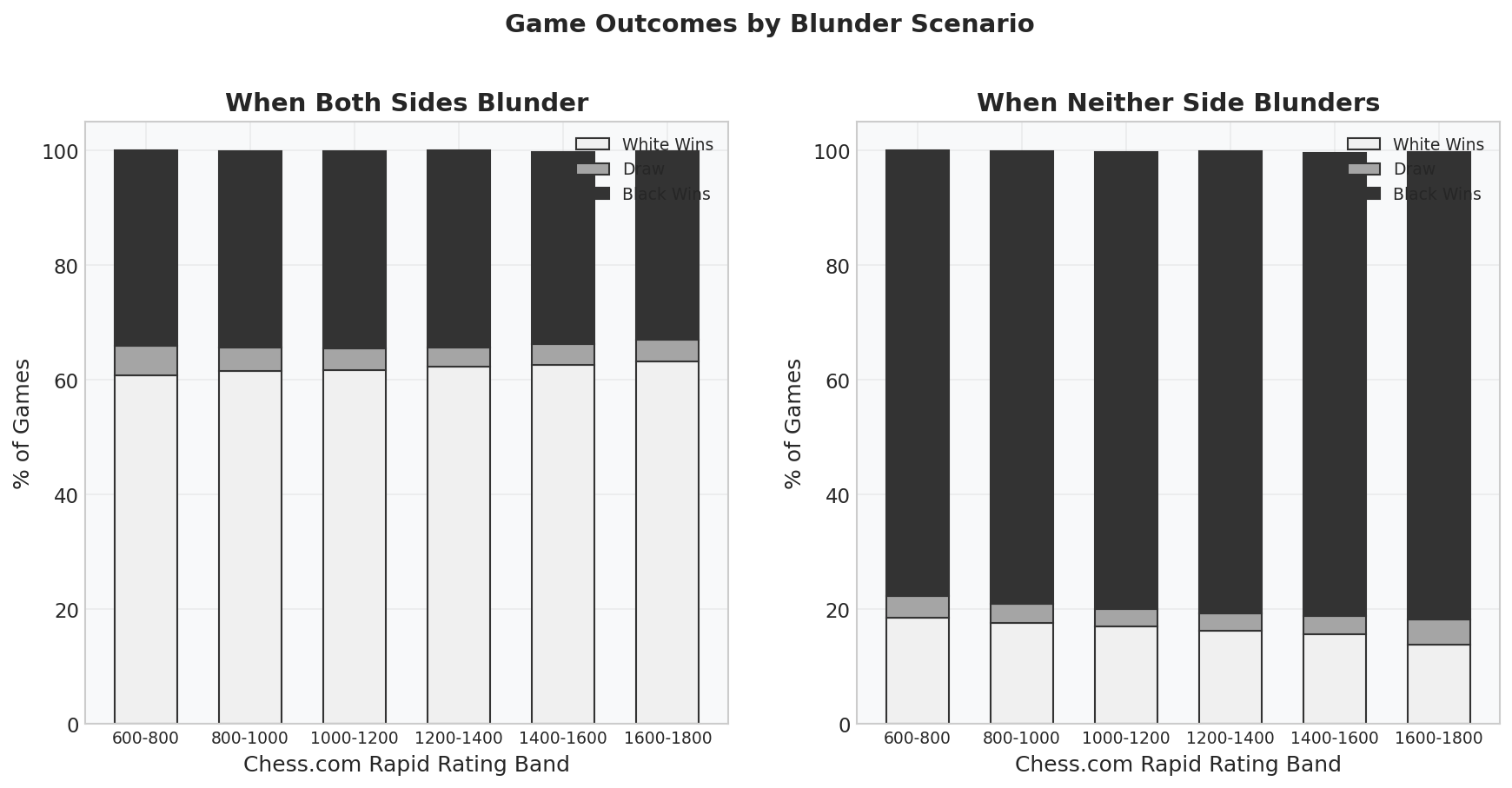
The Blunder Recovery data above tells a compelling story. When both sides blunder (left panel), White wins about 61% of the time across all rating bands, reflecting the inherent first-move advantage. When neither side blunders (right panel), Black actually wins more often (around 78%), suggesting that in clean, well-played games, the second player's ability to react to White's choices provides a slight edge. The key insight for 1400-1600 players is that blunder avoidance is more important than brilliance. If you can simply avoid blundering, you will win the majority of your games.
Actionable Advice to Reach 1800: When you have a winning advantage, your primary goal should be to restrict your opponent's counterplay, not to win faster. Simplify the position by trading pieces (especially Queens) when ahead in material. Stay vigilant until the opponent resigns or is checkmated. Study the endgame seriously: King and Pawn endings, Rook endings, and basic theoretical positions. The data shows that endgame blunder rates remain above 40% even at this level, making endgame study the highest-leverage area for improvement.
The Mate-in-1 Question: How Often Do Players Miss Checkmate?
One of the most common questions from improving players is: "How often do players miss mate-in-one?" While our dataset does not isolate mate-in-one specifically, the puzzle data provides a strong proxy. Mate in 1 is the single most common puzzle theme at the beginner level (14.5% of all puzzles rated below 1000), and it remains a significant theme even at intermediate levels.
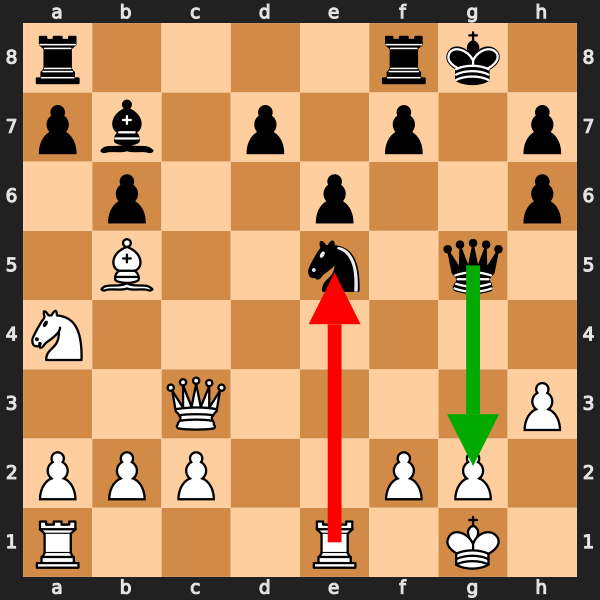
In this position, it is White's move. White plays Rxe5 (red arrow), capturing the Knight but completely missing that Black has Qg2# (green arrow), a devastating mate-in-one. This type of oversight, where a player focuses on material gain while ignoring the opponent's mating threat, is common at every level below 1400.
The first blunder timing data shows that 75% of games at every rating level contain at least one blunder. At the 600-800 level, 21.9% of Black's first blunders happen in the first 10 moves, many of which involve missing or allowing a simple mating pattern. The rate of opening blunders drops steadily as rating increases, suggesting that players gradually internalize basic mating patterns through experience and puzzle practice.
How Lopsided Do Games Get?
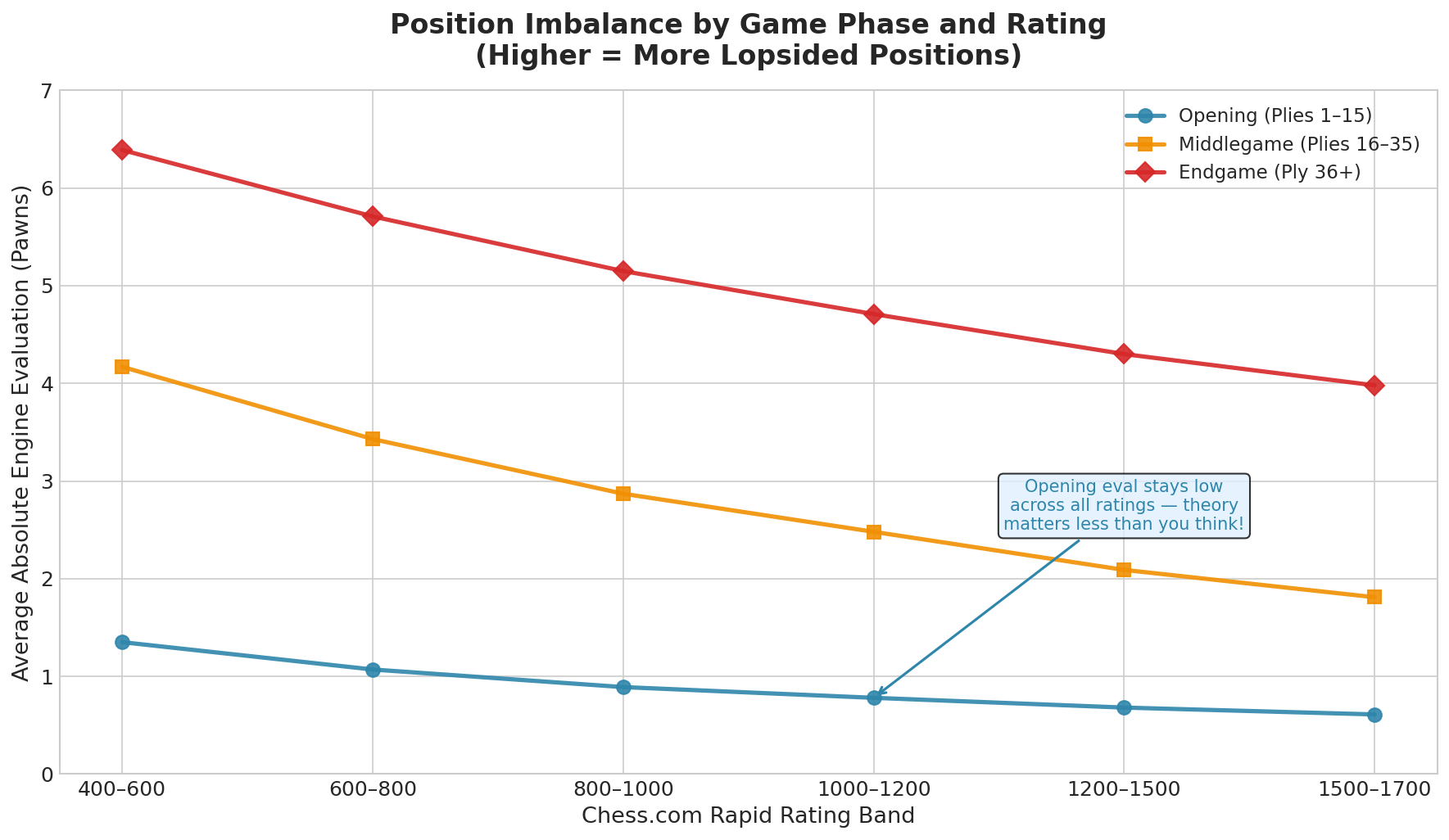
The Eval Trajectory chart reveals how quickly games become one-sided at different rating levels. At the 600-800 level, the average absolute evaluation in the endgame is 6.39 pawns, meaning that by the time the endgame arrives, one side is typically winning by the equivalent of a Rook and a Pawn. At the 1600-1800 level, this drops to 3.98 pawns, still a significant advantage but much closer to a contested game.
The opening phase tells a different story. At the 600-800 level, the average absolute evaluation after the opening is 1.35 pawns, while at 1600-1800 it is only 0.61 pawns. This means that higher-rated players emerge from the opening with much more balanced positions, and the game remains competitive for longer.
The Blunder Distribution: How Many Blunders per Game?
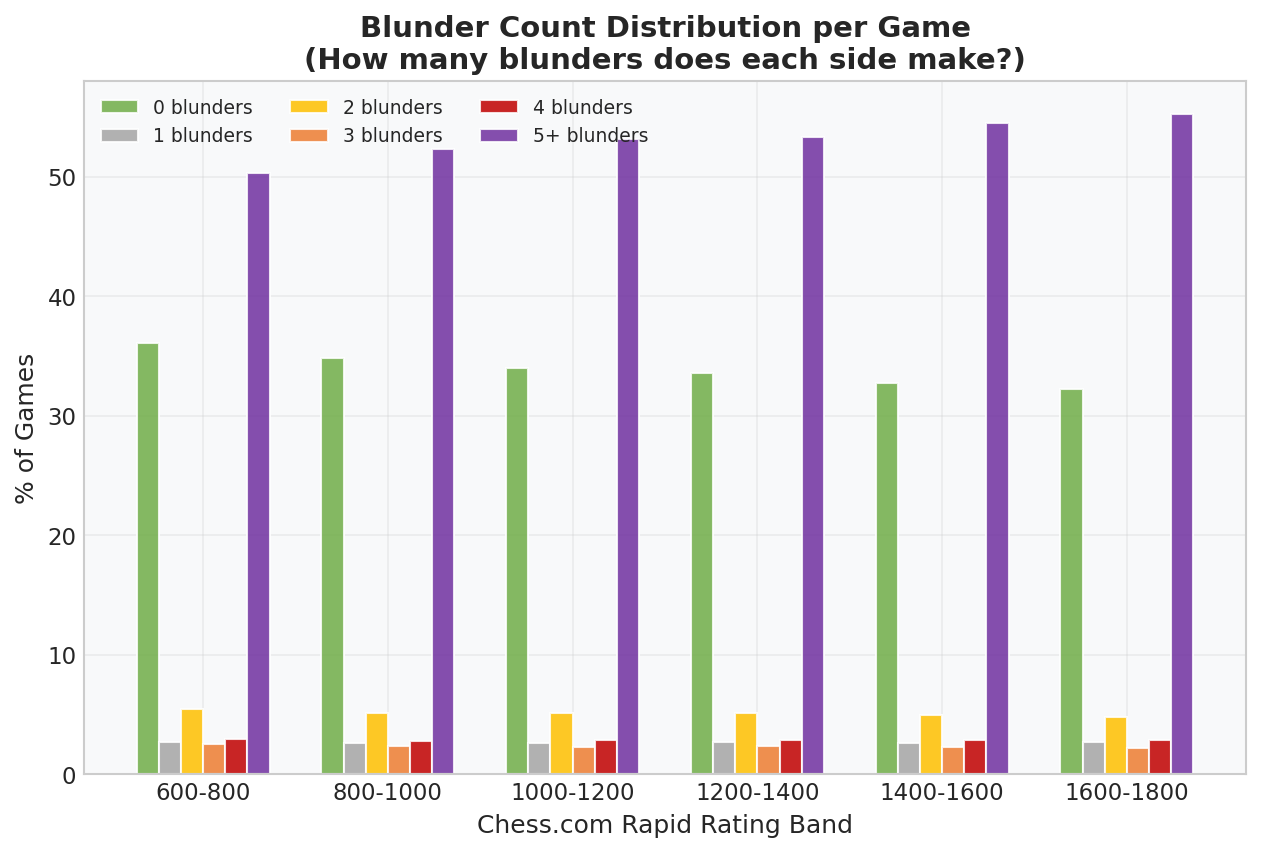
The blunder distribution chart shows the percentage of games with 0, 1, 2, 3, 4, or 5+ blunders per side. At every rating level, the most common category is 5+ blunders per side, which accounts for roughly 40% of games at the 600-800 level and remains above 35% even at the 1600-1800 level. The percentage of blunder-free games (0 blunders per side) hovers around 37-38% across all rating bands.
This distribution reinforces the central finding of this study: blunders are not rare events. They are the norm. The path to improvement is not about eliminating blunders entirely (which is nearly impossible even for titled players in rapid chess), but about making your blunders less severe and occurring later in the game.
Data and Methodology
This analysis was conducted using a dataset of approximately 847,000 Lichess Rapid games played in March 2025. The games were analyzed using Stockfish 17 to extract Centipawn Loss (CPL) and blunder metrics for every ply. The data was accessed via the Grandmaster Guide MCP server, which maintains a curated database of Lichess games with pre-computed engine evaluations and material balance annotations.
A "blunder" in this dataset is defined strictly by the engine evaluation as a move that results in a drop of 300 centipawns (roughly 3 pawns) or more. A "mistake" is defined as a drop of 100-299 centipawns, and an "inaccuracy" as a drop of 50-99 centipawns.
Because Lichess ratings are generally higher than Chess.com ratings for the same skill level, we applied a conversion mapping based on established community consensus. The Lichess rating bands used in the underlying data (700-900, 900-1100, 1100-1300, 1300-1500, 1500-1800, 1800-2000) were mapped to approximate Chess.com Rapid equivalents (600-800, 800-1000, 1000-1200, 1200-1400, 1400-1600, 1600-1800).
Underlying Data Files:
The raw CSV data files generated for this analysis are attached to this report for further review:
| File | Description |
|---|---|
analysis_summary.csv |
Master summary table with all key metrics per rating band |
analysis_cpl_by_rating.csv |
Average CPL, blunder/mistake/inaccuracy rates by rating |
analysis_blunder_taxonomy.csv |
Blunder distribution by position type (equal, slight edge, clear advantage, winning) |
analysis_first_blunder_timing.csv |
Average move of first blunder and % of games with blunders |
analysis_blunder_timing_histogram.csv |
Histogram of first blunder timing by move range |
analysis_phase_accuracy.csv |
Blunder rates by game phase (opening, middlegame, endgame) |
analysis_blunder_distribution.csv |
Distribution of blunder counts per game (0, 1, 2, 3, 4, 5+) |
analysis_blunder_recovery.csv |
Game outcomes by blunder scenario (both blundered, neither, one side only) |
analysis_eval_trajectory.csv |
Average absolute evaluation by game phase and rating |
Chess Coach, April 15, 2026