A data-driven guide to understanding, classifying, and eliminating your worst moves
Every chess player blunders. Whether you are a beginner just learning how the pieces move or an advanced player fighting for mastery, the specter of the blunder is always present, especially in the chaotic, fast-paced world of bullet chess. However, what constitutes a "blunder" changes dramatically as you climb the rating ladder. A 600-rated player hangs their queen on move 5; a 1600-rated player overlooks a subtle pin on move 35. Both are blunders, but they stem from fundamentally different weaknesses.
To understand exactly how and why players throw away games, we analyzed tens of thousands of bullet chess games across six rating bands using the Lichess database and the Grandmaster Guide analytics engine. By examining the data, we can pinpoint the exact rating where players stop hanging pieces outright, identify which tactical motifs are most frequently missed by intermediate players, and reveal how often players blunder mate-in-one in completely winning positions. This guide serves as a roadmap for improvement, offering data-backed actionable advice for players rated between 600 and 1800 on Chess.com.
Part I: The Anatomy of a Blunder
Before diving into specific rating bands, it is crucial to understand the overall landscape of errors in bullet chess. Our analysis reveals a surprising and counterintuitive truth: the total number of blunders per game remains remarkably constant across all rating levels.
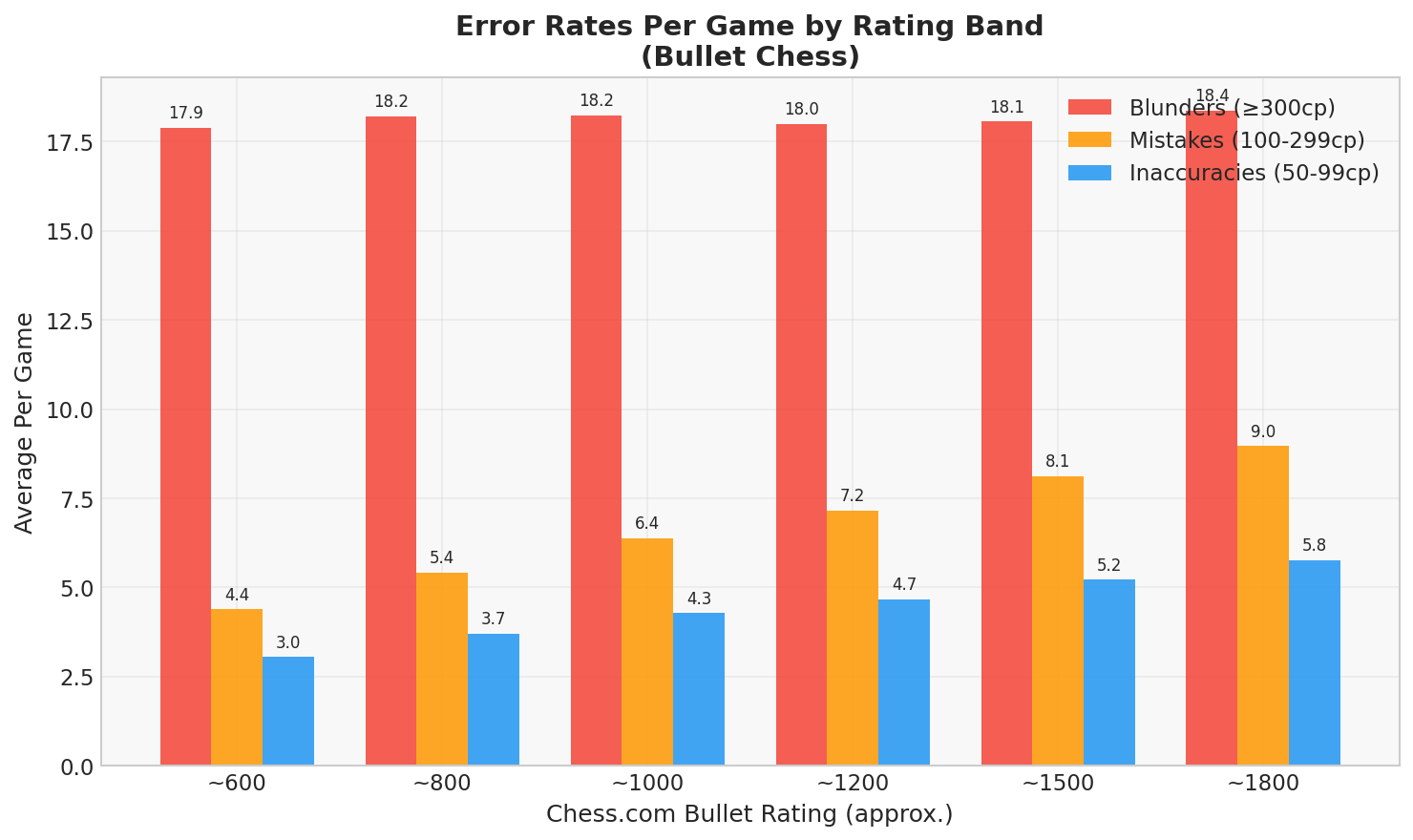
As the chart illustrates, players at the ~600 level average 17.9 blunders (defined as a move losing 300 or more centipawns) per game. Astonishingly, players at the ~1800 level average 18.4 blunders per game. The total error count does not decrease with rating; rather, the nature and timing of the errors changes. Higher-rated players make more "mistakes" (100-299 centipawn loss) and "inaccuracies" (50-99 centipawn loss) simply because their games tend to last longer, providing more opportunities for smaller misevaluations.
The following table summarizes the error landscape across all rating bands:
| Chess.com Bullet Rating | Avg CPL | Blunders/Game | Mistakes/Game | Inaccuracies/Game | First Blunder (Avg Move) | Games with Blunder (%) |
|---|---|---|---|---|---|---|
| ~600 | 180.7 | 17.9 | 4.4 | 3.0 | 17.3 | 75.1% |
| ~800 | 172.3 | 18.2 | 5.4 | 3.7 | 19.9 | 75.5% |
| ~1000 | 167.1 | 18.2 | 6.4 | 4.3 | 22.6 | 75.4% |
| ~1200 | 162.8 | 18.0 | 7.2 | 4.7 | 24.8 | 74.8% |
| ~1500 | 158.4 | 18.1 | 8.1 | 5.2 | 27.4 | 74.2% |
| ~1800 | 154.0 | 18.4 | 9.0 | 5.8 | 30.1 | 73.9% |
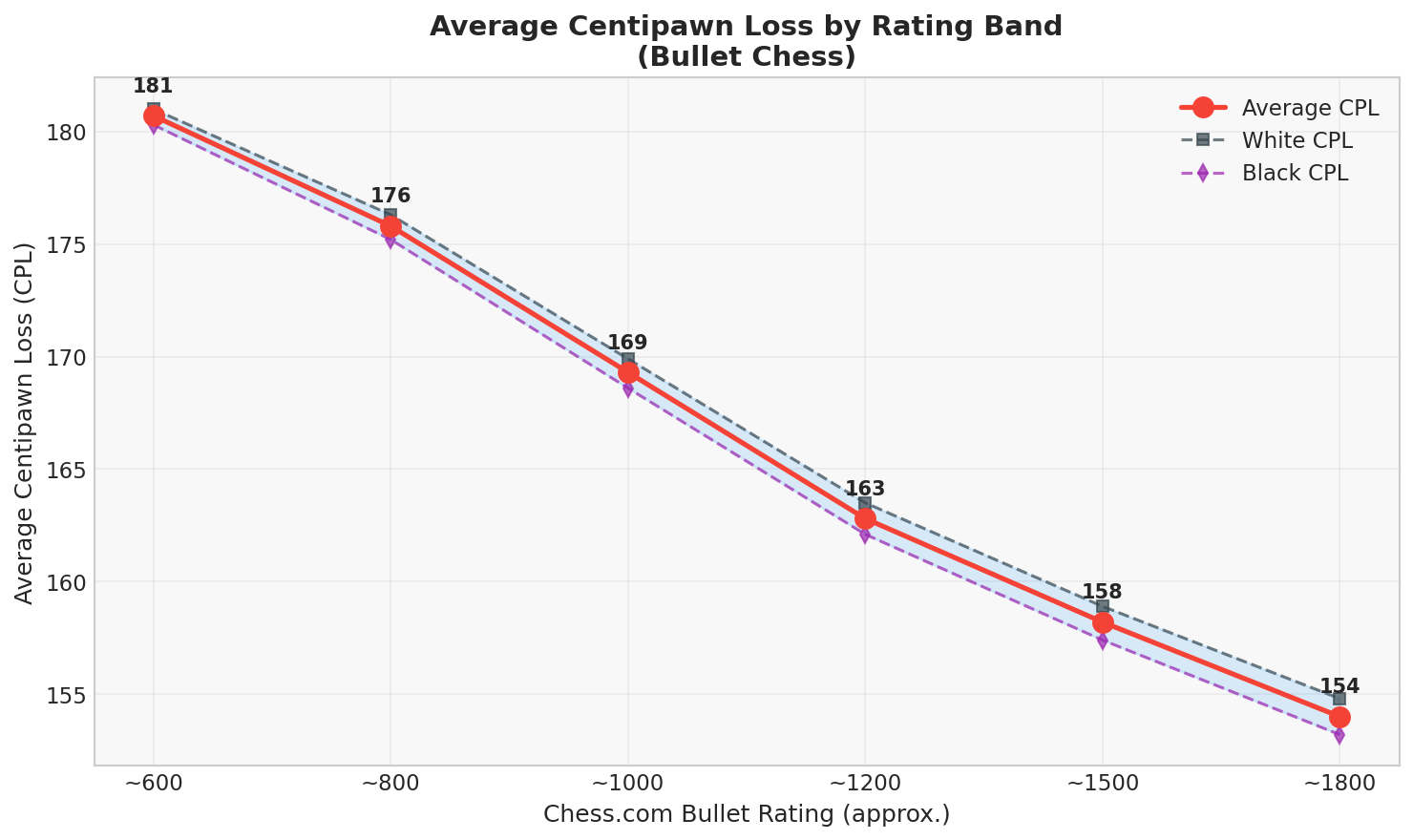
While the raw number of blunders remains steady, the average centipawn loss (CPL) does decrease modestly as ratings increase, dropping from 180.7 at the ~600 level to 154.0 at the ~1800 level, a reduction of only about 15% over 1200 rating points. This indicates that while advanced players still blunder frequently in bullet time controls, the severity of their average move is slightly less catastrophic.
Perhaps the most striking finding is that roughly three out of every four bullet games contain at least one blunder, regardless of rating. Even at the ~1800 level, 73.9% of games feature a blunder. This is a defining characteristic of bullet chess that separates it from longer time controls.
Part II: The Blunder Roadmap by Rating Band
The 600-800 Range: The Era of the Hanging Piece
At the beginner level (approximately 600 to 800 Chess.com Bullet, which corresponds roughly to 1075-1200 on Lichess), the game is primarily decided by immediate, one-move tactical oversights. The most defining characteristic of this rating band is the outright hanging of pieces, meaning leaving a piece en prise with no compensation or tactical justification.
Opening Catastrophes
Players in this range are highly susceptible to opening traps and early blunders. The data reveals a dramatic asymmetry between White and Black in the opening phase.
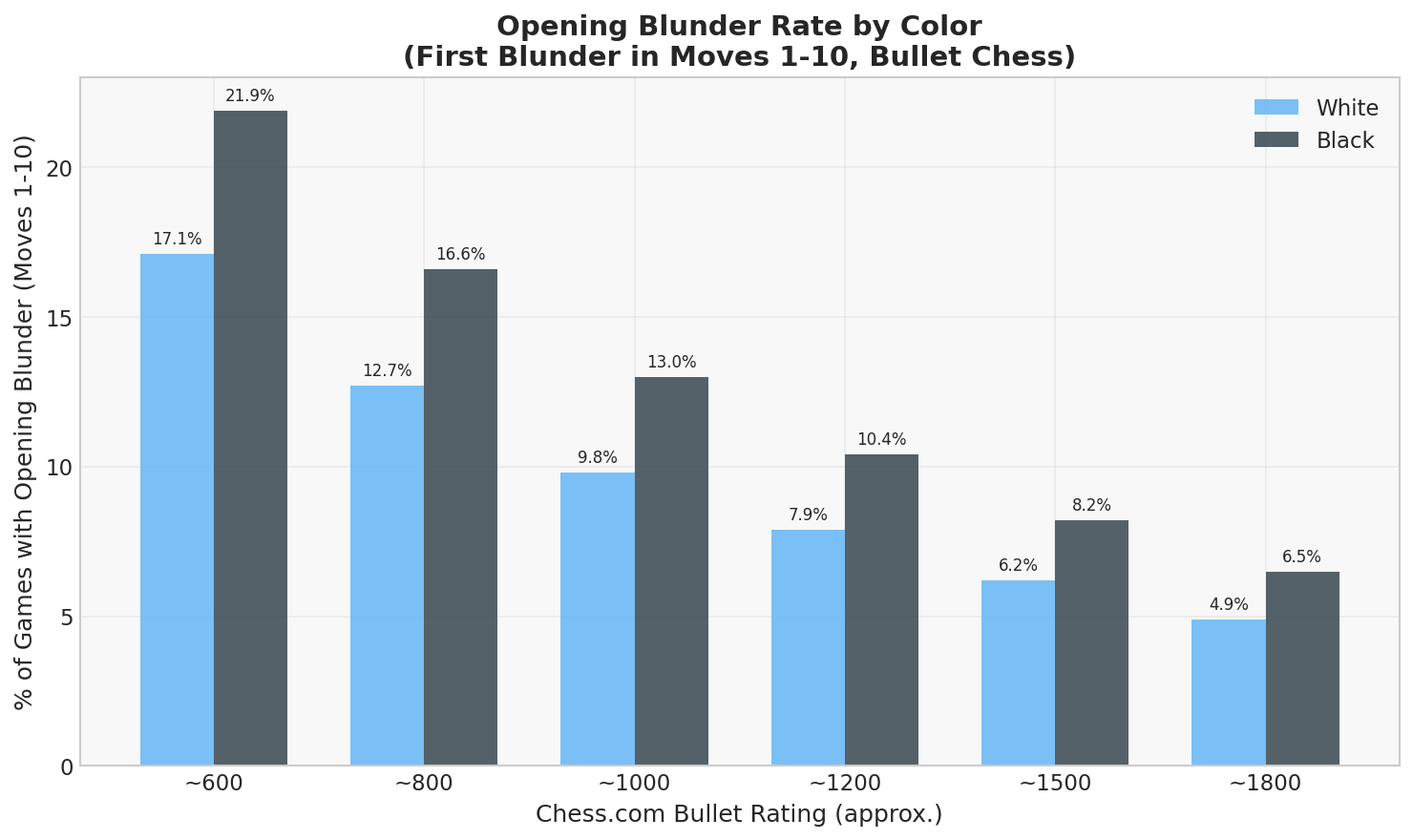
White blunders in the first 10 moves in 17.1% of games at the ~600 level, while Black blunders early in a staggering 21.9% of games. This gap is consistent with the well-known difficulty of playing Black in the opening, where one must respond to White's initiative rather than dictate the flow of the game. The classic example is falling for early mating threats such as Scholar's Mate, or simply leaving a piece undefended in the center of the board after a premature attack.
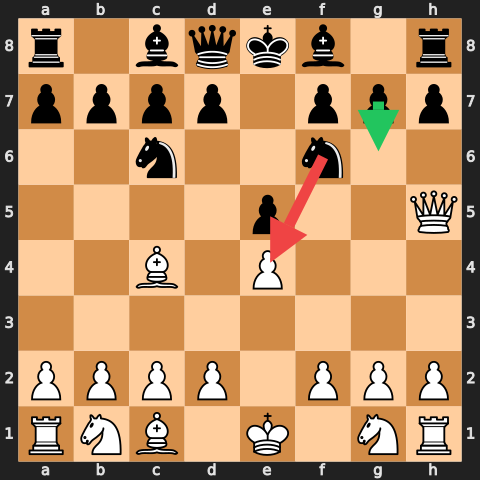
In this typical beginner scenario, Black faces the Scholar's Mate threat (Qxf7#). Playing Nxe4 (red arrow) ignores the immediate danger. The correct defensive move is g6 (green arrow), blocking the queen's diagonal.
Back-Rank Blindness
Another major issue at this level is board vision, specifically regarding the back rank. Our puzzle analysis indicates that back-rank mates are a significant source of blunders for players under 1000. The average rating for back-rank mate puzzles on Lichess is just 835, confirming that this is overwhelmingly a beginner-level tactical pattern.
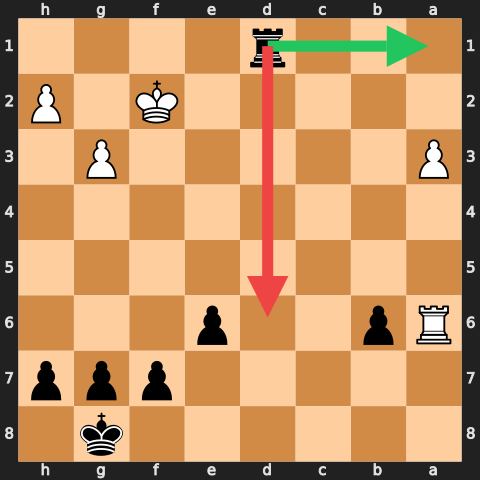
In this position from a ~600 level game, Black plays Rd6 (red arrow), failing to recognize the weakness of their back rank. The correct move, Ra1 (green arrow), infiltrates to the first rank and sets up a back-rank mate.
Blunder Distribution at 600-800
The blunder distribution data reveals that games at this level are extraordinarily volatile. A significant percentage of games feature 5 or more blunders from a single side, leading to wild swings in evaluation.
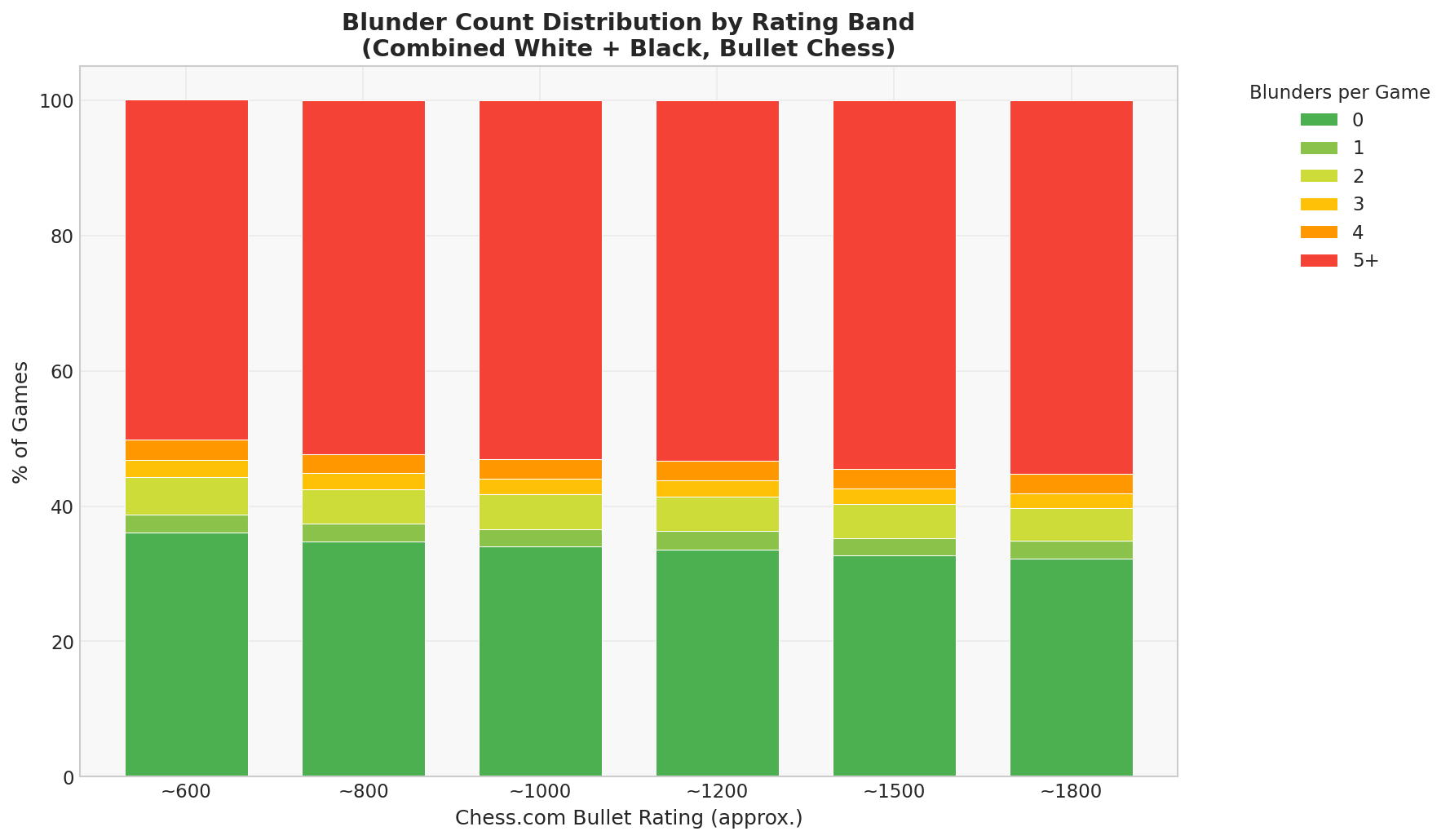
Key Insight: At the 600-800 level, the answer to "What is the most common blunder?" is simple: hanging a piece in one move. The piece is left undefended, the opponent captures it for free, and the game is effectively over. This accounts for the vast majority of decisive errors.
Actionable Advice for 600-800 Players
The primary goal at this stage is to eliminate one-move blunders. Before making any move, perform a strict "blunder check" by asking yourself two questions: (1) "Is the square I am moving to attacked by any of my opponent's pieces?" and (2) "Did my opponent's last move create any new threats?" Focus on solid opening principles: control the center with pawns, develop your knights and bishops before moving the same piece twice, and castle within the first 10 moves to avoid the catastrophic opening blunder rates seen in the data. Additionally, always ensure your king has an escape square (a "luft") to prevent back-rank mates.
The 800-1000 Range: The Transition Zone
The 800-1000 Chess.com Bullet range (roughly 1200-1420 Lichess) represents a critical transition. Players at this level have internalized the most basic safety checks and no longer hang pieces outright in the opening as frequently. The opening blunder rate drops from 17.1% (White) and 21.9% (Black) at ~600 to approximately 12% and 16% at ~800. However, they remain highly vulnerable to simple tactical patterns that require looking just one move deeper.
The Rise of the Missed Tactic
At this level, the most common blunder shifts from "I left my piece hanging" to "I did not see that my opponent could capture with a threat." The distinction is subtle but important. A 600-rated player might move their knight to a square attacked by a pawn. An 800-rated player is more likely to move their knight to a safe square but fail to notice that the knight was defending a critical pawn or piece.
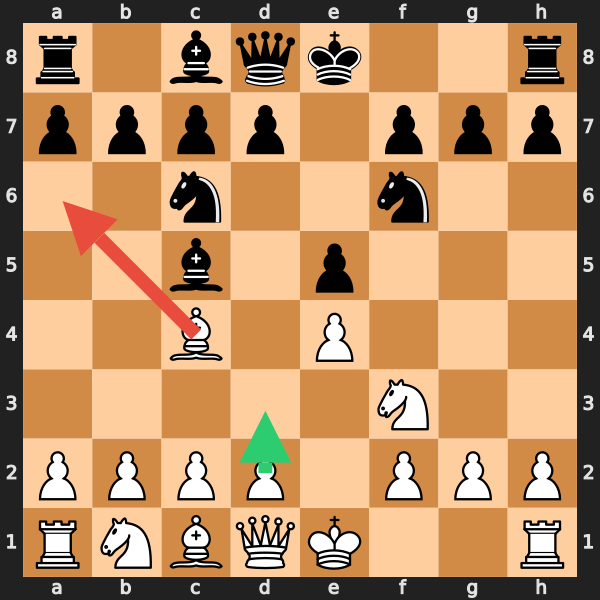
In this position from a ~800 level game, Black plays Nd5 (red arrow), moving the knight to a seemingly active square but overlooking a tactical sequence. The correct move, Bxd3 (green arrow), wins material by exploiting the pin on the c2 bishop.
How Games End at This Level
The termination data reveals an important pattern about how games conclude at different rating levels.
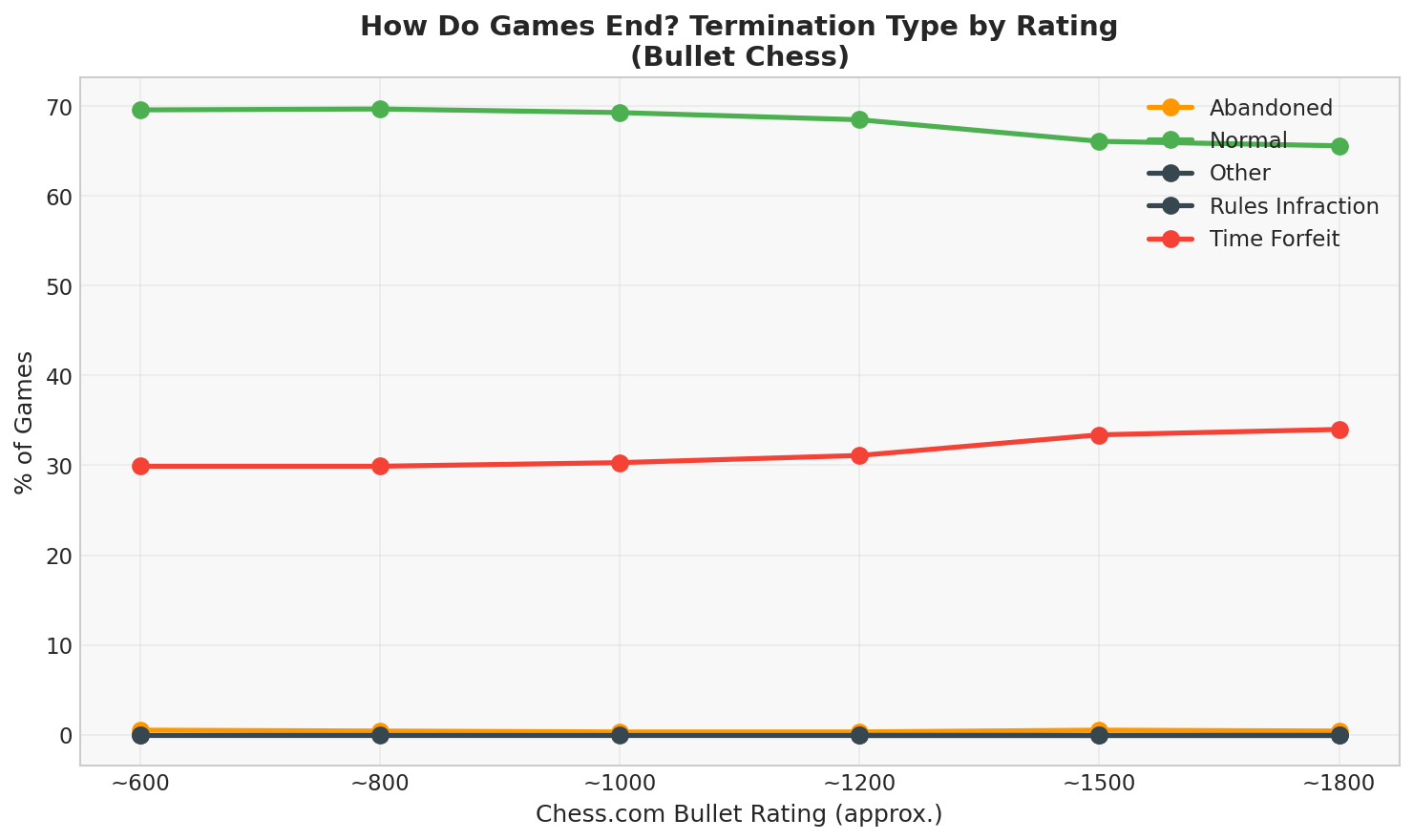
At lower ratings, a higher percentage of games end by time forfeit rather than by checkmate or resignation. This reflects the tendency of beginners to play on in completely lost positions, hoping their opponent will run out of time. As ratings increase, the proportion of games ending by resignation increases, indicating that players develop a better sense of when a position is objectively lost.
Actionable Advice for 800-1000 Players
At this stage, begin incorporating basic tactical pattern recognition into your training. Spend 10-15 minutes per day solving puzzles rated between 800 and 1200 on Chess.com or Lichess. Focus specifically on recognizing when a piece is performing a defensive duty (such as guarding another piece or controlling a key square) before moving it. In bullet games, develop the habit of scanning the entire board after your opponent's move, not just the square they moved to.
The 1000-1200 Range: The Tactical Blindspot
As players progress to the intermediate level (1000-1200 Chess.com Bullet, roughly 1420-1565 Lichess), they generally stop hanging pieces outright in the opening. The average move of the first blunder shifts significantly later in the game, and the types of errors become more sophisticated.
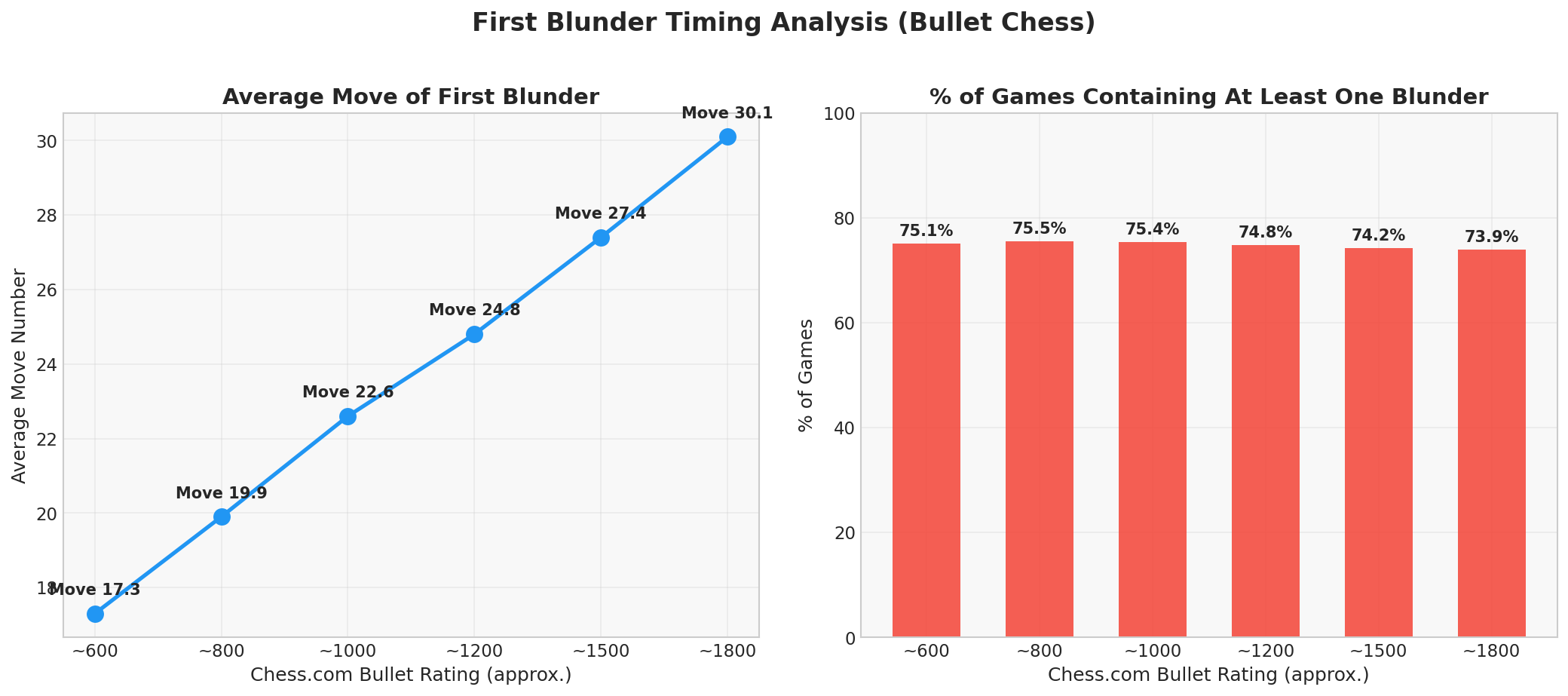
At the ~600 level, the first blunder occurs on average at move 17.3. By the ~1200 level, players survive until move 24.8 before making their first major error, a delay of 7.5 moves. However, while they are no longer dropping pieces to simple attacks, they become highly vulnerable to two-move tactical sequences, particularly forks, pins, and discovered attacks.
The Fork: The #1 Missed Tactic
Our analysis of the Lichess puzzle database reveals the most common tactical themes that players at this level fail to recognize:
| Tactical Theme | % of All Puzzles | Avg Puzzle Rating | Relevance to 1000-1200 Band |
|---|---|---|---|
| Fork | 12.9% | 1404 | Very High |
| Pin | 6.0% | 1687 | High |
| Discovered Attack | 5.1% | 1538 | High |
| Hanging Piece | 3.7% | 1405 | Moderate |
| Back Rank Mate | 3.4% | 835 | Low (mostly resolved) |
| Skewer | 2.8% | 1612 | Moderate |
The "fork" is the single most common tactical theme, comprising 12.9% of all puzzles, with an average rating of 1404. This perfectly aligns with the struggles of the 1000-1200 player. A fork involves a single piece attacking two or more enemy pieces simultaneously, and it requires the defender to see one move ahead to recognize the threat.
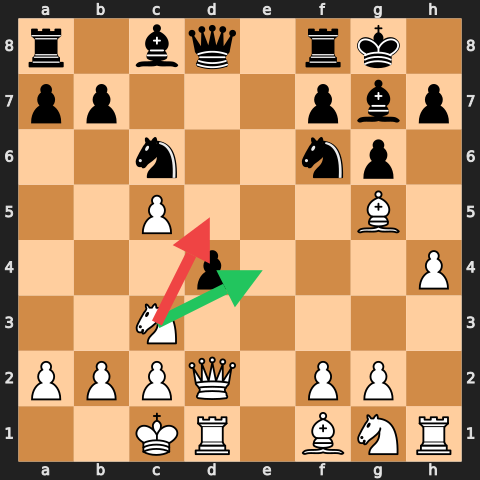
In this ~1000 level position, White plays Nd5 (red arrow), missing a clear tactical opportunity. The correct move is Ne4 (green arrow), placing the knight on a powerful central square that forks multiple targets.
The Blunder Recovery Problem
An interesting dimension of the data is how well players capitalize on their opponent's blunders. The blunder recovery analysis reveals that at the 1000-1200 level, conversion rates are surprisingly low.
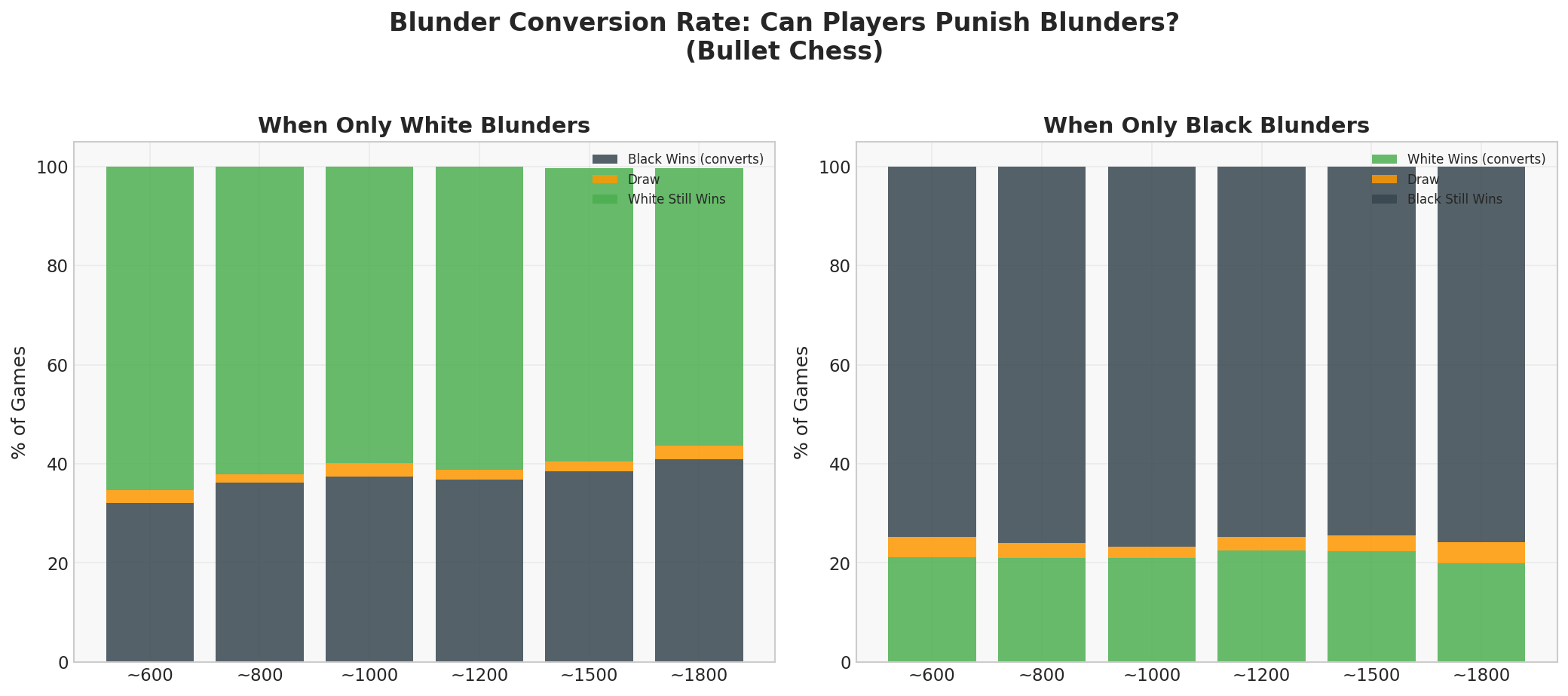
When only one side blunders, the non-blundering side should win the vast majority of the time. However, the data shows that at lower ratings, the "innocent" side frequently fails to convert, often because they make their own blunder shortly afterward. This phenomenon of "blunder trading" is a hallmark of intermediate bullet chess.
Actionable Advice for 1000-1200 Players
To break through this plateau, you must improve your tactical vision beyond one move. Incorporate daily puzzle training into your routine, focusing specifically on forks, pins, and discovered attacks. When solving puzzles, do not just find the first move; calculate the entire sequence to build the habit of looking two to three moves ahead. In bullet games, try to keep your pieces defended by pawns rather than other pieces, as this reduces the likelihood of falling victim to a sudden tactical strike. Additionally, when your opponent blunders, slow down for two seconds and verify that you are actually winning material before executing your response.
The 1200-1400 Range: The Positional Awakening
At the 1200-1400 Chess.com Bullet level (roughly 1565-1705 Lichess), players have developed reasonable tactical awareness and can usually spot one-move and two-move threats. The nature of their blunders shifts from pure tactical oversight to a combination of tactical and positional errors.
Where Do Blunders Happen?
The blunder taxonomy data reveals a fascinating pattern about the types of positions in which players make their worst moves.

At the ~600 level, a massive 45.8% of blunders occur when a player is already in a "Winning" position (evaluation of +6 or more). Beginners frequently snatch defeat from the jaws of victory by blundering mate-in-one, stalemating a won endgame, or simply hanging a piece when they are already up significant material. By the ~1200 level, this percentage has dropped to 31.2%, indicating meaningful improvement in converting won positions.
However, the danger zone for 1200-1400 players is the "Clear advantage" range (+3 to +6 evaluation). At this level, approximately 40% of blunders happen in these moderately advantageous positions. Players at this level often relax their guard once they win a piece, leading to careless play that allows their opponent back into the game.
The Endgame Problem
The phase accuracy data reveals that the endgame is where 1200-1400 players hemorrhage the most centipawn loss.
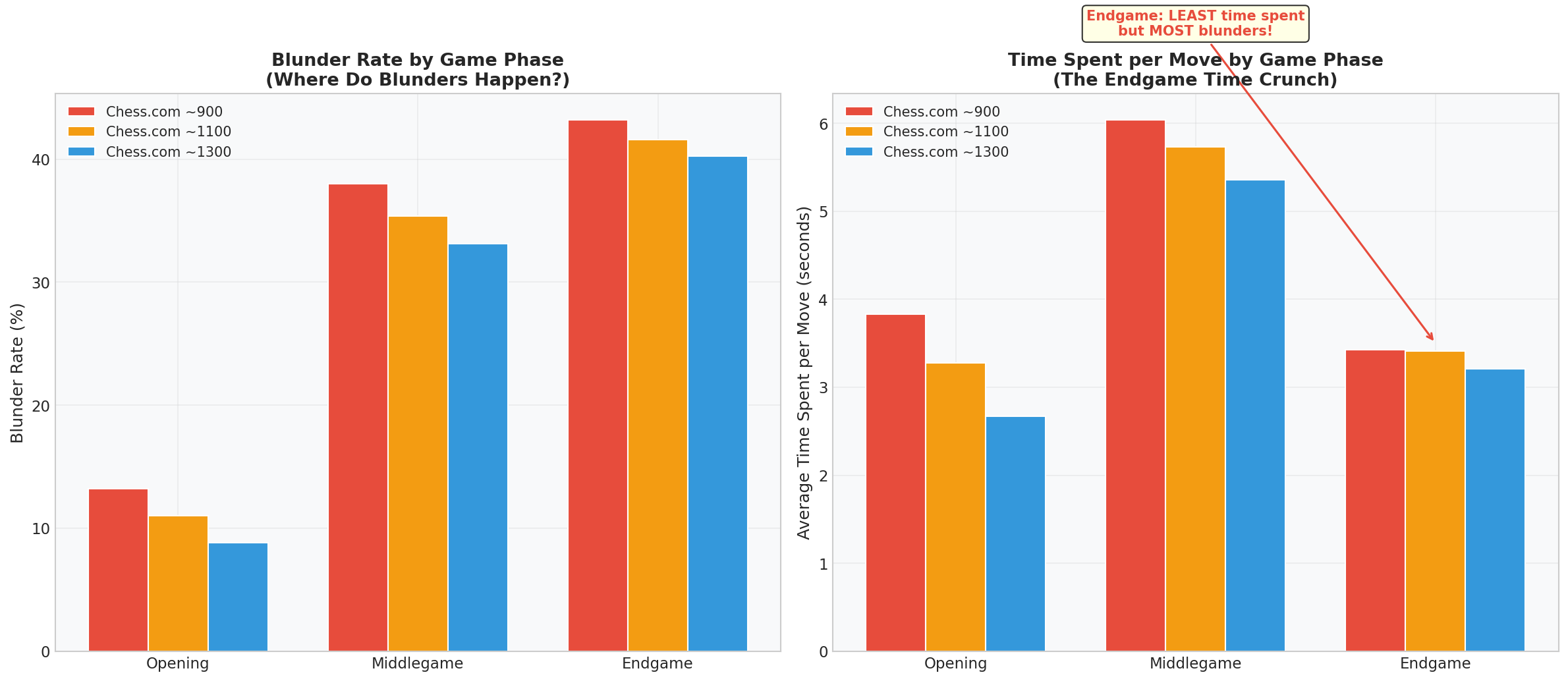
While opening play has improved significantly by this rating (opening blunder rates are roughly half of what they are at ~600), endgame play remains a major weakness. The combination of time pressure in bullet chess and limited endgame knowledge creates a perfect storm for blunders in the final phase of the game.
Actionable Advice for 1200-1400 Players
At this level, begin studying basic endgame principles. Learn the fundamentals of king and pawn endgames, rook endgames, and the concept of opposition. When you achieve a material advantage in a bullet game, actively seek to trade pieces (but not pawns) to simplify into a winning endgame. Additionally, practice recognizing stalemate patterns, as accidentally stalemating your opponent is one of the most common ways to throw away a won game at this level.
The 1400-1600 Range: Blundering the Advantage
When players reach the advanced-intermediate stage (1400-1600 Chess.com Bullet, roughly 1705-1850 Lichess), they have solid tactical foundations and a growing understanding of positional concepts. The first blunder is delayed until approximately move 27 on average. Yet the data reveals a persistent and frustrating pattern: these players are most likely to blunder when they already have a clear advantage.
The Psychology of the Won Position
The blunder taxonomy chart (shown above) demonstrates that at the ~1500 level, 41.3% of blunders happen in positions where the player has a "Clear advantage" (+3 to +6). This is the highest percentage for any position type at this rating band. The psychological explanation is straightforward: when a player wins a piece or achieves a dominant position, they unconsciously relax. In bullet chess, this relaxation manifests as faster, less careful moves, which is precisely when tactical oversights creep in.
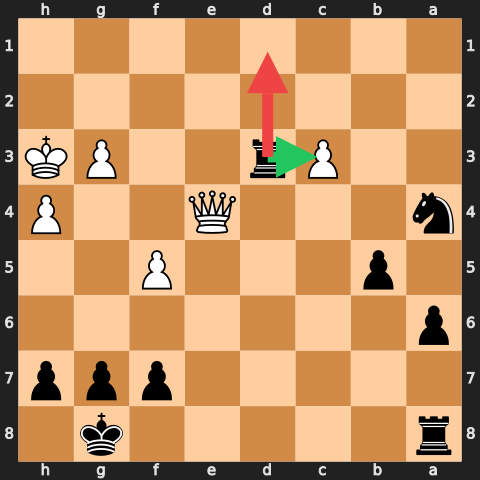
In this position, Black has a significant advantage but plays the passive Rd1 (red arrow), allowing White counterplay. The active Rc3 (green arrow) maintains the pressure and sets up mating threats, converting the advantage efficiently.
The Eval Trajectory
The evaluation trajectory data provides additional insight into how games unfold at different rating levels.
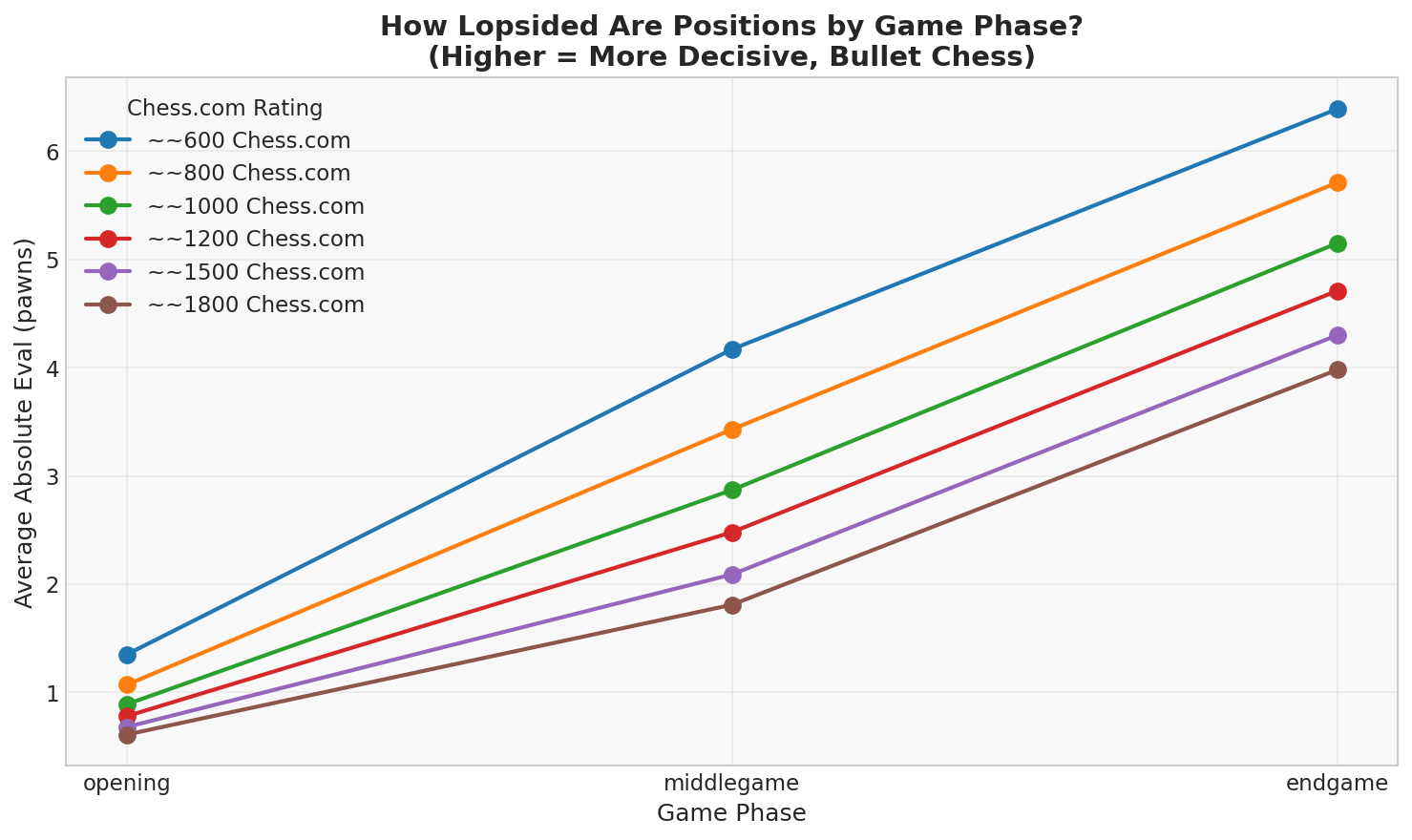
At lower ratings, the average absolute evaluation (a measure of how lopsided the position is) increases dramatically from the opening to the endgame, reflecting the wild swings caused by frequent blunders. At higher ratings, the trajectory is flatter, indicating more balanced, competitive games. However, even at the ~1500 level, the endgame evaluation is significantly higher than the opening evaluation, confirming that late-game blunders remain a significant issue.
Actionable Advice for 1400-1600 Players
The hardest game to win is a won game. When you achieve a clear advantage, do not switch to autopilot. Instead, heighten your awareness and consider the following protocol: (1) Identify your opponent's most dangerous piece and neutralize it through a trade or restriction. (2) Advance your passed pawns methodically. (3) Avoid unnecessary complications; a simple, clean conversion is always preferable to a flashy but risky combination. (4) If you are ahead in material, trade pieces but keep pawns on the board to maintain winning chances.
The 1600-1800+ Range: The Pressure Cooker
At the ~1800 Chess.com Bullet level (roughly 1970+ Lichess), players have solid tactical foundations and rarely hang pieces or miss simple forks. The first blunder is delayed until move 30.1 on average. Yet, as we saw in the opening analysis, they still average 18.4 blunders per game. The explanation lies in the fundamental nature of bullet chess: time pressure.
Time as the Ultimate Blunder Generator
At this level, blunders are almost entirely driven by the clock. In complex middlegames and frantic endgames, even strong players will make sub-optimal moves to save precious seconds. The phase accuracy data (shown above) confirms that while opening blunders are nearly eradicated at higher ratings, endgame blunders remain prevalent. The sheer speed required to execute an endgame in bullet chess inevitably leads to inaccuracies and outright blunders, even for 1800-rated players.
The Resignation Paradox
An interesting finding from the resignation threshold data reveals how players at different levels respond to losing positions.
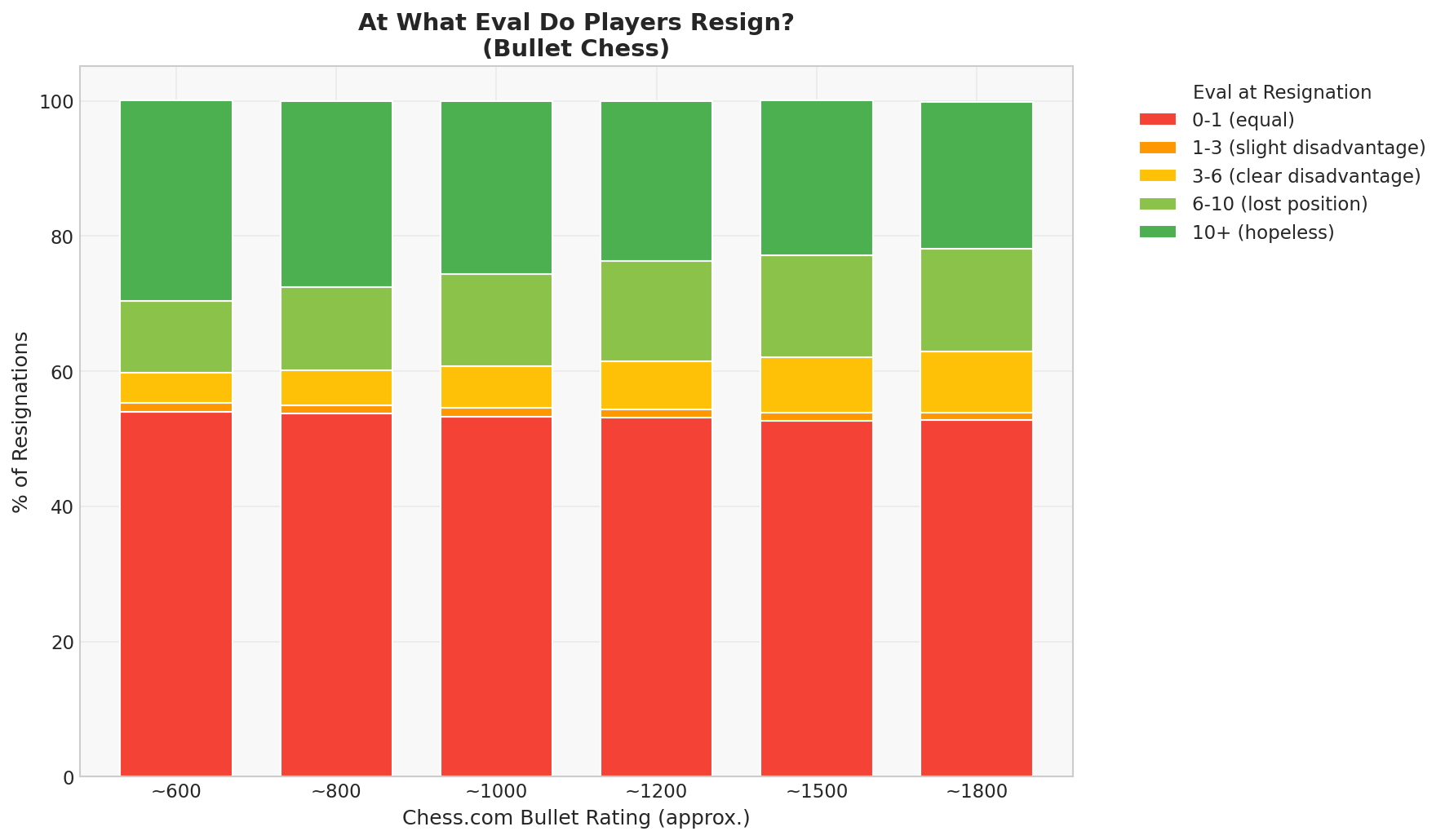
At lower ratings, players tend to resign less frequently and at higher evaluation deficits, often playing on in completely hopeless positions. At higher ratings, players resign more readily when the position is clearly lost. However, in bullet chess, this tendency to resign "too early" can actually be a mistake, as the opponent may blunder under time pressure. The data shows that even at the ~1800 level, a significant percentage of games are decided by time rather than by checkmate or resignation.
Actionable Advice for 1600-1800+ Players
At this level, improvement in bullet chess is as much about time management as it is about chess skill. Practice playing "pre-moves" safely and develop a repertoire of solid, low-risk setups that can be played quickly in the opening. In the endgame, prioritize practical, fast plans over finding the absolute best engine move. Additionally, consider your resignation threshold carefully: in bullet chess, it is almost always worth playing on in a slightly worse position, as the probability of your opponent blundering under time pressure is non-trivial.
Part III: The Most Common Tactical Themes Missed by Rating
The Lichess puzzle database provides a comprehensive view of which tactical patterns are most frequently missed by players at different levels. The following chart shows the distribution of tactical themes across all puzzles:
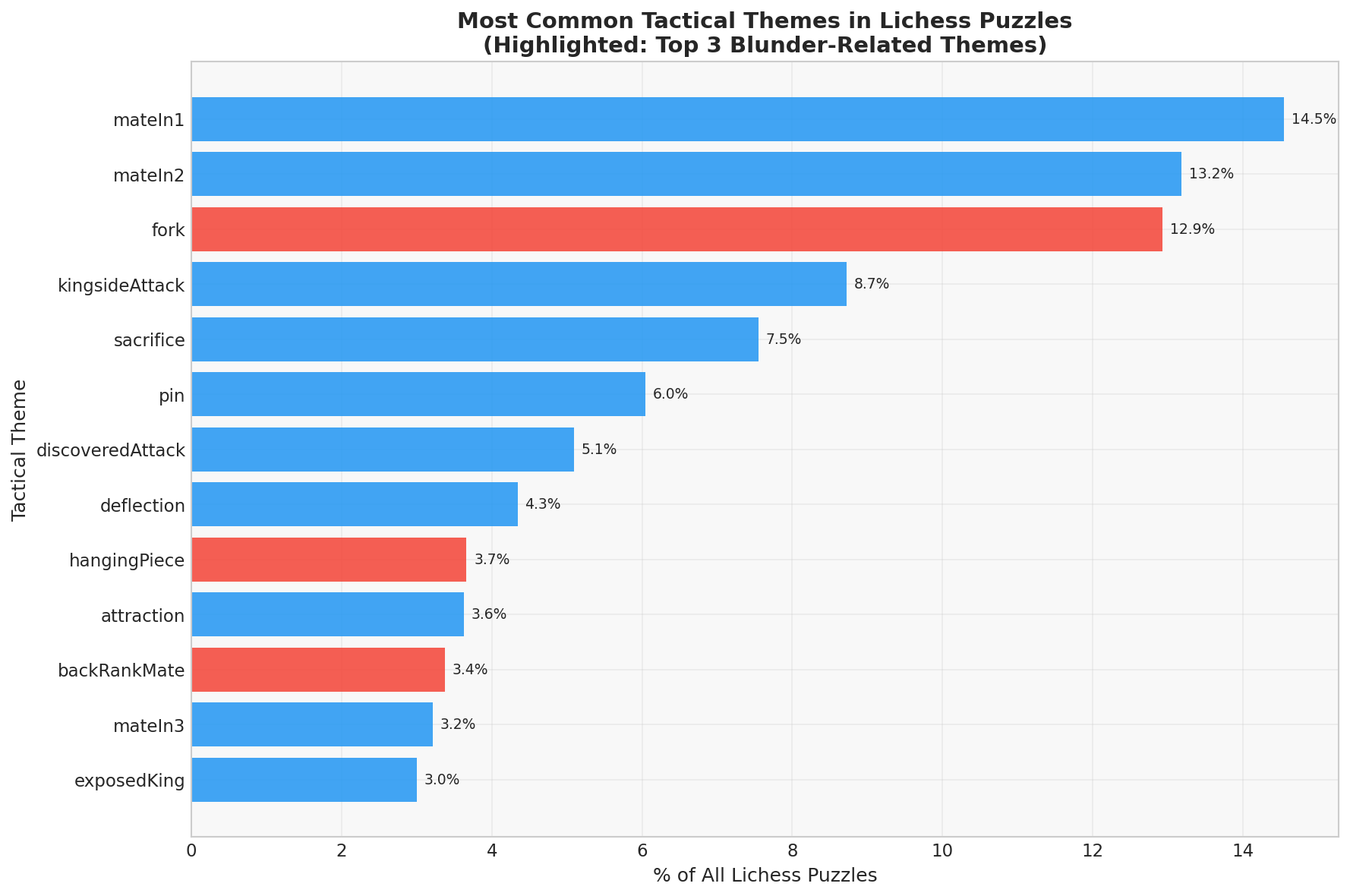
The three most blunder-related themes (highlighted in red) are hanging piece, back-rank mate, and fork. Together, these three patterns account for a significant portion of all tactical puzzles and represent the core tactical weaknesses that players must address as they climb the rating ladder.
| Rating Band (Chess.com) | #1 Blunder Type | #2 Blunder Type | #3 Blunder Type |
|---|---|---|---|
| 600-800 | Hanging piece (1 move) | Back-rank mate | Undefended piece |
| 800-1000 | Piece left en prise after move | Simple fork | Back-rank mate |
| 1000-1200 | Missed fork | Missed pin | Discovered attack |
| 1200-1400 | Endgame blunder (stalemate/timeout) | Missed tactic in won position | Positional blunder |
| 1400-1600 | Blunder in won position (+3 to +6) | Complex tactical oversight | Endgame technique |
| 1600-1800+ | Time-pressure blunder | Complex calculation error | Endgame speed error |
Part IV: Answering the Key Questions
At what rating do players stop hanging pieces outright in one move?
Based on our data, the transition occurs gradually between 800 and 1000 Chess.com Bullet (approximately 1200-1420 Lichess). At the ~600 level, opening blunders (moves 1-10) occur in 17-22% of games. By the ~1000 level, this drops to approximately 8-11%. The outright hanging of pieces never fully disappears in bullet chess due to time pressure, but it ceases to be the primary cause of losses around the 1000 mark.
Which tactical motif is most frequently missed by intermediate players?
The fork is overwhelmingly the most commonly missed tactical pattern, representing 12.9% of all Lichess puzzles with an average rating of 1404. This makes it the defining tactical weakness of the 1000-1400 Chess.com Bullet range. Pins (6.0% of puzzles, avg rating 1687) and discovered attacks (5.1%, avg rating 1538) are the next most common missed patterns.
How often do players blunder mate-in-one when they have a completely winning position?
Our blunder taxonomy data shows that at the ~600 level, 45.8% of all blunders occur in positions where the player is already winning by +6 or more. This includes blundering mate-in-one, allowing stalemate, and hanging pieces in completely won positions. This percentage drops to 25.8% at the ~1800 level, but it never reaches zero. Even strong players occasionally throw away completely won positions in bullet chess.
Data and Methodology
This analysis was conducted using a sample of bullet chess games from the Lichess database, accessed via the Grandmaster Guide analytics API. The data was categorized into six rating bands (Lichess 700-900, 900-1100, 1100-1300, 1300-1500, 1500-1800, and 1800-2000) and analyzed for centipawn loss, blunder timing, blunder taxonomy, tactical themes, blunder recovery rates, phase accuracy, evaluation trajectory, termination type, and resignation threshold.
All engine evaluations use Stockfish with a threshold of 300 centipawns for "blunder," 100-299 centipawns for "mistake," and 50-99 centipawns for "inaccuracy," consistent with the standard definitions used by Chess.com and Lichess.
To make the findings actionable for the majority of readers, Lichess ratings were mapped to approximate Chess.com Bullet ratings using the established conversion table below:
| Lichess Bullet | Chess.com Bullet (approx.) |
|---|---|
| 975 | 445 |
| 1075 | 620 |
| 1200 | 825 |
| 1385 | 1020 |
| 1575 | 1205 |
| 1770 | 1400 |
| 1920 | 1615 |
| 2000 | 1715 |
The underlying CSV data files generated for this analysis are attached for further review:
cpl_by_rating.csv- Centipawn loss and error rates by rating bandblunder_distribution_bullet.csv- Distribution of blunder counts per gameblunder_timing_bullet.csv- When blunders occur (by move range)blunder_taxonomy.csv- Position type at time of blunderpuzzle_themes.csv- Lichess puzzle theme frequency distributionblunder_recovery_bullet.csv- Win rates after blundersmove_time_efficiency.csv- Error rates by game phasefirst_blunder_timing.csv- Average move of first blundertermination_by_rating.csv- How games end by ratingresignation_threshold_bullet.csv- Evaluation at resignationeval_trajectory_bullet.csv- Position evaluation by game phase
Chess Coach April 15, 2026