In chess, we are often taught the value of material: a queen is worth nine points, a rook five, and a pawn one. However, material alone does not win games; the ability to use that material effectively does. This concept is known as piece mobility—the number of legal moves available to a player on any given turn.
A common question among improving players is: Does the player with more legal moves win more often? To answer this, we conducted a rigorous data-driven analysis of over 8,000 Rapid games, focusing on players with Chess.com ratings between 800 and 1500 (calibrated from Lichess Rapid data).
This guide serves as a roadmap for improvement, demonstrating how understanding and prioritizing piece mobility can help you climb through the rating bands.
The Data: Does Mobility Correlate with Winning?
The short answer is a resounding yes. Across all rating bands analyzed, the player who maintained a higher average number of legal moves throughout the game won significantly more often.
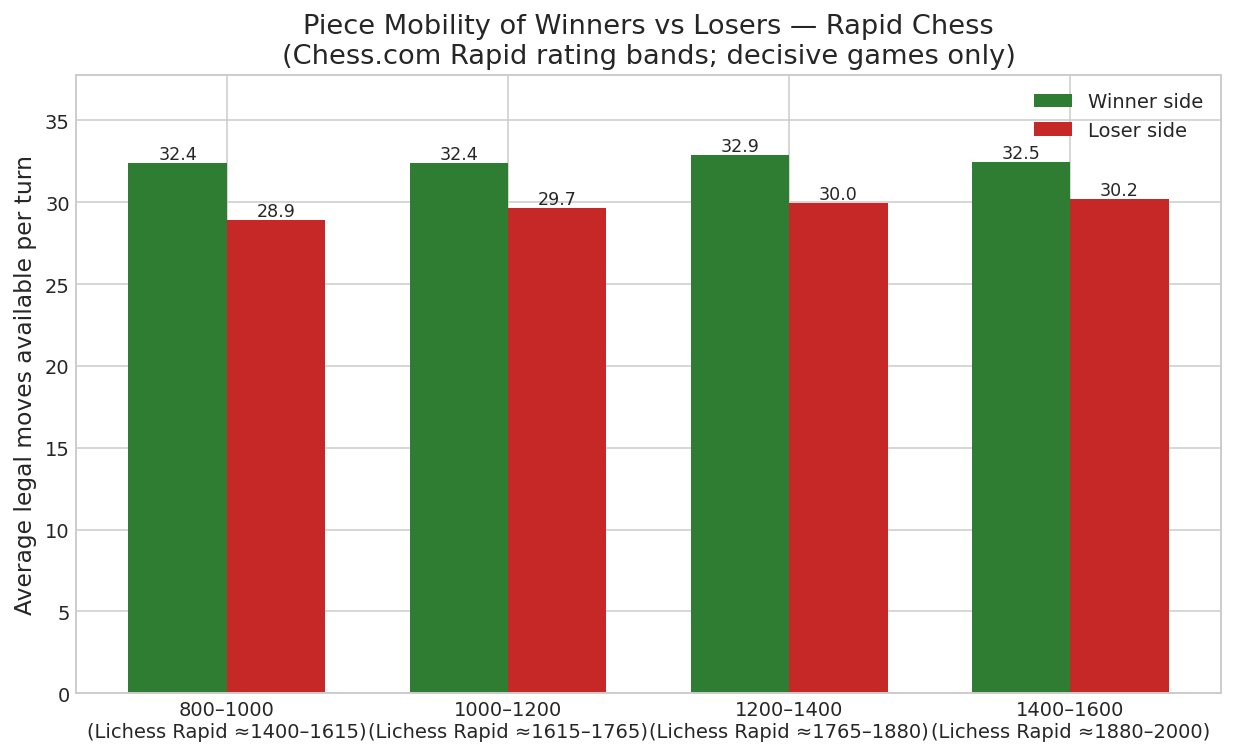
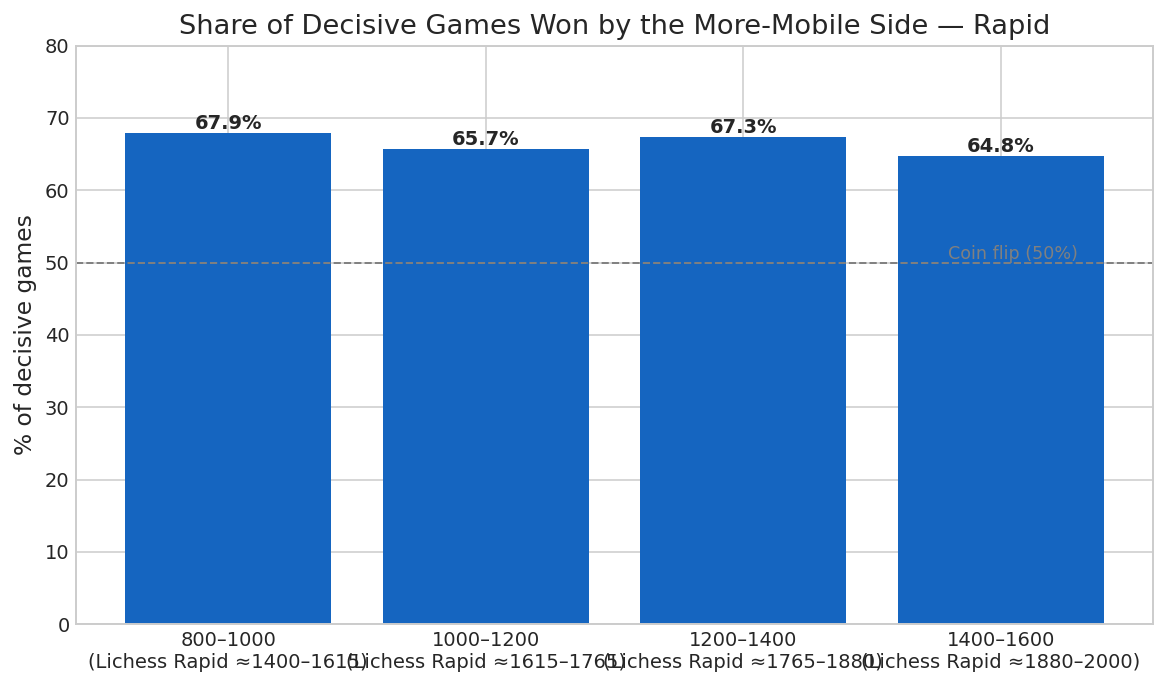
On average, the winning side enjoys an advantage of roughly 2.2 to 3.5 more legal moves per turn than the losing side. While this might seem like a small margin, it compounds over the course of a game. When we look at games where one side had a distinct mobility advantage (an average gap of at least 1 legal move per turn), the more mobile side won approximately 65% to 68% of the time.
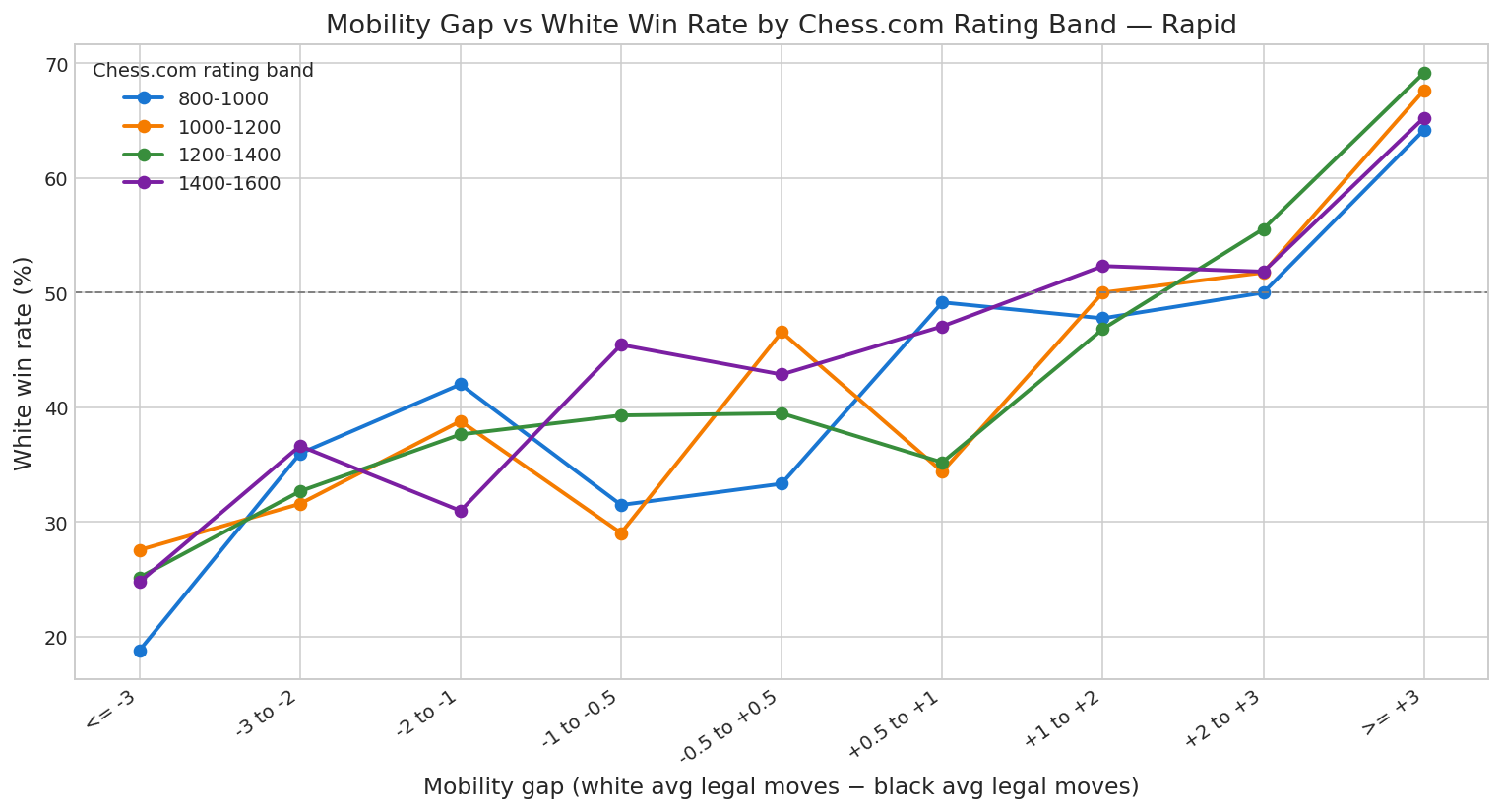
The correlation between the mobility gap and the win rate is stark. As the mobility gap increases in your favor, your expected win rate climbs dramatically. When a player achieves an average advantage of +3 legal moves per turn, their win rate approaches 70%.
The Phase-by-Phase Breakdown
Mobility is not static; it evolves as pieces are developed, exchanged, and maneuvered. Our analysis reveals that the mobility gap between winners and losers is narrowest in the opening and widest in the endgame.
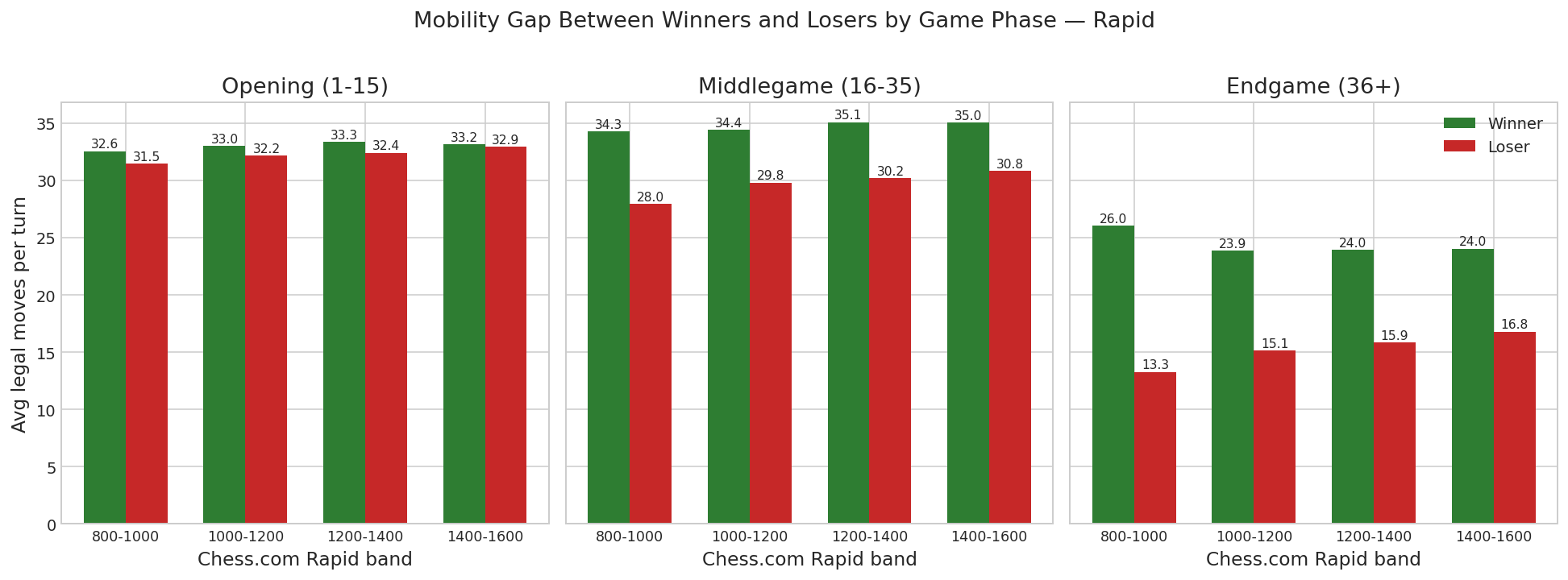
- Opening (Plies 1–15): Both sides are developing, and the mobility gap is minimal (often less than 1 move per turn).
- Middlegame (Plies 16–35): The gap widens significantly to 4–6 moves per turn. This is where positional mistakes are punished, and one side begins to suffocate the other.
- Endgame (Plies 36+): The gap becomes enormous (7–12 moves per turn). The winning side's remaining pieces dominate the board, while the losing side is paralyzed.
Roadmap to Improvement: Actionable Advice by Rating Band
To help you apply these findings, we have broken down the data into 200-point rating bands. For each band, we provide a visual example of a critical "turning point"—a moment where a player made a move (red arrow) that severely restricted their future mobility, compared to the engine's preferred alternative (green arrow).
800–1000: The Foundation of Activity
At this level (roughly equivalent to Lichess Rapid 1400–1615), games are often decided by basic tactical oversights and a failure to develop pieces to active squares. The mobility gap between winners and losers is the highest here (+3.54 moves per turn), indicating that one side frequently gets completely overrun.
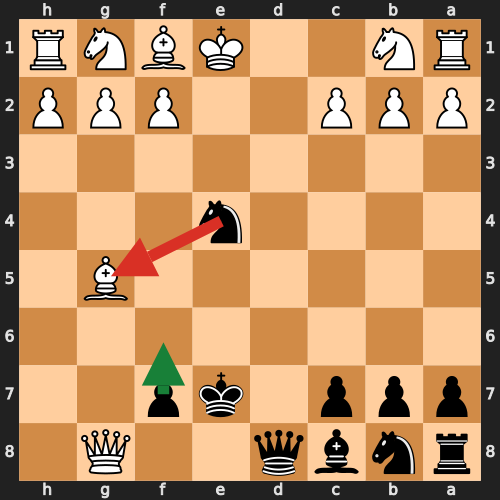 In this King's Pawn Game, Black's queen sortie invites early trouble. The played move (red) allows White to continue developing with tempo, severely restricting Black's options. The engine prefers a more solid developing move (green).
Actionable Advice:
- Develop with Purpose: Do not just move pieces; move them to squares where they control the center and have maximum scope. A knight on f3 has 8 potential moves; a knight on h3 has only 4.
- Avoid Early Queen Sorties: Bringing the queen out too early often allows the opponent to develop their minor pieces while attacking your queen, increasing their mobility while decreasing yours.
1000–1200: Avoiding Suffocation
Players in this band (Lichess Rapid 1615–1765) have a better grasp of basic tactics but often struggle with positional concepts like space and restriction. They may develop their pieces but place them passively, leading to cramped positions.
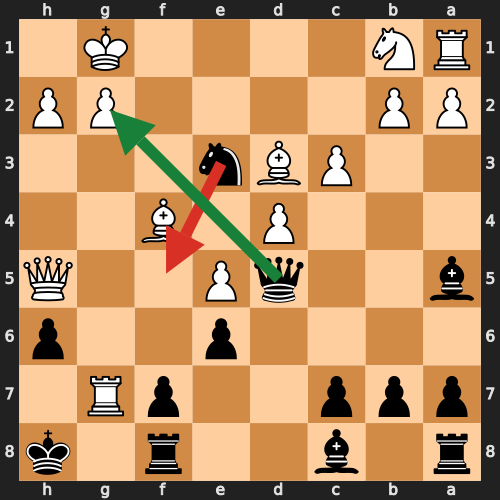 In this Italian Game, Black's passive setup allows White to dictate the pace. The played move (red) walks into a devastating pin and restricts Black's own pieces. The engine suggests a prophylactic move (green) to challenge White's control.
Actionable Advice:
- Fight for Space: Pawns dictate the territorial boundaries of the board. Pushing your central pawns safely gives your pieces more room to maneuver and restricts your opponent's pieces.
- Identify Bad Pieces: Look at your least active piece (often a bishop blocked by its own pawns) and make a plan to improve its position or trade it off.
1200–1400: The Fight for Open Lines
In the 1200–1400 range (Lichess Rapid 1765–1880), players understand development and space, but the battle often revolves around the control of open files and diagonals.
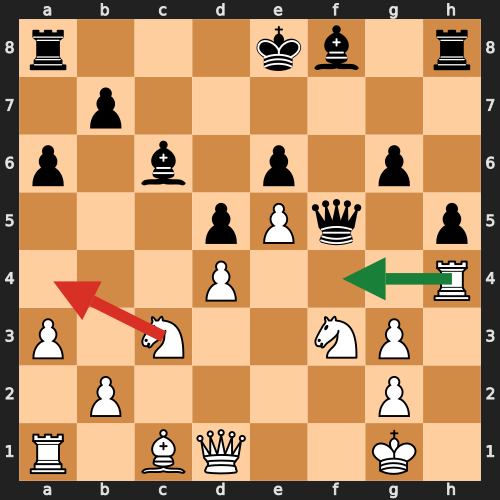 In this Smith-Morra Gambit, Black's king move (red) is a fatal error that walks directly into a discovered attack along the open e-file, instantly paralyzing Black's position. The engine's choice (green) keeps the king safer.
Actionable Advice:
- Seize Open Files: Rooks belong on open files (files with no pawns) or semi-open files. Controlling these avenues allows your major pieces to infiltrate the opponent's position, drastically increasing your mobility.
- Anticipate Discovered Attacks: Always be aware of the geometric alignment of pieces. Do not place your king or queen on the same file or diagonal as an opponent's rook or bishop, even if there are pieces in between.
1400–1600: Prophylaxis and Restriction
As you approach the intermediate-advanced level (Lichess Rapid 1880–2000), games are tighter. The average mobility gap between winners and losers shrinks to +2.25 moves per turn. Winning here requires not just maximizing your own activity, but actively restricting your opponent's.
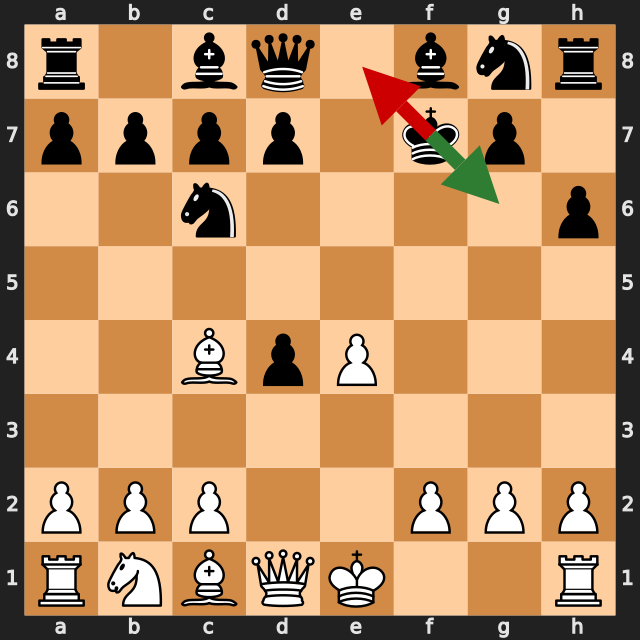 In this Scotch Game, a single careless king move (red) in the opening leaves Black permanently cramped and unable to coordinate. The engine's preferred move (green) maintains flexibility.
Actionable Advice:
- Practice Prophylaxis: Before making your move, ask yourself: What does my opponent want to do? If you can play a useful developing move that also prevents your opponent's active plan, you are winning the mobility war.
- Trade to Restrict: If your opponent has one highly active piece that is causing problems, look for ways to trade it off. Conversely, avoid trading your active pieces for your opponent's passive ones.
Conclusion
Piece mobility is a powerful predictor of success in Rapid chess. By consciously striving to maximize your own options while restricting your opponent's, you shift the statistical probabilities in your favor. Remember: a piece is only as valuable as the squares it controls.
Data and Methodology
Dataset: 8,016 decisive Lichess Rapid games played in March 2025.
Calibration: Lichess ratings were mapped to approximate Chess.com ratings based on established community distributions.
Analysis: Games were parsed using Python (python-chess). For every ply, the number of legal moves was calculated for both sides. The "mobility gap" is defined as the average legal moves per turn of the White player minus the average legal moves per turn of the Black player. Engine evaluations for the visual examples were provided by Stockfish 16.1 at depth 14-18.
Underlying Data Files:
View full data →band games decisive_games draw_rate_pct white_win_pct black_win_pct avg_white_mobility avg_black_mobility avg_winner_mobility avg_loser_mobility mobility_gap_winner_minus_loser avg_plies pct_more_mobile_won pct_more_mobile_lost pct_equal_mob 1000-1200 2004 1861 3.84 49.9 42.96 31.826 29.934 32.428 29.651 2.777 65.0 65.66 33.96 0.38 1200-1400 2009 1886 4.03 49.83 44.05 32.139 30.359 32.867 29.97 2.896 65.8 67.34 32.34 0.32 1400-1600 2002 1878 4.15 49.1 44.71 32.116 30.224 32.473 30.227 2.246 70.0 64.75 35.25 0.0 800-1000 2001 1814 3.6 46.08 44.58 31.374 29.617 32.429 28.89 3.539 59.0 67.86 32.03 0.11
View full data →band mobility_gap_bucket n_games white_win_pct draw_pct black_win_pct 800-1000 <= -3 (black much more) 490 18.78 2.86 73.06 800-1000 -3 to -2 89 35.96 3.37 53.93 800-1000 -2 to -1 100 42.0 3.0 51.0 800-1000 -1 to -0.5 54 31.48 9.26 50.0 800-1000 -0.5 to +0.5 (similar) 90 33.33 2.22 54.44
View full data →band phase winner_avg_mobility loser_avg_mobility gap n_winners_with_phase n_losers_with_phase 800-1000 Opening (1-15) 32.551 31.456 1.095 1814 1814 800-1000 Middlegame (16-35) 34.292 27.96 6.332 1478 1462 800-1000 Endgame (36+) 26.037 13.284 12.754 498 479 1000-1200 Opening (1-15) 33.032 32.181 0.851 1861 1861 1000-1200 Middlegame (16-35) 34.402 29.808 4.595 1617 1594
View full data →band gameId result white_avg_mob black_avg_mob gap eco opening plies whiteElo blackElo timeControl 800-1000 vJBX6Tmd 0-1 12.438 44.031 -31.59 A02 Bird Opening: From's Gambit 64 1500 1377 600+2 800-1000 3Nrrlhp2 1-0 45.857 15.562 30.3 C20 King's Pawn Game: Napoleon Attack 97 1500 1500 600+2 800-1000 HuDocMEQ 0-1 12.816 41.737 -28.92 A00 Barnes Opening 76 1506 1352 600+2 1000-1200 1MkC798G 1-0 39.75 12.444 27.31 C50 Italian Game: Hungarian Defense 127 1674 1658 600+0 1000-1200 Fl5YRTFE 1-0 41.31 17.439 23.87 A40 English Defense 83 1654 1645 600+0
View full data →result plies moves eco opening white_avg_mob black_avg_mob white_mid_mob black_mid_mob white_open_mob black_open_mob white_end_mob black_end_mob band gameId whiteElo blackElo avgRating timeControl 0-1 68 34 A45 Indian Defense 36.0 34.794 33.789 34.789 38.8 34.8 800-1000 4jbJr8rS 1438 1472 1455 600+0 1-0 43 22 B01 Scandinavian Defense: Mieses-Kotroc Variation 32.5 33.571 43.857 28.0 27.2 35.8 800-1000 sq02qo1D 1527 1541 1534 600+0 1-0 73 37 C25 Vienna Game 35.189 28.639 37.35 24.0 33.533 35.667 26.0 16.0 800-1000 dJiYMR0z 1557 1574 1566 600+0 1/2-1/2 130 65 B00 Owen Defense 27.077 27.446 29.35 36.6 35.867 27.867 21.167 21.133 800-1000 8r80yHv5 1588 1549 1569 600+0 1-0 81 41 D00 Queen's Pawn Game 32.463 29.9 29.1 32.6 35.067 32.933 37.167 10.0 800-1000 75TJRTlH 1554 1584 1569 600+0
Chess Coach April 20, 2026