For years, a common piece of advice given to beginner chess players has been to ignore endgame study. The prevailing wisdom suggests that at lower ratings, games are decided by massive blunders in the opening or middlegame, rendering endgame knowledge practically useless. This advice is particularly emphasized in Bullet chess, where the clock is often the ultimate arbiter. But is this assumption actually supported by data?
To answer this question, we analyzed over 280,000 Bullet games played on Lichess, mapping the ratings to their Chess.com equivalents to provide actionable insights for players climbing the ranks from 500 to 1900. The findings challenge several long-held beliefs about how lower-rated games unfold and highlight exactly when endgame study becomes a critical component of improvement.
The Myth of the Non-Existent Endgame
The most fundamental question is whether lower-rated players ever actually reach an endgame. To define an "endgame" objectively, we looked at games that extended beyond 40 moves. The data reveals a stark reality about the frequency of endgames across different skill levels.
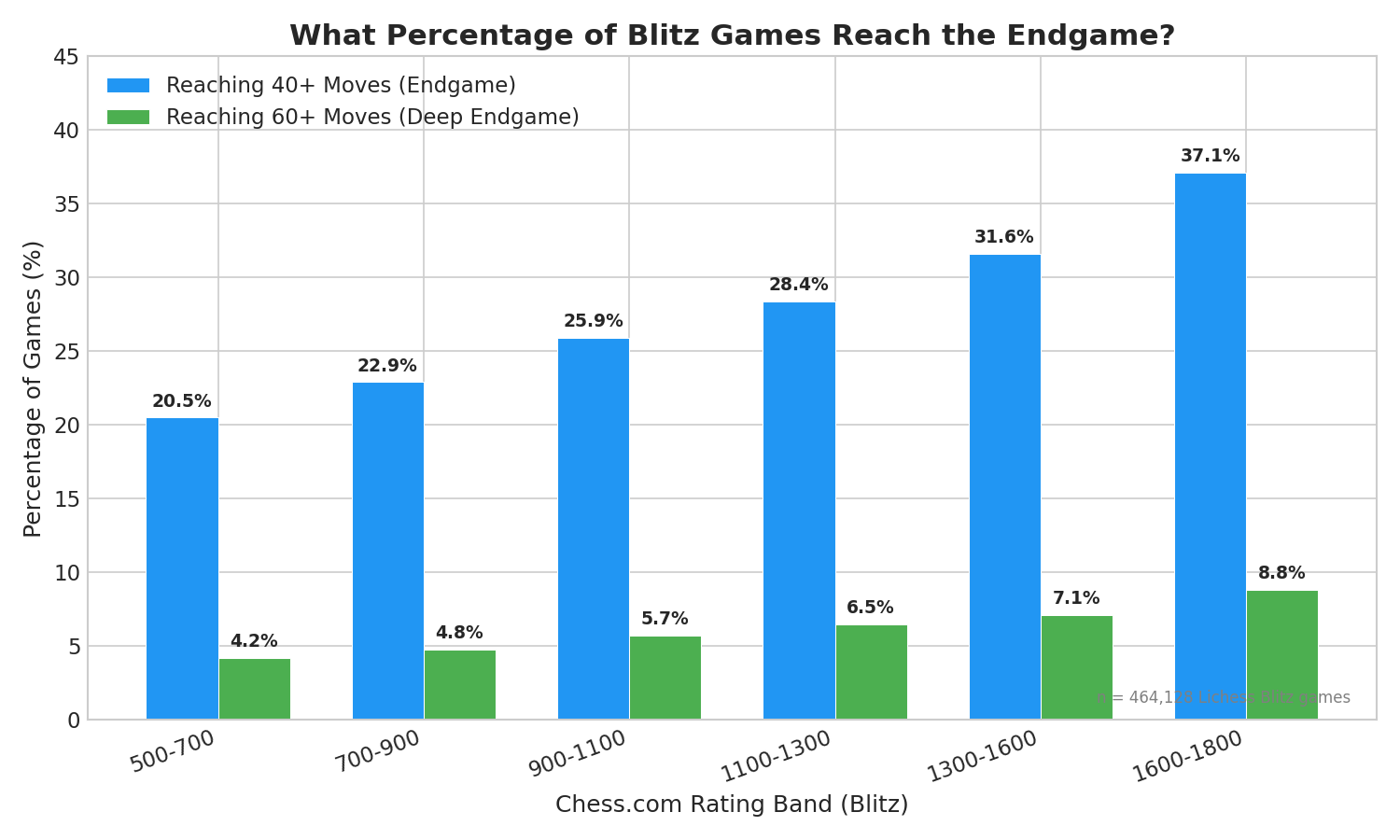
At the lowest rating band (Chess.com 500-725), a mere 5.0% of Bullet games reach the 40-move mark. The vast majority of these games are decided swiftly, often through early checkmates or rapid resignations following catastrophic material loss. However, as players improve, the likelihood of reaching an endgame increases dramatically. By the time a player reaches the 1400-1715 range, nearly a quarter of all games (22.5%) enter the endgame phase. For players approaching the 1900 mark, almost 30% of games extend beyond 40 moves.
This six-fold increase from the lowest to the highest band clearly demonstrates that while beginners might rarely see an endgame, intermediate players encounter them frequently enough that ignoring endgame principles becomes a significant liability.
How Long Do Games Actually Last?
Understanding the distribution of game lengths provides further context on why endgames are rare at lower levels. The following chart breaks down game lengths into distinct phases.
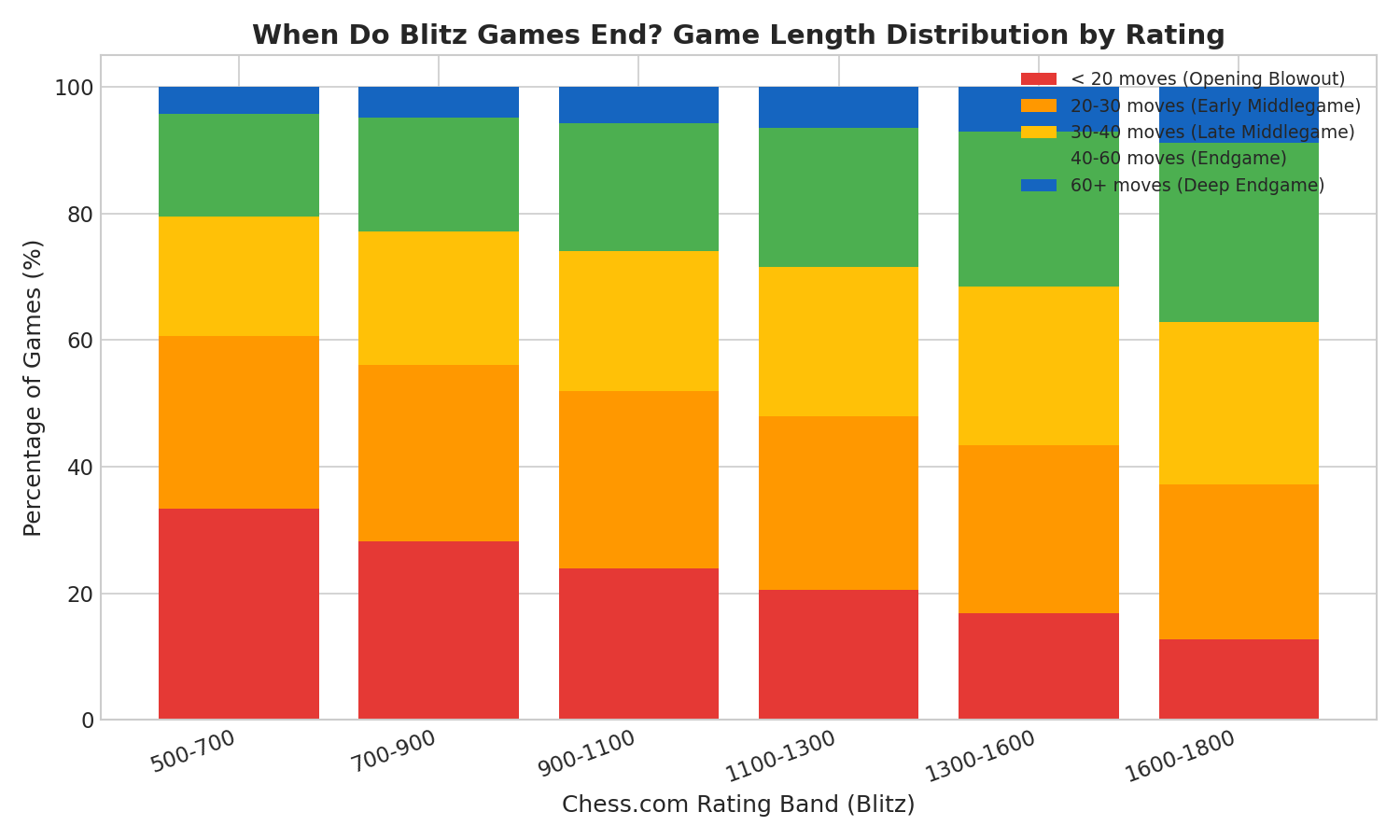
For players in the 500-725 range, an astonishing 41.1% of games end before move 20. These are the "mini-games" characterized by opening traps, immediate blunders, and swift punishments. As ratings increase, the proportion of these ultra-short games steadily declines, dropping to just 11.8% for the 1715-1930 band.
Conversely, the "deep endgame" (games lasting 60+ moves) remains exceptionally rare across all levels in Bullet chess, peaking at just 3.1% for the highest rating band analyzed. The fast time control naturally suppresses marathon games, as players either blunder decisively or flag on time before reaching move 60.
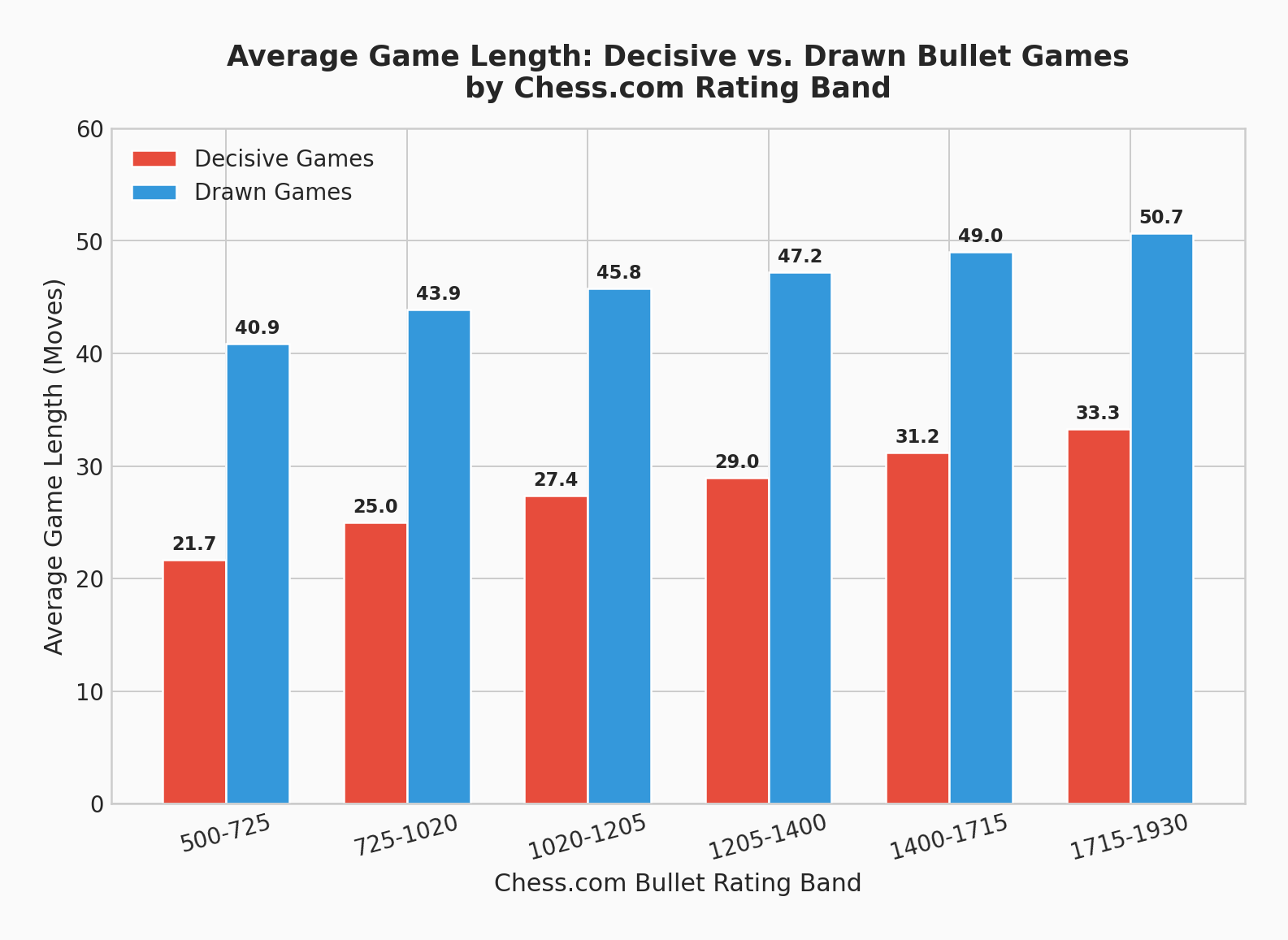
When we separate decisive games from drawn games, another pattern emerges. Decisive games are significantly shorter, averaging 21.7 moves at the lowest level and 33.3 moves at the highest. Drawn games, however, are much longer, averaging between 40.9 and 50.7 moves. This indicates that when games are relatively balanced, they naturally extend into the endgame, but such balance is rarely maintained by lower-rated players.
The Rarity of Draws in Bullet
One of the most striking findings is the near absence of draws in lower-rated Bullet chess.
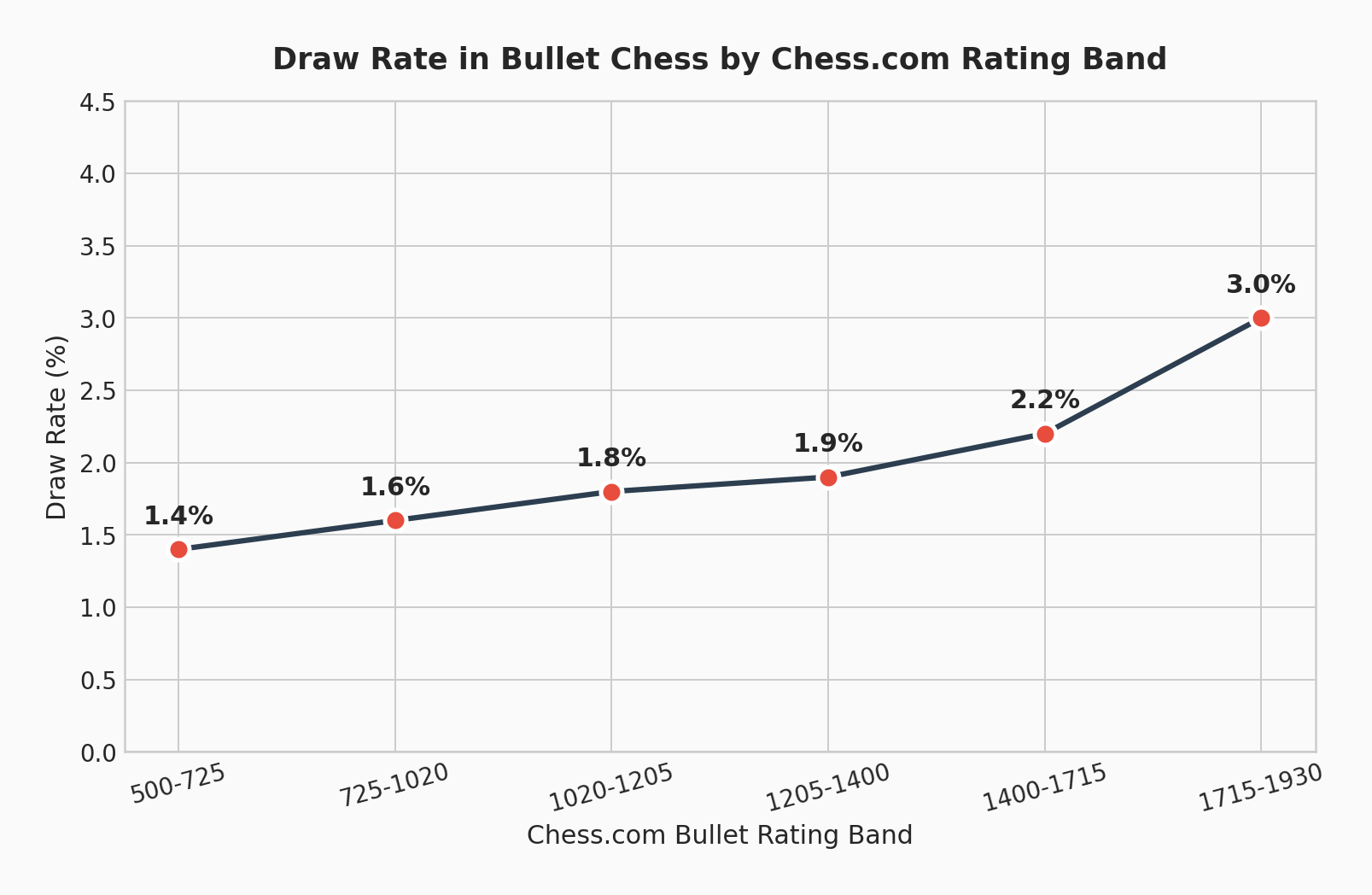
At the 500-725 level, the draw rate is a minuscule 1.4%. Even at the 1715-1930 level, it only rises to 3.0%. In Bullet chess, the clock acts as a decisive tiebreaker. When the position on the board is equal, the disparity in remaining time often determines the victor.
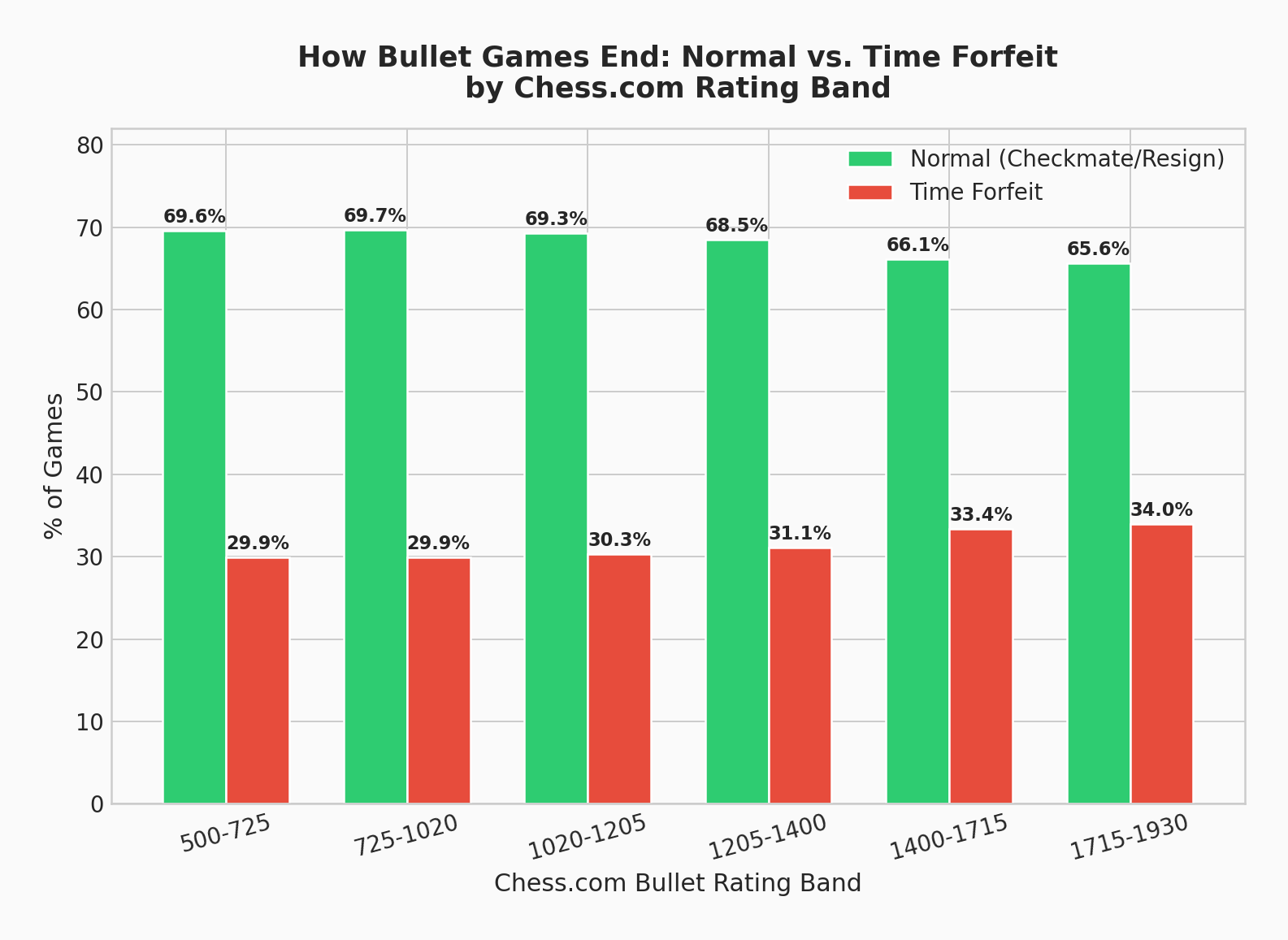
This is corroborated by the termination data. Across all rating bands, roughly 30% to 34% of games end in a time forfeit. The slight increase in time forfeits at higher ratings suggests that as players make fewer immediate blunders, games last longer, and the clock becomes a more prominent factor in the outcome.
Where Do the Blunders Happen?
If games aren't reaching the endgame, it's because they are being decided by blunders earlier on. But where exactly are these blunders occurring?
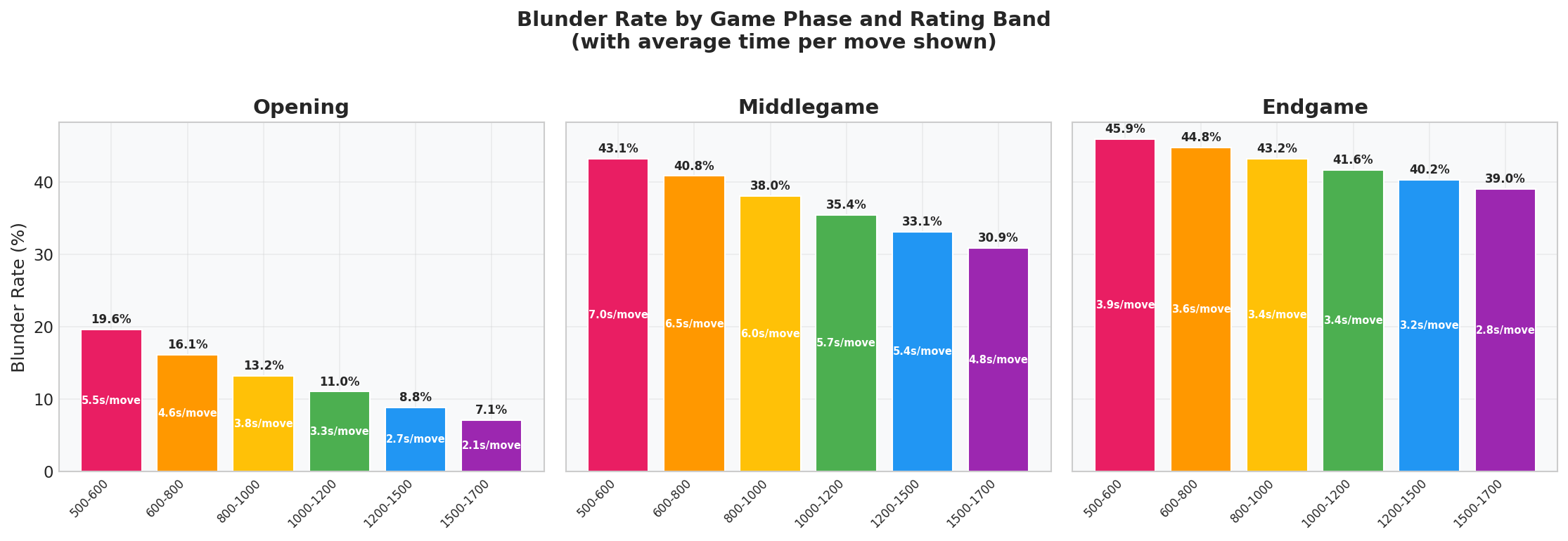
The data shows that the opening phase is relatively safe, with blunder rates (defined as a centipawn loss of 300 or more) ranging from 19.57% at the lowest level down to 7.14% at the highest. The middlegame sees a massive spike in errors, with blunder rates jumping to between 30% and 43%.
However, the most surprising finding is that the endgame is the most error-prone phase at all rating levels. Blunder rates in the endgame range from 39.02% to 45.89%.
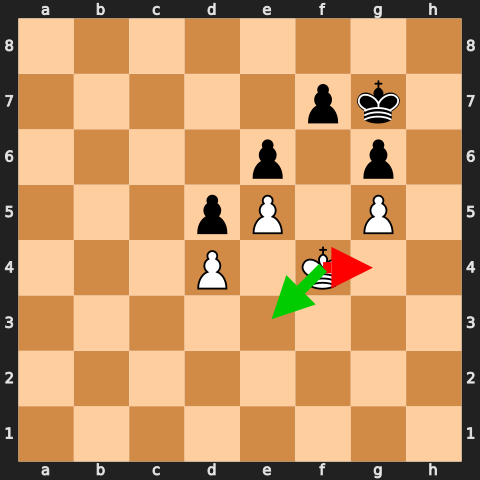
A typical Bullet endgame scenario. White is winning and should play Ke3 to methodically march the king. Instead, under severe time pressure, White plays Kg4?? (red arrow), walking into a potential stalemate trap or losing crucial tempi.
Why are endgames so blunder-heavy? The answer lies in the clock. Our analysis of time spent per move reveals that players spend the least amount of time per move during the endgame (averaging 2.8 to 3.9 seconds). The combination of complex, precise positions and extreme time pressure creates a perfect storm for catastrophic errors.
The Anatomy of a Bullet Blunder
To understand why games end so quickly at lower ratings, we must look at the nature of the blunders themselves.
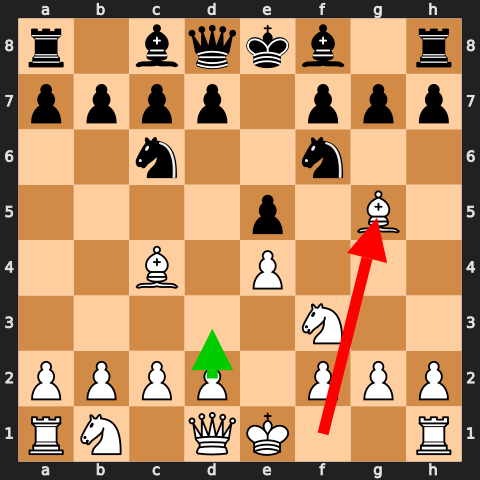
A classic lower-rated blunder. White plays Bg5 (red arrow), attempting an early pin, but hangs the bishop or allows a devastating counter-attack. The engine prefers the solid developing move d3 (green arrow).
These early blunders lead to highly lopsided positions. The average absolute engine evaluation in the middlegame for the 500-725 band is a staggering 4.17 pawns. By the time these games reach the endgame (if they do), the evaluation averages 6.39 pawns. In other words, lower-rated endgames are rarely subtle positional struggles; they are usually desperate attempts to convert or survive massive material imbalances.
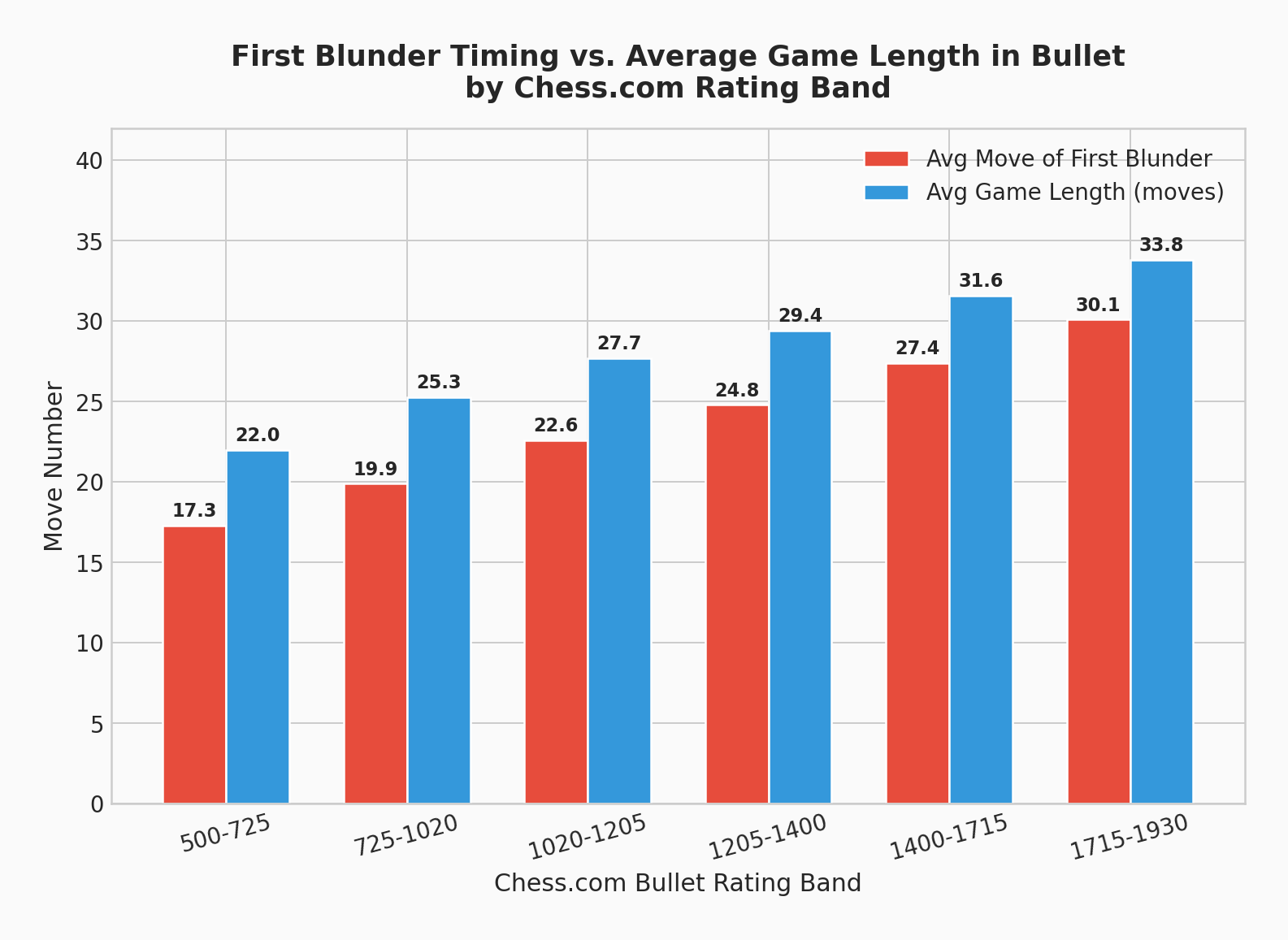
Furthermore, the first major blunder typically occurs just a few moves before the game ends. At the 500-725 level, the first blunder happens on average at move 17.3, and the game ends at move 22.0. This rapid collapse highlights the inability of lower-rated players to recover from significant mistakes.
The Struggle to Convert Material
Even when a player secures a material advantage, converting it into a win is far from guaranteed in Bullet chess.
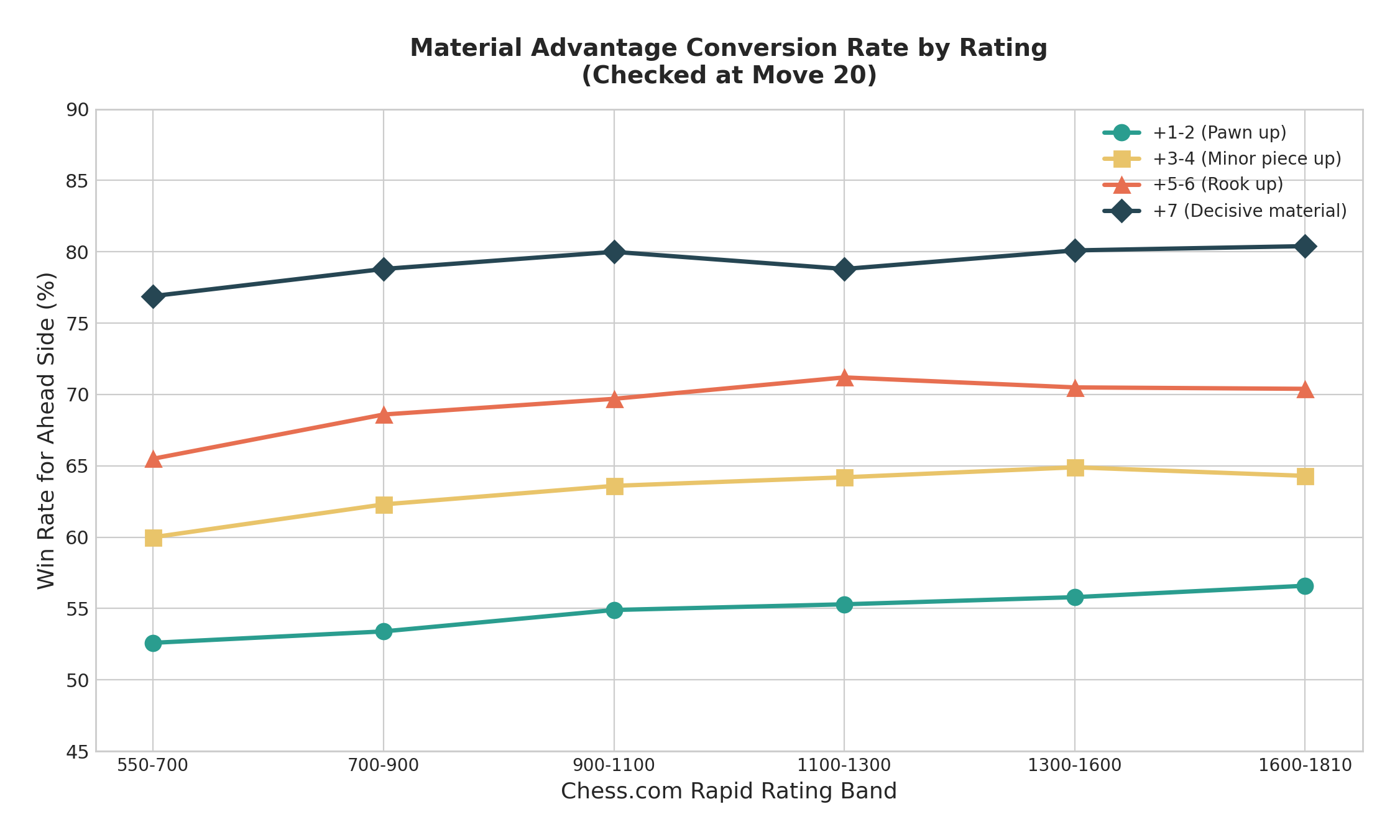
Being up a pawn (+1-2 material advantage) only results in a win roughly 53% to 57% of the time across all rating bands. Even a full rook advantage (+5-6) only converts to a win about 66% to 71% of the time. The chaos of Bullet chess, combined with the ever-present threat of a time forfeit, means that material advantages are frequently squandered.
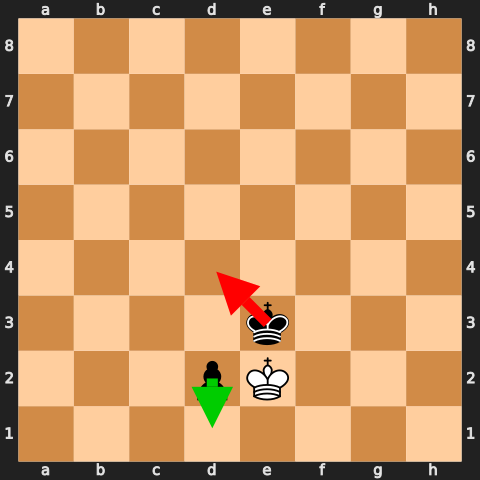
A common failure to convert. Black has a winning passed pawn on d2. Instead of simply promoting with d1=Q (green arrow), Black plays Kd4 (red arrow), wasting precious time and potentially allowing White to draw or win on time.
Actionable Advice by Rating Band
Based on this comprehensive data, here is a roadmap for improvement tailored to specific Chess.com rating bands.
500 - 800: The Survival Phase
- Ignore the Endgame (For Now): With only 5-8% of games reaching 40 moves, your time is better spent elsewhere.
- Focus on Blunder Prevention: 41% of your games end before move 20. Your primary goal is to survive the opening without hanging a full piece. Always do a quick "blunder check" before moving.
- Practice Basic Tactics: Most games are decided by simple one-move tactical oversights. Drill basic forks, pins, and skewers.
800 - 1200: The Transition Phase
- Start Basic Endgame Training: As you approach 1200, nearly 13% of your games will reach the endgame. You must know how to execute basic checkmates (King and Queen vs. King, King and Rook vs. King) quickly and automatically to avoid flagging.
- Improve Conversion: You will frequently find yourself up material. Practice converting these advantages without overcomplicating the position. Simplify when ahead.
- Manage the Clock: Time forfeits account for 30% of game terminations. Ensure you are not spending too much time in the opening, leaving yourself with seconds for the complex middlegame.
1200 - 1600: The Refinement Phase
- Endgames Are Now Mandatory: With 16-22% of games reaching the endgame, you can no longer ignore this phase. Study basic pawn endgames and rook endgames.
- Speed Up Your Endgame Play: The endgame is the most error-prone phase because players are low on time. By knowing endgame patterns automatically, you can play faster and induce blunders from your opponent.
- Resilience: The data shows that games last longer after the first blunder at this level. Learn to fight on in worse positions; your opponent only converts a pawn advantage 55% of the time.
Conclusion
The data confirms the old adage, but with a crucial caveat. For absolute beginners in Bullet chess, endgames are indeed a myth; games are decided by rapid, brutal blunders in the opening and early middlegame. However, the transition happens much earlier than many realize. By the time a player reaches the intermediate ranks, endgames become a frequent and highly decisive phase of the game. Because endgames are played under extreme time pressure, they are the most error-prone part of a Bullet match. Mastering basic endgame patterns so they can be executed instantly is a proven, data-backed strategy for climbing the rating ladder.
Data and Methodology
This analysis was conducted using a dataset of over 280,000 Bullet games sourced from the Lichess database. The games were categorized by average ELO rating bands. To make the insights more applicable to the broader chess community, Lichess ratings were mapped to approximate Chess.com Bullet ratings using established conversion metrics (typically a 200-300 point adjustment in the relevant ranges).
Engine evaluations (Stockfish 17) were used to determine centipawn loss and blunder rates (defined as a loss of ≥300 centipawns). Game phases were defined as: Opening (moves 1-10), Middlegame (moves 11-30), and Endgame (moves 31+).
The underlying CSV data files generated for this analysis are attached for further review.
Chess Coach April 17, 2026