A common piece of advice given to beginner and intermediate chess players is to focus entirely on tactics and opening principles, with the justification that "games at your level never reach the endgame anyway." This conventional wisdom suggests that studying king and pawn endings or rook maneuvers is a waste of time until a player reaches a much higher rating. But is this assumption actually supported by the data?
To answer this question, we analyzed over 464,000 Blitz games played on Lichess, mapping the rating bands to their approximate Chess.com equivalents. By examining game length, phase distribution, blunder rates, and material conversion across different skill levels, a surprising picture emerges. The data reveals that not only do lower-rated games reach the endgame far more often than commonly believed, but the endgame is also the phase where players of all levels struggle the most.
This article serves as a data-driven roadmap for improvement, specifically targeting players looking to climb from the 800 to 1600 rating range on Chess.com.
The Myth of the Endless Middlegame
The most direct way to test the "games never reach the endgame" hypothesis is to look at game length. While there is no strict move-number definition for when an endgame begins, games that extend past move 40 have almost certainly transitioned out of the middlegame.
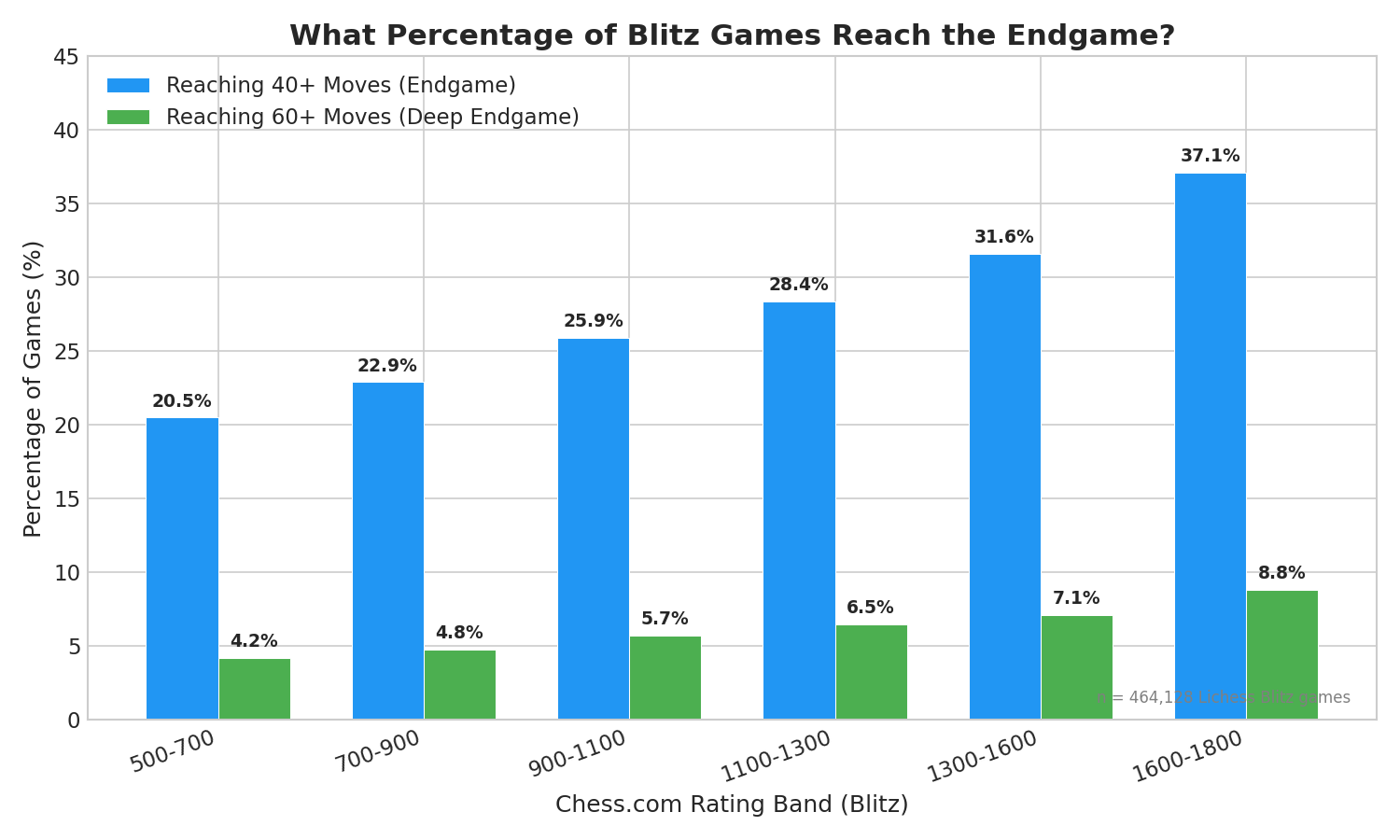
The data shows a clear upward trend: as rating increases, games get longer. However, the baseline frequency at the lowest rating bands is the real surprise. For players in the 500-700 Chess.com range (approximately 700-900 on Lichess), 20.5% of games reach move 40 or beyond. That is one in every five games.
By the time a player reaches the 1100-1300 Chess.com bracket, nearly 30% of their games are entering endgame territory. The idea that lower-rated players can completely ignore endgame study because they will never use it is demonstrably false. If you are playing five blitz games a day, you are likely navigating at least one true endgame.
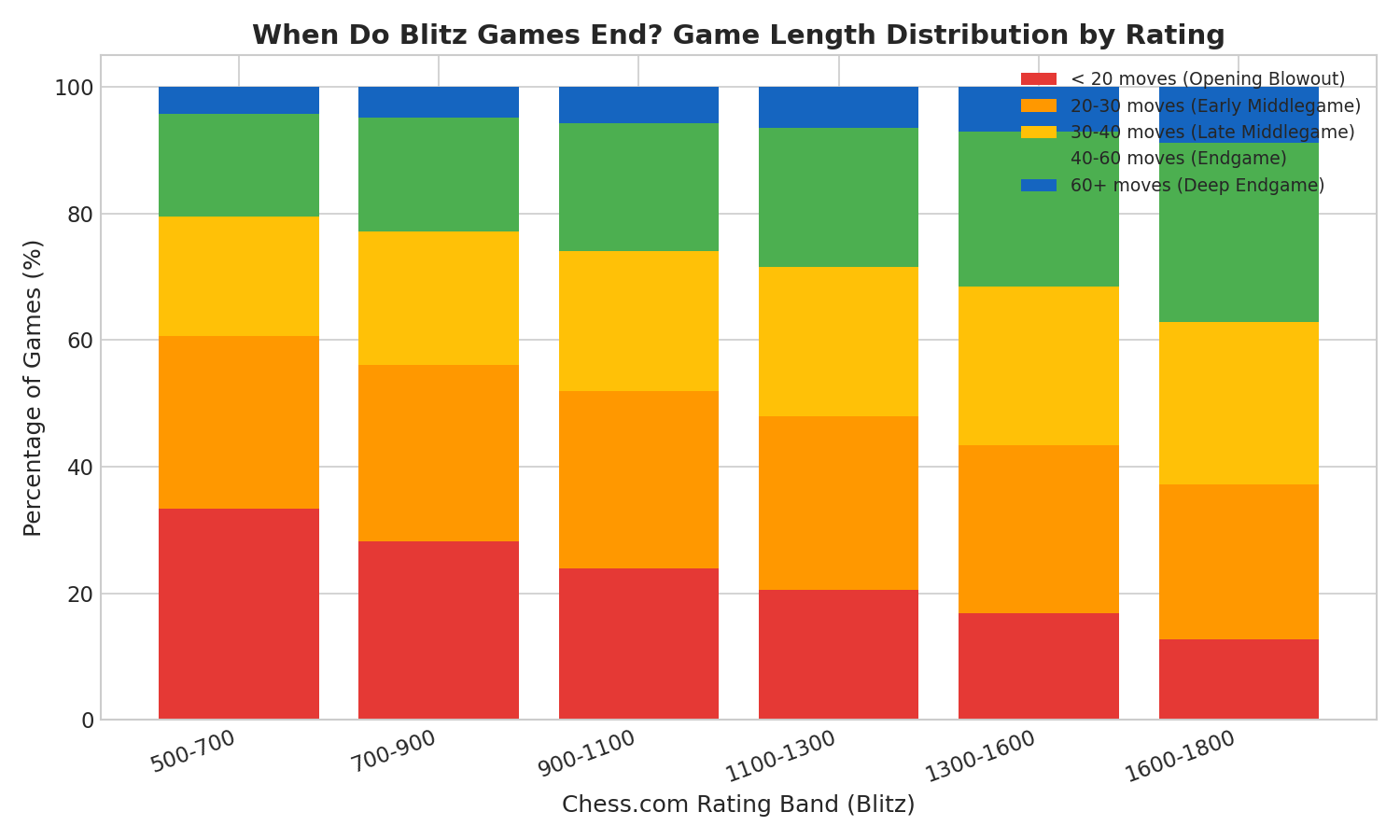
When we break down the termination points, we see that "opening blowouts" (games ending in under 20 moves) do account for a third of games at the lowest levels. However, this percentage drops sharply as players improve. The 20-40 move range (the middlegame) remains the most common termination phase across all bands, but the endgame slice steadily expands.
Where the Blunders Happen
Reaching the endgame is only half the story; how players perform once they get there is equally important. By analyzing the average centipawn loss (CPL) and blunder rates per move across the three phases of the game, we can pinpoint exactly where players are throwing away their advantages.
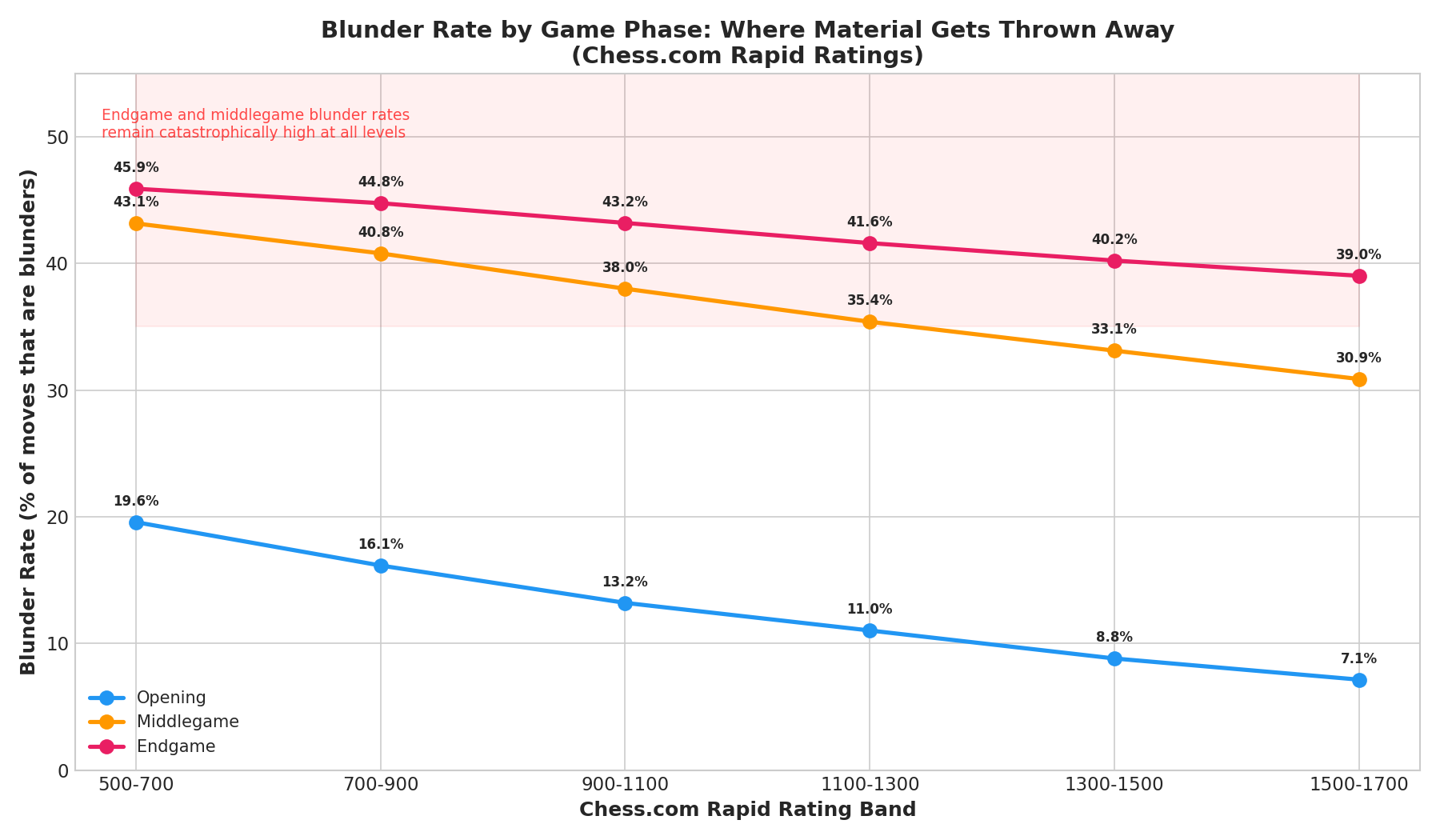
This chart reveals a critical insight into chess improvement. As players climb the rating ladder, their opening accuracy improves dramatically. The blunder rate in the opening drops from nearly 20% at the lowest levels to just 7% at the 1600-1800 level. Middlegame accuracy also sees significant improvement.
However, the endgame blunder rate remains stubbornly high across all rating bands. Even at the 1600-1800 Chess.com level, players are blundering on nearly 40% of their endgame moves. This indicates that while players are successfully memorizing opening lines and sharpening their middlegame tactics, their endgame technique is lagging severely behind. The endgame is the phase with the most room for improvement, regardless of your current rating.
The Struggle to Convert Material
One reason endgame blunders are so frequent is that players struggle to convert material advantages into wins. A common scenario is entering an endgame up a pawn or a minor piece, only to misplay the position and allow the opponent to draw or even win.
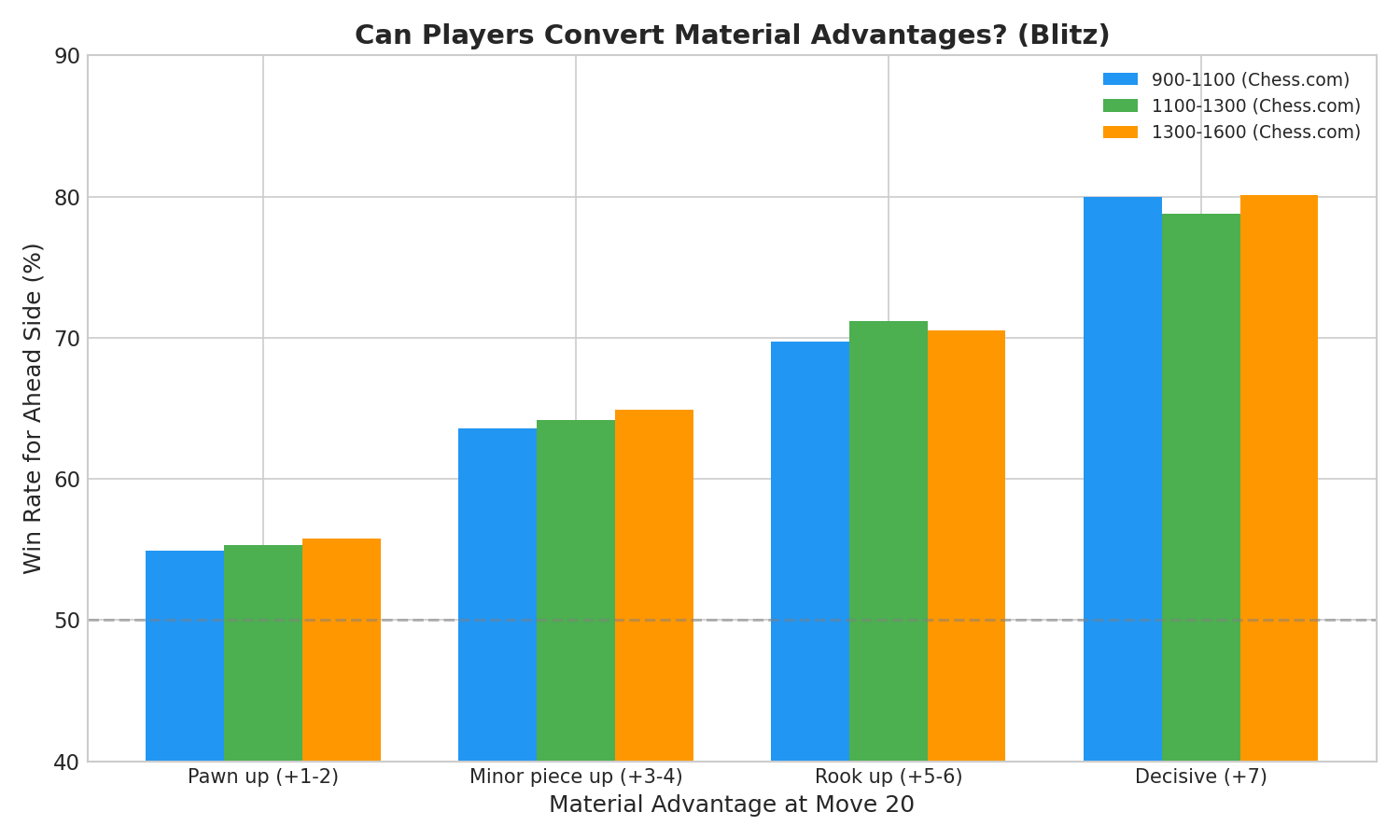
The data on material advantage conversion at move 20 is sobering. If a player in the 900-1100 Chess.com band is up a full minor piece (+3 to +4 points of material), they only win that game 62.3% of the time. Even being up a full rook (+5 to +6 points) only guarantees a win in about 68% of cases.
This highlights a fundamental flaw in the "tactics only" approach. You can use brilliant tactics to win a piece in the middlegame, but if you lack the endgame technique to convert that advantage, the tactical brilliance is wasted.
Visual Evidence: The Passive Rook
Consider this typical endgame scenario that frequently occurs in the 800-1000 rating range. White has successfully navigated the middlegame and emerged with a winning advantage: a Rook and two pawns versus a Rook and one pawn.
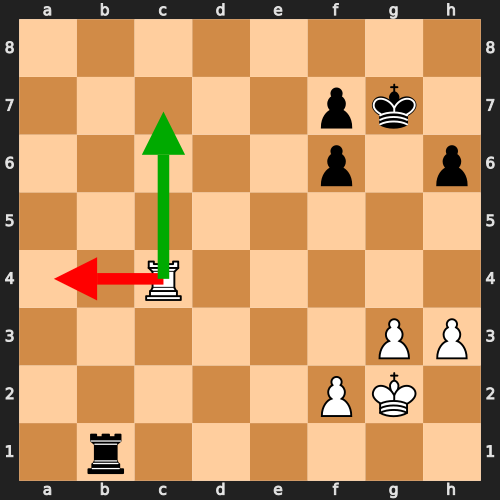
In this position, the instinct of many lower-rated players is to play passively, defending their pawns from the front or side (indicated by the red arrow). This allows the opponent's king and rook to become active, creating counterplay and often leading to a drawn position. The correct technique, taught in basic endgame manuals, is to place the rook actively behind the passed pawns (indicated by the green arrow), supporting their advance while restricting the enemy king. This lack of basic theoretical knowledge is why material advantages so often slip away.
The Role of the Clock
In Blitz chess, the clock is as much a piece on the board as the Queen. The data shows that time management plays a massive role in how games conclude, particularly as players reach the endgame.
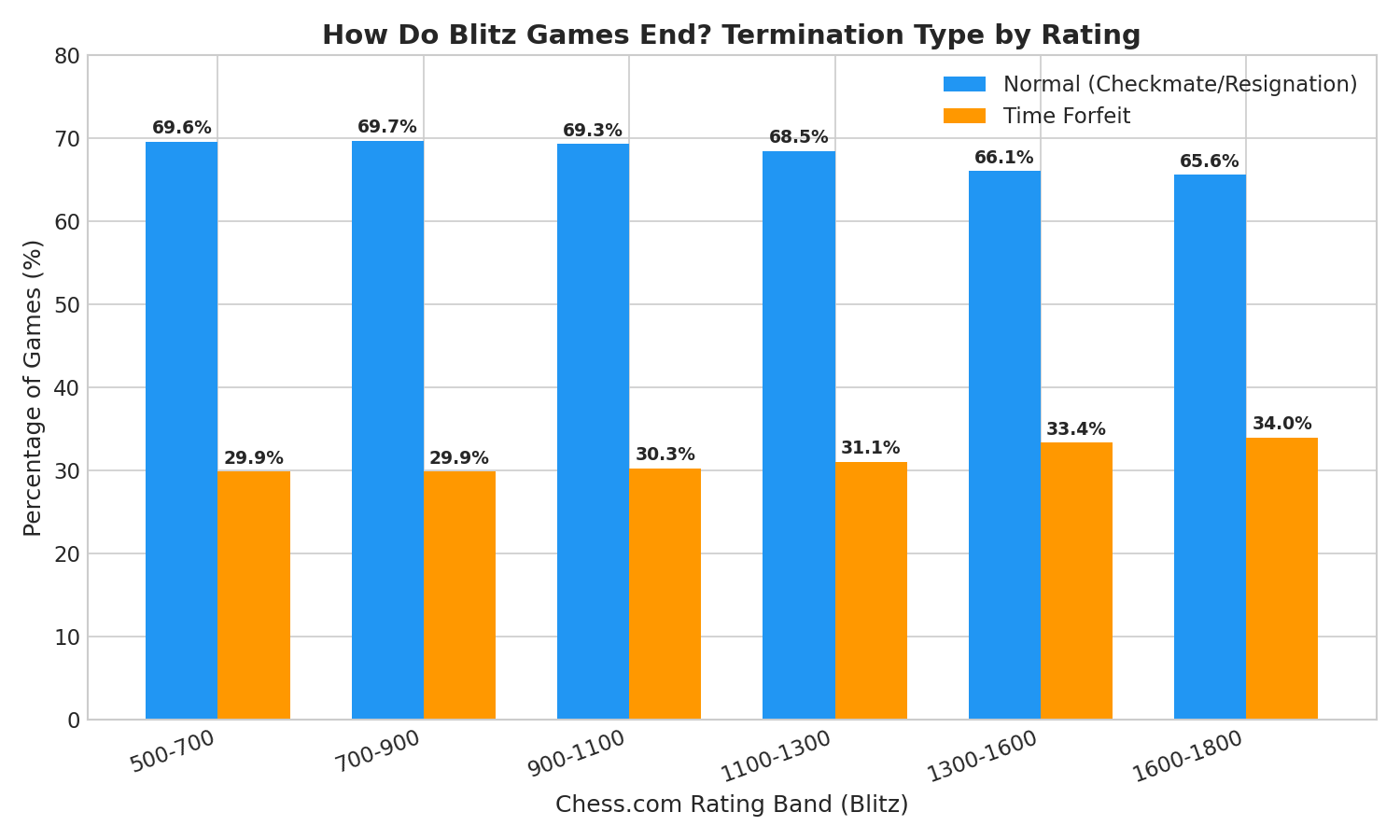
Across all rating bands, approximately 30% to 34% of games end in a time forfeit. Interestingly, this percentage actually increases slightly as ratings go up. Higher-rated players are better at defending difficult positions and prolonging the game, which inevitably leads to more clock pressure in the final stages.
When you combine the high endgame blunder rate with extreme time pressure, the result is chaos. Players who have ingrained basic endgame patterns (like the Lucena or Philidor positions, or basic King and Pawn opposition) can execute these moves instantly, saving precious seconds. Players who have to calculate these positions from scratch will almost certainly flag or blunder.
Visual Evidence: The Opposition
The concept of "opposition" is the cornerstone of King and Pawn endgames. It is the difference between a win and a draw, and it must be understood intuitively to succeed in time scrambles.
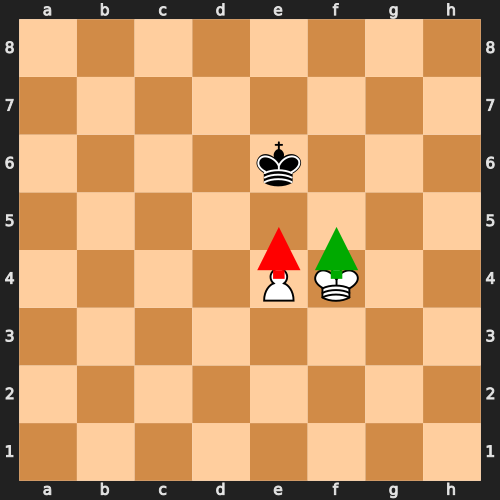
In this position, White must take the opposition by moving the King directly in front of the Black King (green arrow). This forces the Black King to give way, allowing the White King to infiltrate and escort the pawn to promotion. If White impulsively pushes the pawn with check (red arrow), the position is immediately drawn. This is a binary knowledge check: you either know the pattern, or you guess and likely fail.
Actionable Advice by Rating Band
Based on the data, here is a roadmap for integrating endgame study into your training, tailored to your current Chess.com rating.
800 - 1000: The Foundation
At this level, 20-25% of your games are reaching the endgame. While tactics and opening principles should still be your primary focus, you cannot ignore the final phase entirely.
- Actionable Advice: Focus exclusively on basic checkmates. You must be able to reliably checkmate with a Queen and King, and a Rook and King, against a lone King. Practice these against a computer until you can execute them with less than 10 seconds on your clock. The data shows you will need this skill in 1 out of 5 games.
1000 - 1300: The Transition
Nearly 30% of your games are now extending past move 40. You are surviving the opening and middlegame more consistently, but your endgame blunder rate is still hovering around 43%.
- Actionable Advice: Introduce basic King and Pawn endgames. Learn the concepts of "the square of the pawn," "opposition," and "key squares." Understand that being up a pawn is only an advantage if you know how to promote it. Stop playing passively when ahead in material; learn to activate your King and Rooks.
1300 - 1600: The Conversion Gap
You are reaching the endgame in over a third of your games. You are winning material in the middlegame, but the data shows you are failing to convert minor piece advantages nearly 35% of the time.
- Actionable Advice: It is time to study Rook endgames, which are the most common type of endgame you will face. Learn the Philidor position (how to draw when down a pawn) and the Lucena position (how to win when up a pawn). Mastering these two patterns will immediately improve your conversion rate and save half-points in lost positions.
Conclusion
The data definitively busts the myth that lower-rated players do not reach endgames. Even at the 800 level, a significant portion of games extend into the final phase. More importantly, the endgame is universally the weakest phase of play across all intermediate rating bands.
By dedicating even a small fraction of your study time to basic endgame principles, you can exploit this widespread weakness in your opponents. You will convert more material advantages, save more drawn positions, and navigate time scrambles with confidence. The endgame is not a distant realm reserved for masters; it is a practical battleground where rating points are won and lost every day.
Chess Coach April 17, 2026
Data and Methodology
The analysis in this article is based on a dataset of 464,128 Blitz games played on Lichess, accessed via the grandmaster-guide MCP server. The games were categorized by average player rating. Because Lichess ratings are generally higher than Chess.com ratings for the same skill level, a conversion mapping was applied to align the insights with the Chess.com player base.
The underlying data files generated for this analysis are available below:
View full data →ratingBand pctEndingUnder20Moves pctEndingUnder30Moves pctEndingUnder40Moves pctReaching40PlusMoves pctReaching60PlusMoves decisiveAvgMoves drawAvgMoves normalTerminationPct timeForfeitPct sampleGames chesscomBand 700-900 33.4 60.6 79.5 20.5 4.2 26.7 49.9 74.7 25.1 79460 500-700 900-1100 28.2 56.1 77.1 22.9 4.8 28.6 52.2 76.3 23.5 77662 700-900 1100-1300 24.0 51.9 74.1 25.9 5.7 30.3 53.3 76.9 22.9 76494 900-1100 1300-1500 20.5 48.0 71.6 28.4 6.5 31.8 54.1 76.8 23.0 76220 1100-1300 1500-1800 16.8 43.4 68.4 31.6 7.1 33.3 54.9 74.7 24.9 72505 1300-1600
View full data →ratingBand drawRate whiteWinRate blackWinRate totalGames chesscomBand 700-900 4.7 49.6 45.7 79460 500-700 900-1100 3.9 50.3 45.8 77662 700-900 1100-1300 3.7 49.9 46.3 76494 900-1100 1300-1500 3.5 50.1 46.4 76220 1100-1300 1500-1800 3.8 49.6 46.4 72505 1300-1600
View full data →ratingBand phase avgEvalAbsolute chesscomBand 700-900 opening 1.35 500-700 700-900 middlegame 4.17 500-700 700-900 endgame 6.39 500-700 900-1100 opening 1.07 700-900 900-1100 middlegame 3.43 700-900
View full data →ratingBand phase avgCpl blunderPct chesscomBand 700-900 opening 197.5 19.57 500-700 700-900 middlegame 529.6 43.15 500-700 700-900 endgame 686.5 45.89 500-700 900-1100 opening 164.9 16.15 700-900 900-1100 middlegame 461.1 40.79 700-900
View full data →ratingBand normal time_forfeit abandoned chesscomBand 700-900 69.6 29.9 0.5 500-700 900-1100 69.7 29.9 0.4 700-900 1100-1300 69.3 30.3 0.3 900-1100 1300-1500 68.5 31.1 0.3 1100-1300 1500-1800 66.1 33.4 0.5 1300-1600
View full data →ratingBand bucket winPct chesscomBand 700-900 Pawn up (+1-2) 52.6 500-700 700-900 Minor piece up (+3-4) 60.0 500-700 700-900 Rook up (+5-6) 65.5 500-700 700-900 Decisive (+7) 76.9 500-700 900-1100 Pawn up (+1-2) 53.4 700-900
View full data →Chess.com Band Lichess Band % Ending < 20 Moves % Reaching Endgame (40+) % Reaching Deep Endgame (60+) Avg Moves (Decisive) Avg Moves (Draw) Sample Games 500-700 700-900 33.4 20.5 4.2 26.7 49.9 79460 700-900 900-1100 28.2 22.9 4.8 28.6 52.2 77662 900-1100 1100-1300 24.0 25.9 5.7 30.3 53.3 76494 1100-1300 1300-1500 20.5 28.4 6.5 31.8 54.1 76220 1300-1600 1500-1800 16.8 31.6 7.1 33.3 54.9 72505