For many chess players, understanding how accuracy improves with rating is a key part of setting realistic goals. While Chess.com has published their own accuracy charts, players often wonder how these metrics translate to the Lichess player pool and how accuracy degrades across different phases of the game. In this data-driven research article, we analyze over 400,000 Stockfish 17-evaluated Lichess Blitz games to answer these questions.
To make the findings actionable for the broader chess community, all rating bands in this article have been mapped to their approximate Chess.com Blitz equivalents. (For reference, a Chess.com rating of 1000 corresponds to roughly 1420 on Lichess).
1. The Baseline: Average Centipawn Loss by Rating
The most common metric for chess accuracy is Average Centipawn Loss (ACPL), which measures how much evaluation a player loses per move compared to the engine's top choice. A lower ACPL indicates more accurate play.
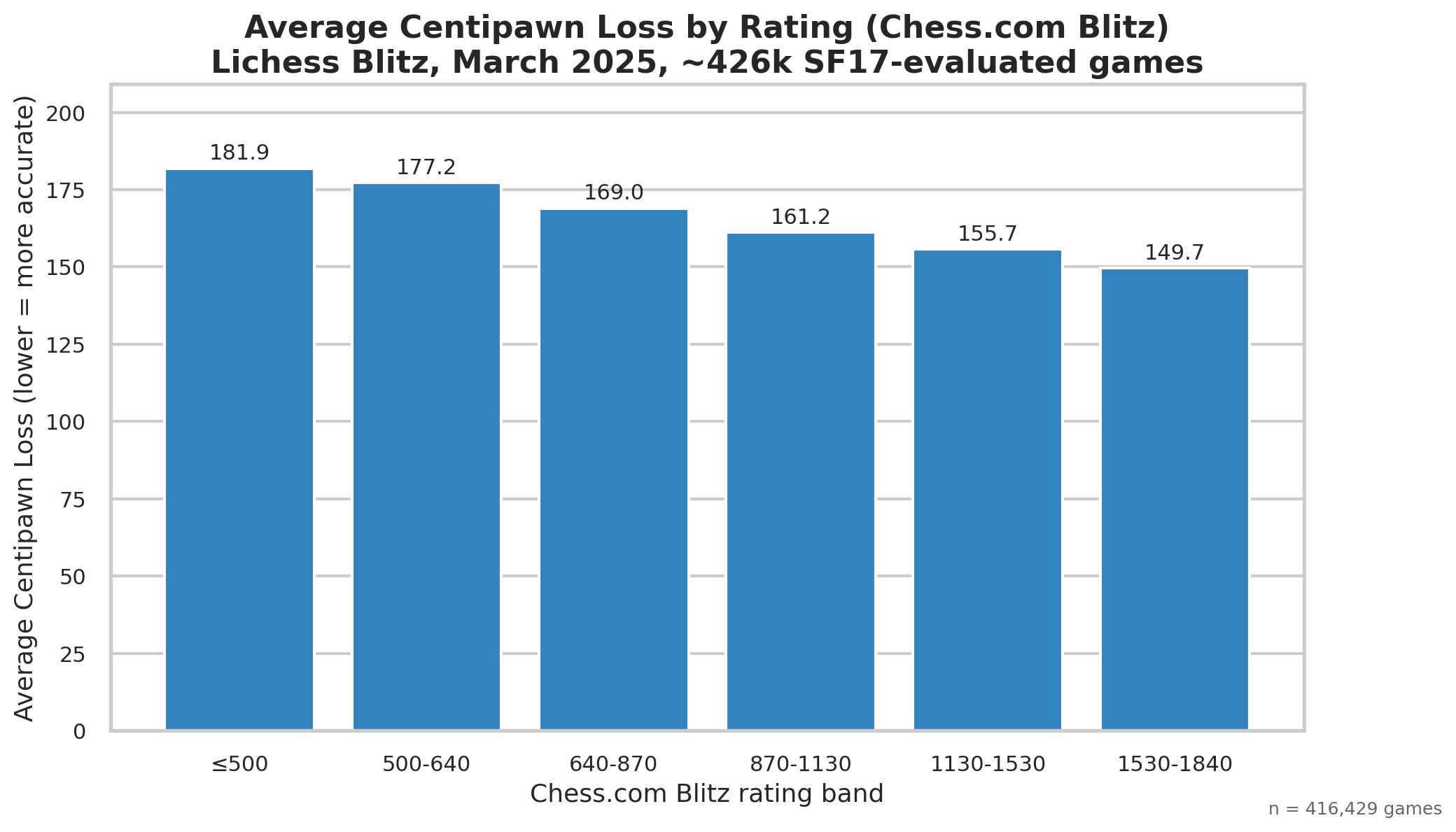
As expected, ACPL steadily decreases as ratings climb. A player in the Chess.com 870–1130 band (Lichess 1300–1500) averages an ACPL of 161.2, while a player in the 1530–1840 band (Lichess 1800–2000) averages 149.7. While a difference of 11 centipawns per move might seem small, compounded over a 30-move game, it represents a massive difference in positional quality and tactical sharpness.
Actionable Advice for Climbing
- Below 800: Focus entirely on board vision. Your ACPL is heavily inflated by one-move blunders (hanging pieces).
- 800–1200: The drop in ACPL here is driven by reducing the frequency of severe blunders. Focus on basic tactics and double-checking your opponent's threats.
- 1200–1500: Improvement here requires reducing "mistakes" (suboptimal plans) rather than just outright blunders.
2. The Phase Breakdown: Where Do Players Lose Accuracy?
A game of chess is not uniformly difficult. The opening is often memorized, the middlegame is chaotic, and the endgame requires precise calculation. How does accuracy change as the game progresses?
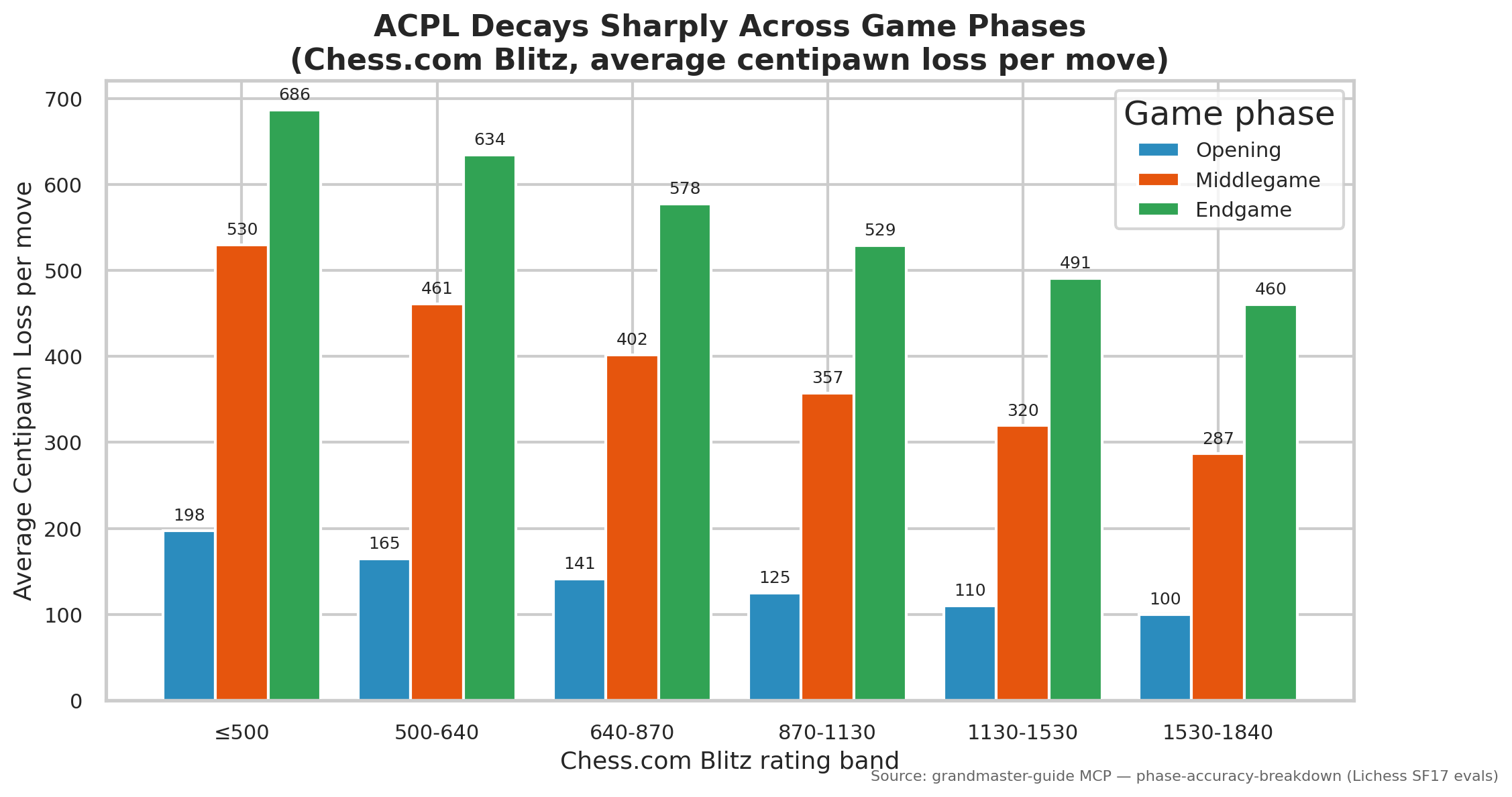
The data reveals a stark reality: accuracy decays sharply as the game progresses. Across all rating bands, players are most accurate in the opening, significantly less accurate in the middlegame, and least accurate in the endgame.
For example, in the Chess.com 870–1130 band, the opening ACPL is a respectable 125. However, once the middlegame begins, the ACPL spikes to 357, and in the endgame, it reaches 529. This pattern holds true even for higher-rated players, though the absolute numbers are lower.
Actionable Advice for Climbing
- Stop obsessing over the opening: The data shows that players at all levels play the opening relatively well. The real battleground is the middlegame and endgame.
- Train endgames: The massive spike in endgame ACPL across all bands indicates that this is the phase where players are most lost. Studying basic endgames will give you a significant edge over your peers.
3. The Anatomy of Errors: Blunders, Mistakes, and Inaccuracies
Not all errors are created equal. Engines classify suboptimal moves into inaccuracies (minor positional errors), mistakes (significant errors), and blunders (game-losing errors). How does the frequency of these errors change with rating?
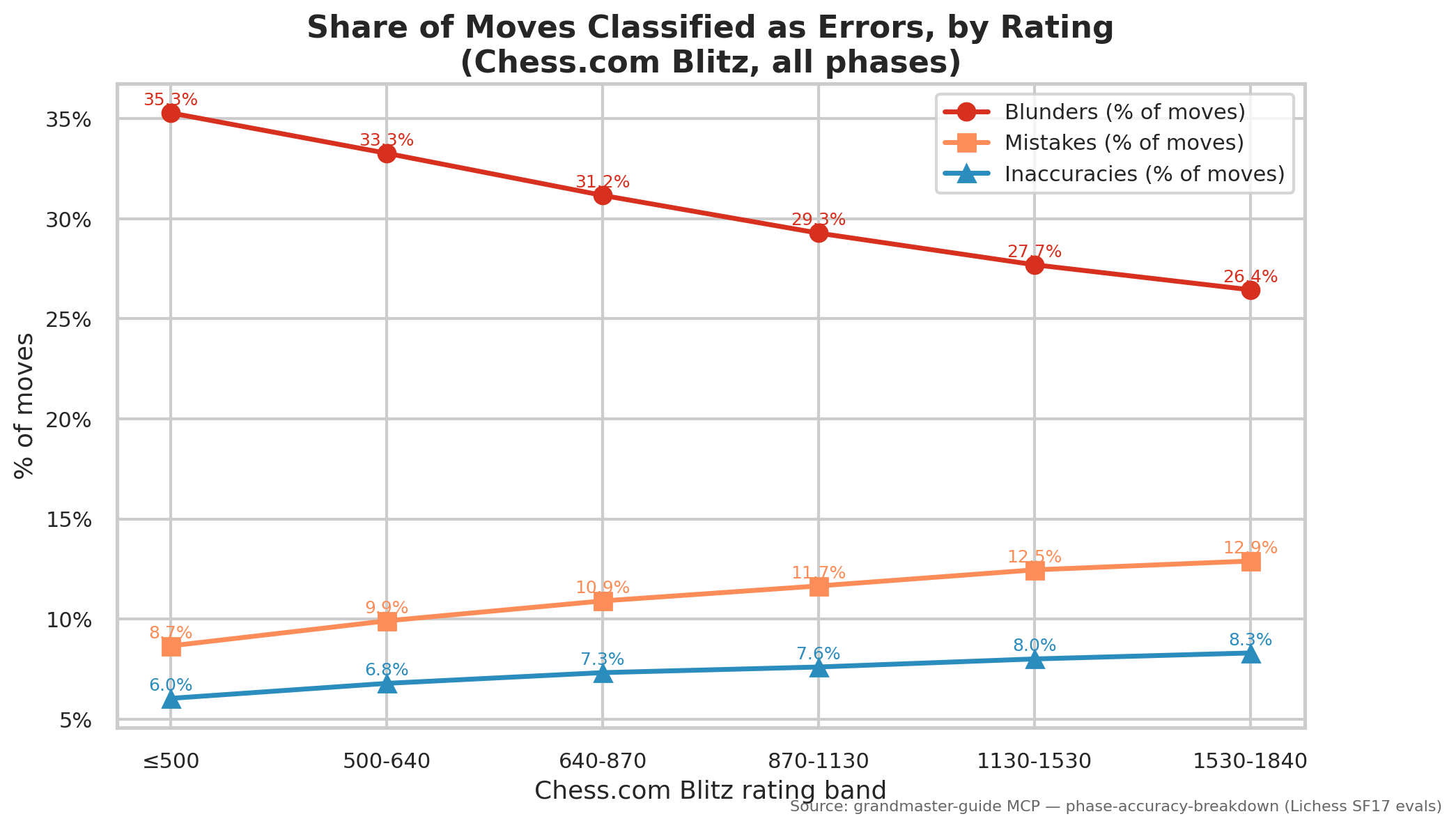
Interestingly, the share of moves classified as blunders decreases steadily as ratings increase, dropping from 35.3% in the lowest band to 26.4% in the highest band. However, the share of mistakes and inaccuracies actually increases slightly.
This is a fascinating insight into chess improvement: as you get better, you don't necessarily make fewer errors overall; rather, your errors become less severe. You stop hanging full pieces (blunders) and start making positional concessions (mistakes/inaccuracies).
Visual Evidence: The Anatomy of a Blunder
To illustrate what these blunders look like in practice, let's examine a few real-world examples from our dataset.
Example 1: The King Walk (Chess.com ~800-1000)
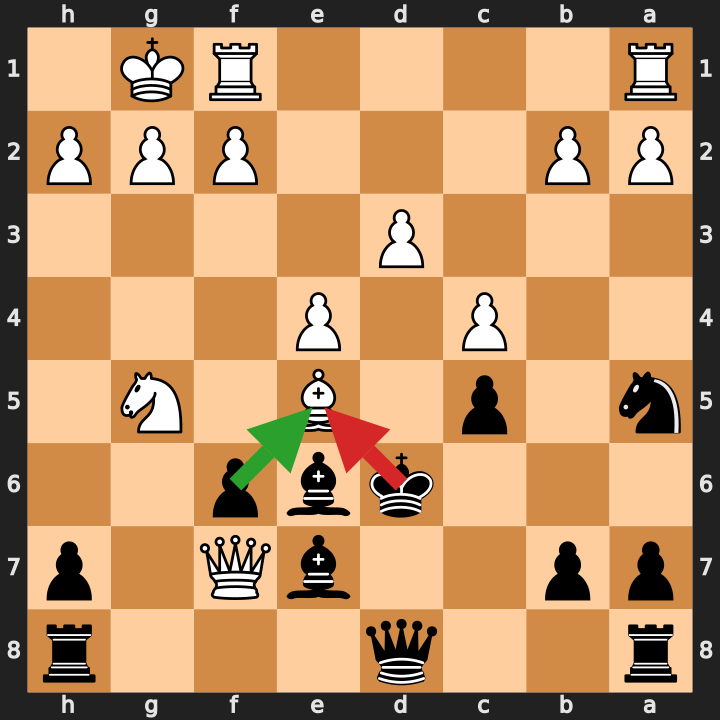 In this position, Black's king has wandered into the center. The king-grab Kxe5?? (red arrow) walks into a discovered check and decisive material loss. The engine prefers Bxe5 (green arrow), restoring some material balance and avoiding the king walk.
Example 2: The Hanging Queen (Chess.com ~1000-1200)
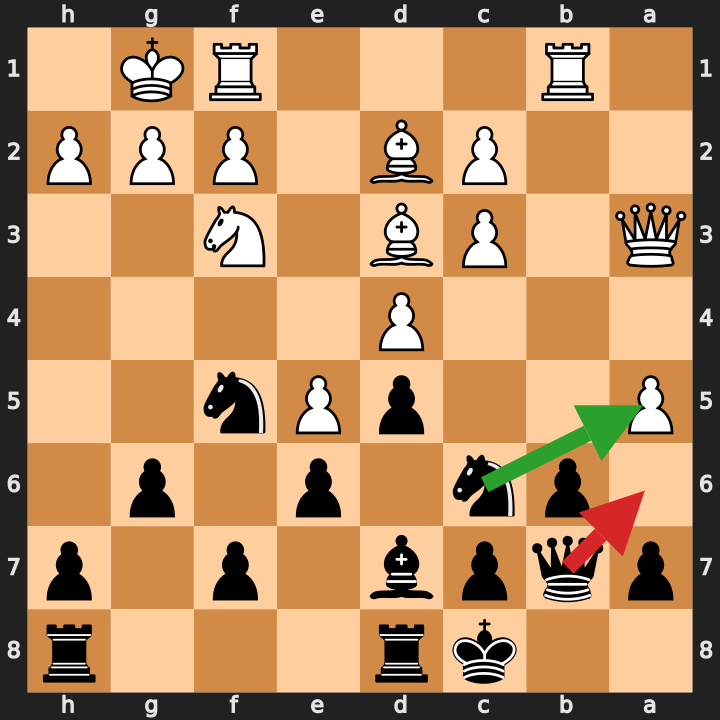 Both kings are castled and Black has a comfortable position. Instead of solid play with a6 to challenge the a-file, Qa6?? (red arrow) hangs the queen to axb6, winning material and shattering the queenside.
Example 3: The Ignored Threat (Chess.com ~1200-1400)
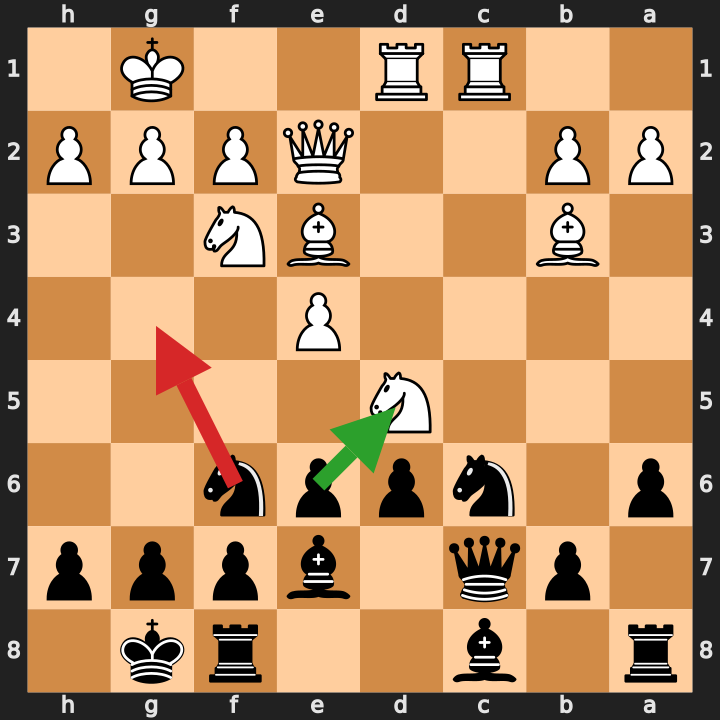 From a perfectly equal Sicilian middlegame, Ng4?! (red arrow) attacks the bishop on e3 but completely ignores the devastating Nxe7+, after which Black's coordination collapses.
4. Winning vs. Losing: The Accuracy Gap
Is there a significant difference in accuracy between winning Blitz games and losing Blitz games for the same player? The data says yes, and the gap is substantial.
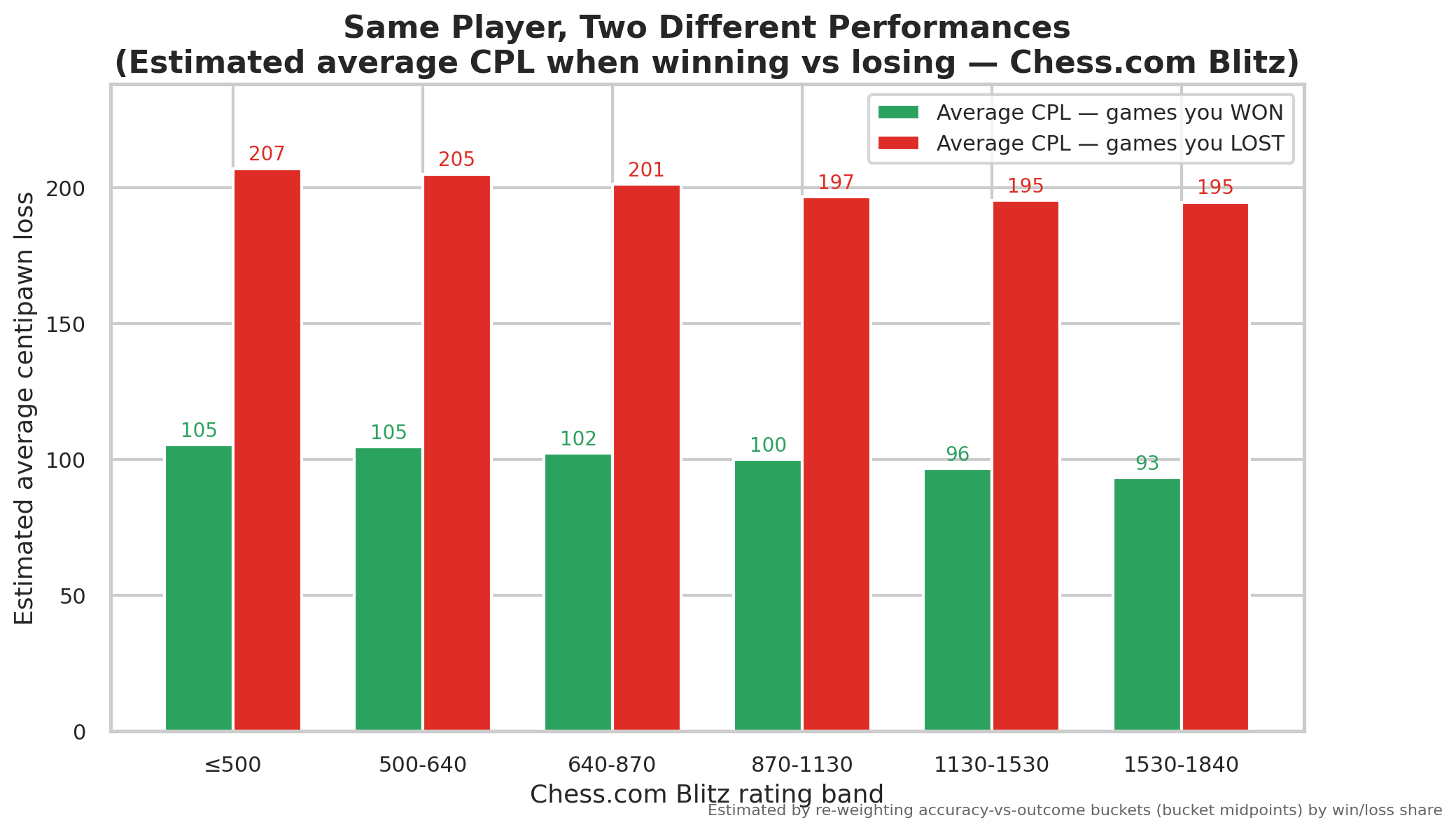
When a player in the Chess.com 870–1130 band wins a game, their average CPL is around 100. When they lose, their average CPL doubles to 197. This ~100-point gap between winning and losing performances is remarkably consistent across all rating bands.
This suggests that chess performance is highly variable. You don't have a single "true" accuracy level; rather, you have a range. When you are playing well (seeing tactics, calculating accurately), you perform at a level roughly 100 CPL better than when you are playing poorly (tilted, tired, or simply outplayed).
Actionable Advice for Climbing
- Consistency is key: The gap between your best games and your worst games is massive. Improving your rating is often less about raising your ceiling and more about raising your floor—reducing the frequency of those 200+ CPL disaster games.
- Recognize tilt: If you find yourself consistently playing in your "losing" CPL range, it's time to take a break.
5. The Impact of Time Control
Finally, how does time control affect accuracy? Does having more time on the clock actually lead to better moves?
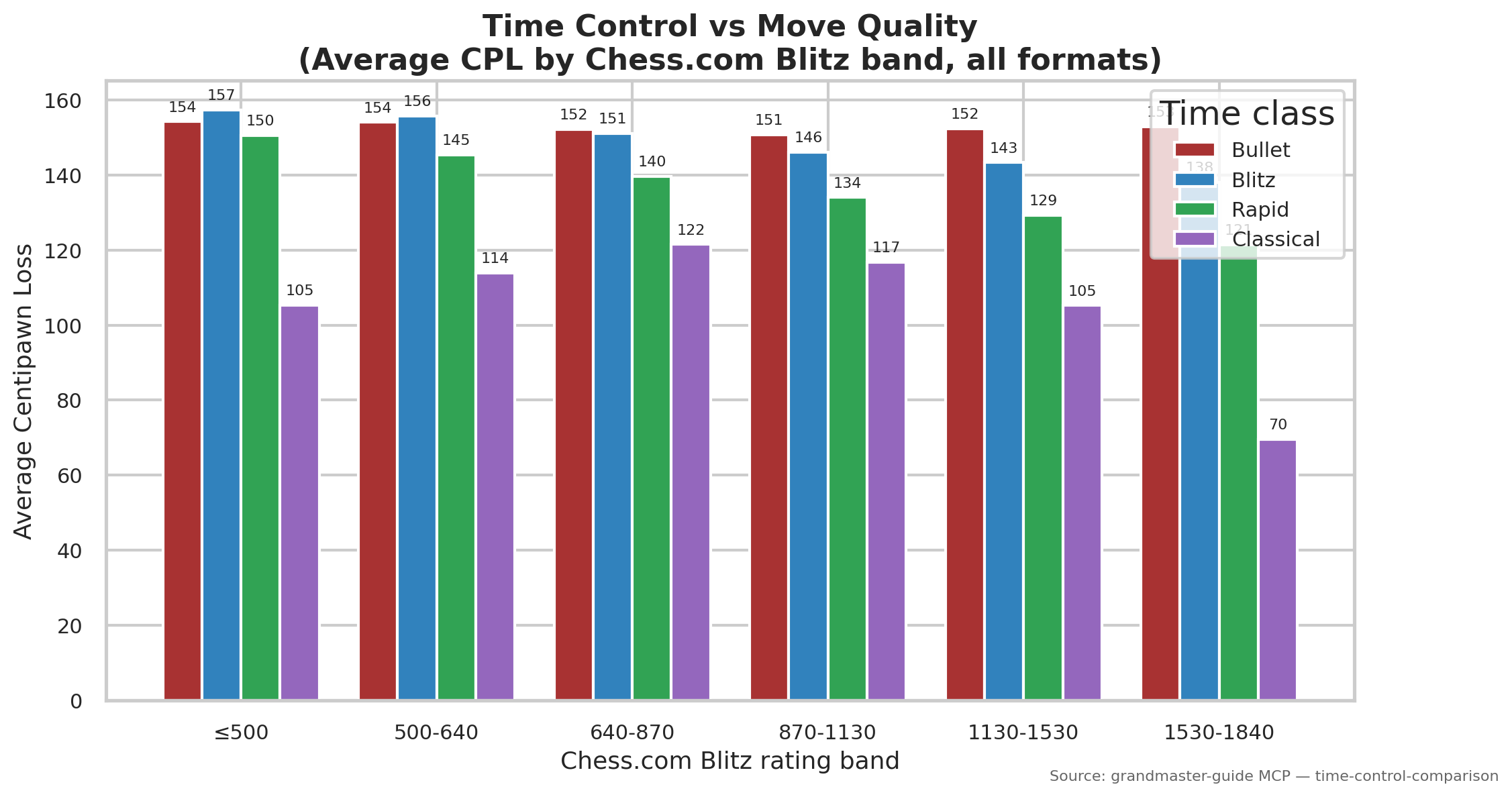
The data confirms what we intuitively know: faster time controls lead to lower accuracy. Across all rating bands, Bullet games have the highest ACPL, followed by Blitz, Rapid, and Classical.
For example, in the Chess.com 870–1130 band, the average CPL drops from 151 in Bullet to 146 in Blitz, 134 in Rapid, and 117 in Classical.
Actionable Advice for Climbing
- Play slower time controls to improve: If you want to improve your move quality and reduce your ACPL, you need time to think. Playing exclusively Blitz and Bullet will reinforce bad habits and superficial calculation.
Data and Methodology
This analysis was conducted using a sample of over 400,000 Lichess Blitz games played in March 2025, specifically focusing on games with Stockfish 17 evaluations. The data was accessed via the grandmaster-guide MCP server.
All rating bands were mapped from Lichess to Chess.com equivalents using a linear interpolation of standard conversion tables.
The underlying CSV data files used to generate the charts in this article are attached below for further exploration:
acpl_by_rating_blitz.csvphase_accuracy_blitz.csvblunder_mistake_inaccuracy_by_rating_blitz.csvaccuracy_vs_outcome_blitz.csvblunder_distribution_blitz.csvtc_comparison.csvcpl_won_vs_lost_blitz.csv
Chess Coach <Apr 19, 2026>