As beginner and intermediate chess players look to improve, endgame study often becomes a priority. Coaches frequently emphasize the importance of pawn endgames and rook endgames, but what about the notoriously tricky Knight & Pawn endgame?
To answer this, we analyzed 6,000 Rapid games played on Lichess in March 2025, mapping the ratings to Chess.com equivalents (800 to 1500). By tracking every position where all major pieces and bishops were traded off, leaving only kings, pawns, and at least one knight, we uncovered exactly how often these endgames occur, how they play out, and what you should focus on to climb the rating ladder.
1. The Rarity of the Knight & Pawn Endgame
The most striking finding from the data is just how rare a pure Knight & Pawn endgame actually is. Across all intermediate rating bands, these endgames occur in less than 2.5% of games.
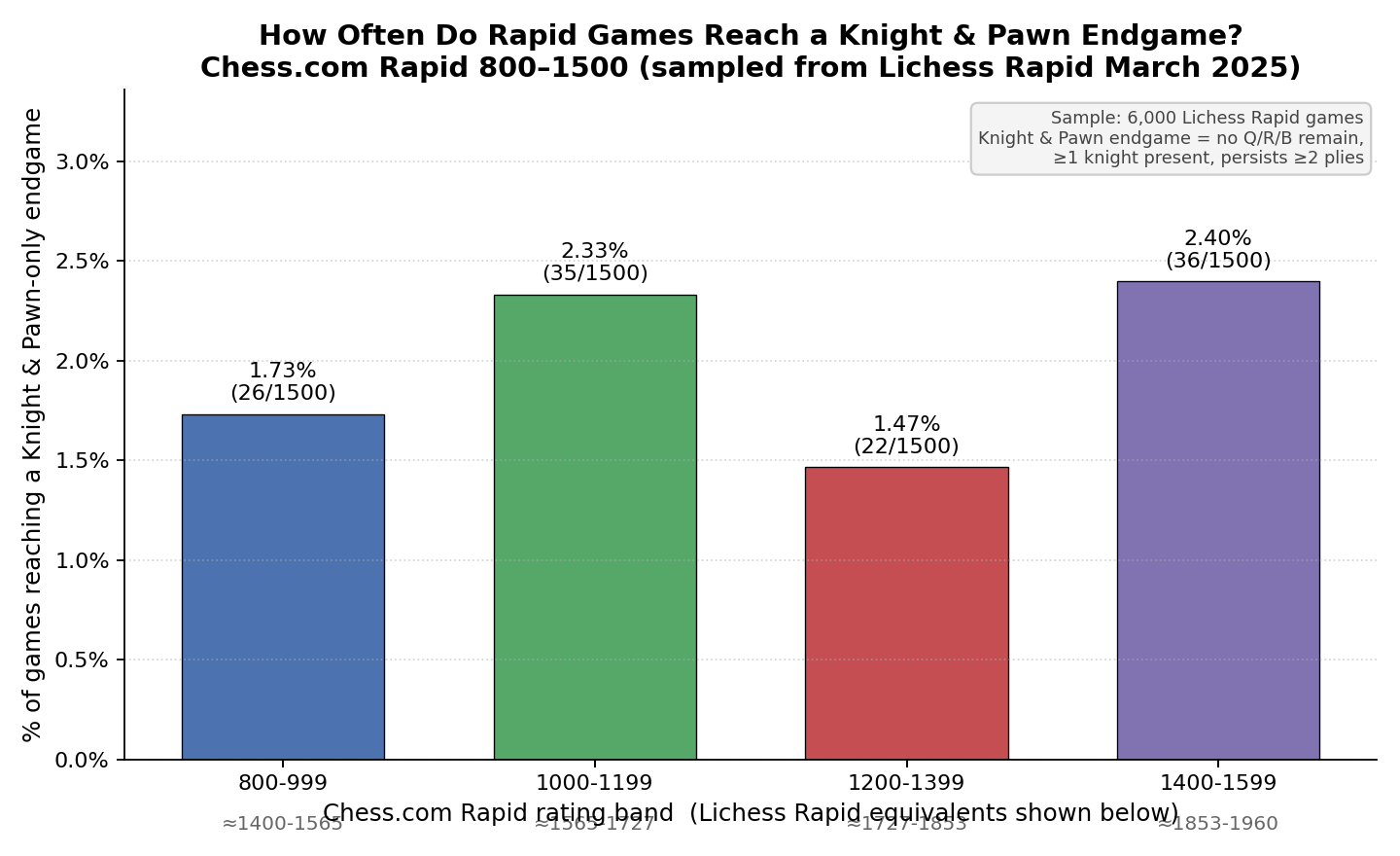
While players rated 1000–1199 and 1400–1599 reach this phase slightly more often (2.33% and 2.40% respectively), the overall frequency remains remarkably low. For context, when looking at the top 20 most common final endgame positions, pure pawn endgames and rook endgames are vastly more prevalent.
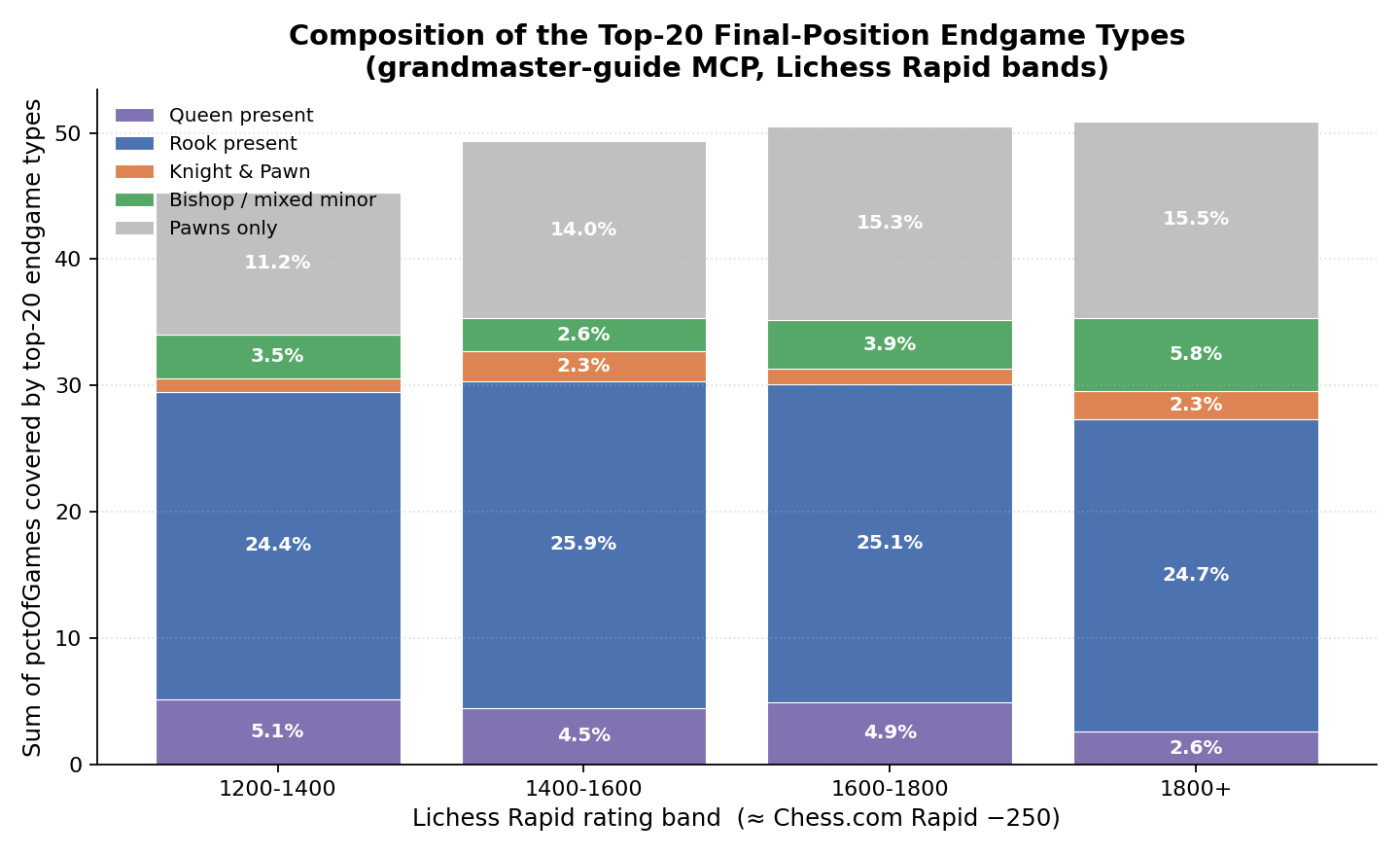
Actionable Advice (800–1199): Do not spend excessive time memorizing complex knight maneuvers or deep Knight & Pawn theory. Your games are overwhelmingly decided by tactics in the middlegame or by basic rook and pawn endgames. Focus your endgame study on King & Pawn fundamentals and basic Rook & Pawn principles.
2. What Does a Knight & Pawn Endgame Look Like?
When these endgames do occur, they rarely feature an equal material balance of one knight per side. At lower ratings, the most common scenario is an unbalanced board where one side has already lost their knight.
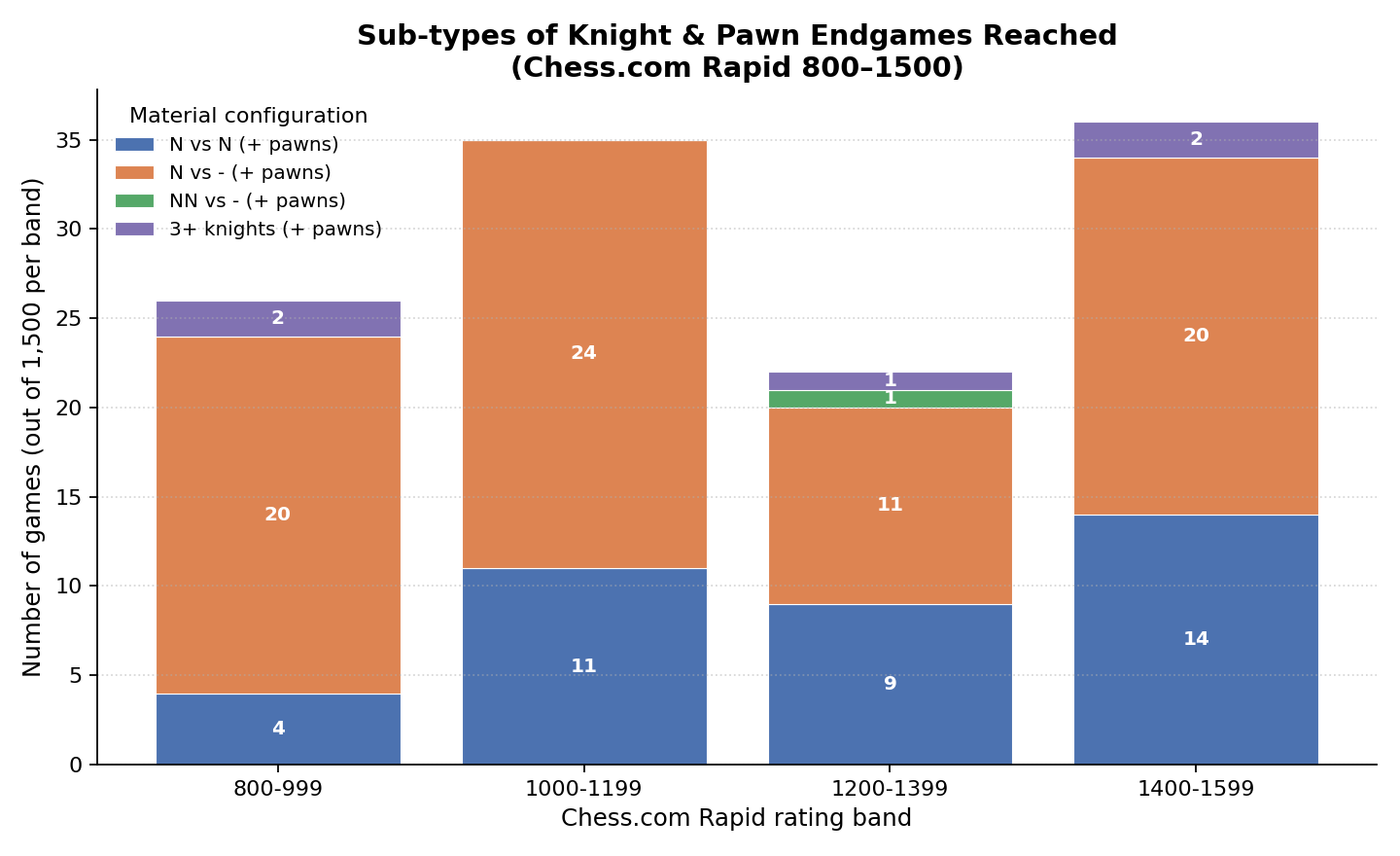
In the 800–999 band, 77% of Knight & Pawn endgames involve a single knight on the board (e.g., Knight + Pawns vs. Pawns). It is only as players approach the 1400–1599 band that "Knight vs. Knight" endgames become a significant portion of the sample (nearly 40%).
Actionable Advice (1200–1500): As you climb past 1200, opponents become better at maintaining material equality into the late game. You will increasingly face Knight vs. Knight scenarios. The key skill here is understanding that knights are terrible at stopping passed pawns on opposite sides of the board. Practice using your knight to blockade passed pawns while activating your king.
3. The Drawish Nature of Knight Endgames
Knight endgames are often compared to pure pawn endgames because, like pawns, knights cannot lose a tempo to triangulate. However, our data reveals a massive spike in draw rates when a Knight & Pawn endgame is reached.
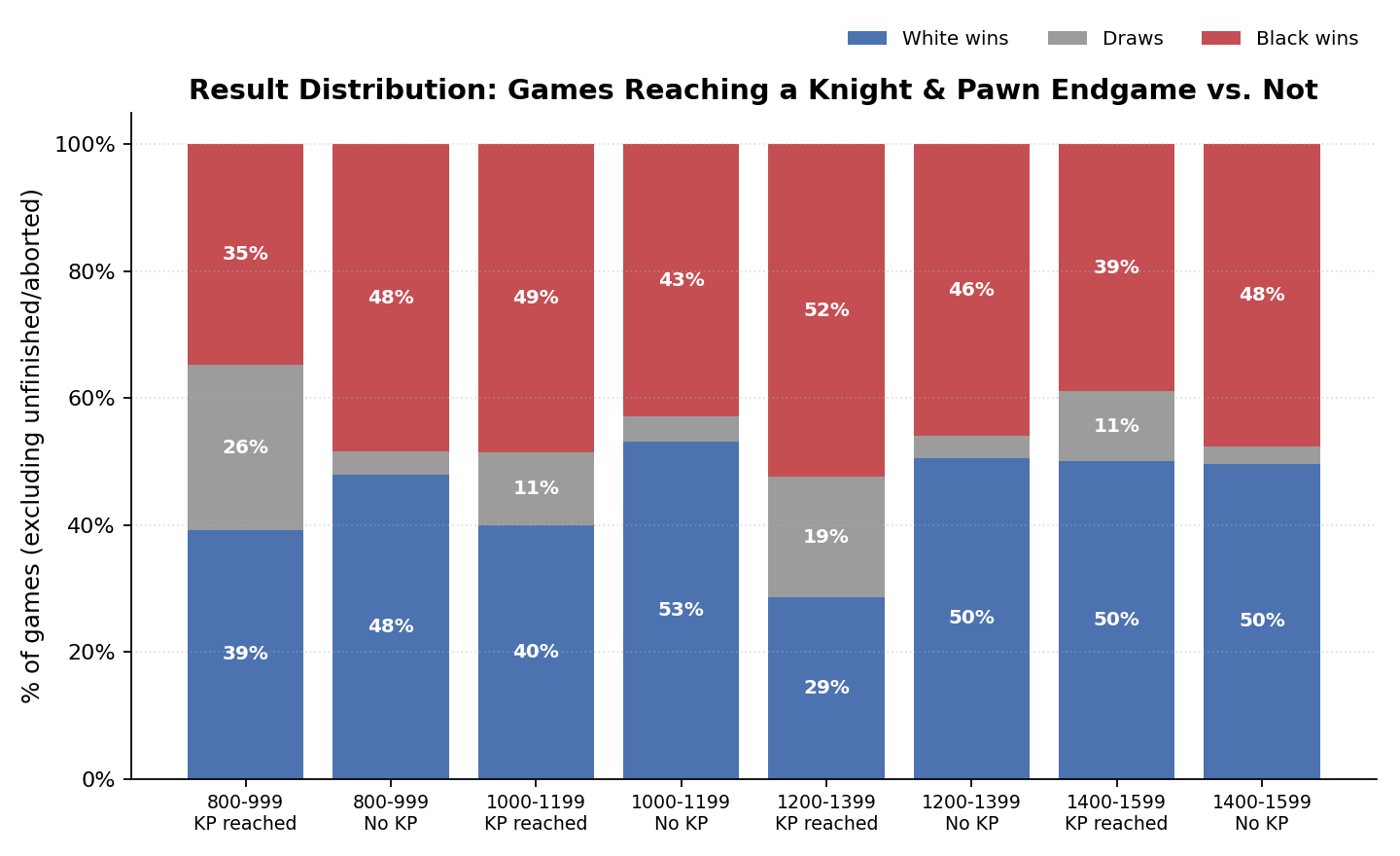
In the 800–999 band, games that do not reach a Knight & Pawn endgame end in a draw only 3.6% of the time. But when a Knight & Pawn endgame is reached, the draw rate skyrockets to 26%. This trend persists across all bands, with Knight & Pawn endgames consistently producing 3 to 7 times more draws than the baseline.
Visual Evidence: The Blunder Factor
Why do these endgames end in draws so often? Knights are short-range pieces that struggle to control multiple areas of the board simultaneously. Players frequently blunder by moving their king or knight to the wrong square, allowing a passed pawn to escape or failing to capture a critical enemy pawn.
Consider this example from a game in the 800–999 band:
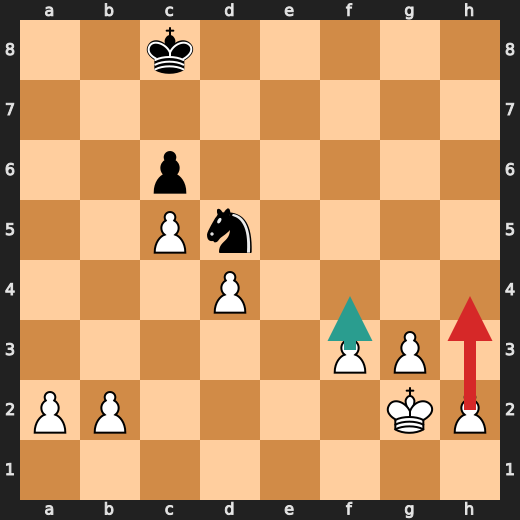
Here, White played h4 (red arrow), pushing the pawn but completely ignoring the threat of the Black king infiltrating. The engine evaluation plummeted by over 1000 centipawns. The correct move was f4 (green arrow), securing the kingside structure and preparing to deal with the centralized Black knight.
Even at higher ratings, the complexity of knight geometry induces errors. In this 1400–1599 game:
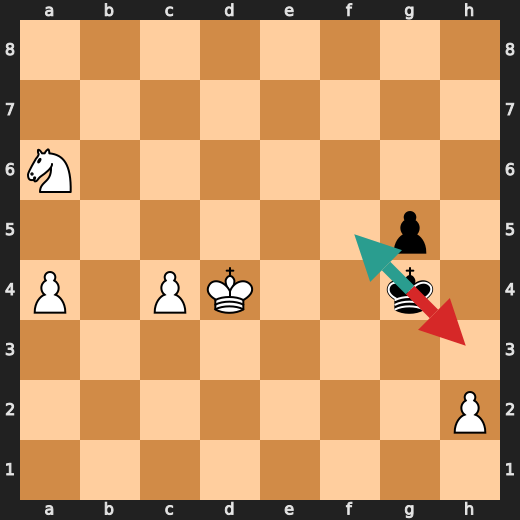
Black played Kh3 (red arrow), stepping away from the action and allowing White's king to dominate the center. The correct move was Kf5 (green arrow), actively challenging White's king and supporting the passed g-pawn.
Actionable Advice (All Ratings): In Knight & Pawn endgames, king activity is paramount. Do not rely solely on your knight to win the game. Use your king to support your pawns and restrict the enemy knight. Furthermore, be hyper-aware of forks; knights thrive on tactical tricks in simplified positions.
4. Timing and Duration
When do these endgames actually begin? On average, the Knight & Pawn phase starts around move 37 to 41.
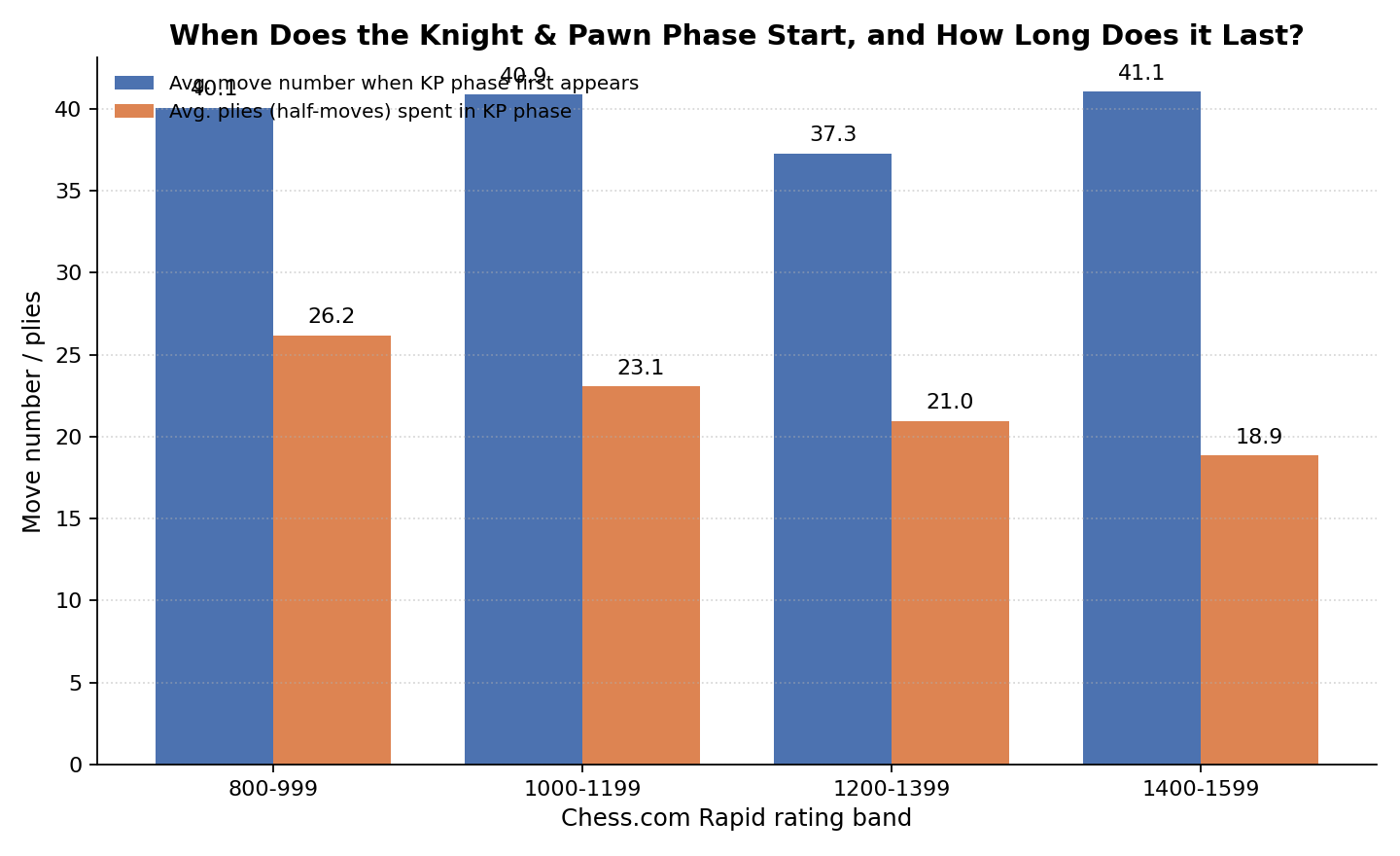
Interestingly, as rating increases, the number of plies (half-moves) spent in this phase decreases. Players in the 800–999 band spend an average of 26.2 plies shuffling pieces, while 1400–1599 players resolve the endgame in just 18.9 plies. Higher-rated players are more decisive—they either convert their advantage quickly or force a clear draw.
Conclusion: A Roadmap for Improvement
The data paints a clear picture of the Knight & Pawn endgame for intermediate players:
- 800–1199: These endgames are rare (<2.5%) and usually involve one side already being up a full piece (Knight vs. Pawns). Do not prioritize studying them. Focus on not blundering full pieces in the middlegame and mastering basic King & Pawn checkmates.
- 1200–1399: You will start seeing more balanced Knight vs. Knight positions. Learn the basic properties of the knight: its inability to lose a tempo, its weakness against edge pawns, and its strength in blockading.
- 1400–1500: The draw rate in these endgames is high. To win them, you must combine precise knight maneuvering with aggressive king activity. Practice calculating concrete lines, as knight forks are the primary tactical weapon in this phase.
Data and Methodology
- Data Source: 6,000 Rapid games sampled from the Lichess March 2025 database via the grandmaster-guide MCP server.
- Rating Calibration: Lichess Rapid ratings were mapped to Chess.com Rapid ratings using standard conversion estimates (e.g., Chess.com 1000 ≈ Lichess 1615).
- Definition: A "Knight & Pawn endgame" was defined as a position where neither side possesses a Queen, Rook, or Bishop, at least one Knight is on the board, and the phase persists for at least 2 plies.
- Engine Analysis: Blunder detection and best-move calculations were performed using Stockfish 14+ evaluations.
Attached Files:
band_summary.csv: Aggregated statistics per rating band.ccm_800_999_kp_endgames.csvtoccm_1400_1599_kp_endgames.csv: Raw game-level data for the analyzed endgames.
Chess Coach — 20 April 2026