If you play bullet chess, you know the feeling: the clock is ticking down to seconds, pieces are flying off the board in a flurry of premoves, and suddenly you are left with just your King and a few pawns. You have a material advantage, but can you convert it before your flag falls?
King and Pawn endgames are the most fundamental of all chess endings, yet they remain a significant stumbling block for players climbing the rating ladder. To understand exactly how these endgames play out in practice, we analyzed a massive dataset of Lichess bullet games, mapping the results to approximate Chess.com rating bands between 500 and 1600. The data reveals fascinating insights into when players actually learn concepts like "the opposition," how often winning advantages are squandered, and why endgame study might be the secret weapon for your next rating milestone.
The Roadmap to Endgame Mastery
This article serves as a data-driven guide to your endgame improvement. We will explore the frequency of these endgames, the critical rating bands where conversion rates jump, and the specific techniques you need to master to stop blundering away half-points.
1. The Inevitability of the Pawn Endgame
It is a common misconception that bullet games rarely reach the endgame. While it is true that many games end in quick checkmates or early time forfeits, the data shows a clear trend: as you improve, you will face endgames more frequently.
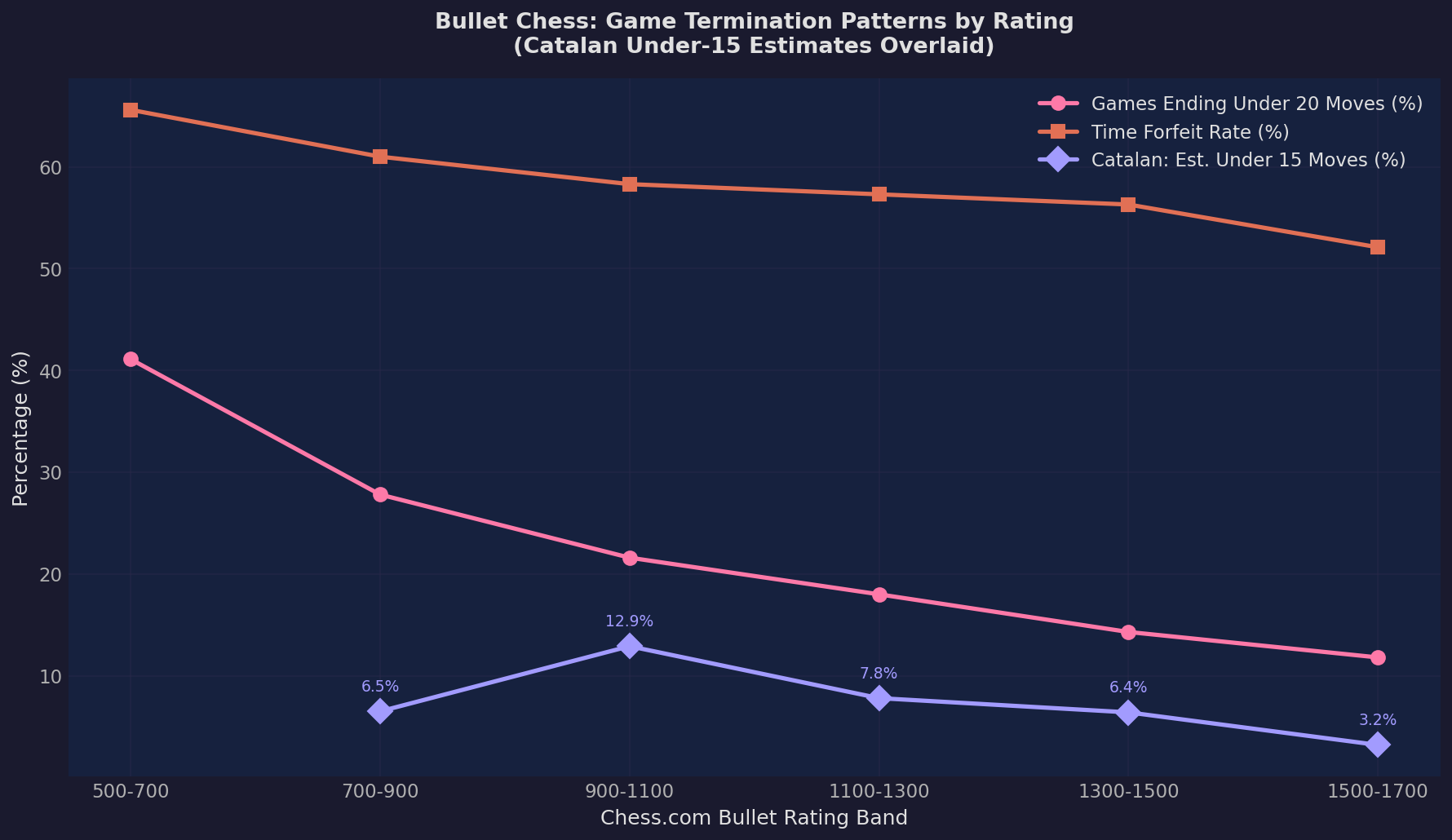
At the Chess.com <500 level, only 5% of games reach move 40 or beyond. However, by the time you reach the 1510-1615 band, nearly 30% of your games will enter the endgame phase. More importantly, when pieces are traded down, pure King and Pawn endgames become increasingly common.
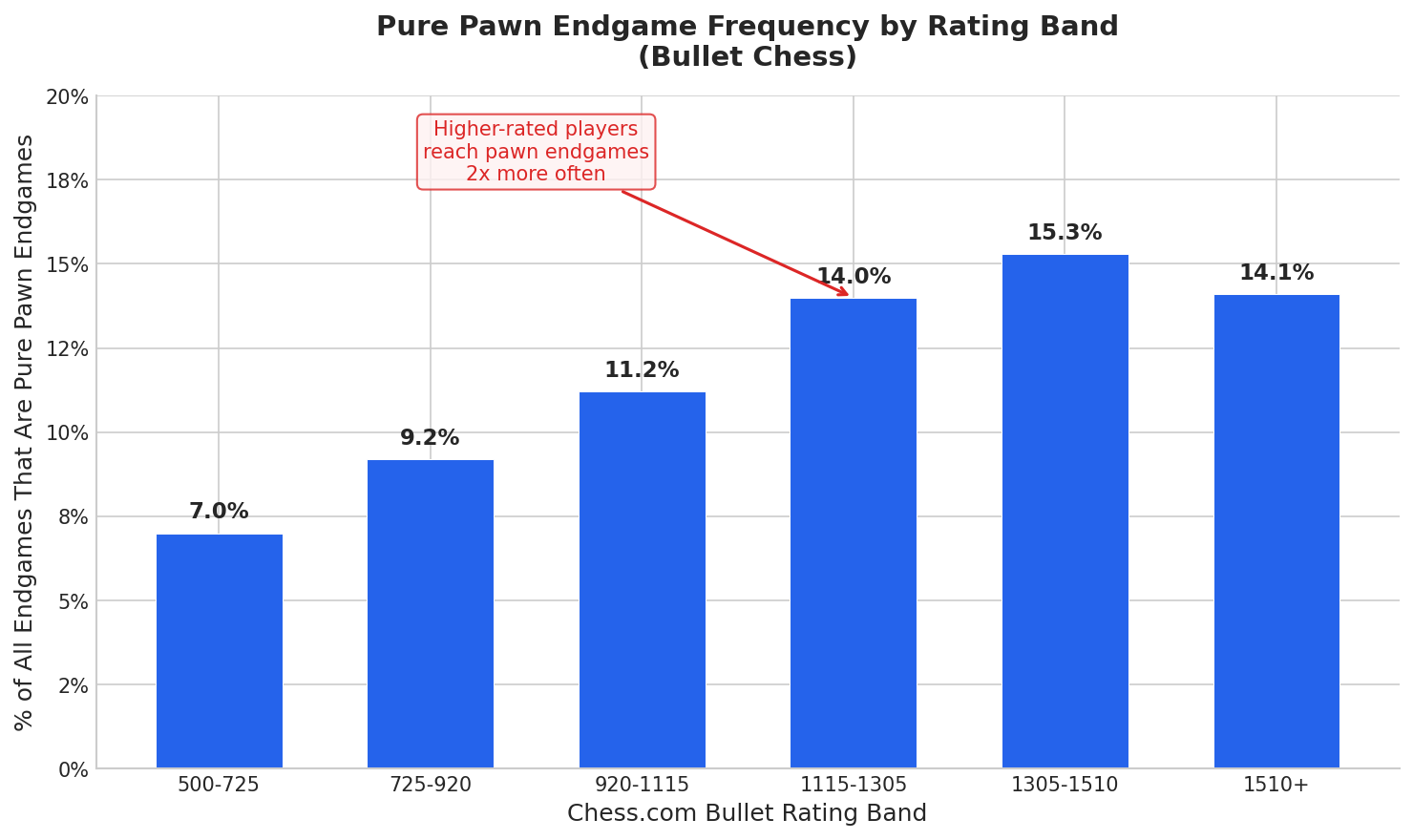
For players in the 500-725 range, pure pawn endgames account for about 7% of all endgames. By the 1305-1510 band, this frequency doubles to over 15%. Higher-rated players are more adept at simplifying into won pawn endgames when they have an advantage, making this specific endgame type a critical battleground.
Actionable Advice (800-1000): Do not assume bullet is just about opening traps and middle-game tactics. You must be prepared to play endgames. Start by ensuring you can quickly and flawlessly execute basic checkmates (King and Queen vs King, King and Rook vs King) so you do not waste time when you successfully promote a pawn.
2. The "Opposition Breakthrough"
The most revealing metric in our analysis is the conversion rate of a specific, common scenario: an endgame where one side has 3 pawns and the other has 2 pawns (a +1 pawn advantage). Mathematically, this is usually a won game for the side with the extra pawn, provided they understand basic concepts like creating a passed pawn and taking the opposition.
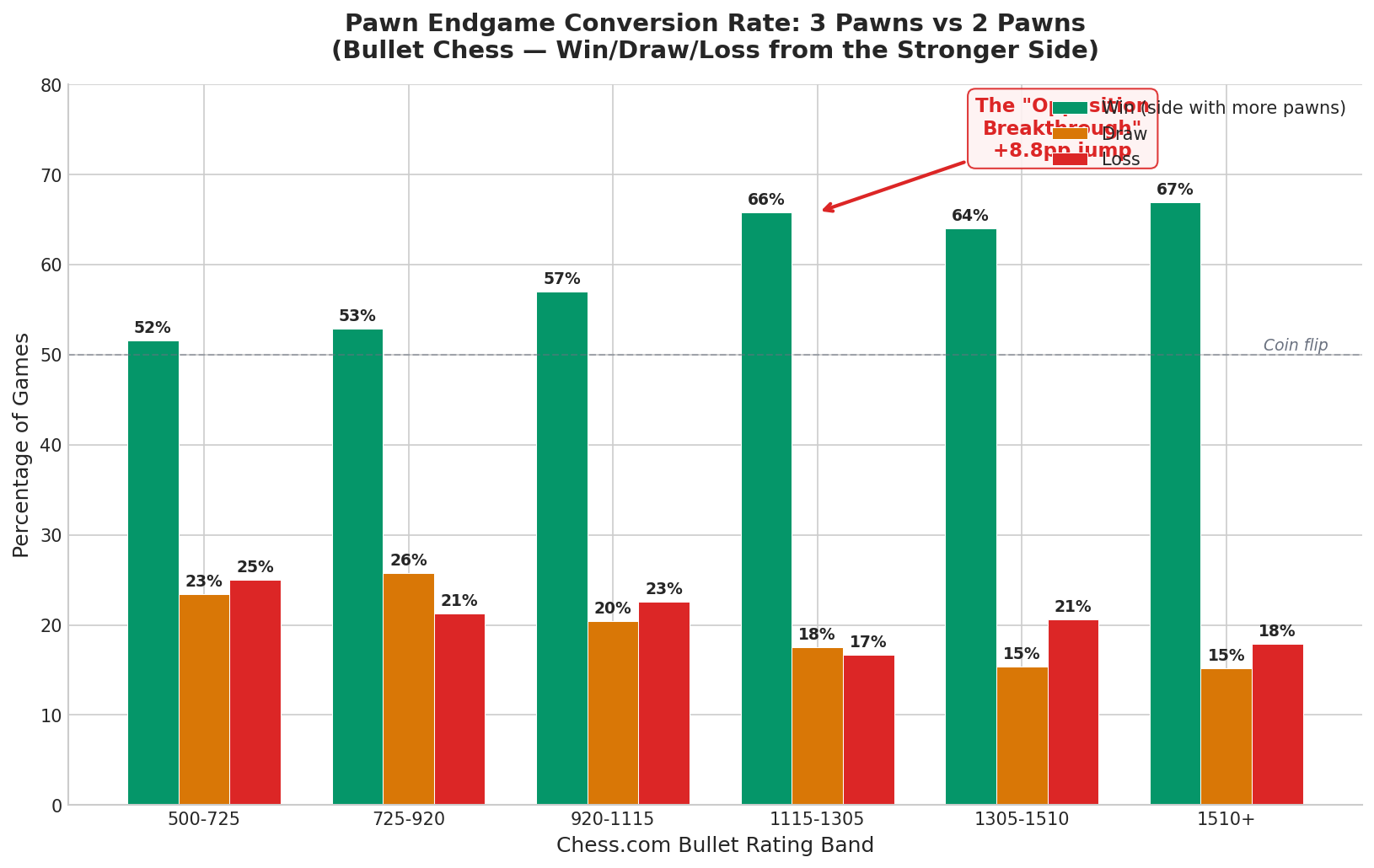
The data shows a stark reality for lower-rated players. In the 500-725 band, having an extra pawn in a 3 vs 2 endgame results in a win only 51.6% of the time—barely better than a coin flip. The opponent draws 23.4% of the time and actually wins 25.0% of the time.
However, look at the massive jump that occurs between the 920-1115 band and the 1115-1305 band. The win rate leaps from 57.0% to 65.8%. This +8.8 percentage point increase is the largest single-band improvement in the dataset. This is the "Opposition Breakthrough"—the rating level where players statistically demonstrate an understanding of key squares and king activity.
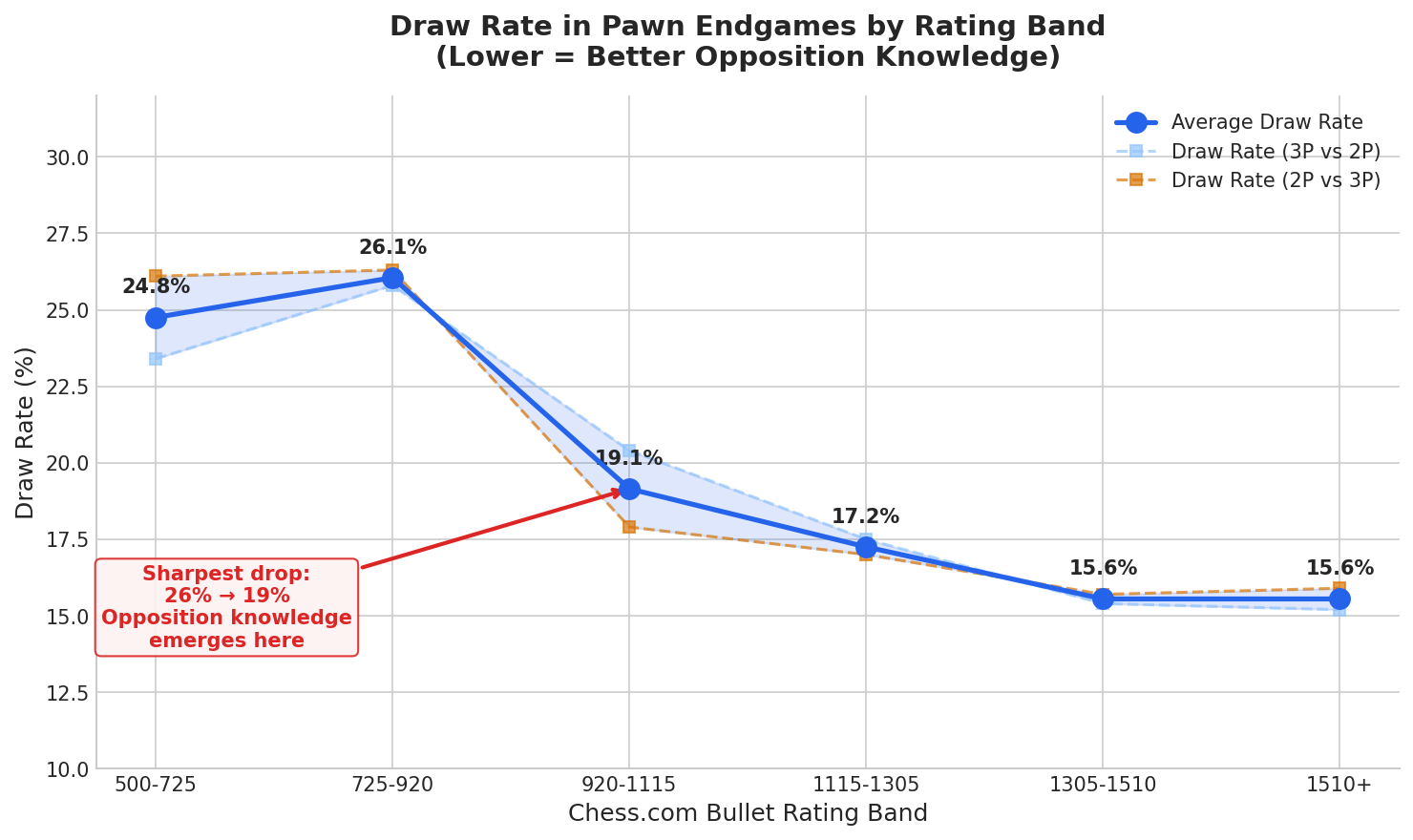
This breakthrough is further evidenced by the sharp drop in draw rates. Draws in pawn endgames often occur because the stronger side allows the defending king to take the opposition, leading to a stalemate or an inability to promote. The draw rate plummets from 26.1% in the 725-920 band to 19.1% in the 920-1115 band, and continues to fall as ratings increase.
Actionable Advice (1000-1200): This is the critical rating band where you must learn "the opposition." If you do not understand how to use your King to outflank your opponent, you are leaving massive amounts of rating points on the table.
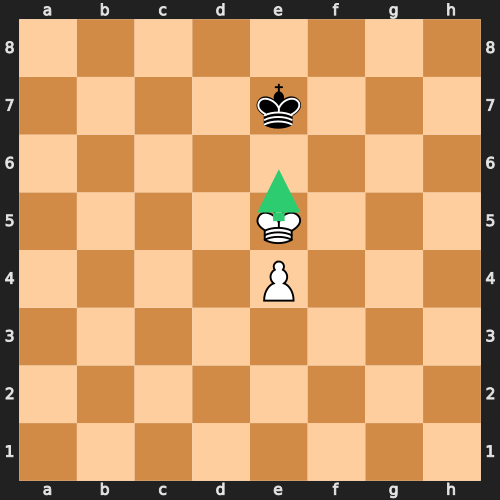
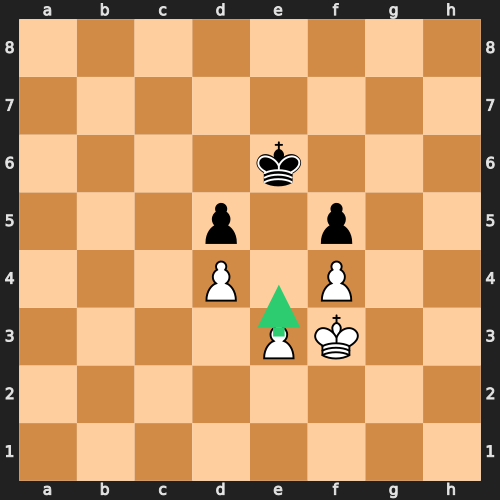
In the position above, White has the opposition. Pushing the pawn immediately with e5? is a common blunder that allows Black to take the opposition with Ke8, leading to a draw. The winning technique is to outflank with Kd6!, controlling the promotion squares.
3. The Blunder Epidemic
While conversion rates improve with rating, the data highlights a sobering fact: endgame play remains the weakest phase of the game across all analyzed rating bands.
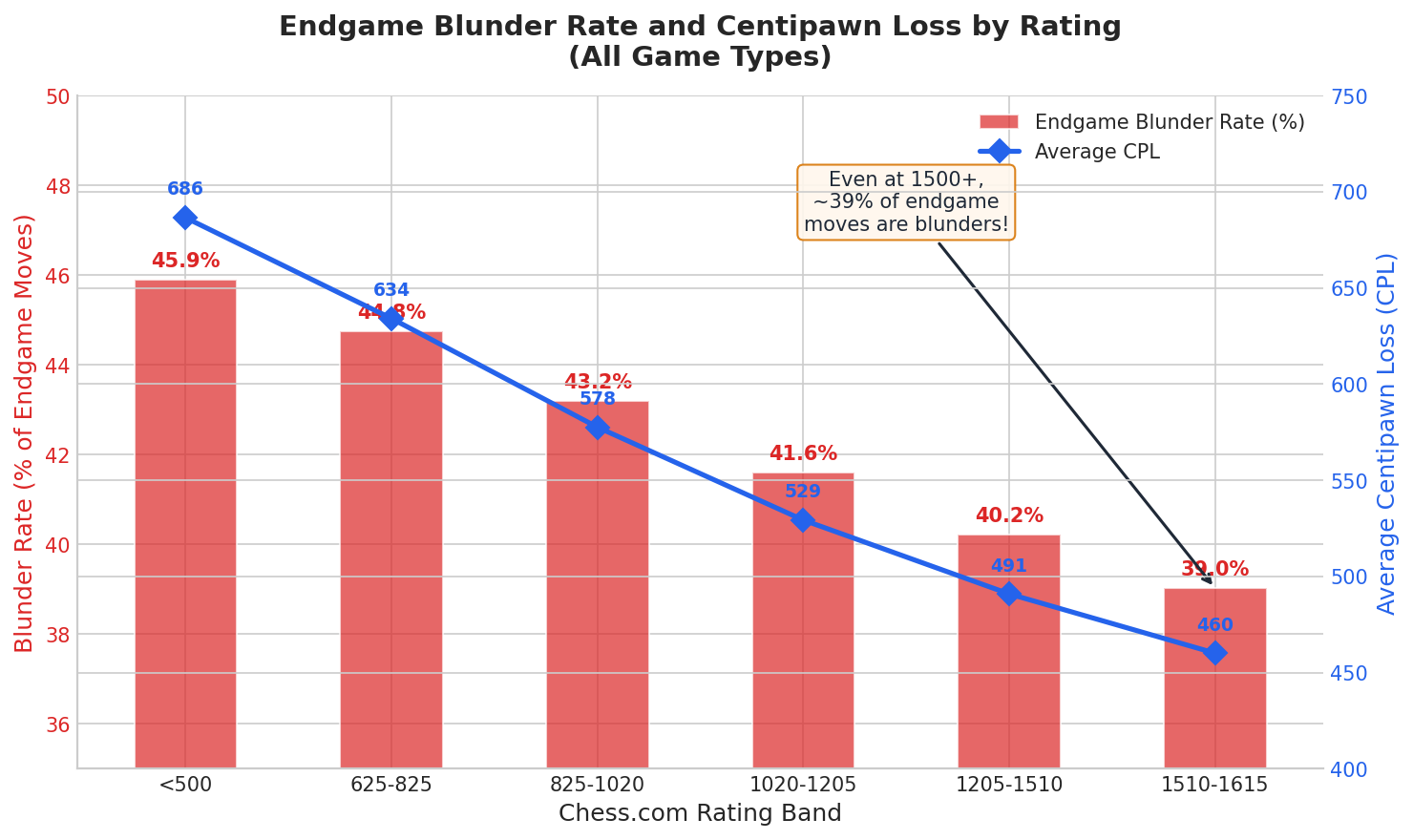
Even in the 1510-1615 band, a staggering 39% of all endgame moves are classified as blunders by the engine. The average Centipawn Loss (CPL) remains incredibly high. In bullet chess, the combination of low time and complex calculation leads to catastrophic errors, even in seemingly simple positions.
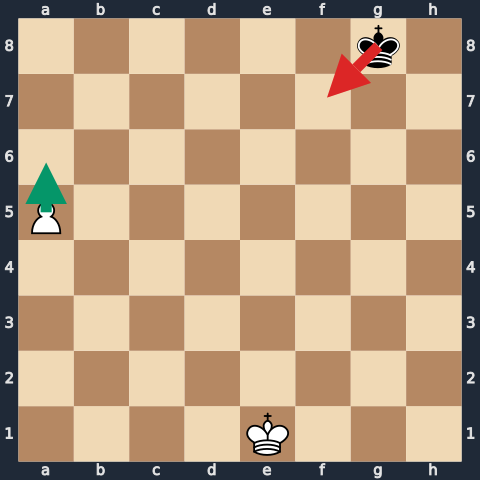
One of the most tragic and common blunders is the stalemate trap. When rushing to promote and checkmate, players frequently trap the enemy king.
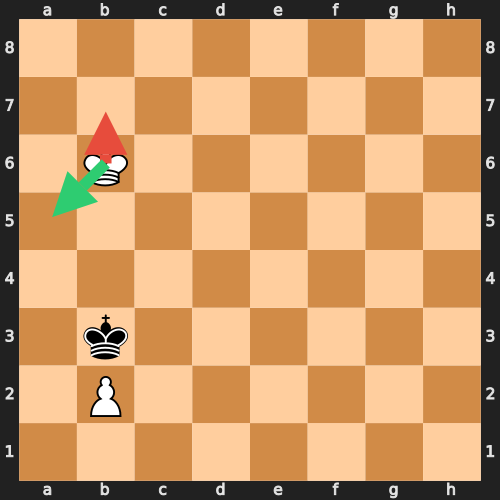
In this classic scenario, White hastily plays a8=Q??, instantly drawing a completely won game. The correct, calm approach is Kb6!, stepping aside to allow the pawn to promote safely on the next move.
Actionable Advice (1200-1400): You know the basic concepts, but your execution under time pressure is flawed. Practice pawn endgames against an engine with a fast time control. Focus on recognizing stalemate patterns instantly so you do not have to calculate them during a game.
4. Material Advantage vs. Technique
How much material do you need to guarantee a win in a bullet endgame? We compared the conversion rates of a 1-pawn advantage (3 vs 2) against a massive 3-pawn advantage (4 vs 1).
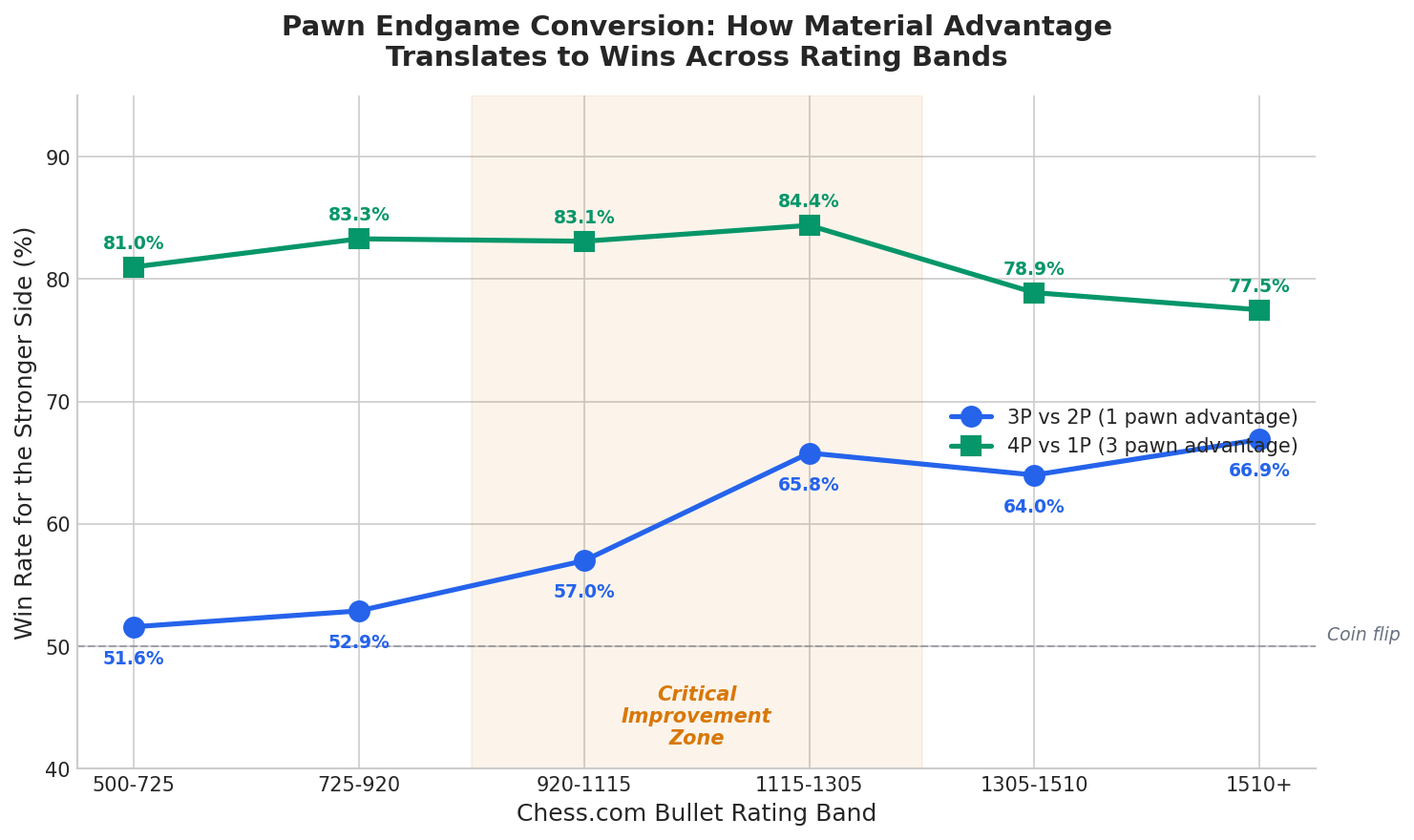
Unsurprisingly, a 4 vs 1 advantage is converted at a much higher rate (around 80% across most bands). However, notice that the conversion rate for the massive advantage actually dips slightly at the highest rating bands (1305+). Why? Because higher-rated defending players are exceptionally resourceful. They know how to create fortresses, sacrifice their lone pawn to create stalemate tricks, or simply flag their opponent in complex positions.
Meanwhile, the conversion of the smaller 1-pawn advantage steadily climbs. This proves that technique eventually outweighs raw material. A 1500-rated player with a 1-pawn advantage is nearly as dangerous as an 800-rated player with a 3-pawn advantage.
Converting these advantages often requires creating a passed pawn. In the position above, White uses the pawn break c5! to force a passed pawn, a technique that becomes second nature to players above 1300.
Actionable Advice (1400-1600): Stop relying on your opponent to blunder. You must learn how to actively create passed pawns using pawn breaks, and you must understand the "Square of the Pawn" rule to know instantly if an enemy king can catch your runner without needing to calculate every step.
Conclusion
King and Pawn endgames are not just theoretical exercises; they are practical battlegrounds that decide thousands of bullet games every day. The data clearly shows that mastering basic concepts like the opposition and passed pawn creation provides a massive statistical advantage, particularly as you cross the 1100 Chess.com rating threshold.
Stop losing won games. Spend a few hours studying pawn endgames, and watch your bullet rating climb.
Chess Coach April 17, 2026
Data and Methodology
This analysis is based on a large dataset of bullet chess games retrieved via the Lichess API. The raw data was categorized by Lichess rating bands and mapped to approximate Chess.com rating equivalents using a standard conversion table (e.g., Lichess 1115 ≈ Chess.com 725; Lichess 1845 ≈ Chess.com 1510).
The analysis focused on pure King and Pawn endgames, calculating frequency, win/draw/loss conversion rates from the perspective of the materially advantaged side, and engine-evaluated blunder rates.
The underlying data files used to generate the charts in this article are available below:
View full data →lichess_band chesscom_band pawn_eg_pct total_eg_games pawn_eg_count 800-1000 500-725 7.0 14764 896 1000-1200 725-920 9.2 15228 1396 1200-1400 920-1115 11.2 15175 1704 1400-1600 1115-1305 14.0 12706 1779 1600-1800 1305-1510 15.3 10175 1560
View full data →lichess_band chesscom_band win draw loss n 800-1000 500-725 51.6 23.4 25.0 188 1000-1200 725-920 52.9 25.8 21.3 520 1200-1400 920-1115 57.0 20.4 22.6 695 1400-1600 1115-1305 65.8 17.5 16.7 701 1600-1800 1305-1510 64.0 15.4 20.6 617
View full data →chesscom_band draw_3v2 draw_2v3 avg_draw 500-725 23.4 26.1 24.75 725-920 25.8 26.3 26.05 920-1115 20.4 17.9 19.15 1115-1305 17.5 17.0 17.25 1305-1510 15.4 15.7 15.55
View full data →lichess_band chesscom_band blunder_pct avg_cpl 700-900 <500 45.89 686.5 900-1100 625-825 44.75 634.1 1100-1300 825-1020 43.19 577.6 1300-1500 1020-1205 41.6 529.3 1500-1800 1205-1510 40.22 490.9
View full data →lichess_band chesscom_band reach_endgame_pct time_forfeit_pct avg_moves n 700-900 <500 5.0 65.6 21.7 34669 900-1100 625-825 8.8 61.0 25.0 41074 1100-1300 825-1020 12.9 58.3 27.4 45388 1300-1500 1020-1205 16.2 57.3 29.0 47397 1500-1800 1205-1510 22.5 56.3 31.2 49779
View full data →chesscom_band endgame_type material_advantage win draw loss n 500-725 3P vs 2P +1 pawn 51.6 23.4 25.0 188 725-920 3P vs 2P +1 pawn 52.9 25.8 21.3 520 920-1115 3P vs 2P +1 pawn 57.0 20.4 22.6 695 1115-1305 3P vs 2P +1 pawn 65.8 17.5 16.7 701 1305-1510 3P vs 2P +1 pawn 64.0 15.4 20.6 617