By Chess Coach
If you play blitz chess, you know the feeling: the clock is ticking down, pieces are flying off the board, and suddenly you are left with just your king and a few pawns. You have a slight material advantage, but with only seconds remaining, panic sets in. Do you push the pawn? Do you move the king?
Many players spend hours studying complex opening theories or intricate middlegame tactics, yet they neglect the most fundamental phase of the game. To understand exactly how important King and Pawn endgames are, and where players go wrong, we analyzed a massive dataset of Lichess Blitz games (calibrated to Chess.com ratings) across various rating bands. The data reveals a clear roadmap for improvement: mastering basic pawn endgames is one of the most efficient ways to climb from the 800 to 1600 rating range.
The Endgame is Where Games are Decided
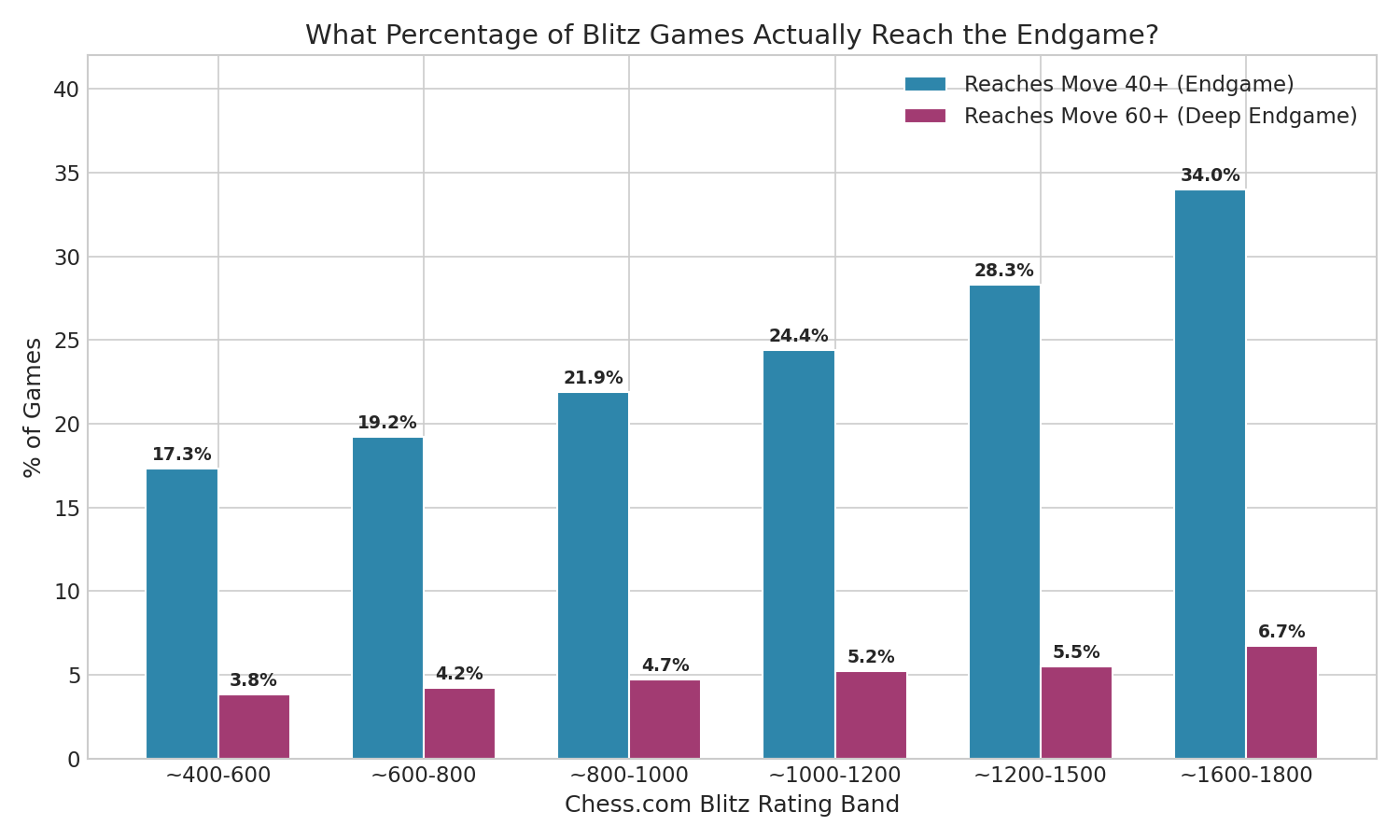
Before diving into pawn endgames specifically, it is crucial to understand the landscape of blitz chess. Our analysis shows that as players improve, their games last longer and reach the endgame more frequently. At the ~400-600 Chess.com level, only 17.3% of games reach move 40. By the time players reach the ~1600-1800 level, 34.0% of games reach this deep stage.
More importantly, the endgame is where the most significant mistakes occur. Across all rating bands, the blunder rate is highest in the endgame phase. For a player rated ~800-1000 on Chess.com, the blunder rate in the opening is a respectable 13.2%, but it skyrockets to 43.2% in the endgame. The average centipawn loss (CPL) follows the exact same pattern, peaking dramatically when the board is nearly empty.
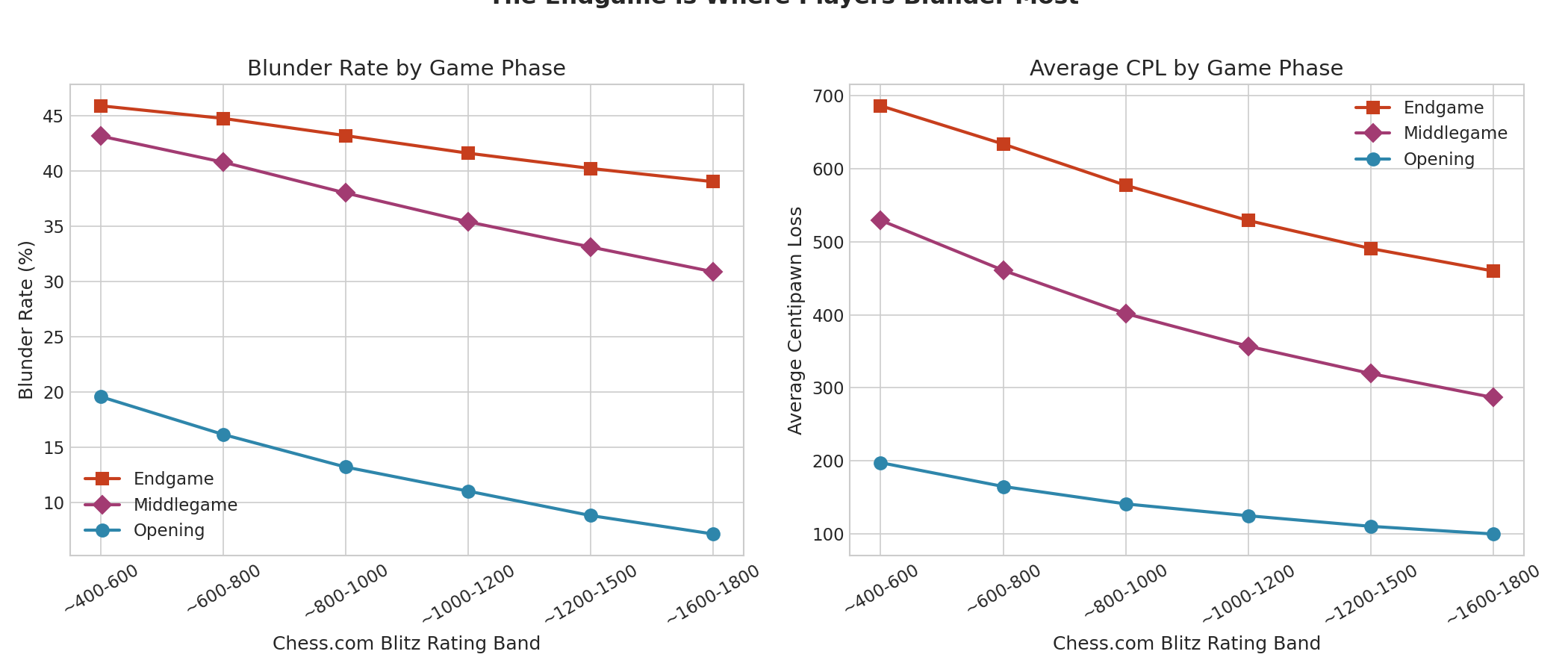
This high error rate is largely driven by time pressure. In blitz, players often reach the endgame with mere seconds on the clock. Our data shows that players in the ~800-1000 range spend an average of just 3.4 seconds per move in the endgame. When you combine complex, calculation-heavy positions with extreme time pressure, blunders are inevitable.
The Frequency of Pawn Endgames
When you do reach an endgame, what type are you most likely to face? Rook endgames are famously the most common, appearing in roughly 28% of all endgames across all rating bands. However, King and Pawn endgames (where no other pieces remain) are the second most frequent, and their prevalence increases significantly as you climb the rating ladder.
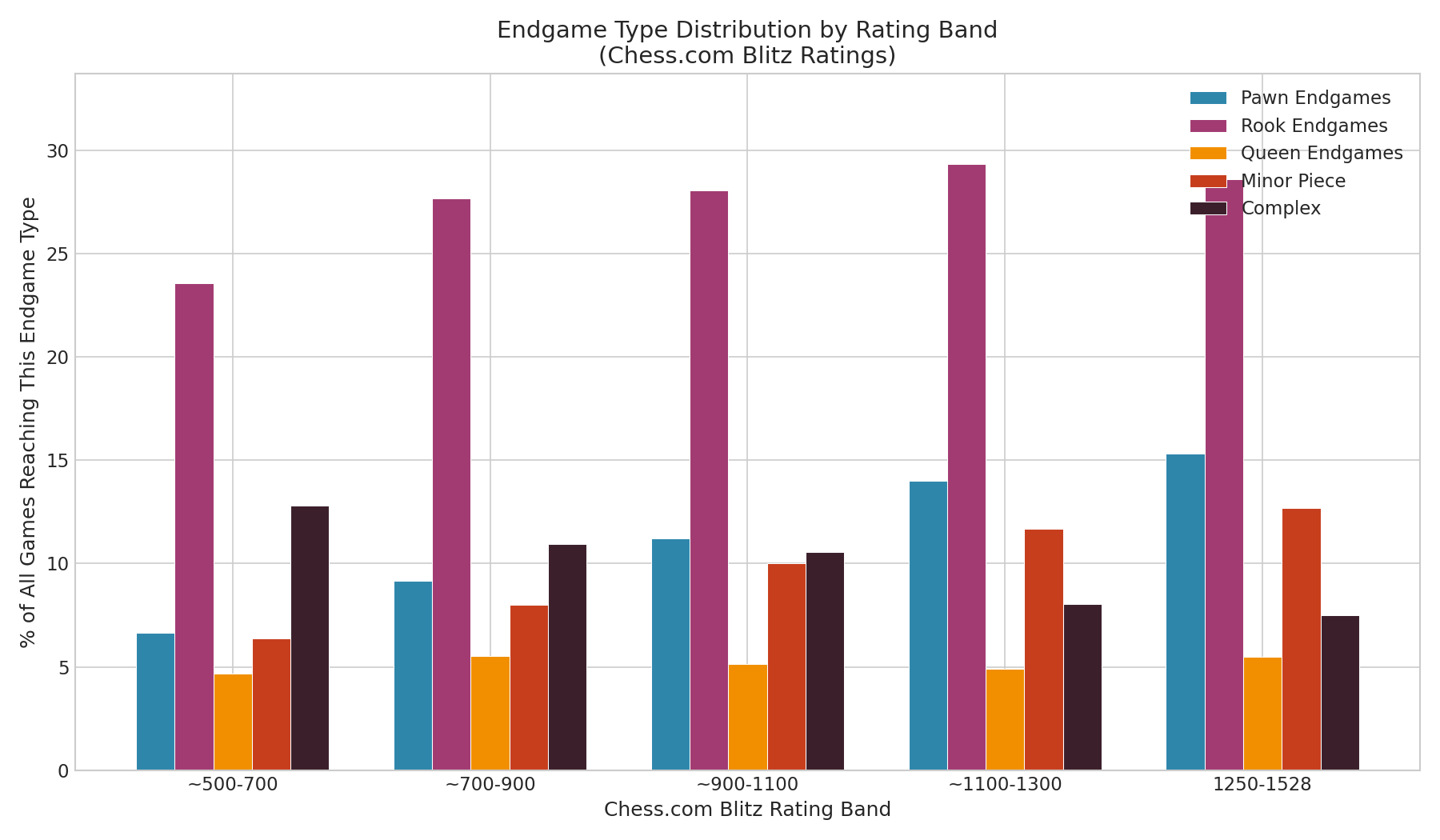
At the ~700-900 Chess.com level, pure pawn endgames account for 9.2% of all endgames. By the ~1250-1528 level, this jumps to 15.3%. This trend makes logical sense: higher-rated players are more adept at trading down into simplified positions when they have an advantage, leading to more pure pawn endings.
The Conversion Problem: Why Being Up a Pawn Isn't Enough
The most striking finding from our data is how poorly players convert material advantages in pawn endgames. If you reach a King and Pawn endgame with a material advantage (e.g., you have an extra pawn), you should theoretically win the vast majority of the time. However, the reality of blitz chess is far less forgiving.
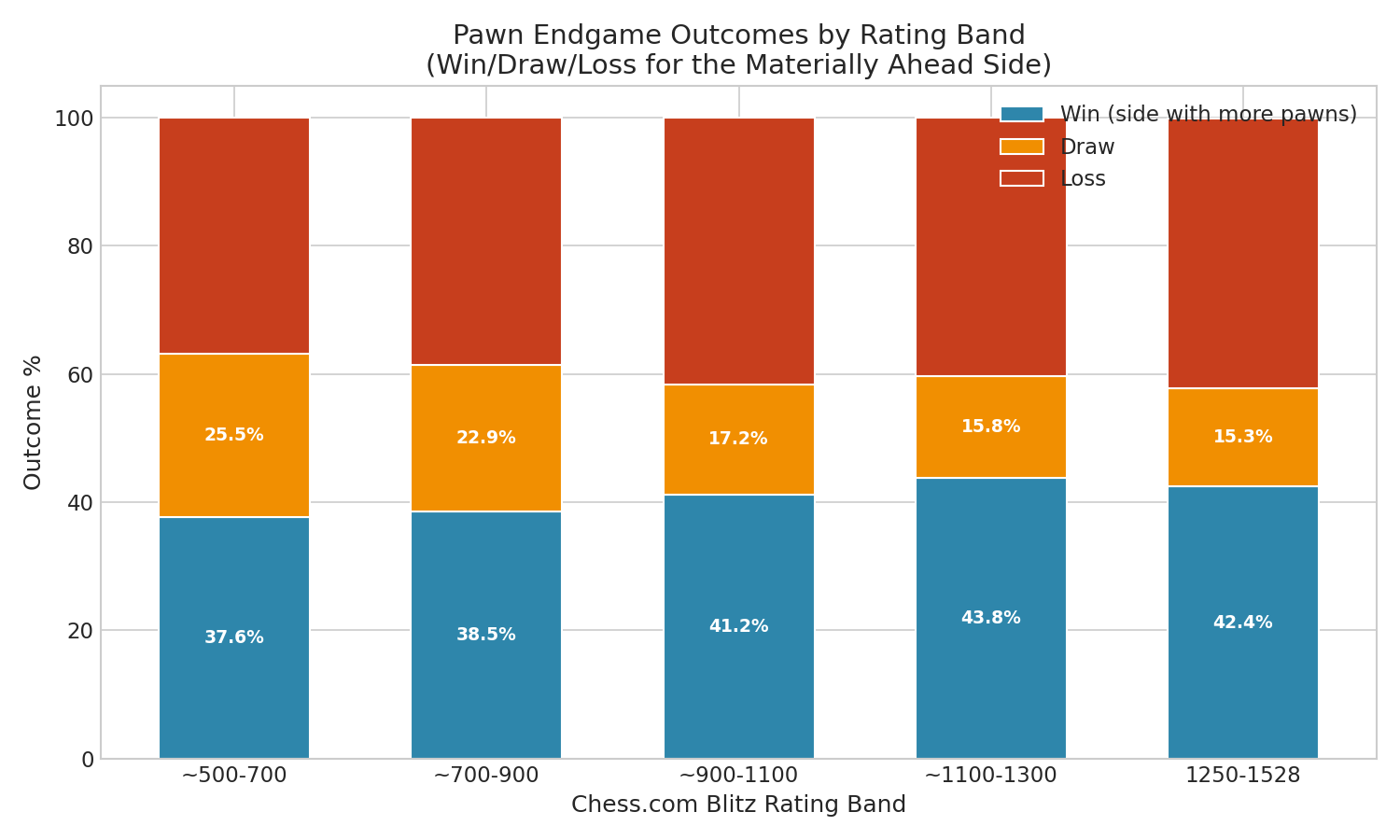
At the ~700-900 Chess.com level, the player with the material advantage in a pawn endgame wins only 38.5% of the time. They actually lose 38.6% of the time, meaning they are just as likely to blunder the game away as they are to win it! Even at the ~1100-1300 level, the win rate only climbs to 43.8%, with a staggering 40.4% loss rate.
Why is conversion so difficult? The answer lies in the precise, unforgiving nature of pawn endgames. Unlike middlegames where a slight inaccuracy might just worsen your position slightly, a single misstep in a King and Pawn endgame often flips the evaluation from +5.0 to 0.0 (a draw) or even to a forced loss.
The Stalemate Trap
One of the most common ways lower-rated players fail to convert a winning pawn endgame is through stalemate. When rushing to promote a pawn, players often forget to ensure the enemy king has a legal move.
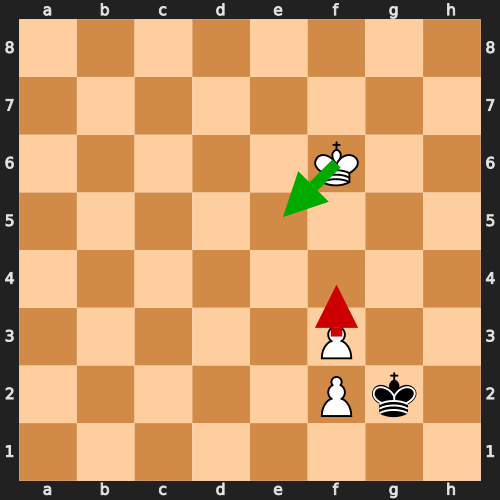
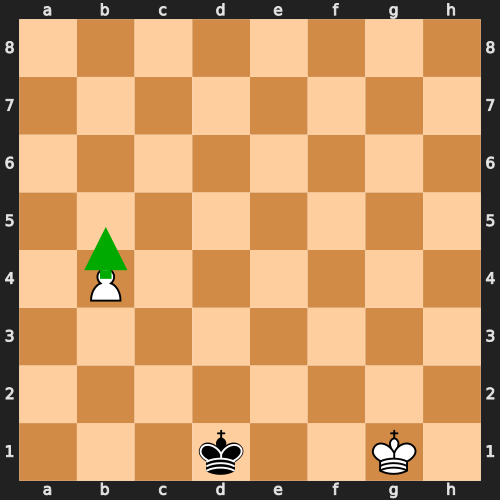
In the position above, White is completely winning. However, a rushed pawn push (f4) immediately stalemates the Black king. The correct approach is to activate the king first (Ke5), controlling the key squares and escorting the pawn safely to promotion.
Mastering "The Opposition"
The concept of "the opposition" is the absolute foundation of King and Pawn endgames. It refers to the situation where the two kings face each other on the same file or rank, with an odd number of squares between them. The player who does not have to move is said to "have the opposition," as they can dictate the movement of the enemy king.
Our data provides a fascinating proxy for when players begin to understand this concept. We looked at the draw rate in pawn endgames across rating bands. Counterintuitively, the draw rate decreases as rating increases. At the ~500-700 level, 25.5% of pawn endgames are drawn. By the ~1250-1528 level, this drops to 15.3%.
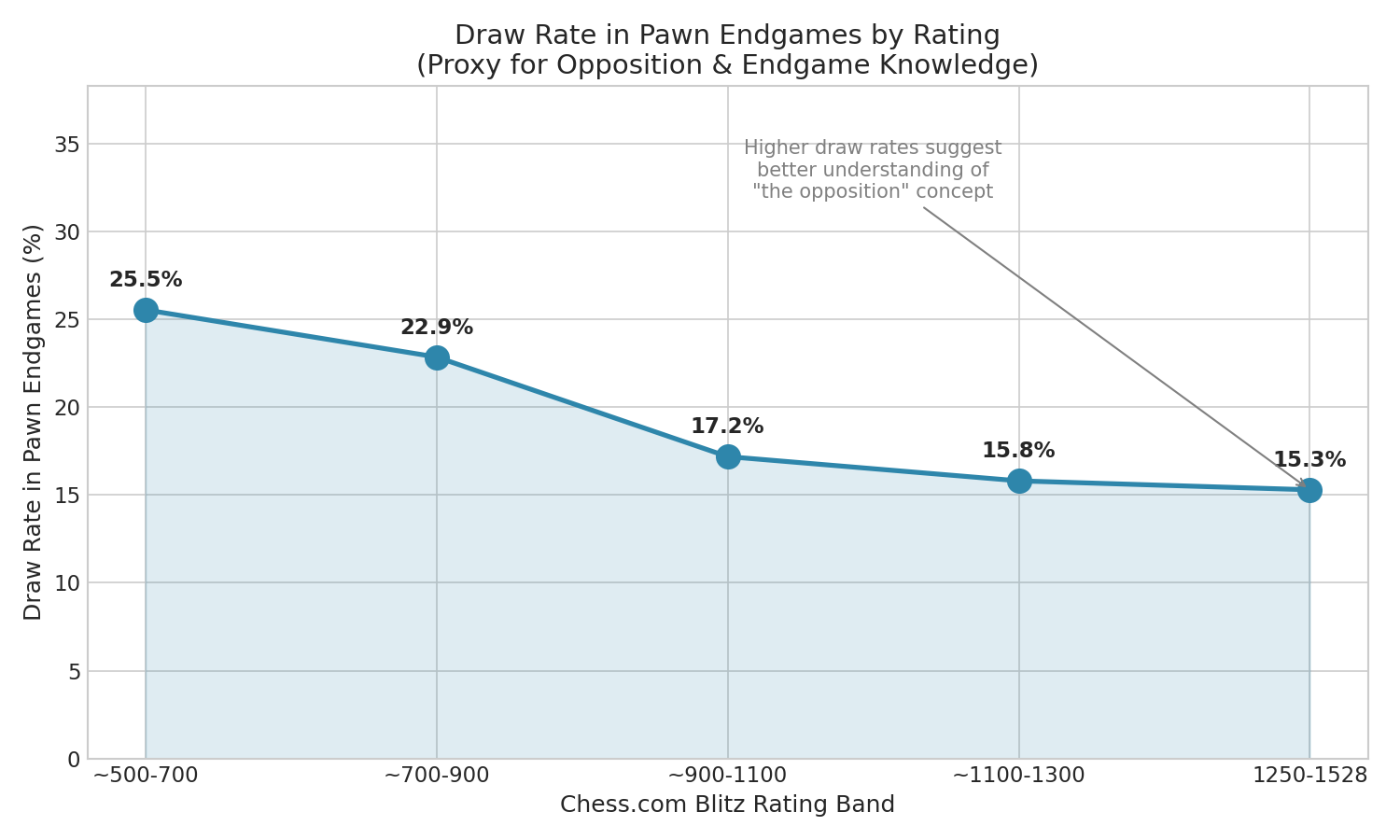
Why do lower-rated players draw more often? It is not because they are defending brilliantly. Rather, it is because the player with the advantage fails to execute the winning technique, often resulting in a stalemate or a drawn position due to a lack of progress. The stabilization of the draw rate around the ~1100-1300 Chess.com mark suggests this is the rating band where players begin to consistently apply concepts like the opposition to force wins.
The Opposition in Practice
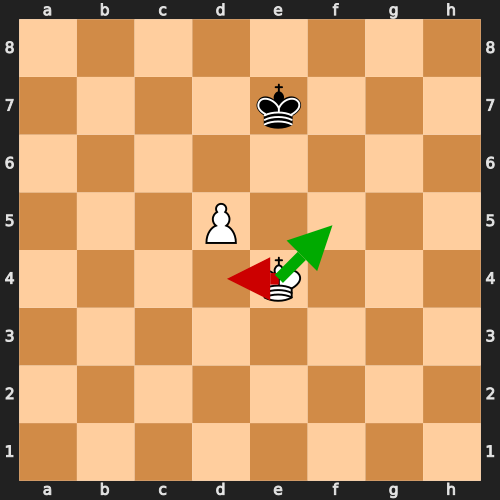
Consider the classic King and Pawn versus King endgame.
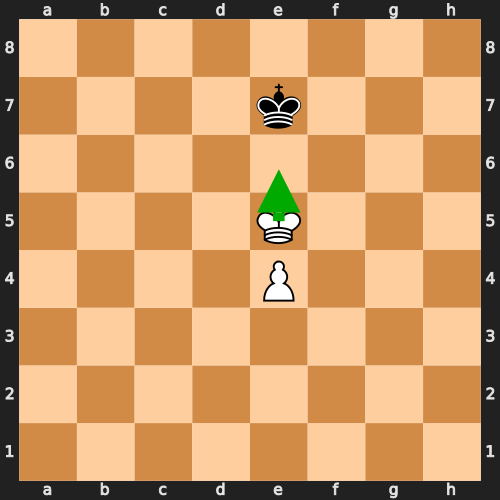
In this position, White has the opposition. By moving the king forward (Ke6), White forces the Black king to give way, securing control of the promotion square for the pawn.
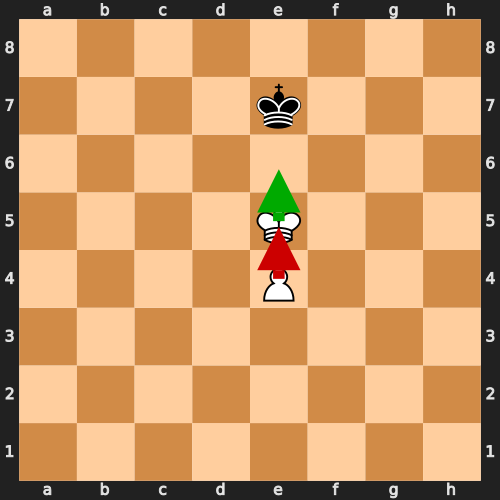
However, a very common blunder is to push the pawn too early (e5). This immediately surrenders the opposition. Black simply steps back, and White can no longer force the pawn through without allowing a stalemate or losing the pawn. The golden rule is: King in front of the pawn!
Actionable Advice by Rating Band
Based on the data, here is a roadmap for improving your endgame play, tailored to your current Chess.com rating.
~500-900: Stop the Blunders
At this level, you are losing almost 40% of the pawn endgames where you have a material advantage. Your primary goal is to stop giving away half-points.
- Action: Learn the basic checkmates (King and Queen vs King, King and Rook vs King). If you can't execute these quickly, you will struggle to finish games even after promoting a pawn.
- Action: Beware of stalemate. Always ask yourself, "If I make this move, does my opponent have a legal move?" before pushing a pawn near the enemy king.
- Action: Learn the "Square of the Pawn" rule. You need to instantly know if your king can catch an enemy passed pawn without calculating every step.
~900-1200: Master the Fundamentals
You are reaching the endgame more often, but your conversion rate is still hovering around 40%. It is time to learn the foundational concepts.
- Action: Master "The Opposition." You must know how to take the opposition and how to use it to outflank the enemy king.
- Action: Understand "Key Squares." For every pawn, there are specific squares your king must reach to guarantee promotion, regardless of whose turn it is. Learn where these squares are.
~1200-1600: Advanced Techniques and Speed
At this level, your opponents will not simply blunder their pawns away. You need to squeeze wins out of slight advantages and do it quickly.
- Action: Practice "Triangulation." Sometimes you need to lose a tempo to force your opponent into a bad position. Triangulation is the art of taking three moves to reach a square you could have reached in two, effectively passing the turn to your opponent.
- Action: Drill endgames against the computer. Set up basic King and Pawn endgames and play them against Stockfish with 30 seconds on your clock. You must build the muscle memory to execute these wins automatically, without burning precious time.
Conclusion
King and Pawn endgames may seem dry compared to a flashy middlegame sacrifice, but they are the bedrock of chess mastery. The data clearly shows that players across the 800-1600 rating spectrum are leaving massive amounts of rating points on the table by failing to convert these fundamental positions. By dedicating just a small portion of your study time to mastering the opposition, key squares, and avoiding stalemates, you will find yourself winning games you previously drew, and drawing games you previously lost.
Chess Coach April 17, 2026
Data and Methodology
This analysis was conducted using a dataset of over 300,000 Lichess Blitz games, accessed via the Grandmaster Guide API. The raw data was categorized by Lichess rating bands and subsequently mapped to approximate Chess.com Blitz ratings using a standard conversion table to ensure relevance for the target audience.
The analysis focused specifically on endgame phases, defined as positions occurring after move 40 or when material is significantly reduced. "Pawn endgames" were strictly defined as positions where only Kings and Pawns remained on the board.
The underlying data files generated during this research are attached below for further review:
View full data →ratingBand category count pct chesscom_band 1000-1200 complex_endgame 1669 10.95 ~700-900 1000-1200 minor_piece_endgame 1219 8.01 ~700-900 1000-1200 pawn_endgame 1396 9.16 ~700-900 1000-1200 queen_endgame 841 5.53 ~700-900 1000-1200 rook_endgame 4218 27.7 ~700-900
View full data →ratingBand winPct drawPct lossPct totalSamples chesscom_band 1000-1200 38.54048442906574 22.85121107266436 38.61937716262976 1445.0 ~700-900 1200-1400 41.17116357504216 17.182743114109048 41.63546936481169 1779.0 ~900-1100 1400-1600 43.80565312843029 15.803841931942921 40.38062568605928 1822.0 ~1100-1300 1600-1800 42.41548507462687 15.294402985074628 42.17014925373134 1608.0 1250-1528 1800+ 42.76102337334176 15.33831332912192 41.892293114339864 3166.0 1800+
View full data →ratingBand phase avgCpl blunderPct chesscom_band 700-900 endgame 686.5 45.89 ~400-600 900-1100 endgame 634.1 44.75 ~600-800 1100-1300 endgame 577.6 43.19 ~800-1000 1300-1500 endgame 529.3 41.6 ~1000-1200 1500-1800 endgame 490.9 40.22 ~1200-1500
View full data →ratingBand pctReaching40Plus pctReaching60Plus chesscom_band 700-900 17.3 3.8 ~400-600 900-1100 19.2 4.2 ~600-800 1100-1300 21.9 4.7 ~800-1000 1300-1500 24.4 5.2 ~1000-1200 1500-1800 28.3 5.5 ~1200-1500