The Italian Game (1.e4 e5 2.Nf3 Nc6 3.Bc4) is one of the oldest and most popular chess openings. It teaches fundamental principles—controlling the center, developing pieces actively, and preparing to castle—while offering sharp attacking lines like the Fried Liver Attack and the Evans Gambit. But a common question arises among improving players: Does the Italian Game perform better when you have time to calculate in Rapid, or when you rely on instinct and traps in Bullet?
To answer this, we analyzed over 900,000 games from the Lichess database, focusing on the performance of the Italian Game across Bullet, Blitz, and Rapid time controls. We specifically targeted players with Chess.com ratings between 800 and 1500, breaking the data down into 200-point bands to provide actionable advice for your climb up the rating ladder.
The Big Picture: White's Expected Score
The data reveals a surprising truth: The Italian Game is a highly effective weapon across all time controls, but its absolute edge is actually largest in Blitz and Rapid, not Bullet.
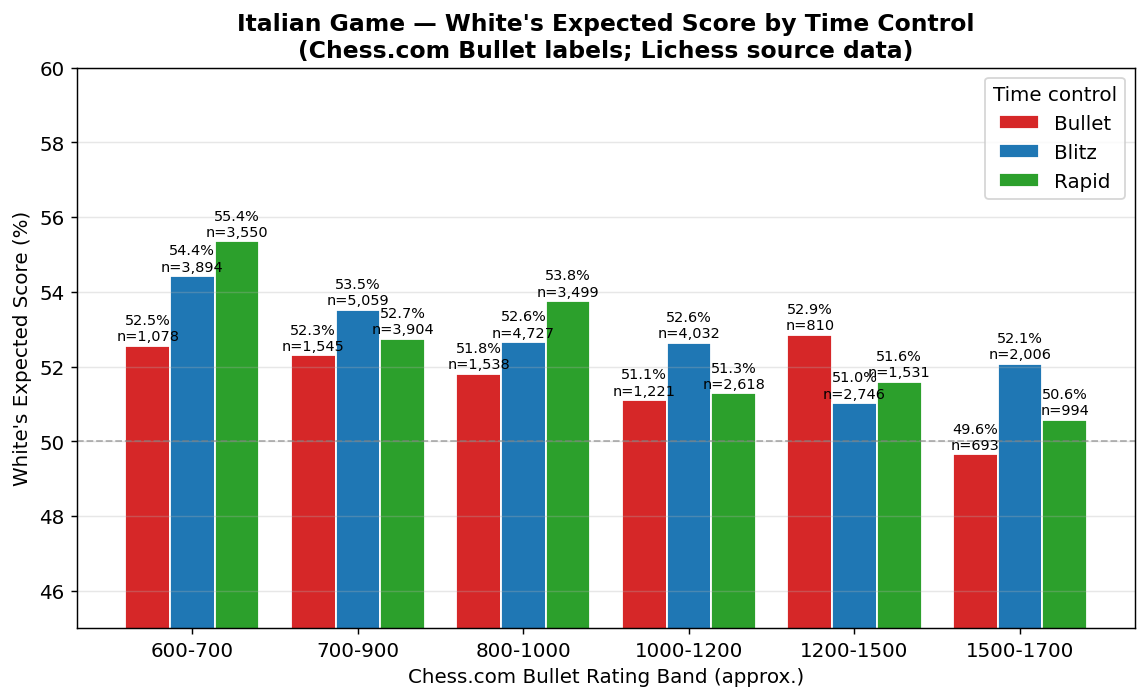
As the chart above illustrates, White's expected score (win percentage plus half the draw percentage) consistently stays above 50% for the Italian Game across the 800–1500 rating spectrum. However, the performance in Bullet slightly trails behind Blitz and Rapid in almost every rating band.
Why does an opening known for its sharp traps perform slightly worse in the fastest time control? The answer lies in the nature of the Italian Game's complexity. While it contains early tactical pitfalls, the most potent attacking plans—such as the Greco Attack or the slow maneuvering of the Giuoco Pianissimo—require precise calculation and execution. In Bullet, players often lack the time to find the critical breakthrough moves, allowing Black to survive the opening phase and equalize the game.
The Decisiveness Factor: Draws vs. Wins
One of the most significant differences between time controls is the draw rate. Bullet chess is inherently more decisive than Rapid chess, simply because players are more likely to flag (run out of time) or blunder catastrophically before a drawn endgame can be reached.
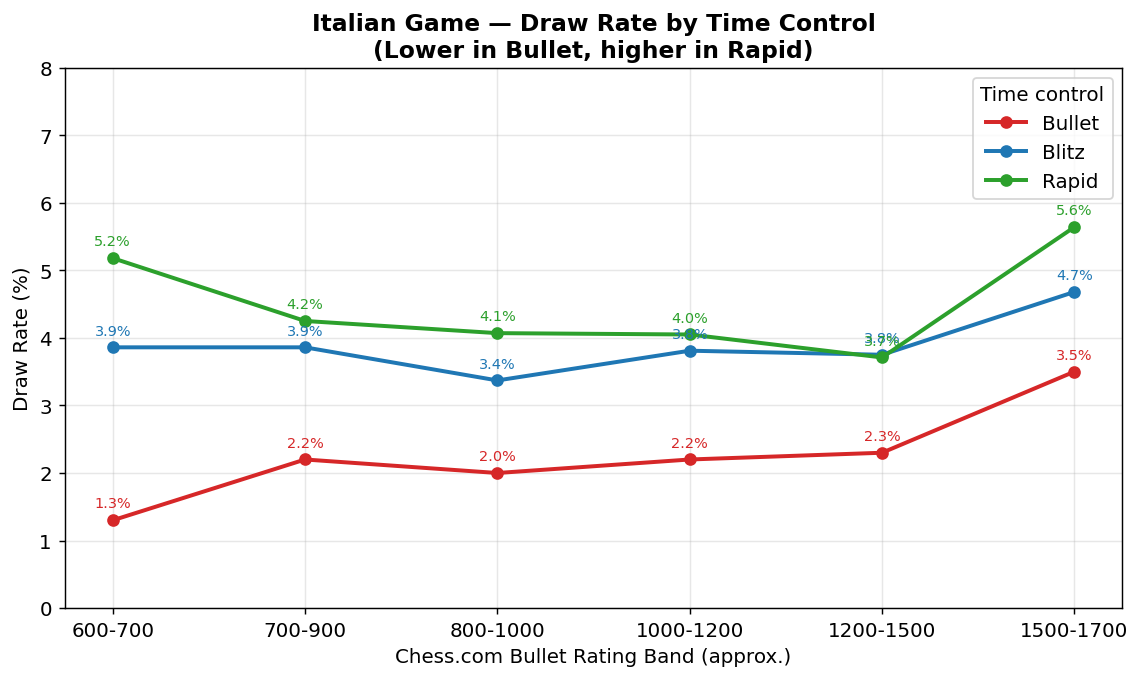
The draw rate in Bullet hovers around 2%, whereas in Rapid, it climbs to 4–5%. This means that when you play the Italian Game in Bullet, you are almost guaranteed a decisive result.
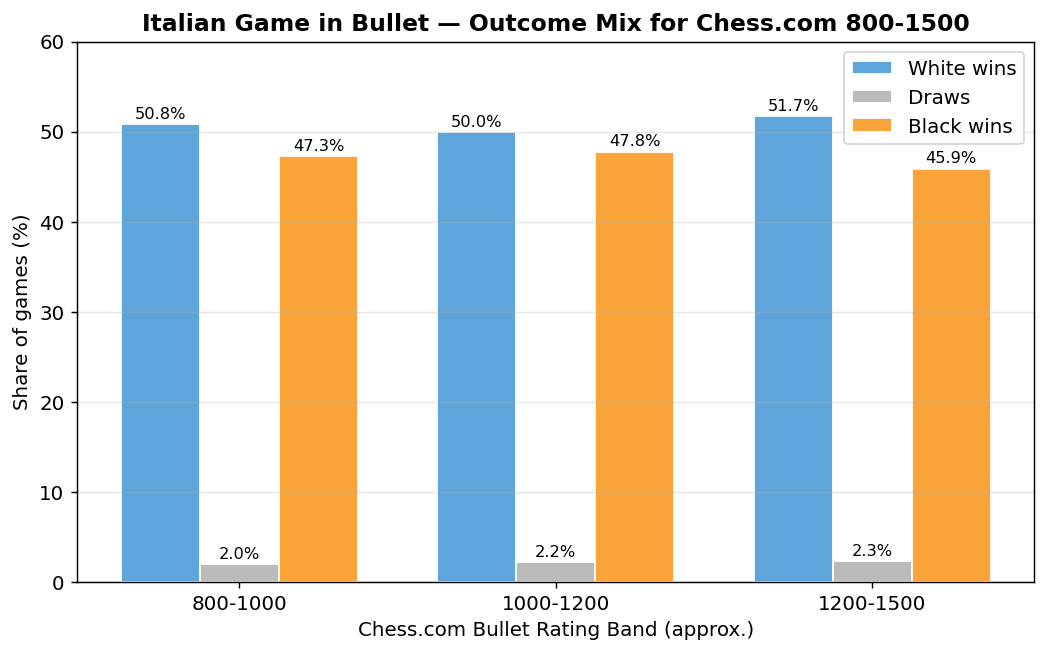
Looking specifically at the Bullet outcome mix for our target rating bands, we see that White maintains a healthy win rate of around 50–51%, while Black wins 46–48% of the time. The low draw rate amplifies the importance of avoiding early blunders, as there is rarely a chance to steer a lost position into a draw by repetition or perpetual check.
Move Quality Context: Centipawn Loss and Blunders
To understand why the results differ, we must look at the overall quality of play. We analyzed the Average Centipawn Loss (CPL) and the number of blunders (moves that drop the evaluation by 300 centipawns or more) per game.
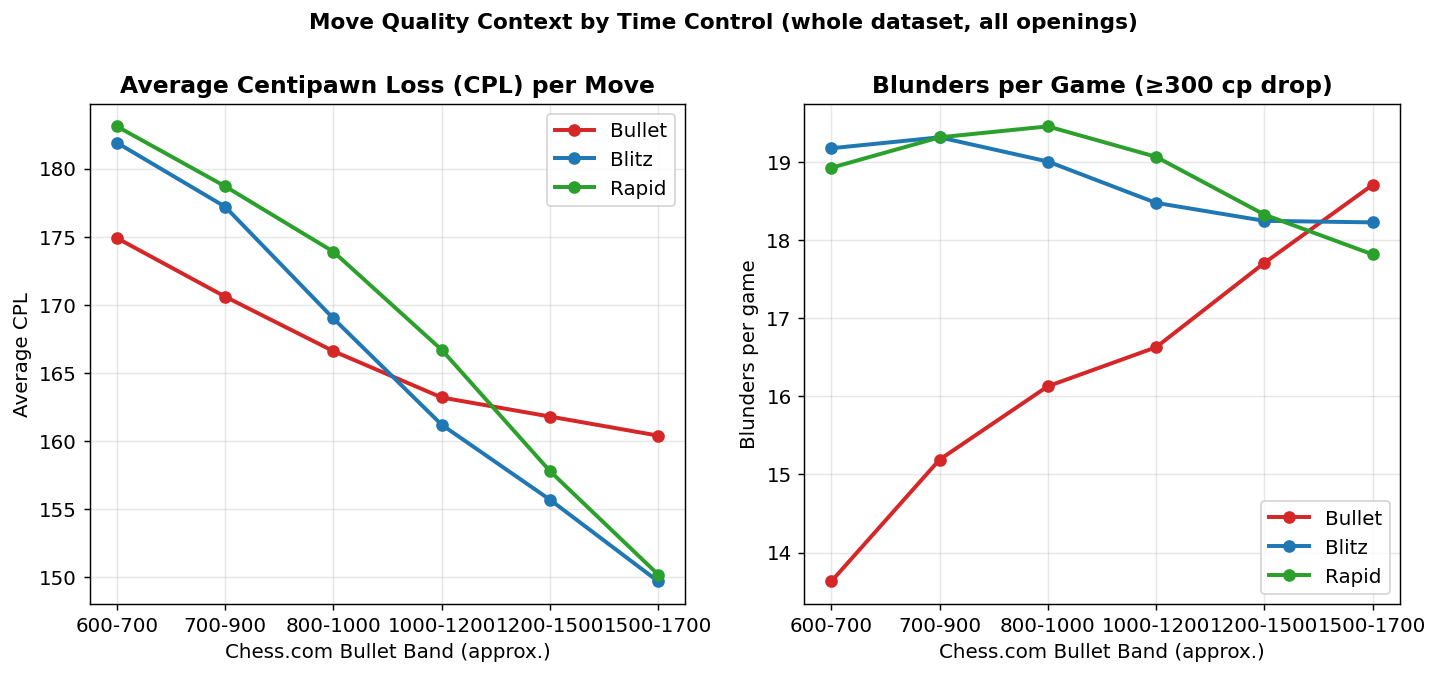
Interestingly, Bullet games actually show a lower Average CPL at the 800–1200 rating bands compared to Blitz and Rapid. This seems counterintuitive—shouldn't faster games be less accurate? The explanation is that Bullet games at these levels are often decided very quickly by a single massive blunder or a timeout, meaning the average move quality across the entire game isn't dragged down by long, complex, error-prone endgames.
However, as ratings increase past 1200, the blunder rate in Bullet climbs sharply, surpassing Rapid. This indicates that as players get better at surviving the opening, the time pressure of Bullet forces more critical errors in the middlegame and endgame.
Actionable Advice by Rating Band
Based on the data, here is a roadmap for utilizing the Italian Game as you climb the Chess.com rating ladder from 800 to 1500.
The 800–1000 Band: Capitalize on Early Mistakes
At this level, the Italian Game is a powerhouse. Your opponents will frequently fall into known traps or play passive, inaccurate moves.
The Data: White scores an impressive 51.8% in Bullet and 53.8% in Rapid. The blunder rate is high across the board.
Actionable Advice: Focus on the sharpest, most forcing lines. The Fried Liver Attack (1.e4 e5 2.Nf3 Nc6 3.Bc4 Nf6 4.Ng5) is incredibly potent here. Many players with Black will incorrectly play 5...Nxd5 instead of the critical 5...Na5.
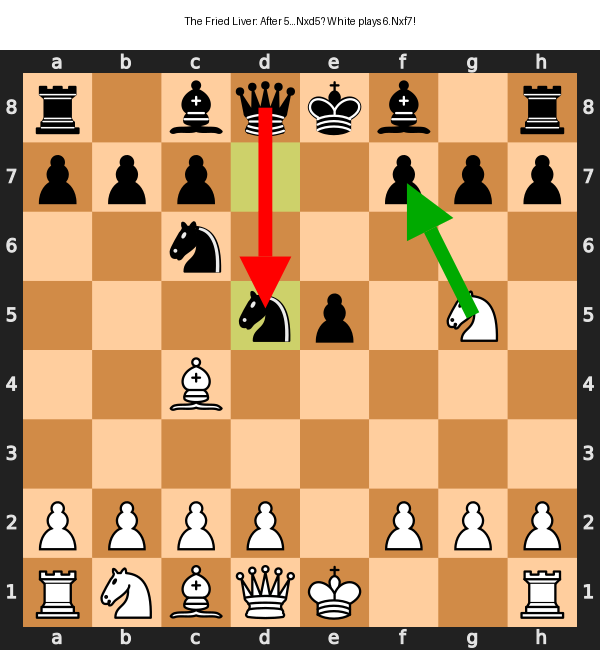 In the Two Knights Defense, Black's 5...Nxd5 (red arrow) is a common mistake at this level. White should immediately strike with the Fried Liver sacrifice 6.Nxf7! (green arrow), exposing the Black king.
In Bullet, simply knowing the first 6–7 moves of these sharp lines will win you games on the spot or give you a massive time advantage.
The 1000–1200 Band: Transitioning to the Middlegame
As you cross the 1000 threshold, opponents become more familiar with the basic traps. The game will more frequently transition into a complex middlegame.
The Data: White's edge narrows slightly (51.1% in Bullet, 51.3% in Rapid). The blunder rate in Bullet begins to rise significantly compared to the lower bands.
Actionable Advice: You can no longer rely solely on early opening traps. You must understand the typical middlegame plans of the Giuoco Pianissimo (the "Very Quiet Game"). A common inaccuracy for Black under time pressure is to pin the f3 knight prematurely.
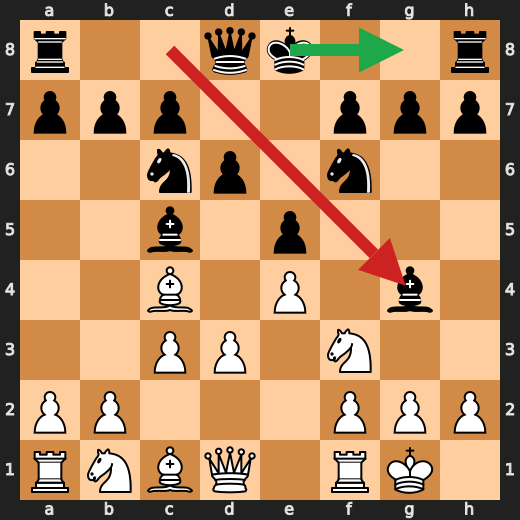 In the Giuoco Pianissimo, Black's early ...Bg4 (red arrow) is often inaccurate before White has castled. The engine prefers simply castling (green arrow). White can exploit this with h3 and g4, launching a kingside attack.
In Bullet, use these typical inaccuracies to launch quick, intuitive attacks. In Rapid, take the time to prepare the classic c3 and d4 pawn break in the center.
The 1200–1500 Band: Mastering the Tension
At this level, players have a solid grasp of opening principles. The Italian Game becomes a battle of maneuvering and maintaining tension.
The Data: White's score in Bullet actually spikes to 52.9%, while Rapid sits at 51.6%. This is the one band where Bullet performance outshines Rapid, likely because the complex maneuvering required in the Italian Game is very difficult to execute perfectly with only 60 seconds on the clock.
Actionable Advice: To maintain your edge, you need to introduce variations that take your opponents out of their comfort zone. The Evans Gambit (1.e4 e5 2.Nf3 Nc6 3.Bc4 Bc5 4.b4) is an excellent choice here. It sacrifices a pawn for rapid development and central control, creating immense practical problems for Black, especially in Bullet.
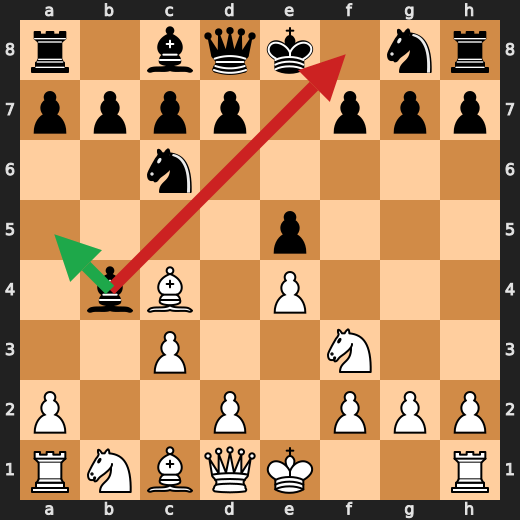 After accepting the Evans Gambit, Black must play precisely. The retreat 5...Bf8 (red arrow) is too passive. The main line 5...Ba5 (green arrow) is required to maintain the balance. White gets massive compensation against passive retreats.
In Bullet, the initiative gained from the Evans Gambit is often worth more than the sacrificed pawn. In Rapid, you must be prepared to prove your compensation through accurate attacking play.
Conclusion
Does the Italian Game perform better in Bullet or Rapid? The data shows that while it is a formidable weapon in both, its highest expected scores are generally found in Blitz and Rapid. The complexity of the Italian Game rewards players who have the time to calculate its sharp attacks and intricate maneuvers.
However, in the 1200–1500 range, the sheer difficulty of defending against the Italian Game's pressure makes it exceptionally strong in Bullet as well. By understanding the typical mistakes your opponents make at each rating band and adjusting your opening choices accordingly, you can use the Italian Game to fuel your climb up the rating ladder.
Data and Methodology
Data Source: The analysis is based on a sample of over 900,000 games retrieved from the Lichess database via the grandmaster-guide analytics API. The dataset includes games played in Bullet, Blitz, and Rapid time controls.
Rating Calibration: Because the raw data is sourced from Lichess, we applied a calibration mapping to approximate Chess.com ratings, which are the primary focus of this article. The mapping adjusts Lichess ratings downwards by approximately 200–300 points for Bullet/Blitz and 350–400 points for Rapid to align with the equivalent Chess.com percentiles.
Data Files: The underlying aggregated data used to generate the charts in this article is available in the attached CSV files:
italian_by_tc_band.csv: Aggregated win/draw/loss rates for the Italian Game family by time control and rating band.italian_pivot.csv: A pivoted version of the performance data for easy comparison across time controls.cpl_by_tc_band.csv: Contextual data on Average Centipawn Loss and blunder rates across the entire dataset.
Chess Coach April 18, 2026