The Italian Game (1. e4 e5 2. Nf3 Nc6 3. Bc4) is one of the most popular openings in chess, played by beginners and grandmasters alike. But how does it actually play out in the chaotic, high-speed environment of 1-minute Bullet chess? Does the opening lead to quick tactical crashes, or do games stretch into long positional grinds?
To answer this, we analyzed a dataset of 1,438 Lichess Bullet games featuring the Italian Game, mapping the players to Chess.com rating bands from 800 to 1500 (in 200-point increments). The data reveals a fascinating progression in how players handle the opening as they improve, offering clear actionable advice for players looking to climb the rating ladder.
The Roadmap: Game Length by Rating Band
The most striking finding from the data is the steady increase in average game length as ratings improve. At the 800–999 level, the average Italian Game in Bullet lasts just 22.2 full moves. By the time players reach the 1400–1599 band, the average game extends to 29.4 moves.
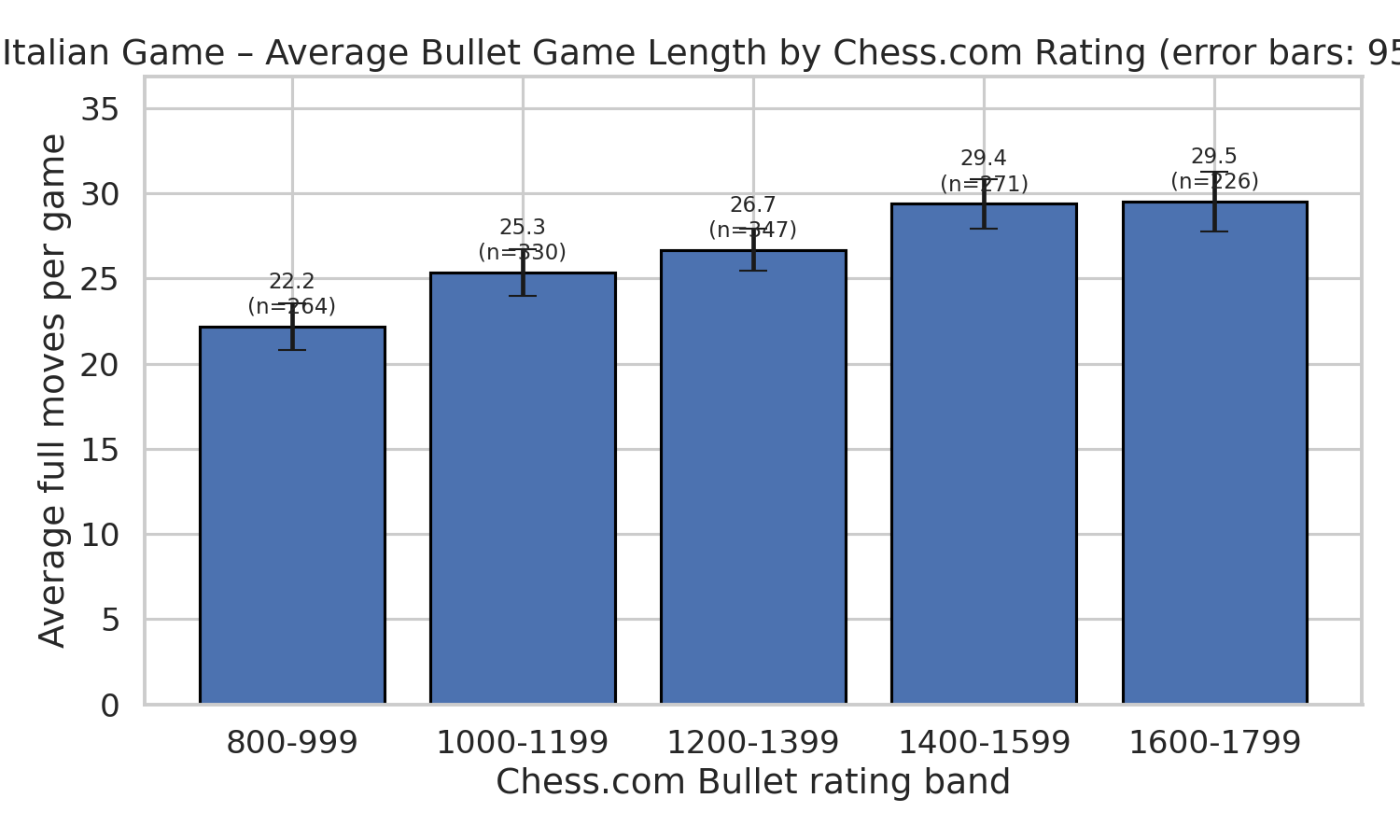
This increase is not because higher-rated players are playing longer endgames. Instead, it is driven almost entirely by a dramatic reduction in "quick crashes"—games that end in fewer than 20 moves due to early blunders or opening traps.
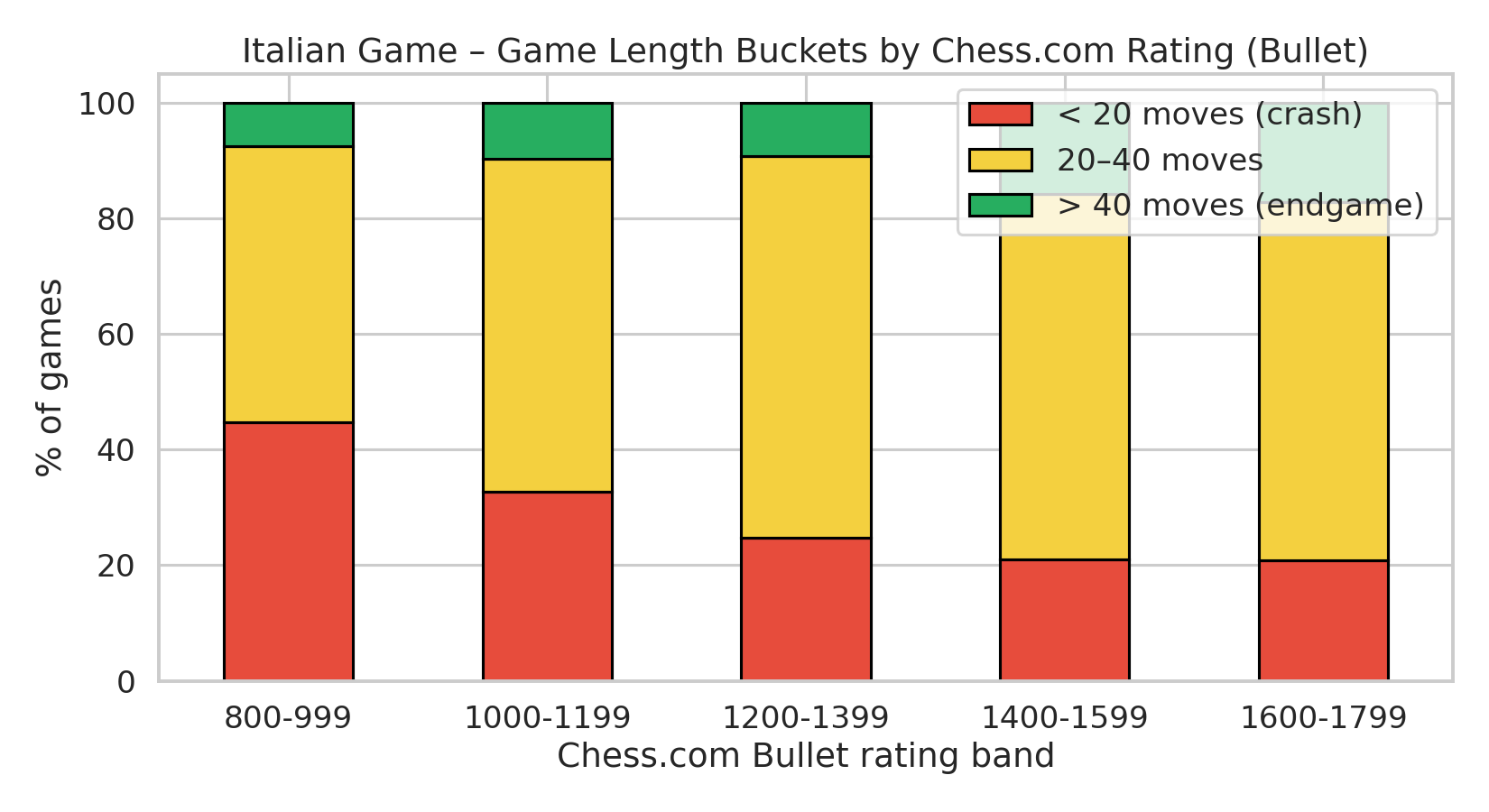
As the chart above shows, nearly 45% of games in the 800–999 band end in under 20 moves. By the 1400–1599 band, this drops to just 20.7%. Meanwhile, the percentage of games reaching the endgame (over 40 moves) triples from 7.6% to 21.8%.
Rating Band Breakdown and Actionable Advice
The 800–999 Band: The Wild West of Tactics
At this level, the Italian Game is a minefield. With an average game length of just 22.2 moves and 45% of games ending before move 20, players are frequently falling for early traps or blundering pieces outright.
Visual Evidence: The 4-Move Crash In this typical example from the 800–999 band, White plays 4. Ng5??, intending to attack f7 (the Fried Liver setup), but completely misses that the g5 square is undefended. Black simply plays 4... Qxg5, winning a clean piece, and White resigns.
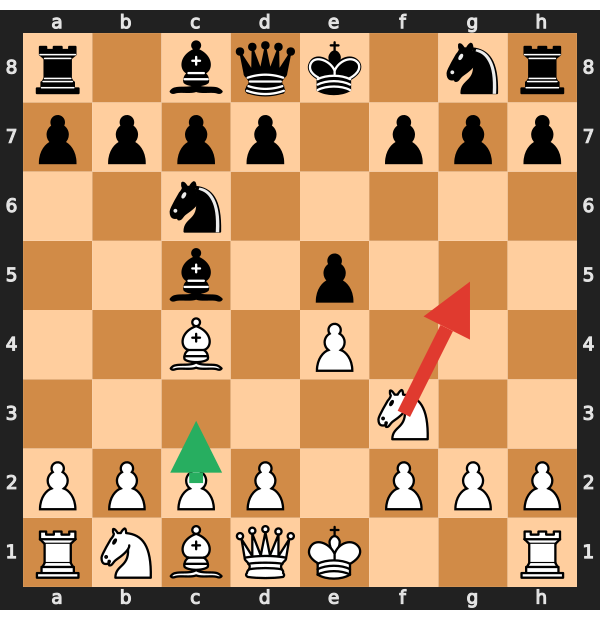 Red arrow: The blunder 4. Ng5??. Green arrow: The engine's preferred 4. c3.
Actionable Advice for 800–999:
- Prioritize Board Vision: Before launching an attack like Ng5, always check if the destination square is defended. Most games at this level are decided by one-move blunders, not deep strategy.
- Learn the Traps: Familiarize yourself with common Italian Game traps (like the Blackburne Shilling Gambit) so you don't fall for them. If you survive the first 15 moves without blundering a piece, your win rate will skyrocket.
The 1000–1199 Band: Surviving the Opening
Players in this band are starting to navigate the opening more safely. The average game length increases to 25.3 moves, and the quick-crash rate drops to 32.7%. However, tactical awareness is still inconsistent, and players often struggle when the game deviates from standard Giuoco Piano lines.
Visual Evidence: The Blackburne Shilling Trap Even as players improve, tricky lines can still catch them off guard. Here, Black plays the dubious 3... Nd4. White greedily grabs the pawn with 4. Nxe5??, falling into the trap. After 4... Qg5 5. Nxf7 Qxg2, Black is completely winning.
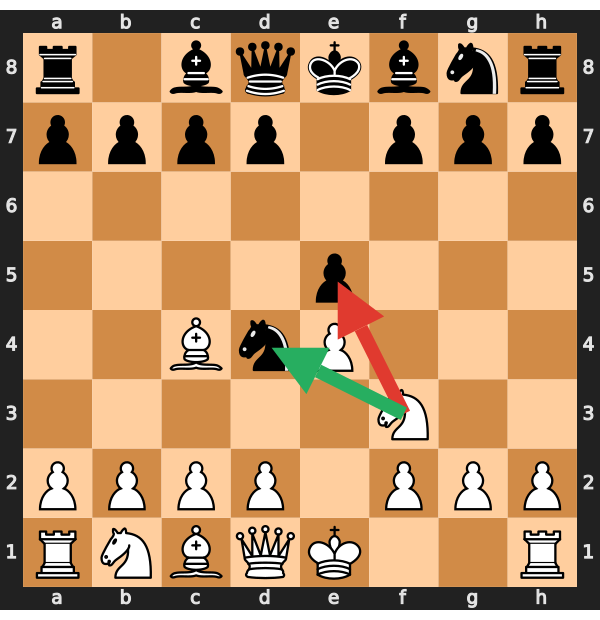 Red arrow: The greedy 4. Nxe5??. Green arrow: The safe 4. Nxd4.
Actionable Advice for 1000–1199:
- Play Solidly: When faced with an unusual move like 3... Nd4, don't rush to grab material. Play developing moves or trade safely (e.g., 4. Nxd4).
- Manage Your Clock: At this level, 60% of games end in time forfeits. Practice making safe, solid moves quickly rather than burning time calculating complex tactical sequences that may be flawed.
The 1200–1399 Band: The Transition to Middlegames
This is the transitional band. The average game length reaches 26.7 moves, and two-thirds of games (66.3%) now end in the 20–40 move range. Players are successfully navigating the opening and reaching complex middlegames, but they often lack the technique to convert advantages smoothly, leading to drawn-out struggles or time scrambles.
Actionable Advice for 1200–1399:
- Focus on Middlegame Plans: You are surviving the opening, so now you need a plan. In the Italian Game, focus on controlling the center (c3 and d4 pushes) or maneuvering your knights to strong outposts (like f5 for White).
- Pre-move Safely: Since games are going deeper into the middlegame, clock management becomes even more critical. Learn to pre-move obvious recaptures to save precious seconds.
The 1400–1500+ Band: Entering the Endgame
At the 1400–1599 level, the Italian Game matures. The average game length hits 29.4 moves, and over 20% of games now extend past move 40 into the endgame. Quick crashes are rare (only 20%), meaning you must be prepared to outplay your opponent over a long, grueling game.
Visual Evidence: The Long Grind In this 79-move marathon from the 1400+ band, the players have navigated the opening and middlegame and reached a complex King and Pawn endgame. These are the types of positions you must be comfortable playing to succeed at this level.
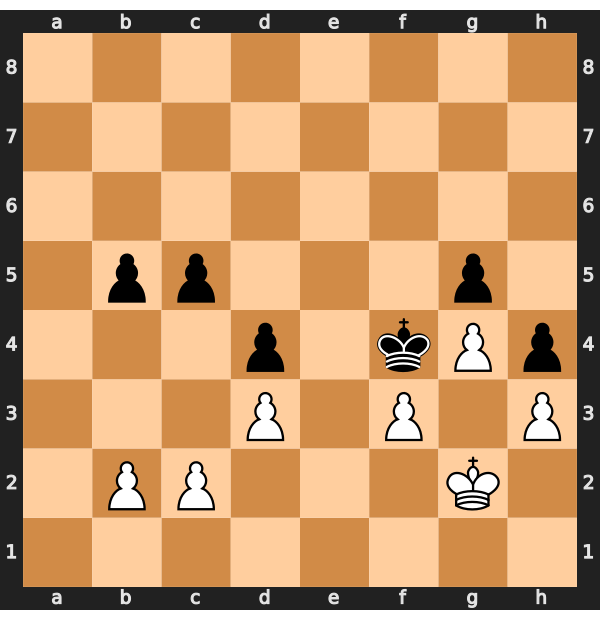 A typical deep endgame reached in the 1400+ band.
Actionable Advice for 1400–1500+:
- Study Endgames: You can no longer rely on your opponent blundering in the opening. You must know basic endgame technique (opposition, pawn breakthroughs, king activity) to convert small advantages.
- Pace Yourself: Bullet games at this level are marathons, not sprints. Don't burn all your time in the opening; you will need those seconds to navigate the move 40+ endgames.
Data and Methodology
This analysis is based on a sample of 1,438 Lichess Bullet games featuring the Italian Game (ECO codes C50–C59), played in March 2025. The data was extracted using the Lichess API and processed to map Lichess ratings to approximate Chess.com ratings using the following conversion:
| Chess.com Bullet | Lichess Bullet |
|---|---|
| 800–999 | 725–920 |
| 1000–1199 | 920–1115 |
| 1200–1399 | 1115–1305 |
| 1400–1599 | 1305–1510 |
| 1600–1799 (Ref) | 1510–1715 |
The underlying data and statistical summaries are available in the attached CSV files:
italian_bullet_games.csv: The raw dataset of 1,438 games.band_length_stats.csv: Summary statistics of game length by rating band.length_buckets.csv: Percentage of games falling into short, medium, and long buckets.outcome_length_stats.csv: Game length broken down by game outcome.
Chess Coach April 18, 2026