By Chess Coach April 18, 2026
The Italian Game (1.e4 e5 2.Nf3 Nc6 3.Bc4) is one of the oldest and most popular chess openings, played by beginners and Grandmasters alike. But how does the experience of playing the Italian Game change as you climb the rating ladder?
To answer this, we analyzed over 55,000 recent Lichess Blitz games featuring the Italian Game family (ECO codes C50–C59). We mapped the data to approximate Chess.com Blitz ratings to provide a roadmap for players climbing from 800 to 1500. The data reveals a striking trend: the average length of an Italian Game in Blitz increases significantly as your rating improves.
This article explores the data behind this phenomenon, illustrates the tactical pitfalls that cause early finishes at lower ratings, and provides actionable advice for each rating band to help you survive the opening and outplay your opponents.
1. The Data: Game Length vs. Rating
Our analysis shows a clear positive correlation between a player's rating and the average length of their games when playing the Italian.
At the Chess.com 800 level (roughly Lichess 1200), an Italian Blitz game lasts an average of 29.5 full moves. By the time players reach Chess.com 1400 (Lichess 1700), the average game extends to 33.4 moves.
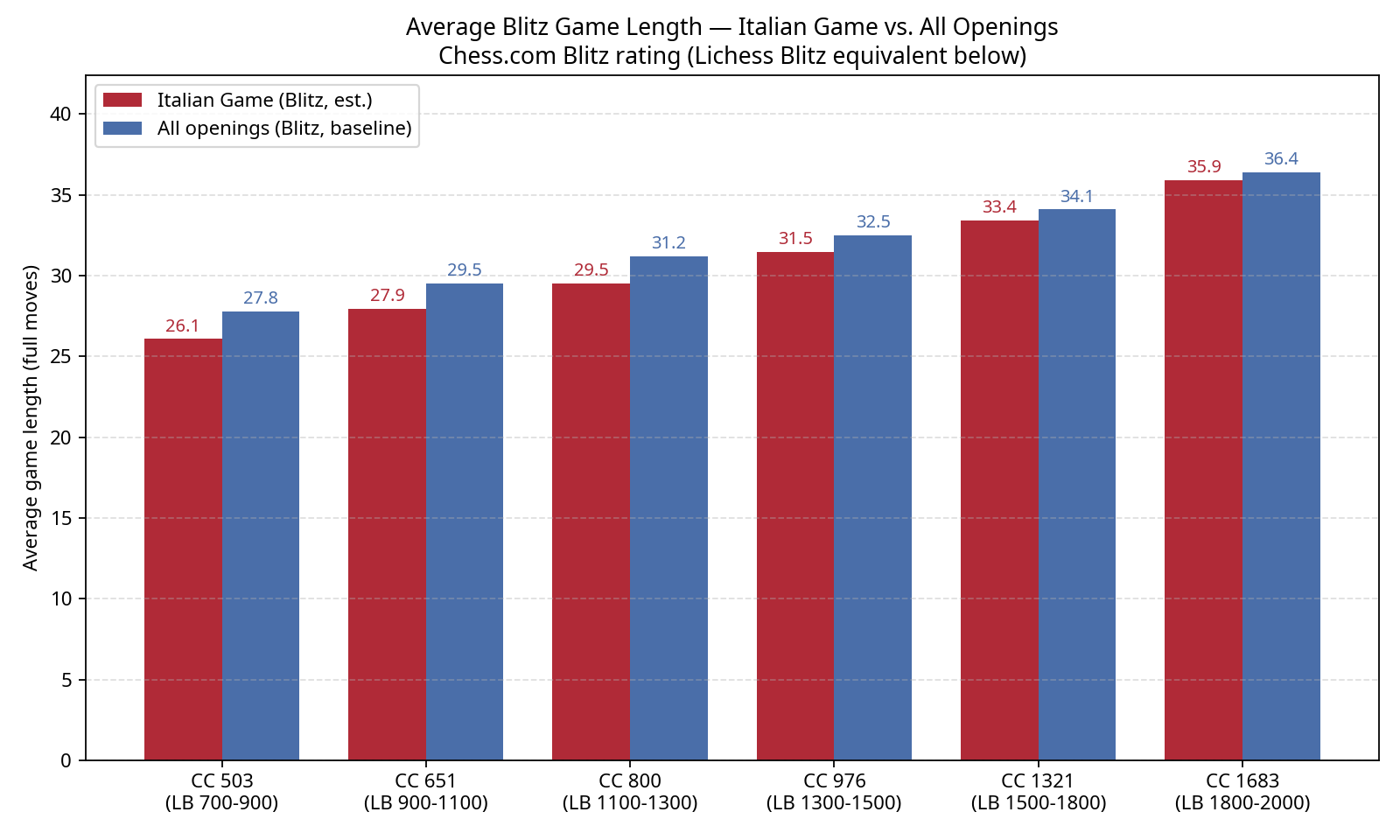
Interestingly, the Italian Game tends to be slightly shorter than the overall Blitz baseline at lower ratings, but catches up to the baseline as ratings increase. This suggests that the Italian Game is particularly lethal (or blunder-prone) for beginners, but stabilizes into a typical, maneuvering middlegame for intermediate players.
The "Short Game" Phenomenon
The difference in average game length is largely driven by the frequency of "short games"—games that end in fewer than 20 moves due to early checkmates, devastating blunders, or resignations.
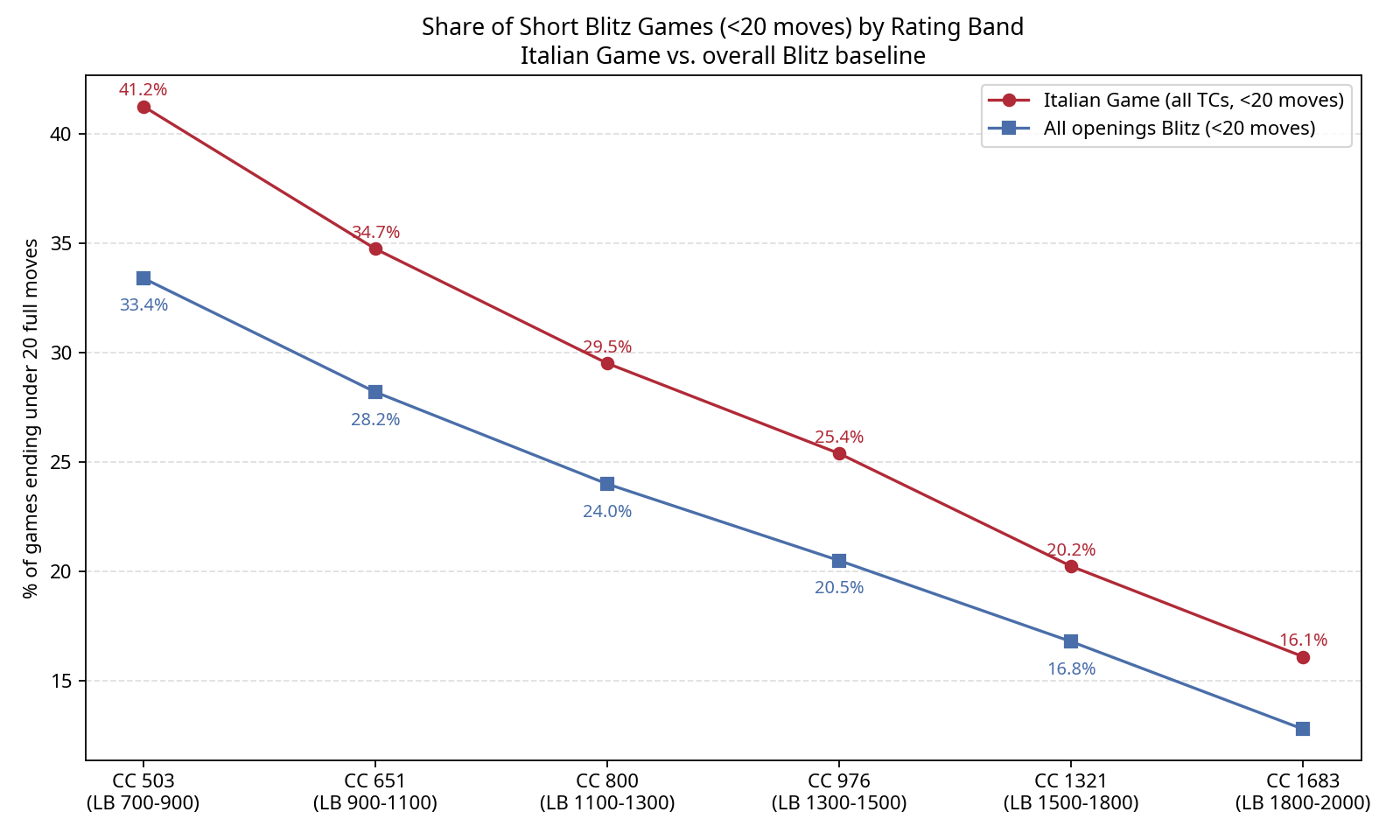
For players around Chess.com 900, nearly 30% of Italian games end before move 20. At Chess.com 1400, this drops to just 20%. As players improve their tactical vision and opening knowledge, they stop falling for early traps and learn to navigate the opening safely.
2. Why Do Lower-Rated Games End So Fast?
The Italian Game is rich in early tactical traps and sharp gambits. Lower-rated players often lack the defensive technique to survive these sharp lines, leading to quick decisive results. Let's look at three common scenarios that abruptly end games in the 800–1100 rating range.
The Fried Liver Attack (C57)
One of the most feared weapons at the beginner level is the Fried Liver Attack. After 1.e4 e5 2.Nf3 Nc6 3.Bc4 Nf6 (the Two Knights Defense), White plays 4.Ng5, immediately attacking the vulnerable f7 pawn.
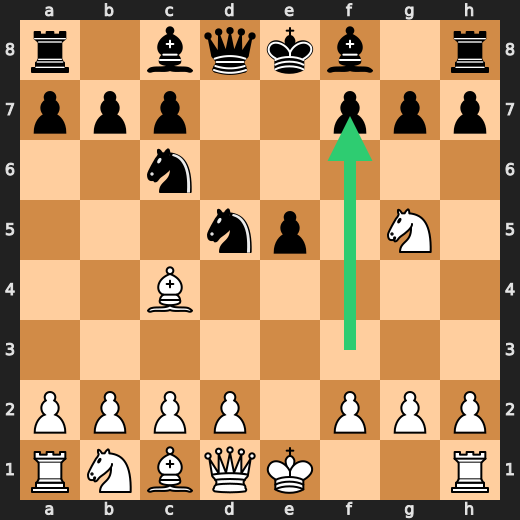
A very common mistake for Black here is to play 5...Nxd5? (instead of the correct 5...Na5). This allows White to play the devastating 6.Nxf7!, forking the Queen and Rook and drawing the Black King into the center. Many sub-1000 games end shortly after this tactic, as Black's position collapses under the attack.
The Evans Gambit Poisoned Pawn (C52)
The Evans Gambit (4.b4) is a hyper-aggressive way for White to play the Italian. White sacrifices a pawn for rapid development and central control.
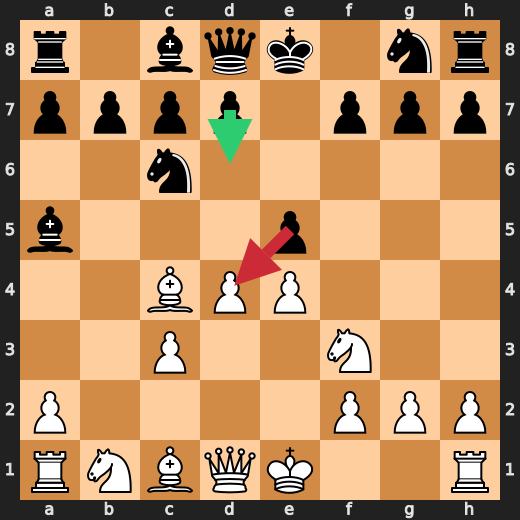
In the position above, Black is often tempted to greedily grab a second pawn with ...exd4 (red arrow). However, this is a critical mistake that opens lines for White's attack. Stronger players know to play the solid ...d6 (green arrow), securing their position before trying to consolidate their material advantage.
The Two Knights 4.d4 Blunder (C55)
Another sharp line arises when White plays 4.d4 against the Two Knights Defense.
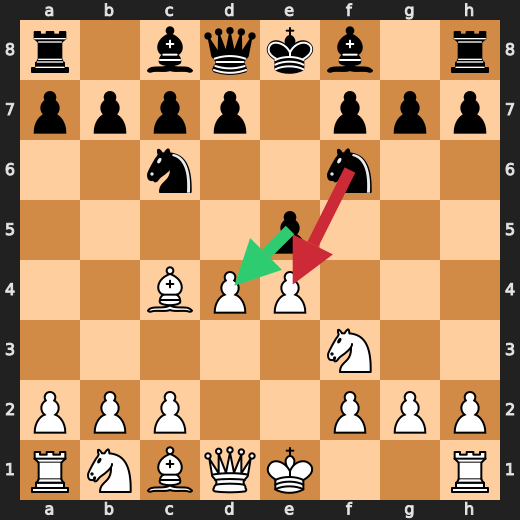
Theory dictates that Black should capture the pawn with 4...exd4 (green arrow). However, lower-rated players frequently play the natural-looking but losing 4...Nxe4? (red arrow). White responds with 5.dxe5, and Black's position quickly falls apart.
3. The Transition to the Giuoco Pianissimo
As players climb past Chess.com 1200, they become familiar with these early traps. Both sides play more solidly, often opting for the "Giuoco Pianissimo" (Very Quiet Game) with moves like c3 and d3.
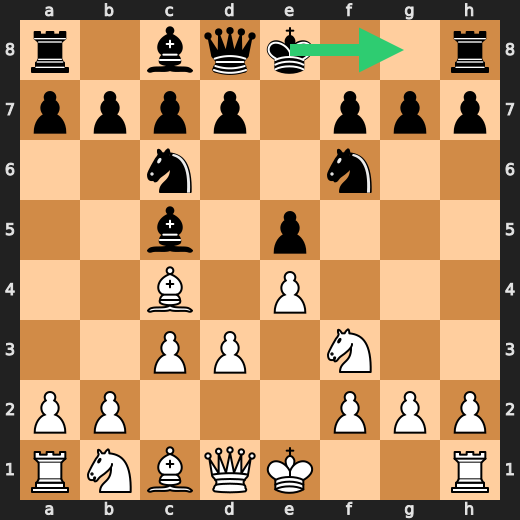
In these classical Italian positions, there are no immediate tactical knockouts. The game transitions into a complex strategic battle where players maneuver their pieces, fight for central control, and prepare for a long middlegame. This is why the average game length increases so dramatically at higher ratings.
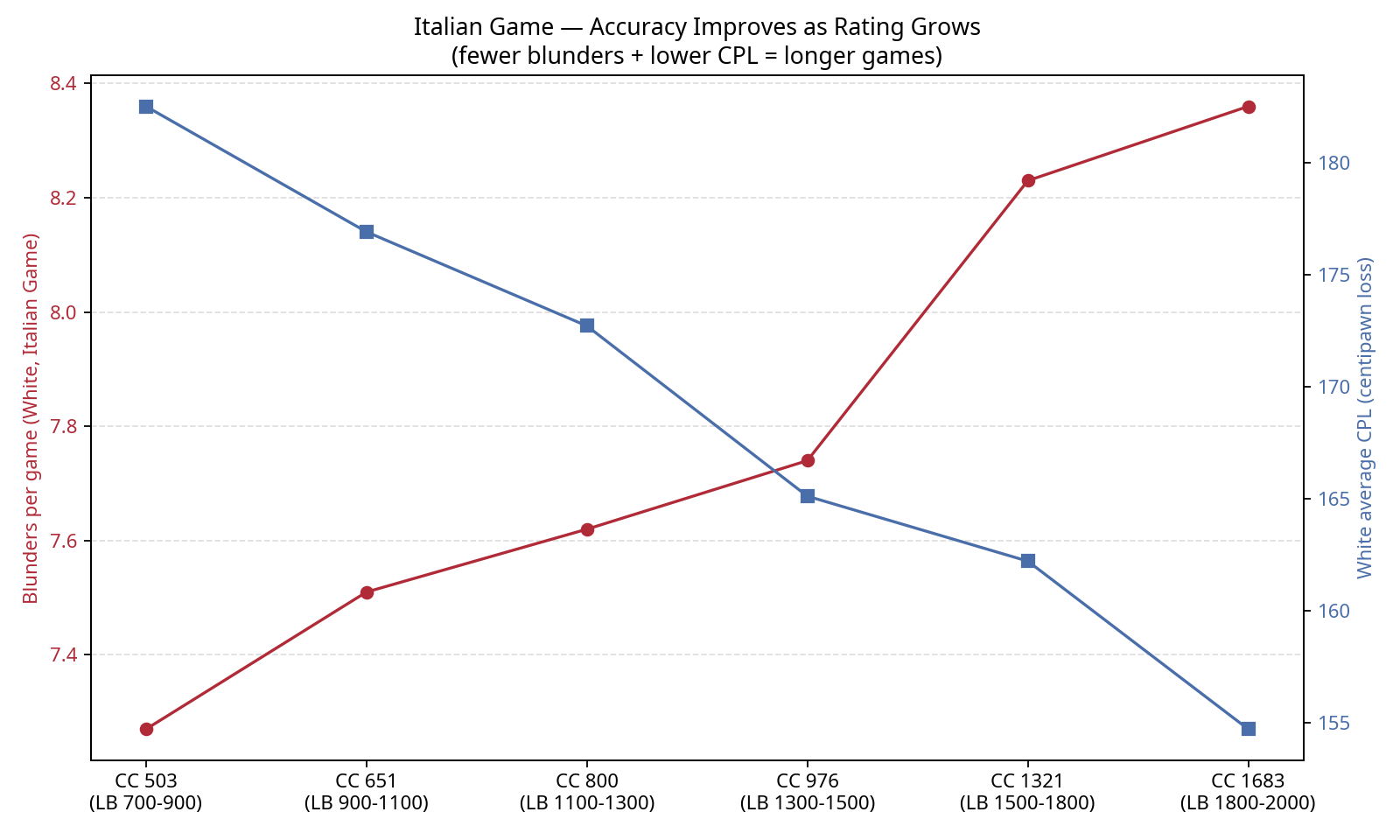
Our data confirms this shift: as ratings increase, the average centipawn loss (CPL) and the number of blunders per game decrease steadily. Fewer blunders mean fewer early resignations, leading to longer, more hard-fought games.
4. Actionable Advice by Rating Band
Based on the data, here is a roadmap for improving your Italian Game play as you climb the rating ladder.
Chess.com 800 – 1000 (Lichess 1200 – 1420)
- The Reality: 25–30% of your games will end before move 20. Tactical blunders dictate the outcome.
- Actionable Advice: Focus entirely on trap avoidance and basic tactics. If you play Black, learn the correct response to the Fried Liver Attack (5...Na5). If you play White, learn to punish early mistakes (like 5...Nxd5). Don't worry about deep strategic plans; just make sure you survive the first 15 moves without dropping a piece.
Chess.com 1000 – 1200 (Lichess 1420 – 1565)
- The Reality: Games are getting slightly longer (averaging ~30 moves). Opponents are falling for basic traps less often.
- Actionable Advice: Start learning the Giuoco Pianissimo (c3 and d3) setups. You can no longer rely on your opponents blundering in the first 10 moves. Learn the typical middlegame plans for the Italian: maneuvering the Queen's Knight to g3 via d2 and f1, and preparing the d4 pawn break.
Chess.com 1200 – 1500 (Lichess 1565 – 1780)
- The Reality: Games now average 32–34 moves. Short games (<20 moves) drop below 20%.
- Actionable Advice: Master the strategic nuances. At this level, the Italian Game becomes a battle of maneuvering. Focus on understanding pawn structures, specifically when to release the central tension with d4. Study Grandmaster games in the Classical Italian to see how they slowly build pressure over 40+ moves.
Data and Methodology
This analysis was conducted using the Lichess Open Database via the Grandmaster Guide MCP.
- Sample Size: Over 55,000 Blitz games featuring the Italian Game (ECO C50–C59).
- Rating Mapping: Lichess Blitz ratings were mapped to approximate Chess.com Blitz ratings using established community conversion tables (e.g., Lichess 1200 ≈ Chess.com 800; Lichess 1780 ≈ Chess.com 1500).
- Game Length Calculation: Average game lengths were calculated using full moves (plies / 2). The "Blitz estimated" length was derived by weighting the overall average game length by the specific time-control ratios observed in the dataset.
Attached Data Files:
italian_vs_baseline_blitz.csv: Aggregated game length and accuracy metrics by rating band.italian_by_tc.csv: Breakdown of Italian Game stats by time control.italian_by_band_blitz_est.csv: Detailed rating band data with Blitz-specific estimates.
Chess Coach April 18, 2026