Interference is one of the most elegant tactical motifs in chess. It occurs when you place a piece between an attacking enemy piece and its target, breaking the line of attack—often winning material or saving a critical piece in the process. Yet, despite its power, it remains a blind spot for many players climbing the rating ladder.
To understand exactly how often players miss these opportunities and what it costs them, we analyzed over 10,000 Blitz games played on Lichess in March 2025. We focused on players with Chess.com Blitz ratings between 800 and 1500 (corresponding to Lichess ratings of roughly 1200 to 1780). The data reveals a surprising truth: the ability to spot interference tactics barely improves across this 700-point rating span.
This guide serves as a roadmap for improvement. By understanding the data and studying real-world examples from your rating bracket, you can train your tactical eye to spot the "invisible shield."
The Data: A Persistent Blind Spot
Our analysis scanned games for moments where a player missed a clear interference tactic that would have swung the material balance by at least two pawns. The frequency of these missed opportunities is remarkably consistent across all rating bands.
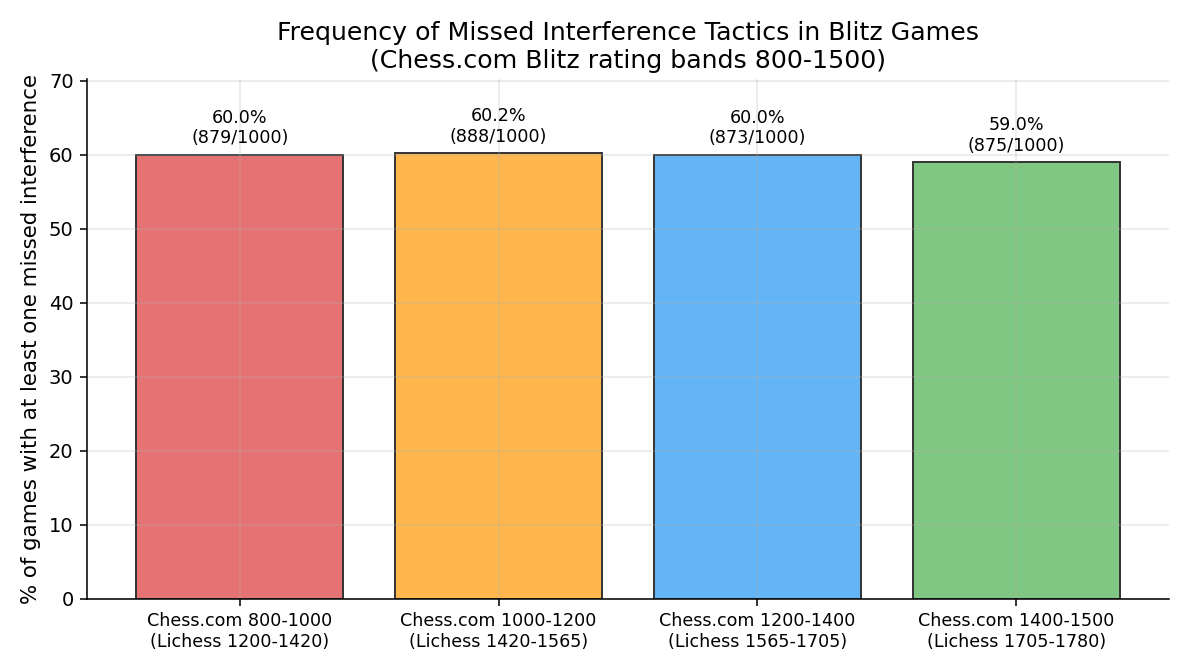
In every rating band from 800 to 1500, approximately 60% of games feature at least one missed interference tactic. Players at 1400 are just as likely to miss these complex line-breaking moves as players at 800. This suggests that interference is not a pattern players naturally absorb through casual play; it requires deliberate study.
Does Missing It Cost the Game?
Missing a tactic is only half the story. Does the opponent capitalize on the mistake?
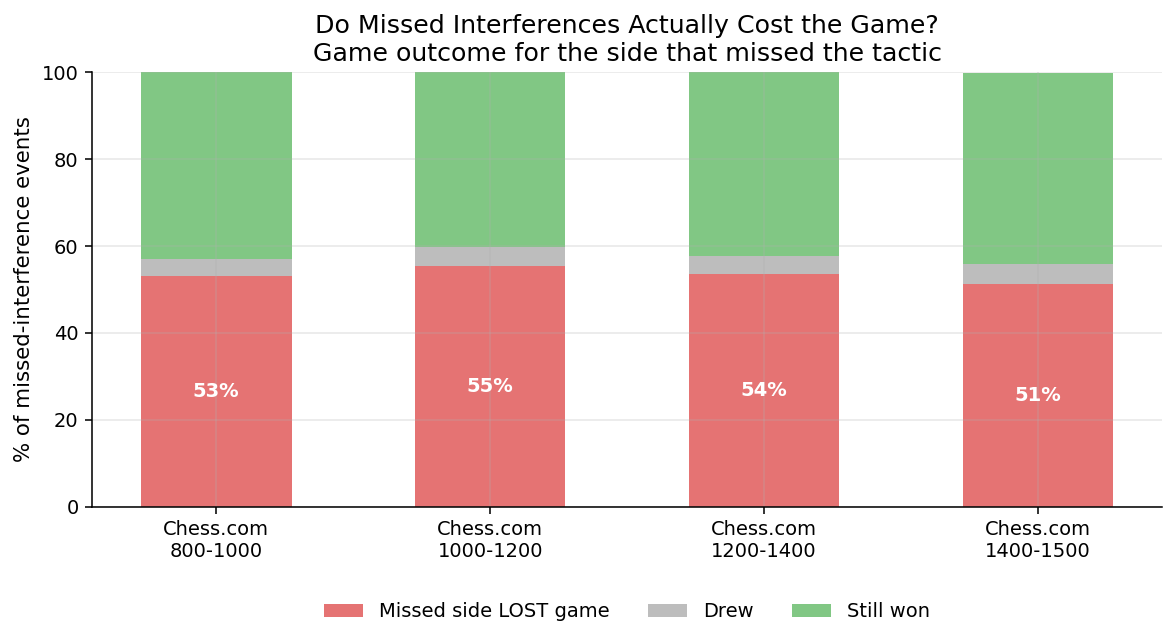
The data shows a fascinating trend. At the 800-1000 level, missing an interference tactic results in a loss 53% of the time. This punishment rate peaks at 55% in the 1000-1200 band—a notorious turning point where opponents stop blundering back as frequently and start converting material advantages. As ratings climb higher, the punishment rate slightly decreases, likely because higher-rated players are better at defending worse positions and swindling draws or wins from behind.
When and Where Do These Misses Occur?
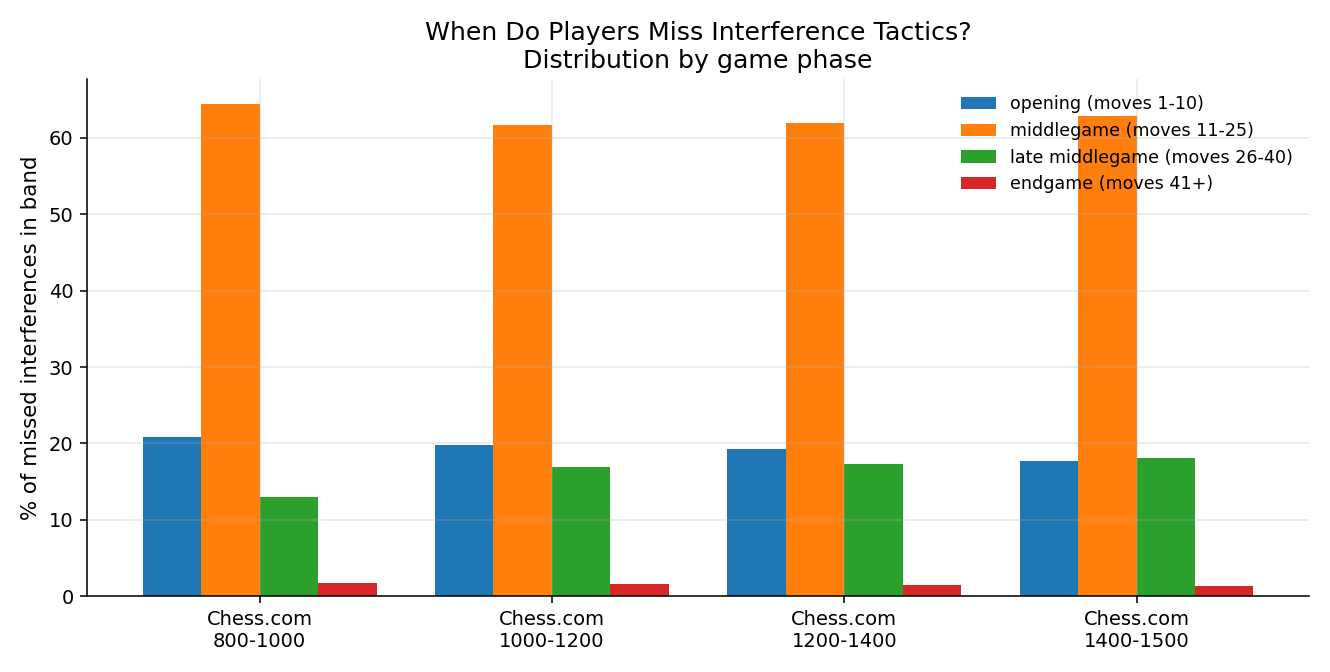
To train effectively, you need to know where to look. Our phase analysis shows that the vast majority of missed interferences happen in the middlegame (moves 11-25), when the board is most cluttered and lines of attack are obscured by complex pawn structures.
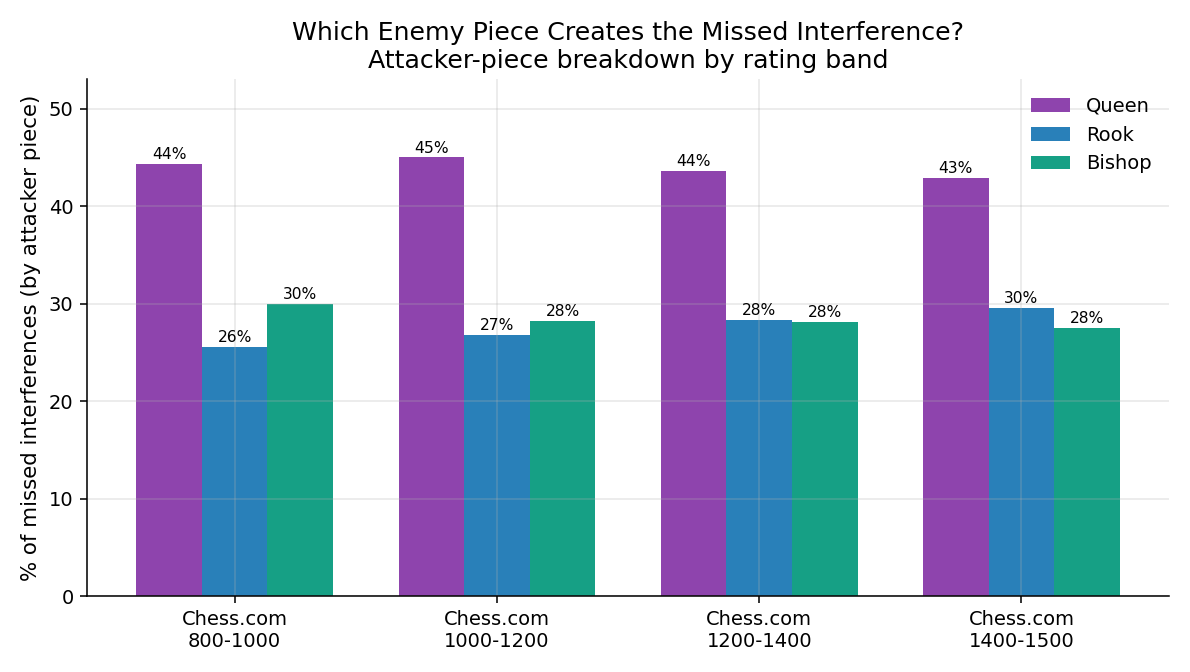
Furthermore, the enemy piece most likely to be the attacker in a missed interference is the Queen (accounting for ~44% of cases), followed by Rooks and Bishops. The friendly piece being shielded is most often a Rook or the King itself.
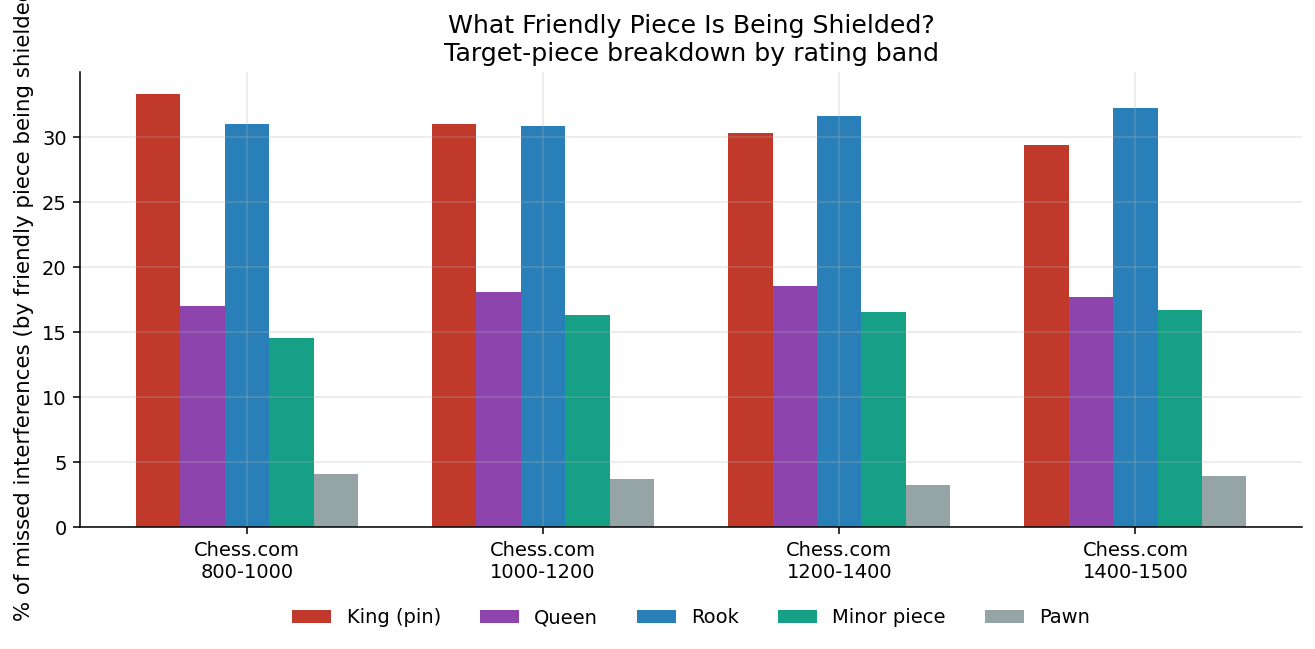
Roadmap to Improvement: Actionable Advice by Rating Band
Based on the data, here is a targeted guide to mastering interference tactics as you climb the rating ladder.
800-1000: Stop the Skewer
At this level, players frequently miss opportunities to break devastating skewers. When your opponent lines up their Queen or Rook against two of your pieces, your first instinct might be to move the attacked piece. Instead, look for a way to drop a piece in between.
Real Game Example (Chess.com 800-1000 / Lichess 1200-1420):
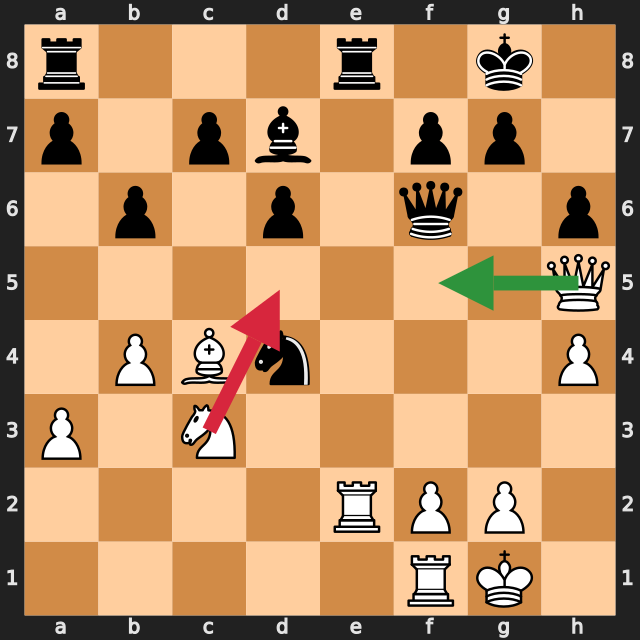
In this position, White's Queen on h5 skewers Black's Queen on f6 through Black's King on g8. White played the routine Nd5?, completely missing the crushing interference move Qf5!. By placing the Queen on f5, White interposes along the h5-d1 diagonal, breaking the skewer while creating new, overwhelming threats.
Actionable Advice: When you see an enemy Queen eyeing your King or major pieces from afar, pause. Before reacting defensively, ask: "Can I safely drop a piece into that line of sight?"
1000-1200: The Cost of Routine Development
This is the rating band where missing an interference tactic is most likely to cost you the game (a 55% loss rate). Players here are focused on opening principles but often play on autopilot, missing tactical nuances hidden in the developing pawn structures.
Real Game Example (Chess.com 1000-1200 / Lichess 1420-1565):
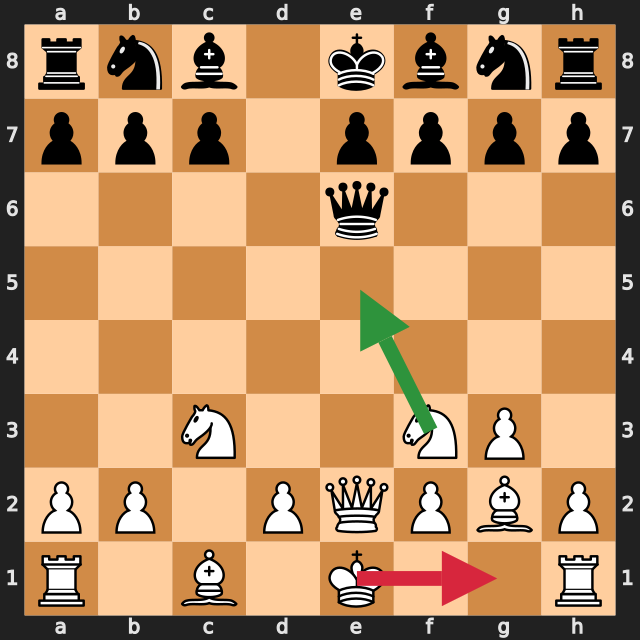
Black's Queen on e6 is eyeing White's Queen on e2 along the half-open e-file. White, playing on autopilot, castled with O-O?. This routine developing move misses the brilliant interference Ne5!. The Knight steps directly into the line of attack, shielding the Queen and winning material.
Actionable Advice: Break the autopilot habit. In the late opening and early middlegame, always check the half-open files. If an enemy Rook or Queen is on the same file as your valuable pieces, look for squares where your minor pieces can safely anchor and block the attack.
1200-1400: Deflecting the Defender
As you reach the intermediate level, interference becomes less about simple survival and more about active deflection. You can use interference to cut off a defending piece from the square it is protecting.
Real Game Example (Chess.com 1200-1400 / Lichess 1565-1705):
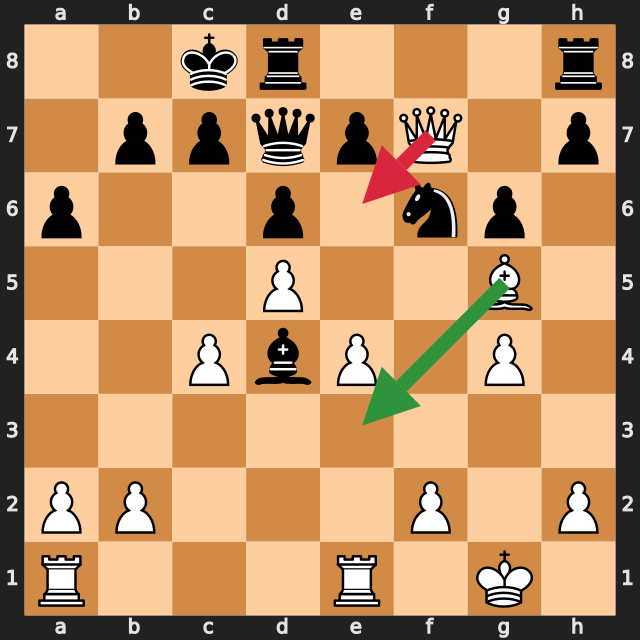
Here, Black's Bishop on d4 is a crucial defensive piece. White played the natural Qe6, but missed the powerful interference Be3!. By interposing on the long diagonal, White deflects the Bishop from its defensive duties, leading to a decisive material advantage.
Actionable Advice: Start looking at the board geometrically. Identify which enemy pieces are holding their position together. Can you place a piece on a square that physically blocks their defensive coordination?
1400-1500: Mastering the Long Diagonals
At the edge of advanced play, the board opens up, and long-range pieces (Bishops and Queens) dominate. Missed interferences here often involve failing to block a fianchettoed Bishop or a Queen sweeping across the board.
Real Game Example (Chess.com 1400-1500 / Lichess 1705-1780):
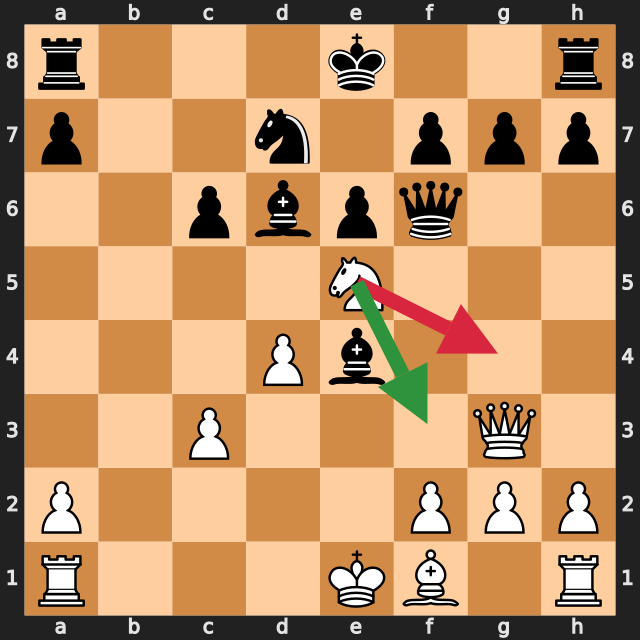
Black's Bishop pair is raking across the board, with the Bishop on e4 threatening White's Rook on h1 through the long diagonal. White played Ng4?, stepping into a fork. The correct move was Nf3!. This Knight move interferes directly on the long diagonal, breaking the X-ray attack and preserving White's material advantage.
Actionable Advice: Pay special attention to the long diagonals (a1-h8 and a8-h1). When an enemy Bishop is stationed there, actively look for squares where your Knights or pawns can permanently blunt its scope.
Conclusion
Interference is the invisible shield of chess tactics. Because it requires you to look at empty squares rather than the pieces themselves, it remains a persistent blind spot for players up to the 1500 level. By actively incorporating interference puzzles into your daily training and pausing to check long lines of attack during your games, you can turn this common weakness into a devastating weapon.
Data and Methodology
This research analyzed 10,111 Blitz games played on Lichess in March 2025. Games were filtered by time control (base time + 40 * increment between 180 and 480 seconds) and categorized into four rating bands based on the average Elo of the players. Lichess ratings were mapped to approximate Chess.com Blitz ratings for the purpose of this article.
A custom Python script utilizing the python-chess library scanned the PGNs for positions where a valid interference move existed (defined as a safe move that blocks a line of attack between an enemy piece and a more valuable friendly piece). A "missed" event was recorded if the player failed to play the interference move AND the material balance (as recorded in the PGN %mb tags) swung against them by at least two pawns within the next two plies.
The underlying data files generated during this analysis are available below:
- Summary Statistics by Band
- Conversion Rates by Band
- Phase Distribution
- Attacker Piece Breakdown
- Target Piece Breakdown
- Severity Breakdown
- Curated Example Positions
Chess Coach <2026-04-21>