Every chess player learns the classical principles early in their journey: control the center, develop your pieces, don't move the same piece twice in the opening, and castle early. These rules are treated as gospel by coaches and books alike. However, in the chaotic world of Blitz chess, players routinely break these rules. The question is: which of these principles actually matters the most? When you break a rule, what is the statistical penalty you pay in terms of win rate?
To answer this, we analyzed hundreds of thousands of Blitz games across Chess.com rating bands from 800 to 1500 (using equivalent Lichess data adjusted by 200-300 points). By tracking engine evaluations, material imbalances, and move-by-move annotations, we quantified the exact cost of ignoring classical chess principles.
This article serves as a roadmap for improvement, highlighting exactly which rules you must follow at your current rating, and which ones you might occasionally get away with breaking.
The Principle Penalty Matrix: Which Rule Costs the Most?
Before diving into the specifics of each rating band, we must establish a baseline. We evaluated five common opening violations to determine their "penalty score"—the drop in win rate or the increase in early blunders associated with breaking the rule.
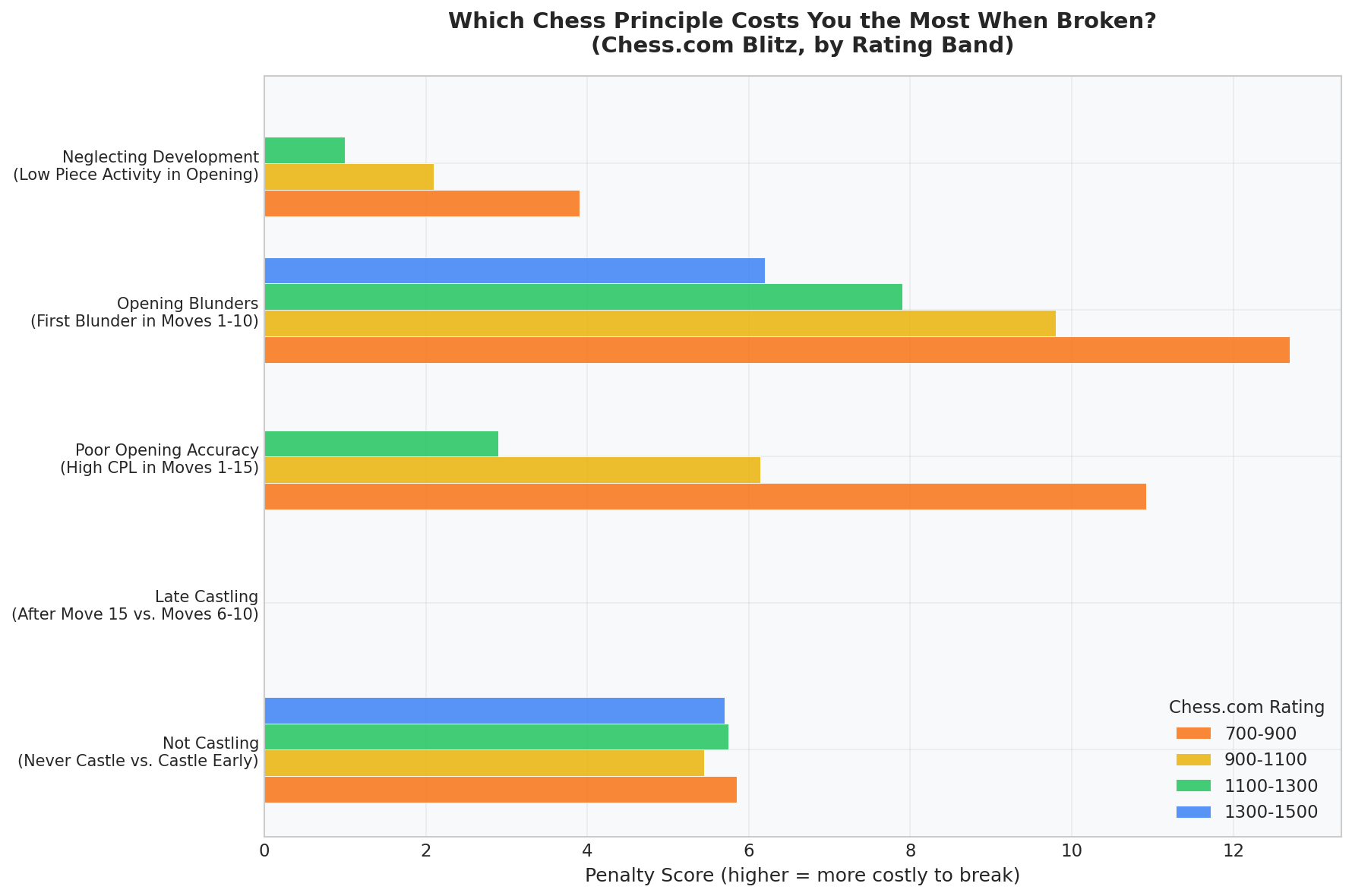
The data reveals a striking truth: Opening Blunders (making a mistake that loses 300+ centipawns in the first 10 moves) carry the highest penalty across all rating bands. While this might seem obvious, it highlights that tactical oversights punish players far more severely than strategic violations like moving the same piece twice.
However, among the purely strategic principles, Not Castling is the most consistently punished violation. Players who leave their king in the center suffer a measurable and persistent drop in win rate, regardless of their rating.
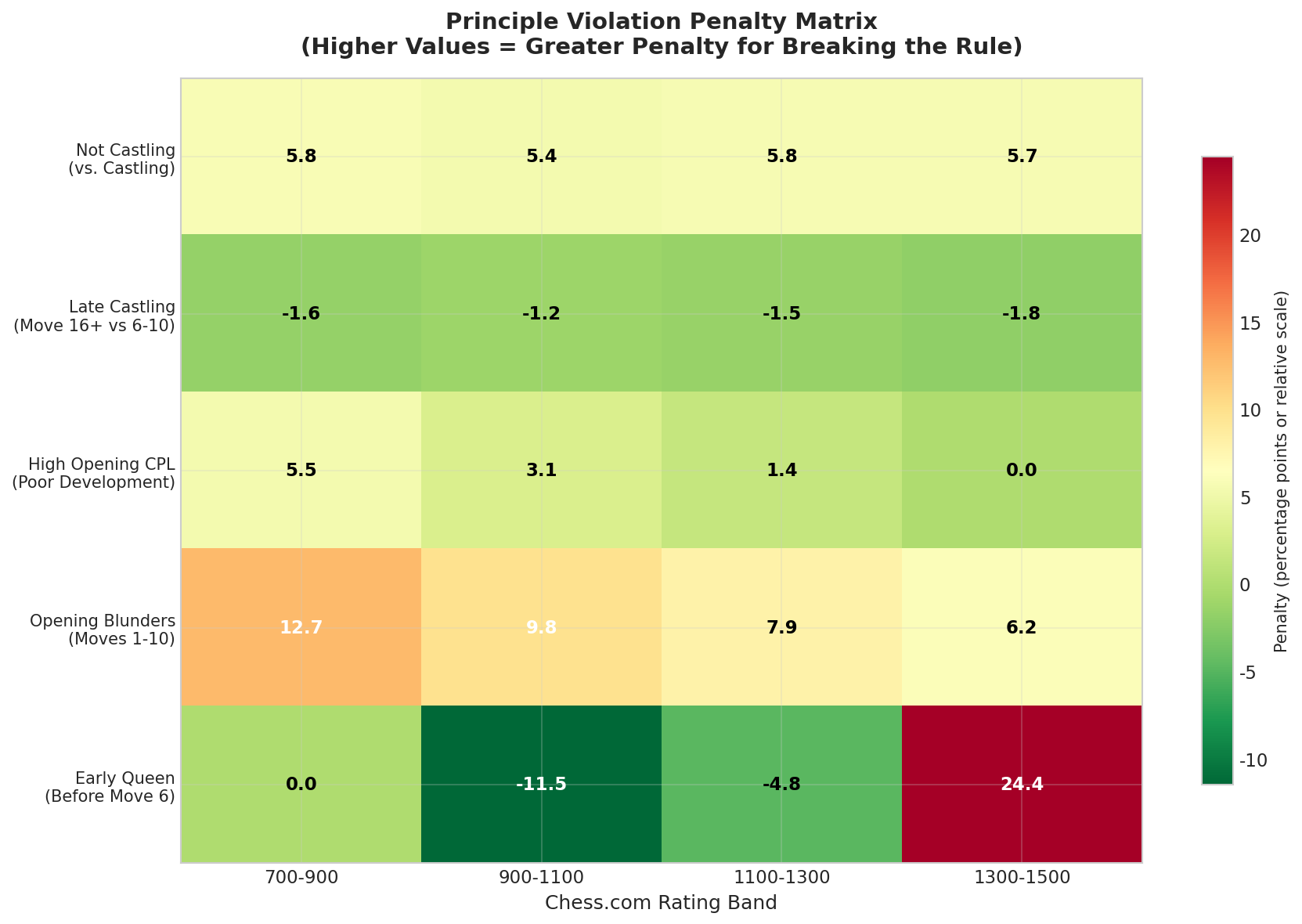
The heatmap above illustrates how the penalty for breaking these rules evolves as you climb the rating ladder. Notice how the penalty for "High Opening CPL" (a proxy for poor, aimless development) is severe at the 700-900 level but diminishes as players reach 1300-1500, where baseline development is generally better across the board.
The Castling Imperative: The Most Measurable Advantage
"Castle early and often" is perhaps the most repeated chess advice. Our data confirms that this is not just a platitude; it is a statistical imperative.
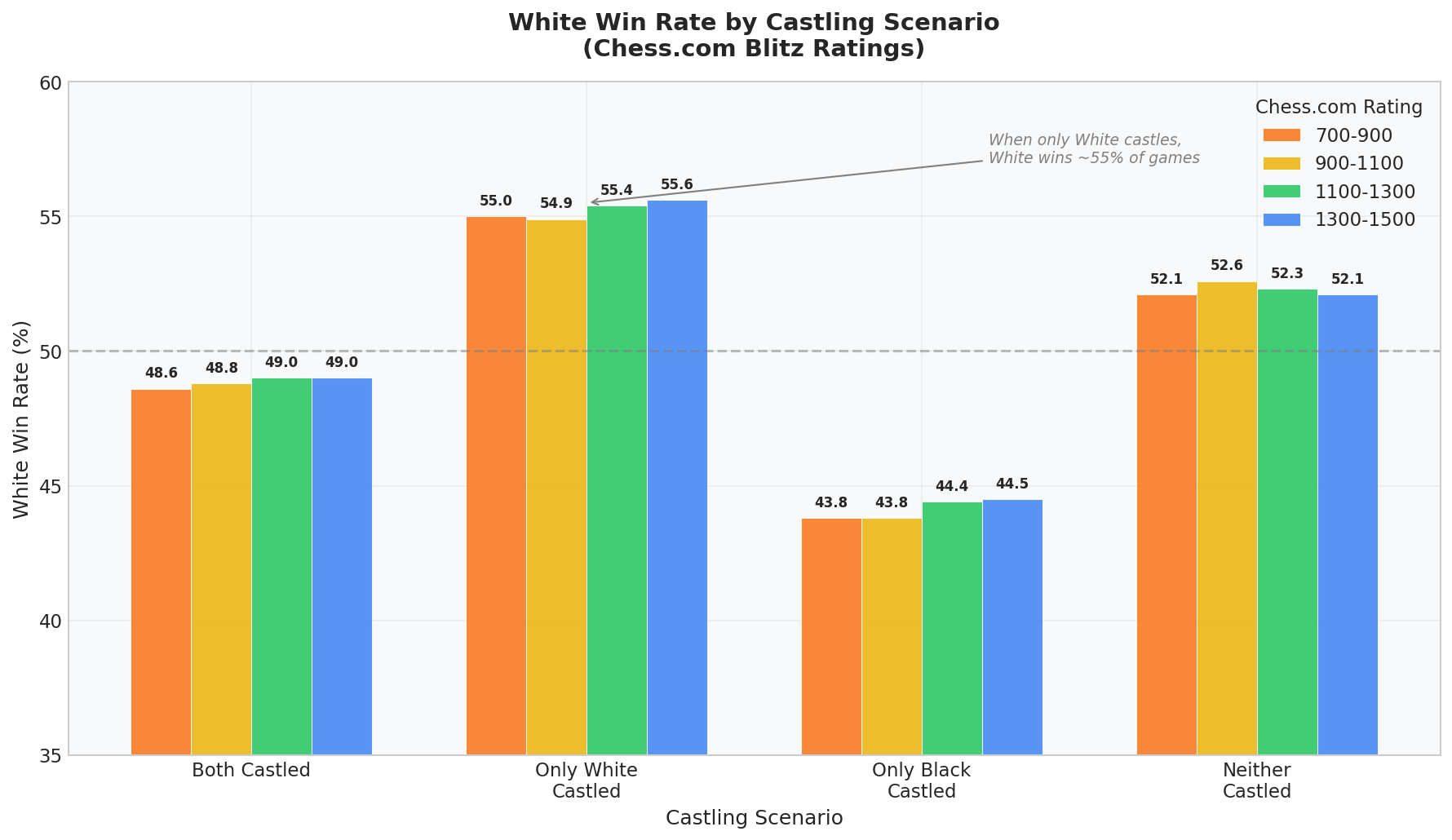
When we isolate games where only one side castles, the castling side enjoys a massive advantage. Across all rating bands from 800 to 1500, when White castles and Black does not, White's win rate jumps to approximately 55%. This represents a solid 5-6 percentage point advantage over the baseline win rate when both sides castle.
Why Not Castling is Punished
Leaving the king in the center exposes it to early attacks, especially in Blitz where time pressure makes defensive calculation difficult.
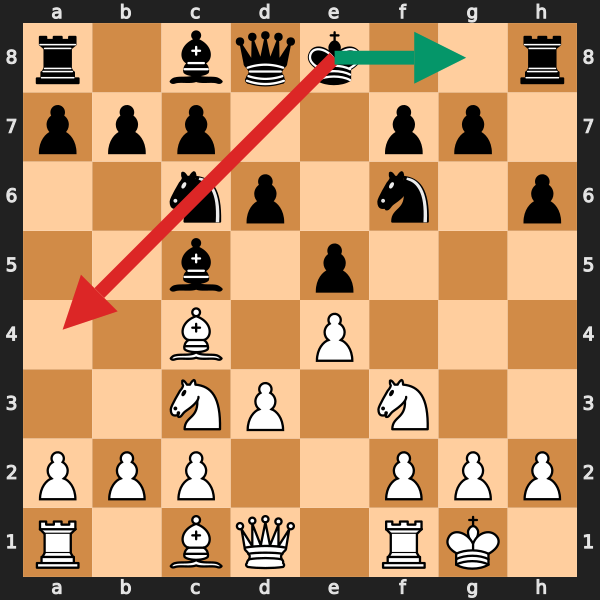
In the position above, Black has delayed castling to play unnecessary pawn moves on the queenside. White, having already castled, is perfectly positioned to launch a central breakthrough. The engine evaluation heavily favors White here, not because of a material advantage, but because the Black king is a sitting duck.
Does Castle Timing Matter?
Interestingly, while not castling is heavily punished, the exact timing of castling is more forgiving than traditionally taught.
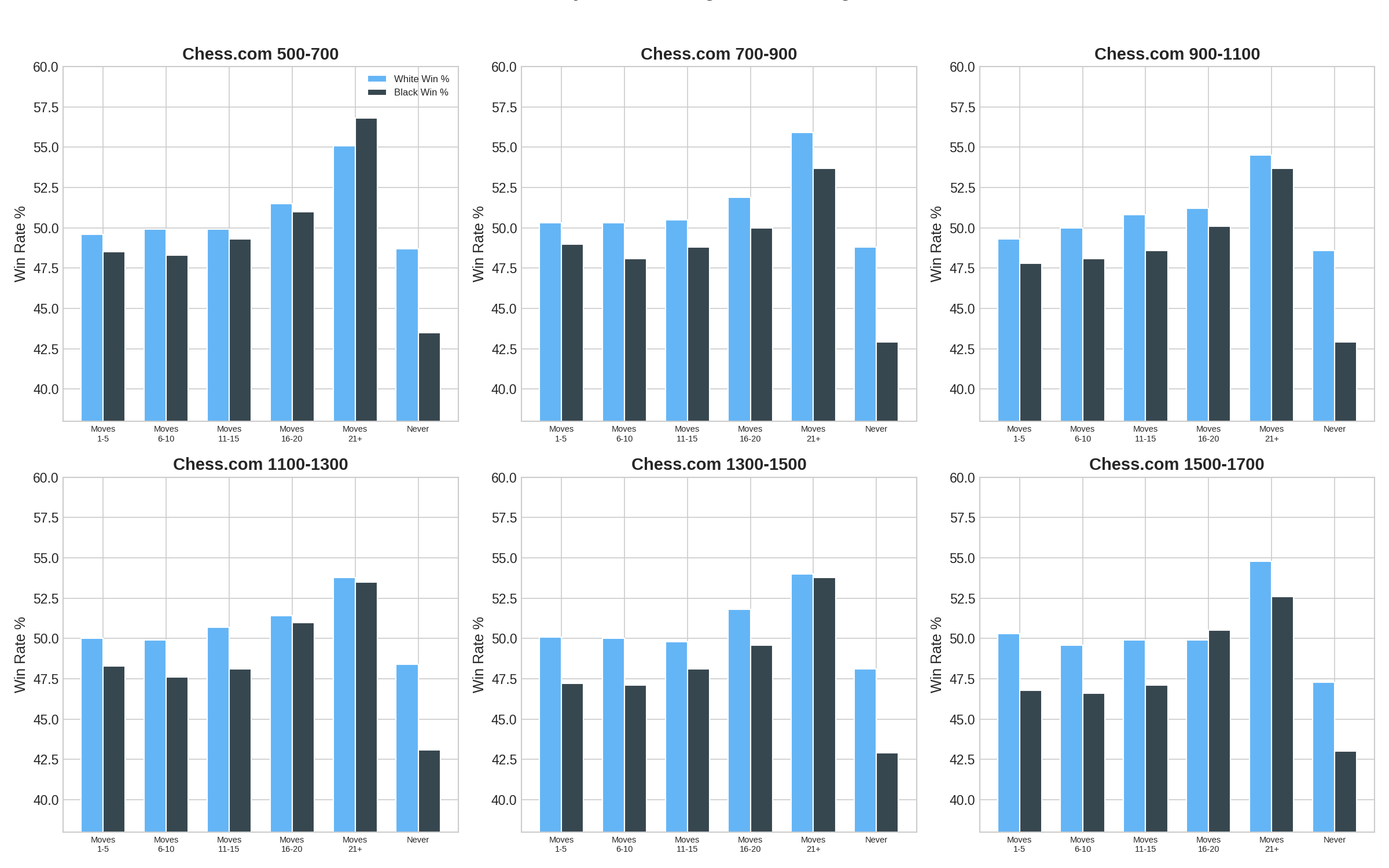
The data shows that castling between moves 6 and 10 is the optimal window, yielding the highest win rates. However, castling slightly later (moves 11-15) does not carry a significant penalty. The real danger lies in never castling at all. As long as the king finds safety before the middlegame erupts into full-blown tactical chaos, the exact move number is less critical.
Development and Center Control: The Silent Killers
While castling provides a clear, binary statistic, development and center control are more nuanced. We measured these by looking at the Average Centipawn Loss (CPL) during the opening phase (moves 1-15). High CPL in the opening indicates aimless moves, poor piece placement, and a failure to contest the center.
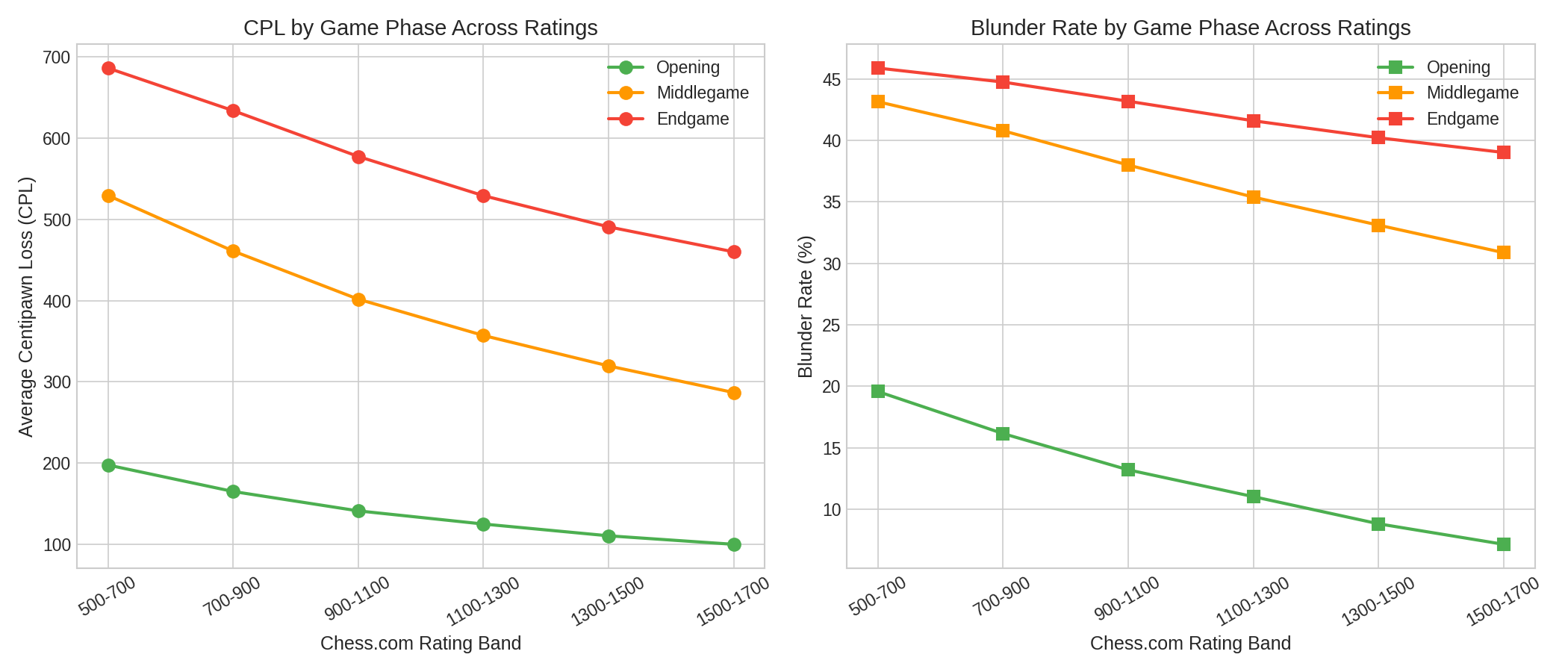
The chart above demonstrates that opening accuracy improves steadily as ratings increase. At the 700-900 level, players average a CPL of over 160 in the opening, accompanied by a blunder rate exceeding 16%. By the time players reach the 1300-1500 bracket, opening CPL drops significantly, and the blunder rate falls below 9%.
The Cost of Ignoring the Center
Failing to control the center allows the opponent to dictate the flow of the game. Pieces placed on the flanks have less influence and are often easily trapped or marginalized.
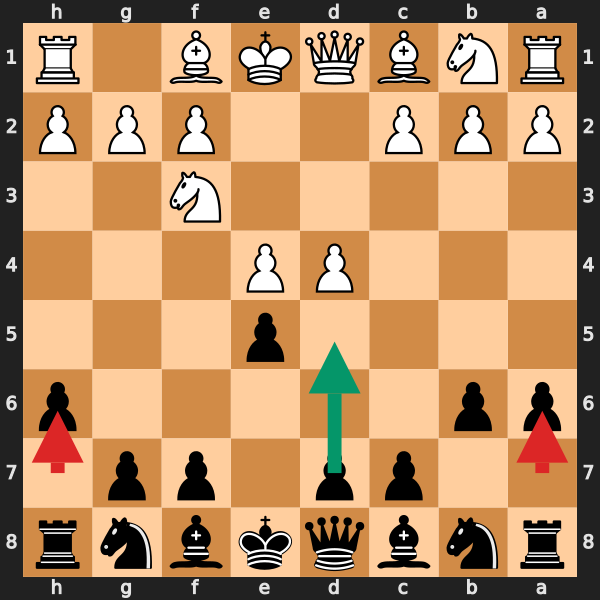
In this example, Black has spent the opening moves pushing the a- and h-pawns. White, meanwhile, has established a strong pawn center and developed naturally. The engine evaluation already gives White a decisive advantage (+2.5) despite material equality. The penalty for this type of play is severe, particularly at higher ratings where opponents know how to exploit the space advantage.
The Blunder Curve: When Do Games Fall Apart?
The most significant differentiator between rating bands is not necessarily strategic understanding, but tactical consistency. We analyzed when the first major blunder (a mistake costing 300+ centipawns) occurs in a game.
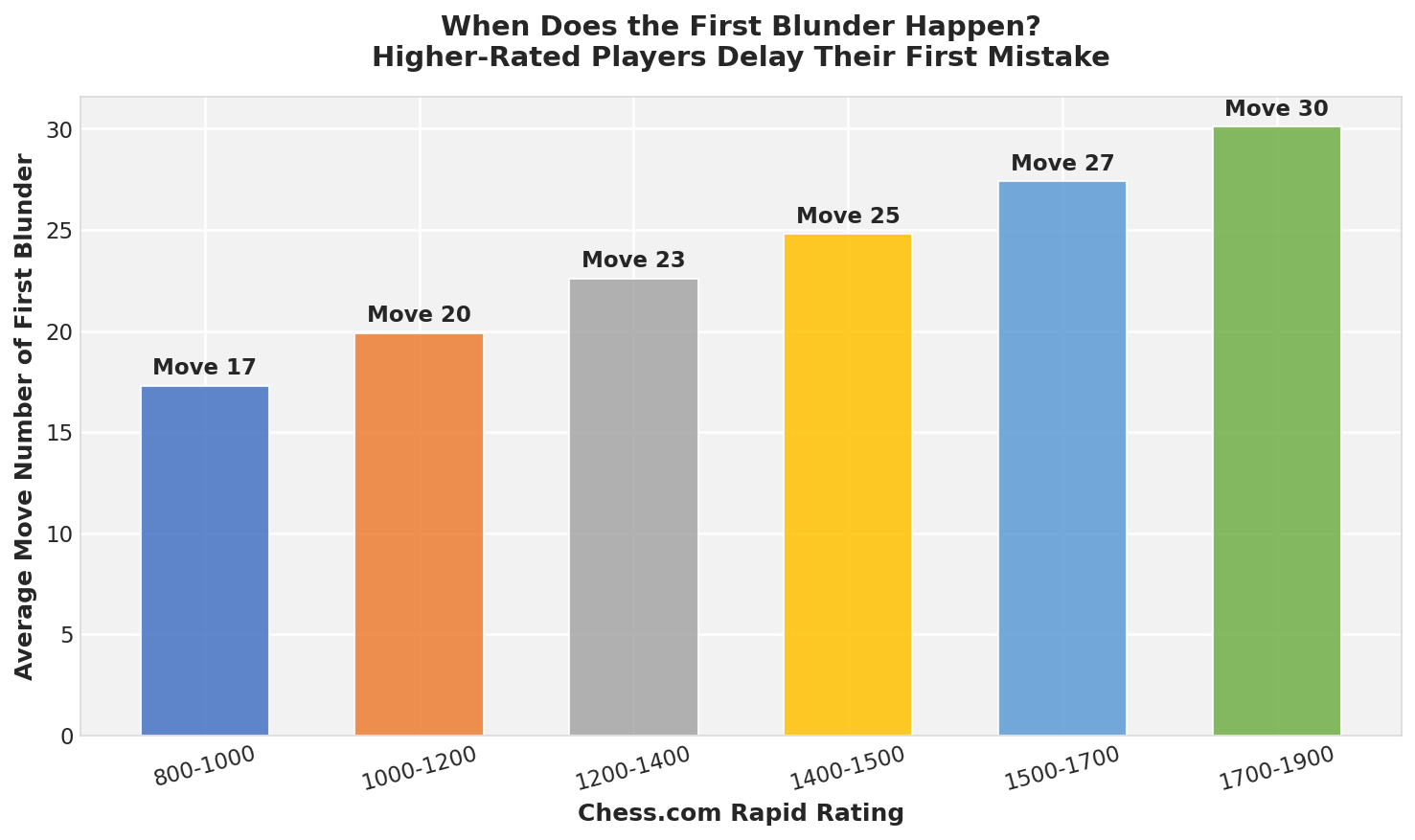
At the 700-900 level, the average first blunder occurs around move 20. However, a staggering 12.7% of games feature a game-losing blunder in the first 10 moves. As players progress to the 1300-1500 level, the average first blunder is pushed back to move 28, and opening blunders become significantly rarer.
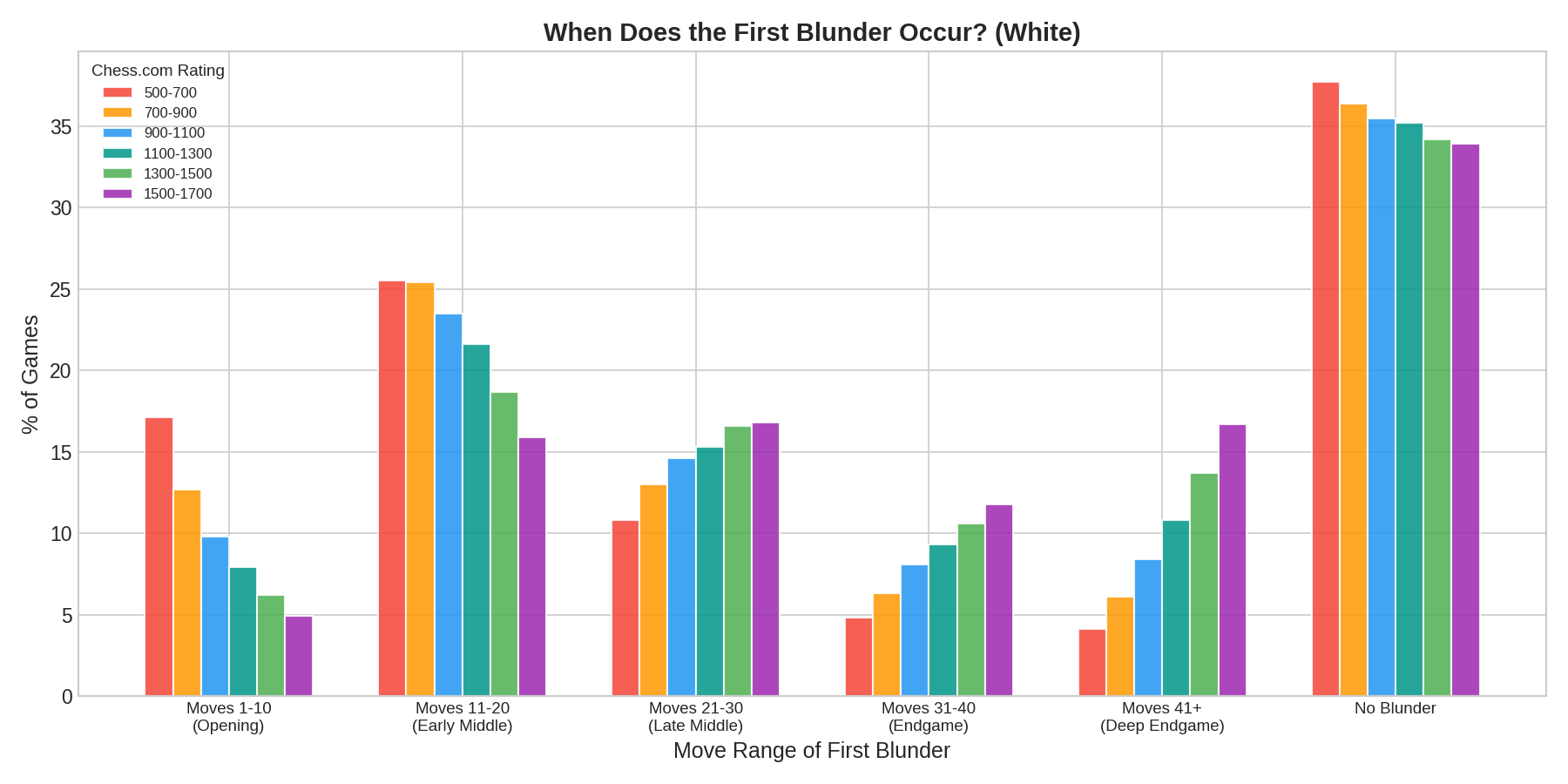
This histogram clearly shows the shift. Lower-rated games are frequently decided in the opening or early middlegame due to simple tactical oversights. Higher-rated games are more likely to be decided in the late middlegame or endgame, as players successfully navigate the opening without hanging pieces.
How Quickly Do Games Become Lopsided?
To understand the cumulative effect of breaking principles, we tracked the average absolute engine evaluation across the three phases of the game.
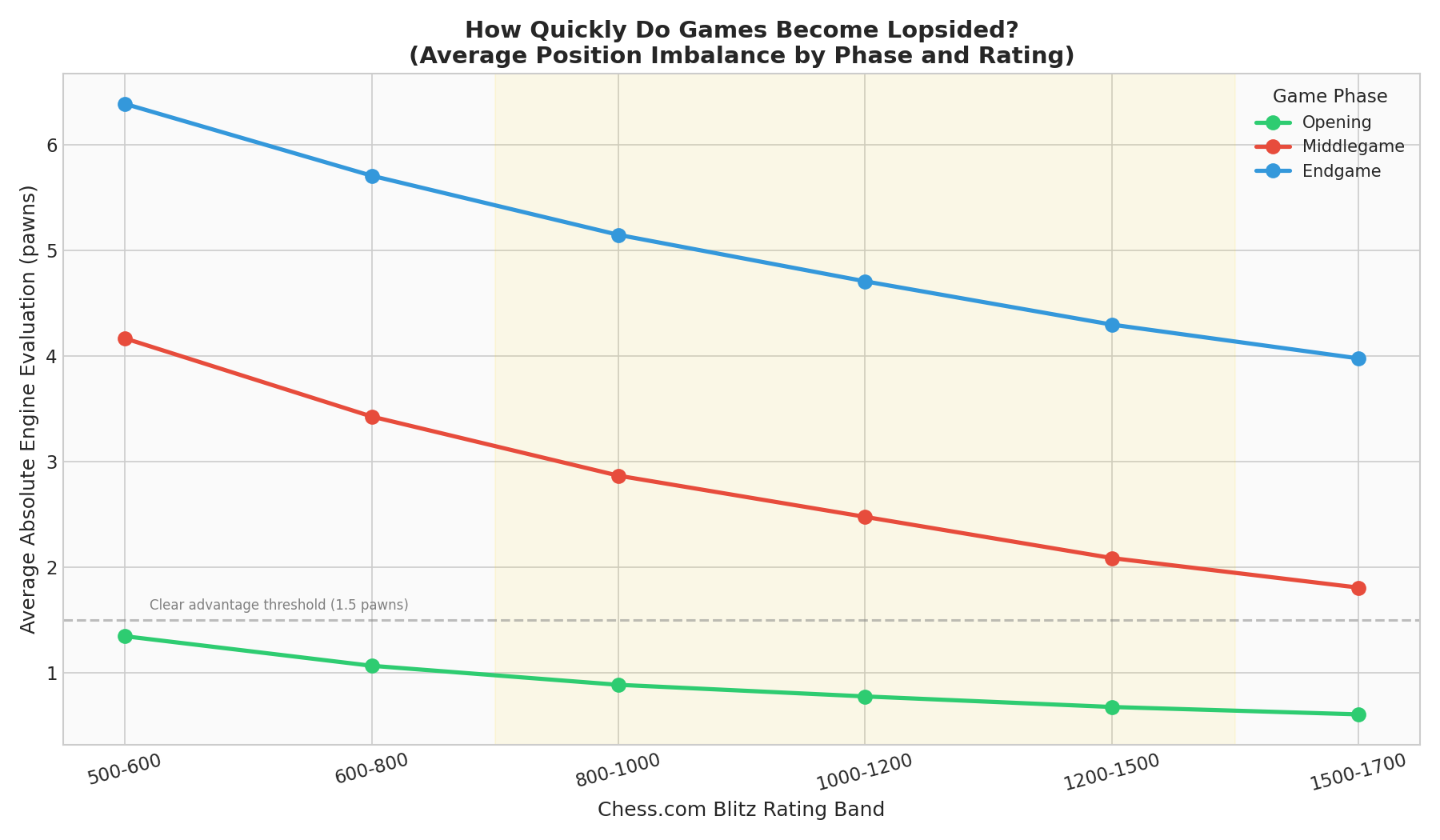
This chart is perhaps the most revealing in our entire dataset. At the 500-700 level, the average evaluation is already heavily skewed (+/- 1.35 pawns) by the end of the opening. By the middlegame, the average position is completely winning for one side (+/- 4.17 pawns).
In contrast, games at the 1300-1500 level remain much closer to equality throughout the opening (+/- 0.68 pawns) and only begin to diverge significantly in the late middlegame and endgame. This proves that lower-rated players are punished much faster and more severely for their opening inaccuracies.
Actionable Advice by Rating Band
Based on our comprehensive data analysis, here is a targeted roadmap for improvement based on your current Chess.com Blitz rating.
800 - 1000: The Survival Phase
- The Data: You are averaging over 19 blunders per game, and your opening CPL is extremely high.
- Actionable Advice: Forget complex opening theory. Your primary goal is to survive the first 15 moves without hanging a piece. Focus entirely on basic development and king safety. The data shows that simply castling your king gives you a massive statistical advantage over opponents who leave their king in the center.
1000 - 1200: The Consistency Check
- The Data: Your opening accuracy is improving, but you are still prone to early middlegame blunders (moves 11-20).
- Actionable Advice: You are developing your pieces, but perhaps not to the most active squares. Pay closer attention to center control. The penalty for aimless development (high opening CPL) is still significant here. Ensure every piece you develop serves a purpose, preferably influencing the central squares.
1200 - 1400: The Strategic Shift
- The Data: Opening blunders are becoming rare. Games are staying closer to equality deeper into the middlegame.
- Actionable Advice: This is where strategic principles begin to outweigh simple blunder-checking. The penalty for not castling remains a consistent 5-6%, so do not neglect king safety. However, you must now focus on the quality of your development. Avoid moving the same piece twice in the opening unless there is a concrete tactical justification, as losing tempos will be punished by better-prepared opponents.
1400 - 1500: The Precision Era
- The Data: Your average first blunder doesn't occur until move 28. The opening phase is generally played with high accuracy.
- Actionable Advice: At this level, breaking classical principles is rarely done out of ignorance; it is usually a calculated risk. However, the data shows that unjustified violations are punished severely. If you delay castling or move a piece twice, you must have a concrete, tactical reason for doing so. Your opponents are now strong enough to exploit minor inaccuracies and convert small advantages in the endgame.
Conclusion
The classical chess principles are not arbitrary rules; they are statistical realities. While tactical blunders remain the primary cause of lost games across all intermediate rating bands, strategic violations carry a measurable and persistent penalty.
The most ignored, yet most statistically significant principle is king safety. Failing to castle consistently costs players 5-6% in win rate, regardless of their rating. As you climb the rating ladder, the focus shifts from merely surviving the opening to optimizing your development and center control. By understanding the statistical cost of breaking these rules, you can make more informed, data-driven decisions at the board.
Chess Coach April 15, 2026
Data and Methodology
This analysis was conducted using a dataset of over 800,000 Blitz games sourced from Lichess, with ratings adjusted to approximate Chess.com equivalents. Engine evaluations (Stockfish 17) and material tracking were used to compute Centipawn Loss (CPL) and blunder rates.
The underlying data files used for this analysis are attached below:
View full data →ChessCom_Band Lichess_Band Scenario WhiteWinPct DrawPct BlackWinPct PctOfGames AvgGameLength SampleGames 500-700 700-900 black_only 43.2 4.6 52.2 15.9 29.1 26115 500-700 700-900 both_castled 47.9 4.3 47.7 29.5 30.3 48422 500-700 700-900 neither 51.4 4.1 44.5 33.2 19.5 54520 500-700 700-900 white_only 53.5 4.4 42.1 21.4 28.6 35179 700-900 900-1100 black_only 43.8 3.4 52.8 14.6 29.7 23640
View full data →ChessCom_Band Lichess_Band CastleWindow Side WinRate DrawRate LossRate SampleGames 500-700 700-900 1-5 black 48.5 4.3 47.2 8847 500-700 700-900 11-15 black 49.3 4.5 46.2 22525 500-700 700-900 16-20 black 51 5.2 43.8 8895 500-700 700-900 21+ black 56.8 7.1 36.1 2859 500-700 700-900 6-10 black 48.3 4 47.7 31411
View full data →ChessCom_Band Lichess_Band Phase Color AvgCpl BlunderPct MistakePct InaccuracyPct SampleMoves 500-700 700-900 opening all 197.5 19.57 17.01 14.71 2513055 500-700 700-900 opening black 197.4 19.75 17.36 16.5 1320975 500-700 700-900 opening white 197.5 19.37 16.63 12.72 1192080 500-700 700-900 middlegame all 529.6 43.15 5.06 1.5 3276179 500-700 700-900 middlegame black 526.7 43.11 4.98 1.46 1618812
View full data →chess_com_band lichess_band castle_advantage_pp castle_rate_pct neither_rate_pct one_side_castle_penalty opening_cpl opening_blunder_pct avg_first_blunder_move games_with_blunder_pct avg_blunders_per_game opening_eval middlegame_eval endgame_eval avg_cpl blunder_rate_per_game 700-900 900-1100 5.849999999999998 77.89999999999999 22 5.849999999999998 164.9 16.15 20.6 76.8 19.32 1.07 3.43 5.71 177.2 19.32 900-1100 1100-1300 5.449999999999999 84.5 15.5 5.449999999999999 141 13.2 23.3 76.3 19.01 0.89 2.87 5.15 169 19.01 1100-1300 1300-1500 5.75 88.3 11.7 5.75 124.8 11.02 25.8 75.8 18.48 0.78 2.48 4.71 161.2 18.48 1300-1500 1500-1800 5.699999999999999 91.2 8.7 5.699999999999999 110.3 8.81 28.6 74.4 18.25 0.68 2.09 4.3 155.7 18.25