A data-driven guide to time management and "flagging" in Blitz chess, from Beginner to 2000 Elo.
In Blitz chess, the clock is just as important as the pieces on the board. Every player has experienced the frustration of completely outplaying an opponent, building a massive material advantage, and then watching helplessly as their clock ticks down to zero. You lose the game, not because your position was worse, but because you ran out of time. This phenomenon is known as "flagging."
But how common is it really? Do players stop flagging as they improve, or does the clock remain a deadly weapon even at higher ratings? To answer these questions, we analyzed over 4,000 decisive Lichess Blitz games across various rating bands, mapping them to their Chess.com equivalents (from 600 up to 2000 Elo).
This article serves as a roadmap for improvement, breaking down the data to show exactly how the clock decides games at your rating, and providing actionable advice to help you climb the ladder.
The Big Picture: Flagging Across Rating Bands
First, let's look at how often games are decided by the clock. In our dataset, we defined a "flag" as any game that ended in a time forfeit. But not all flags are created equal. Sometimes a player flags in an equal position, and sometimes they flag when they are already completely lost.
We categorized flag wins based on the engine evaluation for the winner (the player who flagged their opponent) at the moment the game ended:
- Flag from a worse position: The winner had an evaluation of ≤ −1.5 (they were down the equivalent of 1.5 pawns or more).
- Flag from a lost position: The winner had an evaluation of ≤ −3.0 (they were down a full minor piece or more).
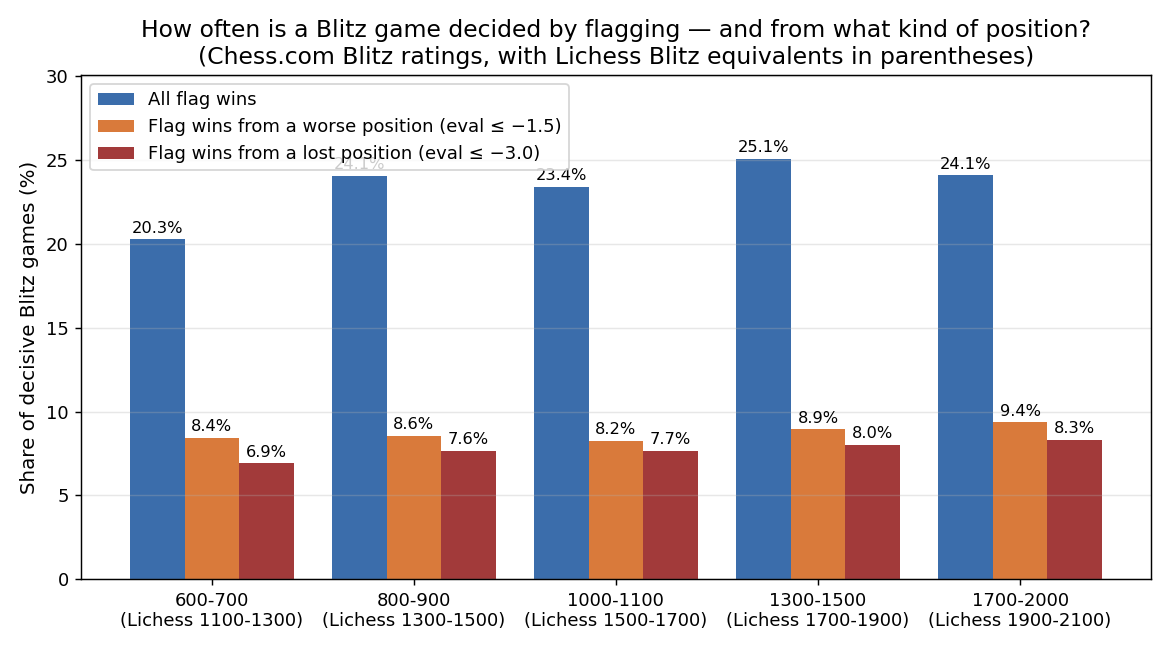
The data reveals a surprising trend: the overall rate of flagging actually increases slightly as you climb the rating ladder. At the Chess.com 600–700 level, about 20.3% of decisive games end in a flag. By the time you reach the 1700–2000 bracket, that number rises to 24.1%.
However, the rate of "dirty flags" — winning on time from a clearly worse or lost position — remains remarkably stable across all rating bands, hovering around 8% to 9% of all decisive games. This means that no matter your rating, nearly 1 in 10 of your decisive games will be won or lost on the clock despite the board position dictating otherwise.
What Does a Flagging Position Look Like?
When a player wins on time, what was the position actually like? We broke down the engine evaluations for the flagger across the different rating bands.
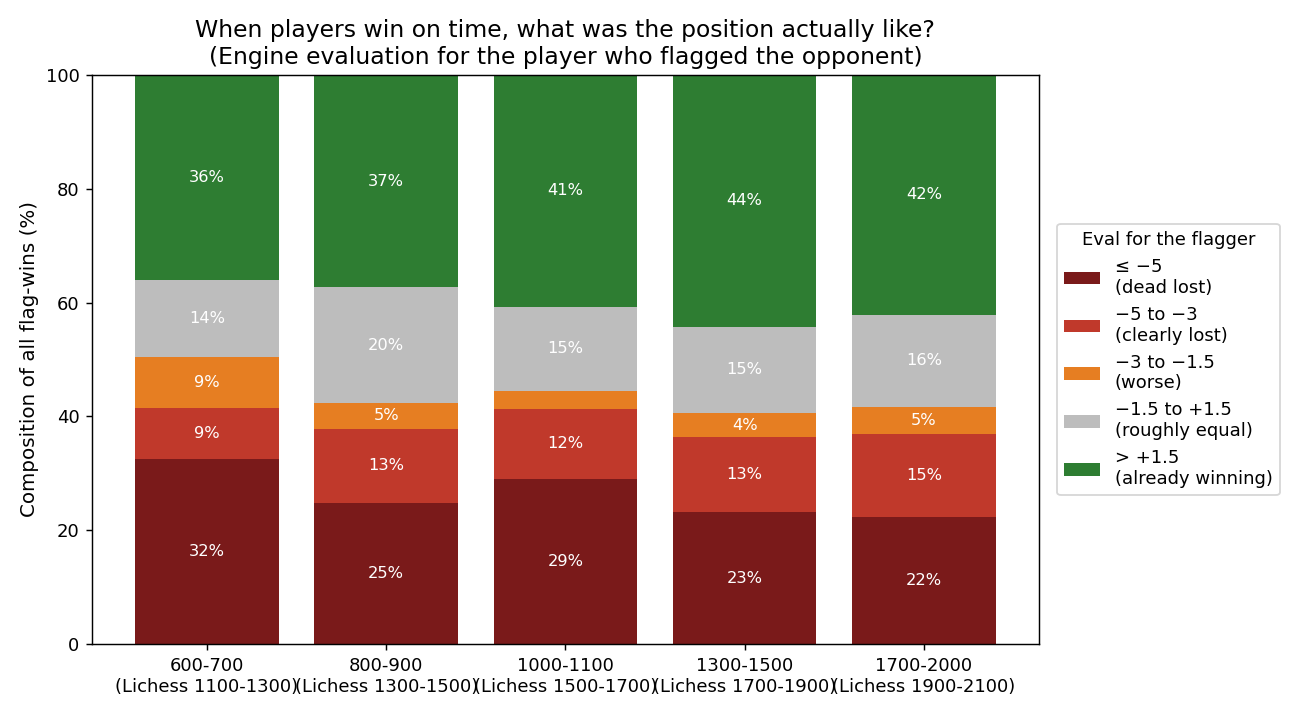
At the Chess.com 1700–2000 level, when a player wins on time:
- 42% of the time, they were already winning on the board (eval > +1.5).
- 16% of the time, the position was roughly equal.
- 42% of the time, they were worse, clearly lost, or dead lost (eval ≤ −1.5).
Astonishingly, in over 20% of all flag wins at the 2000 level, the winner was "dead lost" (eval ≤ −5.0) on the board. The clock is the ultimate equalizer.
The Material Deficit
To put this into perspective, we also looked at pure material balance. How often does a player win on time despite being down significant material?
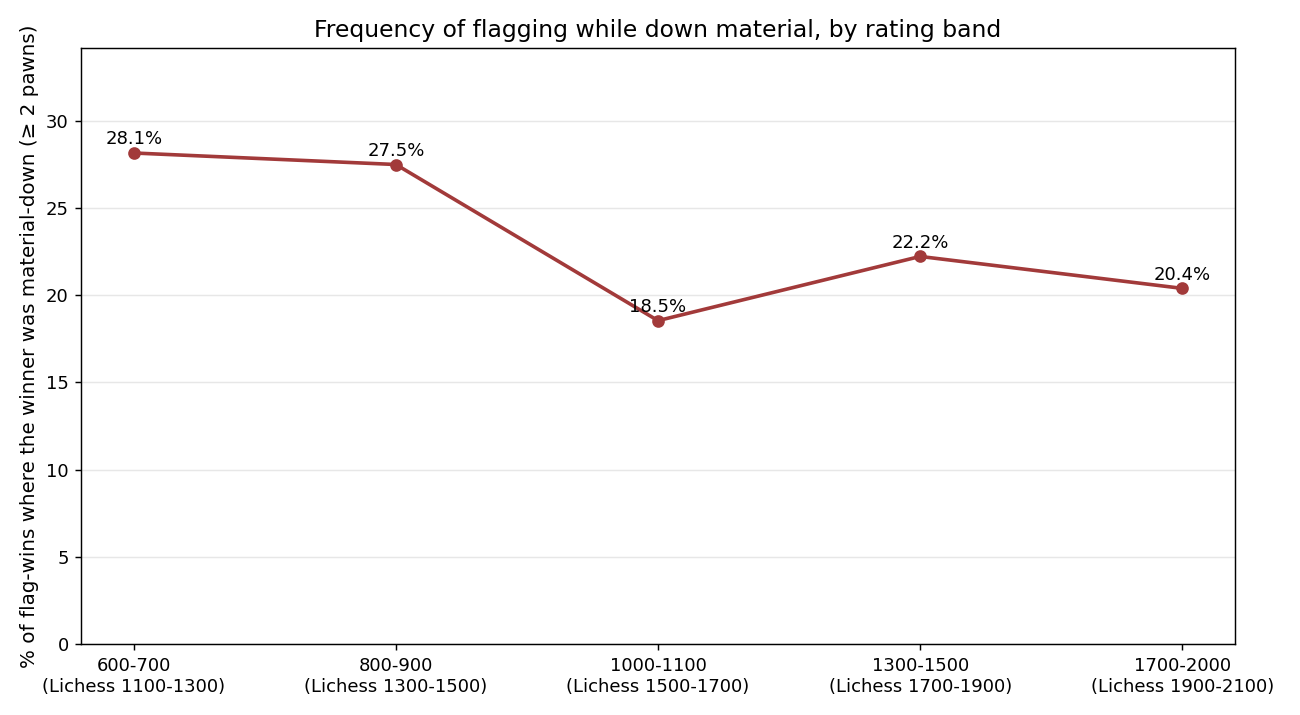
At lower ratings (Chess.com 600–700), over 28% of flag wins involve the winner being down at least 2 pawns of material. This drops to around 18–22% at intermediate and higher ratings, but it never disappears. Even at 2000 Elo, 1 in 5 flag wins involves a player who is down significant material.
Anatomy of a 2000 Elo Flag
Let's zoom in on the Chess.com 1700–2000 bracket (Lichess 1900–2100). How do decisive games end at this level?
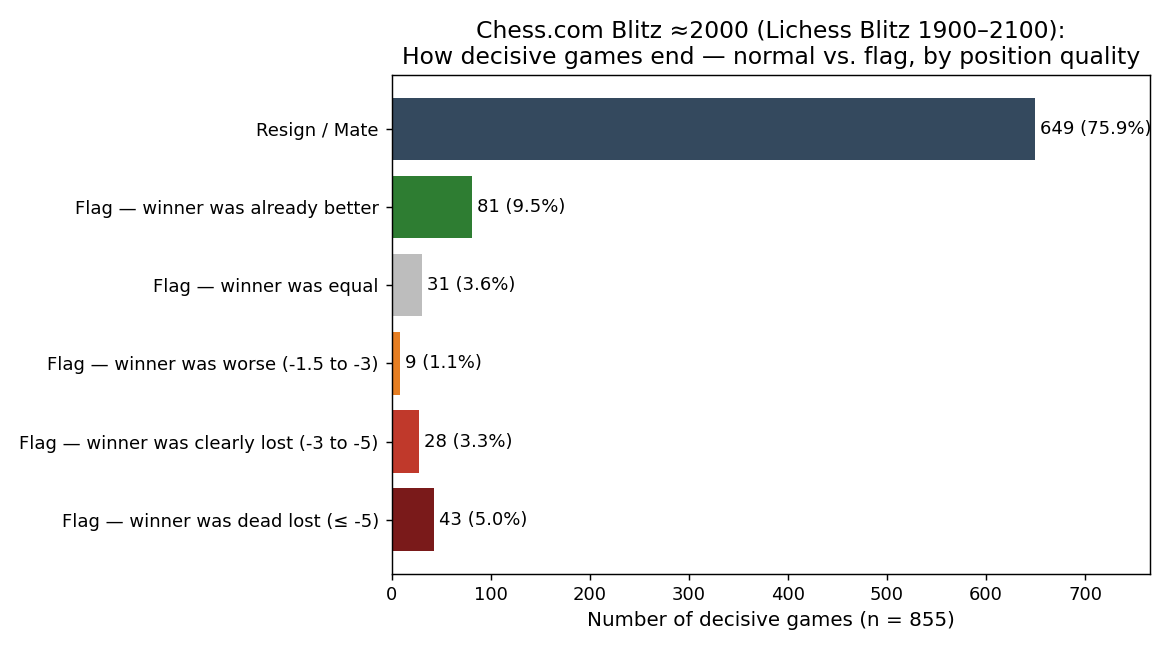
While the vast majority of games (75.9%) end in a normal resignation or checkmate, the remaining 24.1% are decided by the clock. And of those clock victories, a significant portion (9.4% of all decisive games) are won by the player who was worse or completely lost on the board.
Visual Evidence: The "Dirty Flag" in Action
To understand what this looks like in practice, let's examine two real games from the 2000 Elo bracket where a player won on time despite being completely lost.
Example 1: The Trapped King
In this position, White (the loser, playing from the bottom) is completely lost. Black has a massive material advantage (two rooks and a bishop) and an evaluation of −9.69. White's king is trapped on the edge of the board.
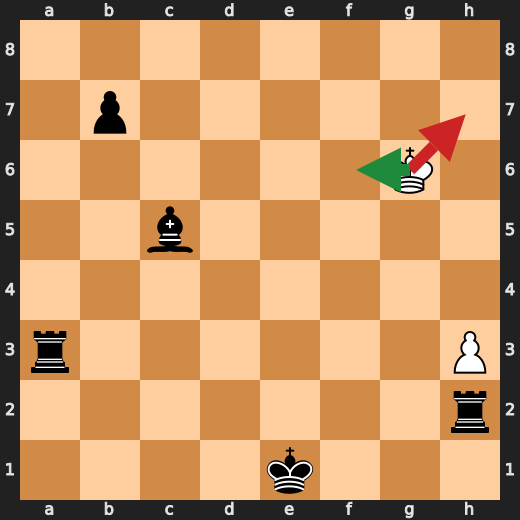
White's last move was to push their pawn (red arrow), while the engine suggests a slightly more resilient king move (green arrow). But the moves hardly matter. White played quickly, keeping the game alive just long enough for Black's clock to hit zero. White wins the game, despite the board.
Example 2: The Desperate Pawn Push
Here, White (the loser, playing from the bottom) is down a Queen and a Rook for a Knight. The evaluation is −8.77 in favor of Black.
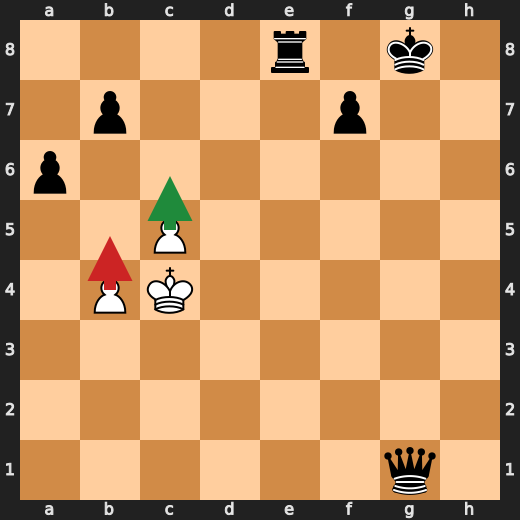
White's last move was a desperate pawn push (red arrow), while the engine suggests a different pawn push (green arrow). Again, the objective quality of the move is irrelevant. White's only goal was to make a legal move as fast as possible. Black, despite having an overwhelming advantage, could not deliver checkmate in time and lost on the clock.
The Flagger's Clock: How Much Time Do They Have?
When a player successfully flags their opponent from a lost position, how much time do they typically have left on their own clock?
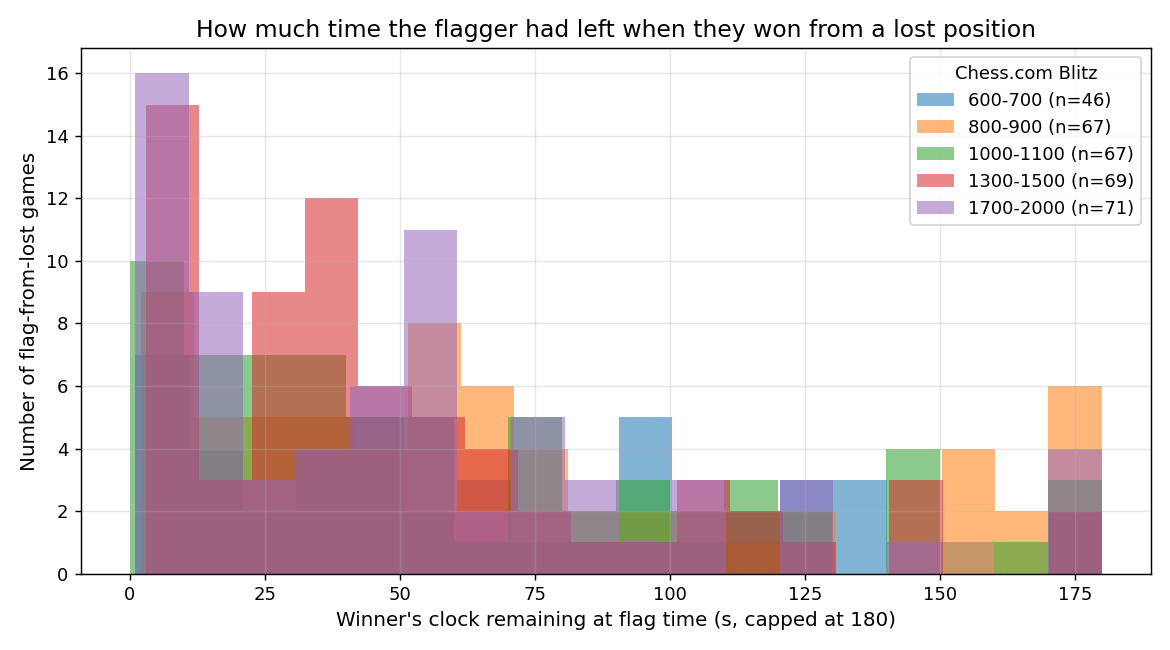
The data shows a wide distribution, but the median time remaining for the flagger is around 47 seconds (in a 3-minute or 5-minute Blitz game). This indicates that the flagger didn't just barely scrape by; they had a significant time advantage built up earlier in the game, which they then weaponized in the endgame.
Roadmap to Improvement: Actionable Advice by Rating
Based on the data, here is how you should adjust your time management strategy as you climb the rating ladder.
Chess.com 600–900: The Survival Phase
At this level, nearly 30% of flag wins involve a player who is down significant material. Games are chaotic, and blunders are frequent.
- Actionable Advice: Do not resign just because you blundered a piece. Your opponent is highly likely to either blunder it back or run out of time trying to convert the advantage. Play fast, make legal moves, and force them to prove they can checkmate you. Conversely, when you are winning, prioritize simple, safe moves over finding the absolute "best" continuation.
Chess.com 1000–1500: The Transition Phase
Here, players are getting better at converting advantages, but the clock is still a major factor. The rate of flagging from a worse position remains steady at around 8%.
- Actionable Advice: Start practicing "pre-moving" obvious recaptures and forced replies. If you are up material, simplify the position. Trade pieces (but not necessarily pawns) to reduce the complexity of the board, making it easier and faster for you to play the endgame. Do not spend 30 seconds looking for a forced mate when a simple endgame conversion will do.
Chess.com 1600–2000: The Weaponized Clock
At this level, players actively use the clock as a weapon. The overall flagging rate peaks here (24.1%), and players are highly skilled at complicating lost positions to drain their opponent's time.
- Actionable Advice: Time management in the opening and early middlegame is critical. If you consistently find yourself with 30 seconds against your opponent's 1 minute in the endgame, you will lose, even if you are up a piece. Learn to play your opening repertoire quickly and confidently. When defending a worse position, actively seek to create complications that force your opponent to think. The clock is your best defensive piece.
Data and Methodology
This analysis was conducted using a sample of 4,300 decisive Lichess Blitz games, filtered to ensure accurate clock data and engine evaluations. Games were categorized into rating bands based on the average Lichess Elo of the players, and then mapped to approximate Chess.com Blitz ratings for clarity.
Engine evaluations were provided by Stockfish 12/17, and positions were analyzed at the exact moment the loser made their final move (the ply before the time forfeit).
The raw data and aggregated statistics used to generate these insights are available below:
Chess Coach
April 20, 2026