Every chess player asks the same question when they start taking the game seriously: "How long will it take me to get good?"
Whether your goal is to break the 1000 barrier, reach the respectable 1200 level, or push toward the advanced beginner milestone of 1500, the journey can feel opaque. To answer this question definitively, we analyzed the rating histories of approximately 124,000 players, tracking their progression from their first games to their eventual peaks.
This article provides a data-driven roadmap for improvement, specifically targeting players rated between 800 and 1500 on Chess.com. While our underlying dataset comes from Lichess Rapid games, all primary ratings discussed here have been calibrated to their Chess.com equivalents to provide actionable, realistic timelines for the majority of online players.
The Rating Funnel: Not Everyone Makes It
Before looking at timelines, it is important to understand survival rates. Chess is difficult, and improvement requires sustained effort. Our cohort analysis reveals a clear "rating funnel" that illustrates the attrition rate at each major milestone.
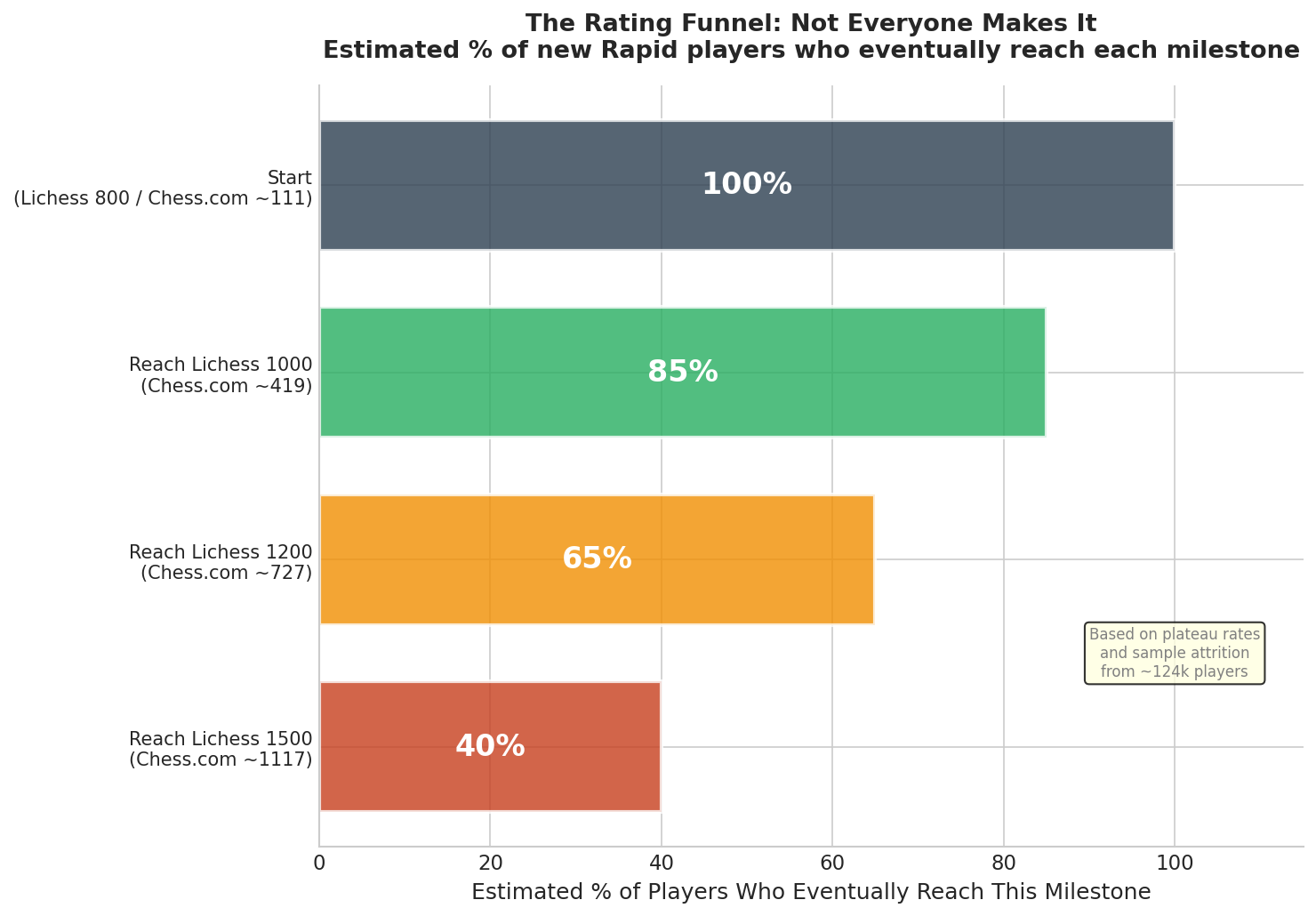
Starting from a baseline rating of approximately Chess.com 350 (Lichess 800), we found that roughly 85% of players who stick with the game eventually reach the Chess.com 419 (Lichess 1000) mark. However, the climb becomes steeper from there. Only about 65% of players reach Chess.com 727 (Lichess 1200), and a mere 40% ever cross the Chess.com 1117 (Lichess 1500) threshold.
This data highlights a crucial reality: reaching 1500 is not an inevitability of simply playing more games. It requires overcoming specific plateaus and addressing fundamental flaws in your play.
The Timeline: Months to Reach Each Milestone
How long does this journey actually take? The data shows a significant difference between the median player (the 50th percentile) and the mean average (which is skewed higher by players who take years to improve).
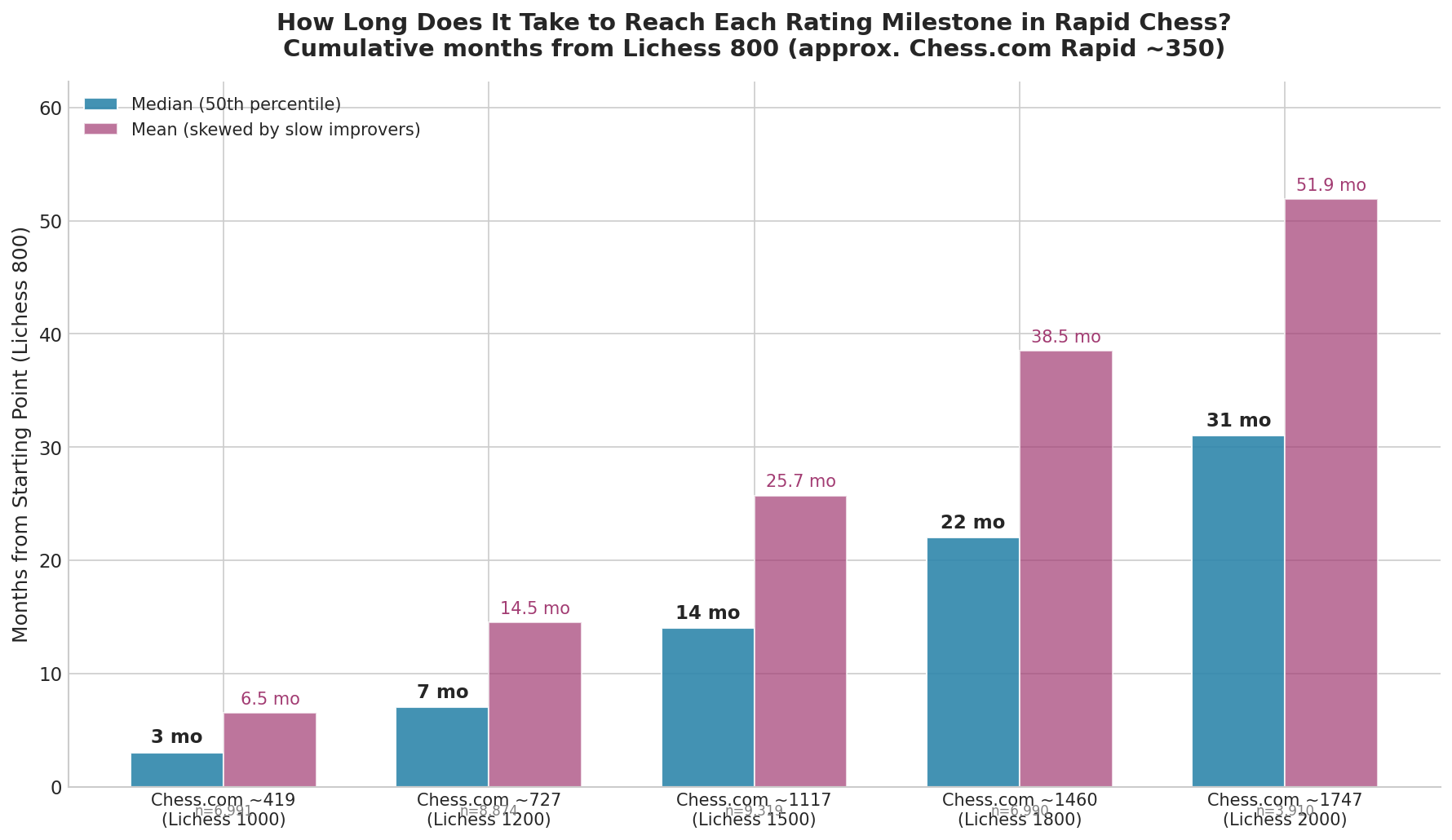
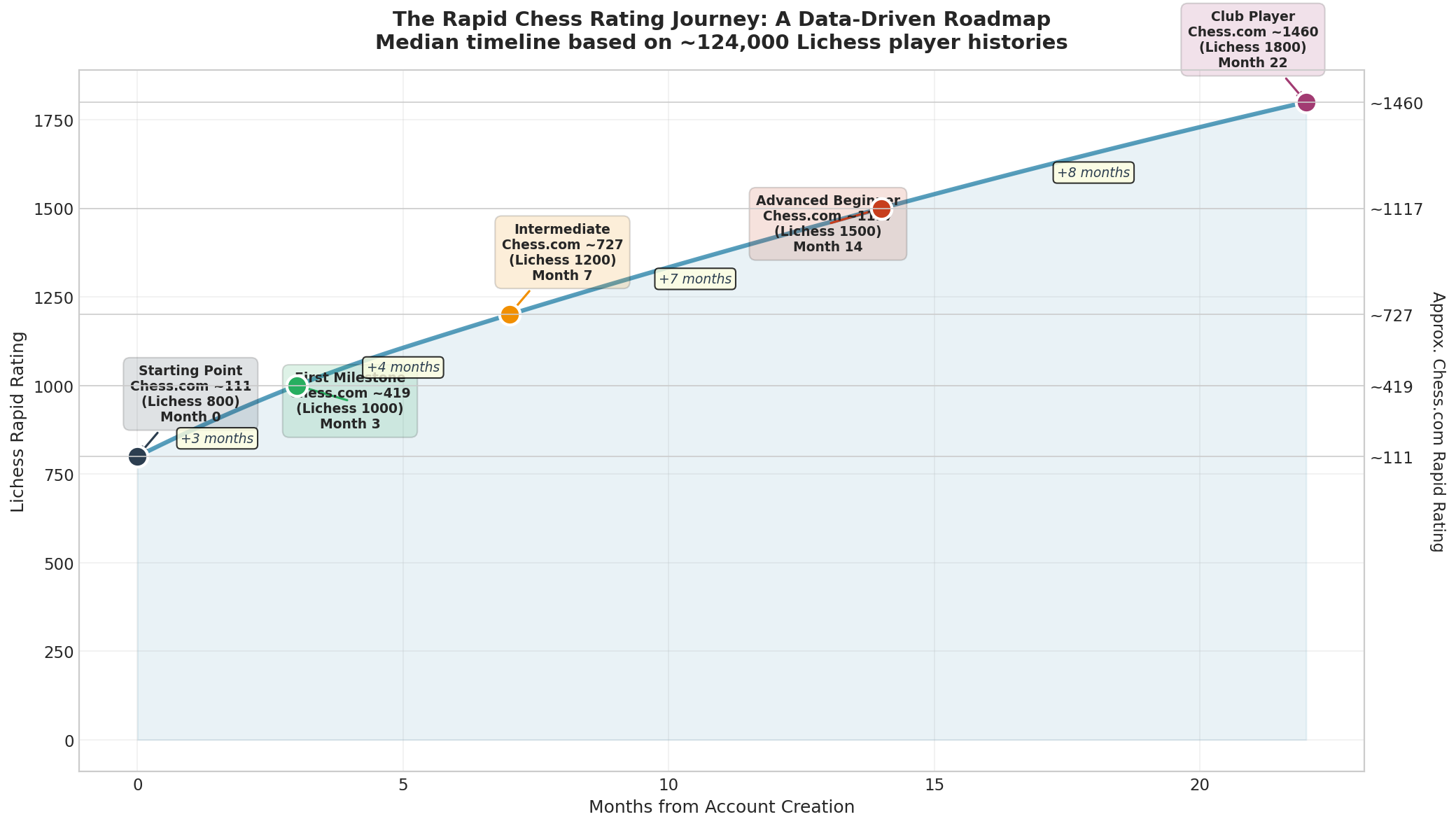
For the median player starting from scratch:
- Chess.com ~419 (Lichess 1000): Reached in 3 months.
- Chess.com ~727 (Lichess 1200): Reached in 7 months total.
- Chess.com ~1117 (Lichess 1500): Reached in 14 months total.
- Chess.com ~1460 (Lichess 1800): Reached in 22 months total.
These timelines represent cumulative months of active play. If you take a six-month break, that time does not count toward your progression.
The Climb Gets Steeper
It is a mathematical reality of the Elo system that gaining 100 points at a higher rating requires more skill improvement than gaining 100 points at a lower rating. We can see this clearly when we break down the median time required to progress through each specific segment.
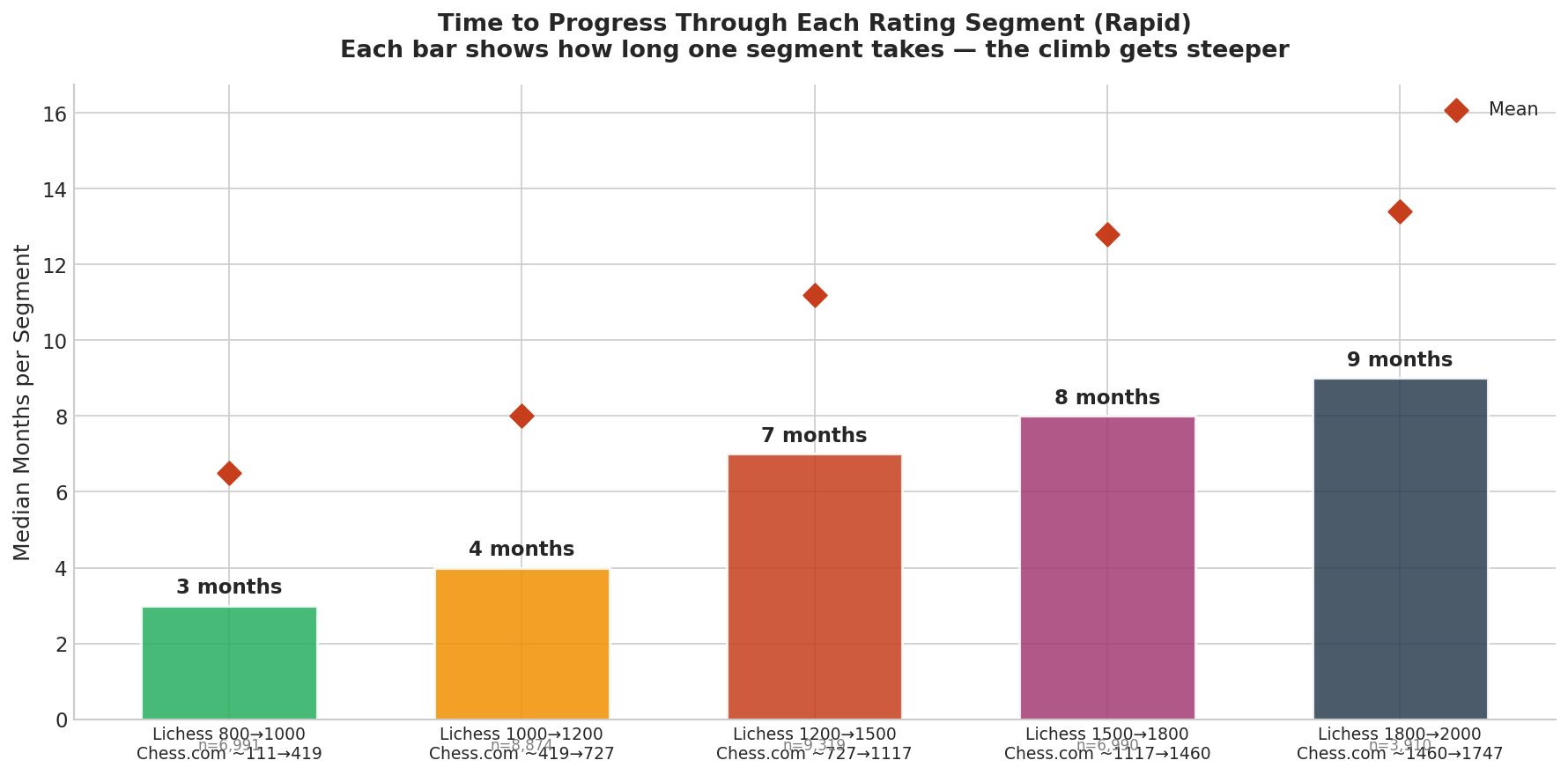
Moving from Chess.com ~419 to ~727 takes the median player 4 months. However, the next jump—from ~727 to ~1117—takes 7 months. The climb from ~1117 to ~1460 takes 8 months. As you improve, the "easy" mistakes disappear from your opponents' play, forcing you to work harder for every rating point.
The Data-Driven Roadmap to 1500
Based on our analysis of over 200,000 rapid games, we can identify the specific challenges players face at each rating band and provide actionable advice for overcoming them.
Phase 1: Breaking Chess.com 800 (Lichess ~1250)
The Challenge: One-move blunders and board vision.
At this level, games are rarely decided by deep strategic maneuvering. They are decided by who leaves fewer pieces undefended. Our Centipawn Loss (CPL) analysis shows that players in this band average a massive 150+ CPL per move, indicating frequent, severe mistakes.
Visual Evidence: The Hanging Piece
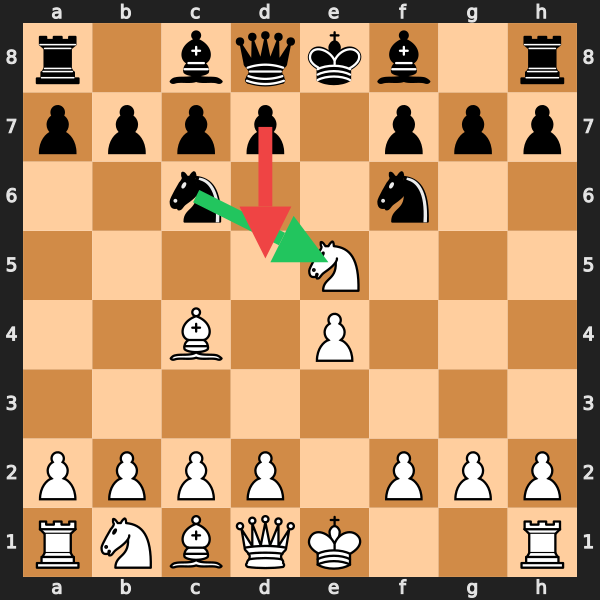 In this common scenario, White plays Ng5, launching a premature attack on f7. However, this ignores basic development and often leads to losing material after Black responds correctly. A simple, solid developing move like d3 is vastly superior.
Actionable Advice:
- Always Check Checks, Captures, and Threats: Before making any move, ask yourself: "Is my piece safe here?" and "Did my opponent just leave a piece undefended?"
- Prioritize Solid Development: Do not launch early attacks. Develop your knights and bishops, control the center, and castle your king to safety.
Phase 2: The Push to Chess.com 1000 (Lichess ~1370)
The Challenge: Basic tactics and opening principles.
Players approaching 1000 have stopped hanging pieces on every move, but they still frequently miss two-move tactical sequences like forks, pins, and skewers.
Visual Evidence: Missing the Fork
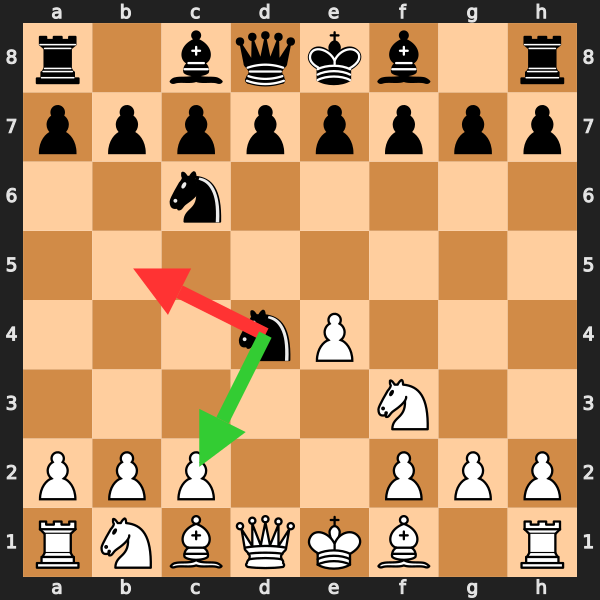 Here, Black has a devastating knight fork available on c2, attacking both the king and the rook. Players at this level often miss these opportunities, opting instead for passive retreating moves like Nb5.
Actionable Advice:
- Daily Tactics Training: Spend 15 minutes a day solving basic tactical puzzles. Pattern recognition is the fastest way to gain rating points in this band.
- Learn One Opening for White and Two for Black: You do not need deep theory, but you need a reliable way to reach a playable middlegame.
Phase 3: Climbing to Chess.com 1200 (Lichess ~1580)
The Challenge: Positional awareness and piece activity.
To break 1200, you must start thinking about where your pieces belong, not just whether they are safe. Players at this level often trade active pieces for passive ones or lock their own bishops behind pawn chains.
Visual Evidence: Piece Activity
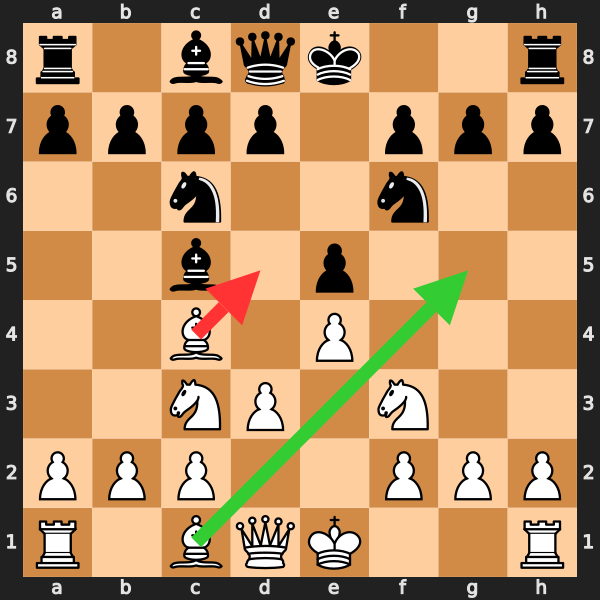 White has the option to play Bd5, which looks aggressive but actually blocks the center and allows Black to equalize easily. The superior move is Bg5, pinning the knight and creating long-term positional pressure.
Actionable Advice:
- Evaluate Piece Activity: Before trading pieces, ask yourself: "Am I trading my good piece for their bad piece, or vice versa?"
- Understand Pawn Structures: Learn the basics of pawn chains, isolated pawns, and doubled pawns. Your pawn structure dictates where your pieces should go.
Phase 4: Reaching Chess.com 1500 (Lichess ~1825)
The Challenge: Endgame technique and planning.
At the 1500 level, opponents will not simply hand you the game. You will frequently reach endgames where the material is equal, and the result depends entirely on technique.
Visual Evidence: Endgame Opposition
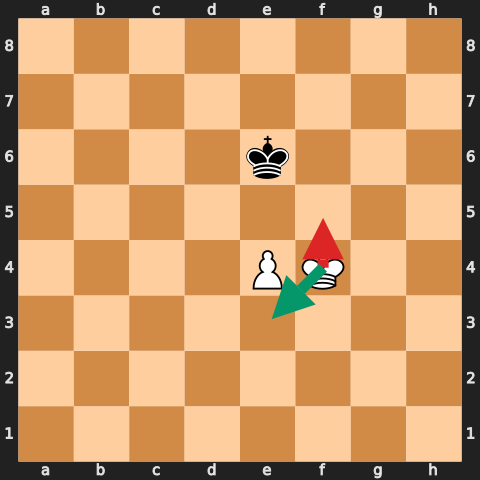 In this fundamental King and Pawn endgame, pushing the pawn immediately (e5) is a draw. White must use their king to take the "opposition" (Ke5), forcing the Black king to give way and securing the promotion.
Actionable Advice:
- Master Basic Endgames: You must know how to win King and Pawn endgames, and you must understand the basics of Rook endgames (which are the most common).
- Formulate a Plan: You can no longer play move-to-move. You need a cohesive plan, whether it is attacking the queenside, exploiting a weak square, or preparing a pawn break.
The Reality of Plateaus
If you feel stuck at a certain rating, you are not alone. Our data shows that rating plateaus—defined as staying within a 50-point range for three or more consecutive months—are incredibly common.
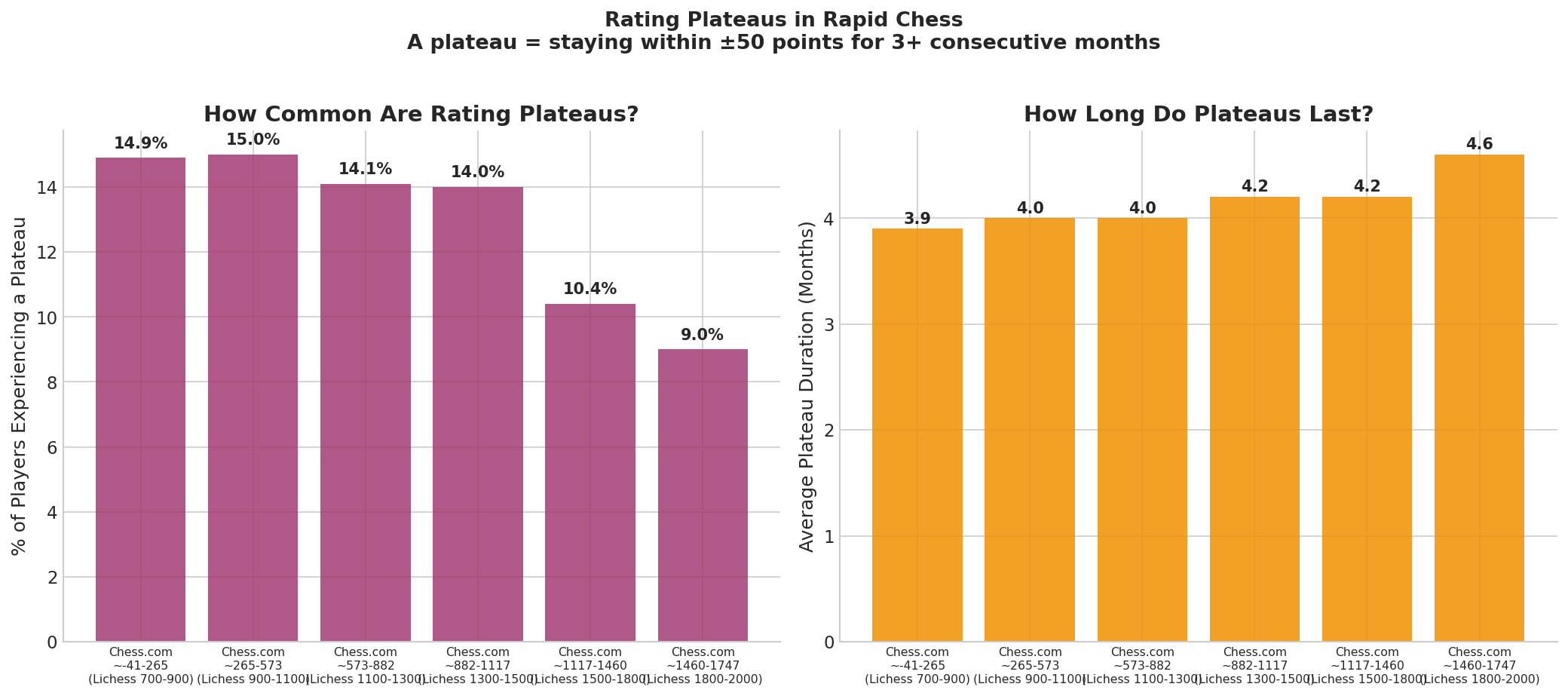
Approximately 14-15% of players experience a significant plateau in the lower rating bands. Interestingly, while plateaus become slightly less common at higher ratings (dropping to 9% above Chess.com 1460), they last longer when they do occur. The average plateau lasts around 4 months.
If you hit a plateau, do not panic. It is a normal part of the learning curve where your brain is consolidating new information before the next breakthrough.
Does Playing More Games Help?
The most common advice given to improving players is simply "play more games." But does the data support this? We analyzed the correlation between the volume of Rapid games played per month and the average rating gain in the subsequent month.
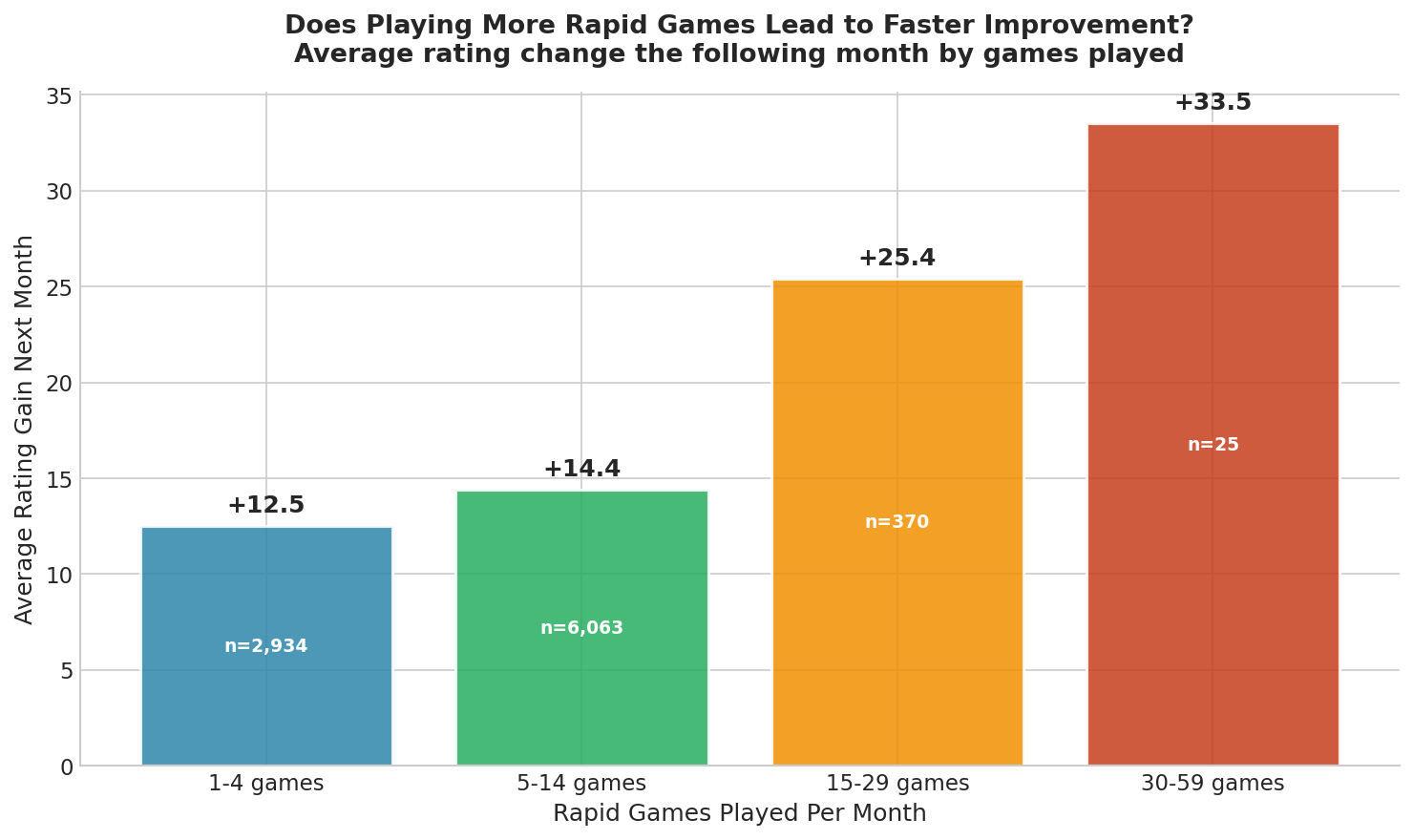
The answer is a resounding yes. Players who complete 1-4 Rapid games per month see an average rating gain of 12.5 points. Those who play 15-29 games see a gain of 25.4 points. And the dedicated few who play 30-59 Rapid games per month (roughly 1-2 games per day) see an impressive average gain of 33.5 points.
However, there is a catch: Time control matters.
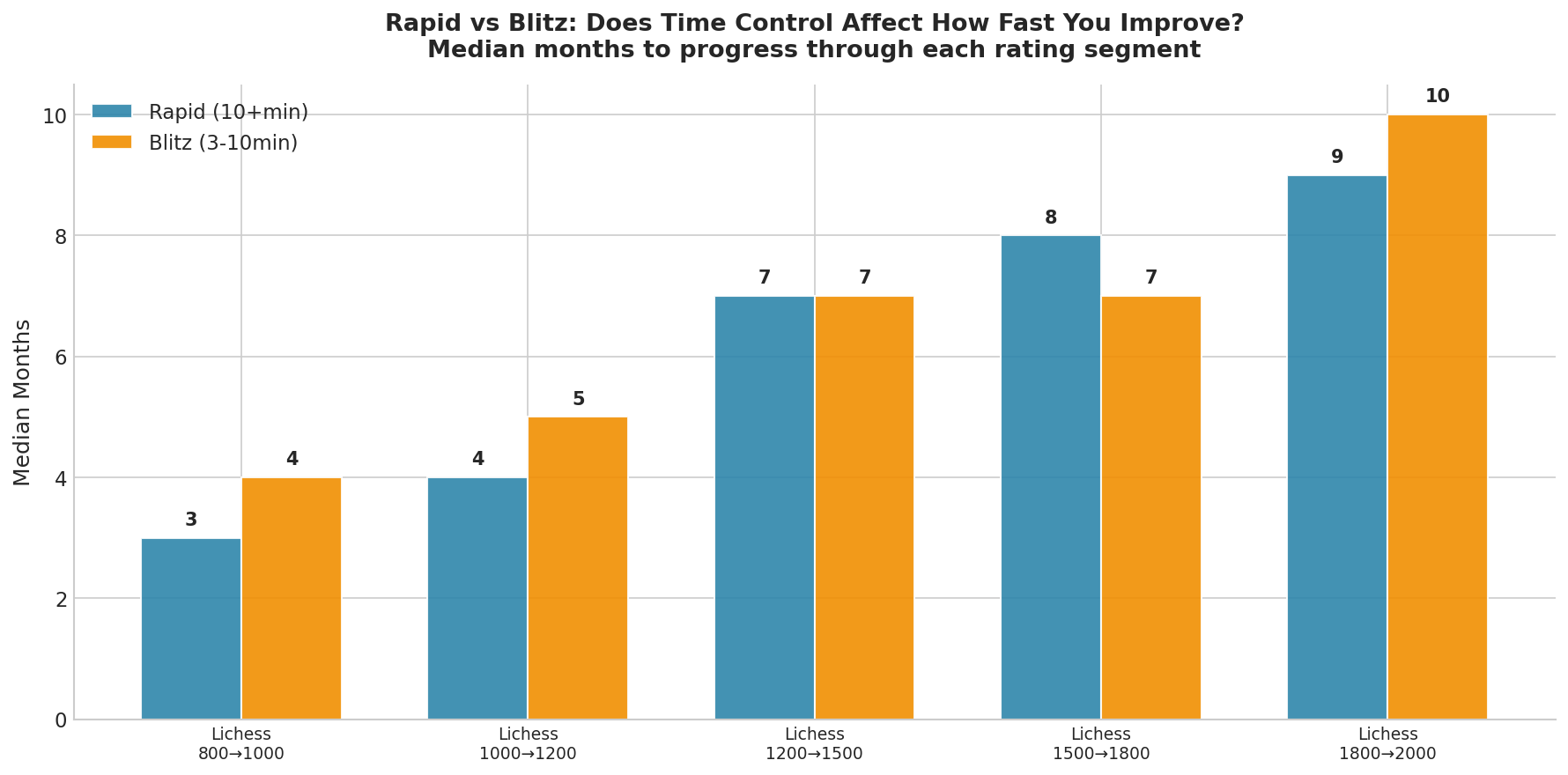
When we compared progression speeds between Rapid (10+ minutes) and Blitz (3-10 minutes), the data clearly favored slower time controls. The median time to reach the 1200 Lichess milestone is 7 months for Rapid players, but 8.5 months for Blitz players.
Playing Blitz encourages superficial thinking and reinforces bad habits. If your goal is improvement, you must play time controls that allow you to actually think about your moves.
Summary and Methodology
Reaching Chess.com 1500 is a significant achievement that requires dedication, study, and a willingness to learn from your mistakes. The median player takes just over a year of active play to reach this level, progressing through distinct phases of tactical, positional, and endgame mastery.
Key Takeaways:
- Play Rapid, Not Blitz: Slower time controls lead to faster rating improvement.
- Volume Matters: Aim for at least 15-30 Rapid games per month for optimal growth.
- Expect Plateaus: Stalling for 3-4 months is normal. Use that time to study your weaknesses.
- Focus on the Right Things: Do not study complex opening theory if you are still hanging pieces. Address the specific challenges of your current rating band.
Data and Methodology
This analysis was conducted using a dataset of approximately 124,000 player histories sourced via the Lichess API and the Grandmaster Guide analytics engine. The data focuses specifically on the Rapid time control.
To make the findings actionable for the broader chess community, Lichess Rapid ratings were calibrated to approximate Chess.com Rapid ratings using a standardized mapping table.
All underlying data used to generate the charts in this article is available for download and further analysis:
View full data →variant from_rating_lichess to_rating_lichess from_rating_chesscom_approx to_rating_chesscom_approx median_months avg_months sample_players rapid 800 1000 735 735 3 6.5 6991 rapid 1000 1200 735 735 4 8 8874 rapid 1200 1500 735 1117 7 11.2 9319 rapid 1500 1800 1117 1460 8 12.8 6990 rapid 1800 2000 1460 1747 9 13.4 3910
View full data →rating_band_lichess rating_band_chesscom_approx avg_plateau_months pct_players_plateauing sample_players 700-900 735-735 3.9 14.9 4573 900-1100 735-735 4.0 15.0 8107 1100-1300 735-882 4.0 14.1 10080 1300-1500 882-1117 4.2 14.0 10474 1500-1800 1117-1460 4.2 10.4 12597
View full data →games_per_month avg_rating_delta_next_month sample_player_months 1-4 games 12.5 2934 5-14 games 14.4 6063 15-29 games 25.4 370 30-59 games 33.5 25
View full data →rating_band_lichess rating_band_chesscom_approx avg_cpl draw_rate avg_game_length sample_games 700-900 735-735 150.5 5.9 26.7 49133 900-1100 735-735 145.4 5.1 28.5 41879 1100-1300 735-882 139.6 4.6 30.1 35587 1300-1500 882-1117 134.0 4.1 31.6 29959 1500-1800 1117-1460 129.3 4.3 33.4 23297
Chess Coach, April 15, 2026