Every chess player has experienced the agonizing tick of the clock. You stare at a complex middlegame position, calculating variations until your head spins, only to play a move that the engine later calls a blunder. Conversely, you might blitz out a move in two seconds, feeling confident, only to realize you hung a piece. This raises a fundamental question: Does thinking longer actually improve move quality, and is there an optimal amount of time to spend on a move?
To answer this, we analyzed over 12,700 moves from 216 Lichess Rapid games (10+0 and slower) across five rating bands, supplemented by aggregate statistics from over 847,000 games via the Grandmaster Guide analytics platform. Every move was mapped against its time expenditure and the resulting Centipawn Loss (CPL) as evaluated by Stockfish 17. The data reveals fascinating insights into human decision-making, the existence of a "diminishing returns" threshold, and the paradox of how we allocate our time.
This guide serves as a roadmap for improvement, specifically targeting players looking to climb from lower to higher ratings. All ratings discussed are approximate Chess.com Rapid ratings, converted from the underlying Lichess data using established community conversion tables. For reference, a Chess.com Rapid 1000 corresponds to approximately Lichess 1615, and a Chess.com Rapid 1500 corresponds to approximately Lichess 1930.
At a Glance: The Numbers by Rating Band
Before diving into the analysis, here is a summary of the key statistics across each rating band.
| Chess.com Rapid Rating | Avg. Time Per Move | Avg. CPL | Blunder Rate | First Blunder (Avg. Move) | Lichess Equivalent |
|---|---|---|---|---|---|
| 800-1000 | 8.0s | 372 | 33.9% | ~17 | 1400-1615 |
| 1000-1200 | 8.9s | 343 | 35.2% | ~20 | 1615-1765 |
| 1200-1400 | 8.5s | 383 | 41.4% | ~23 | 1765-1880 |
| 1400-1500 | 9.0s | 329 | 35.4% | ~25 | 1880-1930 |
| 1500-1700 | 9.7s | 251 | 29.3% | ~27 | 1930-2035 |
The trend is clear: higher-rated players spend slightly more time per move, achieve significantly lower CPL, blunder less frequently, and delay their first blunder by approximately 10 moves compared to the lowest band. However, the relationship between time and quality is more nuanced than a simple "think longer, play better" prescription.
The Core Relationship: Time vs. Accuracy
The data confirms a fundamental truth: taking more time generally leads to better moves. However, the relationship is not linear, and the benefits vary significantly depending on your rating.
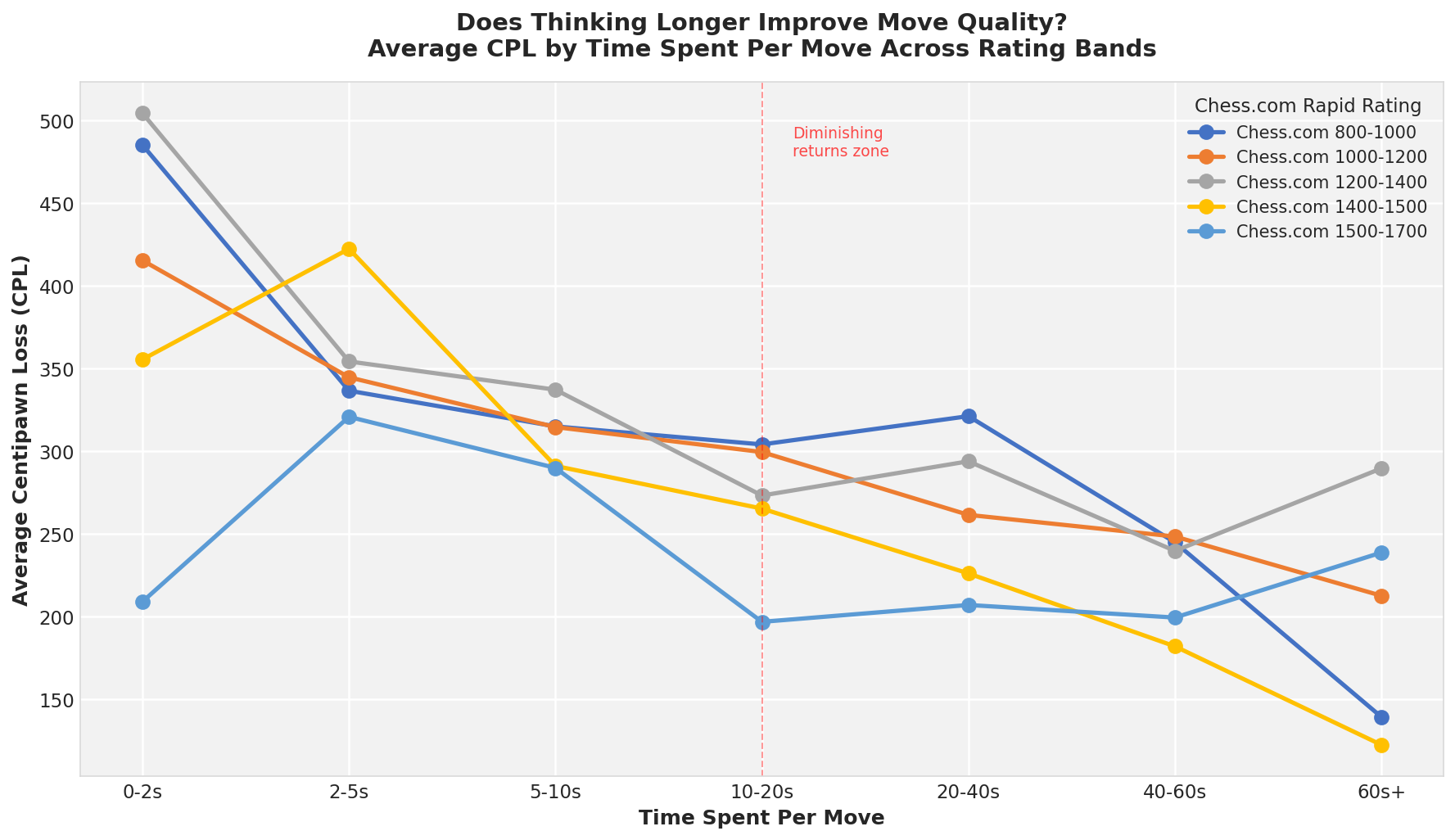
As shown in the chart above, moves played in under two seconds are consistently the least accurate across all rating bands, with average CPL ranging from 209 (for 1500-1700 players) to over 500 (for 1200-1400 players). As players invest more time, move quality improves dramatically through the 5-10 second and 10-20 second buckets, before the improvement begins to taper off.
The following heatmap provides a more granular view. Each cell represents the average CPL for a given rating band and time bucket, with green indicating better move quality and red indicating worse.
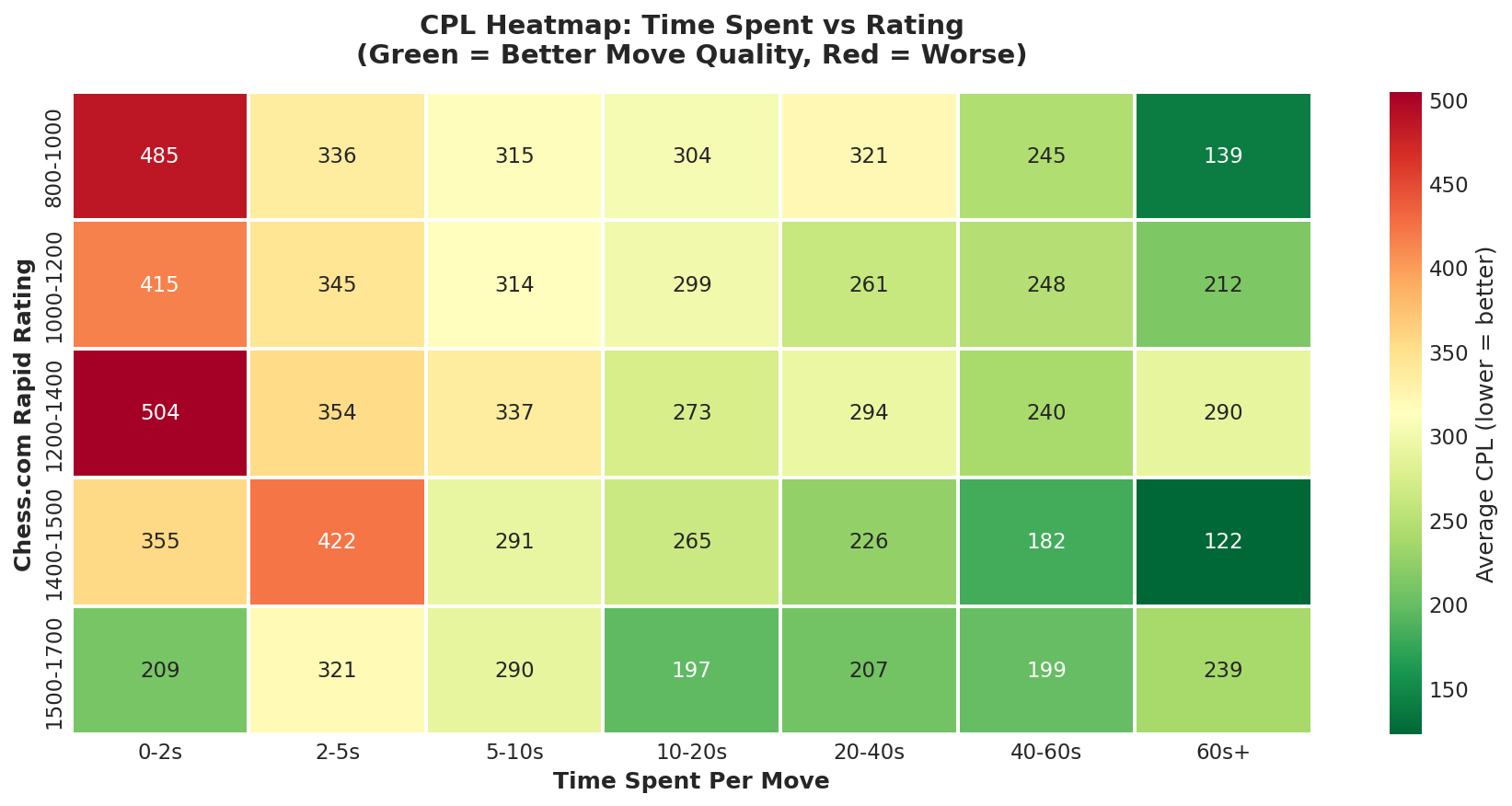
Interestingly, the 1500-1700 rating band maintains a consistently lower CPL across all time buckets compared to lower-rated peers. A 1500-rated player thinking for 10-20 seconds produces a move with an average CPL of 197, which is comparable to the accuracy of an 800-1000 player who thinks for over a minute (CPL 139). This highlights that higher-rated players possess better pattern recognition and calculation efficiency, allowing them to find stronger moves in less time. The implication is profound: improving your chess knowledge and tactical pattern library is at least as important as learning to think longer.
Actionable Advice by Rating
For 800-1200 Players (Lichess ~1400-1765): Your primary goal should be to eliminate "impulse moves." The data shows a massive drop in CPL when you transition from 0-2 seconds to 5-10 seconds of thought. Force yourself to sit on your hands for at least five seconds before moving, even when the recapture seems obvious. Use this time to perform a basic blunder check: Are any of my pieces undefended? Is my king safe?
For 1200-1500 Players (Lichess ~1765-1930): You are likely calculating deeper, but perhaps inefficiently. Your accuracy improves steadily up to the 20-40 second mark. Focus on structured calculation. Instead of looking at the same line repeatedly, identify candidate moves, calculate each one once, and evaluate the resulting position.
For 1500-1700 Players (Lichess ~1930-2035): Your baseline accuracy is much higher, but you still benefit from taking time in critical positions. Your challenge is time management, specifically knowing when to invest those 40-60 seconds. Trust your intuition for standard developing moves, but slow down significantly when the pawn structure changes or pieces are exchanged.
The Diminishing Returns Threshold
While thinking longer helps, there is a clear point where additional time yields minimal improvement. This phenomenon, often referred to as "decision paralysis," occurs when a player cannot decide between relatively equal options or gets lost in complex calculations without reaching a clear conclusion.
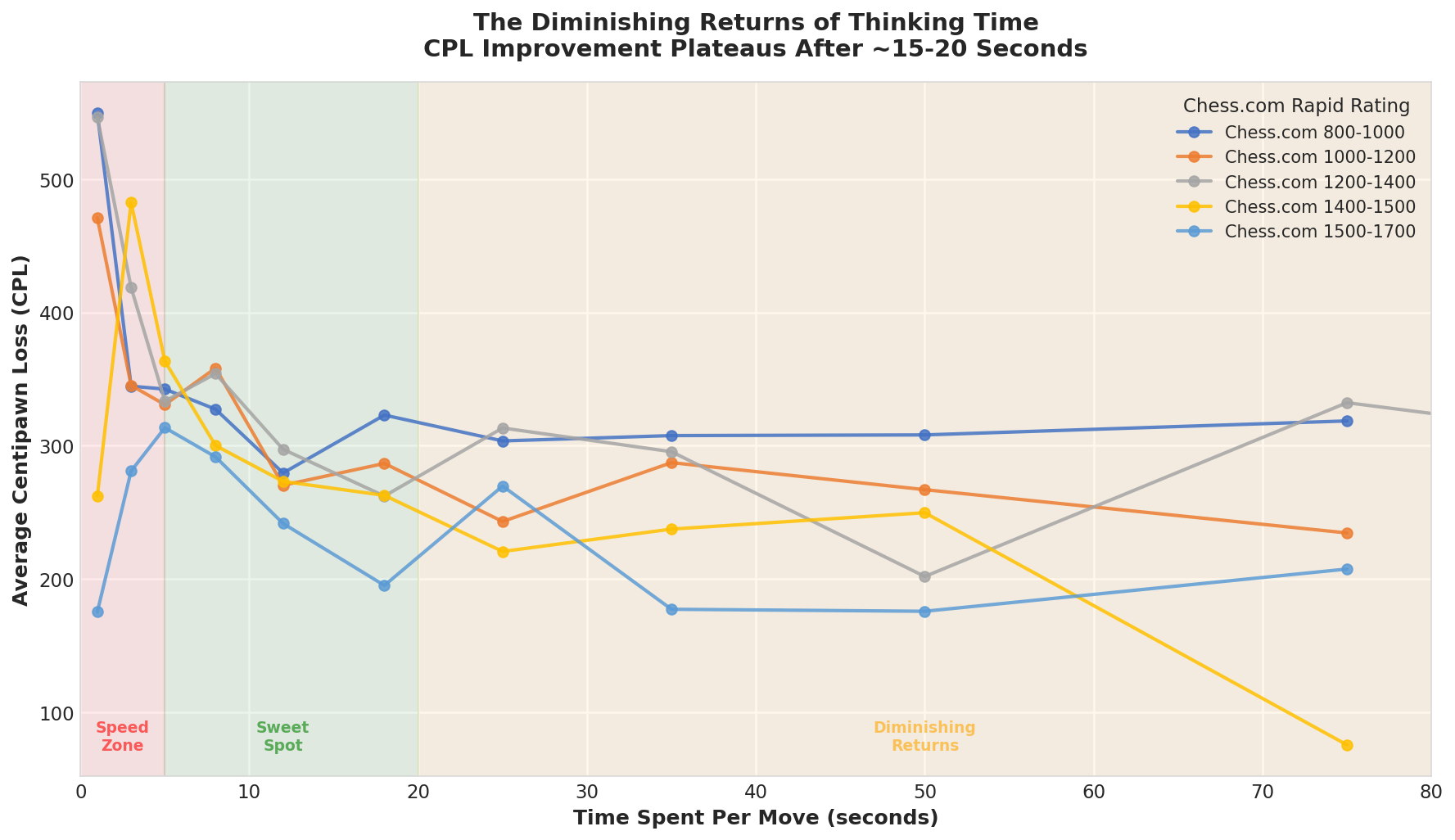
The data reveals three distinct zones of thought:
The Speed Zone (0-5 seconds): High risk of blunders. This zone should be reserved exclusively for forced recaptures or deep opening preparation. Across all rating bands, moves played in under 5 seconds have an average CPL that is 30-50% higher than moves played in the 10-20 second range.
The Sweet Spot (5-20 seconds): This is where the most significant CPL improvements occur. For most non-critical middlegame decisions, this is the optimal time investment. The CPL curves drop steeply through this range before beginning to flatten.
The Diminishing Returns Zone (20+ seconds): Beyond 20 seconds, the curves flatten out. While spending a minute on a move might occasionally find a brilliant tactic, on average, the move quality does not improve substantially compared to a 20-second think. In some bands, the CPL actually increases slightly in the 40-60 second range, suggesting that overthinking can be counterproductive.
Actionable Advice by Rating
For 800-1200 Players: Do not spend more than 30 seconds on a single move unless you are calculating a forced mate or a critical tactical sequence. At this level, long thinks often lead to "seeing ghosts" (imagining threats that do not exist) or simply forgetting the initial calculation. If you have not found a clear tactical sequence after 30 seconds, play a solid, improving move and manage your clock.
For 1200-1500 Players: You are prone to the "sunk cost fallacy" in calculation. If you have spent 45 seconds calculating a line and it still looks murky, it is time to evaluate a different candidate move or play a safe alternative. The data shows your accuracy actually worsens slightly in the 40-60 second bucket compared to the 20-40 second bucket, indicating decision paralysis.
For 1500-1700 Players: Your sweet spot extends slightly longer, up to about 30 seconds for complex decisions. However, be wary of spending over a minute unless the position is objectively critical (e.g., a major material imbalance or a direct attack on the king). The data shows that your CPL at 18 seconds (195) is nearly identical to your CPL at 50 seconds (176), a marginal gain for a massive time investment.
The Blunder Paradox: Time Allocation on Critical Moves
One of the most surprising findings in the data is how players allocate their time relative to the objective criticality of the position. We defined a "blunder" as a move with a CPL of 100 or more, equivalent to losing approximately one pawn of advantage or worse.
Do players spend more time on moves that turn out to be blunders? The data says no.
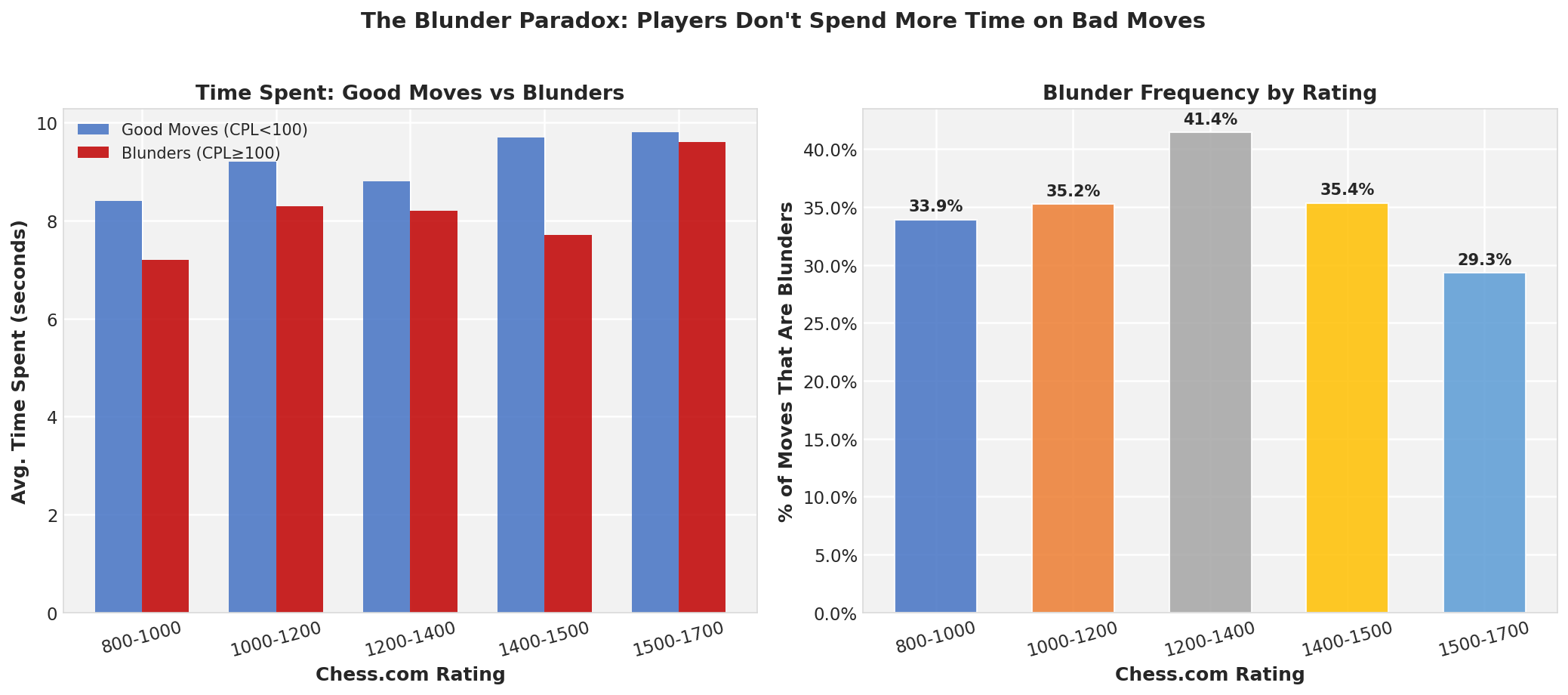
Across all rating bands, players actually spend less time on average when they blunder compared to when they play a good move (CPL < 100). For example, in the 800-1000 band, players spent an average of 8.4 seconds on good moves but only 7.2 seconds on blunders. This pattern holds across every rating band in our dataset.
This indicates a failure in threat detection. Players are not blundering because they calculate poorly after long thought; they are blundering because they fail to recognize that the position requires deep thought in the first place. They play quickly, missing a tactical shot or a positional nuance.
Visual Evidence: The Quick Blunder
Consider the following common scenario in the opening. Black plays quickly, missing a crucial tactical detail.
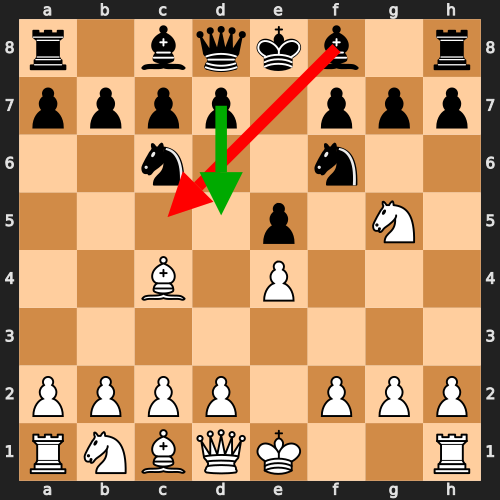
In this position from the Fried Liver Attack setup (after 1.e4 e5 2.Nf3 Nc6 3.Bc4 Nf6 4.Ng5), Black hastily played 4...Bc5?? (red arrow), likely a pre-planned developing move. However, this ignores White's threat of Nxf7. A few seconds of thought would reveal the necessity of 4...d5! (green arrow), the only move that challenges White's initiative by striking at the center and opening lines for Black's pieces.
Visual Evidence: Thinking Pays Off in the Middlegame
In more complex middlegame positions, spending 15-20 seconds can reveal tactical resources that a quick glance would miss entirely.
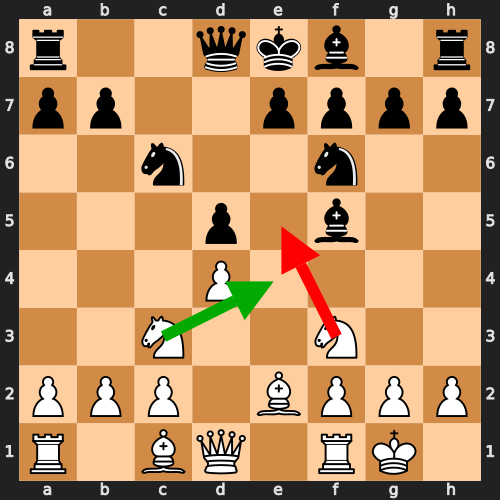
Here, the hasty move Ne5? (red arrow) looks active but is premature. Taking 15-20 seconds to evaluate candidate moves reveals Ne4! (green arrow), which attacks the bishop on f5 and creates a powerful centralized knight. This kind of positional-tactical insight is precisely what the "sweet spot" of 10-20 seconds is designed to capture.
Actionable Advice by Rating
For 800-1200 Players: Your blunder rate is high (33-35%). To reduce this, you must improve your "danger sense." Before every move, ask yourself: What did my opponent's last move do? What are they threatening? This simple habit will force you to pause in critical moments rather than playing on autopilot.
For 1200-1500 Players: You are often caught by intermediate tactics. You might calculate a two-move sequence but miss the opponent's zwischenzug (in-between move). When you feel the urge to play a move quickly because it "looks natural," force yourself to find one reason why it might be a mistake.
For 1500-1700 Players: Your blunder rate is lower (29.3%), but blunders still happen, often due to positional misjudgments rather than simple tactical oversights. Focus on identifying the critical moments in the game, specifically when the pawn structure is about to change, or when pieces are exchanged. These are the moments to invest your time.
Where Should You Spend Your Time? Phase Analysis
Not all phases of the game demand the same level of attention. The data reveals a striking mismatch between where players spend their time and where the most errors occur.
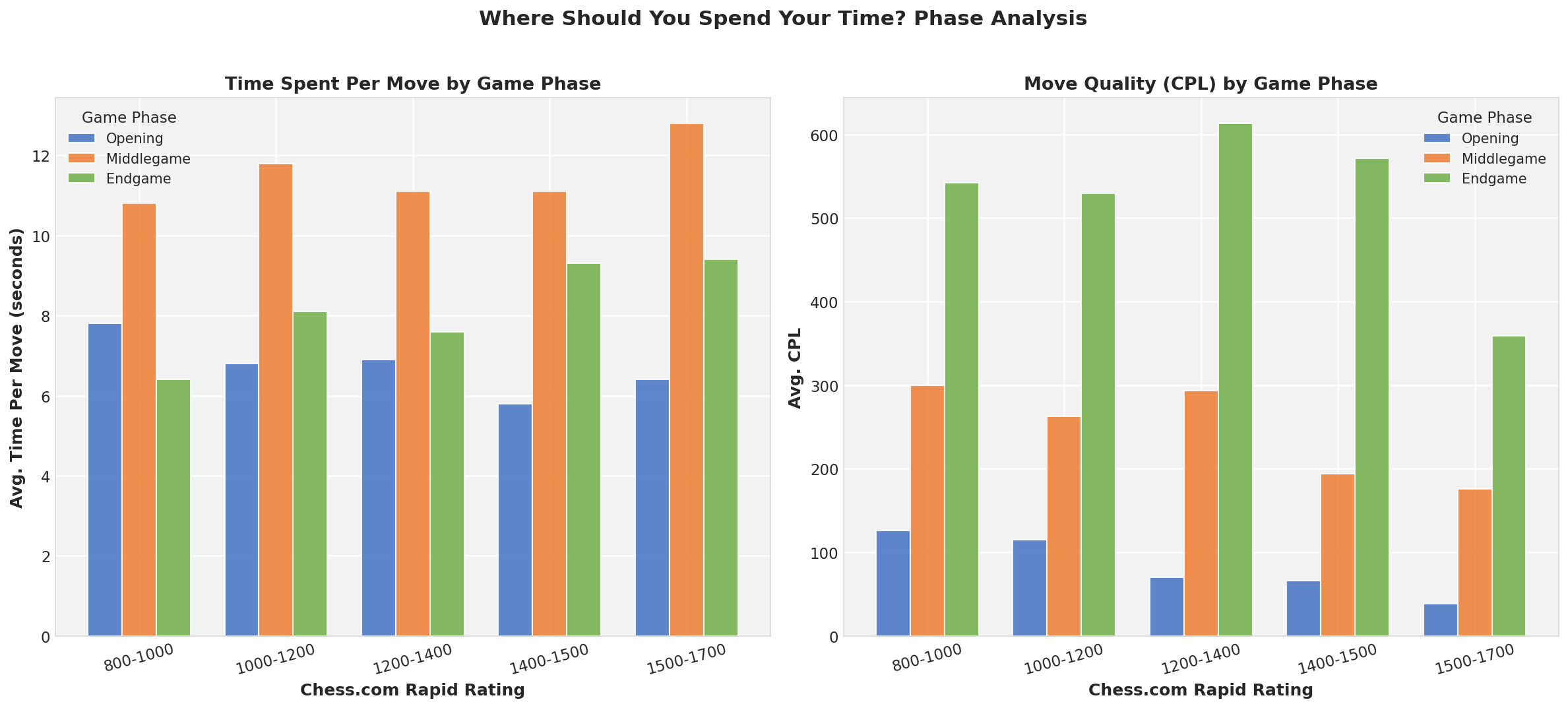
Across all rating bands, players spend the most time per move in the middlegame (11-13 seconds), followed by the endgame (6-9 seconds), and the opening (5-8 seconds). This distribution makes intuitive sense: the middlegame is the most complex phase, with the widest range of candidate moves.
However, the CPL data tells a different story. The endgame consistently produces the highest CPL (360-614 across bands), despite players spending moderate time on it. The opening produces the lowest CPL (38-126), even though players spend the least time on it. This pattern suggests that players are under-investing time in the endgame, where precision matters most and mistakes are most punishing.
| Game Phase | Avg. Time Per Move | Avg. CPL | Blunder Rate | Key Insight |
|---|---|---|---|---|
| Opening (moves 1-10) | 5-8s | 38-126 | 11-24% | Low error rate; pattern knowledge dominates |
| Middlegame (moves 11-25) | 11-13s | 175-300 | 28-44% | Highest time investment; complex decisions |
| Endgame (moves 25+) | 6-9s | 360-614 | 36-52% | Highest error rate; time pressure bites |
Actionable Advice by Rating
For 800-1200 Players: You often play the opening too slowly, leaving yourself with no time for the middlegame and endgame. Focus on learning opening principles rather than memorizing deep theory. Develop your pieces, control the center, get your king safe, and do it efficiently. Save your time for the middlegame and endgame, where the real battles are fought.
For 1200-1500 Players: Your endgame CPL is extremely high (571-613). This is likely because you arrive at the endgame with very little time on the clock. Practice managing your clock so that you have at least 3-4 minutes remaining when the endgame begins. Additionally, study basic endgame principles (king activity, passed pawns, opposition) so that you can make faster, more accurate decisions.
For 1500-1700 Players: Your endgame CPL (359) is significantly better than lower bands, but still represents your weakest phase. Invest in endgame study, particularly rook endgames, which are the most common and the most nuanced. The time you save by playing the opening more efficiently can be redirected to the endgame.
The Time Pressure Trap
As the game progresses into the late middlegame and endgame, players naturally have less time on the clock. The data shows a stark correlation between the phase of the game and move quality.
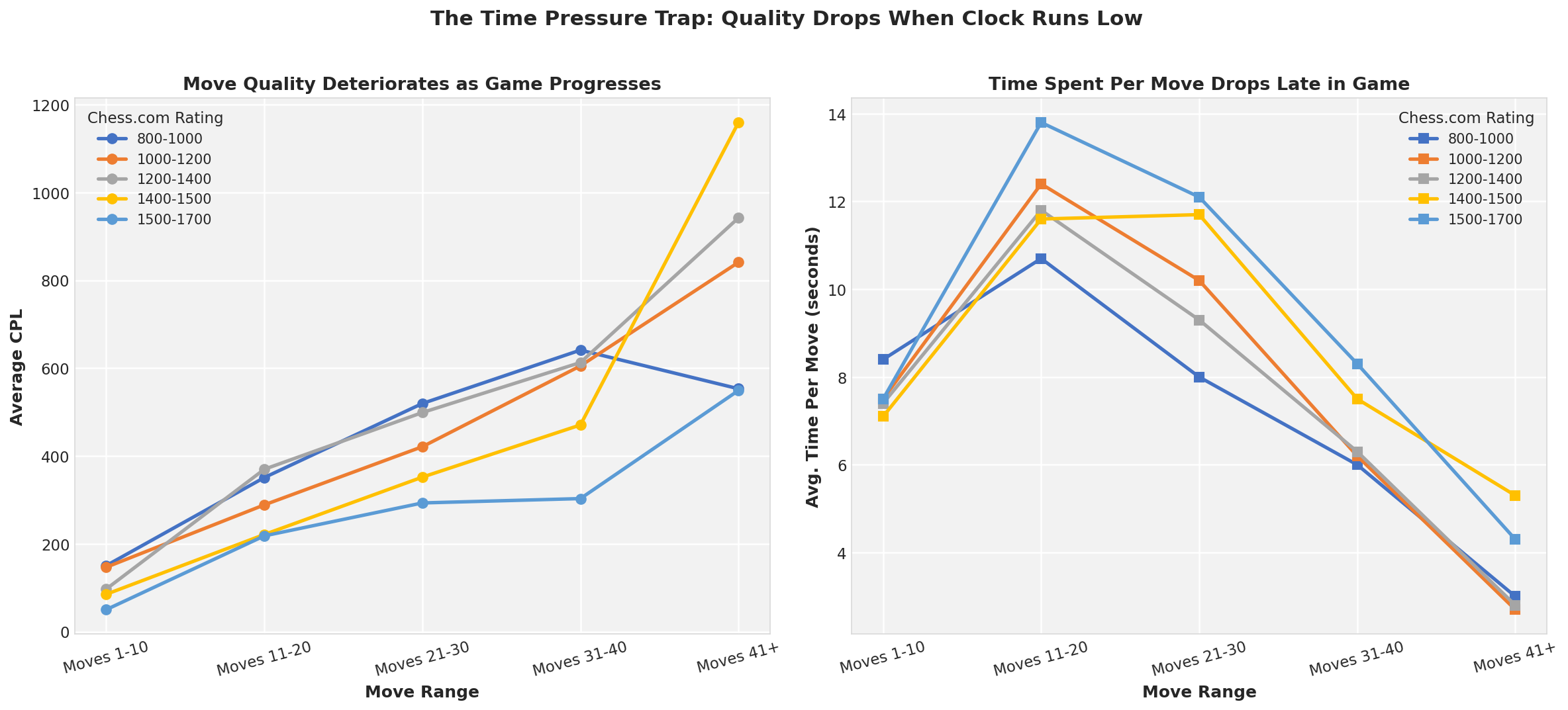
The left panel shows that CPL increases dramatically as the game progresses, with moves after move 41 producing blunder rates exceeding 50% for almost every rating band. The right panel reveals the cause: time spent per move peaks around moves 11-20 (the early middlegame) and then drops precipitously, falling to just 2-5 seconds per move after move 41.
This creates a vicious cycle: players spend their time in the middlegame, arrive at the endgame in time trouble, and then blunder away the advantage they carefully built. The endgame, which requires precise calculation and deep understanding, is often played in a time scramble, leading to massive evaluation swings.
Visual Evidence: Endgame Time Pressure
Endgames are unforgiving. A single tempo or a slight misplacement of the king can turn a win into a draw, or a draw into a loss.
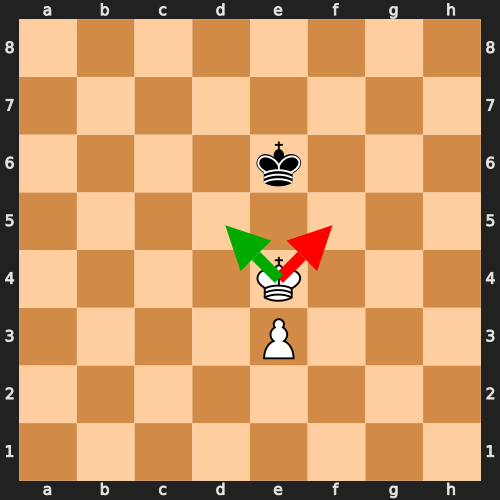
In this pawn endgame, White must maintain the opposition to win. Under time pressure, White might hastily play Kf5? (red arrow), allowing Black to draw by reaching the key square. The precise move, Kd5! (green arrow), requires calculation and an understanding of endgame principles, specifically the concept of the opposition. With 30 seconds on the clock, even a player who knows the theory might panic and play the wrong move.
Actionable Advice by Rating
For All Rating Bands: The single most impactful time management habit is to set a mental "time budget" for each phase. In a 10+0 Rapid game, aim to spend no more than 3 minutes on the opening (moves 1-10), allocate 4-5 minutes for the middlegame (moves 11-25), and reserve at least 2-3 minutes for the endgame. This ensures you always have enough time to think when it matters most.
Rapid vs. Other Time Controls: How Much Does Extra Time Help?
To contextualize the Rapid data, we compared move quality across time controls using aggregate data from over 847,000 games.
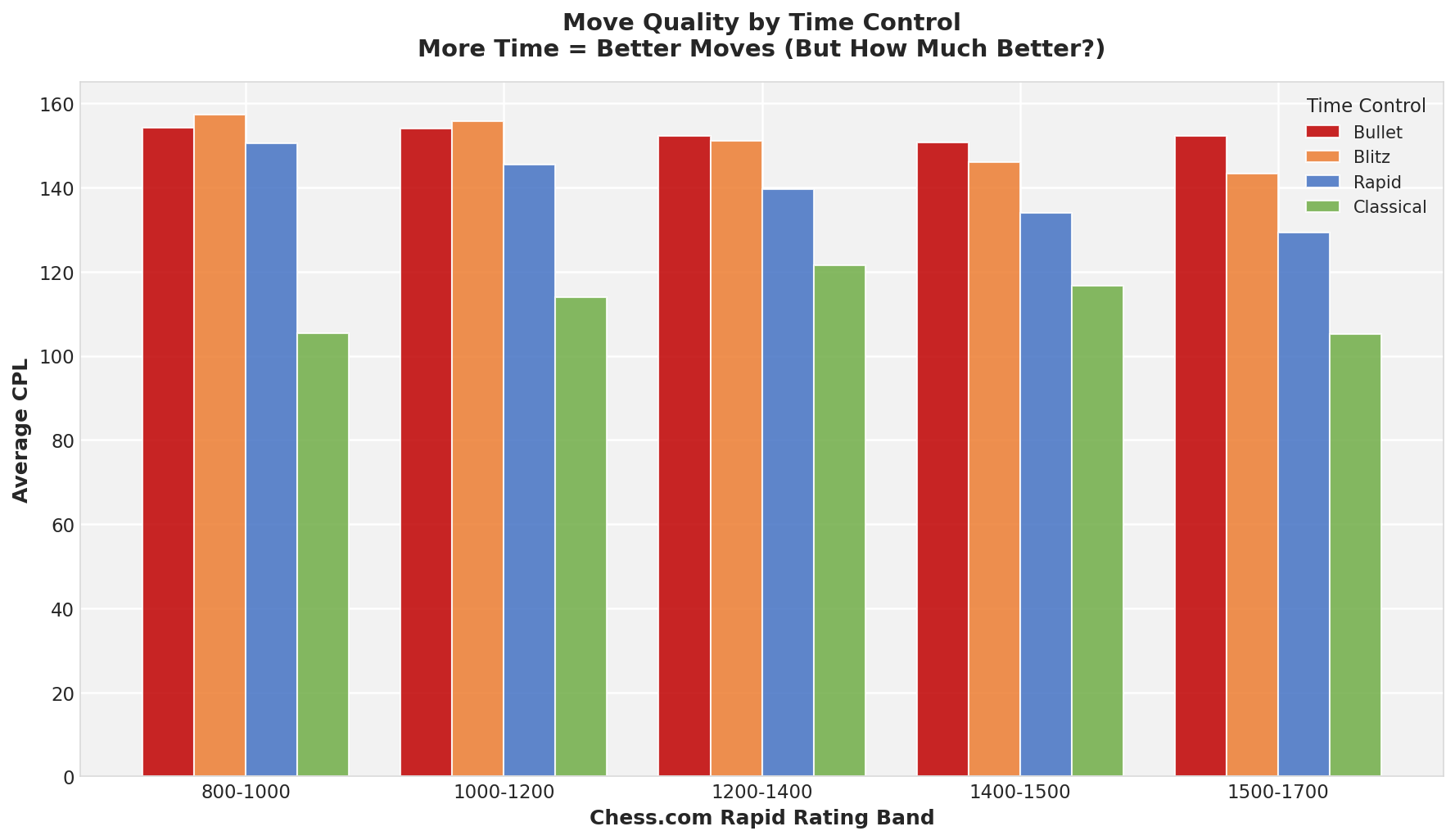
The chart confirms that more time leads to better moves, but the improvement from Bullet to Blitz is minimal (1-3 CPL), while the jump from Blitz to Rapid is more meaningful (7-14 CPL). The largest improvement comes from Rapid to Classical (25-35 CPL), suggesting that the extra time in Classical games allows players to find significantly better moves.
| Time Control | Avg. CPL (800-1000) | Avg. CPL (1500-1700) | Improvement vs. Bullet |
|---|---|---|---|
| Bullet | 154 | 152 | Baseline |
| Blitz | 157 | 143 | -3 to +9 CPL |
| Rapid | 151 | 129 | +3 to +23 CPL |
| Classical | 105 | 105 | +49 to +47 CPL |
For players looking to improve, this data supports the common advice to play Rapid or Classical games for improvement. The extra time allows you to practice the thinking habits that will eventually become automatic, even in faster time controls.
The First Blunder: When Does It Happen?
An often-overlooked metric is the timing of the first significant blunder in a game. This tells us how long a player can maintain accurate play before their concentration or knowledge fails them.
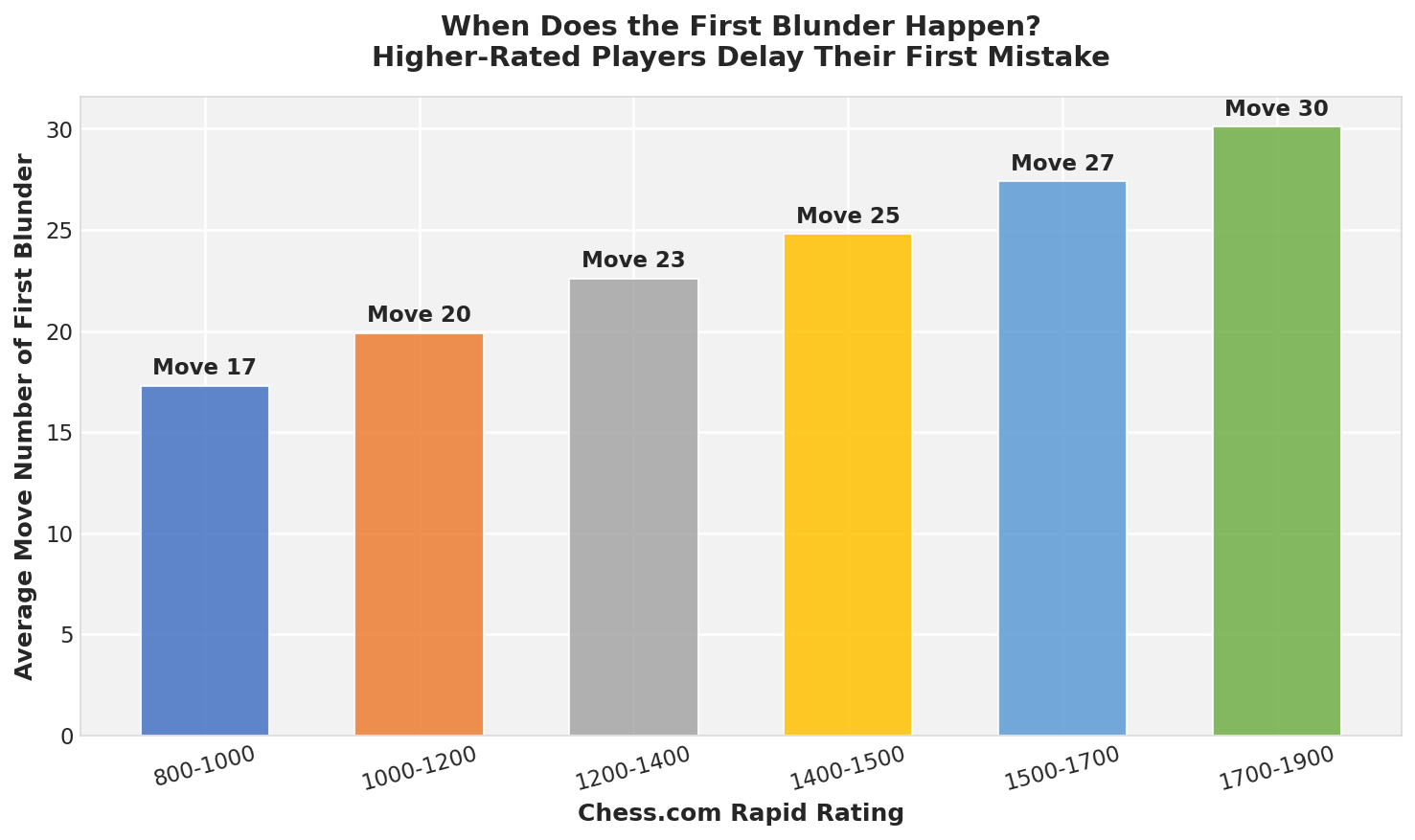
Higher-rated players delay their first blunder by approximately 10 moves compared to the lowest band. An 800-1000 player typically makes their first significant error around move 17, while a 1500-1700 player holds out until approximately move 27. This difference is not primarily about thinking time; it reflects deeper opening knowledge, better positional understanding, and stronger tactical awareness.
Actionable Advice by Rating
For 800-1200 Players: Your first blunder comes early, often in the transition from opening to middlegame. Focus on learning the first 10-12 moves of your openings thoroughly, and practice recognizing common tactical patterns (forks, pins, skewers, discovered attacks) that appear in the early middlegame.
For 1200-1500 Players: You are holding it together through the opening but struggling in the middlegame. Your first blunder typically comes around move 23, often when the position becomes complex. Practice solving middlegame puzzles that require 3-4 move calculations.
For 1500-1700 Players: Your first blunder comes around move 27, often in the transition to the endgame. This is consistent with the phase analysis data showing that the endgame is your weakest area. Invest in endgame study to push this number even higher.
Don't Overthink It: The Decision Paralysis Problem
While most of this article has focused on the dangers of moving too quickly, there is an equally important danger at the other extreme. The data shows that spending over 60 seconds on a move does not consistently produce better results, and in some cases, it produces worse results.
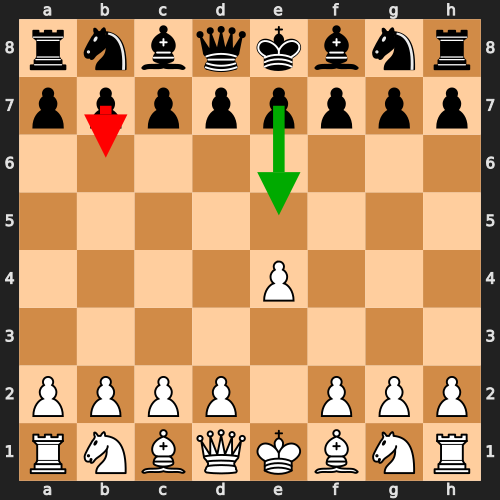
In the position above, Black faces a simple decision after 1.e4. The best response, 1...e5 (green arrow), is straightforward and well-established. An overthinking player might spend 30 seconds considering 1...b6 (red arrow) or other sidelines, ultimately choosing a suboptimal setup. The lesson is clear: when the position calls for a simple, principled move, play it quickly and save your time for the moments that truly require deep calculation.
The Golden Rule of Time Management: Spend your time in proportion to the complexity and criticality of the position. Simple positions deserve simple, quick moves. Complex, critical positions deserve deep thought. The skill is in recognizing the difference.
Conclusion: Your Think-Time Roadmap
The data provides a clear, actionable answer to the question "How long should you think?" The answer depends on the position, the phase of the game, and your rating, but the following general guidelines emerge from the analysis.
| Situation | Recommended Think Time | Rationale |
|---|---|---|
| Forced recaptures / Book moves | 2-5 seconds | Verify there are no tricks, then play |
| Standard developing moves | 5-10 seconds | Quick blunder check, then execute |
| Complex middlegame decisions | 10-20 seconds | The "sweet spot" where most CPL improvement occurs |
| Critical tactical moments | 20-40 seconds | Calculate forcing lines thoroughly |
| Life-or-death positions | 40-60 seconds | Maximum investment; beyond this, diminishing returns |
| Any move after 60 seconds | Stop and play | Decision paralysis is likely setting in |
The most important takeaway is not about the clock at all. It is about recognition: the ability to identify which positions require deep thought and which do not. Higher-rated players are not better because they think longer; they are better because they think more efficiently, investing their time precisely where it matters most.
By training your pattern recognition, studying endgames, and practicing deliberate time management, you can make every second on the clock count.
Data and Methodology
This analysis is based on two complementary data sources. The primary dataset consists of 12,745 individual moves extracted from 216 Lichess Rapid games (time controls of 10+0 and slower), spanning five rating bands from Lichess 1400 to Lichess 2035 (approximately Chess.com 800 to Chess.com 1700). Each game was augmented with Stockfish 17 evaluations at depth 14 or higher to calculate Centipawn Loss (CPL) for every move. Time spent per move was derived from the %clk annotations embedded in the PGN files.
The secondary dataset consists of aggregate statistics from the Grandmaster Guide analytics platform, covering over 847,000 games across all time controls and rating bands. This data was used to validate trends observed in the primary dataset and to provide the time control comparison analysis.
Lichess ratings were mapped to approximate Chess.com Rapid ratings using established community conversion tables. In the article, Chess.com ratings are used as the primary reference, with Lichess equivalents noted where helpful for clarity.
The underlying data files are available for review and further analysis:
- — Individual move-level records with time, CPL, phase, and rating band
View full data →gameId avgRating ratingBand moveNumber ply isWhite timeSpent cpl phase isCritical eval prevEval xmbG3azC 786 700-900 1 1 False 0 0 opening False 0.13 0.79 xmbG3azC 786 700-900 2 2 True 2 0 opening False 0.48 0.13 xmbG3azC 786 700-900 2 3 False 13 0 opening False 0.13 0.48 xmbG3azC 786 700-900 3 4 True 7 0 opening False 0.48 0.13 xmbG3azC 786 700-900 3 5 False 6 81.0 opening False 1.29 0.48 - — Aggregated CPL by time bucket and rating band
View full data →chesscomBand timeBucket avgCpl medianCpl sampleMoves pctBlunder 1000-1200 0-2s 415.3 20.0 725 36.8 1000-1200 10-20s 299.4 0.0 384 33.9 1000-1200 2-5s 344.6 11.5 640 37.8 1000-1200 20-40s 261.4 0.0 204 29.9 1000-1200 40-60s 248.3 0.0 46 30.4 - — Fine-grained time buckets for diminishing returns analysis
View full data →chesscomBand fineTimeBucket avgCpl sampleMoves 1000-1200 1 471.0 448 1000-1200 3 345.2 508 1000-1200 5 330.7 409 1000-1200 8 358.2 310 1000-1200 12 270.2 271 - — Summary statistics per rating band
View full data →chesscomBand avgTimePerMove medianTimePerMove avgCpl medianCpl blunderPct totalMoves uniqueGames 1000-1200 8.9 5.0 342.9 10.5 35.2 2486 46 1200-1400 8.5 4.0 383.3 39.0 41.4 3043 52 1400-1500 9.0 5.0 328.7 20.0 35.4 2328 42 1500-1700 9.7 5.0 250.9 4.0 29.3 2081 28 800-1000 8.0 5.0 372.0 0.0 33.9 2807 48 - Phase Time Allocation (CSV) — Time and CPL by game phase
- Time Pressure Effect (CSV) — Move quality by move number range
- Critical vs Non-Critical Moves (CSV) — Blunder vs good move comparison
Chess Coach, April 15, 2026