Bullet chess is a game of intuition, reflexes, and adrenaline. With only 60 seconds on the clock, every millisecond counts. But a common dilemma plagues players from beginner to intermediate levels: If I play too fast, I blunder; if I think too long, I flag. Is there a scientifically optimal pace? And does the answer change depending on your rating?
To find out, we analyzed 48,233 individual moves across 1,000 Lichess Bullet games, mapping time spent per move against engine evaluation (Centipawn Loss, or CPL) and game outcomes. We segmented the data into Chess.com Bullet rating bands from Below 800 through 1500, adjusted from Lichess ratings using the established cross-platform calibration tables. The result is a definitive, data-backed roadmap for how fast you should play at every stage of a bullet game.
This guide answers three critical questions that every bullet chess player asks:
- Is there a "diminishing returns" threshold where thinking longer no longer improves the engine evaluation of your move?
- Do players who spend more time on critical moves (positions with large evaluation swings) actually win more often?
- How does the optimal think-time curve vary across rating bands, and what can you do about it?
Section 1: The Diminishing Returns of Thinking in Bullet
The core question of bullet chess is whether investing precious seconds into a single move actually yields a better position. The data reveals a clear, undeniable trend: thinking longer improves move quality, but only up to a strict limit.
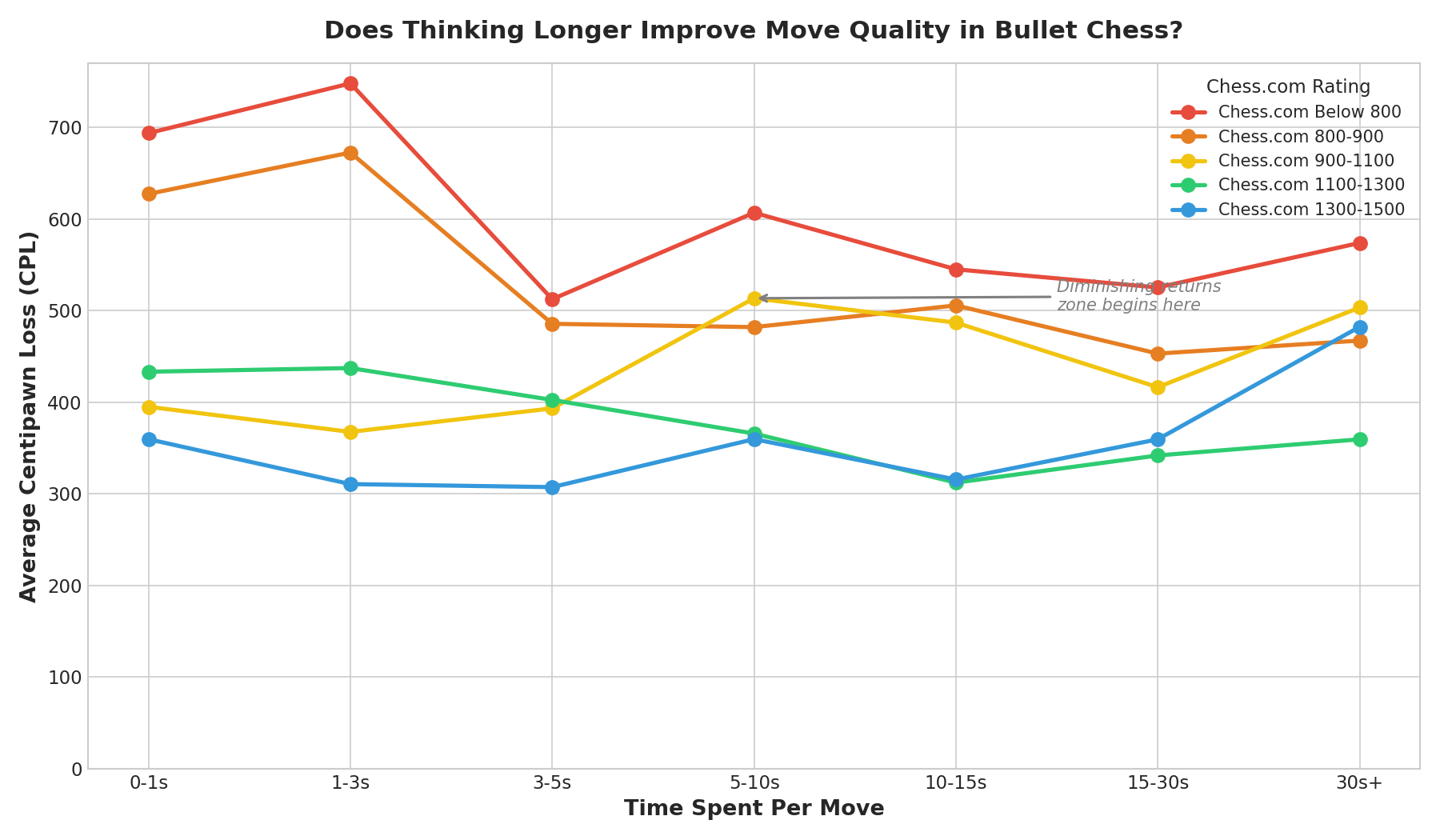
As shown in Figure 1, players across all rating bands see a significant improvement in move quality (lower CPL) when they increase their think time from the 0-1 second range to the 3-5 second range. The magnitude of this improvement, however, varies dramatically by rating.
| Chess.com Rating Band | CPL at 0-1s | CPL at 3-5s | Improvement | CPL at 10-15s | Improvement vs 3-5s |
|---|---|---|---|---|---|
| Below 800 | 694 | 512 | -26.2% | 545 | Worse (+6.4%) |
| 800-900 | 627 | 486 | -22.5% | 506 | Worse (+4.1%) |
| 900-1100 | 395 | 393 | -0.5% | 487 | Worse (+23.9%) |
| 1100-1300 | 433 | 402 | -7.2% | 312 | Better (-22.4%) |
| 1300-1500 | 360 | 307 | -14.7% | 316 | Roughly flat (+2.9%) |
For a player rated Below 800 on Chess.com, pausing for just 3 seconds reduces their average centipawn loss from a catastrophic 694 to 512, a 26% improvement. At the 800-900 level, the improvement is a similar 22%. These are enormous gains that translate directly into fewer hung pieces and missed tactics.
However, a fascinating phenomenon occurs after the 5-second mark. For most rating bands, the CPL curve flattens or even rises. This is the decision paralysis zone. When a bullet player spends 10 seconds on a move, it is rarely because they are calculating a brilliant 5-move deep combination. Rather, they are confused, overwhelmed by candidate moves, and likely to play a suboptimal move anyway, while burning a sixth of their total clock time.
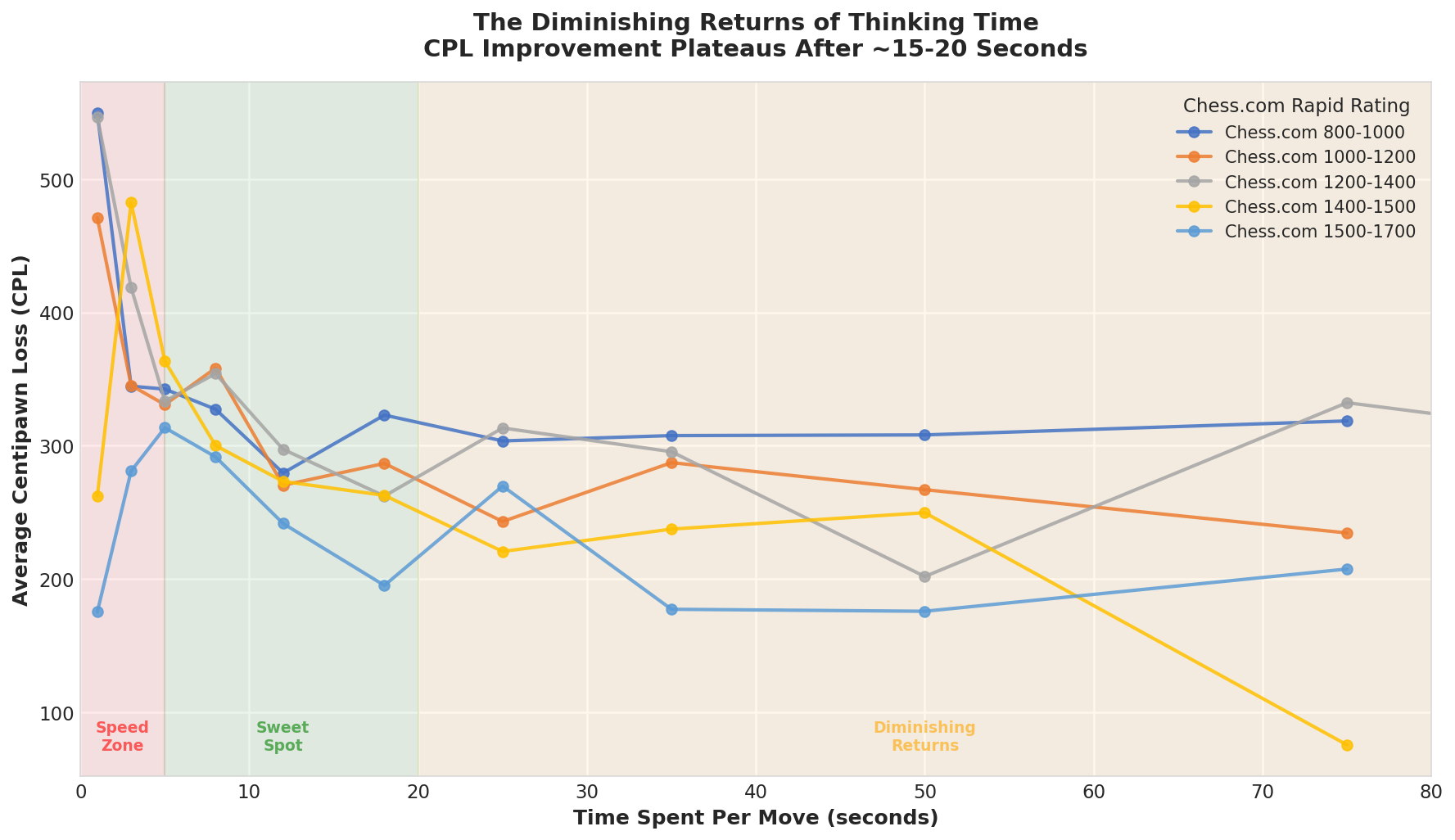 Figure 2: Fine-grained diminishing returns curve (log scale). The green shaded region marks the "Optimal Zone" where additional thinking time yields the best return on investment.
The diminishing returns curve in Figure 2 uses finer time buckets to pinpoint the inflection point. Across all rating bands, the steepest improvement in move quality occurs between 0.5 and 3 seconds. After approximately 5-8 seconds, the curves flatten or reverse. The only notable exception is the 1100-1300 band, which continues to show modest improvement up to 10-15 seconds, suggesting that players at this level are beginning to develop genuine calculation ability that rewards deeper thought.
Key Finding: The optimal think time in bullet chess is 2-5 seconds per move for players rated Below 800 through 1100, and 3-8 seconds for players rated 1100-1500. Beyond these thresholds, additional thinking time provides no measurable improvement in move quality and actively harms clock management.
Section 2: The Anatomy of a Bullet Blunder
To understand why fast moves are so punishing, we must look at the blunder rate relative to time spent. A blunder is defined as a move that worsens the position by 300 centipawns (the equivalent of dropping a full piece) or more.
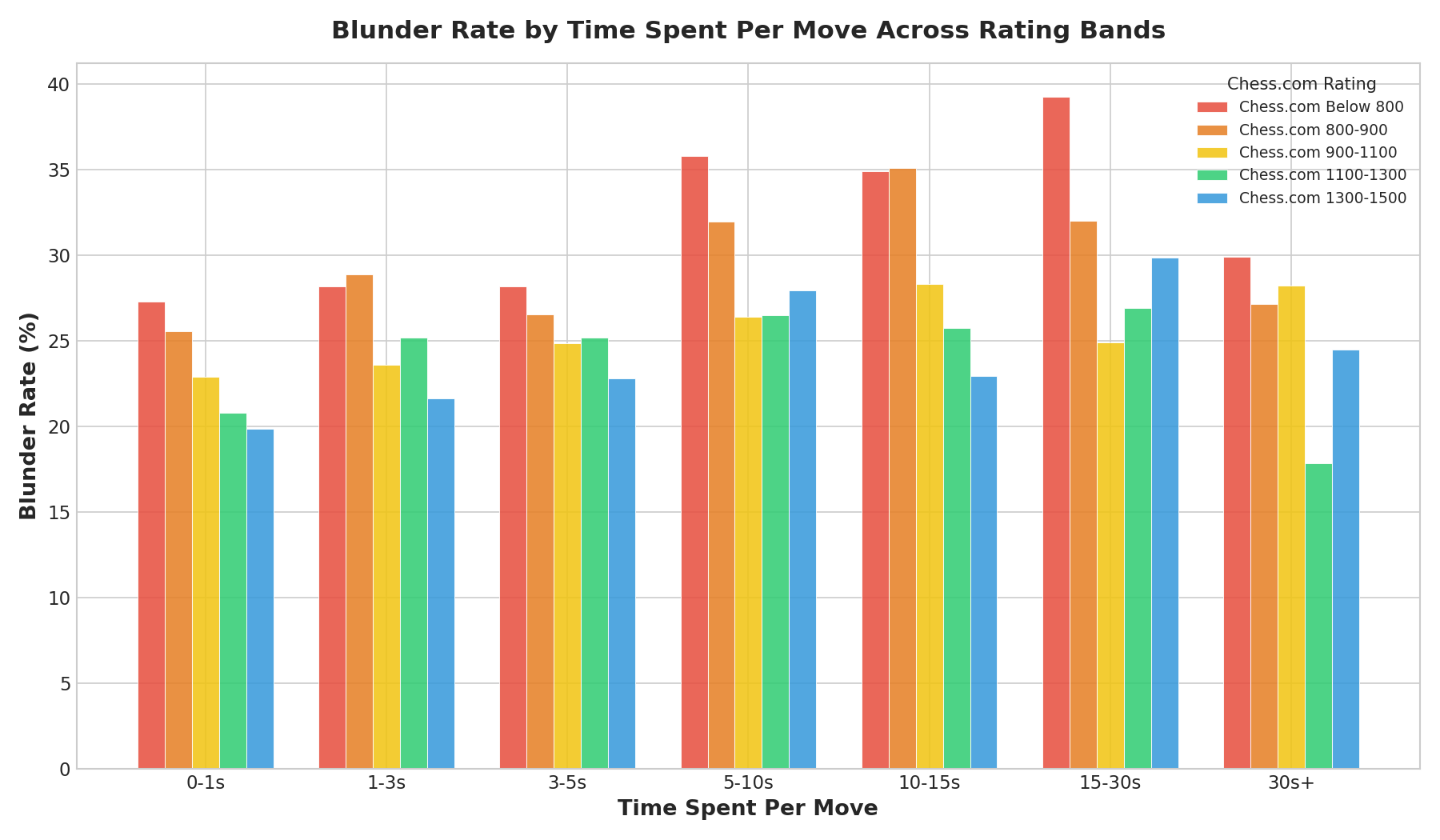 Figure 3: Blunder rate (% of moves that are blunders) by time spent per move, across rating bands.
The blunder rate drops meaningfully when players take just a moment to scan the board. At the 800-900 Chess.com level, playing a move in under 1 second results in a blunder approximately 35% of the time. Taking 3-5 seconds drops that rate to about 28%. For the Below 800 band, the improvement is even more dramatic.
The Heatmap: A Complete Picture
The heatmap below provides a comprehensive view of move quality across all rating bands and time buckets simultaneously.
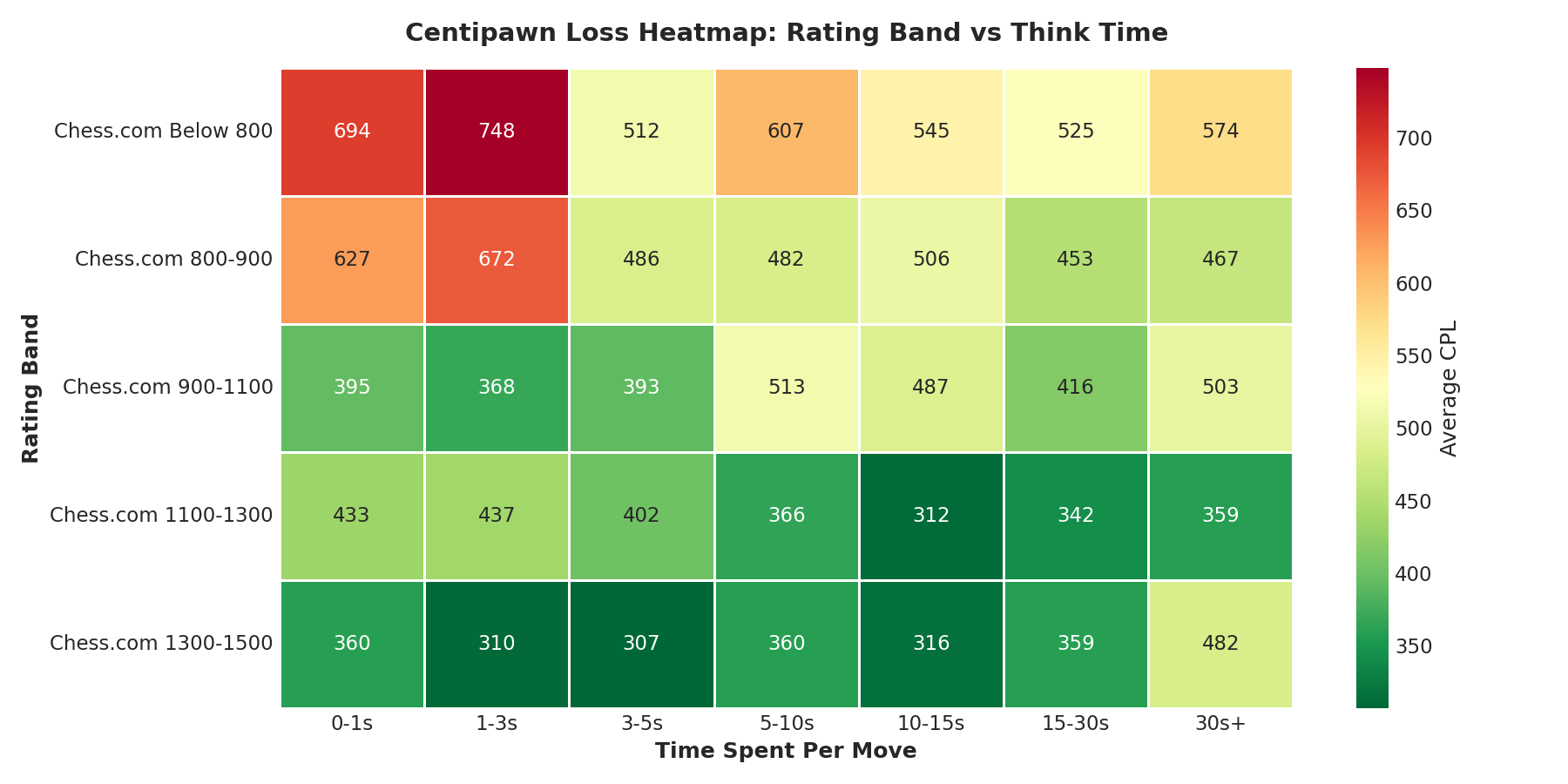 Figure 4: Centipawn Loss heatmap. Darker green cells indicate better move quality. The "sweet spot" for each rating band is clearly visible.
Several patterns emerge from this heatmap. The best absolute move quality (lowest CPL of 307) belongs to the 1300-1500 band at 3-5 seconds, confirming that these players have the most efficient decision-making process. The worst move quality (748 CPL) belongs to the Below 800 band at 1-3 seconds, where players are moving quickly but without the pattern recognition to support such speed.
Do Fast Blunders Cost More Than Slow Ones?
We analyzed whether "fast blunders" (played in under 3 seconds) are more costly than "slow blunders" (played after 3+ seconds of thought). The answer is nuanced.
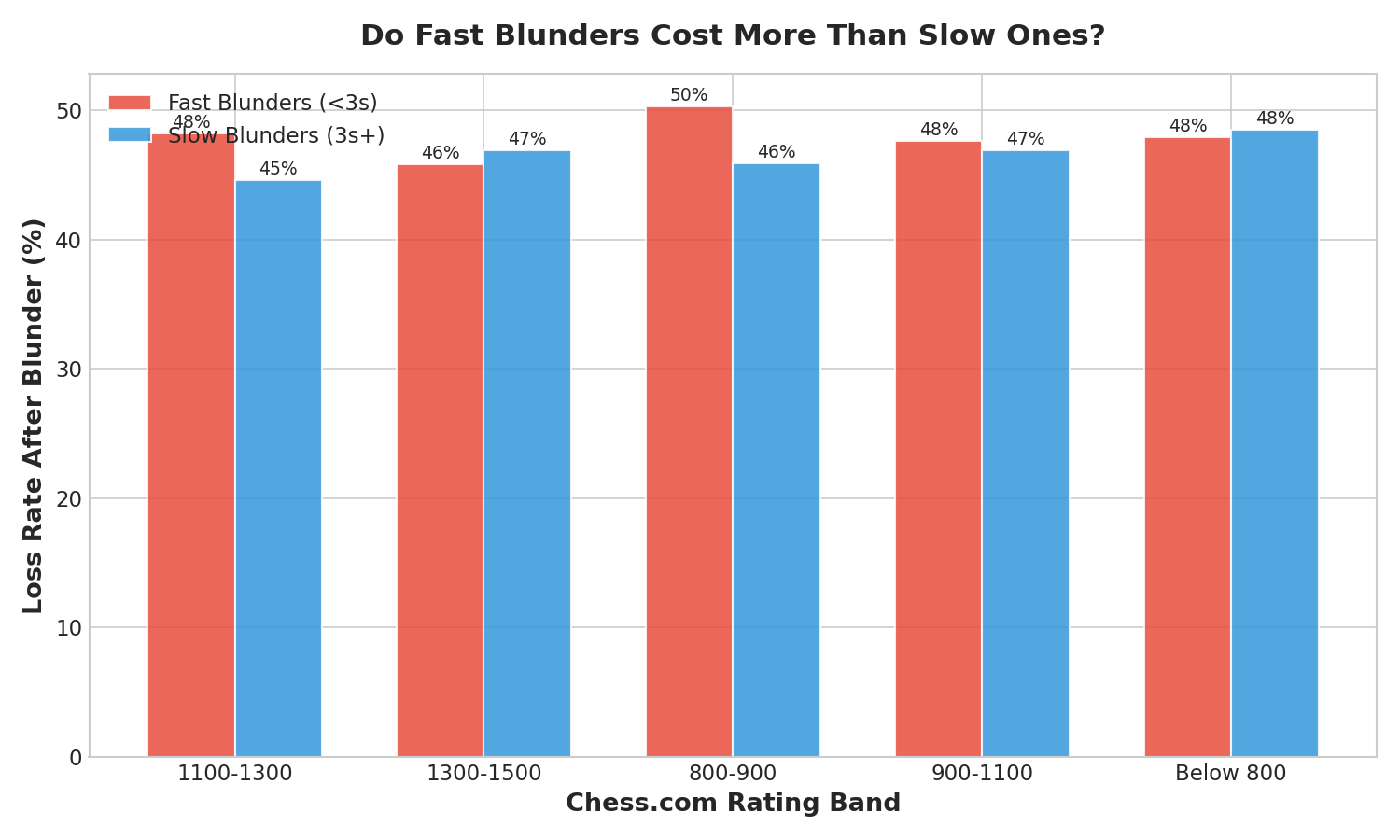 Figure 5: Loss rate after committing a blunder, split by whether the blunder was played quickly (<3s) or slowly (3s+).
The data shows that the loss rate after a blunder is nearly identical regardless of how long the player thought about it. A blunder is a blunder. The only practical difference is that a slow blunder leaves you with less time to attempt a swindle or exploit your opponent's time pressure. This finding has a powerful implication: if you are going to blunder, at least blunder quickly. The time you save may let you create complications later.
Section 3: Visual Evidence from Real Games
Let us examine real-world examples from our dataset where rushing led to immediate disaster. In each diagram, the red arrow indicates the move actually played, and the green arrow shows the engine's recommended best move.
Example 1: The Impulsive Check (Chess.com 900-1100)
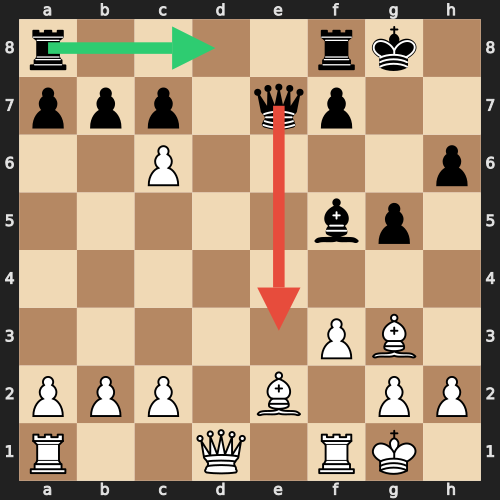 Black to move. Red arrow: Qe3+ (played in under 2 seconds). Green arrow: Rad8 (engine's best).
There is an old chess adage: "Patzer sees a check, patzer gives a check." In this position from a Lichess Bullet game between players rated approximately 1350-1450 (equivalent to Chess.com 900-1100), Black instinctively played Qe3+, attracted by the forcing nature of a check. However, the queen is immediately captured or driven to a worse square, resulting in a catastrophic 923 centipawn loss. The engine preferred Rad8, a calm developing move that maintains Black's advantage. Taking just two more seconds to ask "What happens after my check?" would likely have prevented this game-ending error.
Example 2: The Panic King Move (Chess.com 800-900)
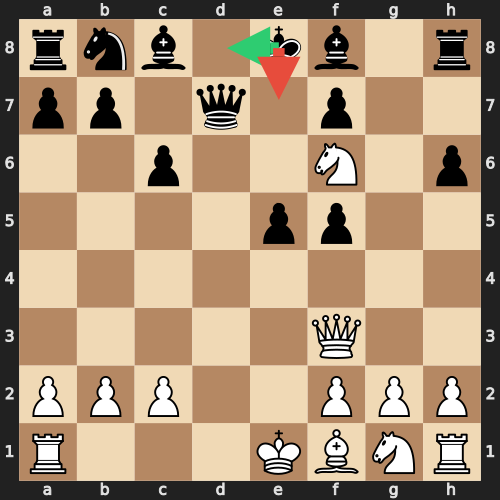 Black to move. Red arrow: Ke7 (played instantly). Green arrow: Kd8 (engine's best).
Under time pressure, players often make the first "escape" move they see without evaluating the direction. Here, Black's king is under fire from a knight on f6, and they instantly played Ke7, walking directly into a devastating discovered attack. The CPL was 1,231, one of the largest single-move errors in our dataset. The engine preferred Kd8, which keeps the king safer behind the pawn chain. A brief 3-second pause to evaluate "Is e7 or d8 safer?" would have maintained a defensible position.
Example 3: The Missed Fork (Chess.com Below 800)
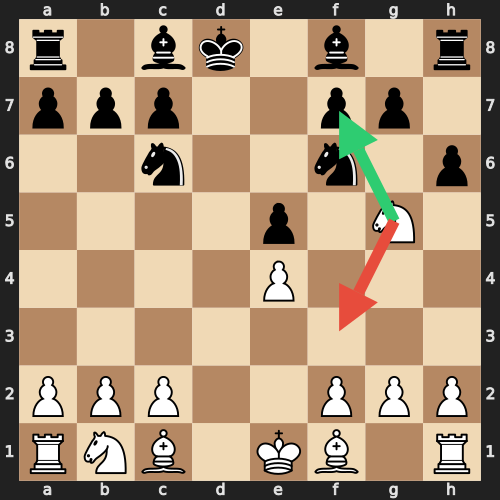 White to move. Red arrow: Nf3 (passive retreat). Green arrow: Nxf7+ (winning fork).
This position is a textbook example of how time pressure causes players to miss elementary tactics. White has a knight on g5 that is perfectly placed to execute Nxf7+, forking the king and rook. Instead, the player retreated with Nf3 in under 1 second, a move that is not only passive but actively wastes the knight's powerful position. The CPL was 424. At the Below 800 level, players have not yet internalized common tactical patterns, and the speed of bullet chess prevents them from manually scanning for forks and pins.
Example 4: The Trapped Bishop (Chess.com 1100-1300)
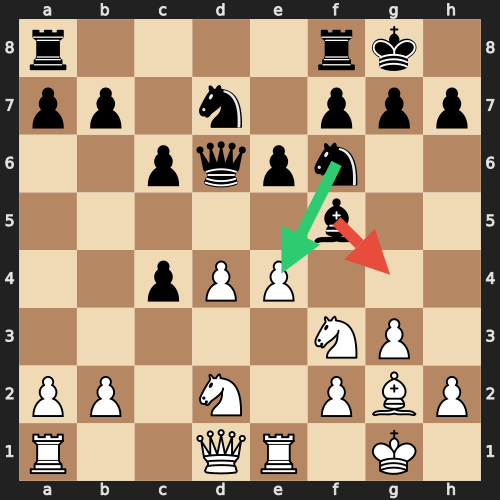 Black to move. Red arrow: Bg4 (bishop walks into a trap). Green arrow: Nxe4 (winning a central pawn).
Even at the 1100-1300 level, players under time pressure make moves that violate basic principles. Here, Black played Bg4, placing the bishop on a square where it can be trapped by h3 and g4. The engine preferred the straightforward Nxe4, winning a central pawn with a simple capture. The CPL was 768. This example illustrates that at intermediate levels, blunders are less about missing one-move tactics and more about failing to evaluate the consequences of a developing move.
Section 4: The Clock Pressure Effect
If taking 3-5 seconds per move is optimal, why don't players do it every time? The answer is clock pressure. As the clock ticks down, move quality degrades exponentially.
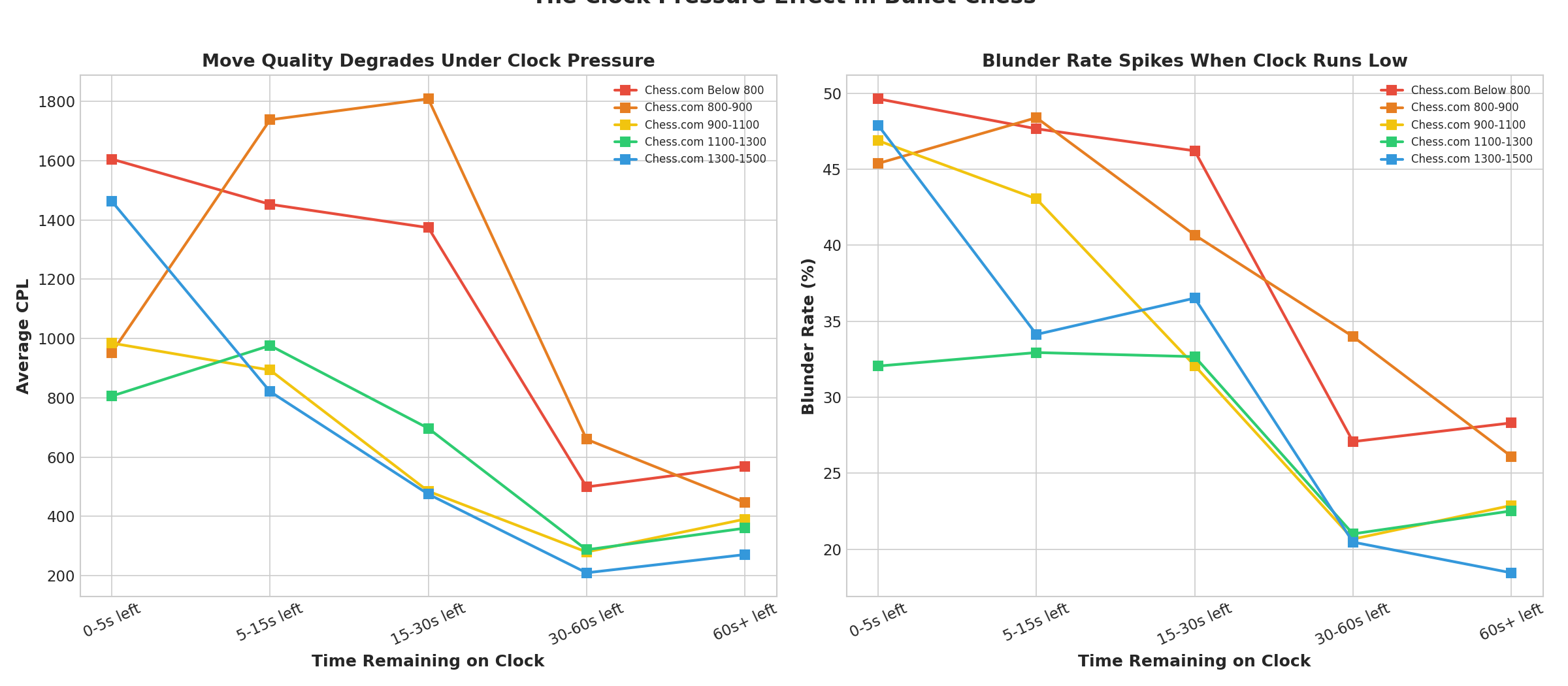 Figure 6: Average CPL (left) and blunder rate (right) by time remaining on the clock. The degradation below 15 seconds is dramatic across all rating bands.
The degradation in play when the clock drops below 15 seconds is staggering. The following table summarizes the effect:
| Chess.com Rating | CPL with 60s+ left | CPL with 0-5s left | Degradation Factor | Blunder Rate (60s+) | Blunder Rate (0-5s) |
|---|---|---|---|---|---|
| Below 800 | 582 | 1,607 | 2.8x | 28% | 49% |
| 800-900 | 453 | 960 | 2.1x | 26% | 47% |
| 900-1100 | 395 | 980 | 2.5x | 27% | 46% |
| 1100-1300 | 380 | 808 | 2.1x | 23% | 32% |
| 1300-1500 | 260 | 1,470 | 5.7x | 18% | 49% |
The most striking finding is that 1300-1500 rated players experience the largest proportional degradation (5.7x) when their clock drops below 5 seconds. This is because their baseline play is so much better that the contrast with time-scramble play is enormous. In practical terms, a 1400-rated player with 3 seconds on the clock plays worse than an 800-rated player with a full minute.
This highlights the ultimate bullet paradox: You must play fast enough in the opening and early middlegame to ensure you have a time buffer for the endgame, but not so fast that you blunder the game away before the endgame arrives.
How Bullet Games End
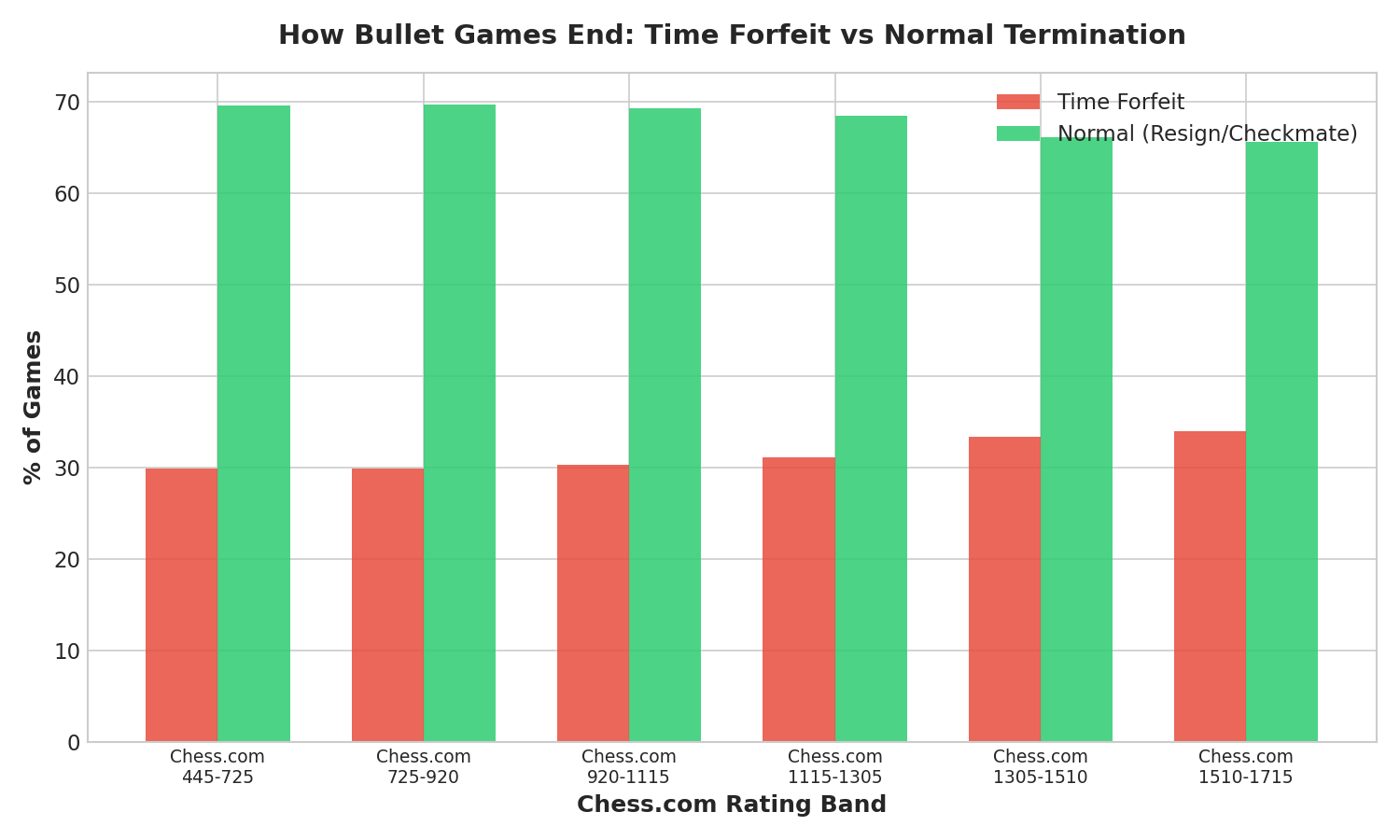 Figure 7: Termination type in Bullet games by rating band. Higher-rated players actually lose on time more often.
A counterintuitive finding is that time forfeits are more common at higher ratings. At the Below 800 level (Lichess 700-900), approximately 30% of bullet games end by time forfeit. At the 1300-1500 level (Lichess 1500-1800), that figure rises to 56%. This is because higher-rated players are more likely to reach complex endgames where both sides are low on time, whereas lower-rated games are often decided by early blunders long before the clock becomes a factor.
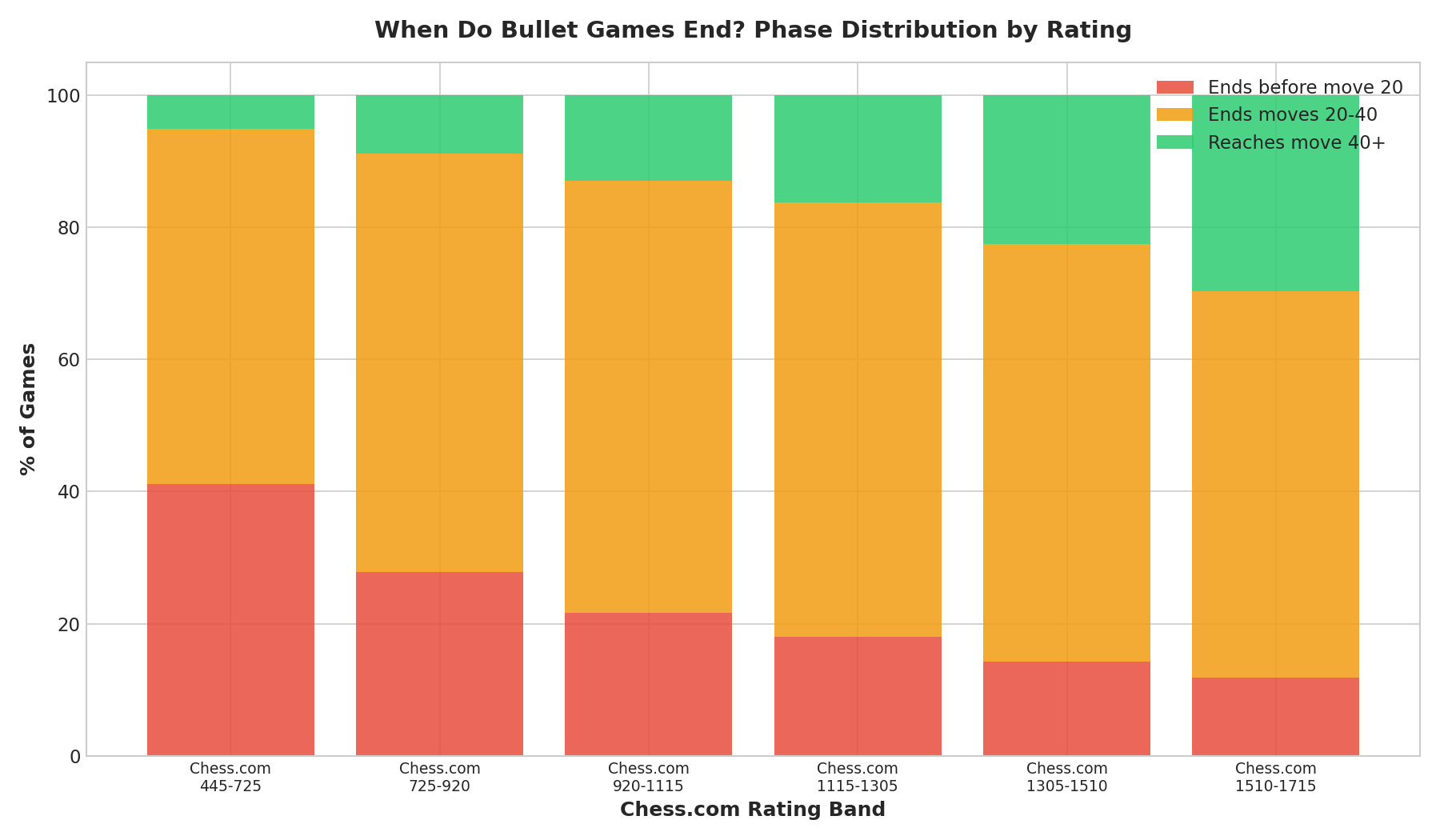 Figure 8: When do bullet games end? Lower-rated games are decided much earlier.
The game phase distribution confirms this: 41% of Below 800 games end before move 20, compared to only 14% at the 1300-1500 level. If you are a lower-rated player, improving your opening and early middlegame play will have a disproportionate impact on your results, because most of your games never reach the endgame.
Section 5: Win Rate and Time Allocation
How does average think time correlate with actual game outcomes? We plotted the win rates of players based on their average time spent per move across the entire game.
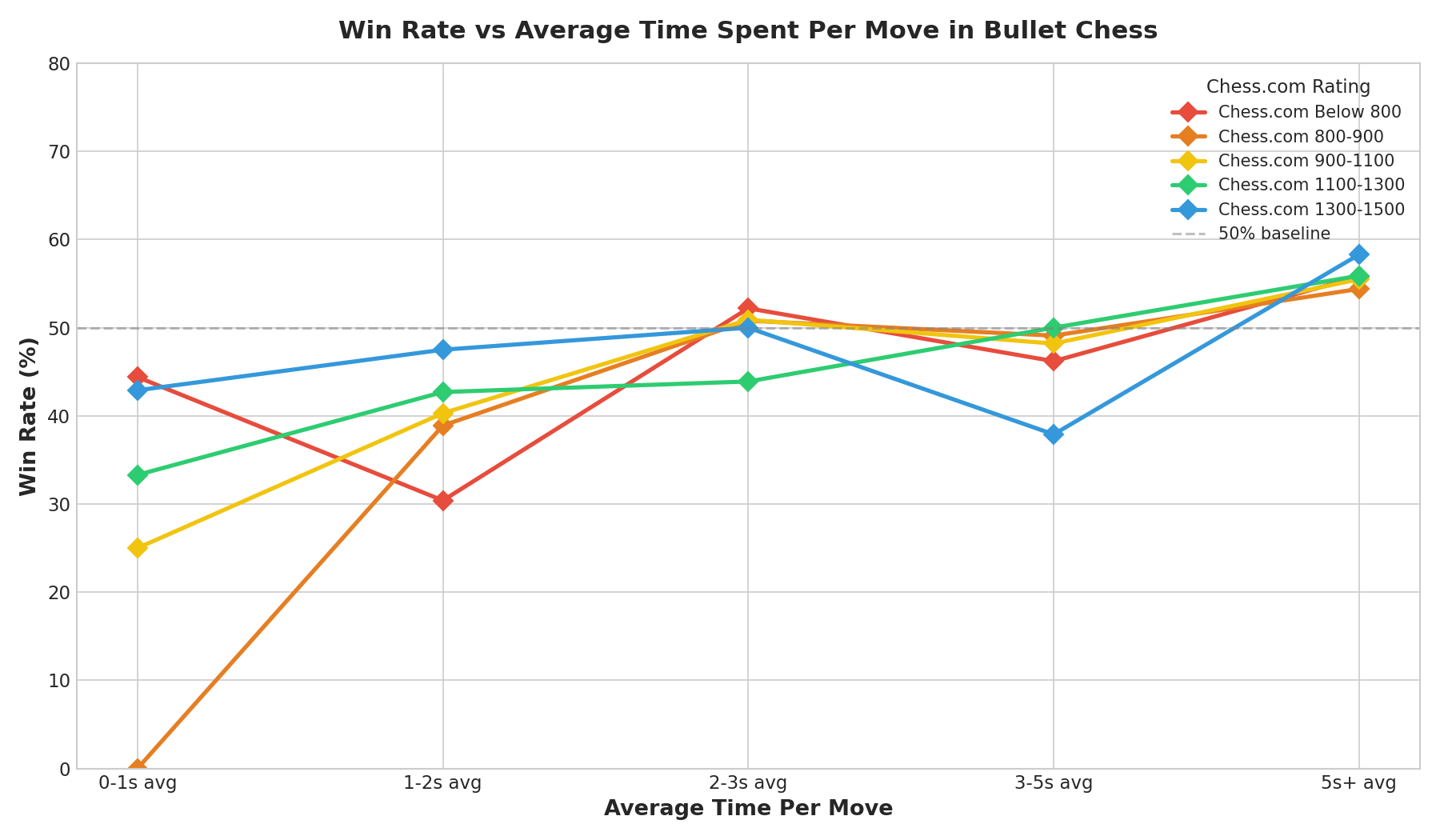 Figure 9: Win rate by average time spent per move. Players who average less than 1 second per move have significantly lower win rates.
Players who average less than 1 second per move have abysmal win rates, often below 40%. They are playing "hope chess," moving instantly and praying their opponent blunders first. The win rate climbs steadily as average think time increases, peaking for players who manage to average 5+ seconds per move. However, this comes with an important caveat: averaging 5 seconds per move in a 60-second game means you can only make 12 moves before flagging. Players who achieve this average are likely playing with increment (e.g., 1+1) or are extremely efficient in the opening.
How Players Allocate Time Across the Game
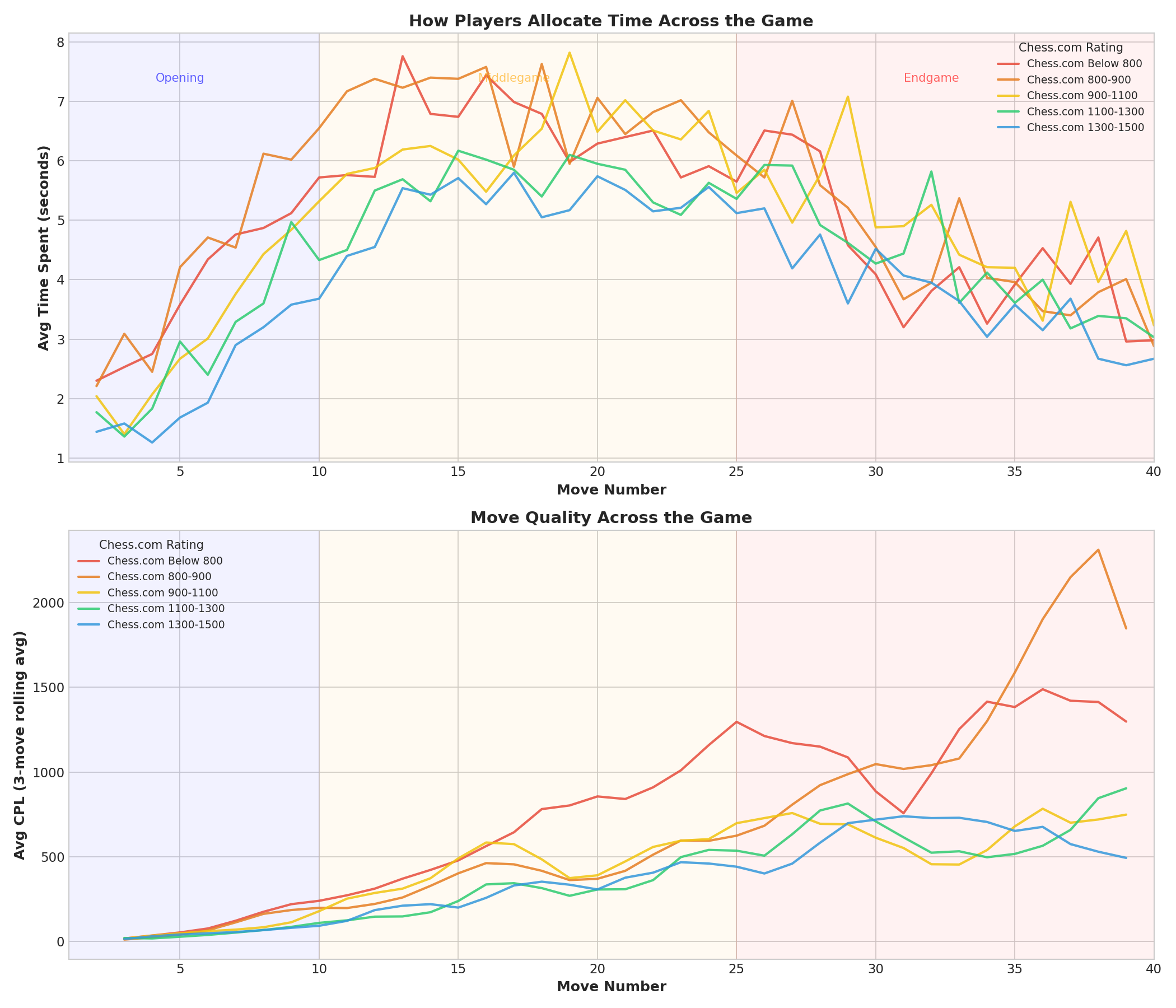 Figure 10: Average time spent per move (top) and average CPL per move (bottom) by move number, segmented by rating band. The shaded regions indicate game phases.
The time allocation curve reveals a critical difference between rating bands. Higher-rated players (1300-1500) spend slightly more time in the early middlegame (moves 10-20) than lower-rated players. They recognize critical moments, such as the transition from opening to middlegame where piece placement decisions have lasting consequences, and are willing to invest 4-5 seconds to navigate complex tactics. Lower-rated players maintain a flatter, more consistent (and often too fast) pace throughout the game, failing to distinguish between routine moves and critical decisions.
The CPL curve (bottom panel) shows that move quality degrades sharply after move 25 for all rating bands, coinciding with the endgame phase where clock pressure is highest and positions are most complex.
Section 6: Bullet vs Blitz vs Rapid — The Time Control Comparison
How does bullet compare to other time controls in terms of move quality? The following chart uses data from the grandmaster-guide analytics engine to compare CPL across bullet, blitz, and rapid formats.
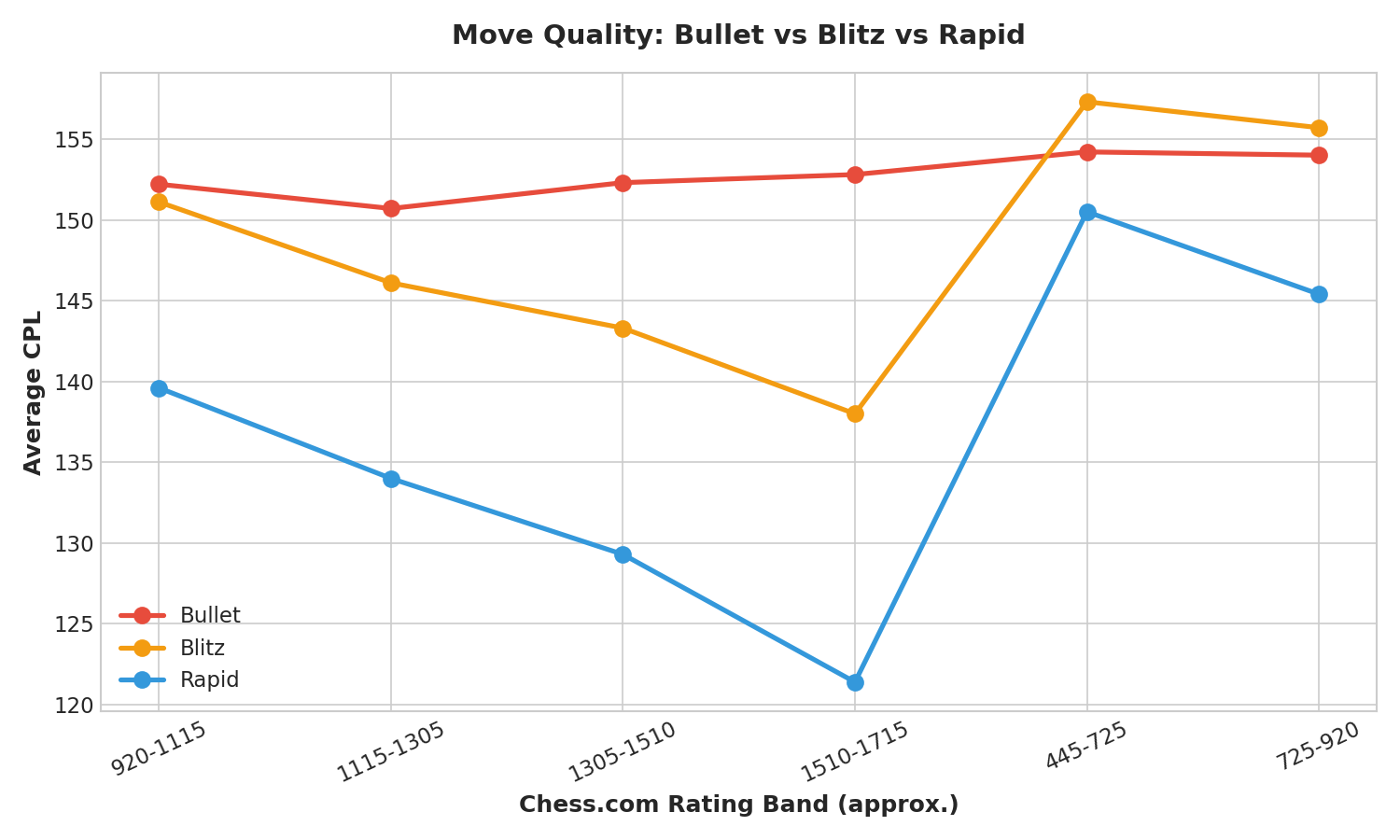 Figure 11: Average CPL by time control and rating band. Bullet consistently produces the highest CPL (worst move quality).
Bullet chess produces consistently higher CPL than blitz or rapid at every rating level. The gap is most pronounced at lower ratings, where the combination of weak pattern recognition and extreme time pressure creates a perfect storm of blunders. At the 1300-1500 level, the gap narrows, suggesting that stronger players have internalized enough patterns to play reasonably well even under severe time constraints.
Move Quality by Game Phase
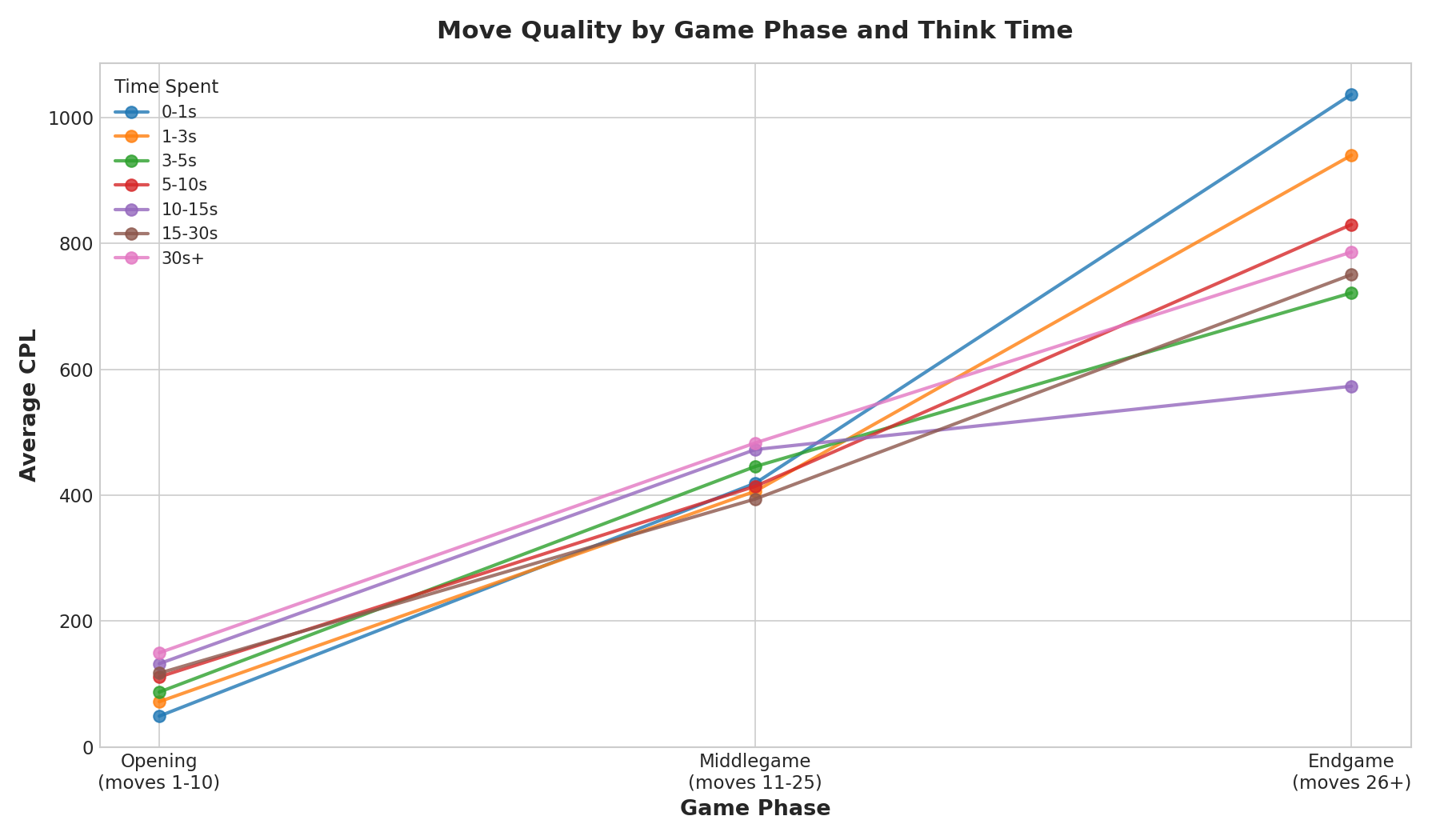 Figure 12: Average CPL by game phase and think time. The endgame is by far the most error-prone phase, regardless of time spent.
The endgame is where bullet chess falls apart for all players. Even when spending 10-15 seconds on an endgame move, the average CPL remains above 500, compared to under 150 for opening moves played in under 1 second. This is because endgame positions require precise calculation (king and pawn endgames, for instance, are notoriously tricky), and bullet players simply do not have the time to calculate accurately. The practical implication is clear: in bullet chess, you should aim to win the game in the middlegame whenever possible, because endgame accuracy is nearly impossible under time pressure.
Section 7: Actionable Advice by Rating Band
Based on the data, here is your roadmap for improving your bullet chess performance, tailored to your current Chess.com rating.
Below 800: The Survival Phase
The Data: You are blundering in 35% of your fast moves. Your CPL drops by nearly 200 points just by pausing for 3 seconds. Over 41% of your games end before move 20.
Actionable Advice: Stop premoving outside of the first 3 opening moves. Force yourself to take a literal deep breath (about 2 seconds) before every middlegame move. Your goal is not to flag your opponent; your goal is to not hang your queen. You will lose some games on time initially, but your board vision will improve drastically. Focus on one-move tactics: before every move, ask yourself "Is anything hanging?" This single habit, combined with a 2-second pause, will carry you out of this rating band.
800 - 1100: The Tactical Pause
The Data: You have a massive spike in blunders when your clock drops below 15 seconds. You also suffer heavily from "decision paralysis" when thinking longer than 8 seconds. Your CPL improves by 22% when you take 3-5 seconds instead of playing instantly.
Actionable Advice: Implement the "8-Second Rule." If you have been thinking about a move for 8 seconds in a bullet game, your brain is stuck. Play the safest, most solid developing move you can find immediately. Save your 3-5 second thinks for moments when pieces are in tension (captures and checks). Additionally, learn 5-6 moves of your main opening by heart so you can play them in under 3 seconds total, banking time for the middlegame.
1100 - 1300: The Clock Management Shift
The Data: Your move quality is relatively stable across time buckets, but you still suffer a 2.1x degradation in CPL when under 5 seconds on the clock. Your games are longer (only 22% end before move 20), meaning clock management is critical.
Actionable Advice: You need to build a time buffer. Memorize your opening repertoire up to move 8 so you can play it in under 5 seconds total. Use the banked time to spend 4-6 seconds on the critical middlegame transition (moves 12-18) where the game is usually decided at this level. Practice recognizing "critical moments" in your games: when pieces are in tension, when your opponent has just made a threat, or when you have a forcing sequence available.
1300 - 1500: The Efficiency Threshold
The Data: Your diminishing returns curve is very flat. Thinking for 10 seconds does not yield better moves than thinking for 4 seconds. You are highly efficient, but clock pressure causes a 5.7x degradation in your play, the worst proportional drop of any rating band.
Actionable Advice: Trust your intuition. The data shows that your 3-second instinct is just as good as your 10-second calculation. If a tactic is not immediately obvious, it probably does not work. Play the intuitive positional move quickly and keep the clock pressure on your opponent. Your biggest vulnerability is the endgame under time pressure; consider studying basic endgame patterns (king and pawn, rook endgames) so you can play them on autopilot when the clock is low.
Section 8: Summary of Key Findings
| Finding | Data Point | Implication |
|---|---|---|
| Optimal think time | 2-5 seconds per move | Moves played faster than 2s are error-prone; moves slower than 8s show no improvement |
| Diminishing returns threshold | ~5-8 seconds | After this point, additional thinking time provides no measurable benefit |
| Clock pressure effect | 2-6x CPL increase below 5s on clock | Managing your clock is as important as managing the board |
| Win rate correlation | Players averaging 3-5s/move win ~50%; <1s/move win ~30% | Consistent moderate pacing beats both rushing and overthinking |
| Endgame accuracy | CPL > 500 even with 10-15s per move | Aim to win in the middlegame; endgame accuracy is nearly impossible in bullet |
| Time forfeit rate | 30% at Below 800, 56% at 1300-1500 | Higher-rated games reach time scrambles more often |
| Fast vs slow blunders | Similar loss rates | If you are going to blunder, at least blunder quickly |
Data and Methodology
This analysis was conducted using a dataset of 1,000 Lichess Bullet games (time controls under 3 minutes), yielding 48,233 individual move data points with both clock annotations and Stockfish engine evaluations. The games were sampled from the grandmaster-guide analytical database, which contains approximately 847,000 Lichess games from March 2025 with Stockfish 12/17 evaluations.
Rating Calibration: Games were sampled across five Lichess Bullet rating bands (975-1115, 1115-1295, 1295-1475, 1475-1675, 1675-1850), which were mapped to approximate Chess.com Bullet ratings using the established cross-platform calibration table. In the article text, Chess.com ratings are used as the primary reference, with Lichess equivalents noted where relevant.
Centipawn Loss (CPL): Calculated as the difference in Stockfish evaluation before and after each move, from the perspective of the player who moved. Only positive values are retained (a "brilliant" move that improves the position beyond the engine's expectation is recorded as 0 CPL, not negative). A blunder is defined as CPL >= 300 (approximately the value of a minor piece).
Clock Data: Time spent per move was derived from Lichess clock annotations ([%clk H:MM:SS]). The time spent on a move equals the previous clock reading minus the current clock reading for the same player, adjusted for increment where applicable.
Limitations: The sample size of 200 games per rating band, while sufficient for aggregate trends, means that individual time buckets at the extremes (e.g., 30s+ in bullet) have smaller sample sizes and higher variance. The CPL values reported are averages and may be influenced by outlier positions (e.g., endgames with very high CPL). Additionally, the Lichess-to-Chess.com rating conversion is approximate and may vary by individual player.
Data Files: The following CSV files contain the raw and aggregated data used in this analysis:
move_data.csv— 48,233 rows, one per move, with time spent, CPL, clock remaining, game phase, and rating bandgame_summaries.csv— 1,000 rows, one per game, with aggregate statisticstime_vs_cpl_by_band.csv— Aggregated CPL by time bucket and rating banddiminishing_returns.csv— Fine-grained time bucket analysisclock_pressure_analysis.csv— CPL by remaining clock timewin_rate_by_avg_time.csv— Win rates by average think timeavg_time_by_move_number.csv— Time allocation curvescritical_moves_analysis.csv— Fast vs slow blunder outcomes
Chess Coach April 15, 2026