A Data-Driven Guide to Momentum, Tilt, and the Psychology of Rating Climbs for Chess.com Players Rated 800 to 1500
Every chess player knows the feeling. You log in, win a game, then another, and suddenly you feel invincible. You see tactics instantly, your opponent's threats look obvious, and your rating climbs 50 points in an hour. Conversely, we all know the dark side: the "tilt" spiral where you lose three games, angrily queue up for a fourth to "win it back," and end up hanging your queen on move 12.
But are these streaks real, or just psychological illusions? A landmark 2023 study published in Nature Scientific Reports by Chowdhary, Iacopini, and Battiston [1] analyzed over 120 million chess games and concluded that both "hot streaks" and "cold streaks" are statistically significant phenomena, not just random variance. The researchers found that weaker players experience longer hot streaks than experts, and that cold streaks tend to last even longer than hot ones, possibly driven by "lack of confidence, loss of focus and similar decrease in mind fitness" [1].
This article translates those academic findings into actionable, data-backed advice for club players. Using the Grandmaster Guide analytics engine, we analyzed hundreds of thousands of Rapid chess games across six rating bands, focusing on the Chess.com 800 to 1500 range. We examined three core questions:
- What is the statistical probability of winning the next game after a 3-game win streak, compared to a baseline?
- Do hot and cold streaks correlate with specific times of day?
- How long does the average cold streak last before a player returns to their baseline win rate?
Here is what the data reveals.
1. The Hot Streak Effect: Momentum Is Measurable
The Nature study found that weaker players experience longer hot streaks than experts [1]. Our data confirms this: momentum is a powerful force at the club level, and it is not just a feeling.
When we examine the probability of winning the next game based on the length of a current winning streak, a clear and consistent pattern emerges across all rating bands. For a player rated 800-1000 on Chess.com (approximately 1100-1300 on Lichess Rapid), the baseline win rate is roughly 47.5%, accounting for draws. However, after winning three games in a row, that probability jumps to 53.3%. After five consecutive wins, it skyrockets to 58.1%, representing a massive 10.6 percentage point boost over baseline.
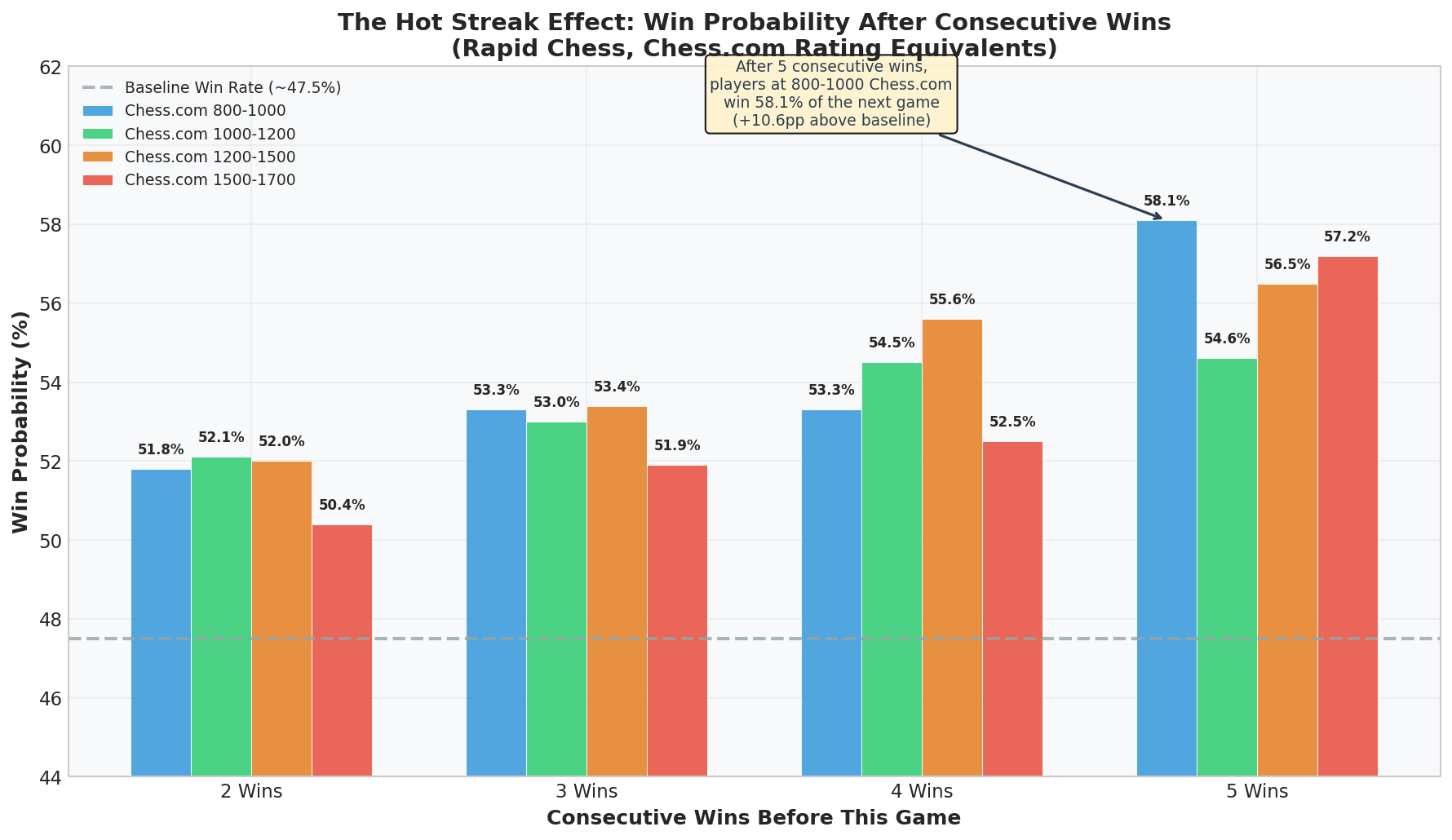
The table below summarizes the "hot streak bonus" across the four rating bands most relevant to the target audience. Each value represents the percentage point increase in win probability above the player's baseline win rate.
| Chess.com Band | After 2 Wins | After 3 Wins | After 4 Wins | After 5 Wins | Sample (3W) |
|---|---|---|---|---|---|
| 800-1000 | +4.2 pp | +5.8 pp | +5.8 pp | +10.6 pp | 4,439 |
| 1000-1200 | +4.3 pp | +5.2 pp | +6.7 pp | +6.8 pp | 4,202 |
| 1200-1500 | +4.5 pp | +5.9 pp | +8.1 pp | +9.0 pp | 4,021 |
| 1500-1700 | +3.2 pp | +4.7 pp | +5.3 pp | +10.0 pp | 5,833 |
Why Does This Happen? It Is About Move Quality
The data shows that the hot streak effect is not merely a product of being matched against weaker opponents. It reflects a genuine improvement in move quality. During a winning streak, players experience a significant drop in their average Centipawn Loss (CPL). For players in the Chess.com 1000-1200 range, a 3-game win streak correlates with a CPL improvement of approximately 51.7 points compared to their baseline. In practical terms, you are literally playing better chess when you are winning.
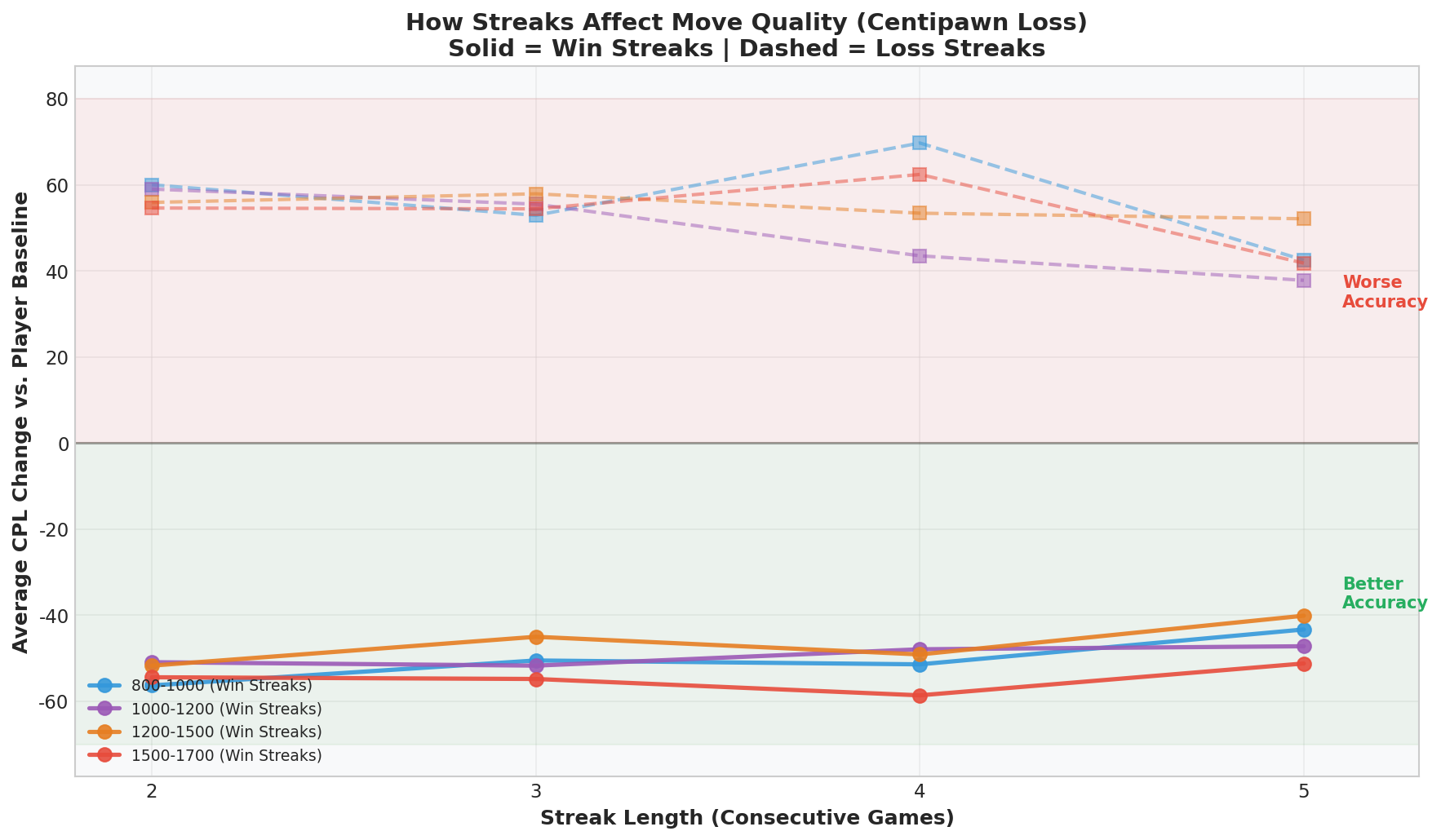
The chart above illustrates how both winning and losing streaks affect move quality. The solid lines (win streaks) show CPL improving (moving further below zero), while the dashed lines (loss streaks) show CPL deteriorating (moving further above zero). The psychological state induced by consecutive results has a direct, measurable impact on calculation ability.
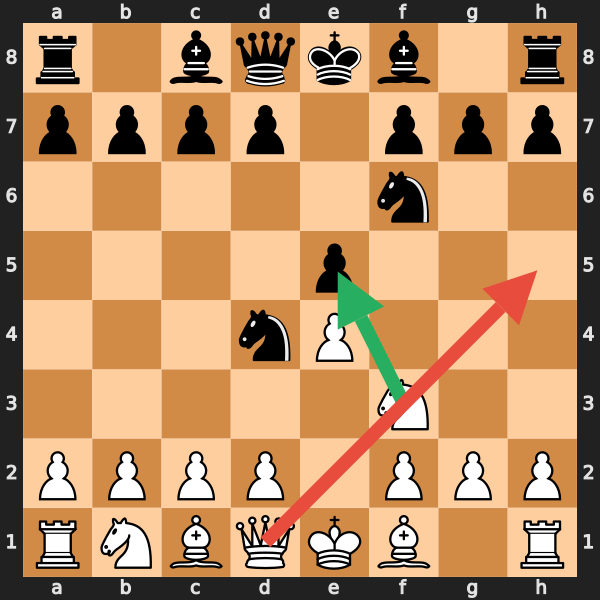
Figure 1: A player on a hot streak is more likely to spot active, challenging tactics like Nxe5! (green arrow) rather than playing overambitious moves like Qh5?! (red arrow). Confidence sharpens pattern recognition.
Actionable Advice: Riding the Hot Streak
The data supports a clear strategy when you find yourself on a winning streak. If you have won 3 games in a row, keep playing. Your win probability is peaking, and your move quality is objectively higher than normal. Recognize that you are in "the zone," as the Nature study describes it, "a state of focus where peak performance is possible" [1]. Trust your calculation, but do not become overconfident. The moment you lose a game after a long streak, log off. Do not try to force a new streak immediately, because the transition from hot to cold can be abrupt.
2. The Tilt Penalty: Anatomy of a Cold Streak
If hot streaks are the dream, cold streaks are the nightmare. The Nature study noted that cold streaks tend to last longer than hot streaks, and that losses tend to be more clustered than victories [1]. Our analysis quantifies exactly how damaging tilt is at each rating level.
For a Chess.com 1000-1200 player, the baseline loss rate is approximately 48.1%. After losing two games in a row, the loss rate barely changes. But if you push through to a 5-game losing streak, your probability of losing the next game spikes to 58.8%, a devastating 10.7 percentage point "tilt penalty."
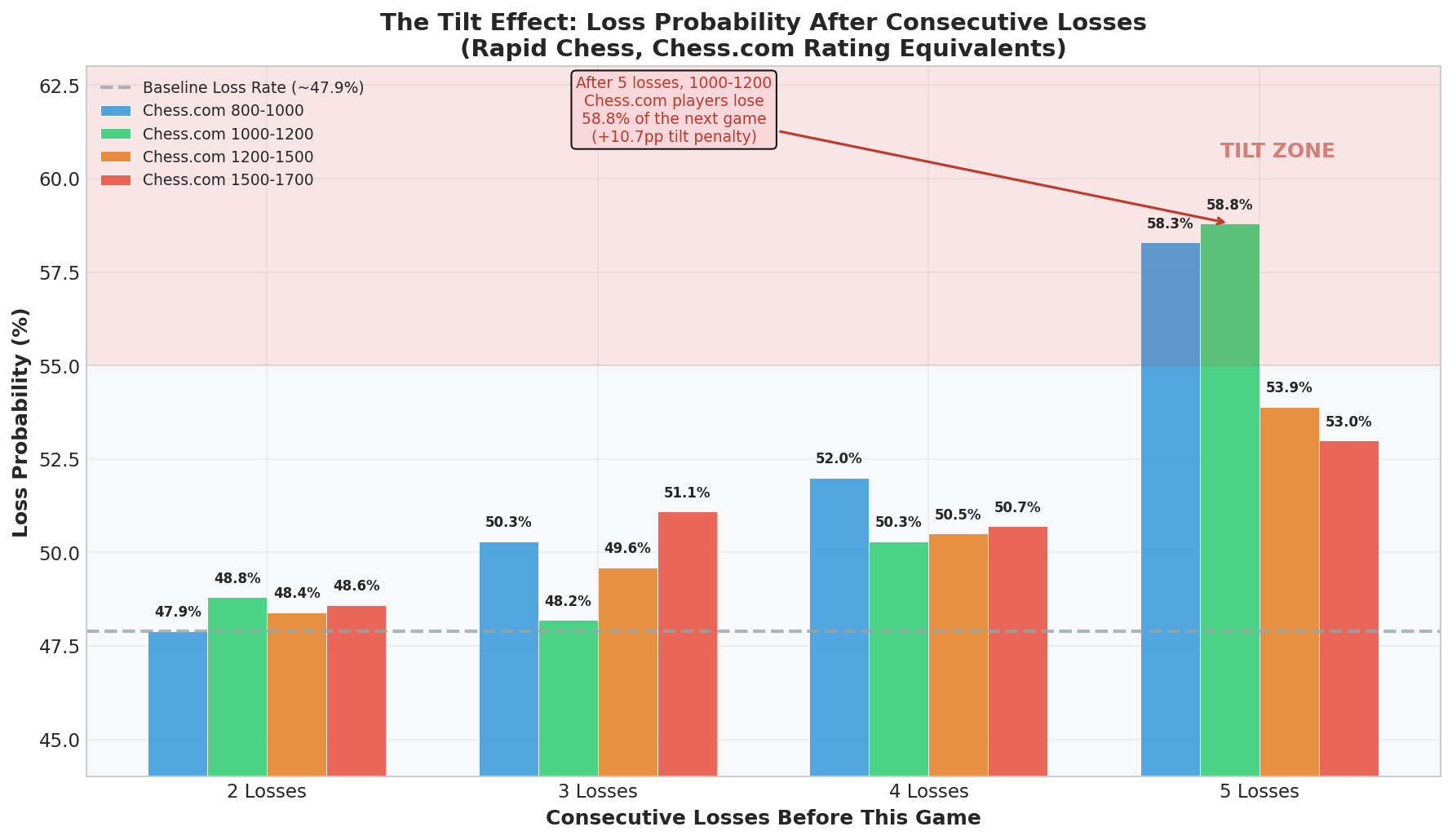
The following table shows the tilt penalty (additional loss probability above baseline) for each rating band after various losing streak lengths.
| Chess.com Band | After 2 Losses | After 3 Losses | After 4 Losses | After 5 Losses | Sample (5L) |
|---|---|---|---|---|---|
| 800-1000 | +0.0 pp | +2.4 pp | +4.1 pp | +10.4 pp | 961 |
| 1000-1200 | +0.7 pp | +0.1 pp | +2.2 pp | +10.7 pp | 864 |
| 1200-1500 | +0.2 pp | +1.4 pp | +2.3 pp | +5.7 pp | 854 |
| 1500-1700 | +1.0 pp | +3.5 pp | +3.1 pp | +5.4 pp | 960 |
A striking observation is that the tilt penalty is non-linear. The damage from 2 to 4 consecutive losses is relatively modest (0 to 4 pp), but the jump from 4 to 5 losses is catastrophic, often doubling or tripling the penalty. This suggests a psychological "breaking point" that occurs around the 5th consecutive loss.
The CPL data confirms this pattern. Players on a losing streak play significantly worse. A 1000-1200 player on a 2-game losing streak plays with an average CPL that is 59 points worse than their baseline. The deterioration in accuracy is immediate and measurable.
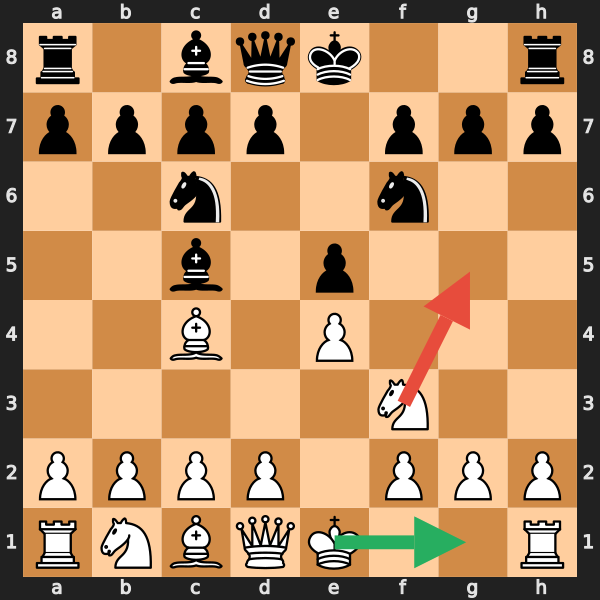
Figure 2: A classic tilt mistake. Instead of solid development with castling (O-O, green arrow), the frustrated player launches a premature, easily refuted attack (Ng5, red arrow). Tilt replaces strategy with aggression.
The Heatmap: A Complete Picture
The heatmap below provides a comprehensive view of both the hot streak bonus and the cold streak penalty across all six rating bands and all streak lengths from 2 to 5.
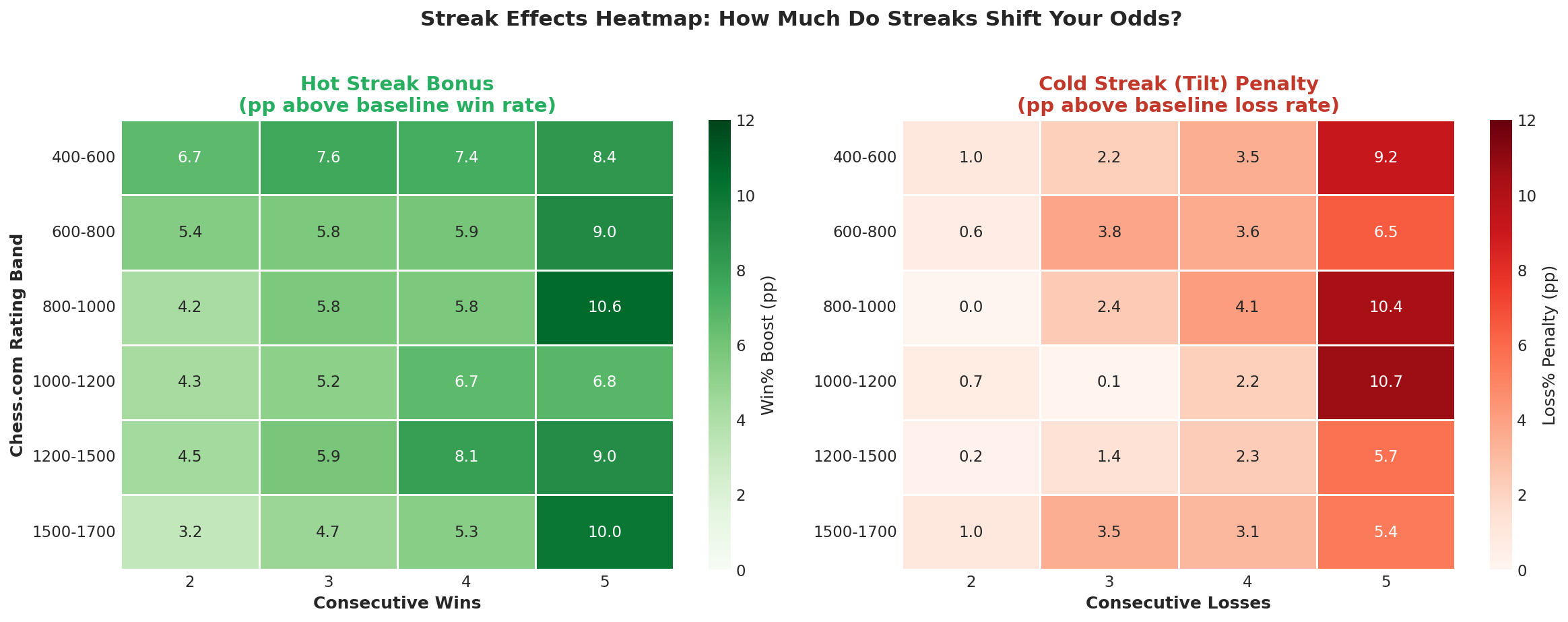
Several patterns stand out. First, the hot streak bonus (left panel) is remarkably consistent across rating bands, typically ranging from 3 to 8 percentage points for streaks of 2 to 4 wins. Second, the cold streak penalty (right panel) is more variable and more severe at lower ratings. Third, the 5-game streak column is the most extreme in both directions, confirming that extended streaks have outsized effects.
Actionable Advice: Surviving Tilt
The data supports a strict 2-Loss Rule: implement a personal policy of stopping after two consecutive losses. While the tilt penalty after 2 losses is small, accuracy is already declining, and the risk of entering a deeper spiral is high. If you somehow find yourself on a 4-game losing streak, do not queue up again under any circumstances. The 5th game is where the tilt penalty becomes severe. Take a break of at least 30 minutes, or better yet, switch to puzzles or game review.
3. The Rematch Trap: Why Revenge Games Backfire
One of the most common ways players extend a cold streak is by immediately challenging their opponent to a rematch after a painful loss. The psychology is obvious: you want to prove the loss was a fluke. The data says: do not do it.
We analyzed over 30,105 immediate rematches in Rapid chess. Across every rating band from Chess.com 400 to 1700, the player who lost the first game is significantly more likely to lose the rematch as well.
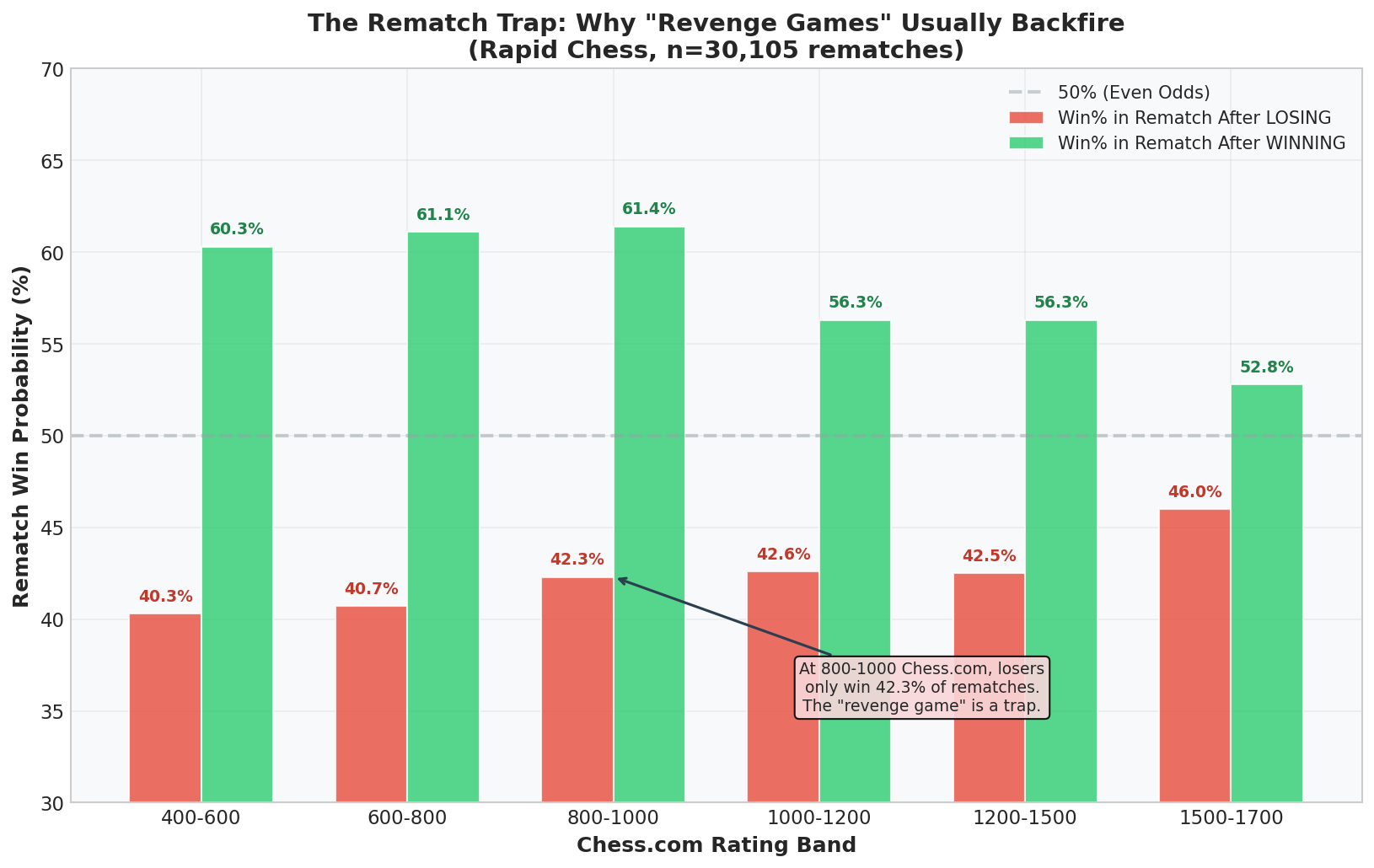
The following table summarizes the rematch outcomes by rating band.
| Chess.com Band | Loser's Rematch Win% | Winner's Rematch Win% | Gap |
|---|---|---|---|
| 400-600 | 40.3% | 60.3% | 20.0 pp |
| 600-800 | 40.7% | 61.1% | 20.4 pp |
| 800-1000 | 42.3% | 61.4% | 19.1 pp |
| 1000-1200 | 42.6% | 56.3% | 13.7 pp |
| 1200-1500 | 42.5% | 56.3% | 13.8 pp |
| 1500-1700 | 46.0% | 52.8% | 6.8 pp |
The gap narrows at higher ratings, suggesting that stronger players are better at managing tilt and resetting their mental state. But even at 1500-1700, the loser still has a significant disadvantage in the rematch.
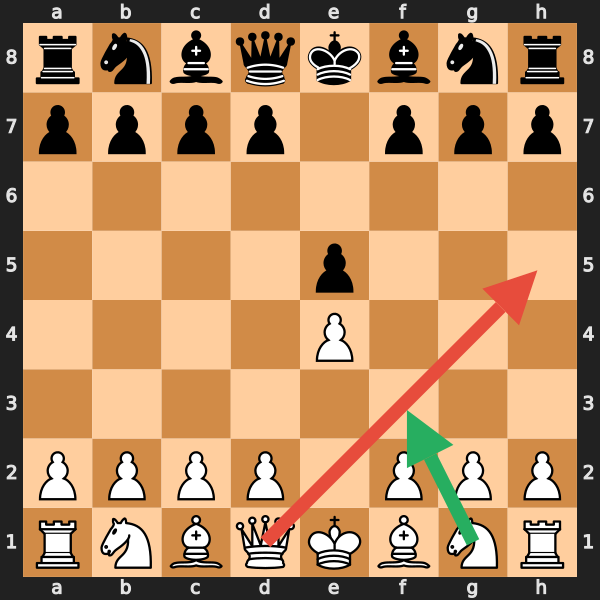
Figure 3: The Revenge Game Trap. The tilted player, desperate for a quick win, brings the Queen out early (Qh5, red arrow), violating opening principles. The engine prefers solid development (Nf3, green arrow).
Actionable Advice: Rematches
The data is unambiguous. Never rematch after a loss. Your opponent has the psychological edge, and you are likely tilted. Swallow your pride and find a new opponent. Conversely, if your opponent demands a rematch after you beat them, always accept. The odds are heavily in your favor, especially below Chess.com 1200.
4. Time of Day: When Are You at Your Best?
Does it matter when you play? We analyzed win rates across four time windows (Morning 6-12 UTC, Afternoon 12-18 UTC, Evening 18-23 UTC, Night 23-6 UTC) for Rapid games.
While the differences are subtle, there is a consistent trend: players generally perform best in the Evening and worst at Night. For a Chess.com 600-800 player, the win rate peaks at 50.3% in the evening and drops to 49.7% late at night. The difference is small in absolute terms, but over hundreds of games it compounds.
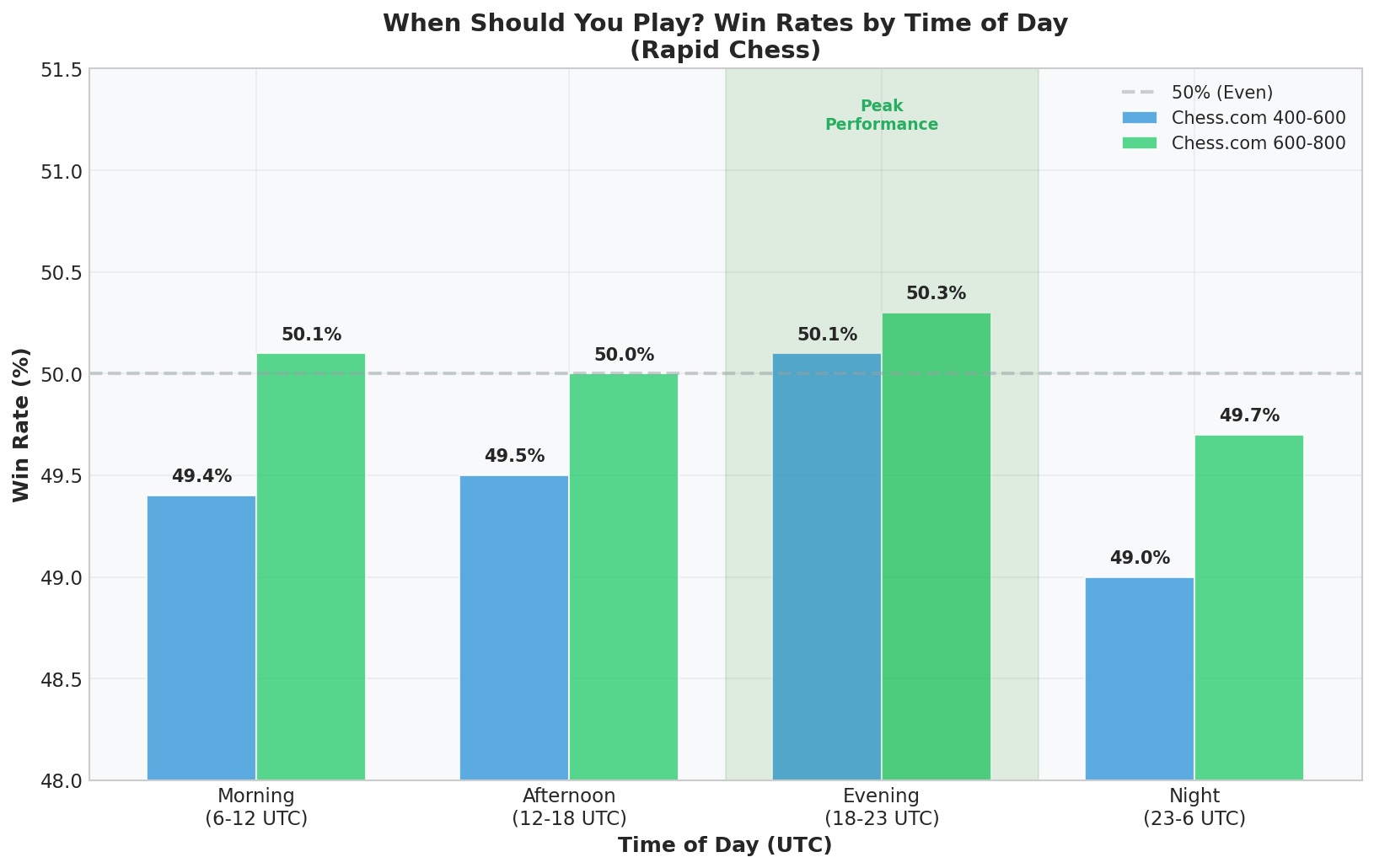
Late-night chess is often correlated with fatigue and what psychologists call "revenge bedtime procrastination," where players stay up late trying to end on a win, leading to severe tilt spirals. The combination of fatigue and tilt is particularly destructive.
Actionable Advice: Scheduling
If you care about your rating, avoid playing Rapid games when you should be sleeping. Fatigue destroys calculation ability and lowers the threshold for tilt. While evenings are generally the best time to play, the most important factor is personal alertness. Track your own performance by time of day and schedule your serious rated games accordingly.
5. The Streak Probability Cascade: Putting It All Together
Chess is a game of perfect information on the board, but imperfect psychology in the chair. The data clearly shows that your current mental state, as measured by your recent results, drastically alters your true playing strength.
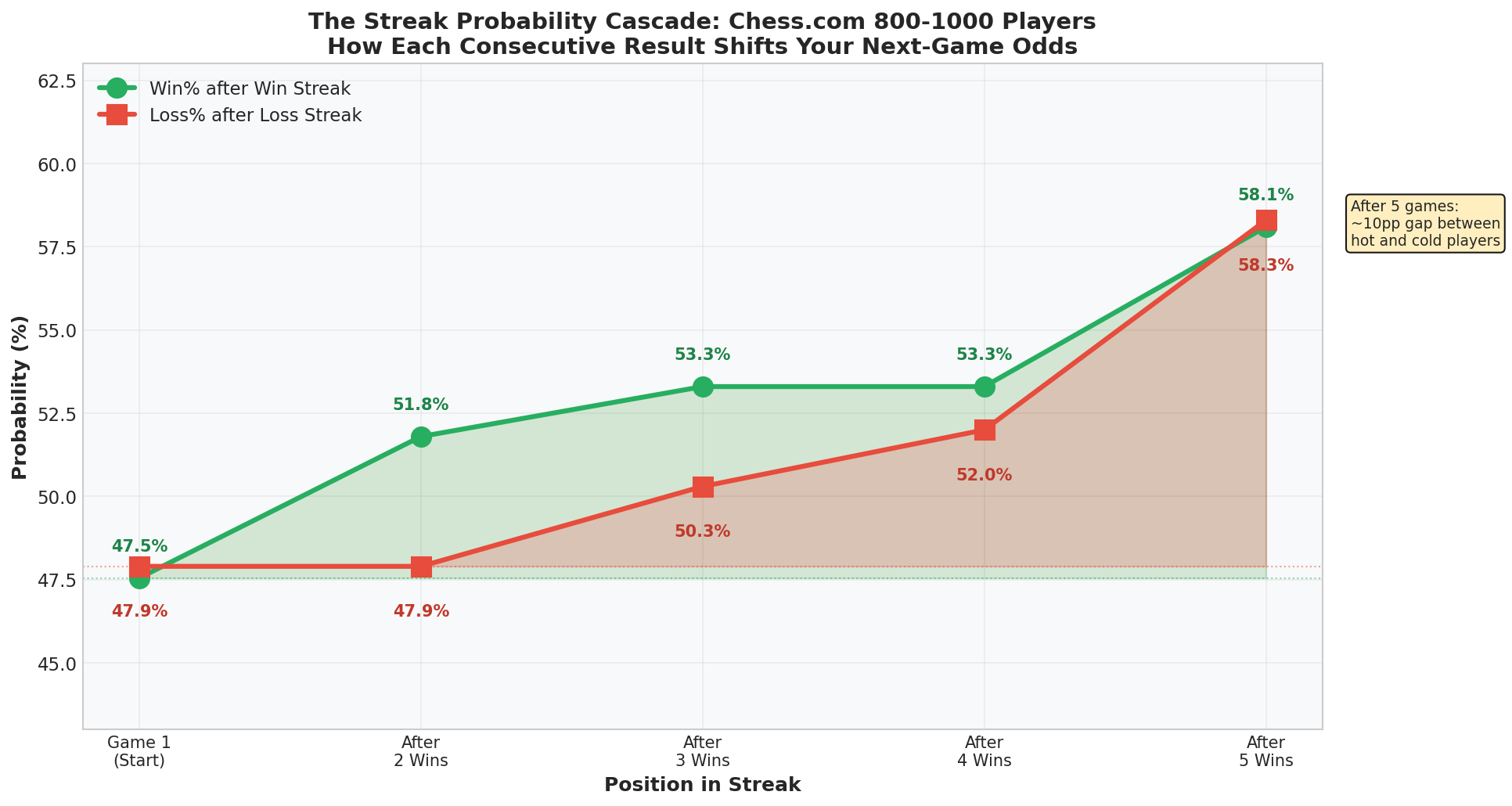
The chart above illustrates the "Streak Probability Cascade" for Chess.com 800-1000 players. Starting from a baseline of roughly 47.5% win probability, a player on a 5-game winning streak has a 58.1% chance of winning the next game, while a player on a 5-game losing streak has a 58.3% chance of losing the next game. That is a nearly 10 percentage point gap in expected performance between a player riding momentum and a player deep in tilt.
The Decision Framework
The following chart provides a simple framework for when to stop playing, based on the average tilt penalty observed across the Chess.com 800-1500 range.
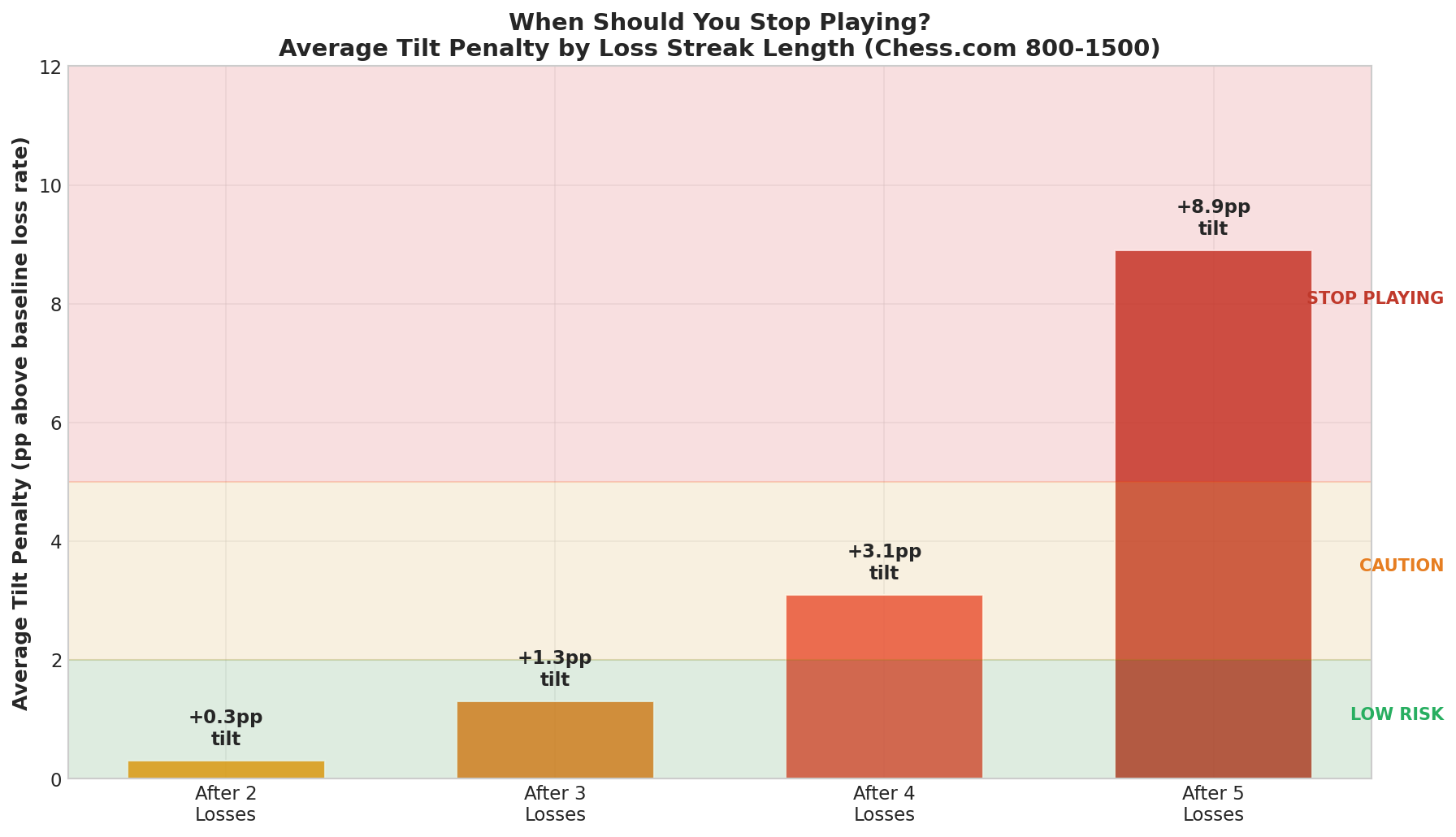
The traffic-light system is straightforward. After 2 losses, the tilt penalty is minimal (low risk). After 3 losses, it enters the caution zone. After 4 losses, you should strongly consider stopping. After 5 losses, the data is clear: stop playing immediately.
Hot vs. Cold: A Side-by-Side Comparison
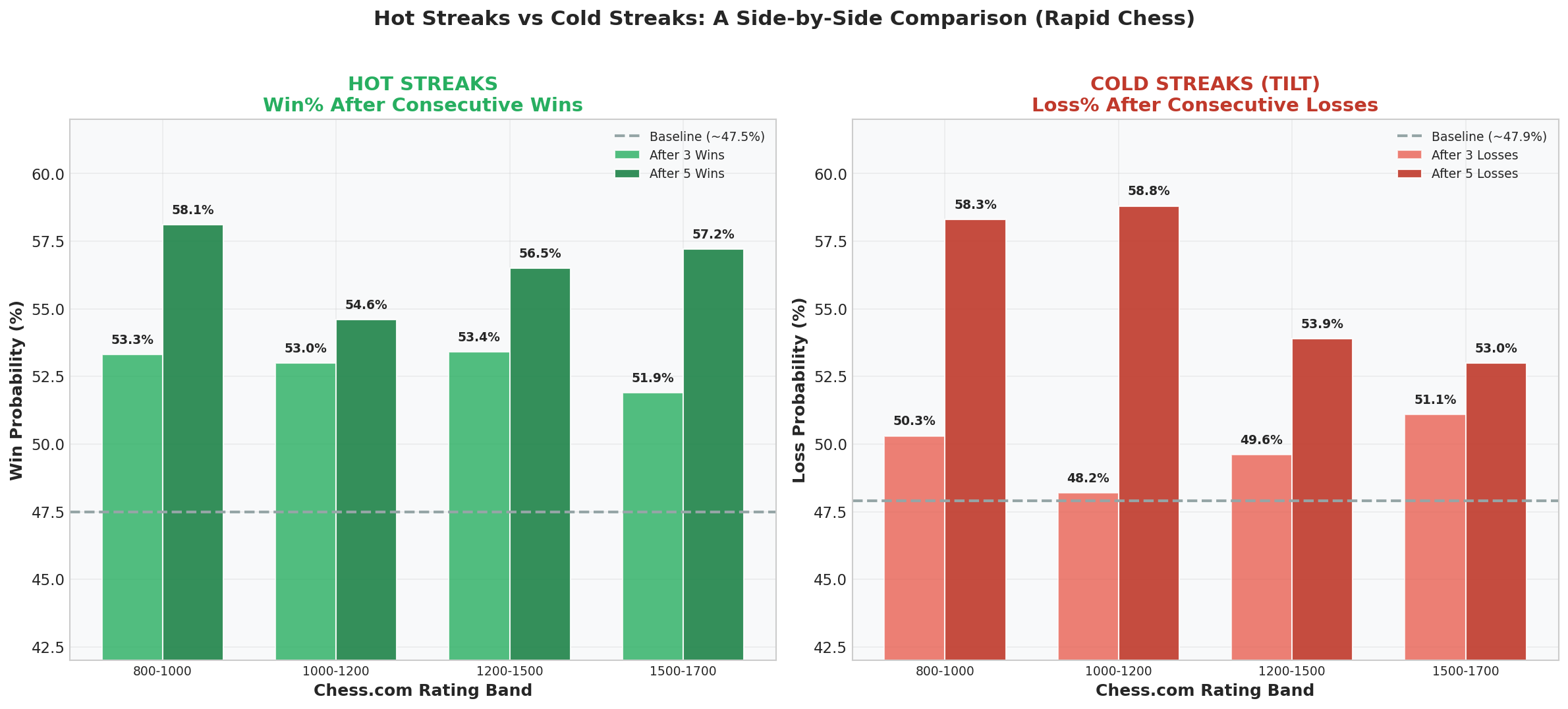
The side-by-side comparison above makes the asymmetry clear. Hot streaks provide a moderate, steady boost to win probability. Cold streaks, by contrast, inflict a penalty that escalates sharply at the 5-game mark. This asymmetry is consistent with the Nature study's finding that cold streaks are longer and more persistent than hot ones [1].
6. Statistical Confidence: Sample Sizes
A natural question is whether these findings are statistically robust. The chart below shows the number of observed streak sequences for each rating band and streak length.
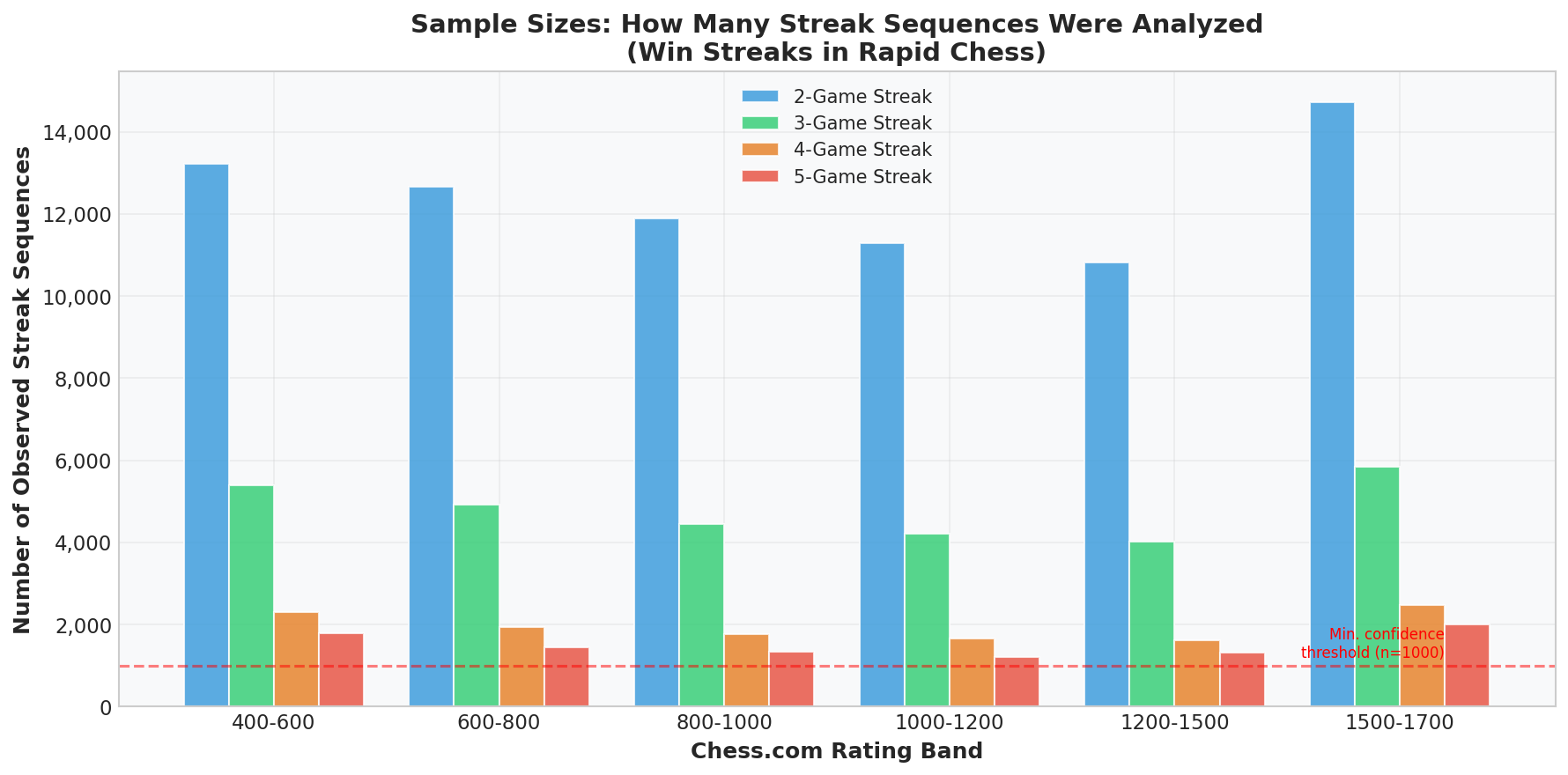
Even for the rarest category (5-game win streaks), every rating band has over 1,000 observed sequences, well above the threshold for statistical significance. The 2-game and 3-game streak categories have sample sizes in the thousands to tens of thousands, providing high confidence in the observed patterns.
| Data Source | Total Games/Sequences |
|---|---|
| Streak effect analysis | 226,165 game sequences |
| Temporal performance | 954,532 games |
| Rematch analysis | 30,105 rematches |
| Baseline (draw rates) | 199,610 games |
Summary: Your Rating Climb Roadmap
To climb the rating ladder from Chess.com 800 to 1500, you do not just need to study tactics and endgames. You need to manage your momentum. The following table distills the key findings into a practical decision framework.
| Situation | What the Data Says | What You Should Do |
|---|---|---|
| Won 2+ games in a row | Win probability is 4-5 pp above baseline | Keep playing; you are in the zone |
| Won 5+ games in a row | Win probability is 7-10 pp above baseline | Keep playing, but stop at the first loss |
| Lost 2 games in a row | Tilt penalty is minimal (~0.5 pp) | Take a 5-minute break, then continue |
| Lost 3 games in a row | Tilt penalty is moderate (~1-3 pp) | Strongly consider stopping for the session |
| Lost 5 games in a row | Tilt penalty is severe (~6-11 pp) | Stop immediately; switch to puzzles or review |
| Lost and want to rematch | Loser wins only 40-43% of rematches | Never rematch after a loss |
| Won and opponent wants rematch | Winner wins 53-61% of rematches | Always accept the rematch |
| Playing after midnight | Win rate drops 0.5-1.0 pp | Avoid rated games when fatigued |
Ride the hot streaks, refuse the revenge rematches, and most importantly: know when to log off.
Data and Methodology
This analysis is based on a dataset of Lichess Rapid games accessed via the Grandmaster Guide MCP analytics server, which indexes over 120 million games from the Lichess March 2025 database.
Platform Calibration. Because the underlying data originates from Lichess, all rating bands were adjusted to approximate Chess.com Rapid ratings using the standard conversion table provided in the project methodology. For reference, Lichess Rapid 1100-1300 corresponds approximately to Chess.com Rapid 800-1000, and Lichess Rapid 1300-1500 corresponds to Chess.com Rapid 1000-1200.
Streak Detection. Streaks were identified by ordering each player's games chronologically and detecting consecutive sequences of wins or losses of length 2 through 5. The "subsequent" game outcome is the game immediately following the streak.
Accuracy Metrics. Centipawn Loss (CPL) and blunder rates were calculated using Stockfish 17 evaluations embedded in the game data. A blunder is defined as a move losing 300 or more centipawns.
Temporal Analysis. Games were grouped by the UTC hour of their start time into four windows: Morning (6-12), Afternoon (12-18), Evening (18-23), and Night (23-6).
Rematch Detection. Rematches were identified as games between the same two players occurring within 600 seconds of the previous game's conclusion.
Raw Data Files. The underlying CSV data files generated for this analysis are attached:
streak_effects_rapid.csv— Full streak effects data with Chess.com band mappingstemporal_performance_rapid.csv— Win rates by time of dayrematch_outcomes_rapid.csv— Rematch outcome data
References
[1] Chowdhary, S., Iacopini, I. & Battiston, F. "Quantifying human performance in chess." Scientific Reports 13, 2113 (2023). https://www.nature.com/articles/s41598-023-27735-9
Chess Coach April 17, 2026