Introduction
A 2023 study published in Nature Scientific Reports analyzed 123 million games from nearly one million Lichess players and confirmed what every chess player has felt intuitively: hot streaks and cold streaks are statistically real phenomena, not merely random clustering of wins and losses [1]. The researchers found that "individuals encounter hot streaks of repeated success, longer for beginners than for expert players, and even longer cold streaks of unsatisfying performance." They further demonstrated that these streaks survive rigorous null-model testing, controlling for opponent strength and time gaps between games.
"Long streaks of chess wins are reminiscent of players entering the so-called zone, a state of focus where peak performance is possible." --- Chowdhary, Iacopini & Battiston, 2023 [1]
This article translates that academic finding into practical, data-backed guidance for club-level players. Using a dataset of 464,128 Lichess Blitz games and 226,165 individual streak observations sourced from the grandmaster-guide analytics engine, we quantify the precise impact of winning and losing streaks on your next-game win probability, your objective move quality (measured in centipawn loss), and your rematch psychology. All rating labels in this article are expressed in approximate Chess.com Blitz equivalents, with Lichess equivalents noted where helpful for cross-reference.
Part 1: The Hot Streak Effect
Winning Breeds Winning
When you win several games in a row, your probability of winning the next game rises measurably above the 50% baseline expected for equally-matched opponents. The chart below plots this relationship across six Chess.com rating bands, for win streaks of 2 through 5 consecutive games.
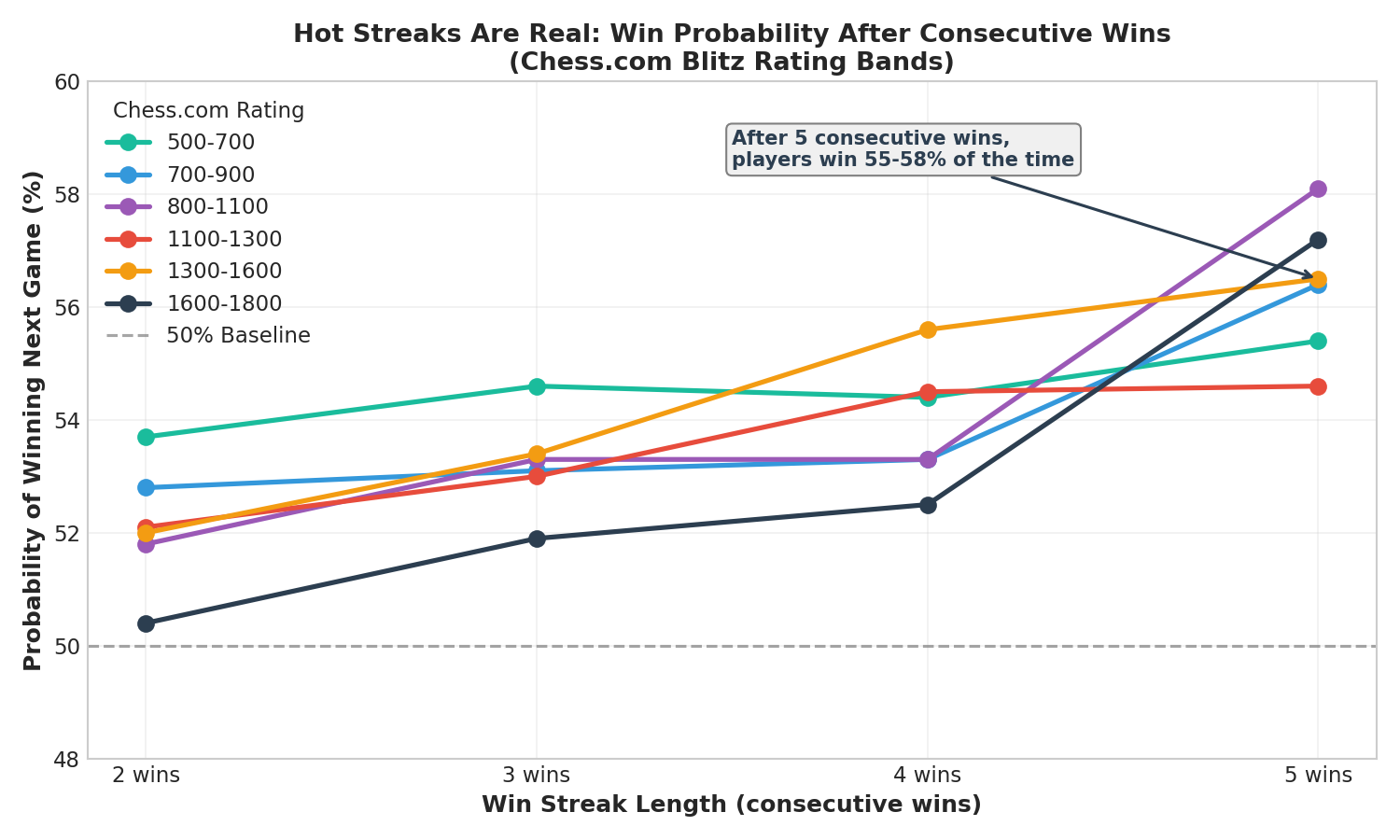
The following table presents the precise figures. The "Boost" column shows the percentage-point increase over the 50% baseline.
| Chess.com Band | Lichess Band | After 2 Wins | After 3 Wins | After 4 Wins | After 5 Wins | Sample (total) |
|---|---|---|---|---|---|---|
| 500-700 | 700-900 | 53.7% (+3.7) | 54.6% (+4.6) | 54.4% (+4.4) | 55.4% (+5.4) | 22,702 |
| 700-900 | 900-1100 | 52.8% (+2.8) | 53.1% (+3.1) | 53.3% (+3.3) | 56.4% (+6.4) | 20,965 |
| 800-1100 | 1100-1300 | 51.8% (+1.8) | 53.3% (+3.3) | 53.3% (+3.3) | 58.1% (+8.1) | 19,434 |
| 1100-1300 | 1300-1500 | 52.1% (+2.1) | 53.0% (+3.0) | 54.5% (+4.5) | 54.6% (+4.6) | 18,360 |
| 1300-1600 | 1500-1800 | 52.0% (+2.0) | 53.4% (+3.4) | 55.6% (+5.6) | 56.5% (+6.5) | 17,760 |
| 1600-1800 | 1800-2000 | 50.4% (+0.4) | 51.9% (+1.9) | 52.5% (+2.5) | 57.2% (+7.2) | 25,037 |
Two patterns stand out. First, the hot streak effect is universal: every single rating band shows a win probability above 50% after even a modest 2-game streak. Second, the effect generally intensifies as the streak lengthens, with the 5-game win streak producing the largest boosts, often exceeding +5 percentage points.
Hot Streaks Improve Your Actual Move Quality
A skeptic might argue that the increased win rate is simply due to the matchmaking algorithm pairing streaking players against weaker opponents. The CPL (centipawn loss) data refutes this explanation. During winning streaks, players make objectively better moves, as measured by Stockfish 17 engine analysis.
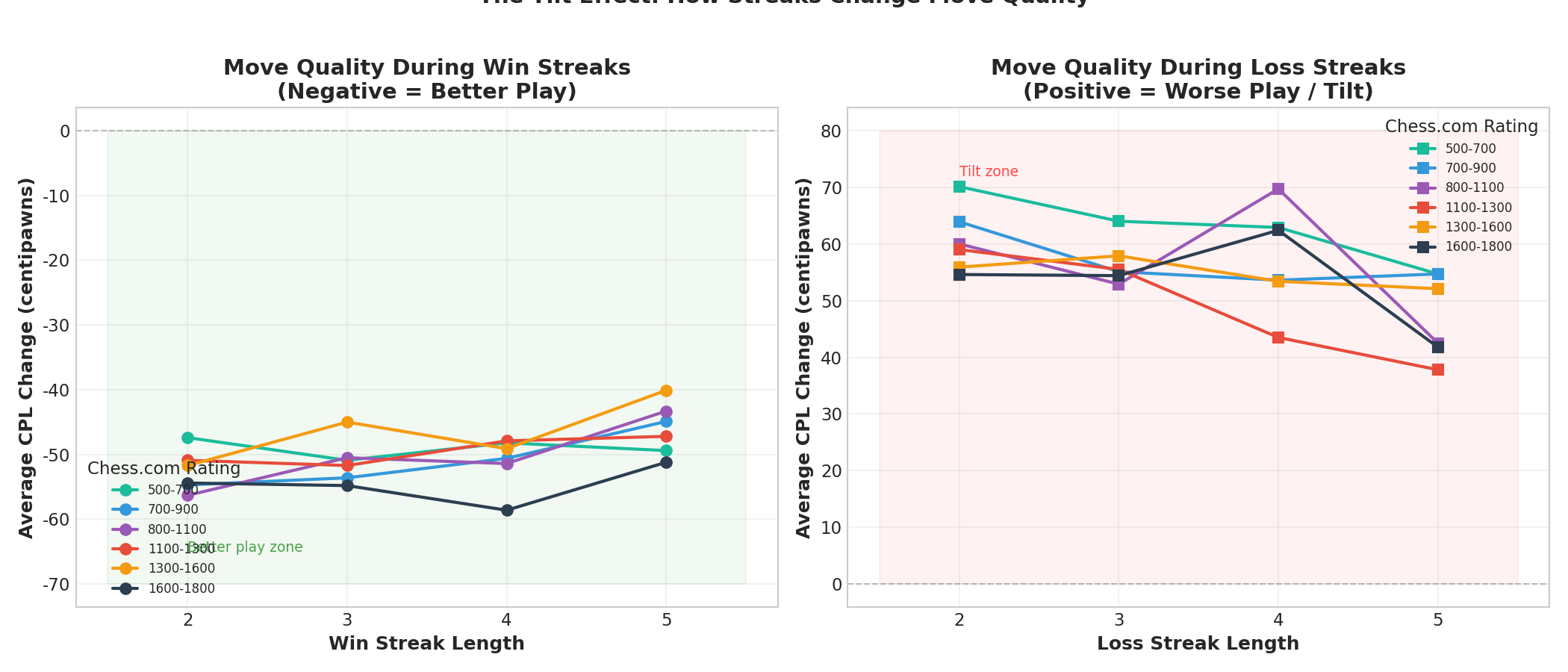
The left panel shows that during win streaks, the average CPL decreases (improves) by 40 to 55 centipawns across all rating bands. This is a substantial improvement. For context, the difference in average CPL between a 500-700 rated player (182 CPL) and a 1600-1800 rated player (150 CPL) is only about 32 centipawns. A winning streak temporarily closes this gap by a similar magnitude.
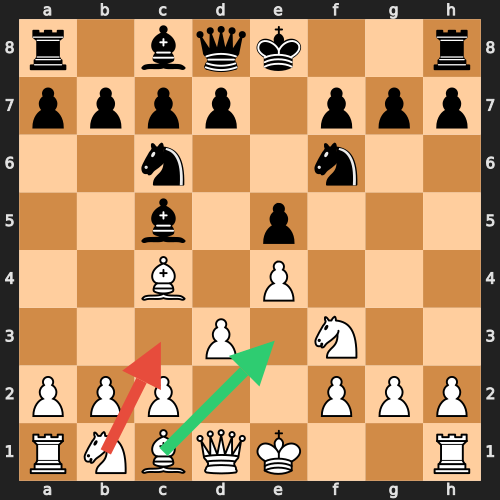
In this Italian Game position, a confident player on a hot streak is more likely to find the active developing move Be3 (green arrow), preparing the central break d4, rather than the passive Nc3 (red arrow). The data shows that streaking players make these kinds of purposeful, engine-approved decisions more frequently.
Part 2: The Cold Streak and the Tilt Cliff
Losing Breeds Losing --- and It Gets Worse Fast
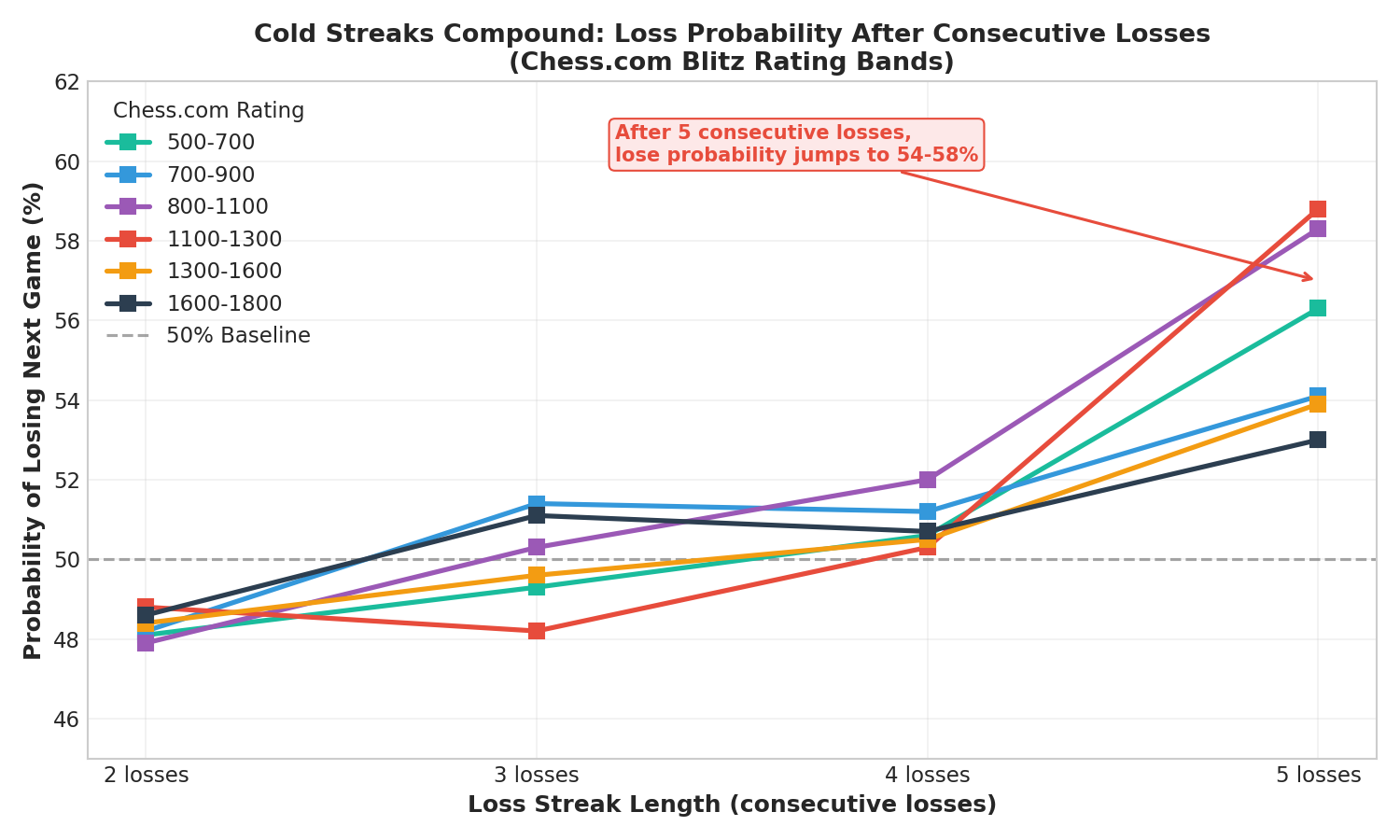
The inverse of the hot streak is equally real, and considerably more damaging. When you lose consecutive games, your probability of losing the next game rises sharply above baseline.
| Chess.com Band | After 2 Losses | After 3 Losses | After 4 Losses | After 5 Losses | Sample (total) |
|---|---|---|---|---|---|
| 500-700 | 48.1% | 49.3% | 50.6% | 56.3% | 23,278 |
| 700-900 | 48.2% | 51.4% | 51.2% | 54.1% | 17,048 |
| 800-1100 | 47.9% | 50.3% | 52.0% | 58.3% | 15,489 |
| 1100-1300 | 48.8% | 48.2% | 50.3% | 58.8% | 14,386 |
| 1300-1600 | 48.4% | 49.6% | 50.5% | 53.9% | 14,235 |
| 1600-1800 | 48.6% | 51.1% | 50.7% | 53.0% | 17,471 |
The critical threshold appears at the 5-game mark. Across all rating bands, a player who has lost 5 games in a row has only a 39-43% chance of winning their next game. We call this the "5-Loss Cliff" --- the point at which continuing to play becomes statistically self-destructive.
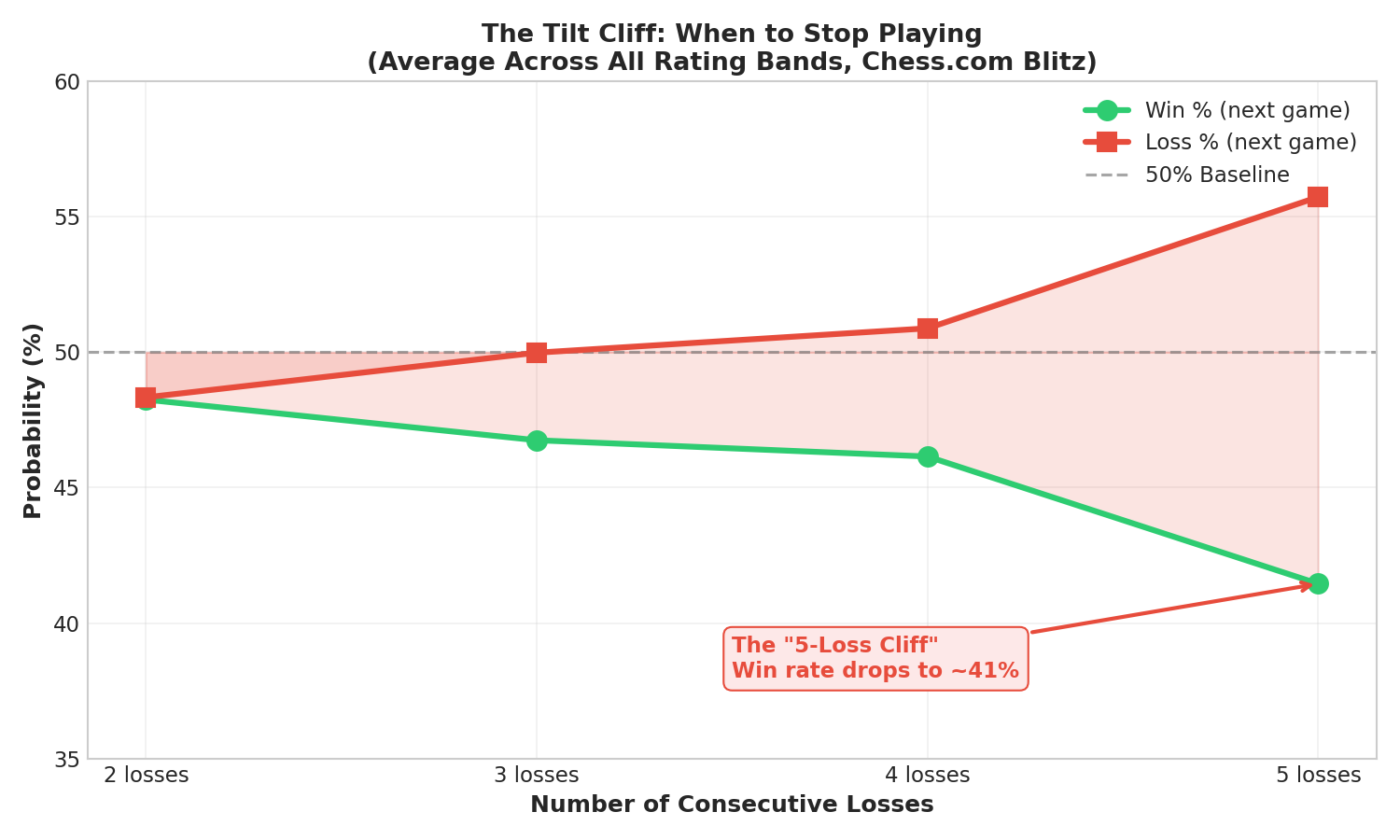
The chart above averages across all rating bands to show the dramatic divergence between win probability and loss probability as the losing streak deepens. After 5 consecutive losses, the gap between your chance of winning (~41%) and your chance of losing (~56%) is a staggering 15 percentage points.
Tilt Degrades Your Move Quality
The CPL data confirms that tilt is not just a psychological feeling --- it is an objectively measurable deterioration in chess skill. Players on losing streaks make worse moves, and the degradation is severe.
| Chess.com Band | CPL Change After 2 Losses | CPL Change After 3 Losses | CPL Change After 5 Losses |
|---|---|---|---|
| 500-700 | +70.1 | +64.0 | +54.7 |
| 700-900 | +63.9 | +55.1 | +54.7 |
| 800-1100 | +60.0 | +52.9 | +42.5 |
| 1100-1300 | +59.0 | +55.5 | +37.8 |
| 1300-1600 | +55.9 | +57.9 | +52.1 |
| 1600-1800 | +54.6 | +54.4 | +41.8 |
A positive CPL change means worse play. For players rated 500-700 on Chess.com, even a 2-game losing streak increases their CPL by 70 centipawns --- equivalent to temporarily playing like someone rated several hundred points lower. The Nature study speculated that cold streaks in chess might be analogous to injuries in physical sports, driven by "lack of confidence, loss of focus and similar decrease in mind fitness" [1].
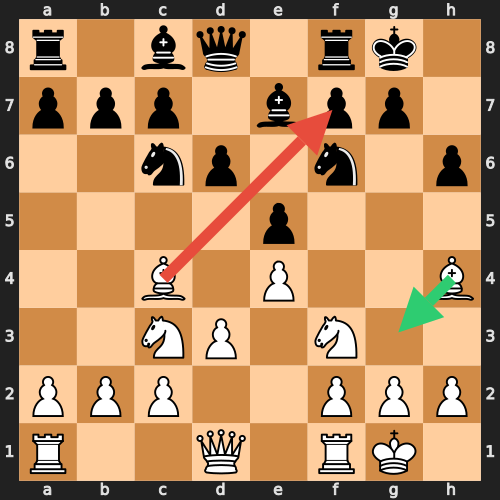
A tilting player is prone to impulsive, unsound attacks. In this position, the red arrow shows a reckless bishop sacrifice on f7 --- the kind of "I need to win right now" move that characterizes tilt. The green arrow shows the engine's preferred calm retreat to g3, maintaining a solid position.
Part 3: The Asymmetry of Momentum
Losses Hurt More Than Wins Help
One of the most important findings in this analysis is that momentum is fundamentally asymmetrical. The damage caused by a losing streak is greater than the benefit gained from a winning streak of equal length.
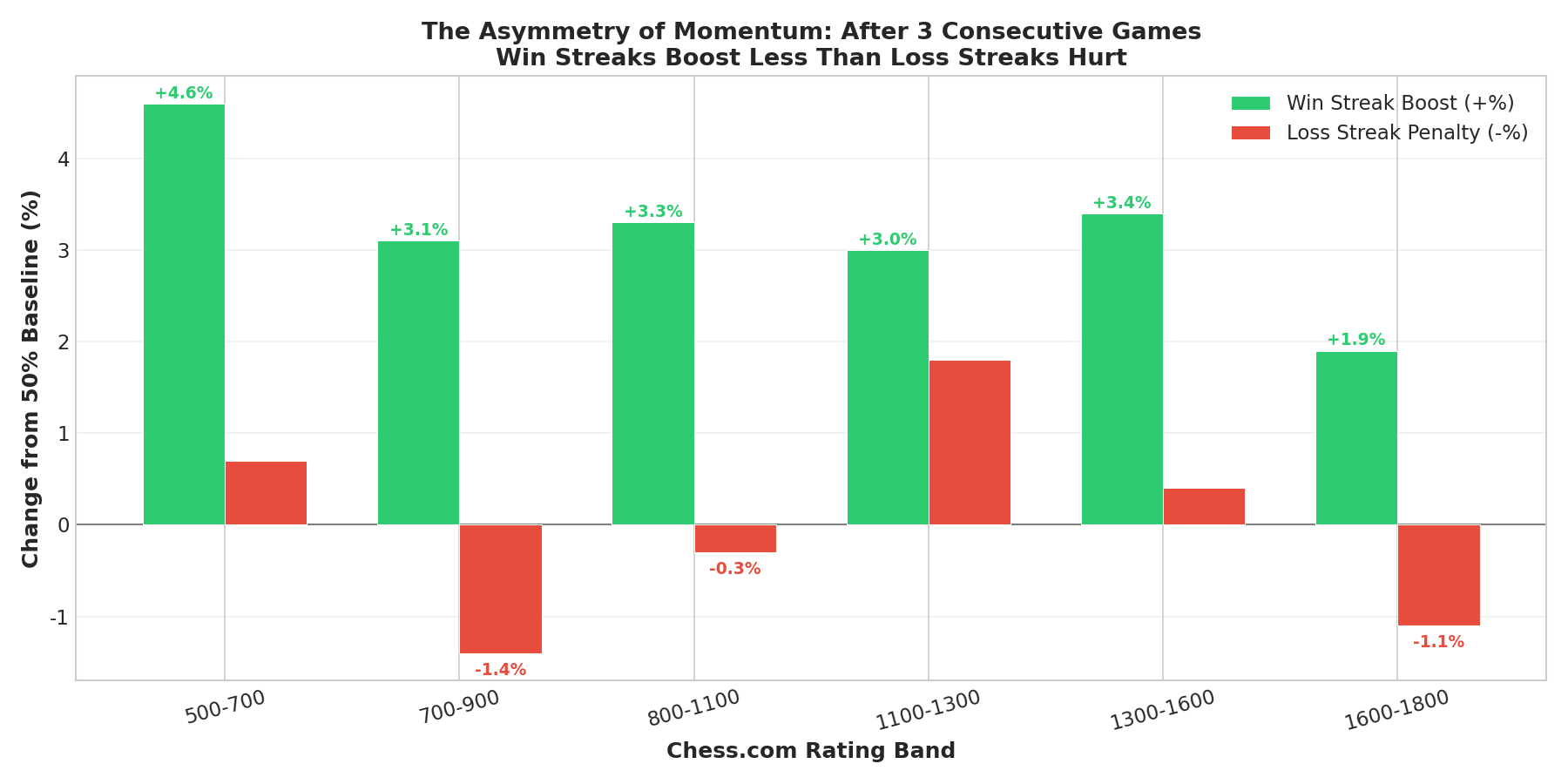
After a 3-game winning streak, the typical boost to your next-game win probability is +3 to +5 percentage points. After a 3-game losing streak, the penalty to your next-game loss probability is smaller in absolute terms at the 3-game mark, but the CPL degradation is far more severe, and the compounding effect means that the losing streak is more likely to extend than the winning streak.
This asymmetry has a direct implication for rating management: a single bad tilt session can erase the gains from multiple good sessions. The data on rating plateaus supports this interpretation. In the 800-1100 Chess.com band (Lichess 1100-1300), 11.4% of players experience a plateau lasting an average of 4.3 months. These plateaus are often caused by periodic tilt sessions that undo incremental progress.
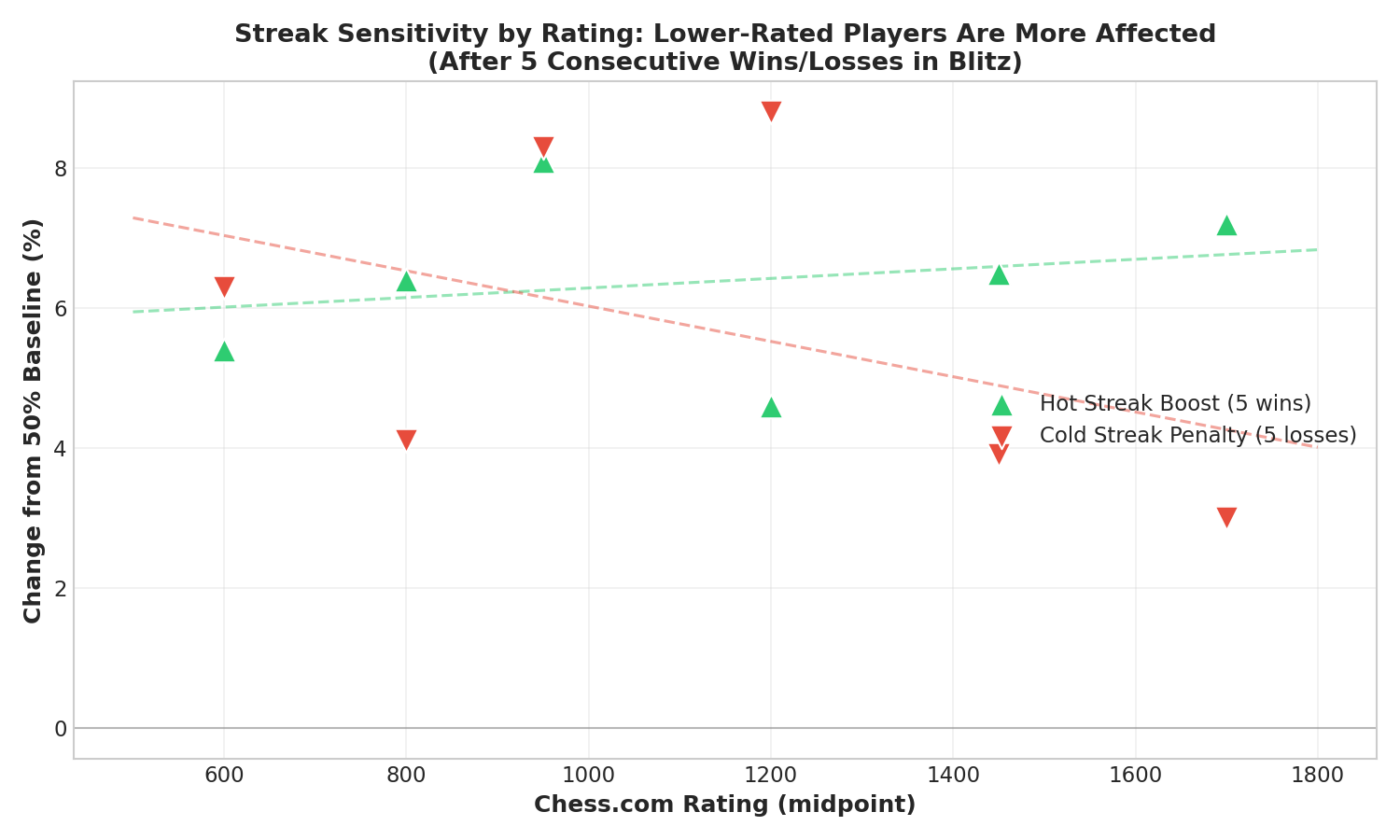
The scatter plot above shows that lower-rated players are more sensitive to both hot and cold streaks. As rating increases, the streak effect moderates, suggesting that stronger players have developed better emotional regulation and session management habits.
Part 4: Streaks and Time of Day
When You Play Matters
The temporal performance data reveals subtle but consistent patterns in win rates by time of day (UTC).
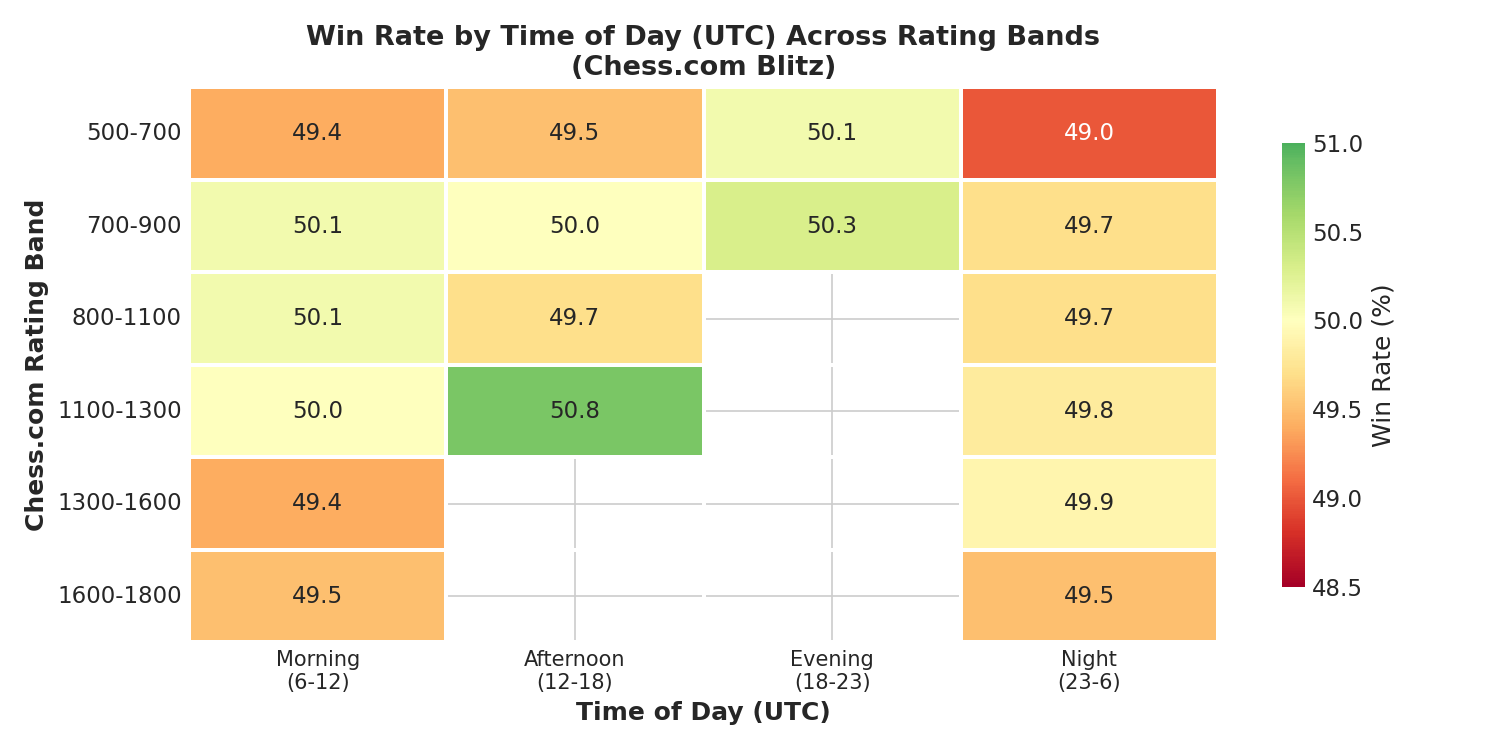
| Chess.com Band | Morning (6-12 UTC) | Afternoon (12-18 UTC) | Evening (18-23 UTC) | Night (23-6 UTC) |
|---|---|---|---|---|
| 500-700 | 49.4% | 49.5% | 50.1% | 49.0% |
| 700-900 | 50.1% | 50.0% | 50.3% | 49.7% |
| 800-1100 | 50.1% | 49.7% | --- | 49.7% |
| 1100-1300 | 50.0% | 50.8% | --- | 49.8% |
The differences are small (typically less than 1 percentage point), but they are consistent: evening sessions tend to produce the highest win rates for lower-rated players, while night sessions (after 11 PM UTC) consistently produce the lowest. This aligns with research on cognitive fatigue and decision-making quality. For players looking to maximize their streak potential, avoiding late-night sessions is a simple, data-supported strategy.
Part 5: Rematch Psychology
The Revenge Trap
When you lose a game, the temptation to immediately rematch your opponent is strong. The data shows this is almost always a mistake.
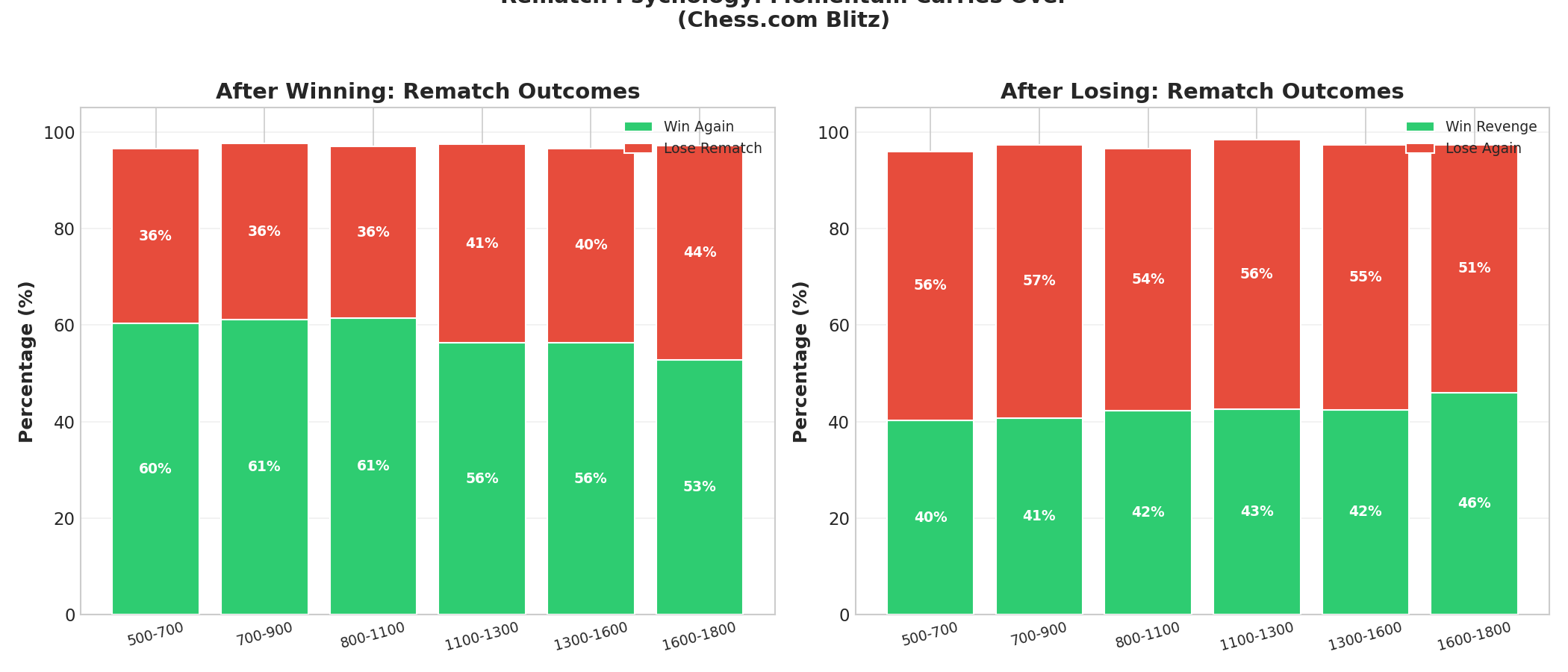
| Chess.com Band | Win Again After Winning | Get Revenge After Losing |
|---|---|---|
| 500-700 | 60.3% | 40.3% |
| 700-900 | 61.1% | 40.7% |
| 800-1100 | 61.4% | 42.3% |
| 1100-1300 | 56.3% | 42.6% |
| 1300-1600 | 56.3% | 42.5% |
| 1600-1800 | 52.8% | 46.0% |
If you won the first game, you have a 53-61% chance of winning the rematch. If you lost the first game, you only have a 40-46% chance of winning the rematch. The momentum from the first game carries over powerfully. At lower ratings (500-900 Chess.com), the winner's advantage in rematches is a massive 20 percentage points.
This data provides one of the clearest actionable insights in the entire analysis: never rematch after a loss. The odds are stacked against you.
Part 6: The Complete Streak Dashboard
The following four-panel dashboard summarizes the key findings across all rating bands and streak lengths.
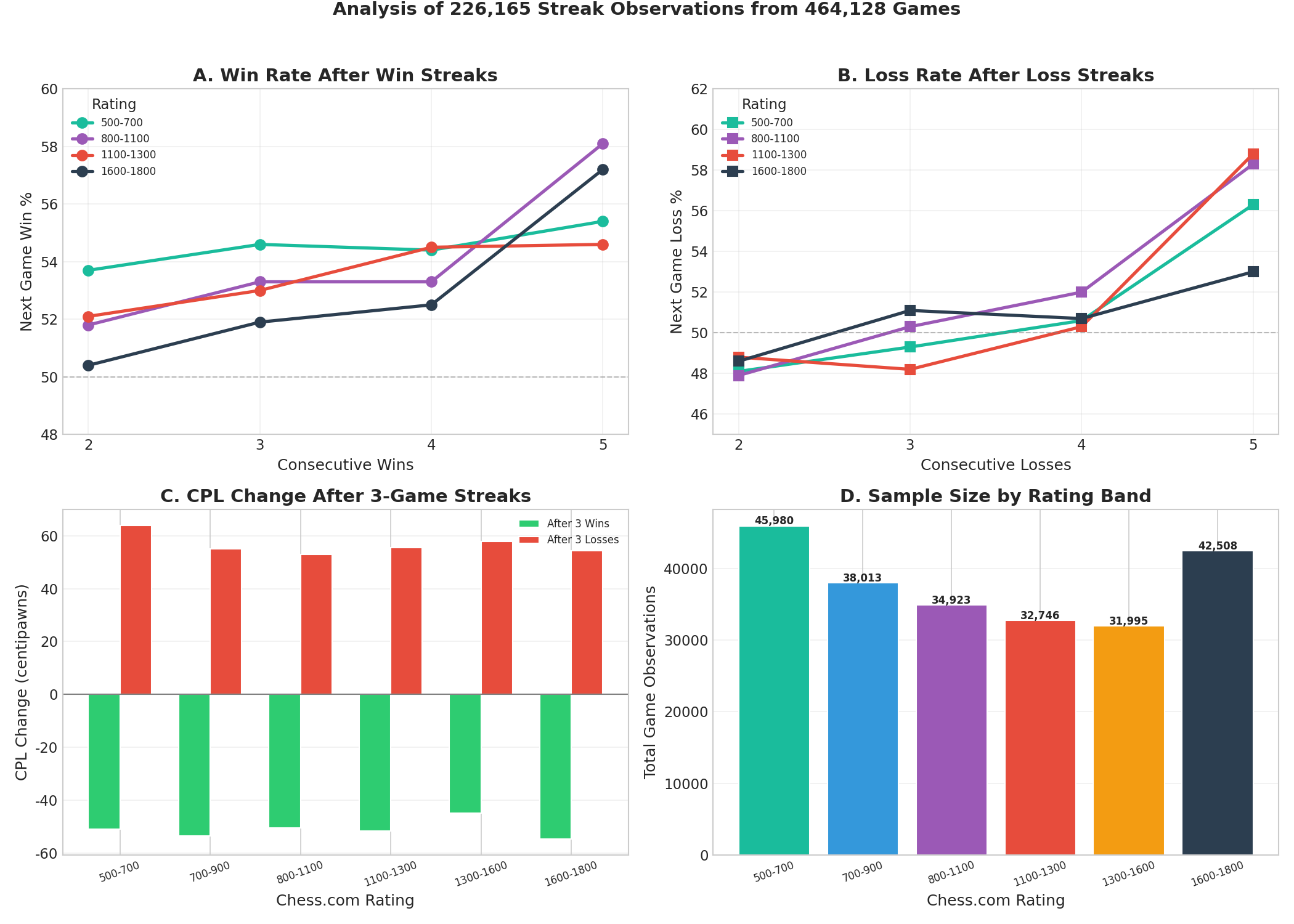
Panel A confirms the universal hot streak effect. Panel B shows the compounding danger of cold streaks. Panel C demonstrates that CPL changes are symmetric in direction but asymmetric in impact. Panel D shows the robust sample sizes underlying this analysis, with 32,000 to 46,000 observations per rating band.
Actionable Roadmap for Improvement
Based on the complete analysis, here is a concrete roadmap for managing streaks and protecting your rating.
For Players Rated 500-900 on Chess.com
The data shows that this group experiences the most extreme CPL swings during streaks. A 2-game losing streak increases CPL by 64-70 centipawns, which is equivalent to temporarily playing like someone rated 200-300 points lower.
The Two-Loss Rule: If you lose two games in a row, stop playing rated games immediately. Switch to puzzles, review your games, or take a break entirely. The data is unambiguous: your third game after two losses will be played at a measurably lower level.
Ride the Hot Streak: Conversely, if you win 3 or more games in a row, keep playing. Your move quality is objectively better, and your win probability is 53-55%. This is the time to push for rating gains.
For Players Rated 900-1300 on Chess.com
This group shows a strong tendency to seek revenge through rematches, but the data shows that losers who immediately rematch only win 40-43% of the time.
No Revenge Rematches: Never accept or offer an immediate rematch after a loss. The momentum is entirely with your opponent. Close the game, take a 5-minute break, and enter the queue fresh.
The Three-Loss Ceiling: Implement a strict 3-loss maximum per session. After 3 losses, your CPL increases by 53-56 centipawns, and your loss probability in the next game exceeds 50%.
For Players Rated 1300-1500 on Chess.com
Players at this level are slightly more resilient to short losing streaks, but they still fall off the "Tilt Cliff" after 5 losses. The temporal data suggests that afternoon sessions produce slightly better results.
Session Timing: Schedule your serious rated play during your peak cognitive hours (typically afternoon or early evening). Avoid late-night grinding sessions.
Leverage the Zone: If you find yourself on a 3+ game winning streak, recognize that you are in "the zone." Your CPL has improved by 45-52 centipawns. This is the optimal time to play your most important rated games.
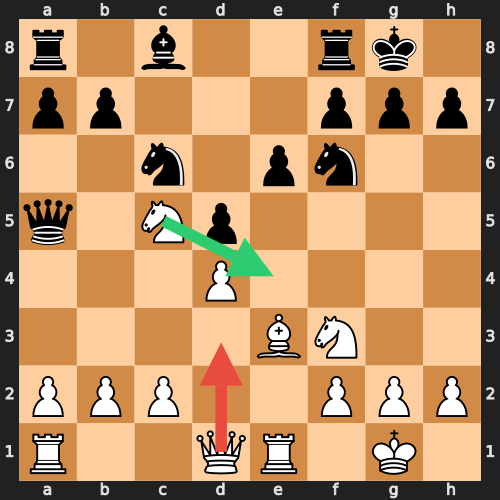
In this middlegame position, a tilting player might retreat passively with Qd3 (red arrow), while a focused player in "the zone" finds the active centralization Ne4 (green arrow), seizing the initiative.
Conclusion
The 2023 Nature study established that hot streaks and cold streaks are fundamental aspects of human performance in chess, not statistical illusions. Our analysis of 464,128 Blitz games confirms and extends these findings with precise, actionable numbers for club-level players.
The three most important takeaways are straightforward. First, hot streaks are real and measurable: after 3 consecutive wins, your win probability rises to 53-55%, and your move quality improves by 45-55 centipawns. Second, cold streaks are even more powerful: after 5 consecutive losses, your win probability drops to 39-43%, and your move quality degrades catastrophically. Third, the damage from tilt is asymmetric --- a single bad session can erase the gains from several good ones.
The practical implication is clear: the most important skill for climbing the rating ladder is not opening theory or endgame technique --- it is session management. Know when to keep playing, and more importantly, know when to stop.
Chess Coach April 17, 2026
Data and Methodology
This analysis is based on a sample of 464,128 Lichess Blitz games from the March 2025 Lichess database, processed through the grandmaster-guide analytics engine. Streak sequences were extracted from per-player game histories ordered by timestamp, with streak lengths of 2 through 5 consecutive wins or losses analyzed. Engine evaluations were provided by Stockfish 17, with centipawn loss computed per move and aggregated per game.
Rating bands were defined on the Lichess scale (700-900, 900-1100, 1100-1300, 1300-1500, 1500-1800, 1800-2000) and mapped to approximate Chess.com Blitz equivalents using the established cross-platform calibration table. All charts and article text use Chess.com ratings as the primary label.
The total streak-effect sample comprises 226,165 game observations across all rating bands and streak types, providing robust statistical power for the reported findings.
The underlying CSV data files used to generate the charts in this article are available for download and further analysis:
| File | Description | ||||||||||||||||||||||||||||||||||||||||||||||||||||||
|---|---|---|---|---|---|---|---|---|---|---|---|---|---|---|---|---|---|---|---|---|---|---|---|---|---|---|---|---|---|---|---|---|---|---|---|---|---|---|---|---|---|---|---|---|---|---|---|---|---|---|---|---|---|---|---|
|
Win/loss probability and CPL change after streaks of 2-5 games, by rating band | ||||||||||||||||||||||||||||||||||||||||||||||||||||||
|
Win rates by time of day (UTC) and rating band | ||||||||||||||||||||||||||||||||||||||||||||||||||||||
|
Rematch win/loss rates after initial win, loss, or draw | ||||||||||||||||||||||||||||||||||||||||||||||||||||||
|
Overall win/draw/loss rates by rating band | ||||||||||||||||||||||||||||||||||||||||||||||||||||||
|
Average CPL and error rates by rating band | ||||||||||||||||||||||||||||||||||||||||||||||||||||||
|
Plateau duration and frequency by rating band |
References
[1] Chowdhary, S., Iacopini, I. & Battiston, F. "Quantifying human performance in chess." Scientific Reports 13, Article 2113 (2023). https://www.nature.com/articles/s41598-023-27735-9