By Chess Coach April 20, 2026
In the chaotic scramble of Bullet chess, our eyes are naturally drawn to direct threats: a knight forking two pieces, a pawn marching to promotion, or a queen bearing down on the king. But there is a more subtle, geometric motif that players consistently overlook when the clock is ticking down: the X-Ray attack (or skewer).
An X-Ray occurs when a long-range piece (a bishop, rook, or queen) attacks through an enemy piece to hit a second, more valuable target behind it. Unlike a pin, where the front piece is paralyzed because moving it would expose a more valuable piece, an X-Ray forces the front piece to move, allowing the attacker to capture the piece behind it.
To understand how often these tactics are missed—and how you can train your eyes to spot them—we analyzed 6,000 Lichess Bullet games across four rating bands, approximating Chess.com ratings from 800 to 1500. The data reveals a fascinating story about board vision, time pressure, and the specific geometric patterns that elude intermediate players.
The Scope of the Problem: How Often Are X-Rays Missed?
Our analysis scanned over 360,000 plies (half-moves) to identify positions where a clear, material-winning X-Ray tactic was available, but the player chose a different move that resulted in a significant drop in engine evaluation (a mistake or blunder).
The sheer volume of missed opportunities is staggering. Across all rating bands, nearly 80% of Bullet games contained at least one missed X-Ray tactic.
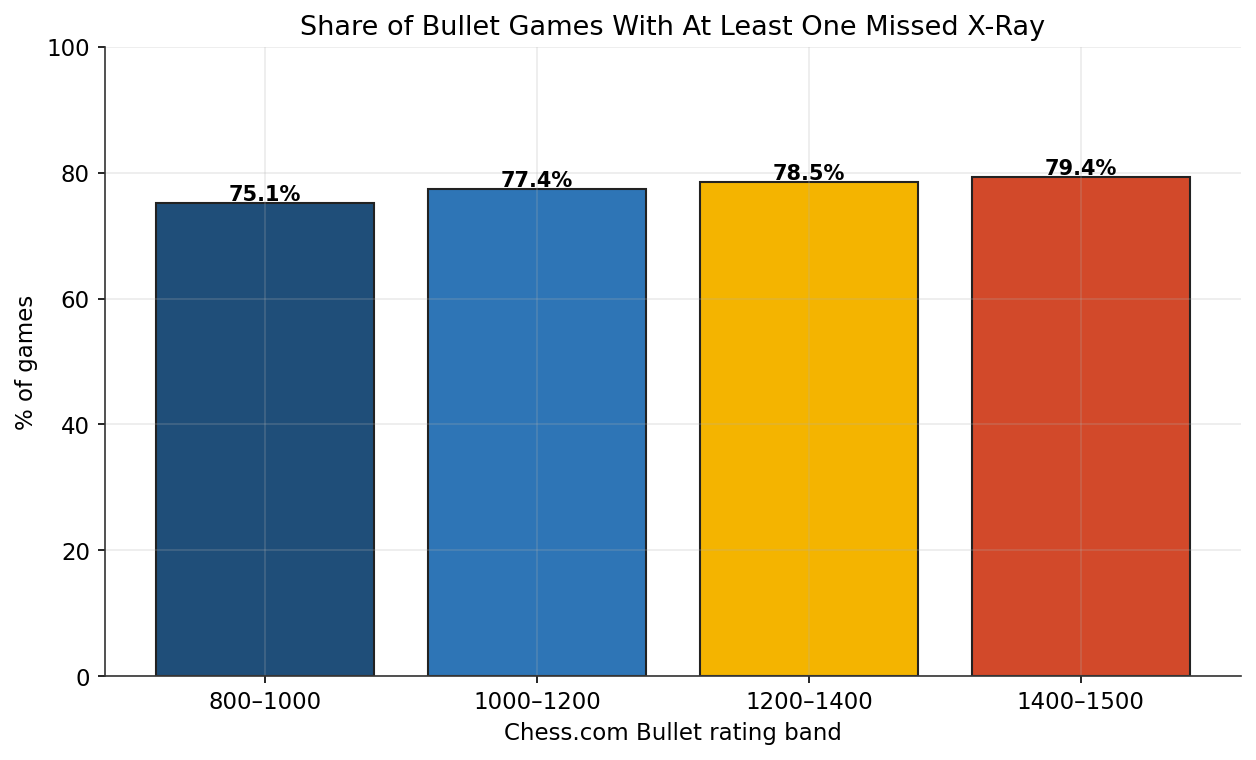
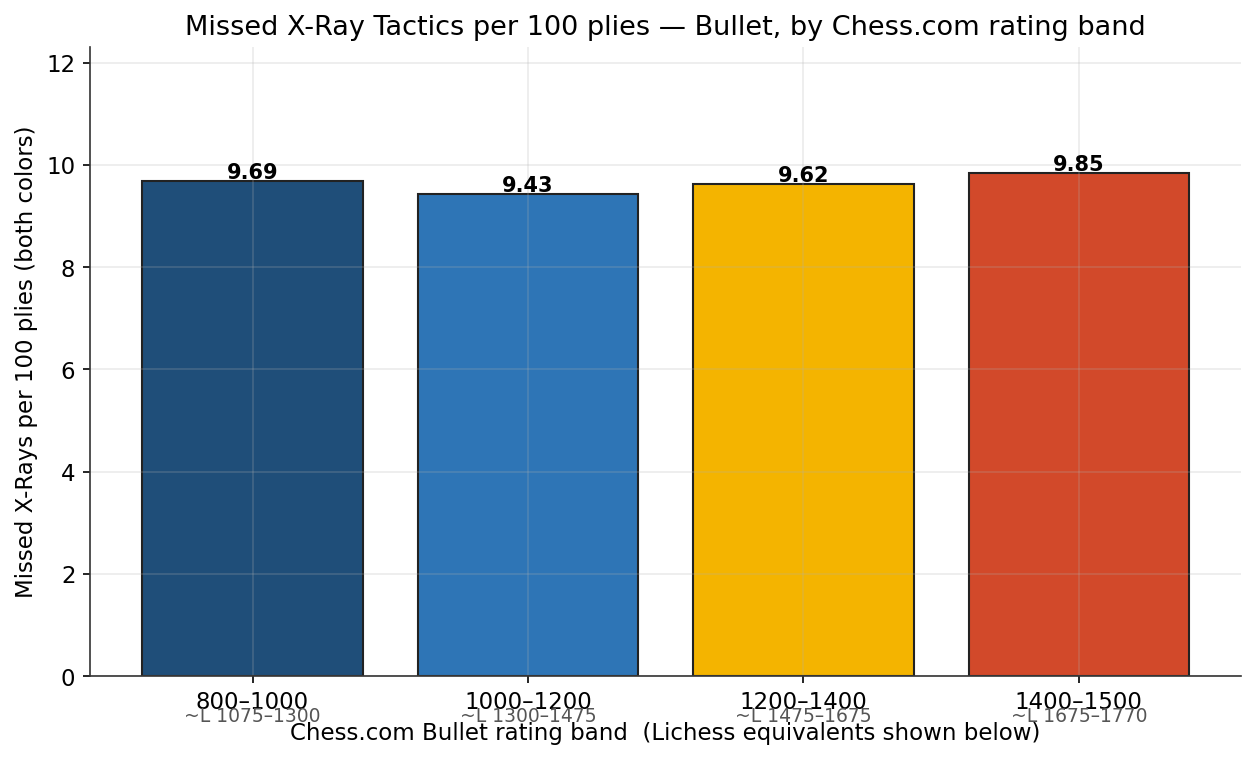
While you might expect higher-rated players to miss fewer tactics, the frequency of missed X-Rays per 100 plies remains remarkably consistent—hovering around 9.5 to 9.8 missed opportunities per 100 plies across all bands. In fact, the raw number of missed X-Rays slightly increases as ratings go up, primarily because games between 1400–1500 players tend to last longer and feature more complex middlegames where these geometric motifs arise.
However, the true measure of board vision is the conversion rate: when an X-Ray is available on the board, how often does the player actually play it?
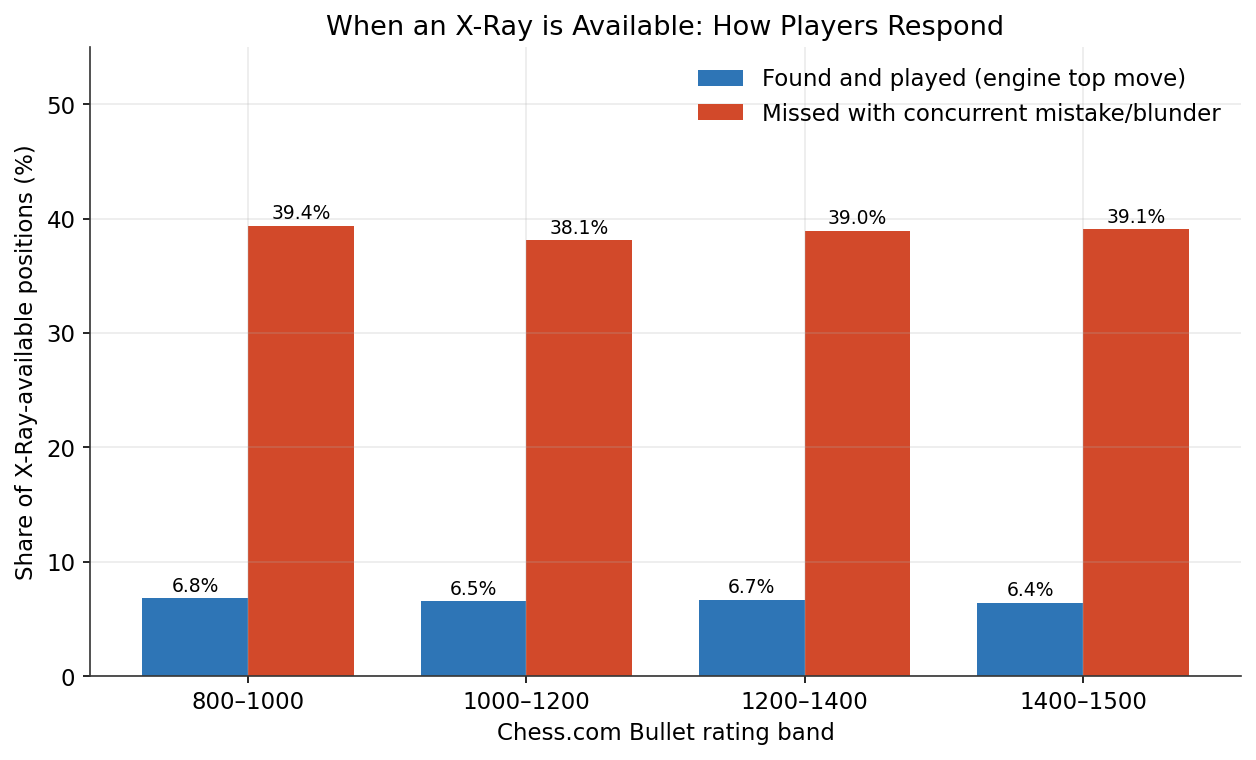
The data shows that players in the 800–1500 range only spot and execute the best X-Ray move about 6.5% of the time in Bullet. In nearly 40% of cases where an X-Ray is available, the player not only misses it but plays a move that actively worsens their position. The remaining cases are situations where the player played a different, but still acceptable, move.
The Anatomy of a Missed X-Ray
To improve, we need to know what we are missing. The data breaks down the anatomy of these overlooked tactics into three key components: the attacker, the target, and the phase of the game.
1. The Invisible Bishop
When we look at which pieces are initiating the missed X-Rays, the Bishop is the overwhelming culprit.
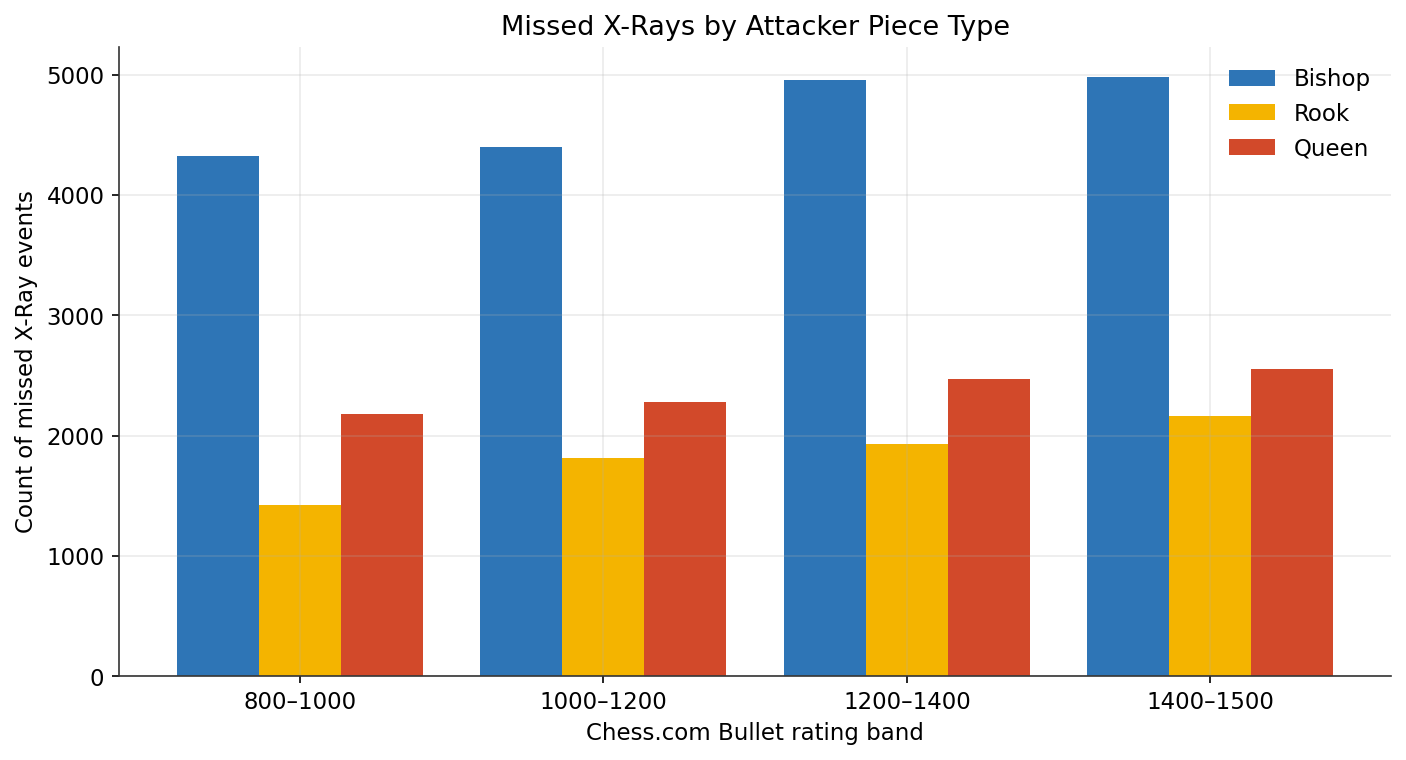
Bishops account for roughly 50% of all missed X-Rays across all rating bands. Why? Because diagonal geometry is inherently harder for the human brain to process quickly than the straight lines of rooks. In Bullet, players often suffer from "tunnel vision," focusing on the files and ranks immediately surrounding the action, while a bishop lurking on the opposite side of the board goes unnoticed.
2. The King as a Shield
What are these X-Rays targeting? The most common back-piece target—the piece sitting behind the initial target—is the King.
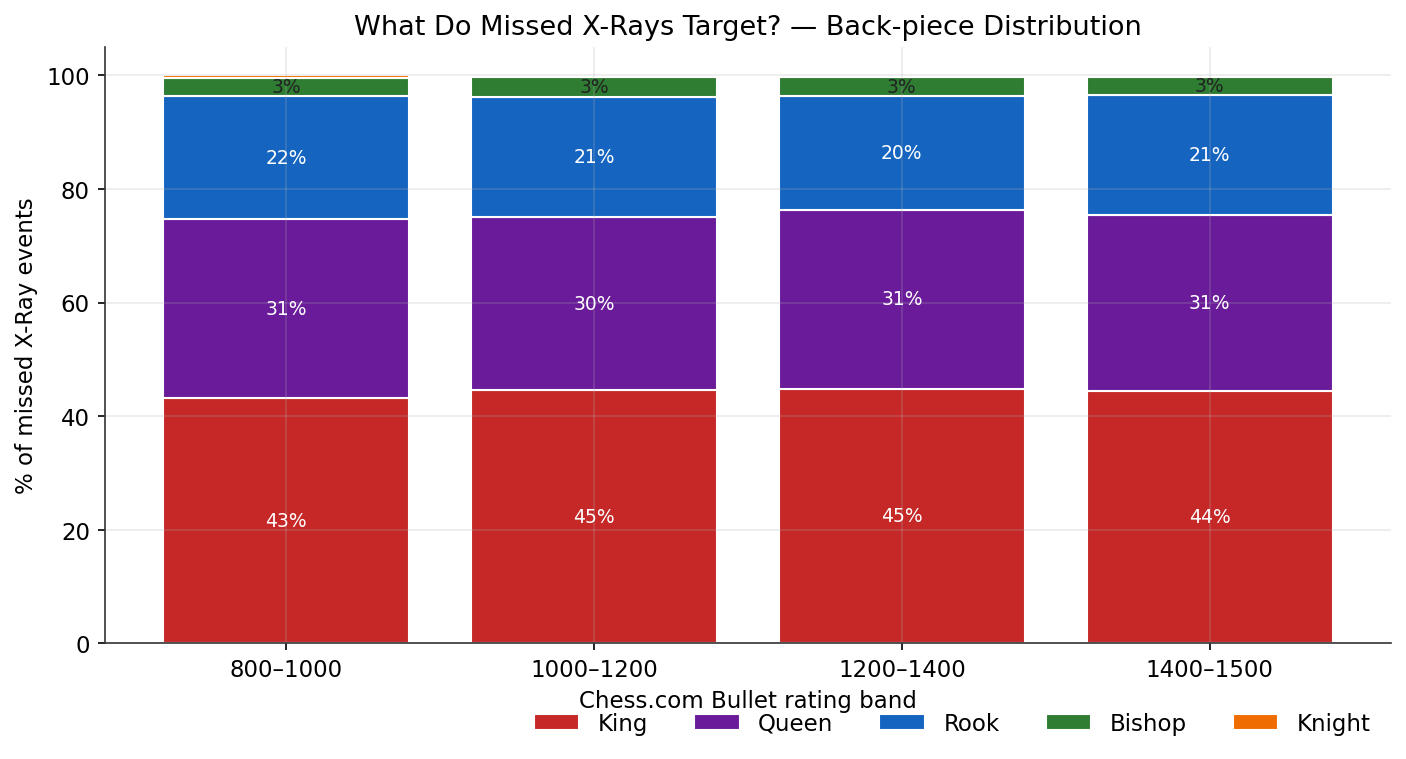
In over 40% of missed X-Rays, the tactic involves attacking through a piece to hit the King (an absolute skewer), or attacking the King to win the piece behind it. The fact that players miss checks that win material suggests that in time scrambles, players are so focused on their own plans that they fail to scan the board for forcing moves (Checks, Captures, Threats).
3. The Middlegame Muddle
The vast majority of missed X-Rays (over 60%) occur in the middlegame.
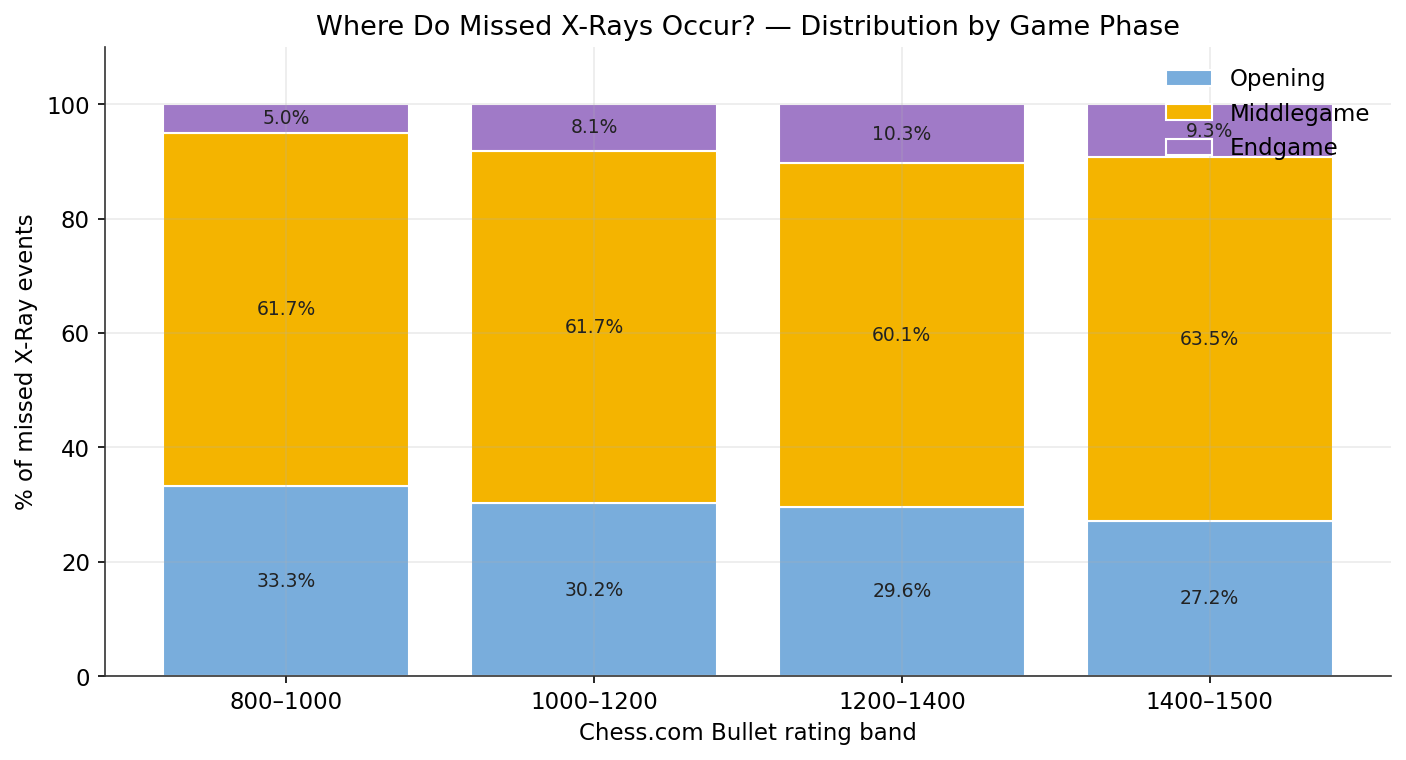
The opening is largely memorized, and the endgame has fewer pieces, making long-range geometry easier to spot. The middlegame, with its cluttered board and intersecting lines of attack, is where X-Rays hide best.
The Cost of Blindness
Missing an X-Ray isn't just a missed opportunity; it is often a game-losing blunder. Our analysis tracked the average centipawn (cp) drop in evaluation when a player missed an X-Ray and played a mistake instead.
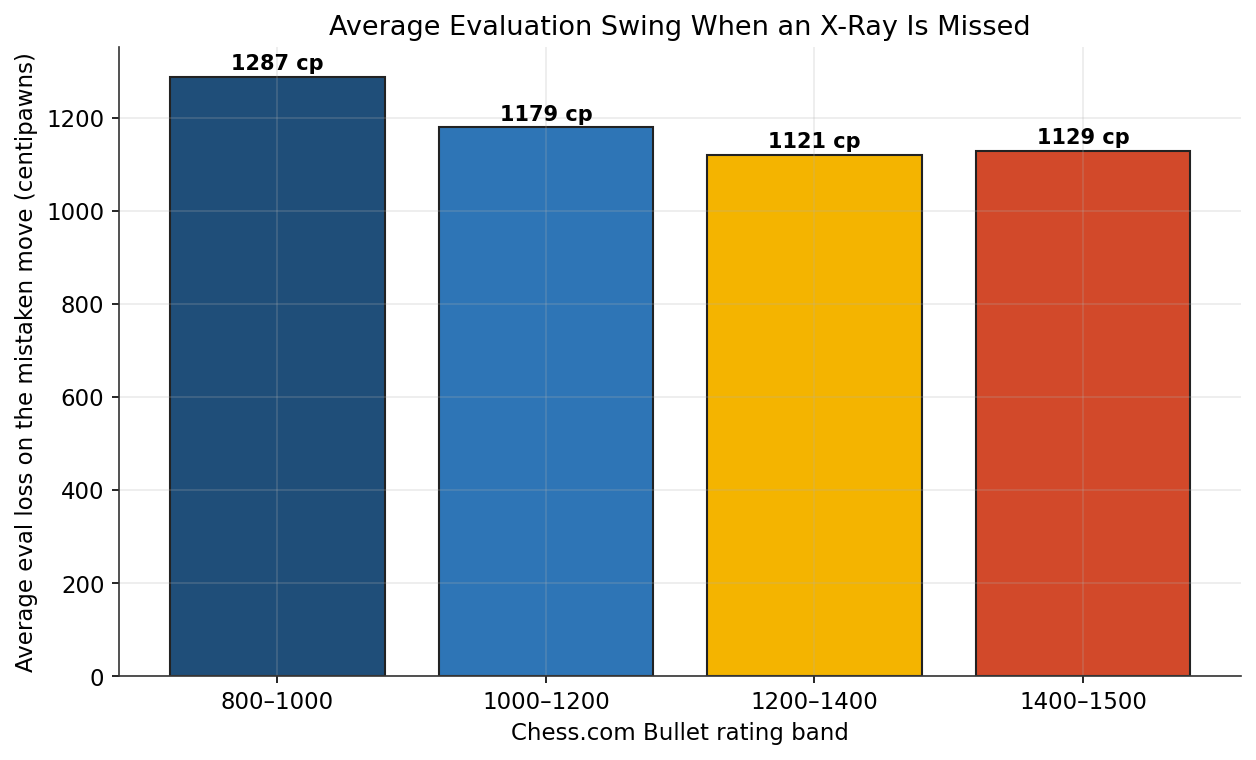
The average cost of missing an X-Ray is a staggering -1100 to -1200 centipawns (roughly equivalent to losing a Queen and a pawn). These are not subtle positional inaccuracies; these are catastrophic, game-deciding moments.
Visualizing the Blind Spots
Let's look at some real examples from the dataset to understand what these missed tactics look like in practice.
Example 1: The Diagonal Blind Spot (Chess.com 800–1000)
In this position, White played f4e5, completely missing a devastating Bishop X-Ray.
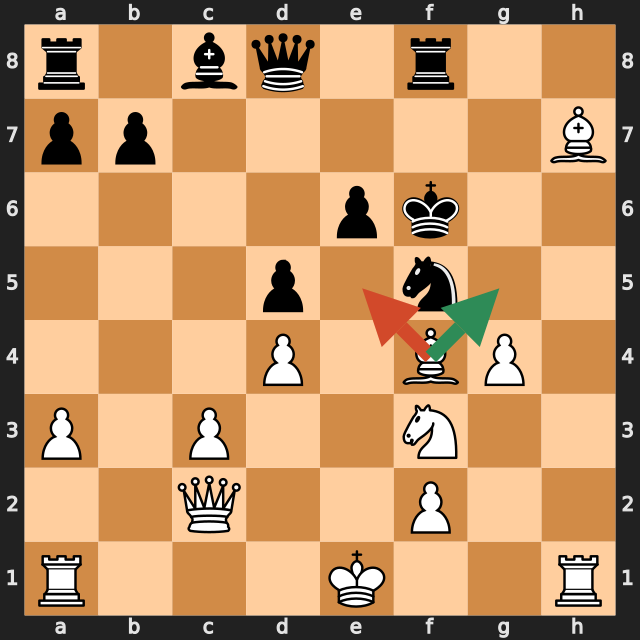
The Missed Tactic: Bg5+. The bishop attacks the Black King on f6. The King must move, exposing the Black Queen on d8 to capture. This is a classic absolute skewer that wins the Queen, but the diagonal geometry was overlooked in the Bullet scramble.
Example 2: The Back-Rank Illusion (Chess.com 1200–1400)
Here, White played Qf5, missing a massive Queen X-Ray.
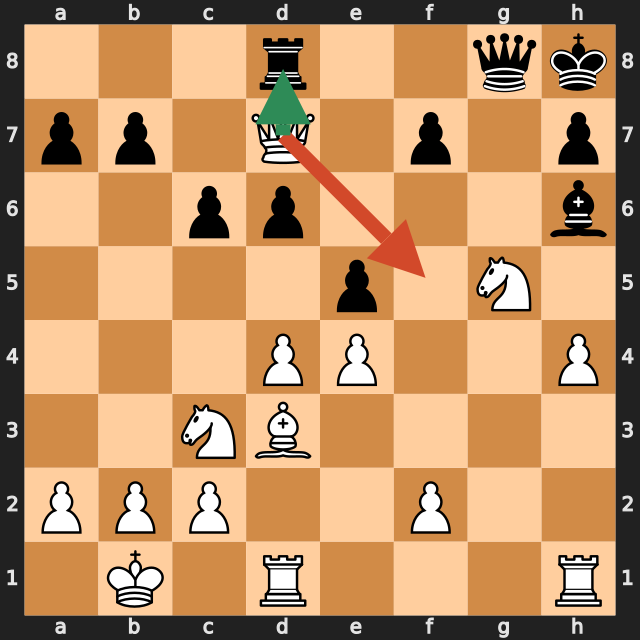
The Missed Tactic: Qxd8. White's Queen on d7 can simply capture the Rook on d8. Because the Black Queen on g8 is undefended, this is an X-Ray attack through the d8 square. If Black recaptures ...Qxd8, White has won a free Rook. If Black doesn't recapture, White is up a Rook and threatening mate. The alignment of the Queens on the 8th rank was completely missed.
Roadmap to Improvement: Actionable Advice by Rating
Based on the data, here is a targeted guide to training your board vision and eliminating these blind spots as you climb the rating ladder.
For the 800–1000 Player (Lichess ~1075–1300)
- The Problem: You are missing basic absolute skewers, especially those involving the King.
- Actionable Advice: Always Look for Checks. Before you make any move, scan the board for every possible check. In our data, over 40% of missed X-Rays involved the King. If you force yourself to identify every check, you will naturally spot the skewers where the King is the front piece.
For the 1000–1200 Player (Lichess ~1300–1475)
- The Problem: You are suffering from diagonal blindness. Bishops account for half of your missed X-Rays.
- Actionable Advice: Trace the Diagonals. When your opponent's King or Queen is on an open diagonal, physically (or mentally) trace that diagonal all the way across the board. Ask yourself: "Do I have a Bishop or Queen that can step onto this line?"
For the 1200–1400 Player (Lichess ~1475–1675)
- The Problem: You are missing X-Rays in the cluttered middlegame.
- Actionable Advice: Identify Undefended Pieces. An X-Ray only works if the piece in the back is undefended (or less valuable than the attacker). Make it a habit to constantly note which of your opponent's pieces are loose. If you see an undefended piece, look for ways to attack it through another piece.
For the 1400–1500 Player (Lichess ~1675–1770)
- The Problem: You are missing complex, multi-piece alignments, particularly Queen-on-Queen X-Rays.
- Actionable Advice: Look for Geometric Alignments. Train yourself to notice when valuable pieces (Kings, Queens, Rooks) are on the same rank, file, or diagonal, even if there are pieces between them. These alignments are the breeding ground for X-Rays and discovered attacks.
Conclusion
In Bullet chess, speed is essential, but speed without board vision leads to catastrophic blunders. The data clearly shows that X-Ray tactics are a massive, unexploited opportunity for players in the 800–1500 range. By training yourself to see the hidden geometry of the board—especially the sneaky diagonals of the Bishop and the vulnerable alignments of the King—you can turn these missed opportunities into game-winning brilliancies.
Chess Coach April 20, 2026
Data and Methodology
This analysis was conducted using a sample of 6,000 Lichess Bullet games, filtered for players with ratings approximating Chess.com 800–1500. Games were analyzed using Stockfish 17 evaluations to identify positions where a material-winning X-Ray tactic (gain ≥ 100cp) was available, but the player played a move resulting in a significant evaluation drop (delta ≤ -100cp).
Underlying Data Files:
View full data →band games plies xr_available_plies xr_available_per_100_plies xr_missed_plies xr_missed_per_100_plies xr_taken_plies games_with_any_xr_available pct_games_with_any_xr_available games_with_missed_xr pct_games_with_missed_xr avg_missed_xr_per_game missed_xr_conversion_rate_when_available missed_by_attacker_bishop missed_by_attacker_rook missed_by_attacker_queen missed_front_king missed_front_queen missed_front_rook missed_front_bishop missed_front_knight missed_front_pawn missed_back_king missed_back_queen missed_back_rook missed_back_bishop missed_back_knight missed_phase_opening missed_phase_middlegame missed_phase_endgame avg_delta_cp_on_missed avg_gain_cp_on_missed analysis_seconds CC_800_1000 1500 81866 20131 24.59 7929 9.685 1366 1472 98.13 1127 75.13 5.286 39.39 4324 1424 2181 461 558 824 2066 4020 0 3349 2438 1682 237 42 2638 4896 395 -1287.4 505.0 266.5 CC_1000_1200 1500 90109 22300 24.75 8493 9.425 1455 1470 98.0 1161 77.4 5.662 38.09 4399 1817 2277 474 519 1017 2555 3928 0 3681 2514 1749 282 32 2565 5237 691 -1179.2 495.1 288.7 CC_1200_1400 1500 97234 24030 24.71 9359 9.625 1608 1476 98.4 1178 78.53 6.239 38.95 4959 1931 2469 475 614 1247 2537 4486 0 4103 2876 1826 319 22 2769 5626 964 -1120.6 503.3 307.1 CC_1400_1500 1500 98478 24809 25.19 9696 9.846 1595 1487 99.13 1191 79.4 6.464 39.08 4981 2161 2554 513 667 1360 2899 4257 0 4206 2941 1987 301 34 2636 6160 900 -1128.7 505.3 310.0
View full data →band gameId whiteElo blackElo avgRating timeControl result total_plies xr_available_plies xr_missed_plies CC_800_1000 yKPRoSND 1047 1150 1099 60+0 0-1 52 14 3 CC_800_1000 I07cA3sj 1131 1201 1166 120+1 0-1 30 8 8 CC_800_1000 hqfCXozo 1201 1288 1245 120+1 1-0 45 14 5 CC_800_1000 4uOor21G 1248 1278 1263 60+0 1-0 17 2 2 CC_800_1000 cGAwQaQd 1099 1095 1097 60+0 0-1 50 15 8
View full data →band gameId whiteElo blackElo result ply move_no color fen_before played_move_uci xray_best_move_san xray_move_uci xray_attacker_type xray_front_type xray_back_type xray_best_gain_cp delta_cp CC_800_1000 I07cA3sj 1131 1201 0-1 9 5 white r1bqkbnr/ppp3pp/2n2p2/3pp3/3P1B2/4PN2/PPP2PPP/RN1QKB1R w KQkq - 0 5 d4e5 Bb5 f1b5 bishop knight king 320 -226 CC_800_1000 I07cA3sj 1131 1201 0-1 10 5 black r1bqkbnr/ppp3pp/2n2p2/3pP3/5B2/4PN2/PPP2PPP/RN1QKB1R b KQkq - 0 5 f6e5 Bg4 c8g4 bishop knight queen 740 -257 CC_800_1000 I07cA3sj 1131 1201 0-1 11 6 white r1bqkbnr/ppp3pp/2n5/3pp3/5B2/4PN2/PPP2PPP/RN1QKB1R w KQkq - 0 6 f3e5 Bb5 f1b5 bishop knight king 320 -298 CC_800_1000 I07cA3sj 1131 1201 0-1 19 10 white r3kbnr/pp1bq1pp/8/1BppB3/3Q4/4P3/PPP2PPP/RN2K2R w KQkq - 2 10 b5d7 Ba4 b5a4 bishop bishop king 330 -398 CC_800_1000 I07cA3sj 1131 1201 0-1 23 12 white r3kbnr/pp2q1pp/8/2pQB3/8/4P3/PPP2PPP/RN2K2R w KQ - 1 12 e1g1 Qe6 d5e6 queen queen king 900 -790