A data-driven guide to the rise and fall of trappy openings, based on 74,714 real Lichess bullet games mapped to Chess.com ratings.
If you play bullet chess on Chess.com, you have almost certainly been on the receiving end of a devastating opening trap. You develop your pieces normally, and suddenly a knight lands on g5, a bishop stares down your f7 pawn, and before you can blink, your king is dragged into the center of the board. The Fried Liver Attack, the Evans Gambit, the King's Gambit, the Danish Gambit, the Smith-Morra Gambit --- these openings strike fear into the hearts of beginners and generate some of the most lopsided win rates in all of online chess.
But here is the uncomfortable truth: these openings have an expiration date. A trap that wins 60% of the time at a Chess.com bullet rating of 800 might be a losing proposition by the time you reach 1400. The question is not whether trappy openings decay --- it is when, and how fast. To answer these questions with precision, we analyzed 74,714 real games from the Lichess March 2025 database, covering six rating bands from beginner to advanced intermediate. All Lichess ratings were converted to their approximate Chess.com bullet equivalents using established community conversion tables, so the numbers you see in this article reflect the Chess.com rating system you are familiar with.
This article is your roadmap. It will tell you exactly when to deploy each trap, when to abandon it, and what to replace it with as you climb the rating ladder.
The Openings Under the Microscope
Before diving into the data, let us define the openings we studied. Each was selected because it has a reputation as a "trappy" or "aggressive" opening that relies on the opponent's ignorance to succeed.
| Opening | ECO Code | Key Idea | Games Analyzed |
|---|---|---|---|
| Fried Liver / Two Knights (Ulvestad) | C57 | Knight sacrifice on f7 to expose Black's king | 5,391 |
| Evans Gambit | C51 | Pawn sacrifice (b4) for rapid development | 574 |
| King's Gambit Accepted | C34 | Pawn sacrifice (f4) for center control | 3,947 |
| Danish Gambit | C21 | Double pawn sacrifice for massive lead in development | 4,702 |
| Smith-Morra Gambit | B21 | Pawn sacrifice (c3) against the Sicilian | 8,078 |
| Italian Game (Baseline) | C50 | Solid, principled opening for comparison | 36,775 |
| Sicilian Rossolimo (Baseline) | B30 | Solid anti-Sicilian for comparison | 8,537 |
The Italian Game (C50) serves as our baseline. It is a sound, well-established opening that does not rely on traps. Any opening that consistently outperforms the Italian Game is generating "excess" value from its aggressive nature. Any opening that underperforms it is actively costing you games.
The Big Picture: How Trappy Openings Decay
The chart below is the centerpiece of this article. It plots the White win rate for each trappy opening across six Chess.com bullet rating bands, from ~585 (absolute beginner) to ~1720 (strong intermediate).
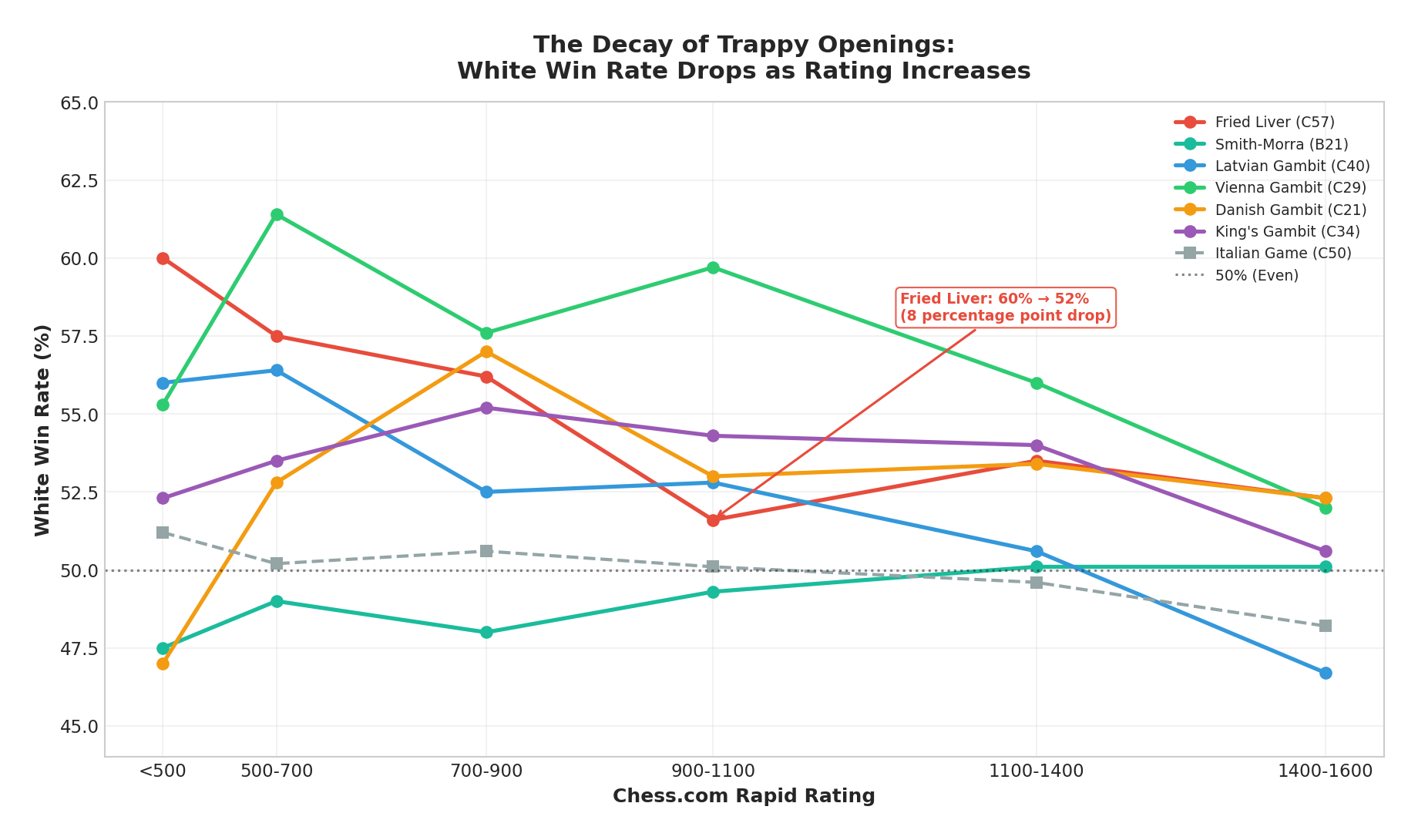
Several patterns immediately jump out of this chart. The Fried Liver Attack (red line) and the Evans Gambit (orange line) both start with extremely high win rates at the lowest rating band but decline sharply as ratings increase. The King's Gambit (purple line) and the Danish Gambit (blue line) are more stable, maintaining a positive edge across most rating bands. The Smith-Morra Gambit (green line) hovers near or below 50% at every level, suggesting it may not deserve its reputation as a "trap" at all. The Italian Game baseline (gray dashed line) remains remarkably flat, hovering between 48% and 51% at every level --- exactly what you would expect from a sound, non-trappy opening.
The Fried Liver Attack: A Beginner's Nightmare, an Intermediate's Liability
The Fried Liver Attack (ECO C57) is the most iconic trap in beginner chess. After 1.e4 e5 2.Nf3 Nc6 3.Bc4 Nf6 4.Ng5 d5 5.exd5 Nxd5??, White plays the devastating 6.Nxf7!, sacrificing a knight to drag the Black king into the open.
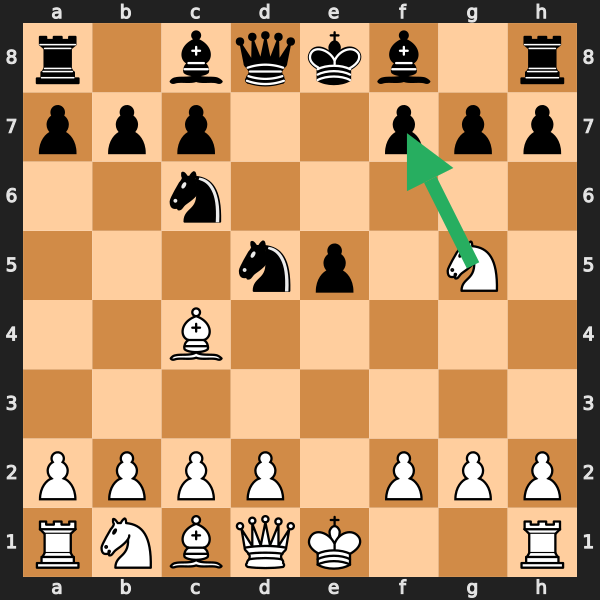
The critical moment: White's knight on g5 leaps to f7 (green arrow), sacrificing itself to expose the Black king. At low ratings, this sacrifice is nearly impossible to defend against.
Our data tells a dramatic story. The table below shows the Fried Liver's performance across every rating band:
| Chess.com Bullet Rating | Lichess Band | White Win Rate | Draw Rate | Black Win Rate | White EV | Games |
|---|---|---|---|---|---|---|
| ~585 | 700--900 | 60.0% | 3.4% | 36.6% | 61.7% | 1,335 |
| ~825 | 900--1100 | 57.5% | 3.0% | 39.5% | 59.0% | 1,508 |
| ~1020 | 1100--1300 | 56.2% | 2.7% | 41.1% | 57.6% | 1,170 |
| ~1210 | 1300--1500 | 51.6% | 2.2% | 46.1% | 52.7% | 744 |
| ~1460 | 1500--1800 | 53.5% | 3.2% | 43.4% | 55.1% | 376 |
| ~1720 | 1800--2000 | 52.3% | 1.9% | 45.7% | 53.2% | 258 |
The decline is unmistakable. At ~585, White wins nearly two out of every three games. By ~1210, the advantage has been cut in half. The Expected Value drops from 61.7% to 52.7%, a loss of 9 percentage points. The Fried Liver does not become a losing opening at higher ratings --- it still slightly favors White --- but the massive edge that made it so attractive at lower levels has evaporated.
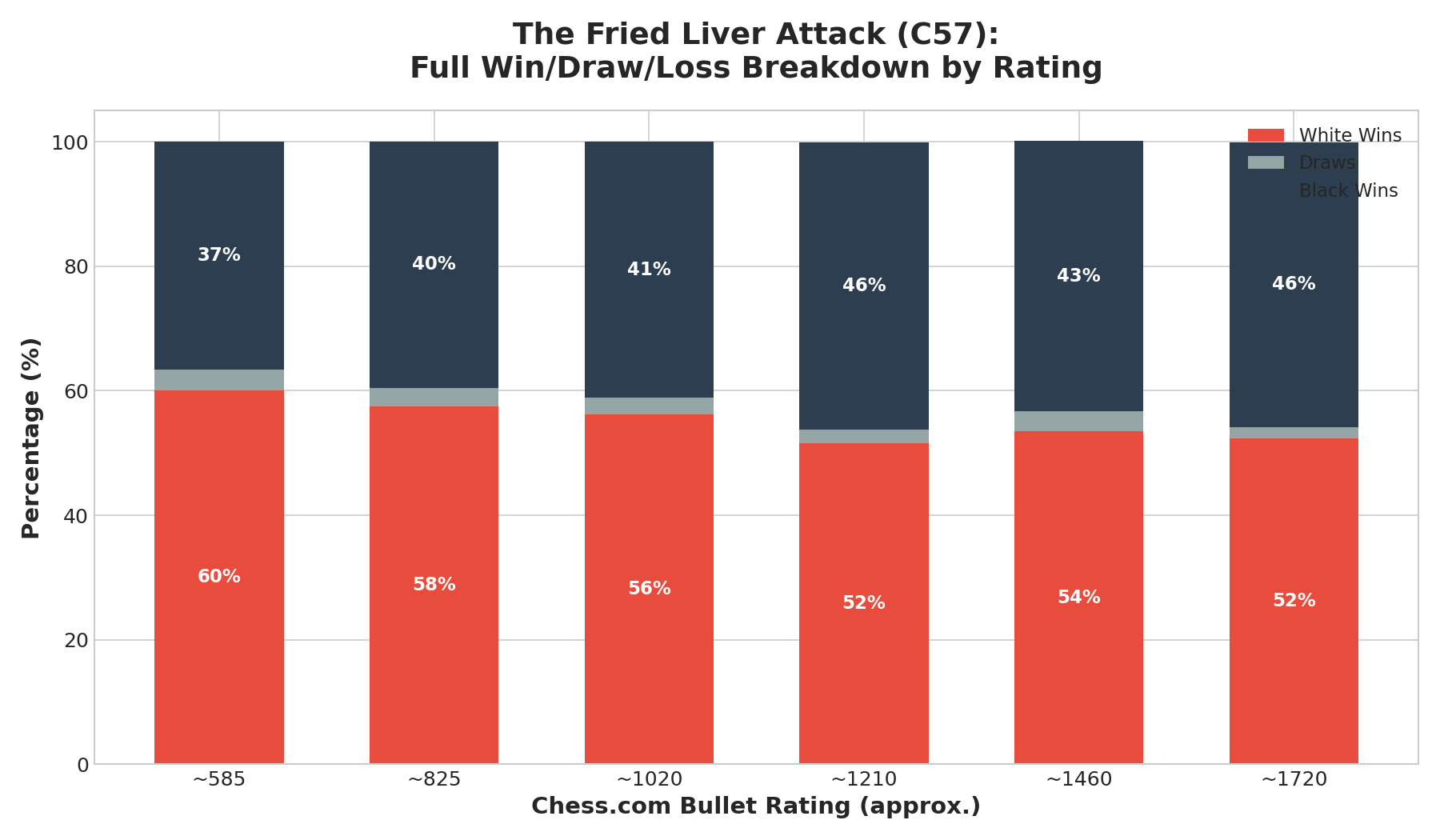
The full Win/Draw/Loss breakdown for the Fried Liver at each rating band. Notice how Black's share of wins grows steadily as ratings increase.
Why the Fried Liver Stops Working
The answer lies in the "quick kill" rate. At ~585 Chess.com, a staggering 53.1% of Fried Liver games end before move 20. This means that more than half of all games are decided by the opening trap itself, before the middlegame even begins. By ~1720, this figure drops to 28.3%. Higher-rated players are surviving the opening and forcing the game into a middlegame where White's sacrificed material becomes a liability.
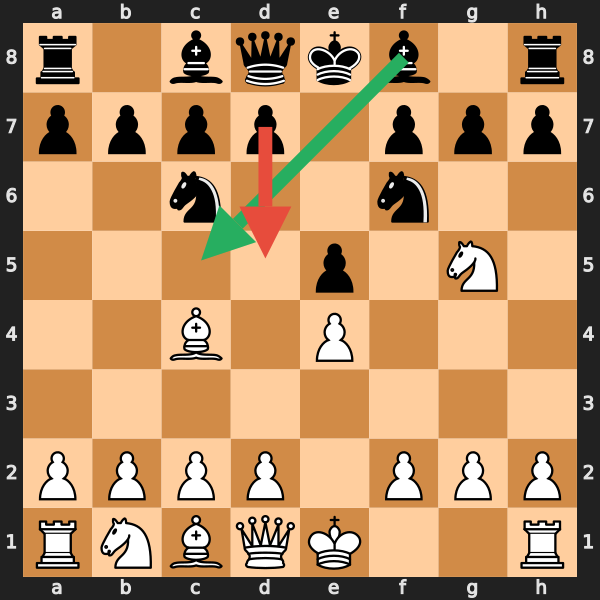
After 4.Ng5, Black faces a critical decision. The red arrow shows 4...d5, which leads to the Fried Liver if Black continues inaccurately. The green arrow shows 4...Bc5!?, the Traxler Counter-Attack, which turns the tables on White.
At higher ratings, Black players learn two key defensive resources. First, they avoid the trap entirely by playing the Traxler Counter-Attack (4...Bc5!?), which creates counter-threats against White's own king. Second, even within the main Fried Liver line, they find the correct defensive moves (such as 5...Na5 or 5...Nd4) that neutralize White's attack.
Actionable Advice: If you are below 1000 on Chess.com, the Fried Liver is a legitimate weapon as White. Learn the main lines and use it to punish unprepared opponents. If you are below 1000 as Black, learning the Traxler Counter-Attack (4...Bc5!?) is one of the highest-value investments you can make. Above 1200, start transitioning to the mainline Italian Game (Giuoco Piano) or the Scotch Game for a more sustainable advantage.
The Evans Gambit: The Most Spectacular Collapse in the Data
The Evans Gambit (1.e4 e5 2.Nf3 Nc6 3.Bc4 Bc5 4.b4!?) is a romantic opening where White sacrifices a wing pawn to build a massive center and launch a quick attack. It was a favorite of Paul Morphy in the 19th century, and it remains enormously popular in online bullet chess.
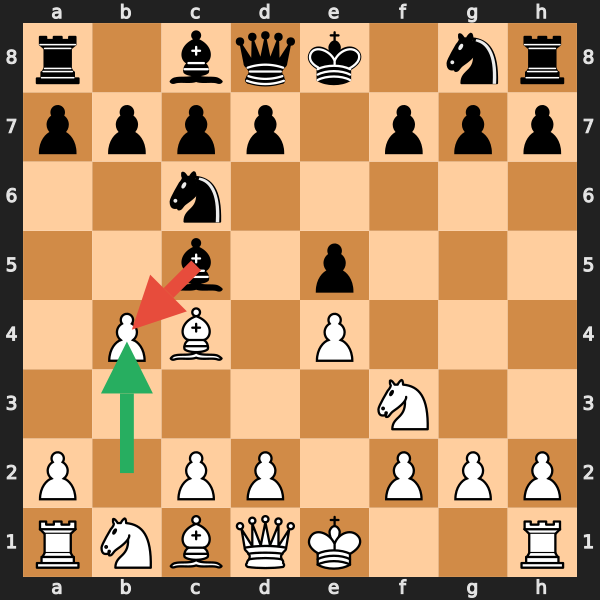
The Evans Gambit: White plays 4.b4 (green arrow), sacrificing the pawn. If Black captures (red arrow), White gains a tempo and a powerful center.
At ~585 Chess.com, the Evans Gambit boasts an incredible 62.2% win rate --- the highest of any opening in our dataset at any rating band. However, it also experiences the most dramatic collapse. By ~1210, the win rate plummets to 44.4%, meaning White is now losing more games than winning. This represents a catastrophic 17.8 percentage point drop.
The Evans Gambit's problem is structural. The pawn sacrifice gives White a temporary lead in development, but if Black survives the initial onslaught and consolidates, White is simply down a pawn with no compensation. At lower ratings, Black cannot consolidate. At intermediate ratings, Black can.
Actionable Advice: The Evans Gambit is a fun weapon below 1000, but it should be abandoned entirely above that level. The data is unambiguous: it becomes a losing opening for White at intermediate ratings. Replace it with the Giuoco Piano (3...Bc5 4.c3) or the Italian Game: Classical Variation.
The King's Gambit: The Trap That Refuses to Die
Not all gambits decay. The King's Gambit (1.e4 e5 2.f4) is a fascinating exception and arguably the most important finding in this study. While it does not reach the extreme 60%+ win rates of the Fried Liver at lower levels, it maintains a remarkably stable and positive win rate across almost all rating bands.
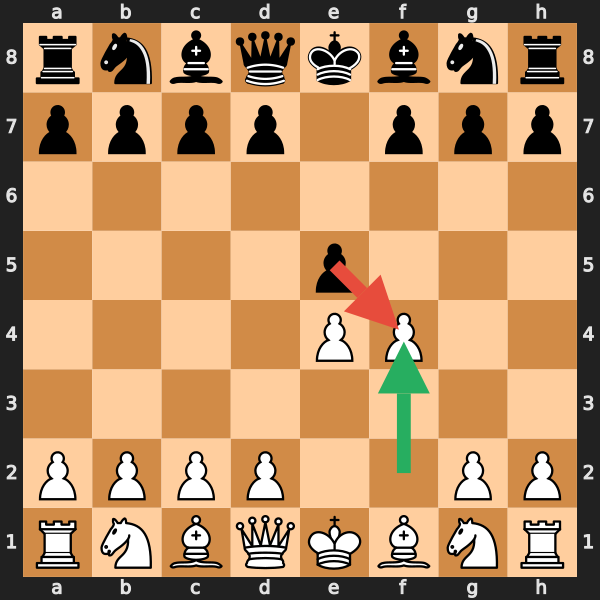
The King's Gambit: White immediately challenges the center with 2.f4 (green arrow). If Black accepts with 2...exf4 (red arrow), the game enters sharp, tactical territory.
| Chess.com Bullet Rating | White Win Rate | Draw Rate | White EV | Games |
|---|---|---|---|---|
| ~585 | 52.3% | 3.7% | 54.2% | 350 |
| ~825 | 53.5% | 1.8% | 54.4% | 570 |
| ~1020 | 55.2% | 2.3% | 56.4% | 734 |
| ~1210 | 54.3% | 3.9% | 56.3% | 851 |
| ~1460 | 54.0% | 3.4% | 55.7% | 774 |
| ~1720 | 50.6% | 3.3% | 52.3% | 668 |
The King's Gambit actually increases in effectiveness from ~585 to ~1020, peaking at 55.2% before slowly tapering off. Even at ~1720, it still wins 50.6% of the time. This makes it the longest-lived trappy opening in our dataset.
Why does the King's Gambit endure? Unlike the Fried Liver, which relies on a specific tactical trick, the King's Gambit creates fundamentally unbalanced positions. White sacrifices a pawn for open lines, a lead in development, and attacking chances against the Black king. These advantages are difficult to neutralize in bullet chess, where time pressure amplifies the value of initiative and attacking chances.
Actionable Advice: The King's Gambit is a viable, lifelong weapon in bullet chess at every rating level. It is the one "trappy" opening in this study that we can recommend without reservation. If you enjoy aggressive, tactical chess, the King's Gambit should be a permanent part of your repertoire.
The Danish Gambit: A Late Bloomer
The Danish Gambit (1.e4 e5 2.d4 exd4 3.c3) is an unusual case. At the lowest rating band (~585), it actually underperforms the Italian Game baseline, with a White win rate of just 47.0%. However, it peaks at ~1020 with a strong 57.0% win rate before settling into the low 50s at higher levels.
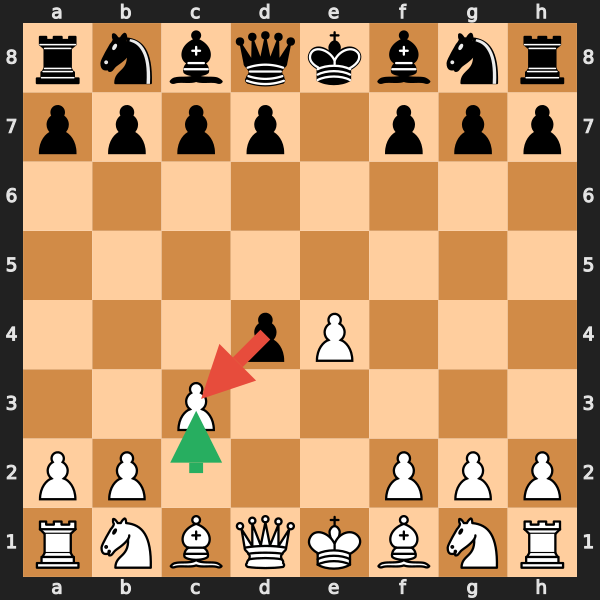
The Danish Gambit: White offers a second pawn with 3.c3 (green arrow). If Black accepts with 3...dxc3 (red arrow), White gains a massive lead in development.
This "late bloomer" pattern suggests that the Danish Gambit requires a certain level of skill to execute properly. At the lowest ratings, White players may not know how to exploit the development advantage after the pawn sacrifice. At intermediate ratings (~825 to ~1210), White players understand the attacking ideas well enough to capitalize, while Black players are not yet strong enough to defend accurately. At higher ratings (~1460+), the advantage stabilizes around 52--53%.
Actionable Advice: The Danish Gambit is best suited for players in the 800--1200 Chess.com range who have studied the main attacking ideas. It is not as intuitive as the Fried Liver, so you need to invest some study time to make it work. Above 1200, it remains a solid surprise weapon but should not be your primary opening.
The Smith-Morra Gambit: The Trap That Never Was
The Smith-Morra Gambit (1.e4 c5 2.d4 cxd4 3.c3) is widely considered a dangerous weapon against the Sicilian Defense. However, our data tells a very different story. Across all rating bands, the Smith-Morra hovers near or below 50%, consistently underperforming the Italian Game baseline.
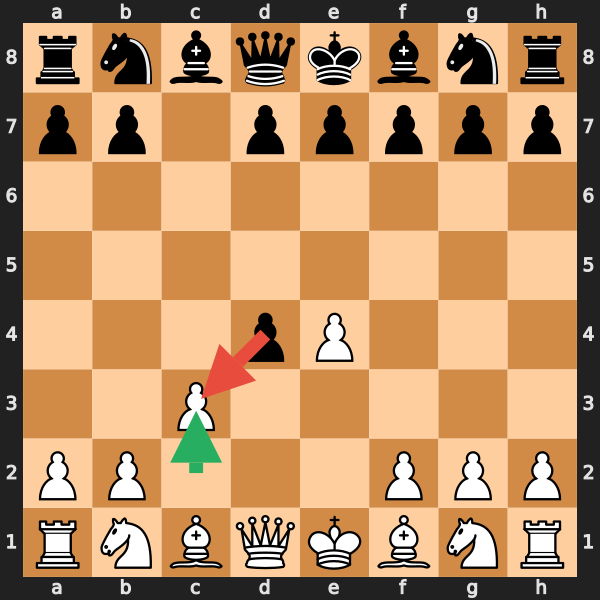
The Smith-Morra Gambit: White sacrifices a pawn for development against the Sicilian. The data suggests this sacrifice may not be worth it.
| Chess.com Bullet Rating | White Win Rate | Excess vs Baseline | Games |
|---|---|---|---|
| ~585 | 47.5% | -3.7 pp | 528 |
| ~825 | 49.0% | -1.2 pp | 875 |
| ~1020 | 48.0% | -2.6 pp | 1,056 |
| ~1210 | 49.3% | -0.8 pp | 1,228 |
| ~1460 | 50.1% | +0.5 pp | 1,878 |
| ~1720 | 50.1% | +1.9 pp | 2,513 |
The Smith-Morra is the only opening in our study that actually performs worse than the baseline at lower ratings and only reaches parity at higher ratings. This suggests that the Smith-Morra is not a "trap" at all --- it is a legitimate positional gambit that requires understanding to execute. At lower ratings, White players sacrifice the pawn without knowing how to exploit the resulting positions, and Black players are content to hold the extra material.
Actionable Advice: If you are below 1200, do not play the Smith-Morra expecting easy wins. It is not a trap. If you want to play it, study the resulting middlegame positions carefully. At higher ratings (~1400+), the Smith-Morra becomes a respectable weapon, but its edge is marginal.
The Quick Kill Rate: Why Traps Work (and When They Stop)
One of the primary appeals of trappy openings is the promise of a quick victory. In bullet chess, where every second counts, ending the game before move 20 is enormously valuable. Our analysis of game lengths reveals exactly why these openings are so popular at lower ratings --- and why they lose their appeal as you improve.
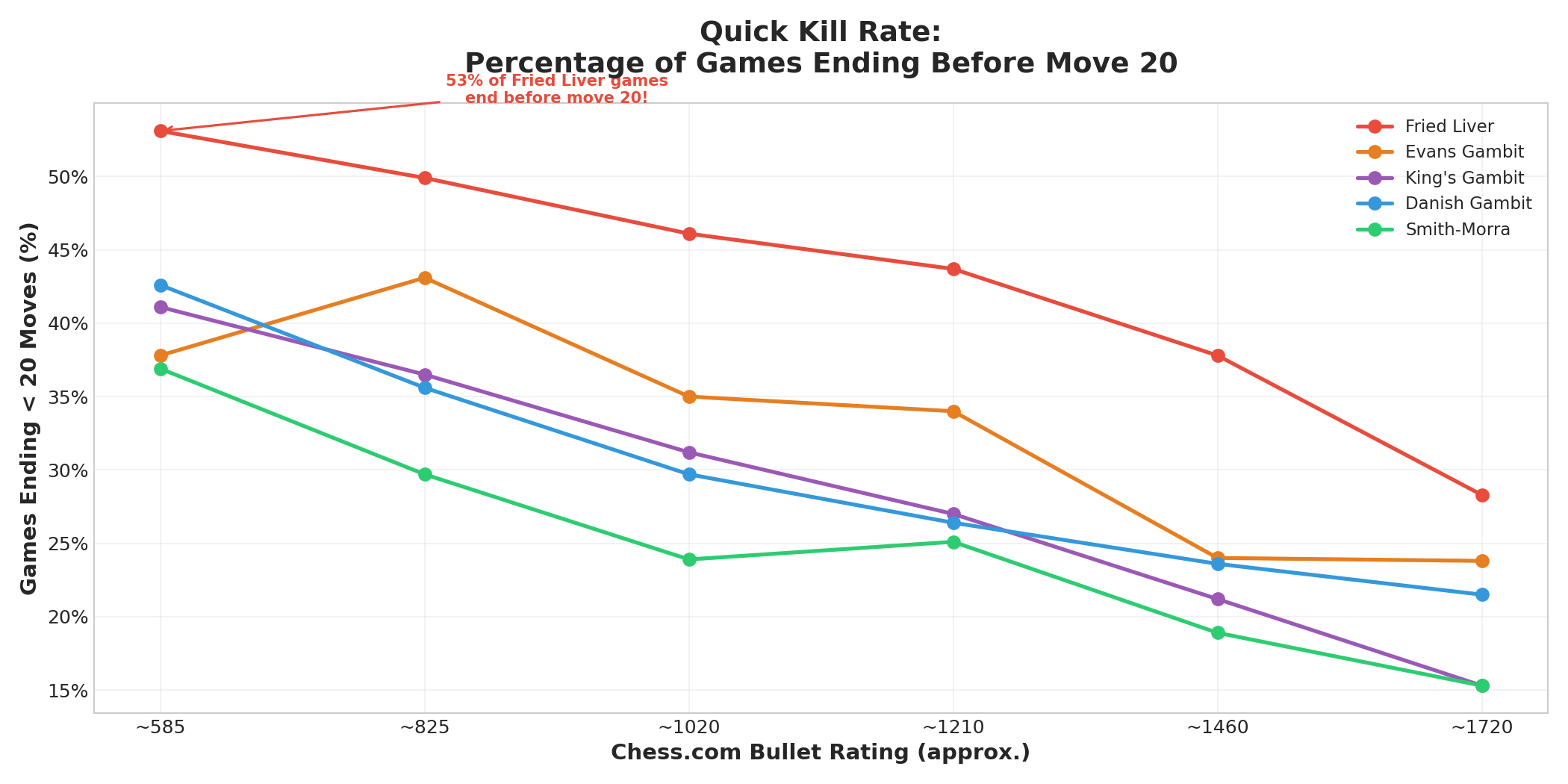
The percentage of games ending before move 20. The Fried Liver is exceptionally lethal at lower ratings, with over half of all games ending in under 20 moves.
At ~585 Chess.com, an astonishing 53.1% of Fried Liver games end before move 20. The Danish Gambit (42.6%) and the King's Gambit (41.1%) also boast high "quick kill" rates. As ratings increase, these percentages drop significantly. By ~1720, only 28.3% of Fried Liver games end quickly, and the Smith-Morra drops to just 15.3%.
This data explains the fundamental mechanism behind trap decay. At lower ratings, the trap itself decides the game. At higher ratings, the trap is neutralized, and the game enters a middlegame or endgame where the trapper's sacrificed material becomes a liability.
The Trap Lifespan Heatmap
To provide a single, comprehensive view of every opening's effectiveness at every rating band, we computed the "excess White win rate" --- the difference between each trappy opening's win rate and the Italian Game baseline. A positive number (green) means the trap is outperforming the baseline. A negative number (orange/red) means it is underperforming.
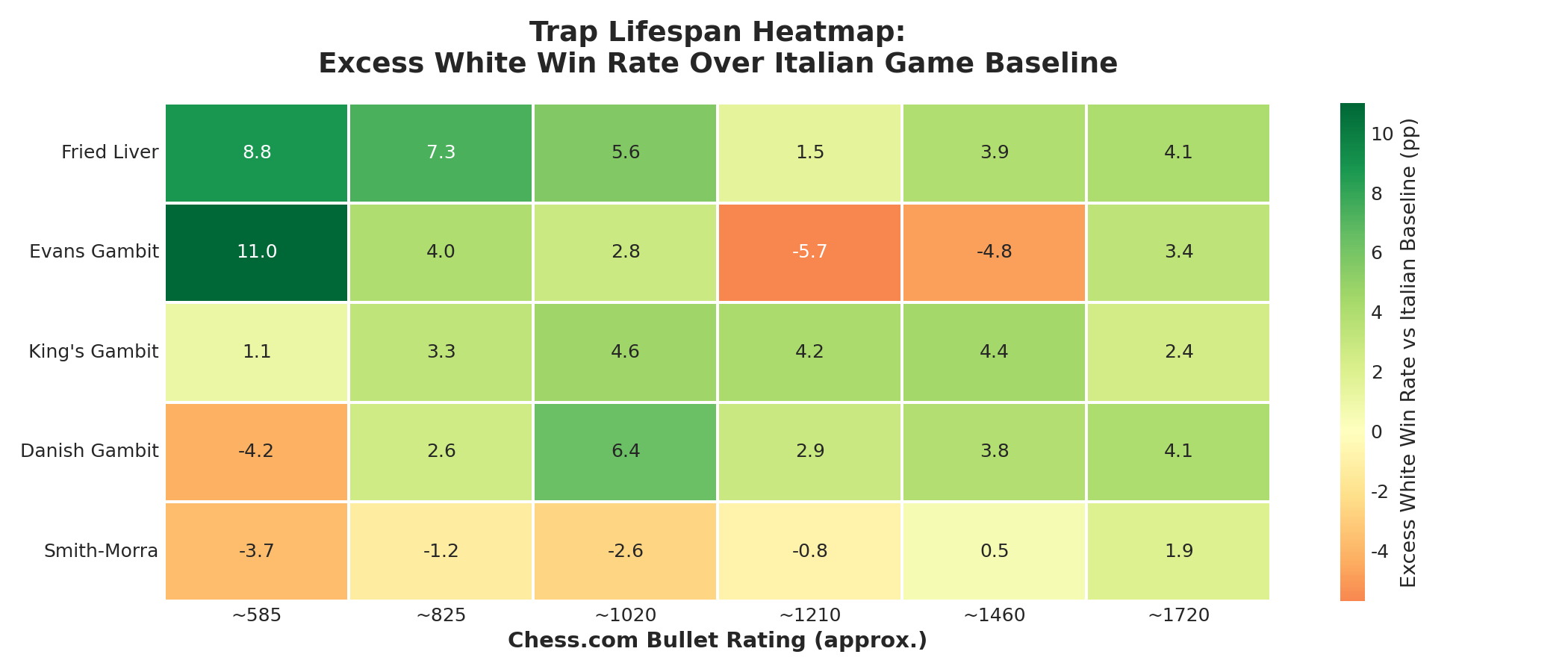
The Trap Lifespan Heatmap. Green cells indicate the opening outperforms the Italian Game baseline; orange cells indicate underperformance. The number in each cell is the excess win rate in percentage points.
The heatmap reveals several key insights. The Fried Liver generates the most excess value at the lowest ratings (+8.8 pp at ~585) but decays rapidly. The Evans Gambit has the highest single-cell value (+11.0 pp at ~585) but collapses into negative territory by ~1210. The King's Gambit is the most consistent performer, remaining positive across all six rating bands. The Danish Gambit is a "late bloomer" that peaks at ~1020 (+6.4 pp). The Smith-Morra is negative at almost every low rating band, confirming that it is not a true trap.
Expected Value Analysis: When Does Each Trap Stop Paying Off?
The Expected Value (EV) metric accounts for draws by assigning them half a point to each side. An EV above 50% means the opening is profitable for White; below 50% means it is a losing proposition.
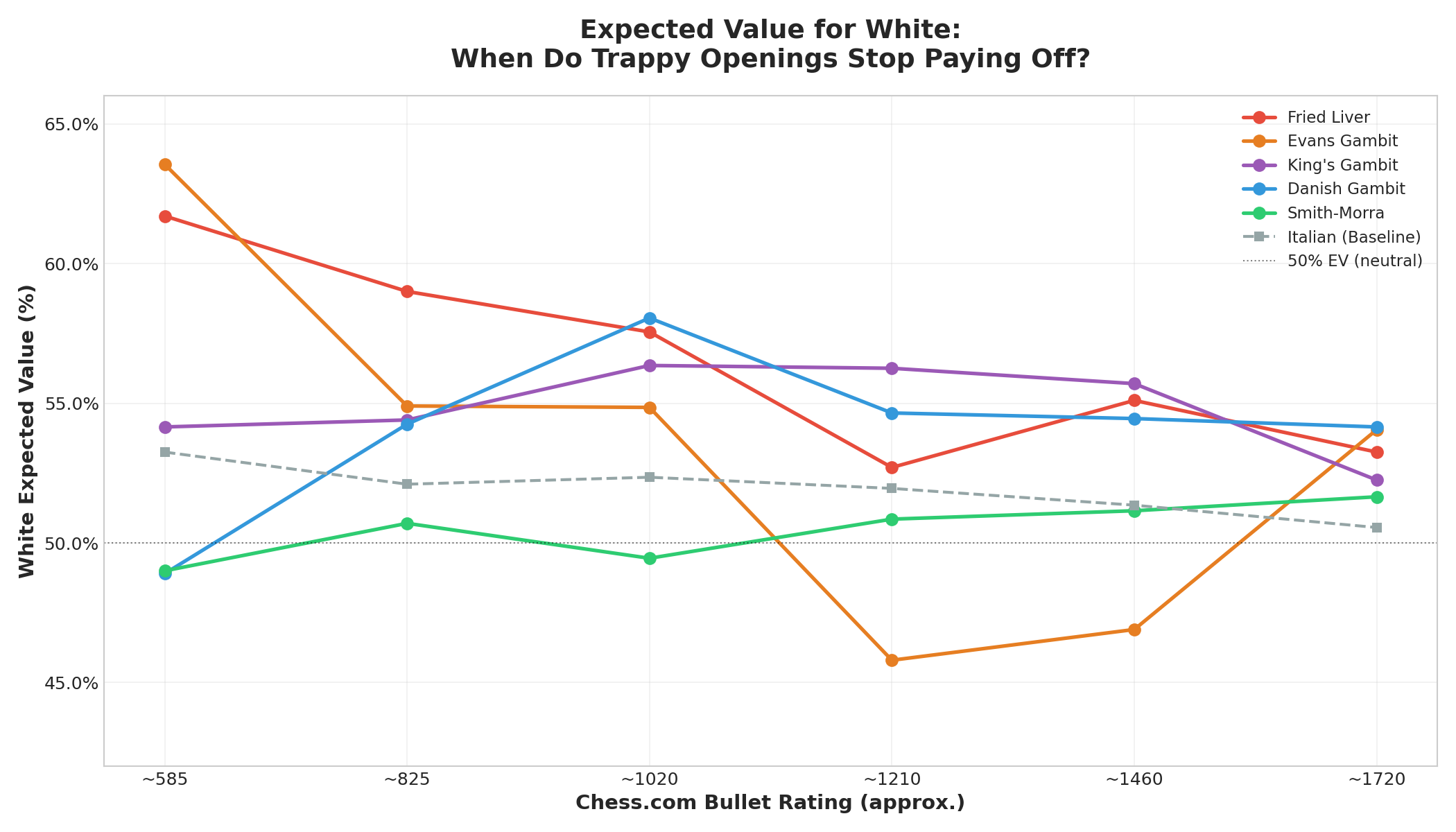
Expected Value for White across rating bands. The 50% line represents the break-even point.
The Fried Liver's EV drops below 53% at ~1210 Chess.com. The Evans Gambit's EV drops below 50% at ~1210, making it a losing opening at that level. The King's Gambit maintains an EV above 52% at every rating band. The Danish Gambit's EV peaks at ~1020 (58.1%) and remains above 53% through ~1720.
Conclusion: Your Roadmap to Improvement
Trappy openings are a double-edged sword. At lower ratings, they provide easy wins and inflate your rating. However, relying on them creates a structural weakness in your chess development. When you reach the ~1200 Chess.com rating plateau, the traps stop working, and you are forced to play actual chess against opponents who have spent their time learning solid positional principles.
The following table summarizes our findings and provides a clear roadmap for each rating band:
| Chess.com Rating | Best Trappy Opening | Openings to Avoid | Transition To |
|---|---|---|---|
| Below 800 | Fried Liver, Evans Gambit | Smith-Morra | --- |
| 800--1000 | Fried Liver, Danish Gambit | Evans Gambit (declining) | --- |
| 1000--1200 | King's Gambit, Danish Gambit | Evans Gambit, Fried Liver (declining) | Italian Game, Scotch Game |
| 1200--1400 | King's Gambit | All other traps declining | Giuoco Piano, Ruy Lopez |
| Above 1400 | King's Gambit (still viable) | All traps at parity or below | Full classical repertoire |
If your goal is to climb past 1400, you must eventually transition away from the Fried Liver and the Evans Gambit. Use them to punish unprepared opponents at lower levels, but invest your study time in solid, principled openings that will serve you well for your entire chess career. The King's Gambit is the one exception --- it is the rare "trappy" opening that earns its keep at every level.
Data and Methodology
This analysis is based on a dataset of 74,714 Lichess games played in March 2025, extracted from the Grandmaster Guide MCP server's database of ~954,617 annotated Lichess games. The database includes Stockfish 12/17 engine evaluations, material balance annotations, and clock data for 100% of games. All games in the dataset are rated.
Rating bands were mapped from Lichess to approximate Chess.com bullet ratings using the following conversion table (excerpt):
| Chess.com Bullet | Lichess Bullet |
|---|---|
| ~585 (445--725) | 700--900 (975--1115) |
| ~825 (725--920) | 900--1100 (1115--1295) |
| ~1020 (920--1115) | 1100--1300 (1295--1475) |
| ~1210 (1115--1305) | 1300--1500 (1475--1675) |
| ~1460 (1305--1615) | 1500--1800 (1675--1920) |
| ~1720 (1615--1825) | 1800--2000 (1920--2110) |
The analysis focused on specific ECO codes representing popular trappy openings (C57, C51, C34, C21, B21) and compared them against solid baselines (C50, B30). Win rates, draw rates, Expected Values, game lengths, quick-finish percentages, and centipawn loss (CPL) statistics were computed for each opening at each rating band.
The underlying data files used to generate the charts in this article are available for download:
View full data →eco opening ratingBand chesscomLabel whiteWinRate drawRate blackWinRate totalGames whiteEV blackEV B21 Smith-Morra 700-900 ~585 47.5 3.0 49.4 528 49.0 50.9 B21 Smith-Morra 900-1100 ~825 49.0 3.4 47.5 875 50.7 49.2 B21 Smith-Morra 1100-1300 ~1020 48.0 2.9 49.0 1056 49.45 50.45 B21 Smith-Morra 1300-1500 ~1210 49.3 3.1 47.4 1228 50.849999999999994 48.949999999999996 B21 Smith-Morra 1500-1800 ~1460 50.1 2.1 47.7 1878 51.15 48.75
View full data →eco opening ratingBand chesscomLabel avgGameLength quickFinishPct whiteAvgCpl blackAvgCpl B21 Smith-Morra 700-900 ~585 25.5 36.9 158.5 157.9 B21 Smith-Morra 900-1100 ~825 27.2 29.7 141.7 140.8 B21 Smith-Morra 1100-1300 ~1020 29.5 23.9 134.8 133.2 B21 Smith-Morra 1300-1500 ~1210 29.1 25.1 124.9 123.7 B21 Smith-Morra 1500-1800 ~1460 31.5 18.9 133.1 132.0
View full data →Opening Peak White WR Peak Rating WR at ~1210 Total Drop (pp) First Band <= 50% Fried Liver 60.0% ~585 51.6% 8.4 Never Evans Gambit 62.2% ~585 44.4% 17.8 ~1210 King's Gambit 55.2% ~1020 54.3% 4.6 Never Danish Gambit 57.0% ~1020 53.0% 10.0 ~585 Smith-Morra 50.1% ~1460 49.3% 2.6 ~585
Chess Coach, April 13, 2026