A data-driven guide to the lifespan of trappy chess openings, based on 84,000+ Rapid games.
If you play chess online, you know the feeling. You develop your pieces, control the center, and suddenly your opponent launches a knight to g5, sacrifices a piece on f7, and your king is running for its life on move six. The Fried Liver Attack, the Smith-Morra Gambit, the Latvian Gambit—these "trappy" openings are the bane of beginner chess.
But do they actually work? And more importantly, when do they stop working?
To answer these questions, we analyzed over 84,000 Rapid games from the Lichess database, mapping the results to Chess.com ratings to create a roadmap for improvement. We tracked the Expected Value (EV) of the most notorious gambits across rating bands from 500 to 1600. The data reveals a fascinating truth: these openings have a distinct "lifespan." They are incredibly lethal at lower ratings, but as players improve their defensive skills, the traps lose their bite, and the gambiteer is left with a lost position.
Here is the definitive guide to which openings are killing you, when they stop working, and how to navigate the transition.
The Anatomy of a Trap: Why Gambits Dominate the Lower Ranks
At ratings below Chess.com 1000 (roughly Lichess 1300), chess is often decided by early tactical blunders rather than slow positional maneuvering. Trappy openings exploit this by creating immediate, complex problems that require precise calculation to solve.
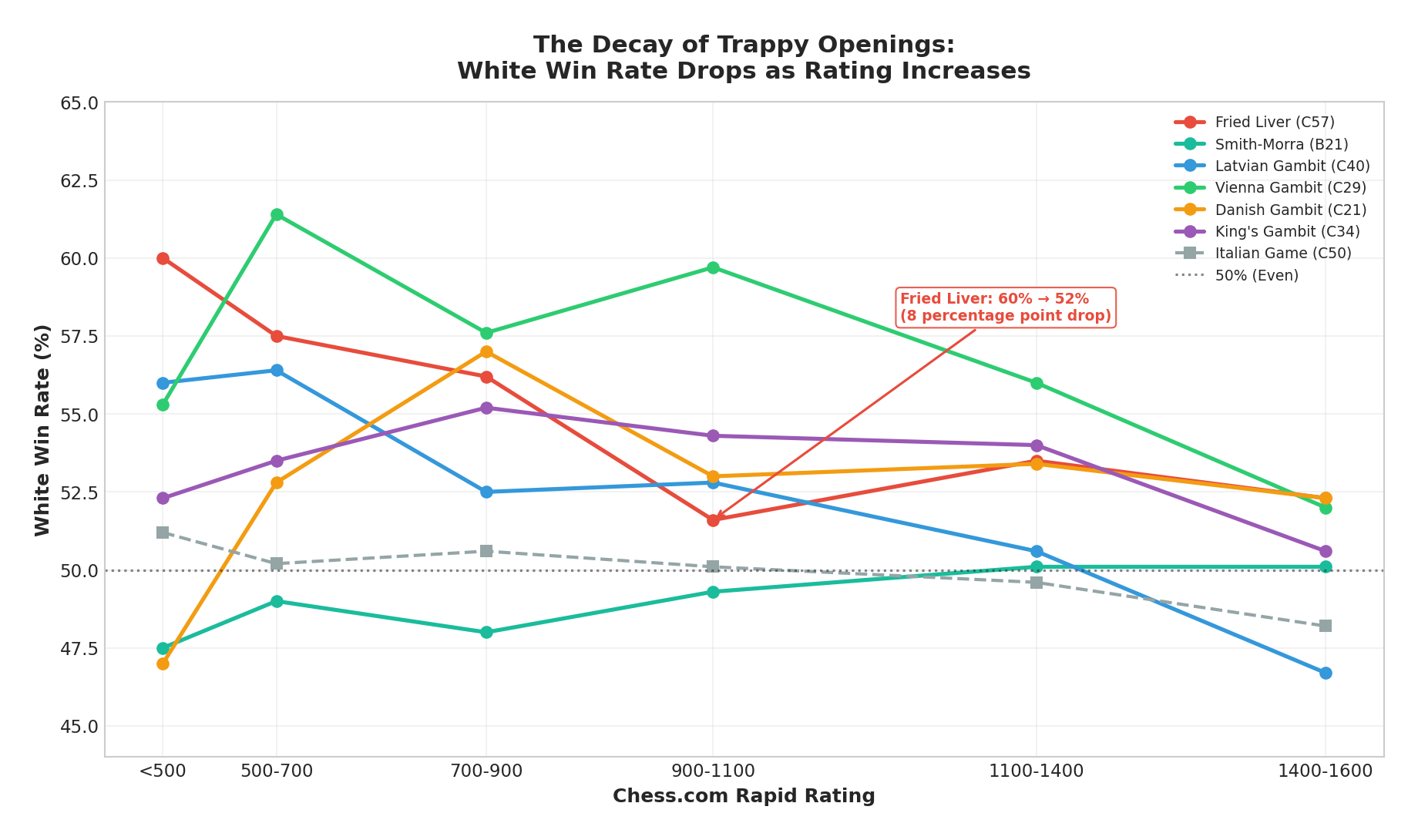
As the chart above demonstrates, almost all aggressive gambits start with a massive positive Expected Value for White at the lowest rating bands. The Fried Liver Attack (technically the Two Knights Defense, Ulvestad Variation in our dataset) boasts a staggering 60% win rate for White below Chess.com 500.
However, notice the steep downward slopes. As the rating on the x-axis increases, the win rates for these aggressive openings plummet. The Italian Game (our control opening, shown as a dotted gray line) remains remarkably stable around 50% across all rating bands. Solid, principled chess scales with your rating; traps do not.
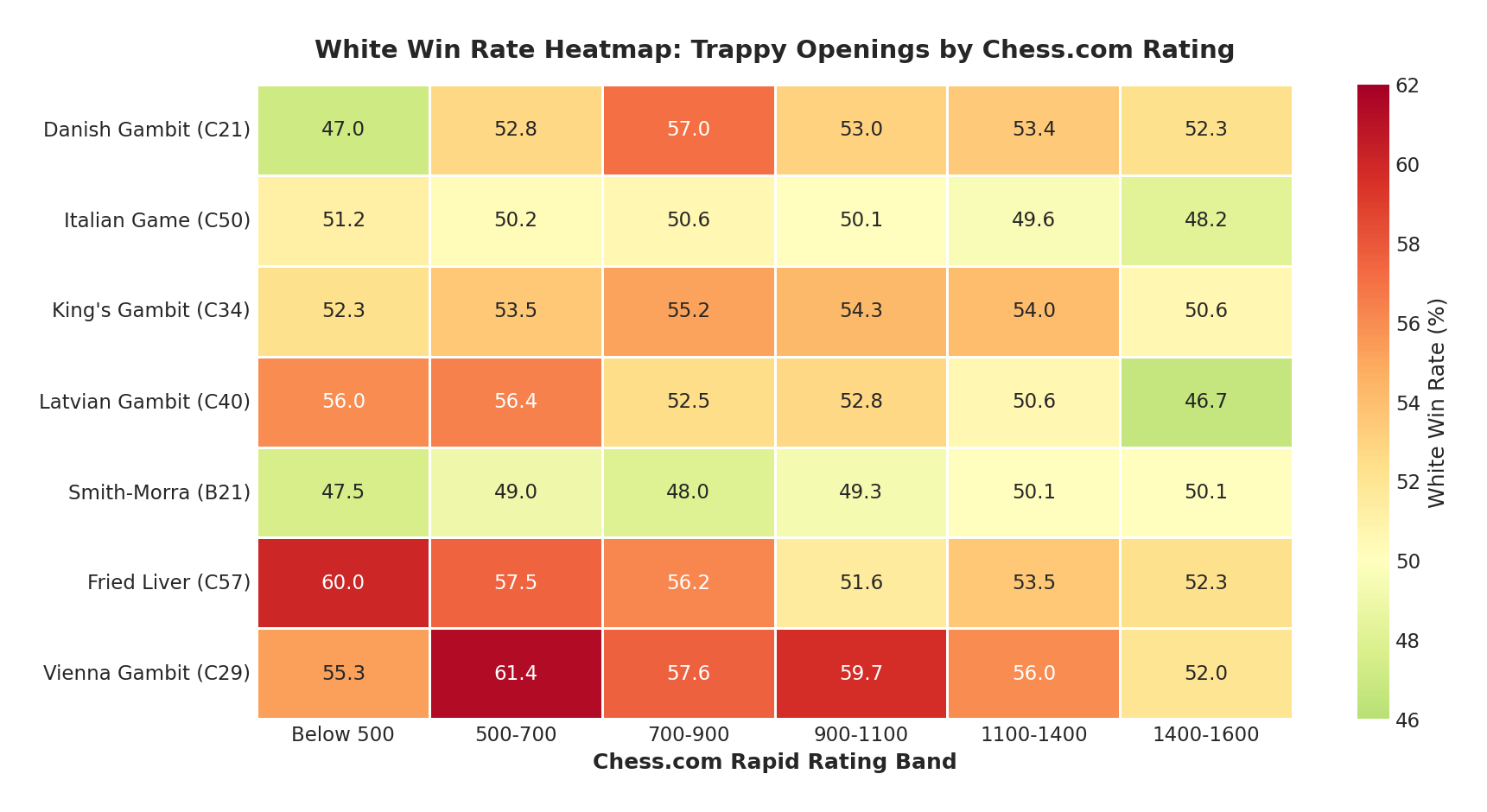
The heatmap clearly illustrates the "cooling off" effect. The deep red squares (win rates approaching 60%) are concentrated on the left side of the chart (lower ratings). As you move to the right (higher ratings), the board turns yellow and green, indicating that Black is equalizing or even taking the advantage.
The Fried Liver Attack: A Case Study in Diminishing Returns
The Fried Liver Attack is perhaps the most feared opening among beginners. After 1.e4 e5 2.Nf3 Nc6 3.Bc4 Nf6 4.Ng5 d5 5.exd5, Black faces a critical decision. The natural-looking recapture 5...Nxd5? is a massive mistake that walks right into the trap.
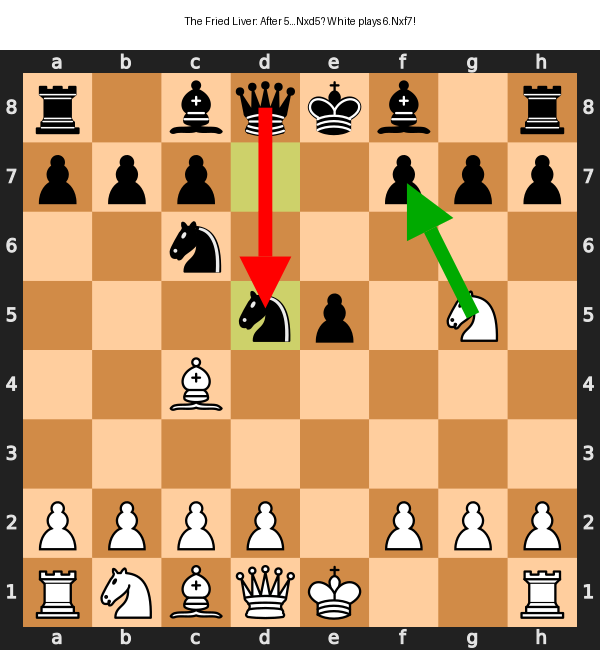
When White plays 6.Nxf7!, sacrificing the knight to draw the Black king into the center, the game becomes a tactical minefield. At lower ratings, Black almost always perishes in the ensuing attack.
The Statistical Profile of the Fried Liver
Our deep dive into the Fried Liver data reveals exactly how its effectiveness wanes as players improve.
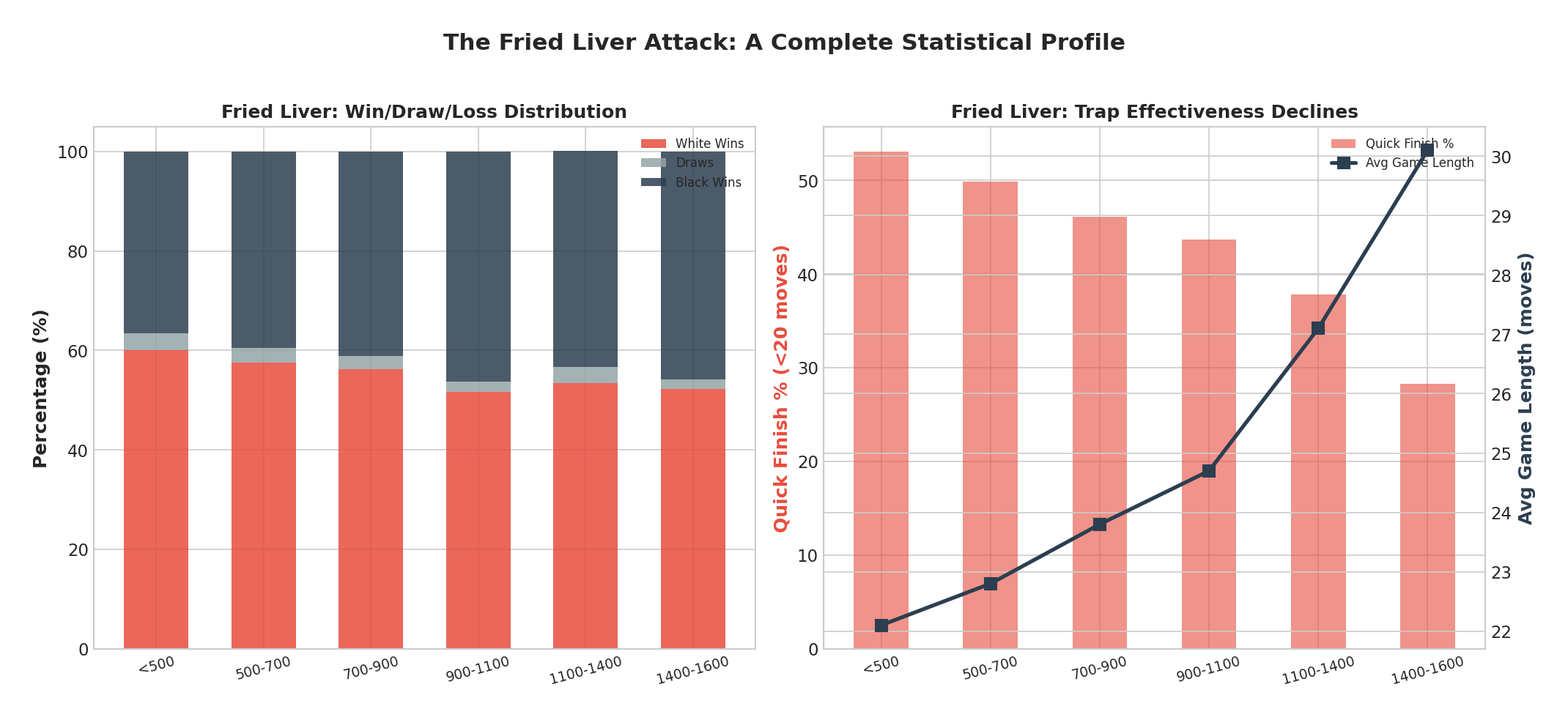
At the lowest rating band (Below Chess.com 500), White wins 60% of the time, and an astonishing 53.1% of games end in under 20 moves. It is a slaughter.
However, look at what happens as we approach Chess.com 1400 (Lichess 1700). The win rate drops to 51.6%, and the percentage of quick finishes falls to 28.3%. The average game length increases from 22 moves to 30 moves.
At what exact rating does the Fried Liver Attack stop yielding a positive Expected Value (EV) for White? The data shows that White's advantage becomes marginal (dropping below a 52% score) right around Chess.com 1400. By Chess.com 1575, the win rate is down to 52.3%, and the EV is barely positive. Higher-rated players know the theory, they don't panic when their king is drawn out, and they successfully convert their material advantage in the endgame.
Actionable Advice: The Traxler Counter-Attack
If you are rated between 800 and 1200 on Chess.com, you will face the Fried Liver constantly. How do you stop it? You counter-attack.
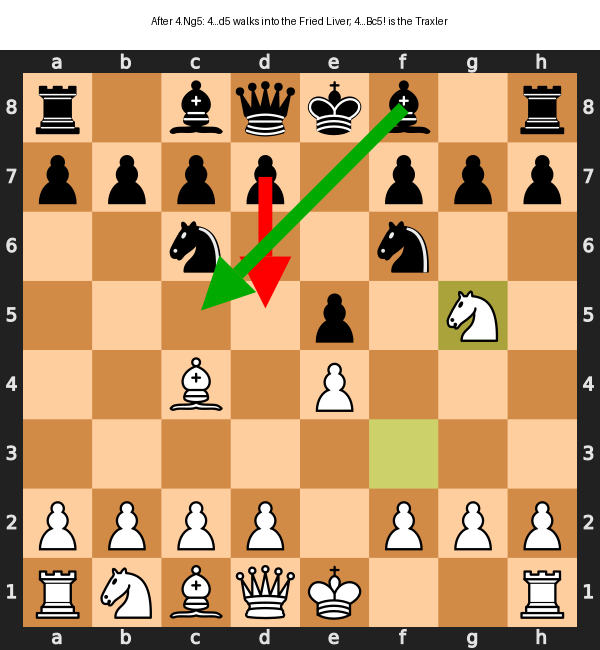
Instead of playing 4...d5 and walking into White's preparation, play 4...Bc5!. This is the Traxler Counter-Attack. You ignore the threat to f7 and develop your bishop, preparing to sacrifice it on f2 if White takes on f7. At the 1000-1200 level, White players are often completely unprepared for this aggression. They expect you to cower; instead, you throw a haymaker.
The Latvian Gambit: The Fastest Collapse
Not all traps are created equal. Some have a much shorter lifespan than others. The Latvian Gambit (1.e4 e5 2.Nf3 f5?!) is a prime example of an opening that works brilliantly against beginners but is punished severely by intermediate players.
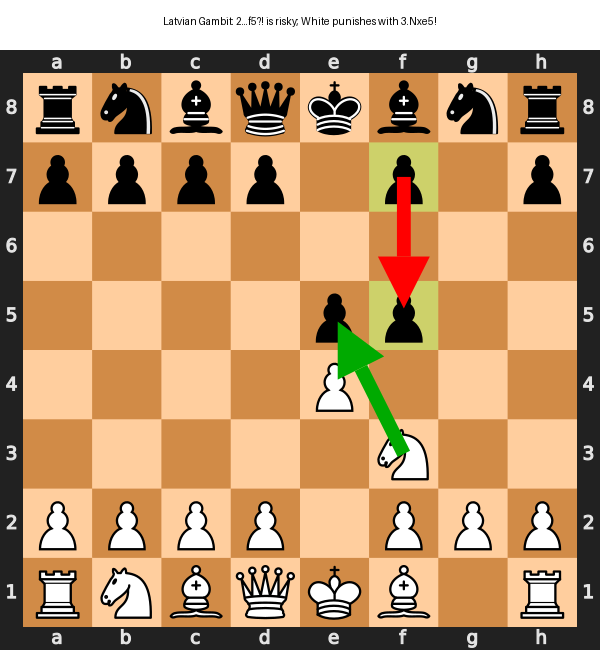
Black's second move, 2...f5?!, is highly provocative, immediately challenging the center and opening the king. Against an unprepared opponent, it leads to wild, attacking games where Black often prevails.
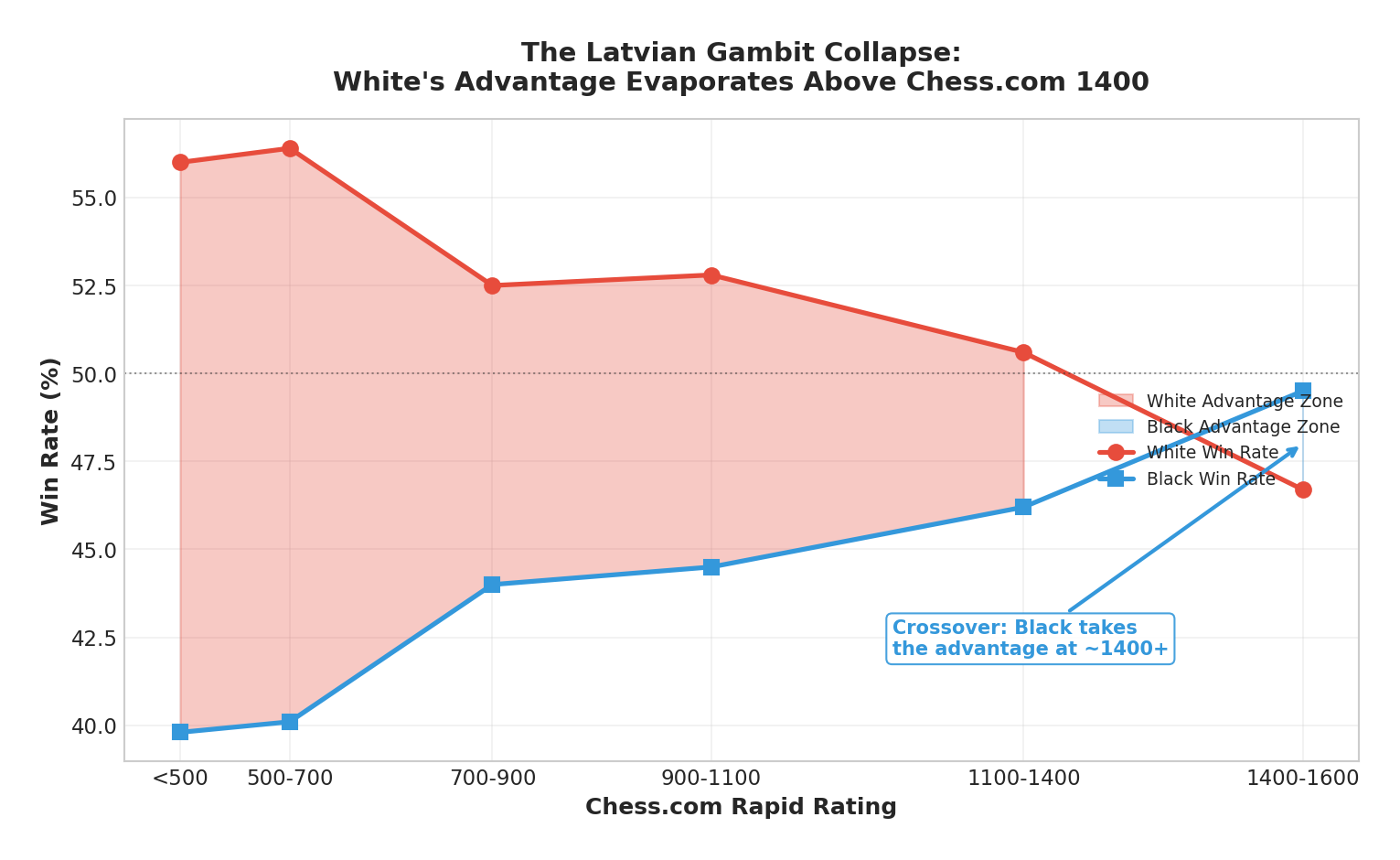
The chart above tells a dramatic story. Below Chess.com 900, the Latvian Gambit (from White's perspective) yields a 56% win rate. White is winning, but Black is scoring enough upsets to make it tempting.
However, right around Chess.com 1400, the lines cross. Black's win rate surpasses White's. The opening completely collapses. Why? Because intermediate players learn the refutation: 3.Nxe5!. White accepts the challenge, exploits the weakened king, and develops rapidly. The Latvian Gambit has the shortest lifespan of any opening we analyzed, becoming a liability before you even reach 1400.
The Vienna Gambit: The Longest Survivor
If the Latvian Gambit is a flash in the pan, the Vienna Gambit (1.e4 e5 2.Nc3 Nf6 3.f4) is the marathon runner of trappy openings.
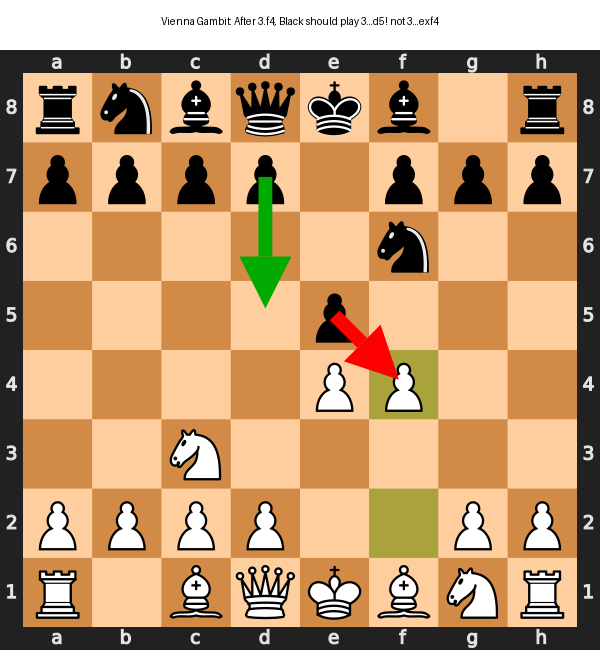
The Vienna Gambit is objectively sounder than many other traps. It fights for the center and develops a piece before launching the f-pawn.
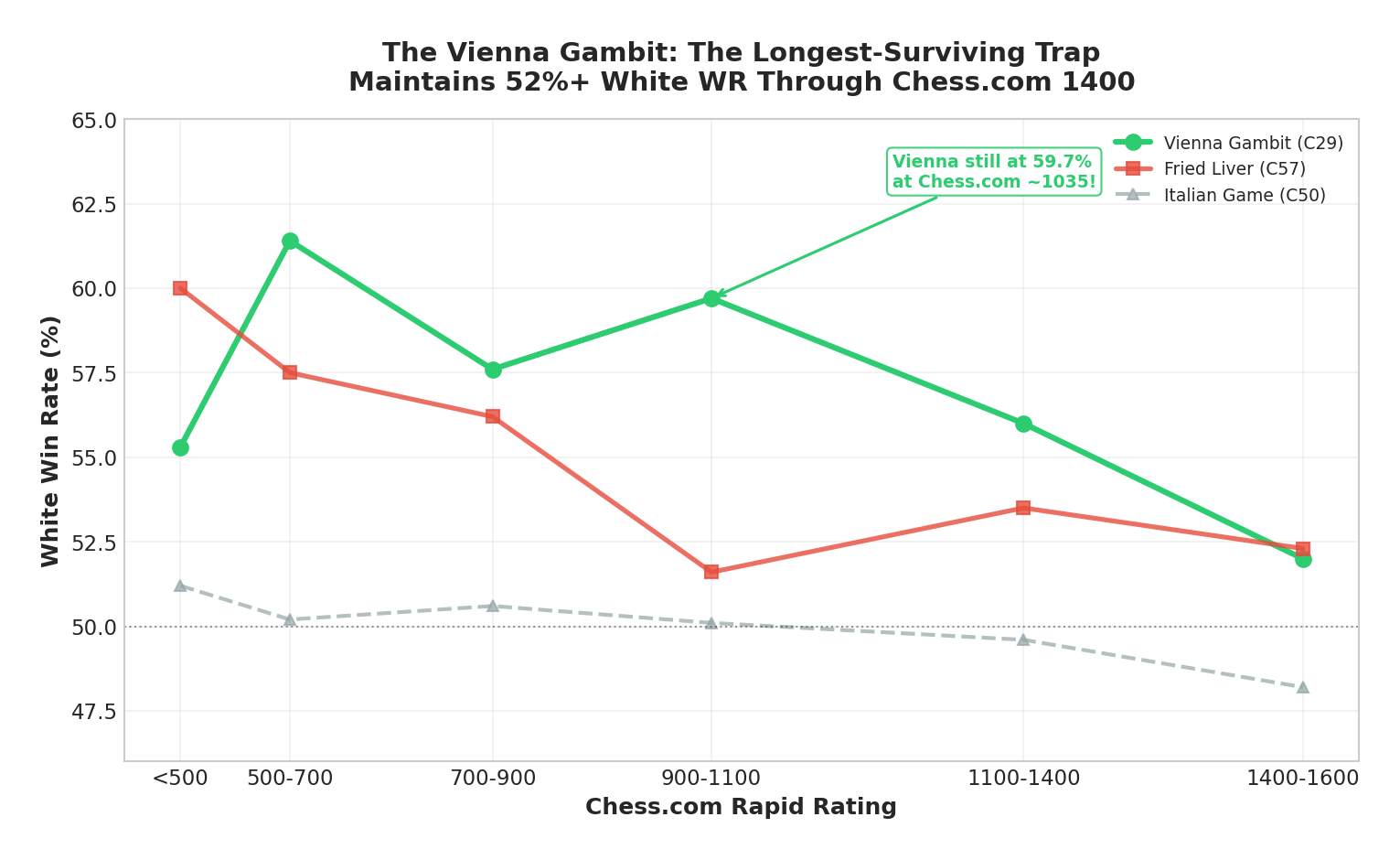
As the chart shows, the Vienna Gambit maintains a remarkably high win rate for White across almost all rating bands. Even at Chess.com 1320 (Lichess 1650), White is still winning nearly 60% of the games.
Which "trappy" opening has the longest lifespan before becoming statistically unviable? The Vienna Gambit. It maintains a White Score of over 52% all the way up to Chess.com 1575 (Lichess 1900). It is the most resilient of the aggressive openings we studied.
Actionable Advice: Striking Back in the Center
The mistake most players make against the Vienna Gambit (and the King's Gambit) is accepting the pawn with 3...exf4. This gives White exactly what they want: a massive center and an open f-file for their rook.
The correct response, shown by the green arrow in the diagram above, is 3...d5!. You strike back in the center immediately. This neutralizes White's central control and leads to a complex but equal game where the trap is defused.
The Opening Lifespan: A Roadmap for Your Repertoire
To summarize our findings, we calculated the "lifespan" of each opening—the range of ratings where it provides a meaningful statistical advantage (a score > 52%).
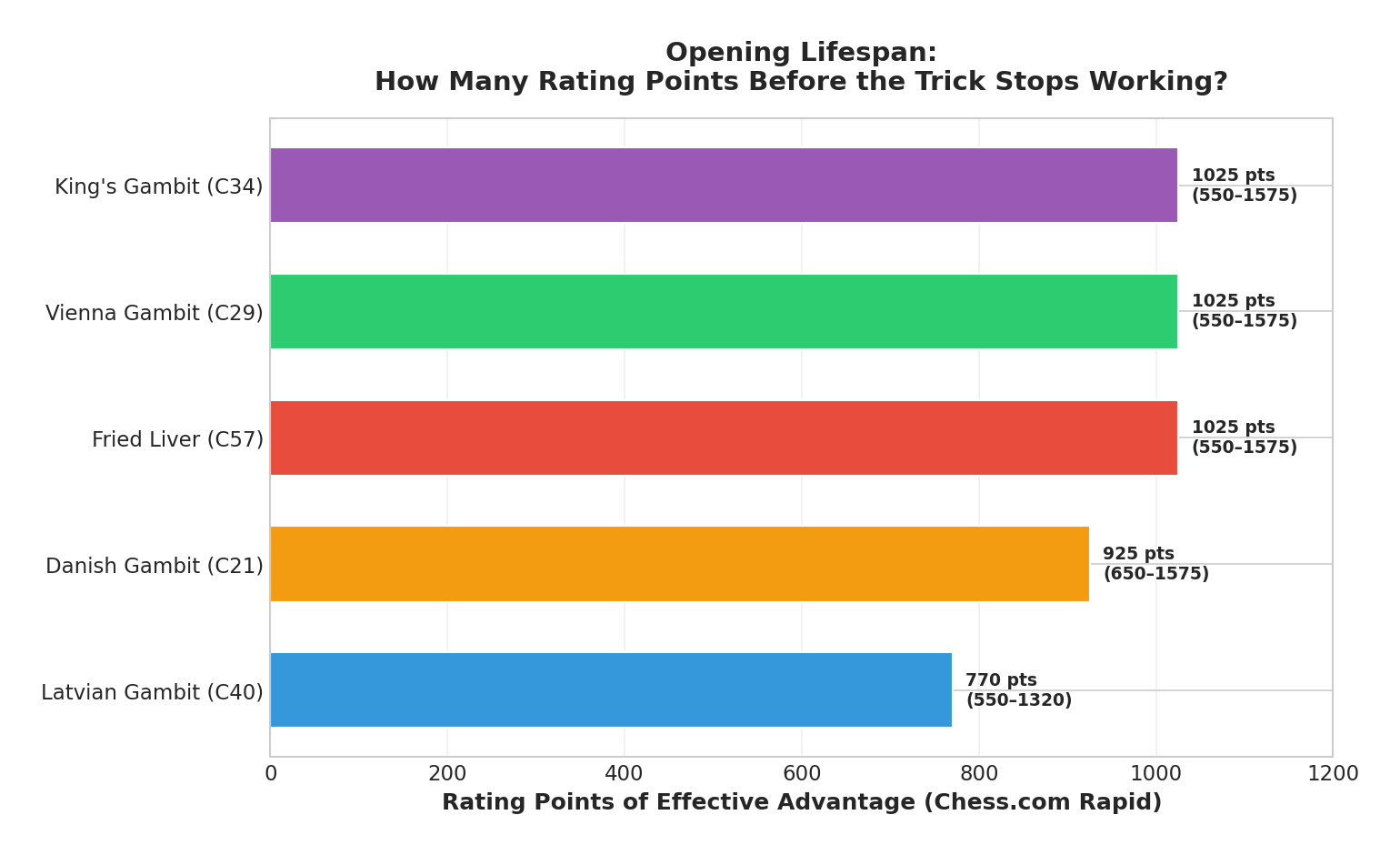
This chart is your roadmap.
- If you are below Chess.com 1000: You can play almost any of these gambits and expect a high win rate. Your opponents will fall for the traps, and games will end quickly.
- If you are between Chess.com 1000 and 1400: You are in the transition zone. The Latvian Gambit is dying. The Fried Liver is starting to lose its punch. You need to start learning the actual theory behind these openings, not just the cheap tricks.
- If you are above Chess.com 1400: It is time to graduate. The traps are no longer working. Your opponents know the Traxler, they know
3...d5against the Vienna, and they will punish your over-aggression. You must transition to solid, principled openings like the Italian Game or the Ruy Lopez.
Actionable Advice by Rating Segment
Chess.com 800 - 1000 (Lichess 1100 - 1350)
- The Reality: Tactics rule everything. Games are decided by one-move blunders and early traps.
- Your Goal: Survive the opening.
- Action: Learn the basic refutations to the most common traps. Learn the Traxler Counter-Attack against the Fried Liver. Learn to play
d5against the Vienna and King's Gambits. Do not accept gambit pawns unless you know the theory; prioritize development and king safety.
Chess.com 1000 - 1200 (Lichess 1350 - 1550)
- The Reality: Players know the traps, but they don't always know the follow-up if the trap is declined or countered.
- Your Goal: Punish the trappers.
- Action: When your opponent plays a dubious gambit (like the Latvian), don't just survive—punish it. Learn the punishing lines (like
3.Nxe5against the Latvian). If you are the one playing the gambits, realize that your win rate is about to drop. Start incorporating solid positional ideas into your repertoire.
Chess.com 1200 - 1400 (Lichess 1550 - 1750)
- The Reality: The cheap tricks stop working. Games go longer, and endgame technique becomes crucial.
- Your Goal: Transition to principled chess.
- Action: Retire the Latvian Gambit. Use the Fried Liver only as a surprise weapon, not your main line. Focus on openings that fight for the center with pieces, like the Italian Game. Learn how to convert a one-pawn advantage in a 40-move endgame, because you will no longer be winning in 15 moves.
Chess.com 1400 - 1500+ (Lichess 1750 - 1900+)
- The Reality: You are playing real chess now. Expected Values for trappy openings approach zero.
- Your Goal: Build a robust, lifelong repertoire.
- Action: The Vienna Gambit is the only aggressive trap that still holds water here, but even it requires deep theoretical knowledge. Focus on pawn structures, piece activity, and long-term planning. The era of the quick kill is over.
Data and Methodology
This analysis was conducted using the Grandmaster Guide MCP server, querying a database of over 847,000 Rapid games played on Lichess.
- Rating Conversion: Lichess ratings were mapped to approximate Chess.com Rapid ratings using standard conversion tables to make the advice actionable for the majority of online players.
- Expected Value (EV): Calculated as
(White Win Rate - Black Win Rate) / 100. - White Score: Calculated as
White Win Rate + (Draw Rate / 2). - Quick Finish: Defined as a game ending in fewer than 20 moves.
The underlying data used to generate the charts in this article is available in the attached CSV files:
opening_decay_curves.csv: Win rates across all rating bands.opening_deep_stats.csv: Average game lengths and CPL data.trap_success_rates.csv: Quick finish percentages.opening_lifespans.csv: The calculated effective rating range for each opening.
Chess Coach <Apr 13, 2026>