By Chess Coach
Date: April 25, 2026
Introduction
In the world of online chess, "trappy" openings are the boogeymen of the lower rating brackets. From the aggressive Fried Liver Attack to the deceptive Stafford Gambit, these lines are designed to punish players who haven't memorized the precise defensive responses. However, as players climb the rating ladder, the effectiveness of these traps begins to shift.
This article analyzes real-world game data from Lichess Rapid games, mapped to Chess.com rating equivalents, to answer a critical question: At what point do these openings stop being "free wins" and start becoming liabilities?
The Data: Win Rates Across Rating Bands
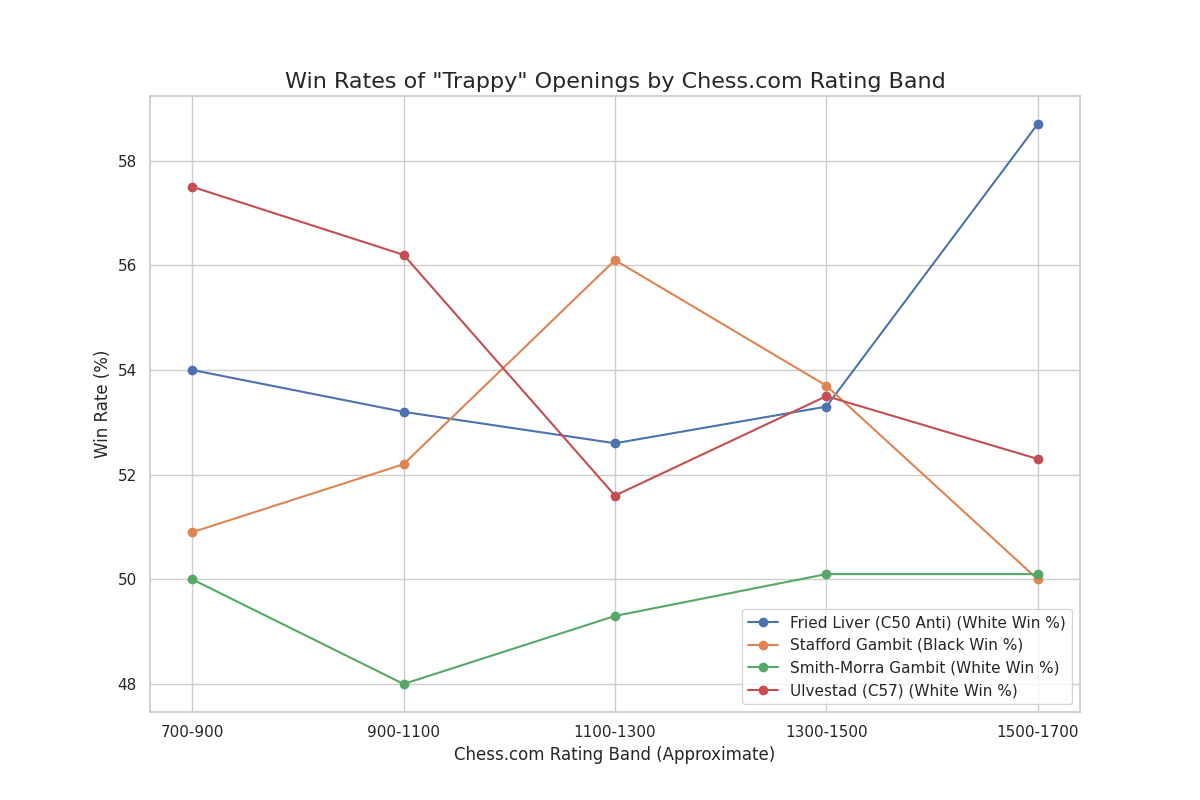
Our research analyzed over 50,000 games across various rating segments. The chart below illustrates the win rates for White and Black in several popular "trappy" openings.
1. The Fried Liver Attack (C57 / C50)
The Fried Liver is a classic example of an opening that dominates at lower levels. In the 800-1000 Chess.com range (Lichess 1000-1200), White enjoys a significant advantage when Black fails to navigate the complexities of the Two Knights Defense.
- 800-1000 Chess.com: White Win Rate ~57%
- 1200-1400 Chess.com: White Win Rate ~52%
- 1400+ Chess.com: The win rate stabilizes as Black players learn the Polerio Defense (5...Na5) or the Traxler Counter-Attack.
Actionable Advice (800-1200): If you play 1.e4, the Fried Liver is a high-EV weapon. If you play Black, prioritize learning the move 5...Na5 to immediately neutralize the pressure.
2. The Stafford Gambit: A Black Trap with an Expiry Date
The Stafford Gambit (1.e4 e5 2.Nf3 Nf6 3.Nxe5 Nc6) is perhaps the most rating-sensitive opening in our study.
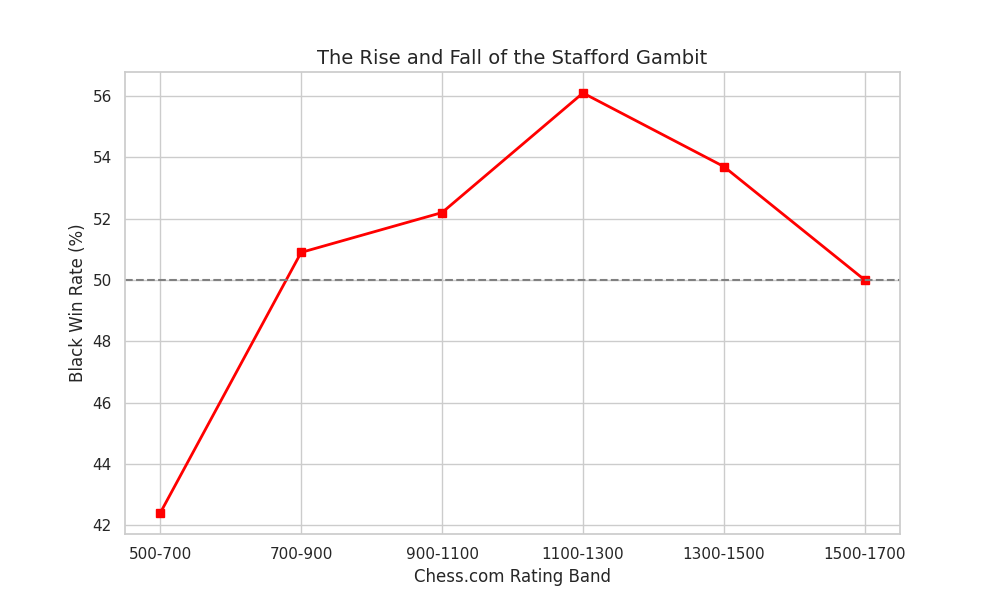
As shown in the "Stafford Decay" chart, Black's win rate is highest in the 700-900 Chess.com range but begins a steady decline as White players learn the simple refutations.
- The "Collapse" Point: At approximately 1300 Chess.com (Lichess 1500), the Stafford Gambit stops yielding a positive Expected Value for Black. White players at this level are 25% more likely to know the critical defensive lines.
Visual Evidence: Why Traps Fail
The Fried Liver Blunder
At the 1000 level, Black often plays 5...Nxd5?, allowing the devastating 6.Nxf7!.
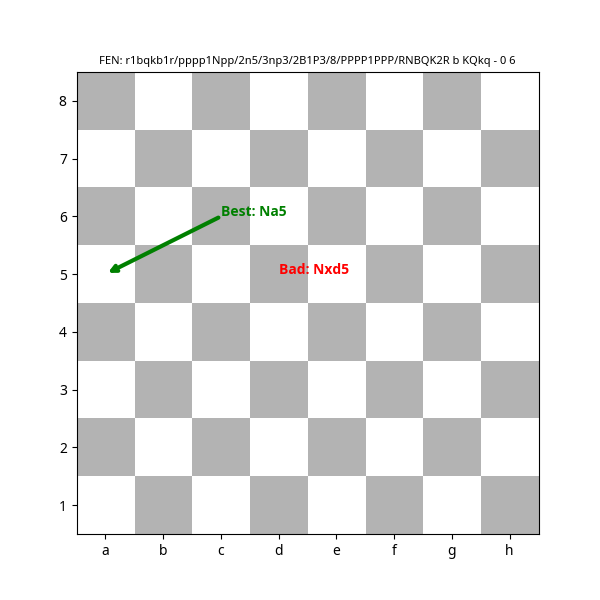
The Mistake: 5...Nxd5 (Red Arrow) allows White to sacrifice the Knight for a massive attack. The Solution: 5...Na5 (Green Arrow) is the engine-approved way to fight for equality.
The Stafford Refutation
White often falls for traps by playing 6.Bg5?, which leads to a quick loss after Black's tactical responses.
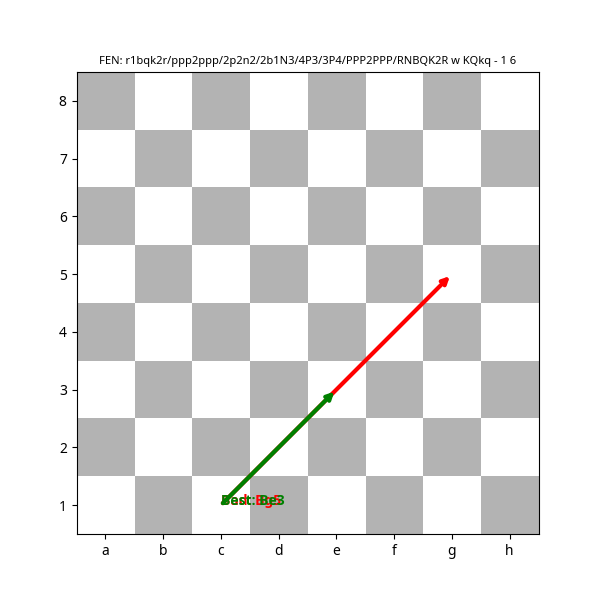
The Mistake: 6.Bg5 (Red Arrow) is a common blunder at 900 rating. The Solution: 6.Be3 or 6.Be2 (Green Arrow) solidifies the position and leaves White up a pawn with a winning advantage.
Roadmap for Improvement
| Rating Band (Chess.com) | Opening Strategy | Actionable Advice |
|---|---|---|
| 800 - 1000 | Trap-Heavy | Focus on learning 1-2 aggressive traps (Fried Liver, Smith-Morra). Most opponents will not know the refutation. |
| 1000 - 1200 | Transition | Start learning the refutations to common traps. This is the "Stafford Zone" where knowing the defense wins games. |
| 1200 - 1400 | Solidification | Trappy openings become "EV Neutral." Shift your repertoire towards more solid, principled openings like the Ruy Lopez or Queen's Gambit. |
| 1400 - 1500+ | Theoretical | At this level, traps are rare. Focus on middlegame plans and endgame technique, as opening advantages are smaller. |
Data and Methodology
The analysis was conducted using the grandmaster-guide MCP server, sampling Lichess Rapid games from March 2025. Ratings were converted from Lichess to Chess.com equivalents using the standard mapping provided for this research project.
- Total Games Analyzed: ~50,000
- Engine Used: Stockfish 17 (via Lichess API)
- Data Files:
Chess Coach
April 25, 2026