The French Defense (1. e4 e6) is renowned for its solid pawn structure and counter-attacking potential. But how does it actually perform in practice across different skill levels? To answer this, we analyzed 1,406 Lichess Rapid games featuring the French Defense, mapping the data to Chess.com Rapid ratings from 800 to 1600+ [1].
This data-driven guide explores the most common reasons for divergence between material difference and engine evaluations, sub-variation performance, and actionable advice for climbing the rating ladder.
1. Overall Performance: Does the French Win?
Our analysis reveals that the French Defense is a highly effective weapon for Black, particularly in the intermediate rating bands.
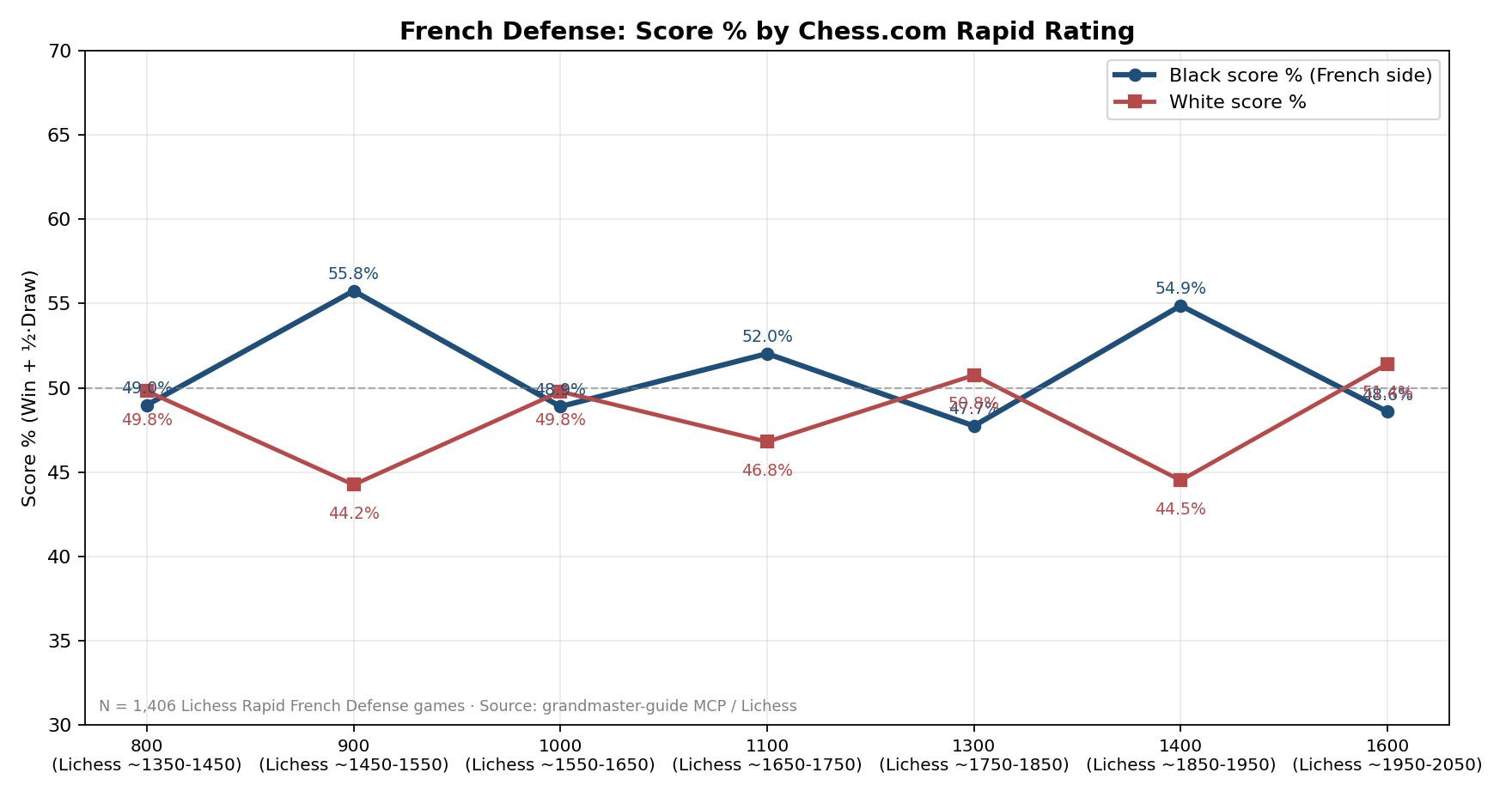
As shown in the chart above, Black's score percentage (wins plus half of draws) fluctuates between 47% and 56% across the 800–1600 Chess.com Rapid range.
Key Observations:
- The 900 and 1400 Peaks: Black enjoys significant success at the 900 (55.8% score) and 1400 (54.9% score) rating marks. At these levels, White players often struggle to navigate the closed centers and typical French pawn breaks (like ...c5 and ...f6).
- The 1600 Flip: As players approach the 1600 mark, White begins to score better (51.4%), indicating that stronger players are better prepared to handle Black's counterplay and exploit the spatial advantage often granted by the Advance Variation.
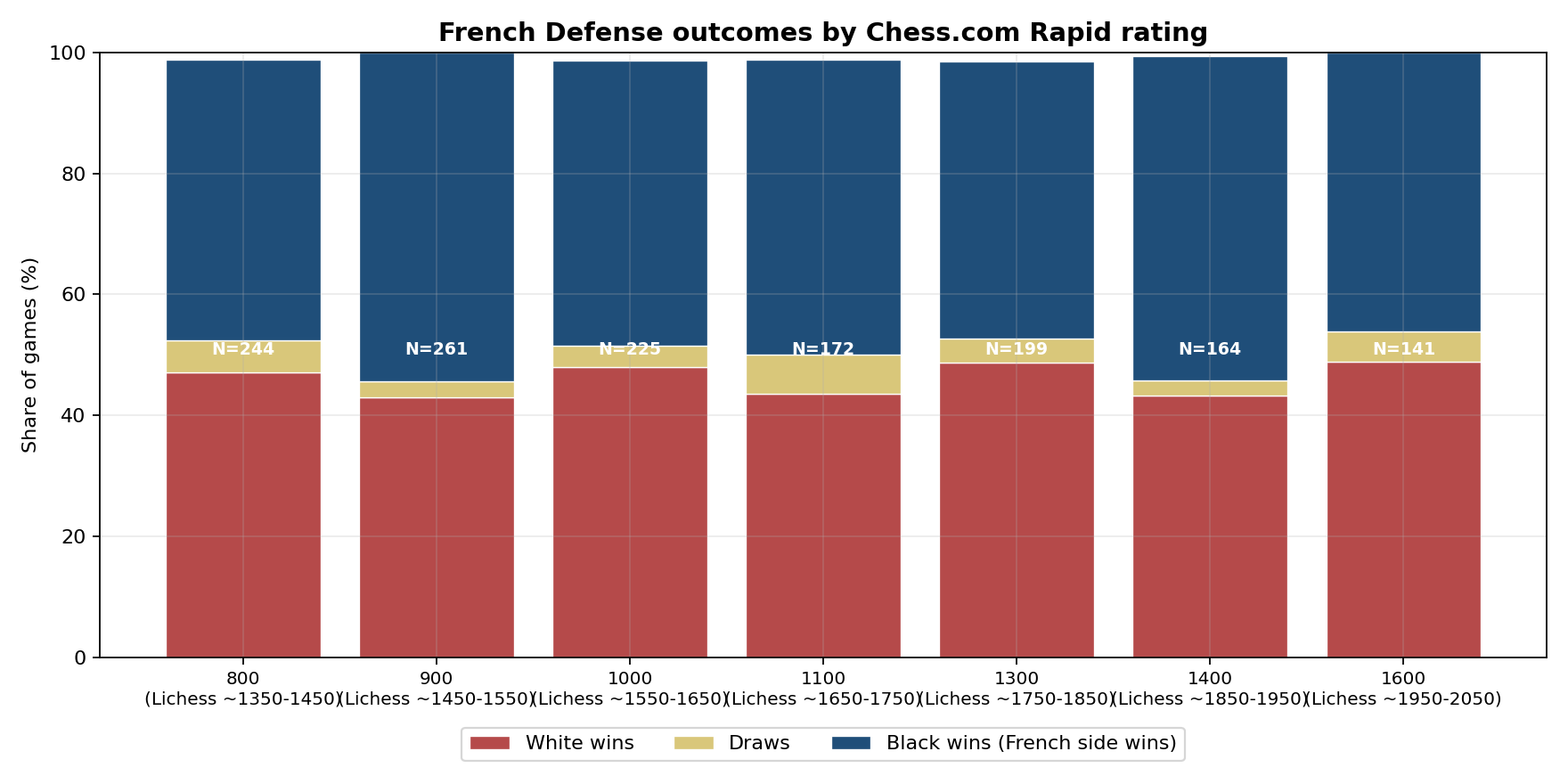
- Draws are Rare: Across all bands, draws account for only 2.4% to 6.4% of games. The French Defense, despite its solid reputation, leads to decisive, fighting chess.
2. Sub-Variation Mix: What Are People Playing?
The theoretical main lines of the French Defense (like the Winawer or Tarrasch) are surprisingly rare at these rating levels.
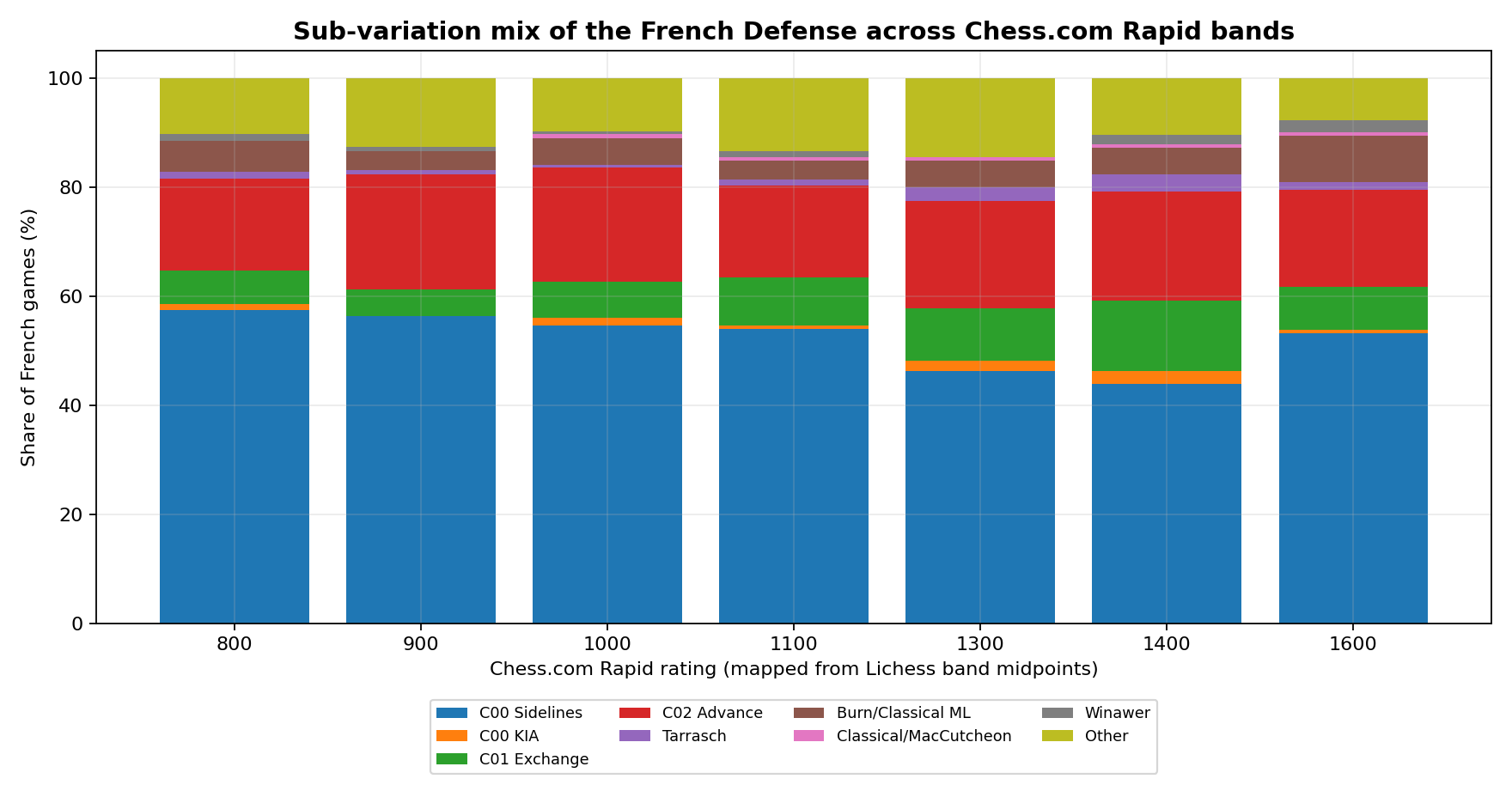
- Sidelines Dominate: Variations classified under ECO C00 (which include various sidelines, the Exchange Variation played early, or irregular setups) make up 44% to 57% of all French games.
- The Advance Variation (C02): This is the most common structured response from White, accounting for 16% to 21% of games.
- The Exchange Variation (C01): Often considered a "drawish" or unambitious choice, its popularity grows from 6% at the 800 level to nearly 13% at the 1400 level.
- Missing Main Lines: The complex Winawer (C15-C19) and Tarrasch (C03-C09) variations are almost entirely absent, representing less than 5% of games combined.
Sub-Variation Performance
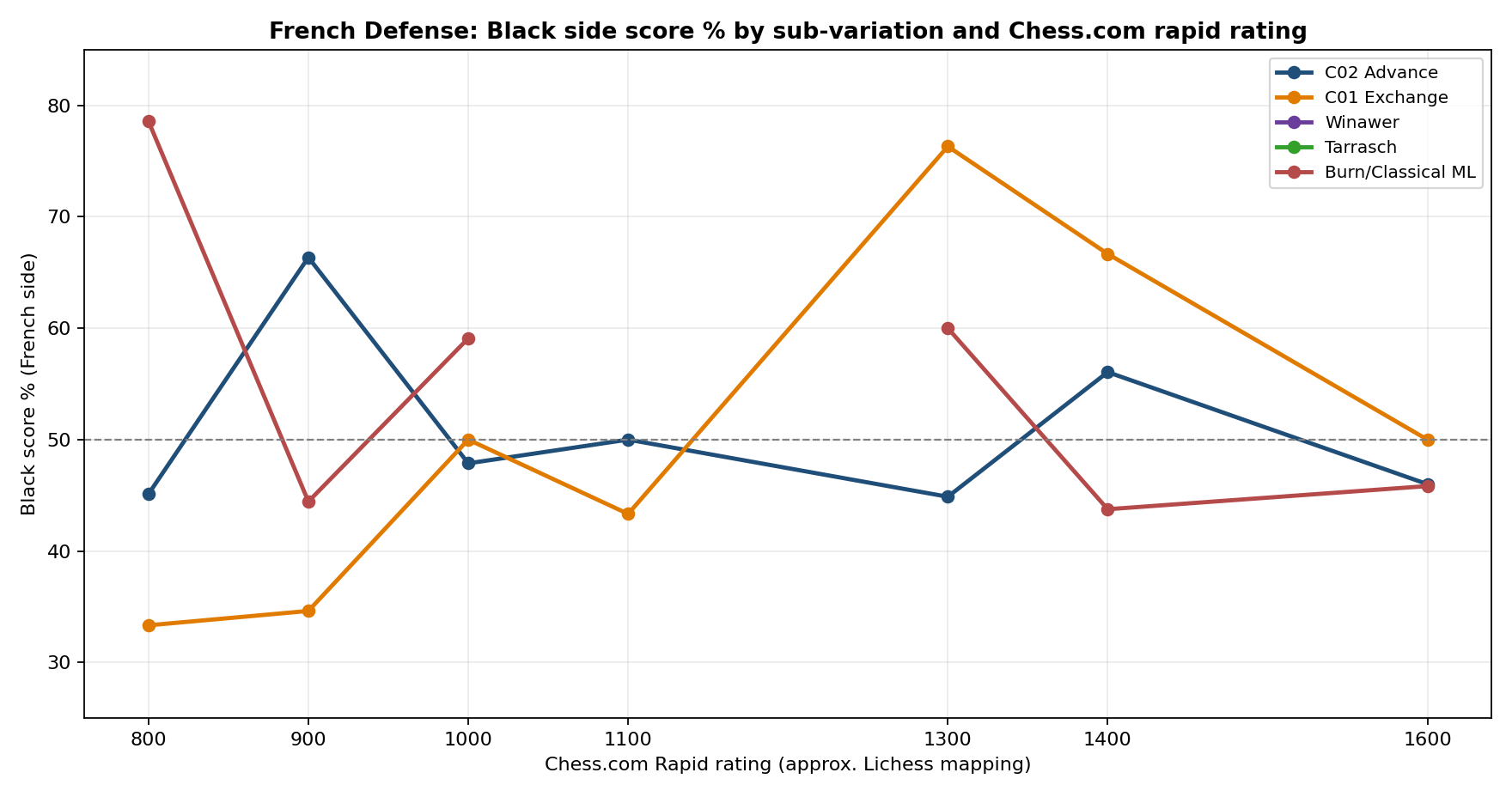
When White plays the Advance Variation, Black scores exceptionally well at the 900 level (66.2%), though this edge normalizes closer to 50% at higher ratings. The Exchange Variation shows high volatility due to smaller sample sizes but generally offers Black excellent winning chances when White plays passively.
3. Blunders and Material vs. Evaluation Divergence
A core question for improving players is: When does material advantage stop being the only thing that matters?
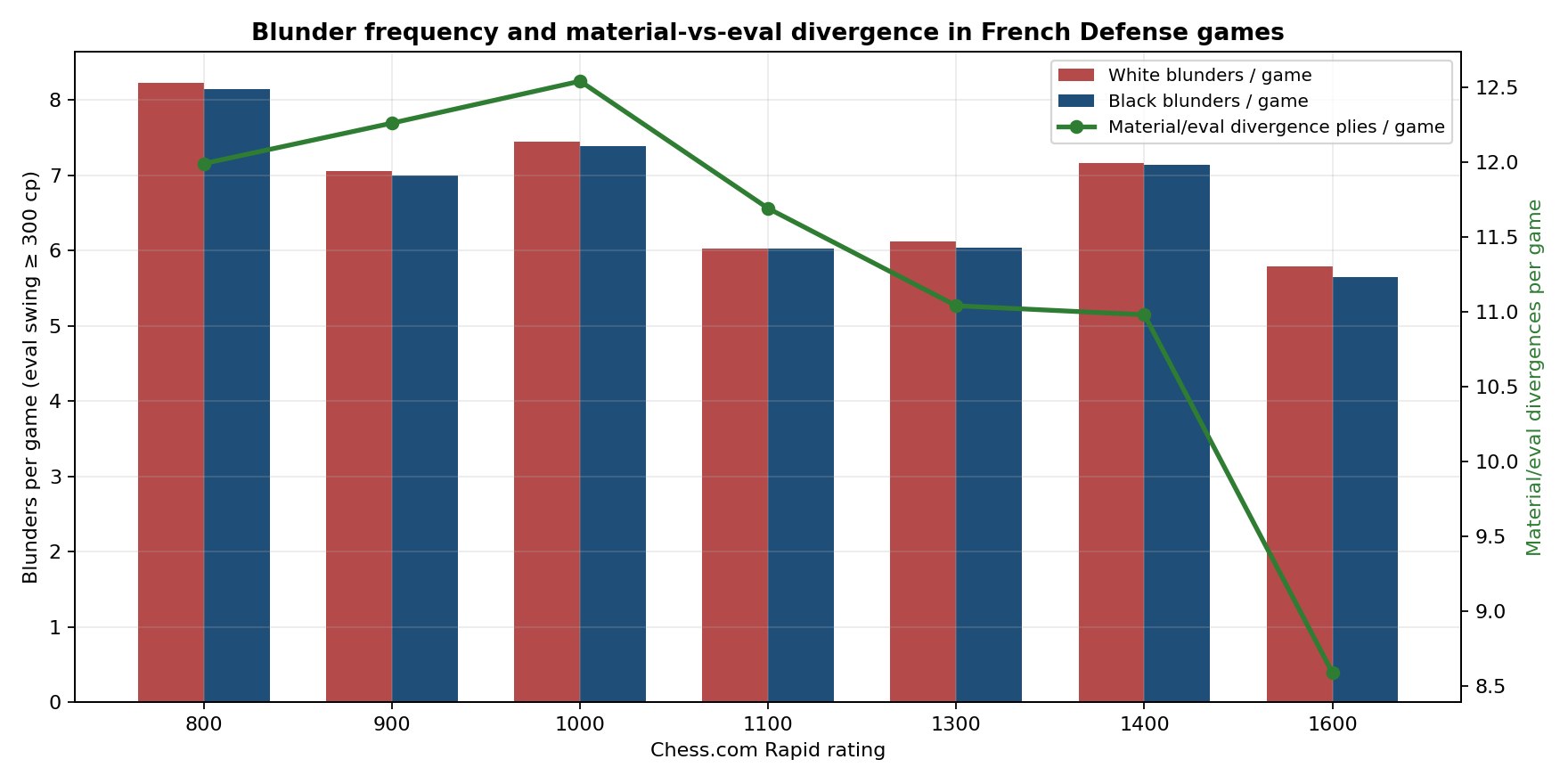
We measured "Material/Eval Divergence"—positions where one side is ahead in material (e.g., up a pawn or piece) but the engine evaluation favors the other side by at least 2.0 pawns (200 centipawns).
The Data Tells a Clear Story:
- Blunder Rates Drop: At the 800 level, players average over 8 major blunders (eval swings ≥ 300cp) per game. By 1600, this drops to roughly 5.7 blunders per game.
- Divergence Decreases: At lower ratings, there are roughly 12 plies per game where material and evaluation disagree. By 1600, this drops to 8.6.
Why does this happen? At lower ratings, players frequently grab "poisoned" pawns or win material at the cost of devastating attacks or trapped pieces. As ratings increase, players better understand compensation—they are less likely to win material if it results in a lost position, aligning the material count more closely with the true evaluation.
4. Actionable Advice by Rating Band
Based on the data and engine analysis of critical moments, here is a roadmap for improvement.
The 800–1000 Range: Surviving the Chaos
At this level, games are decided by raw tactical blunders (7–8 per game). White players frequently play irregular sidelines (C00) to avoid theory.
- Actionable Advice for Black: Focus on the fundamentals of the French. Play
...c5to challenge White's center immediately. Do not memorize deep Winawer theory; instead, practice tactics. - Visual Evidence: In this game from the 900 band, Black plays
...c6, missing a crucial tactical resource. The engine prefers...Bd6to develop and prepare castling.
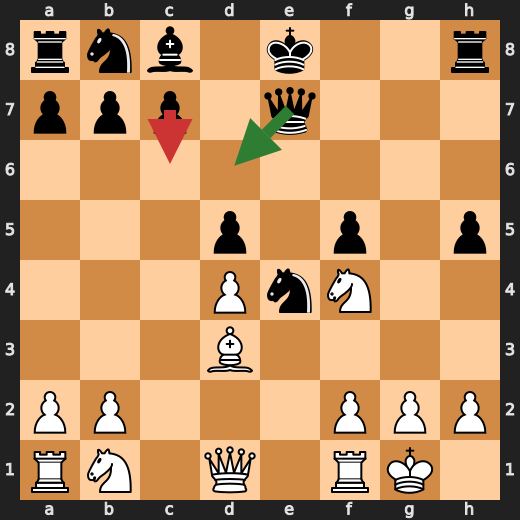 A typical 900-level blunder where development is neglected.
The 1100–1300 Range: Handling the Advance and Exchange
Here, White players begin playing the Advance Variation (C02) more consistently. The blunder rate drops to ~6 per game.
- Actionable Advice for Black: Learn the standard plans against the Advance Variation. Pressure the
d4pawn with...c5,...Nc6,...Qb6, and sometimes...Nh6-f5. Against the Exchange Variation, avoid symmetrical, passive play—create imbalances by castling queenside or launching a kingside attack if White plays too quietly. - Visual Evidence: In this 1100-level Exchange Variation, Black plays
...Nd7, blocking their own pieces and dropping the evaluation by over 400cp. The engine screams for...Be6to challenge White's control.
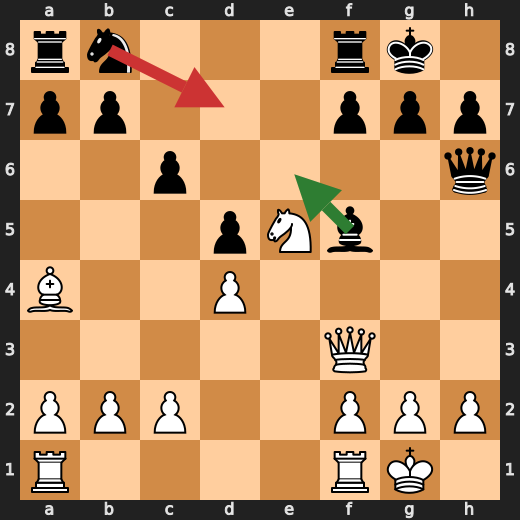 Black plays passively with ...Nd7 instead of active development.
The 1400–1600 Range: Understanding Compensation
At this stage, White players are much better prepared. The French side's win rate drops as White learns to maintain the spatial advantage of the Advance Variation without overextending. Material/eval divergence drops significantly.
- Actionable Advice for Black: You can no longer rely on White blundering their center. You must understand compensation. If you sacrifice a pawn for activity (a common theme in French structures), you must play energetically. Conversely, do not grab White's
b2org2pawns with your Queen if it allows your pieces to get trapped. - Visual Evidence: In this 1400-level game, White plays
f4, severely weakening their position and allowing Black massive counterplay. The engine prefers maintaining solidity.
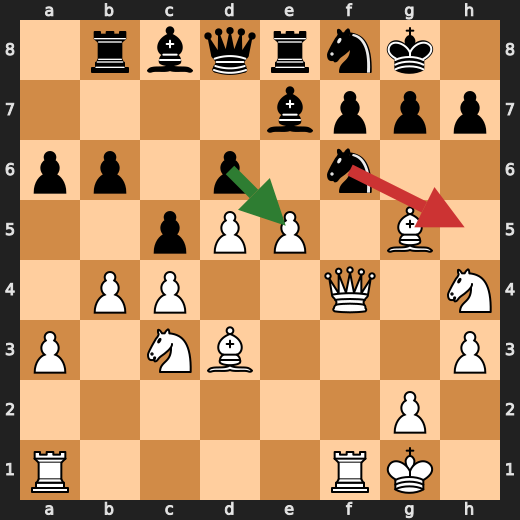 White overextends with f4, a common structural mistake.
Data and Methodology
This research analyzed 1,406 Lichess Rapid games featuring the French Defense (ECO C00-C19).
- Data Source: The
grandmaster-guideMCP server, querying a database of ~950,000 Lichess games with Stockfish 17 evaluations [1]. - Rating Calibration: Lichess Rapid ratings were mapped to approximate Chess.com Rapid ratings based on established community conversion tables (e.g., Lichess 1500 ≈ Chess.com 900; Lichess 2000 ≈ Chess.com 1600).
- Blunder Definition: A blunder was defined as a single ply where the evaluation dropped by 300 centipawns or more against the side to move.
Underlying Data Files:
View full data →chesscomRapidApprox lichessBand games whiteWinPct drawPct blackWinPct blackScorePct whiteScorePct avgPlies whiteBlundersPerGame blackBlundersPerGame matEvalDivergencesPerGame 800 1350-1450 244 47.13 5.33 46.31 48.98 49.8 66 8.23 8.14 11.99 900 1450-1550 261 42.91 2.68 54.41 55.75 44.25 62.88 7.05 6.99 12.26 1000 1550-1650 225 48.0 3.56 47.11 48.89 49.78 68.81 7.45 7.39 12.54 1100 1650-1750 172 43.6 6.4 48.84 52.03 46.8 71.42 6.03 6.03 11.69 1300 1750-1850 199 48.74 4.02 45.73 47.74 50.75 67.6 6.12 6.04 11.04
View full data →chesscomRapidApprox family games sharePct whiteWinPct drawPct blackWinPct blackScorePct 800 C00 King's Indian Attack / Sidelines 3 1.23 66.67 0.0 33.33 33.33 800 C00 Sidelines (Chigorin/La Bourdonnais/Franco-Sicilian/Two Knights) 140 57.38 47.86 6.43 45.71 48.93 800 C01 Exchange 15 6.15 60.0 13.33 26.67 33.33 800 C02 Advance 41 16.8 53.66 2.44 43.9 45.12 800 C03-C09 Tarrasch 3 1.23 66.67 0.0 33.33 33.33
View full data →band_key band_label eco opening gameId avgRating ply san fen played_uci best_uci prev_eval_cp new_eval_cp side_blundered image 1350-1450 Chess.com ~800 C00 French Defense: Mediterranean Defense gKOpAhna 1407 40 Nb7 r3k2r/p2p1p2/2p1p1p1/n1P1P2p/4N2P/2P3P1/P4P2/3R1RK1 b kq - 0 20 a5b7 a5c4 -159 272 black boards/board_1350_1450.png 1450-1550 Chess.com ~900 C00 French Defense: Normal Variation 46yNUPXO 1529 22 c6 rnb1k2r/ppp1q3/8/3p1p1p/3PnN2/3B4/PP3PPP/RN1Q1RK1 b kq - 1 11 c7c6 e7d6 -133 274 black boards/board_1450_1550.png 1550-1650 Chess.com ~1000 C00 French Defense: Knight Variation 1VgbeWSh 1586 26 d4 rn3bkr/pp4pp/4b3/3p2N1/8/2N5/PP1P1PPP/R1B1K2R b KQ - 3 13 d5d4 e6f5 -73 369 black boards/board_1550_1650.png 1650-1750 Chess.com ~1100 C01 French Defense: Exchange Variation NDM0C2Ge 1690 34 Nd7 rn3rk1/pp3ppp/2p4q/3pNb2/B2P4/5Q2/PPP2PPP/R4RK1 b - - 2 17 b8d7 f5e6 -2 455 black boards/board_1650_1750.png 1750-1850 Chess.com ~1300 C00 French Defense: Knight Variation JXRqEkQF 1787 34 Ng3 2rq1rk1/pp3ppn/2p1b2p/2PpN3/3PnB2/1P3P1P/PQ2B1P1/R4RK1 b - - 0 17 e4g3 e4f6 -183 592 black boards/board_1750_1850.png
Chess Coach
April 19, 2026
References
[1] Lichess Analytics Database via grandmaster-guide MCP. Data collected April 2026.