The French Defense (1. e4 e6) is one of the most popular and resilient openings in chess. However, for players climbing the ranks below 1200 on Chess.com, the opening often leads to complex middlegames where material and positional advantages can swing wildly. To understand exactly where and why these swings occur, we analyzed nearly 1,000 Rapid games played on Lichess, mapping the data to Chess.com Rapid rating bands (800–999, 1000–1199, and 1200–1399).
By examining games where the engine evaluation swung by at least 200 centipawns (the equivalent of two pawns) against Black, we have identified the most common pitfalls. This guide serves as a roadmap for improvement, offering data-backed actionable advice for each rating segment.
The Big Picture: How Often Does Black Blunder?
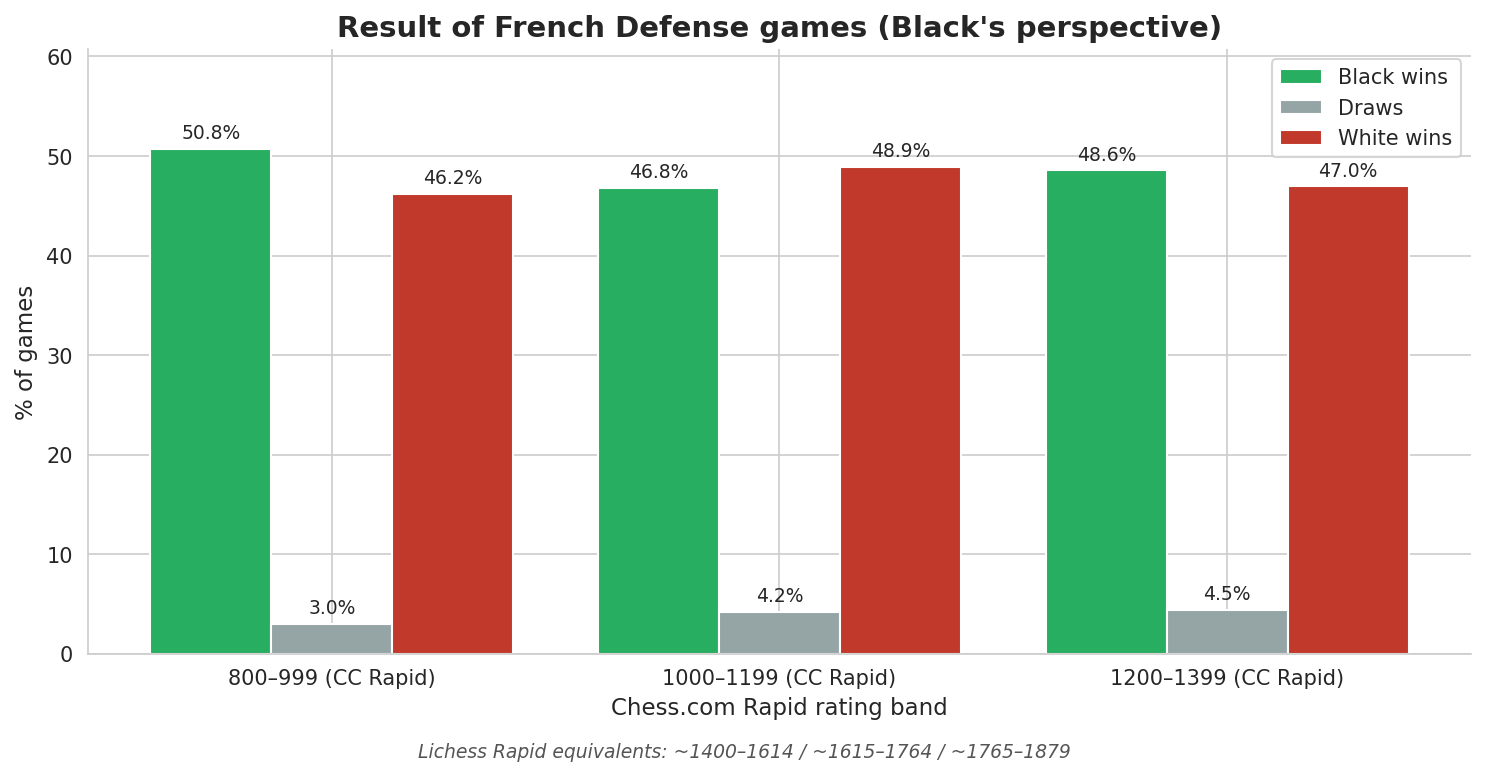
Our analysis reveals that blunders in the French Defense are incredibly common at these levels. In the 800–999 rating band, over 72% of games feature at least one significant blunder by Black, averaging 1.75 blunders per game. As players improve, the frequency decreases, but even in the 1200–1399 band, 64% of games still see Black making a major error.
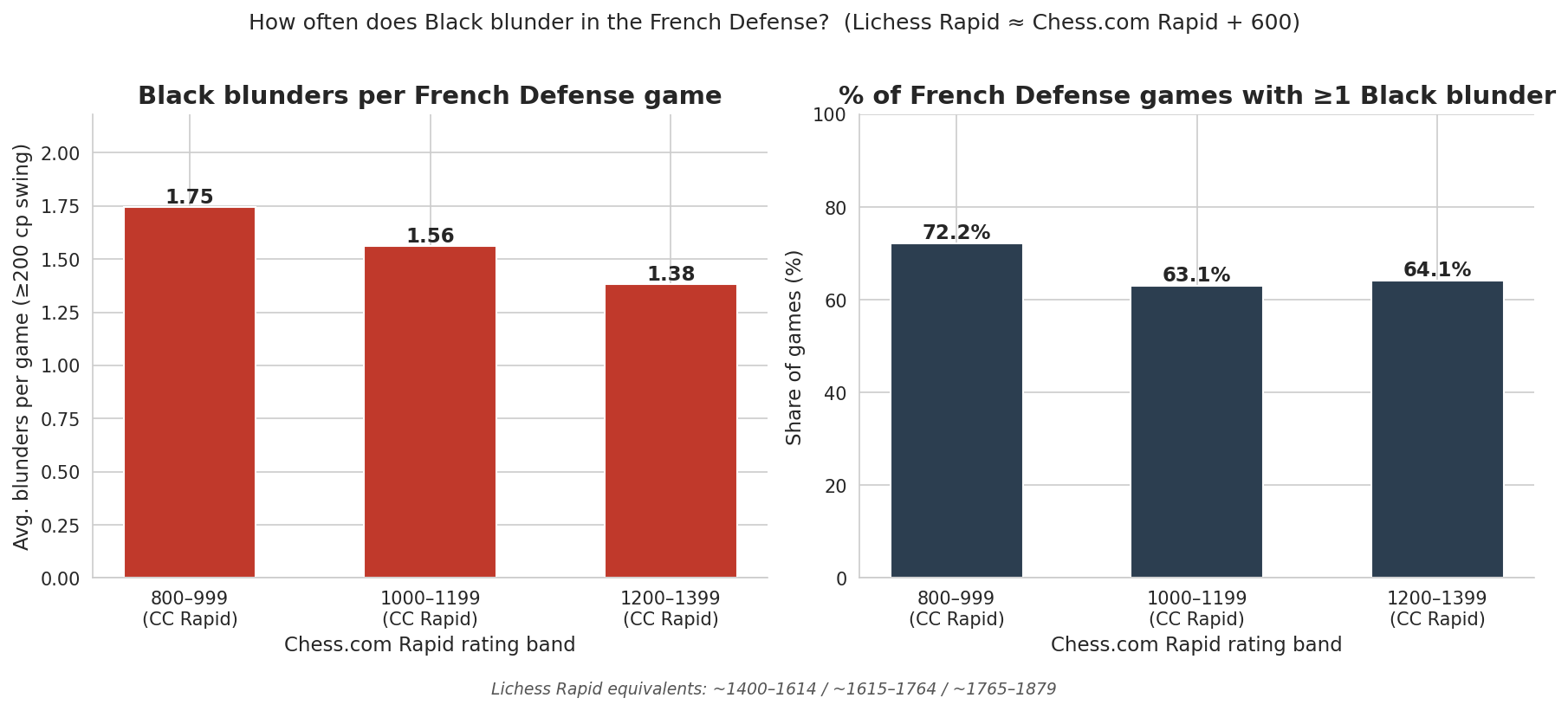
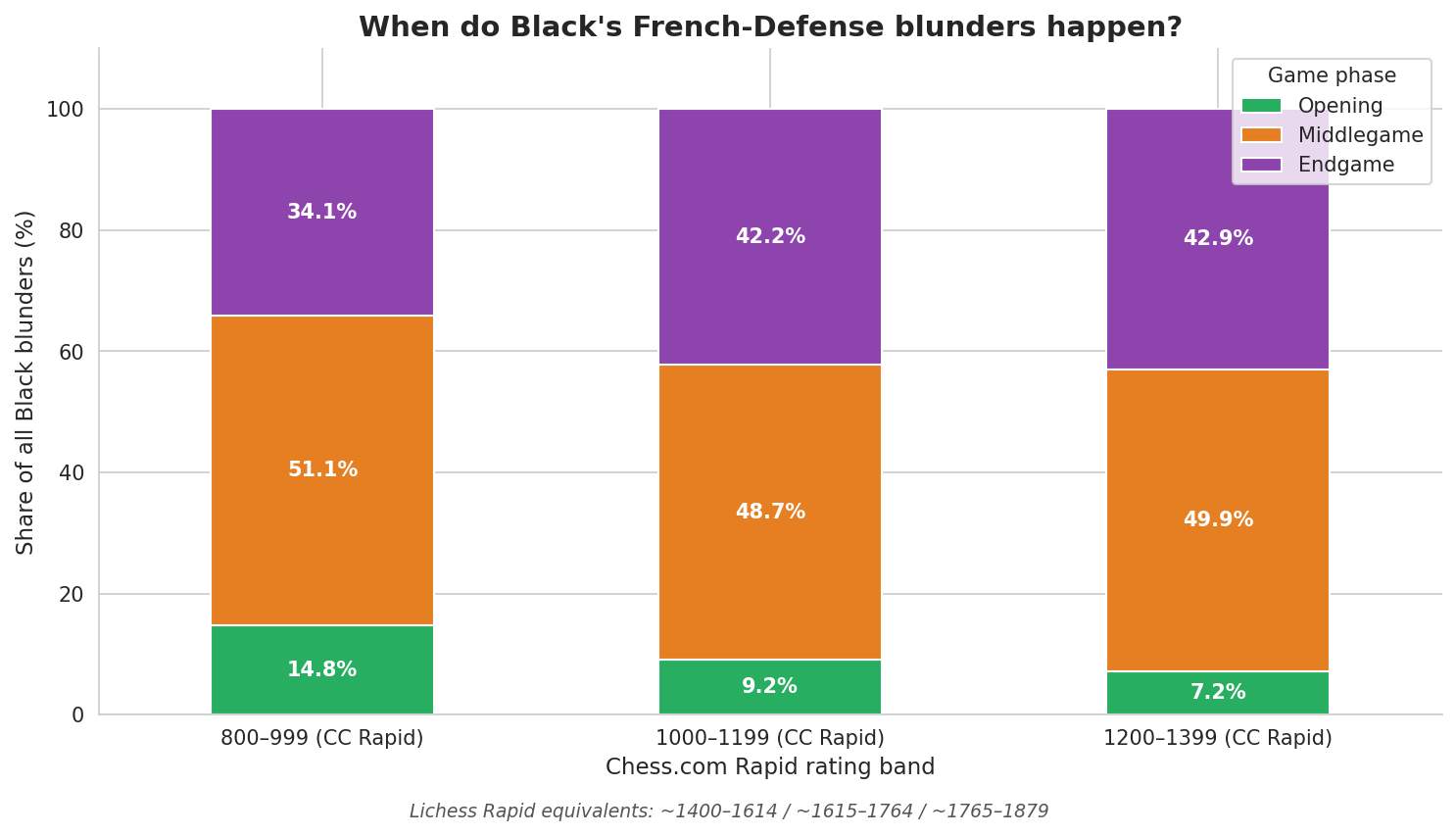
Interestingly, the phase of the game where these blunders occur shifts as ratings increase. For the 800–999 group, 14.8% of blunders happen in the opening, but this drops to just 7.2% for the 1200–1399 group. Across all bands, the middlegame remains the most dangerous phase, accounting for roughly half of all major errors.
Rating Band 800–999: Surviving the Tactical Minefield
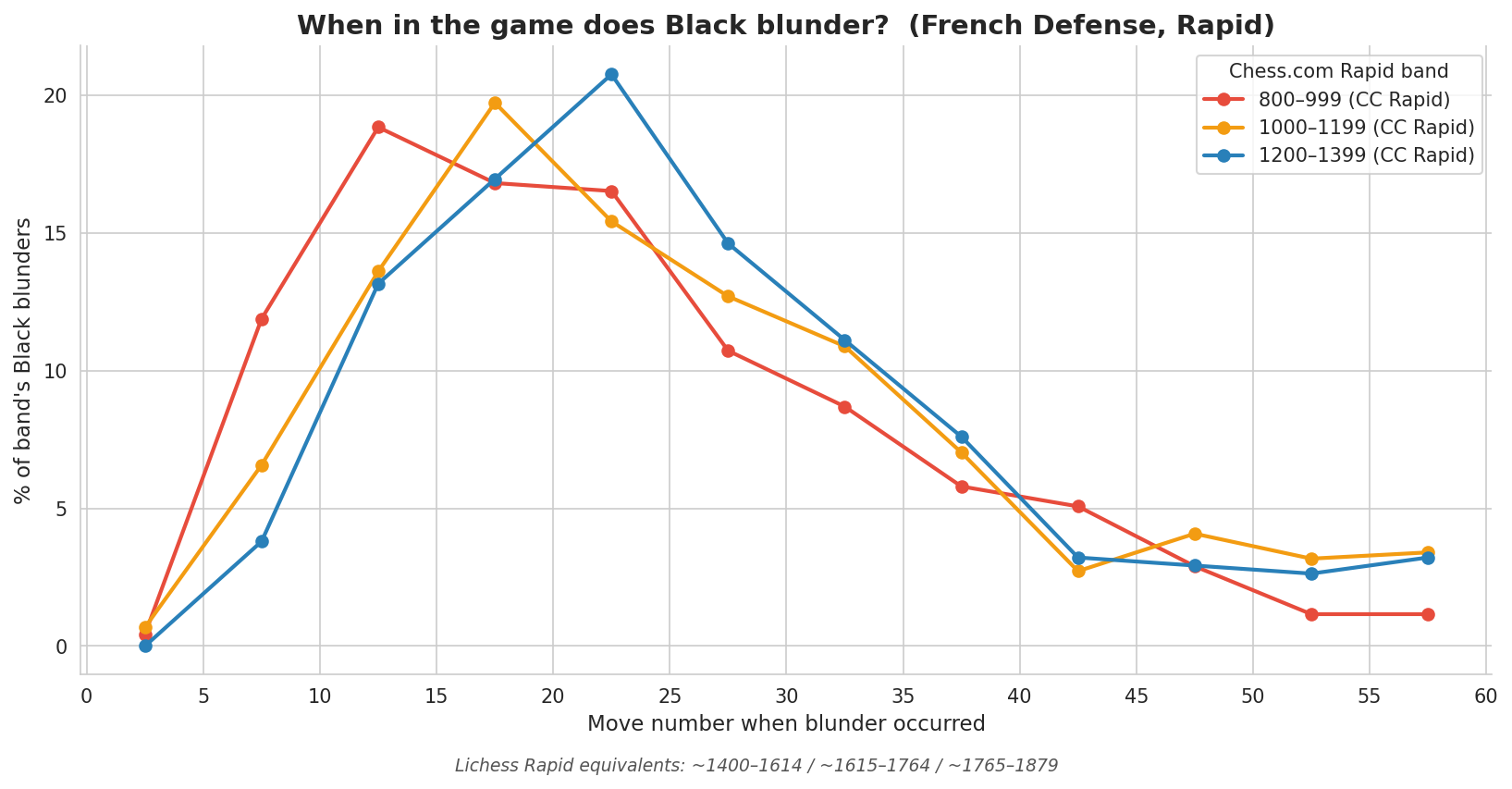
For players in the 800–999 Chess.com Rapid range (roughly equivalent to 1400–1614 on Lichess), the French Defense is often a tactical minefield. The data shows that blunders in this band peak early, typically between moves 7 and 12.
Common Pitfalls
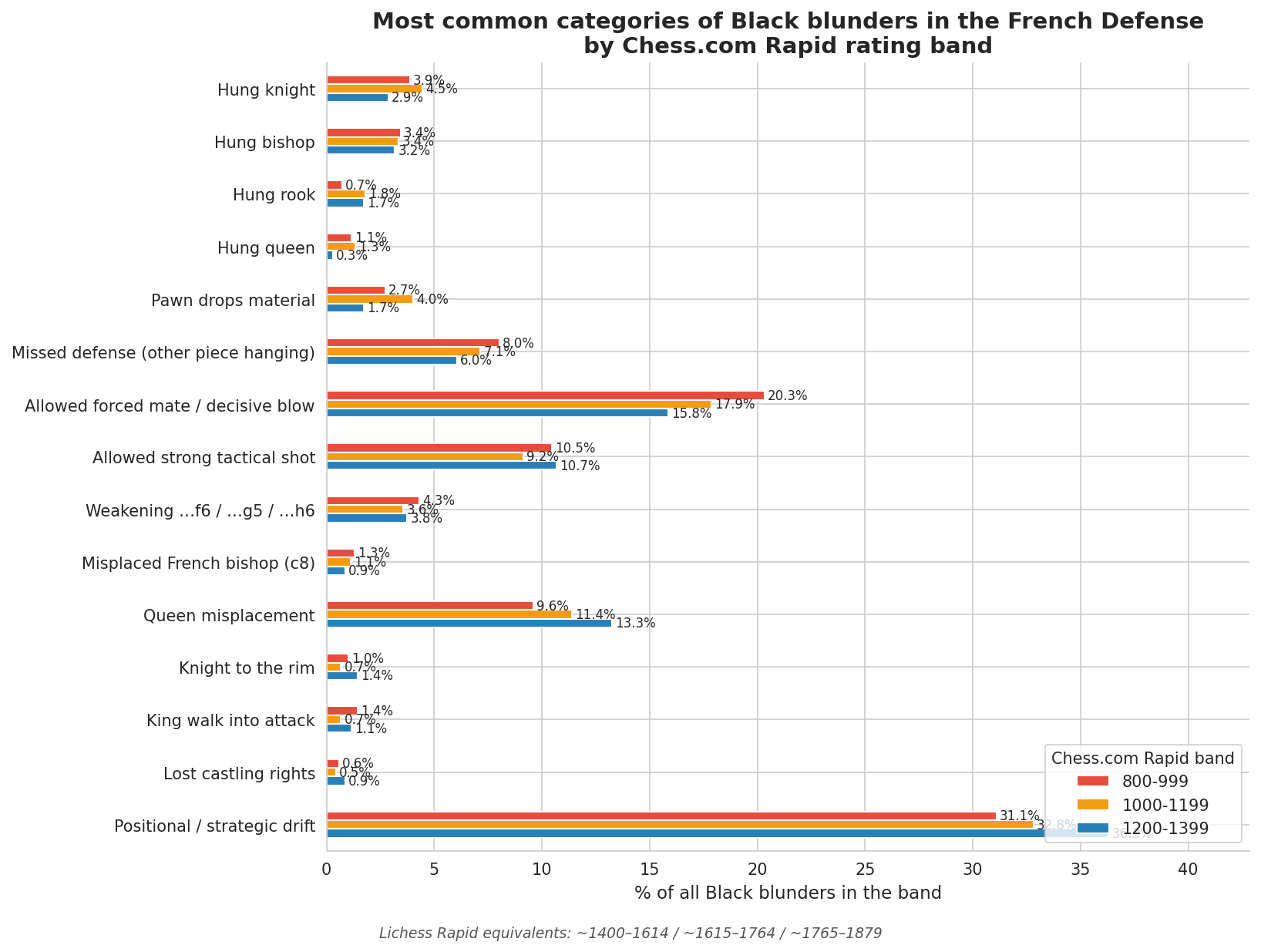
The most frequent specific errors in this band involve allowing forced mates or decisive tactical blows (20.3% of blunders) and simply hanging pieces. Queen misplacement is also a significant issue, accounting for nearly 10% of blunders. Players at this level often bring the queen out too early or place it on squares where it becomes a target, losing crucial tempi.
A classic example of a tactical oversight at this level is the missed defense, where a player focuses on their own plans and fails to notice a hanging piece elsewhere on the board.
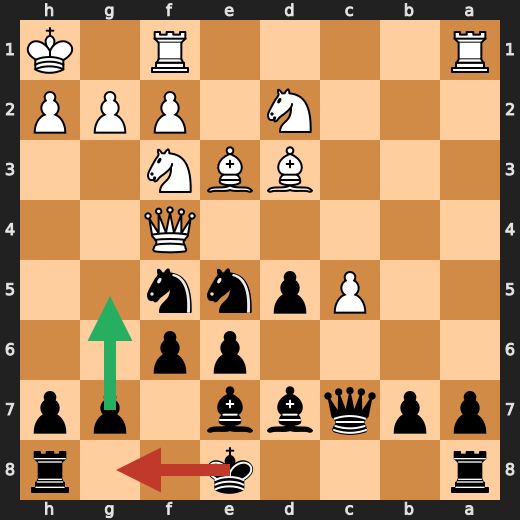 In this position, Black played O-O (red arrow), completely missing that the bishop on d1 was hanging. The engine prefers g5 (green arrow) to challenge White's setup.
Actionable Advice for 800–999
Prioritize Board Vision: Before making any move, perform a quick "blunder check." Ask yourself: "Does my intended move leave any of my pieces undefended?" and "What is my opponent threatening?"
Delay Queen Sorties: Avoid bringing your queen out early unless there is a concrete, forcing tactical reason. In the French Defense, the queen often belongs on c7 or b6, but only after the minor pieces are developed and the center is stabilized.
Focus on Development: The data shows a high rate of opening blunders. Stick to the core principles of the French: challenge the center with ...c5, develop the knights, and prepare to castle.
Rating Band 1000–1199: Managing the Center and the "French Bishop"
As players progress to the 1000–1199 Chess.com Rapid band (Lichess 1615–1764), the nature of the blunders begins to shift. While tactical oversights still occur, positional and strategic drift becomes more prominent, accounting for nearly 33% of all major errors.
Common Pitfalls
In this band, players often struggle with the pawn structure and the notorious "French Bishop" (the light-squared bishop on c8). The data highlights issues with weakening pawn pushes, such as premature ...f6 or ...g5 breaks, which compromise king safety. Additionally, players frequently misplace the c8 bishop, trying to force its development to active squares where it simply becomes a target.
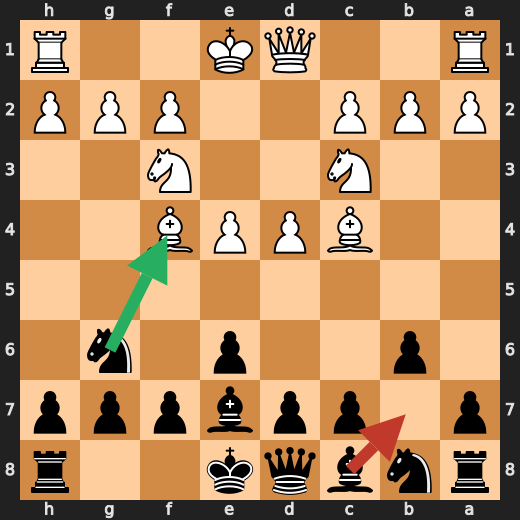 Here, Black played Bb7 (red arrow), placing the bishop on a passive diagonal where it bites on granite. The engine suggests Nxf4 (green arrow) to resolve the tension actively.
Another common issue is the mistimed pawn break. The French Defense relies on precise timing for breaks like ...c5 and ...f6. Executing these breaks when the king is still in the center or when White is fully prepared leads to rapid positional deterioration.
Actionable Advice for 1000–1199
Solve the Bishop Problem Patiently: Do not rush the development of the c8 bishop. Often, it is best deployed to d7 to support the center, or it can be traded off via ...b6 and ...Ba6 if the position allows. Accept that it may be a "bad" bishop for a significant portion of the game.
Time Your Pawn Breaks: The ...c5 break is essential, but ensure your king is safe and your development is adequate before opening the center. Similarly, reserve ...f6 for when you can adequately defend the resulting weaknesses on e6 and g6.
Watch for Hanging Minor Pieces: The data shows a persistent issue with hanging knights and bishops. Double-check the safety of your minor pieces, especially when they are placed on advanced outposts.
Rating Band 1200–1399: Navigating Complex Middlegames
For the 1200–1399 Chess.com Rapid group (Lichess 1765–1879), opening blunders are relatively rare (only 7.2%). The battleground is firmly in the middlegame, where blunders peak later, around moves 17 to 22.
Common Pitfalls
At this level, the blunders are predominantly positional and strategic (36.3%). Players understand the basic tactical motifs but often lose the thread of the position in complex, closed centers. Queen misplacement remains a stubborn issue (13.3%), often involving the queen getting trapped or sidelined on the queenside after an early ...Qb6.
Interestingly, the data shows that players in this band face a wide variety of sidelines from White. The King's Indian Attack (KIA) setups and other non-d4 lines account for over 23% of the games. Black players often stumble because they try to apply standard French Defense plans against these completely different structures.
Actionable Advice for 1200–1399
Adapt to Sidelines: You cannot play the French Defense on autopilot. When White avoids the main lines (e.g., playing 2. d3 or 2. Nf3), you must adjust your strategy. Understand the specific plans against the KIA, such as expanding on the queenside and challenging the center cautiously.
Maintain Positional Tension: In the closed centers typical of the Advance Variation, avoid releasing the tension prematurely. Keep the pressure on d4 and wait for the optimal moment to break.
Evaluate Queen Excursions: Before playing ...Qb6 or ...Qa5, ensure the queen has a clear purpose and a safe retreat path. Do not let the queen become a target for White's minor pieces.
Conclusion
The French Defense is a robust weapon, but it demands precision. By understanding the common blunders specific to your rating band, you can proactively adjust your play. Lower-rated players must focus on basic board vision and tactical awareness, while intermediate players need to refine their handling of the pawn structure and the light-squared bishop. Across all levels, patience and a solid understanding of the resulting middlegame structures are the keys to success.
Chess Coach April 19, 2026
Data and Methodology
This analysis is based on a dataset of Rapid games played on Lichess in 2025, featuring the French Defense (ECO C00-C19). The games were filtered to include only those with engine evaluations. Blunders were defined as moves by Black that resulted in an evaluation swing of at least 200 centipawns in White's favor, provided Black was not already in a completely lost position (evaluation > +3.00).
The Lichess ratings were mapped to approximate Chess.com Rapid ratings using standard conversion tables to ensure the insights are directly applicable to the target audience.
The underlying data files generated during this research are available below:
View full data →band games games_with_black_blunder pct_games_with_black_blunder total_black_blunders blunders_per_game black_win_pct white_win_pct draw_pct 800-999 400 289 72.25 698 1.745 50.75 46.23 3.02 1000-1199 287 181 63.07 448 1.561 46.83 48.94 4.23 1200-1399 251 161 64.14 347 1.382 48.58 46.96 4.45
View full data →band category blunders pct_of_blunders blunders_per_game 800-999 Positional / strategic error (no immediate tactic) 217 31.09 0.542 800-999 Allowed forced mate / decisive combination 142 20.34 0.355 800-999 Allowed a strong tactical shot 73 10.46 0.182 800-999 Queen misplacement / loss of tempo 67 9.6 0.168 800-999 Left another piece hanging (missed defense) 56 8.02 0.14
View full data →band phase blunders pct_of_blunders 800-999 Middlegame 357 51.15 800-999 Endgame 238 34.1 800-999 Opening 103 14.76 1000-1199 Middlegame 218 48.66 1000-1199 Endgame 189 42.19
View full data →band moveNumber 800-999 12 800-999 13 800-999 24 800-999 50 800-999 30
View full data →band subvariation games pct_of_games 800-999 Advance (3.e5) 49 12.25 800-999 2...Nf6 sideline 5 1.25 800-999 KIA / Two Knights / Sideline 116 29.0 800-999 2...c5 sideline 16 4.0 800-999 Other 66 16.5
View full data →band gameId avgRating result ply moveNumber phase subvariation moveSan category detail evalBefore evalAfter swing 800-999 OmTOlB0q 1497 1-0 24 12 Middlegame Advance (3.e5) Ke7 Left another piece hanging (missed defense) N on d4 -258 433 691 800-999 1VgbeWSh 1585 1/2-1/2 26 13 Middlegame KIA / Two Knights / Sideline d4 Left another piece hanging (missed defense) B on e6 73 369 296 800-999 1VgbeWSh 1585 1/2-1/2 48 24 Middlegame KIA / Two Knights / Sideline g5 Weakening king-shelter pawn push (e.g. ...f6/...g5/...h6) g5 225 465 240 800-999 1VgbeWSh 1585 1/2-1/2 100 50 Endgame KIA / Two Knights / Sideline Ke4 Positional / strategic error (no immediate tactic) Ke4 -302 -33 269 800-999 eVFahigb 1404 0-1 60 30 Endgame 2...c5 sideline Qb2+ Queen misplacement / loss of tempo Qb2+ -716 -498 218