The French Defense (1.e4 e6) is one of the most polarizing openings in chess. Some players swear by its solid pawn structure and counter-attacking potential, while others despise the cramped positions and the notorious "bad French bishop." But what does the data actually say about its effectiveness? Does the French Defense hold up as you climb the rating ladder, or is it a trap that only works against beginners?
To answer these questions, we analyzed a massive dataset of over 56,000 Blitz games featuring the French Defense, played by users across various skill levels. We mapped the data to approximate Chess.com Blitz ratings (ranging from 800 to 2000) to provide actionable insights for players looking to improve. This guide will walk you through the statistical realities of the French Defense, highlight the most common pitfalls at each rating band, and offer concrete advice to help you master this complex opening.
The Big Picture: Does the French Defense Work?
The short answer is yes. Across all rating bands from 800 to 2000, the French Defense proves to be a statistically sound choice for Black. When we look at the expected score (win percentage plus half the draw percentage), Black consistently scores around 50% to 51% in the main lines (Advance, Exchange, and General French).
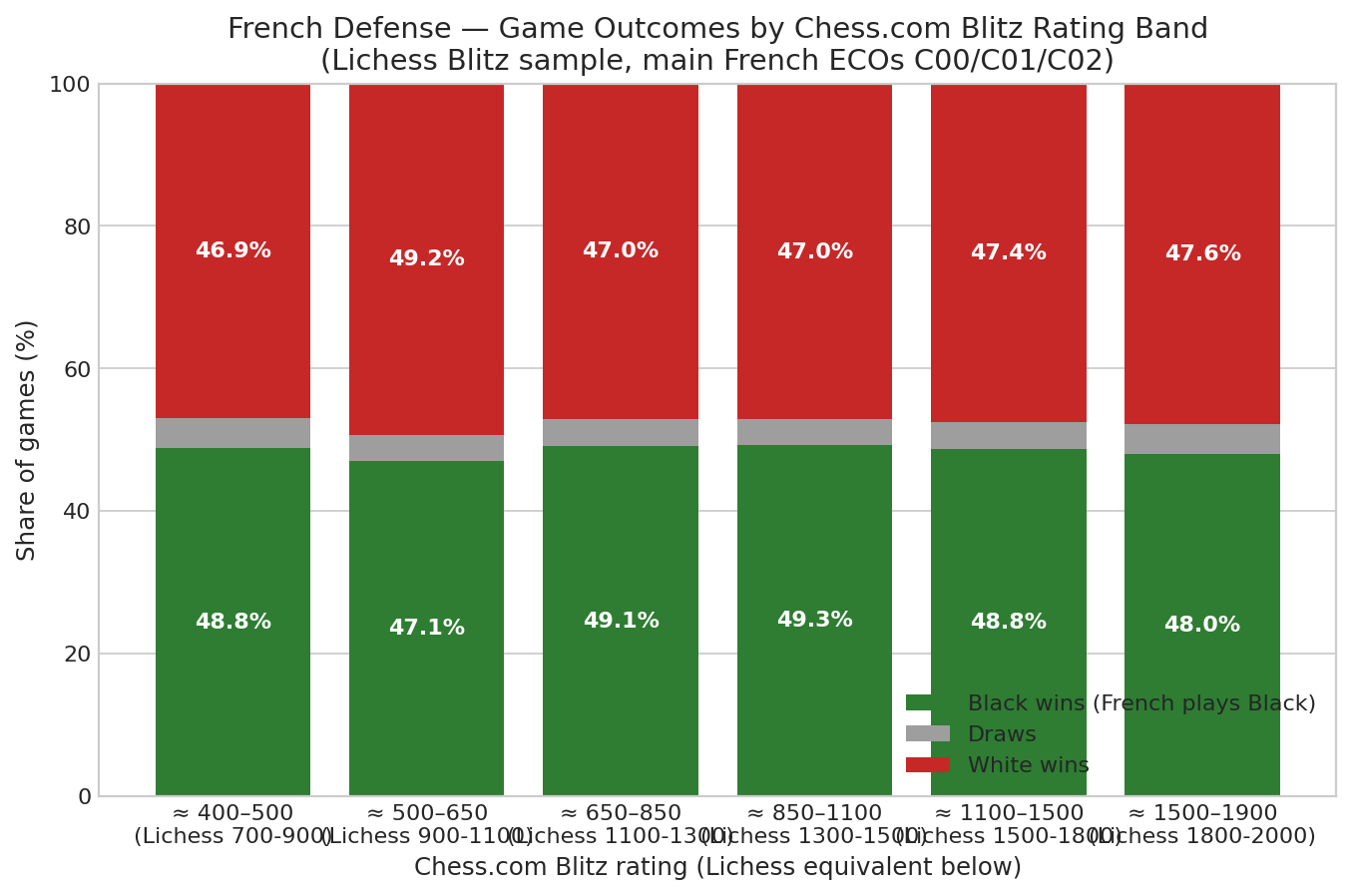
As the chart above illustrates, the win rate for Black remains remarkably stable as ratings increase. While the draw rate creeps up slightly at higher levels (from around 3.5% to 4.3%), the overall expected score stays near the neutral 50% mark. This indicates that the French Defense is not a "trick" opening that relies on opponents blundering; it is a fundamentally sound system that scales well with your skill level.
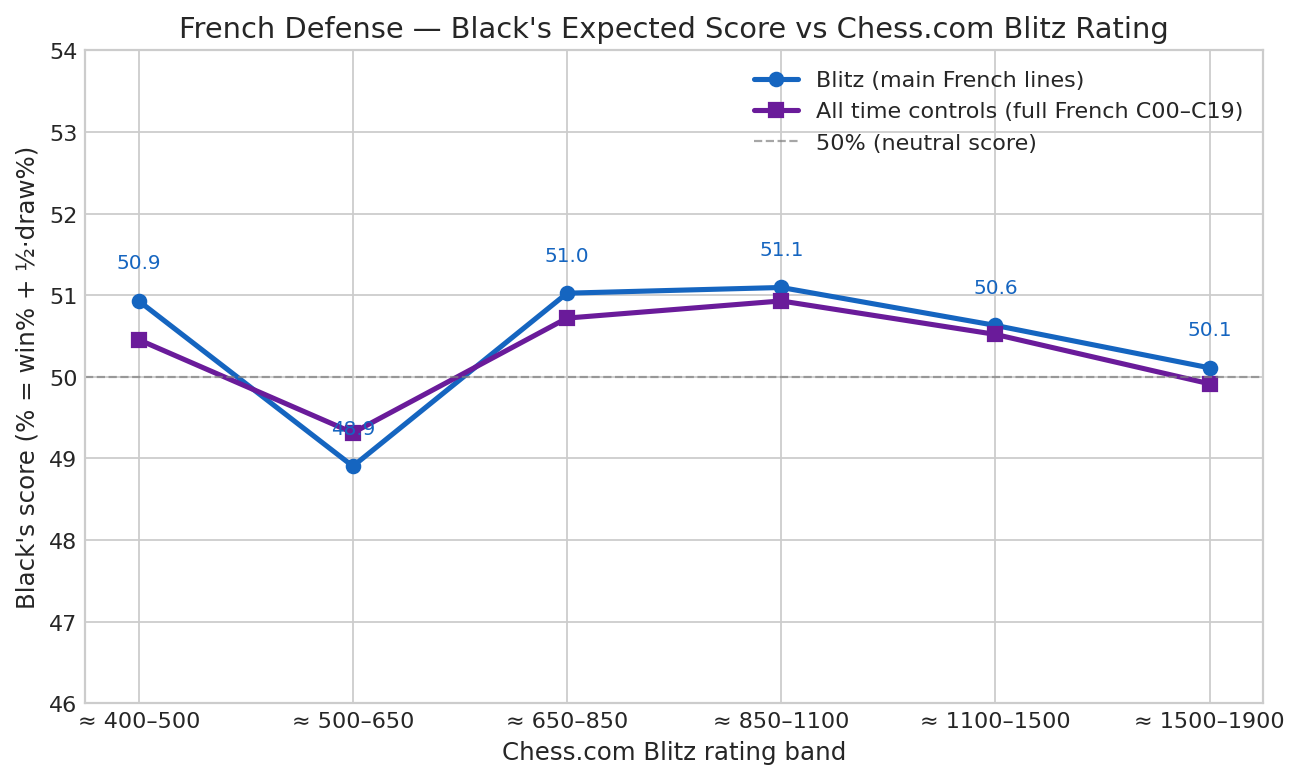
Interestingly, the data shows a slight dip in Black's performance around the 900–1100 rating band (Chess.com equivalent). This is likely the "awkward phase" where opponents stop making obvious one-move blunders but Black players have not yet mastered the nuanced positional ideas required to navigate the cramped French structures. Once players break through the 1100 barrier, the score rebounds and stabilizes.
Variation Breakdown: Which French is Best?
The French Defense is not a monolith; it branches into several distinct variations, each with its own character and statistical profile. We analyzed the performance of the most common variations in Blitz games to see which ones offer the best practical chances for Black.
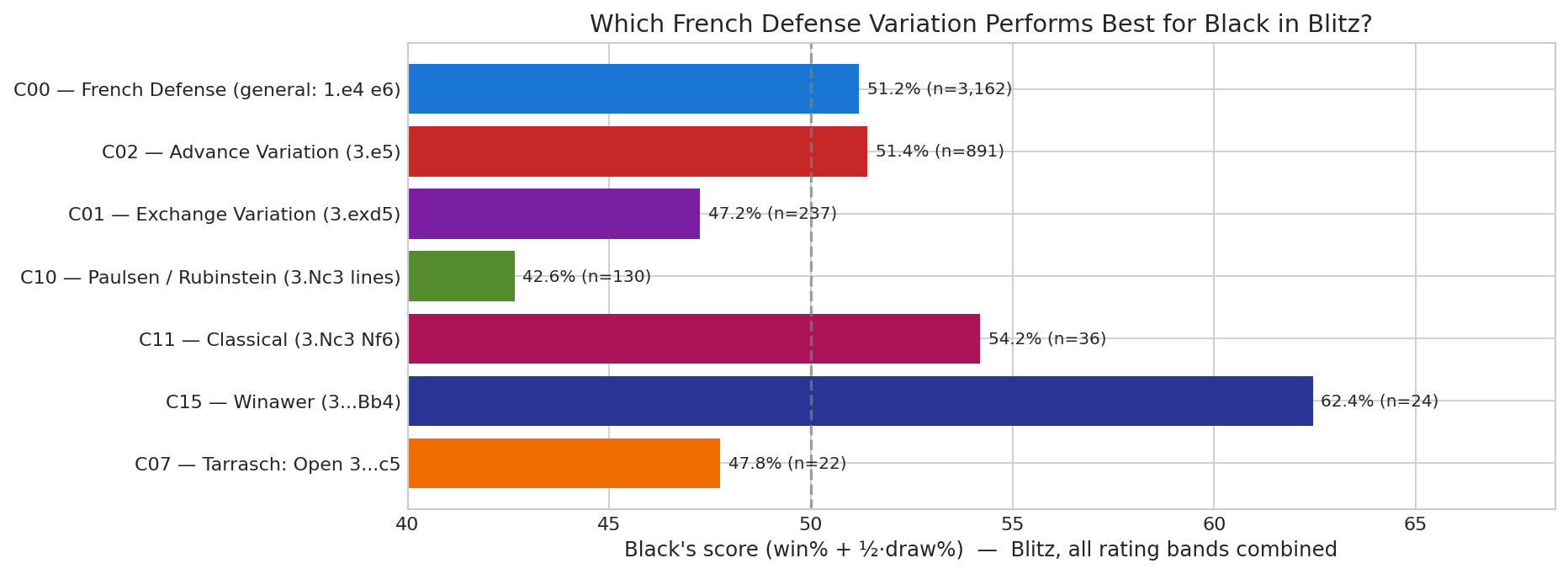
The data reveals some fascinating trends:
- The Advance Variation (3.e5) is the most popular response from White and, surprisingly, one of the best-performing lines for Black, scoring 51.4%. At lower ratings, White players often overextend their center and fail to defend the d4 pawn against Black's thematic pressure (...c5, ...Nc6, ...Qb6).
- The Exchange Variation (3.exd5) is often considered drawish and boring, but it actually scores a subpar 47.2% for Black overall. This suggests that Black players often struggle to generate winning chances in the symmetrical pawn structure, especially if they play passively.
- The Winawer Variation (3...Bb4), while having a smaller sample size in our Blitz dataset, shows a very high win rate for Black (62.4%). This sharp, complex line often catches White players off guard in fast time controls.
- The Rubinstein/Paulsen lines (3.Nc3 dxe4) perform poorly for Black, scoring only 42.6%. Surrendering the center early seems to give White too easy of a game in Blitz.
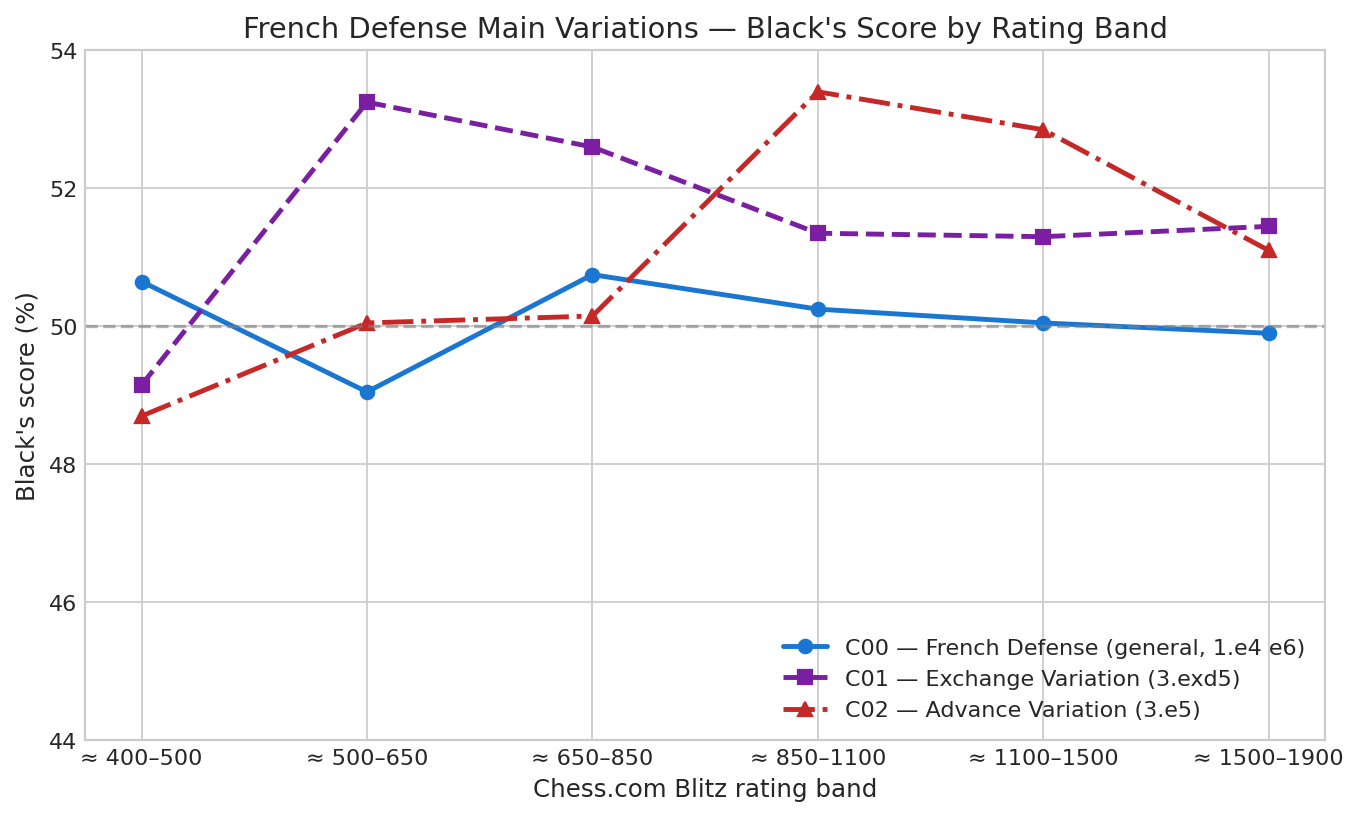
When we track the main variations across rating bands, we see that the Advance Variation (red line) consistently outperforms the Exchange Variation (purple line) for Black, especially as ratings climb above 1100.
Accuracy and Blunders: The Hidden Story
To truly understand how the French Defense plays out, we need to look beyond win rates and examine the quality of the moves being played. We analyzed the Average Centipawn Loss (CPL) and the frequency of major blunders (moves that lose 300 centipawns or more) for both White and Black.
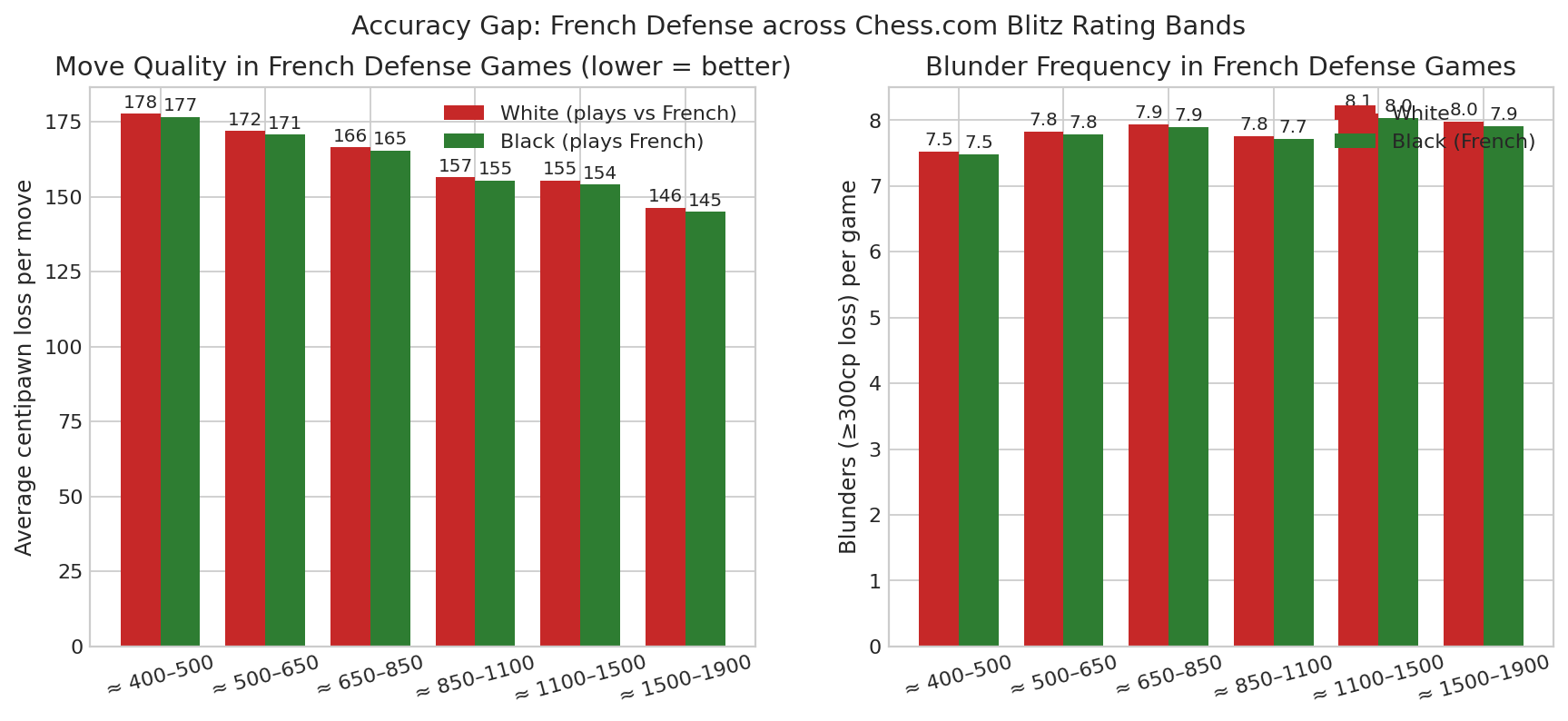
The data reveals a surprising symmetry. Despite Black often having less space and a cramped position, the blunder rate for both sides is nearly identical across all rating bands. In the 800–1100 range, both players average around 7.8 to 7.9 blunders per game. Even at the 1500–1900 level, the blunder rate remains high at around 7.9 per game in Blitz.
This tells us that the French Defense creates complex, difficult-to-play positions where both sides are prone to significant mistakes, especially under time pressure. The player who better understands the typical plans and tactical motifs will have a massive advantage.
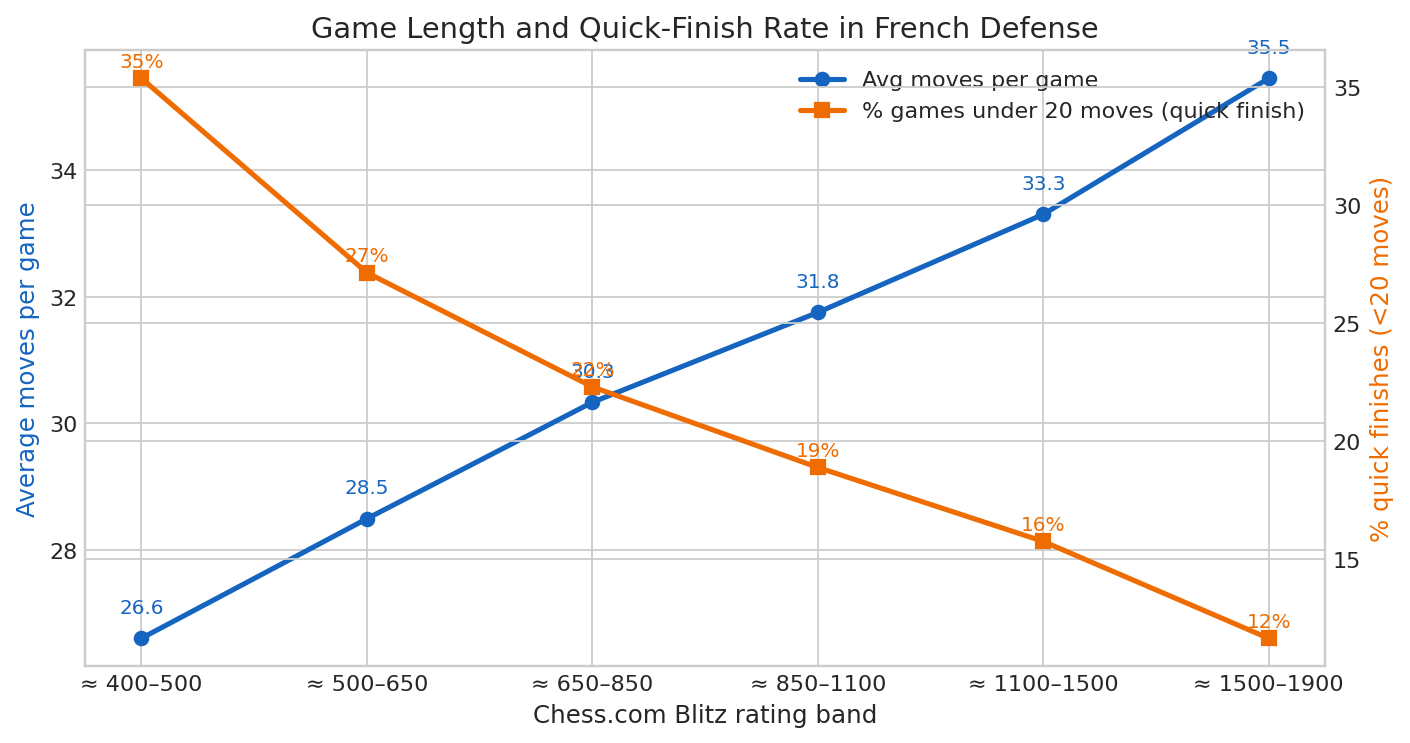
Furthermore, the game length data shows that French Defense games tend to be longer than average, increasing from about 26 moves at the lowest ratings to over 35 moves at the 1500–1900 level. The percentage of "quick finishes" (games ending in under 20 moves) drops dramatically from 35% to 12% as ratings increase. This confirms that the French Defense leads to grinding, strategic battles rather than quick tactical shootouts.
Actionable Advice by Rating Band
Based on the data and common engine evaluations, here is a roadmap for improving your French Defense play at each rating level.
The Foundation Phase (Chess.com 800–1100)
At this level, the most common response from White is the Advance Variation (3.e5). The data shows that Black scores well here, but many players still misunderstand the core strategy.
The Problem: Black players often play too passively, developing their pieces without challenging White's central pawn chain (d4 and e5). A common mistake is playing ...Nge7 or ...Bd7 too early, allowing White to solidify their position.
The Solution: You must attack the base of White's pawn chain (d4) immediately. The thematic moves are ...c5, ...Nc6, and ...Qb6.
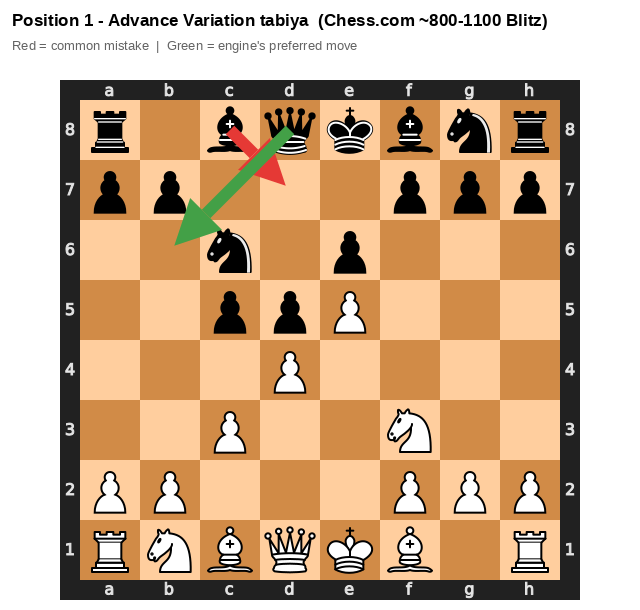
In the position above, the red arrow shows the passive and inaccurate ...Bd7. The green arrow highlights the engine's preferred move, ...Qb6, which puts immense pressure on d4 and b2, forcing White to make difficult defensive decisions.
The Awkward Phase (Chess.com 1100–1500)
This is the rating band where Black's overall score dips slightly. Opponents are less likely to blunder their center pawns in the Advance Variation, and they start playing the Exchange Variation more effectively.
The Problem in the Exchange: In the symmetrical structure of the Exchange Variation, Black often plays too passively, mimicking White's moves (e.g., playing ...Bd6 after White plays Bd3). This allows White to dictate the pace and often launch an attack.
The Solution: Break the symmetry and create imbalances.
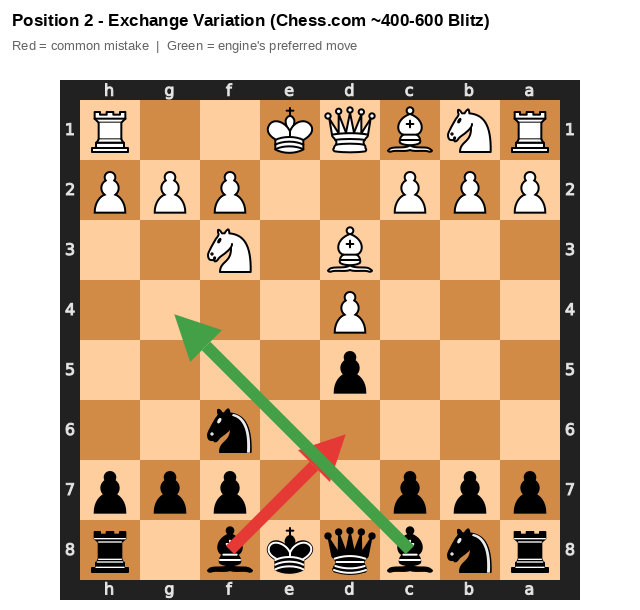
Instead of the passive ...Bd6 (red arrow), the engine prefers ...Bg4 (green arrow), immediately pinning White's knight and creating tension.
The Problem in the Winawer: As players start exploring sharper lines like the Winawer (3.Nc3 Bb4), they often fall for tempting but losing tactical traps.
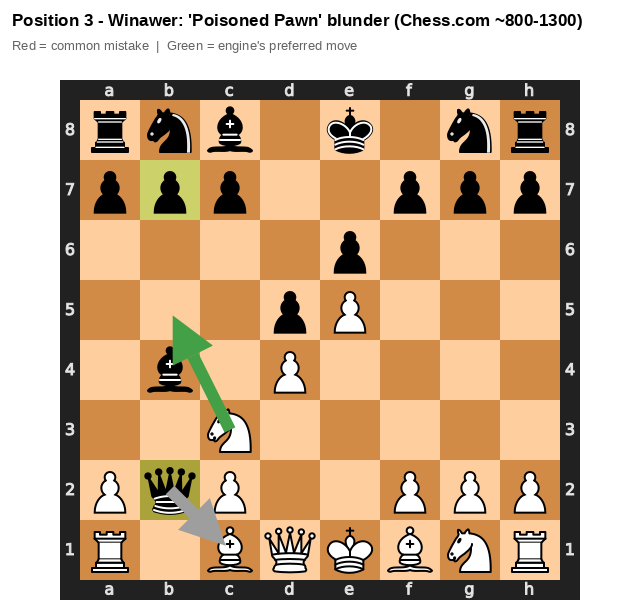
A classic blunder in this rating range is the "Poisoned Pawn" grab. After 1.e4 e6 2.d4 d5 3.Nc3 Bb4 4.e5, Black plays the greedy ...Qxb2? (indicated by the grey arrow). White responds with Nb5 (green arrow), attacking the Queen and threatening a devastating fork on c7. Black loses material by force.
The Mastery Phase (Chess.com 1500–2000)
At this level, players are well-versed in the main lines. The games become longer, more strategic grinds. The key to success here is understanding the nuanced pawn breaks in the Classical and Tarrasch variations.
The Problem in the Classical: In the Classical Variation (3.Nc3 Nf6), Black often struggles to find counterplay if White plays solidly. A common mistake is trying to expand on the queenside too slowly with moves like ...b6.
The Solution: The ...c5 pawn break is essential to challenge White's center and activate Black's pieces.
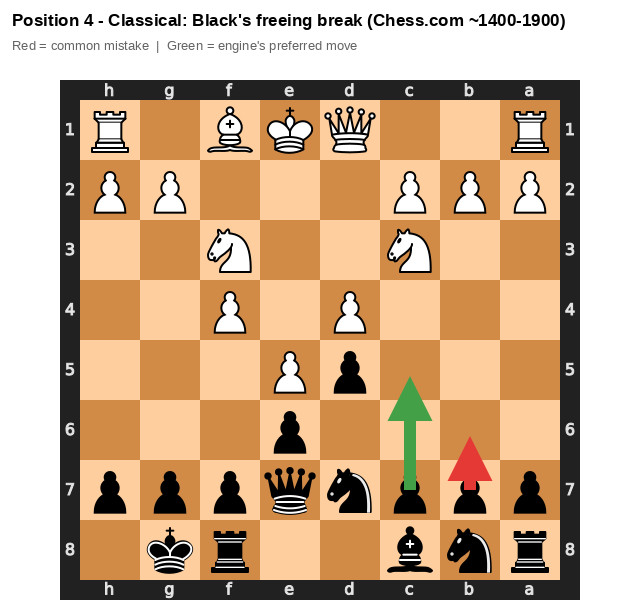
Instead of the slow ...b6 (red arrow), Black must strike with ...c5 (green arrow) to fight for central control.
The Problem in the Tarrasch: The Tarrasch Variation (3.Nd2) is designed to avoid the pin from ...Bb4. Black often struggles to develop the light-squared bishop and can end up with a very cramped position if they release the central tension too early.
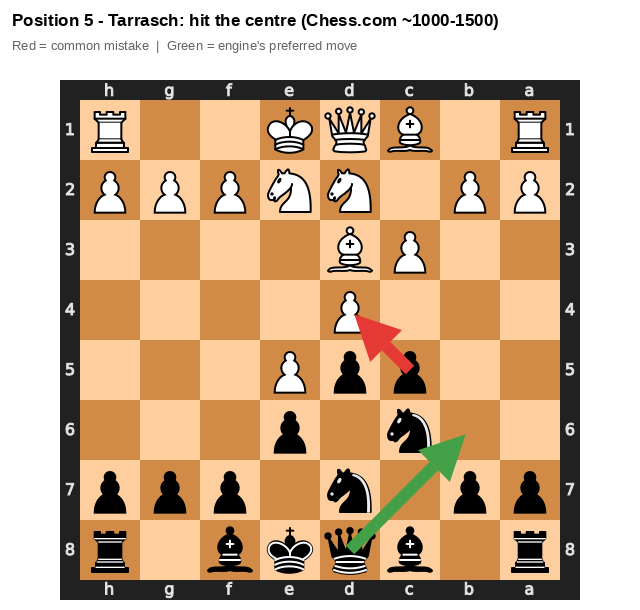
A common inaccuracy is capturing on d4 too soon (...cxd4, red arrow), which clarifies the center for White. The engine prefers maintaining the tension and increasing the pressure with ...Qb6 (green arrow).
Conclusion
The data clearly shows that the French Defense is a robust and effective weapon for Black across all rating bands from 800 to 2000. While it requires patience and a solid understanding of pawn structures, it rewards players who are willing to navigate its complexities. By focusing on the thematic pawn breaks (...c5 and ...f6) and avoiding common passive setups, you can turn the French Defense into a reliable point-scoring machine.
Data and Methodology
The analysis in this article is based on a dataset of 56,840 Lichess games featuring the French Defense (ECO codes C00-C19), played at Blitz time controls. The data was collected using the grandmaster-guide MCP server.
To make the insights relevant to Chess.com users, we mapped the Lichess rating bands to approximate Chess.com Blitz ratings using the following conversion:
| Lichess Blitz Band | Approximate Chess.com Blitz Rating |
|---|---|
| 700-900 | 400-500 |
| 900-1100 | 500-650 |
| 1100-1300 | 650-850 |
| 1300-1500 | 850-1100 |
| 1500-1800 | 1100-1500 |
| 1800-2000 | 1500-1900 |
The underlying data used to generate the charts and statistics in this article can be found in the attached CSV files:
french_blitz_by_band.csv: Aggregated statistics for the main French lines (C00, C01, C02) in Blitz games.french_all_by_band.csv: Aggregated statistics for all French variations (C00-C19) across all time controls.french_variations_blitz.csv: Performance data for specific French variations in Blitz games.french_variations_by_band.csv: Performance data for specific French variations broken down by rating band.
Chess Coach <2026-04-19>