The French Defense (1.e4 e6) is one of the most polarizing openings in chess. For some, it is an impenetrable fortress; for others, a cramped, passive struggle. But how does it actually perform under the intense time pressure of Bullet chess? Does the French defender's win rate improve as they climb the rating ladder, or do stronger opponents learn to crack the structure?
To answer these questions, we analyzed over 2,100 French Defense Bullet games played on Lichess, mapping the data to Chess.com Blitz rating bands from 800 to 2000. This article serves as a roadmap for intermediate players looking to understand the statistical realities of the French Defense and how to adapt their repertoire as they improve.
1. The Overall Trend: Does the French Get Better With Rating?
A common assumption is that the French Defense is too complex for beginners but becomes a powerful weapon in the hands of masters. The data tells a slightly different story in Bullet chess.
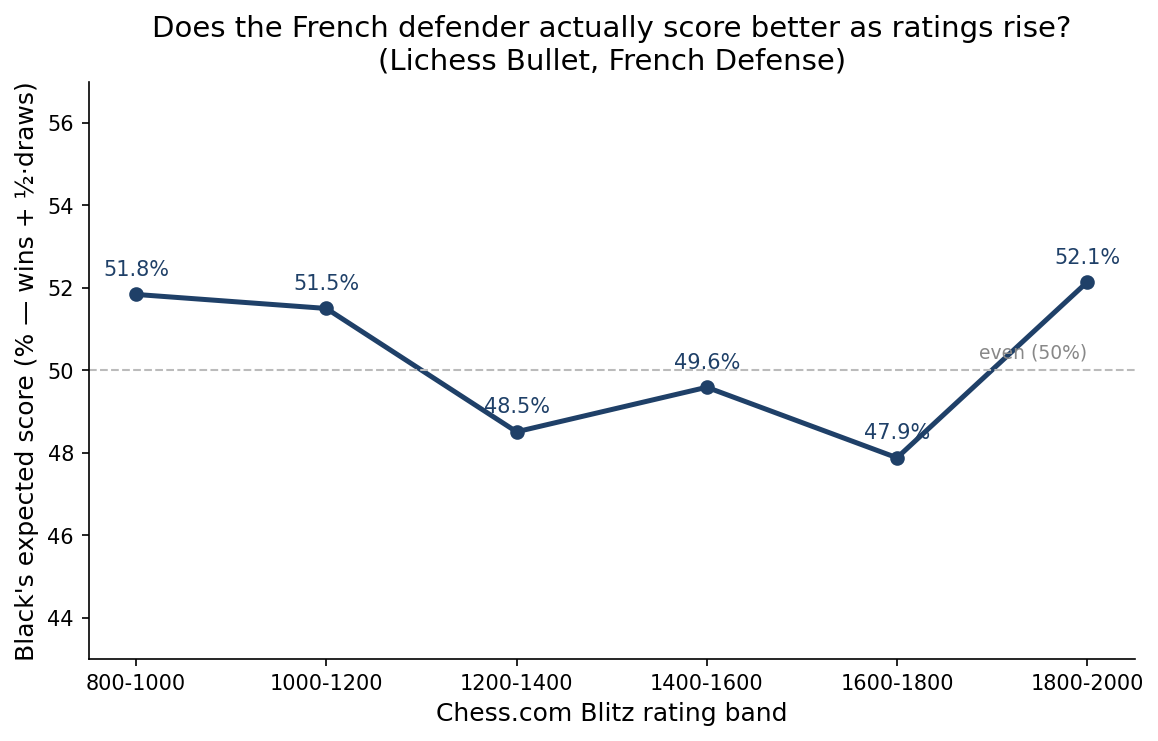
As the chart above illustrates, Black's expected score (wins plus half of draws) starts strong at the 800-1000 level (51.8%). At this rating, White players often struggle to navigate the closed pawn structures and frequently overextend or blunder material.
However, as we move into the intermediate bands (1200-1800), Black's score dips below 50%. Here, White players have learned the basic attacking plans against the French (such as the Greek Gift sacrifice or kingside pawn storms) while Black players may still struggle with the cramped position and the notoriously bad "French Bishop" on c8.
It is only when players reach the 1800-2000 band that Black's score rebounds to a dominant 52.1%. At this level, Black players have mastered the necessary counterplay (typically involving ...c5 and ...f6 breaks) and can effectively punish White's overextensions.
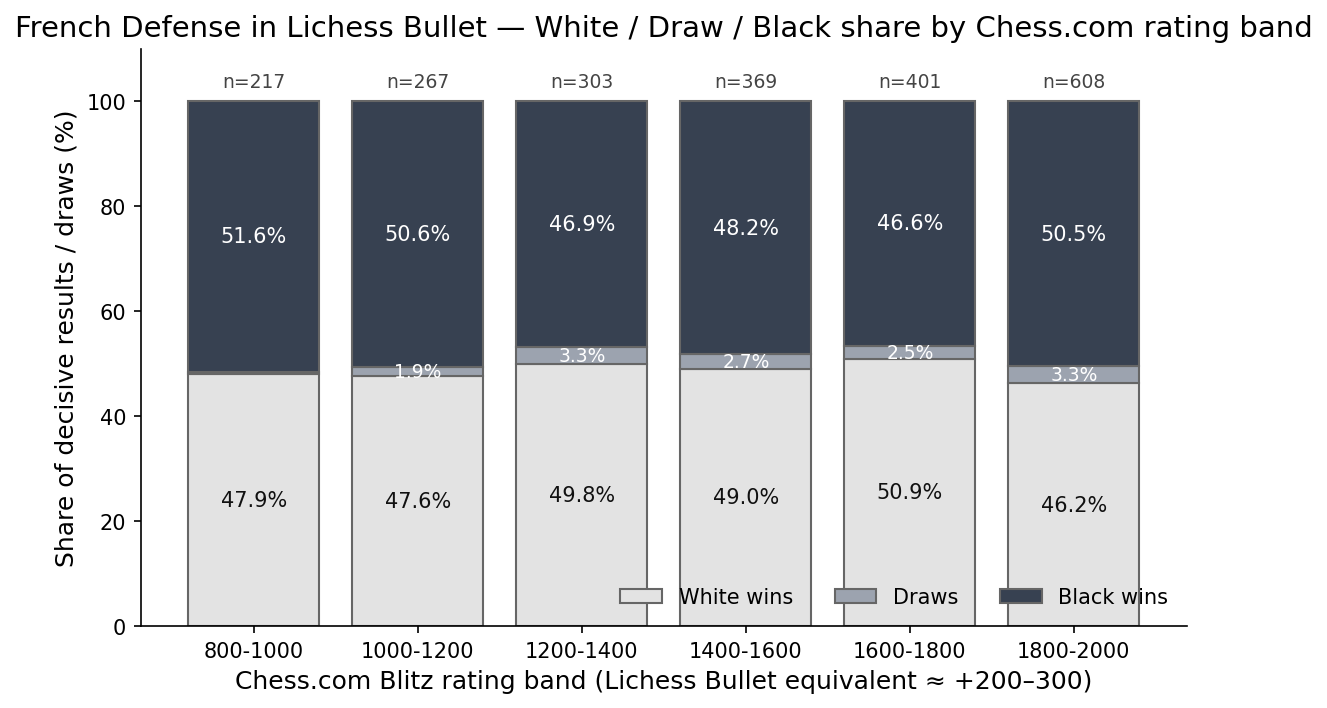
Actionable Advice by Rating:
- 800-1200: Focus on basic tactics and surviving the opening. White will often blunder if you simply maintain a solid structure.
- 1200-1600: This is the danger zone. You must actively study White's attacking plans and learn how to generate counterplay on the queenside or center. Passive defense will lead to a slow death.
- 1600-2000: Refine your understanding of specific sub-variations and pawn breaks. Your ability to transition from defense to counter-attack is what will win games here.
2. The Popularity Contest: Who Plays the French?
Is the French Defense a niche choice or a mainstream weapon?
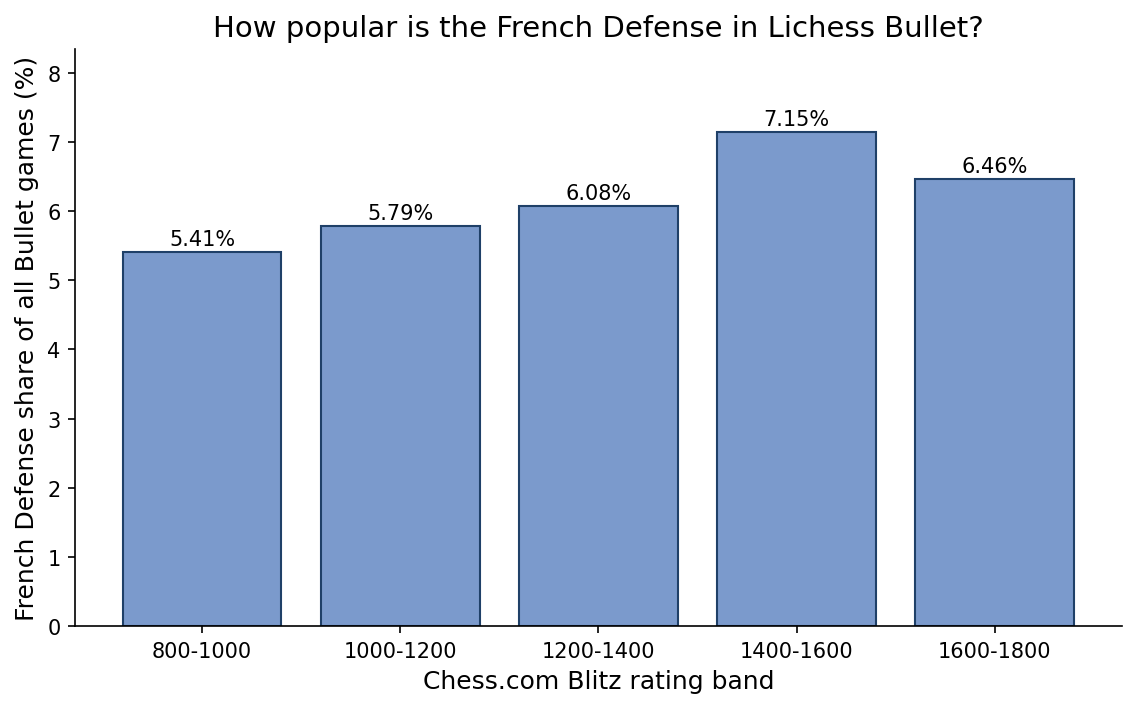
The French Defense accounts for roughly 5.5% to 7% of all Bullet games where Black faces 1.e4. Its popularity peaks in the 1400-1600 band (7.15%). This suggests that as players move out of the beginner phase, they actively seek out structured, theoretical openings like the French to avoid the chaos of open games (1.e4 e5).
3. Variation Breakdown: What Actually Works?
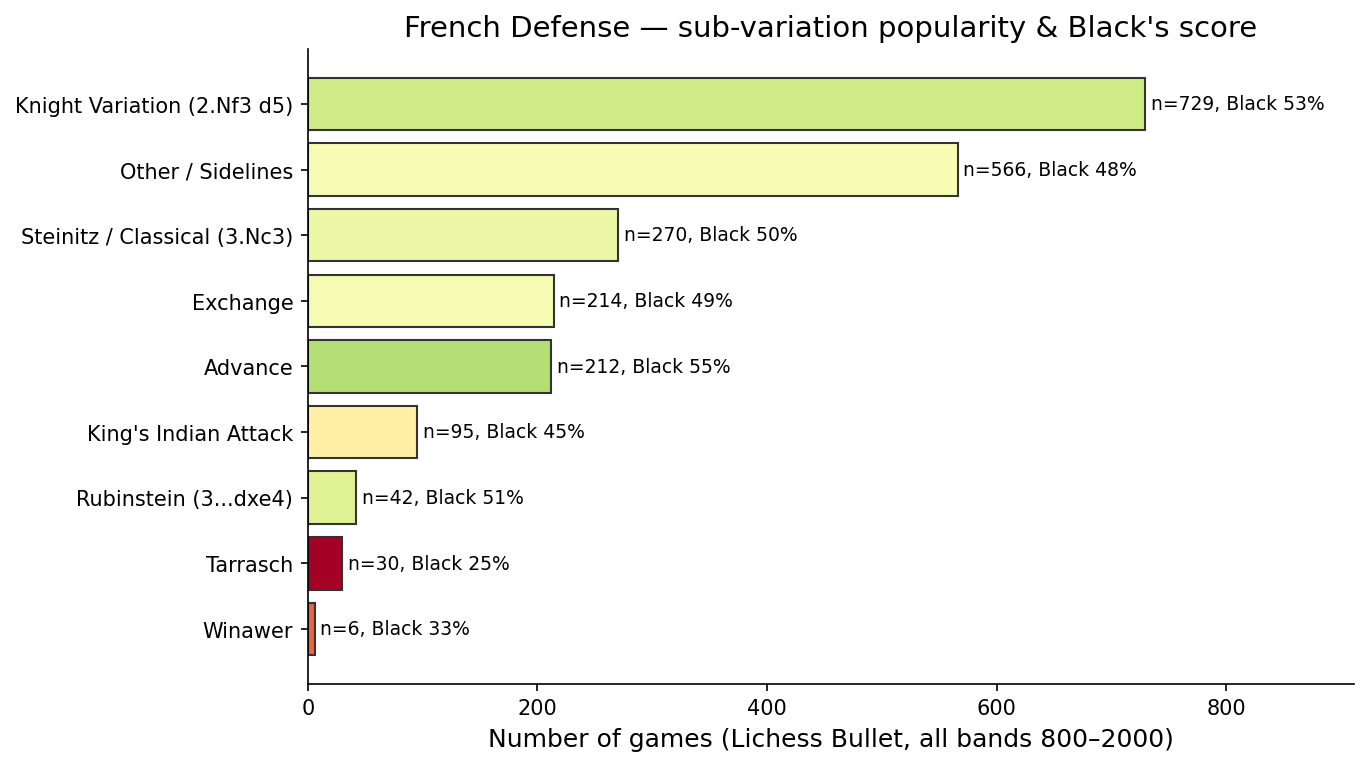
The French Defense is not a monolith; it branches into several distinct variations, each with its own strategic flavor. We analyzed the performance of the most common sub-variations.
The Advance Variation (3.e5)
Often feared by club players, the Advance Variation is actually where Black performs best overall, scoring an impressive 55% expected score.
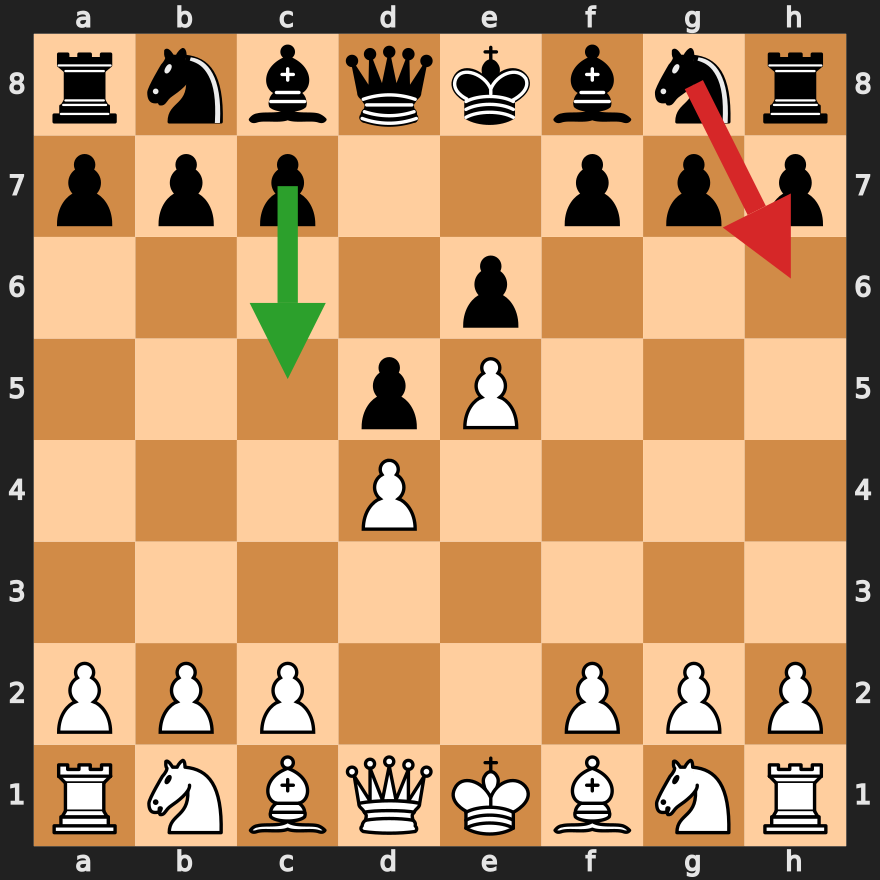
The Advance Variation. Black's best plan is the immediate 3...c5 (green arrow), attacking the base of White's pawn chain. A common beginner mistake is 3...Nh6 (red arrow), which is passive and allows White to maintain their space advantage.
Actionable Advice: Do not fear the Advance Variation. Learn the theory behind the immediate ...c5 break, followed by ...Nc6 and ...Qb6. If you can consistently apply pressure to White's d4 pawn, you will score heavily.
The Exchange Variation (3.exd5 exd5)
Known for its symmetry and drawish reputation, the Exchange Variation is surprisingly decisive in Bullet chess. Black scores a respectable 49% overall.
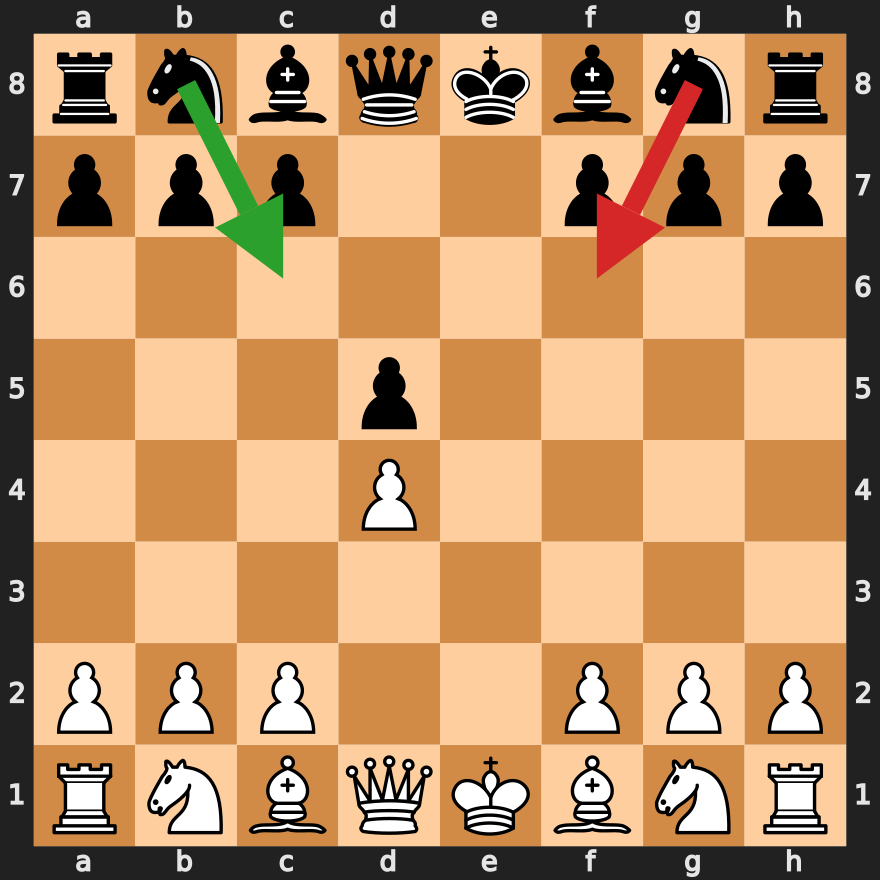
The Exchange Variation. Black should aim for active development with ...Nc6 (green arrow) and ...Bd6. Playing symmetrically with ...Nf6 (red arrow) often leads to passive positions where White can dictate the pace.
Actionable Advice: Avoid playing for a draw. Use the open e-file and aim for active piece placement. Asymmetrical setups (e.g., castling queenside or early ...c5 breaks) can create the imbalances needed to win in Bullet.
The Tarrasch Variation (3.Nd2)
The Tarrasch is statistically the most dangerous variation for Black in our sample, with Black scoring a dismal 25% (though the sample size is small).
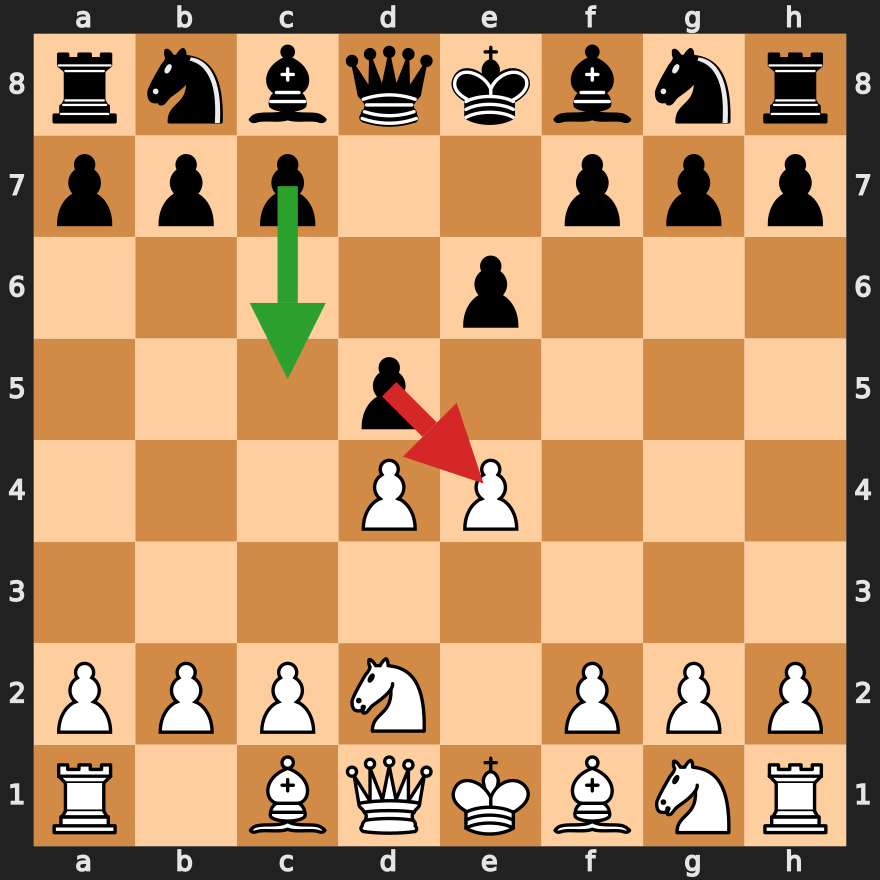
The Tarrasch Variation. Black must challenge the center immediately with 3...c5 (green arrow) or 3...Nf6. The passive 3...dxe4 (red arrow), known as the Rubinstein Variation, often leads to cramped positions where White has a free hand.
Actionable Advice: If you face the Tarrasch, you must be prepared. The Open System (3...c5) is highly recommended for Bullet chess as it leads to dynamic, open positions where tactical awareness is paramount.
The King's Indian Attack (2.d3)
When White plays 2.d3, they are often trying to avoid mainstream French theory. Black scores poorly here (45%).
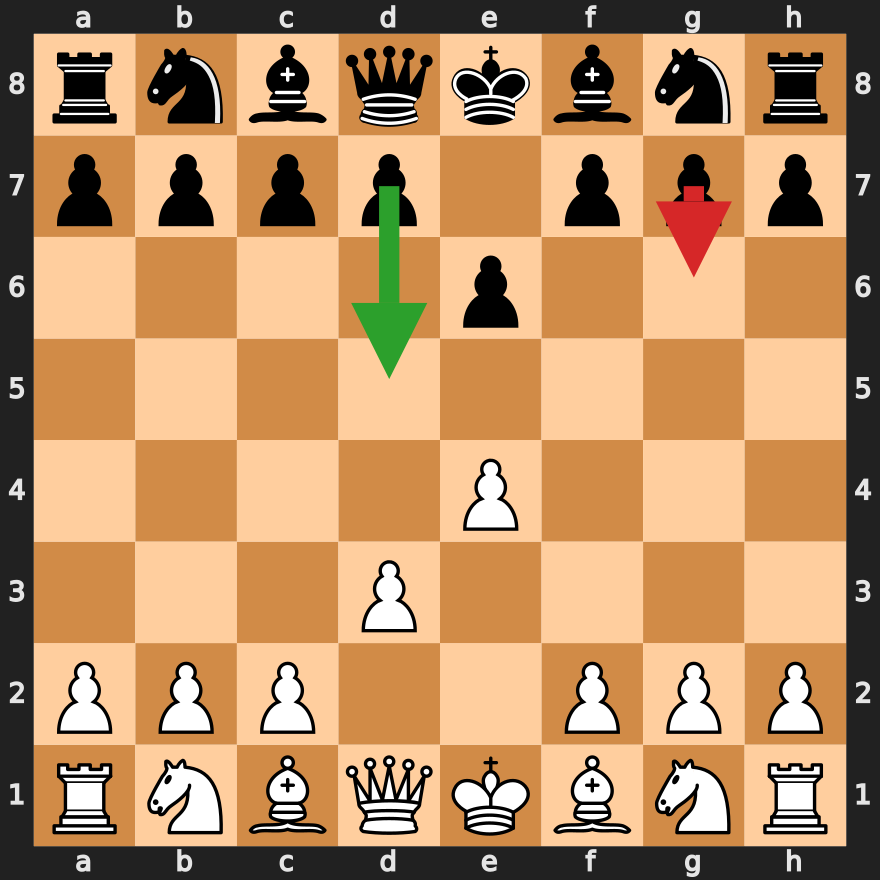
The King's Indian Attack setup. Black must immediately claim the center with 2...d5 (green arrow). Reverting to a King's Indian Defense setup with ...g6 (red arrow) gives White exactly what they want: a free hand to attack on the kingside.
Actionable Advice: Do not let White dictate the structure. Play ...d5 and ...c5 aggressively. Treat it as a reversed King's Indian Defense where you have an extra tempo.
4. How Do Games End?
Bullet chess is notorious for time scrambles, and the French Defense is no exception.
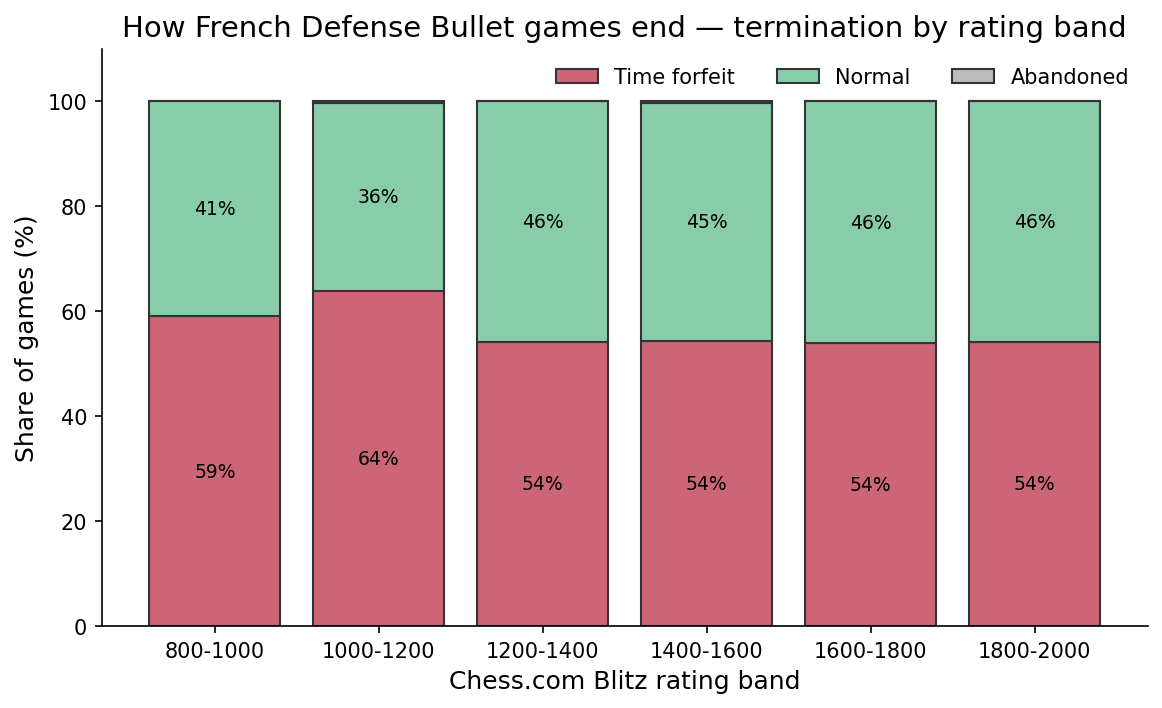
Across all rating bands, the majority of games (54% to 64%) end in a Time Forfeit. The closed, maneuvering nature of the French Defense means that players often burn significant time navigating the early middlegame, leading to frantic clock scrambles in the endgame.
Actionable Advice: Time management is critical. You must know your opening lines well enough to play the first 10-15 moves almost instantly. The player who reaches the complex middlegame with more time on the clock has a massive advantage.
Conclusion
The French Defense is a robust and effective weapon in Bullet chess, provided you understand its nuances. While it may require weathering a difficult period in the intermediate rating bands, mastering the necessary pawn breaks and counter-attacking plans will reward you handsomely as you approach the 2000 level.
Embrace the Advance Variation, fight actively in the Exchange, and prepare diligently for the Tarrasch. Most importantly, manage your clock—in the French Defense, time is often your most valuable piece.
Chess Coach April 19, 2026
Data and Methodology
This analysis is based on a sample of 2,167 French Defense Bullet games extracted from a larger dataset of ~950,000 Lichess games.
- Platform Calibration: The data was collected from Lichess. To make the insights actionable for Chess.com users, we mapped the Lichess Bullet ratings to approximate Chess.com Blitz ratings (e.g., Chess.com 1200 ≈ Lichess 1475).
- Time Control: Bullet games were defined as having a base time of ≤120 seconds and an estimated total time (base + 40*increment) of <180 seconds.
- Opening Classification: Games were classified as French Defense if the Opening tag began with "French Defense" or if the ECO code was C00-C19 and the first moves were 1.e4 e6.
Underlying Data Files: