A data-driven roadmap for intermediate players looking to optimize their response to 1.e4.
The Sicilian Defense (1.e4 c5) is the most popular, most analyzed, and arguably most feared response to 1.e4 in chess history. At the Grandmaster level, it is the weapon of choice for playing for a win with the black pieces. But what happens when we descend from the heights of elite chess to the trenches of intermediate online play? Specifically, what is the "Expected Value" (EV) of playing the Sicilian Defense for a player rated around 1500 on Chess.com?
To answer this, we analyzed over 120,000 Rapid games played on Lichess, mapping the data to Chess.com rating bands to provide actionable insights for players climbing the rating ladder. This article serves as a roadmap, breaking down the statistical reality of the Sicilian Defense from the 800 level up to 1500 and beyond.
1. The EV Premium: Does the Sicilian Actually Score Better?
The short answer is yes. Across every rating band from Beginner (Chess.com 800) to Club level (Chess.com 1700), the Sicilian Defense yields a higher Expected Value for Black than the traditional 1…e5 (the Open Game).
Note: Expected Value (EV) is calculated as Win% + (0.5 × Draw%). An EV of 50% means Black is scoring equally with White.
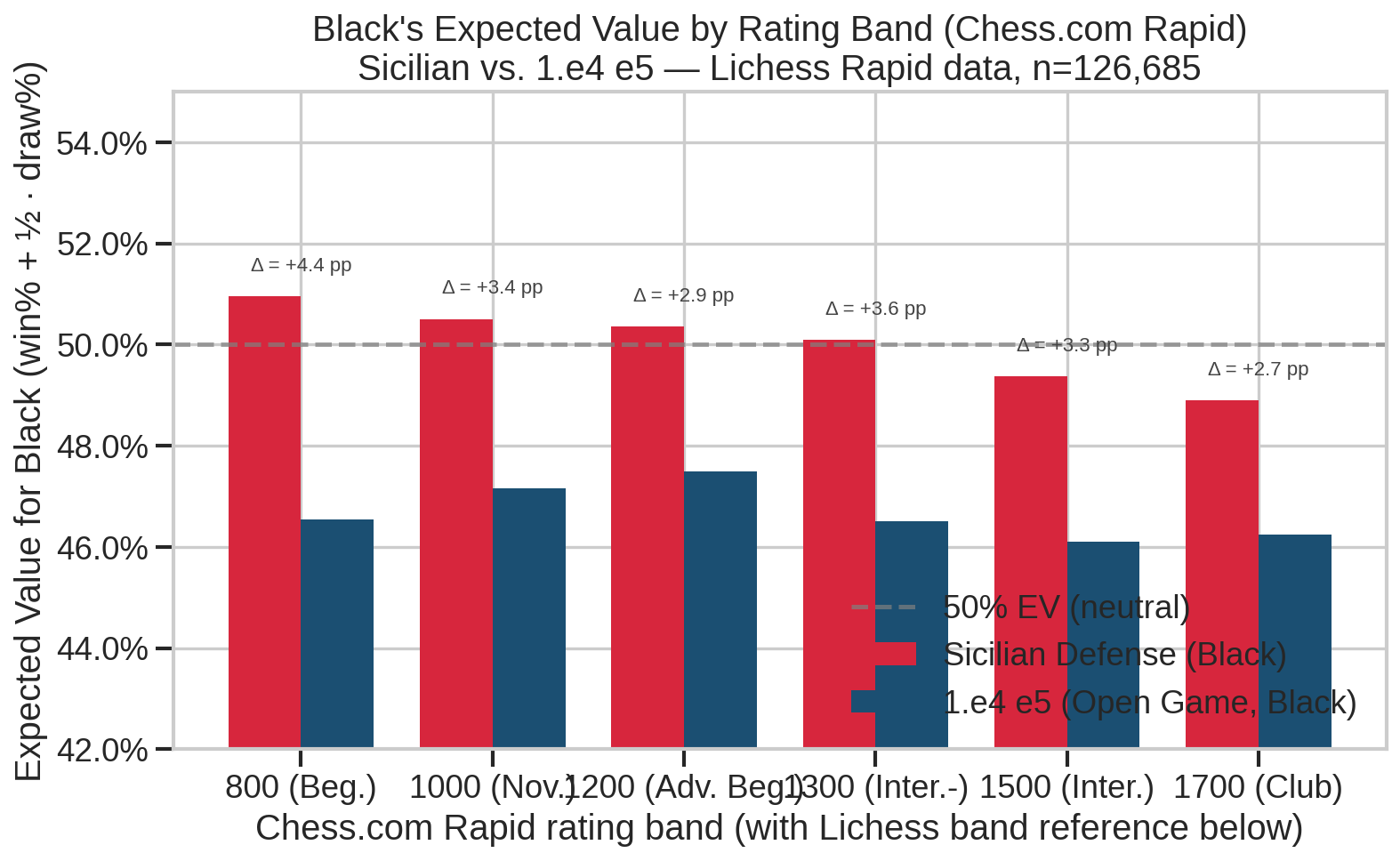
At the Chess.com 800 level, the Sicilian is a massive weapon, providing Black with an EV of 51.0% compared to just 46.5% for 1…e5. This +4.4 percentage point premium is statistically massive.
However, as we approach the Chess.com 1500 level, the gap narrows. At 1500, the Sicilian's EV drops to 49.4%, while 1…e5 sits at 46.1%. The Sicilian still outperforms the Open Game by +3.3 points, but Black is no longer scoring a net positive against White.
Why does the EV drop as ratings increase?
At lower ratings, the Sicilian creates immediate, unfamiliar imbalances. White players often blunder early because they lack a coherent plan against 1…c5. By the time players reach 1500, White has typically adopted a pet system against the Sicilian (such as the Alapin, the Grand Prix, or a specific Open Sicilian setup) and knows how to navigate the early middlegame.
2. The Accuracy Tax: Complexity Comes at a Cost
The Sicilian is notoriously complex, and the data reflects this. We measured the average Centipawn Loss (CPL) per move—a metric of how much value a player loses compared to the engine's top choice. Lower CPL means higher accuracy.
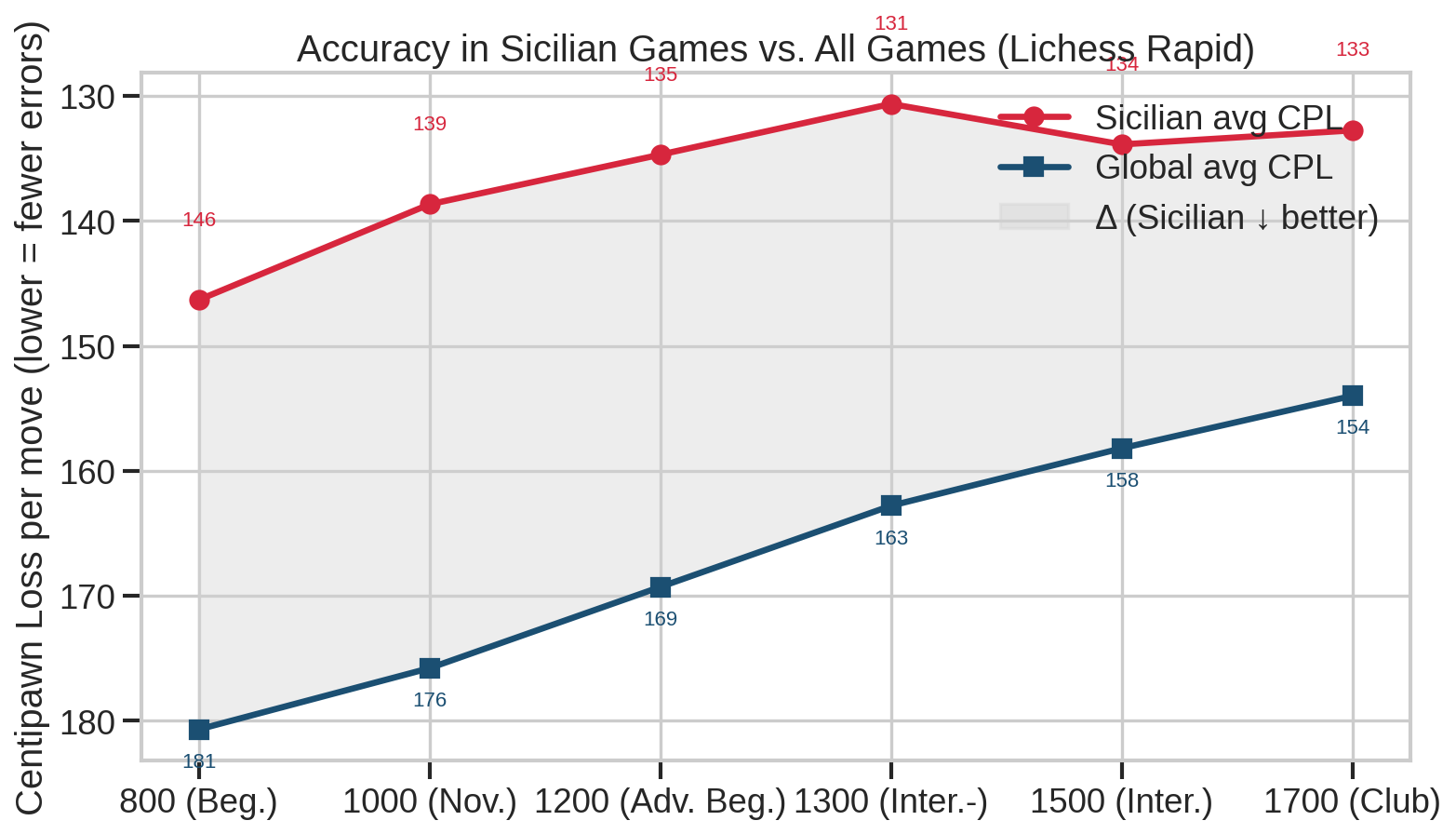
In Sicilian games, both White and Black play significantly more accurately than the global average for their rating band. At the Chess.com 1500 level, the average CPL in a Sicilian game is 134, compared to the global average of 158.
This seems counterintuitive: if the Sicilian is so complex, shouldn't players make more mistakes? The answer lies in opening preparation. Players who venture into the Sicilian (on both sides) tend to know their opening lines better than average. The games are sharper, but the early moves are heavily booked.
However, this sharpness means that when mistakes do happen, they are catastrophic.
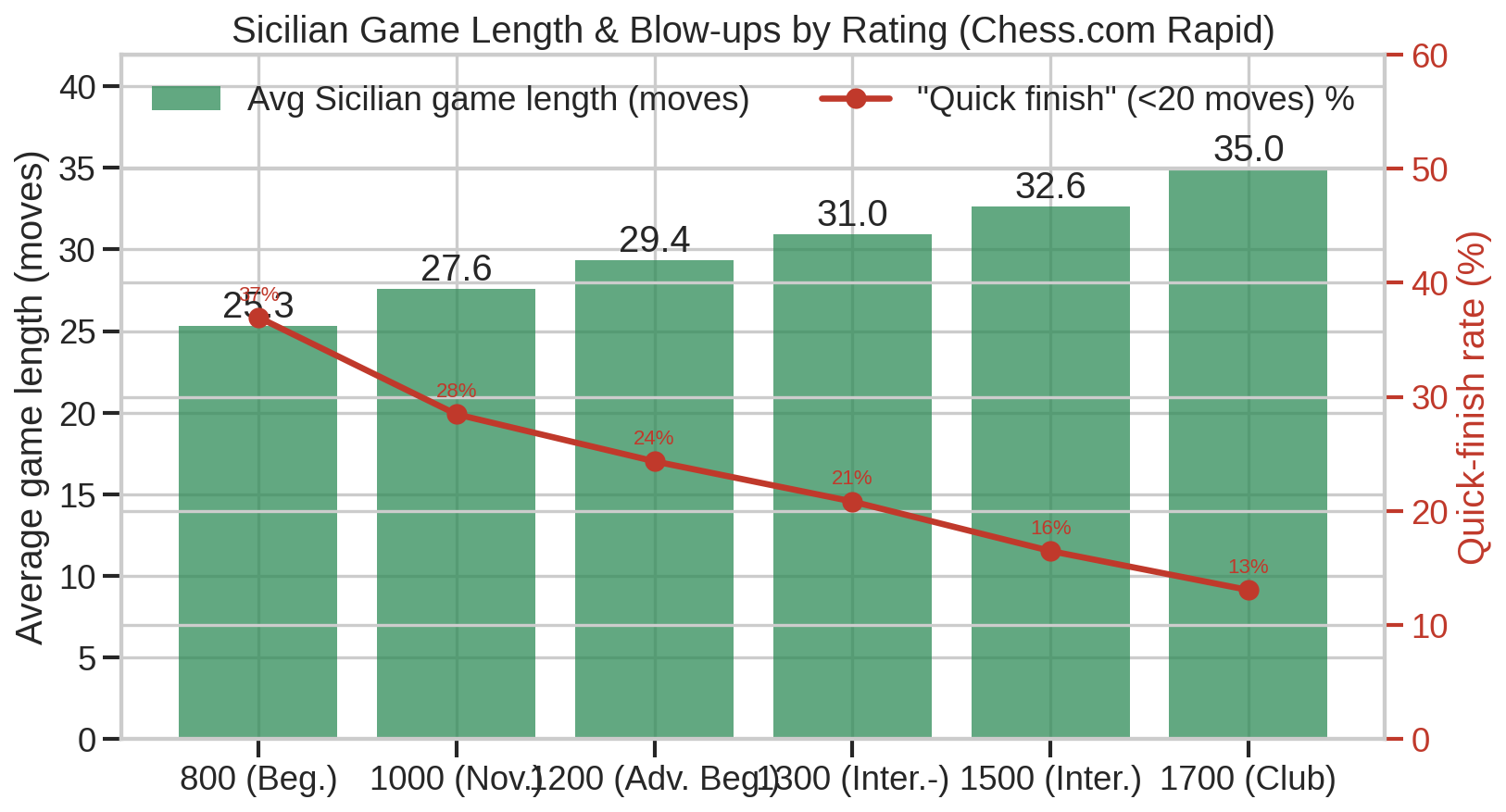
At the 1500 level, 16% of Sicilian games end in under 20 moves. The Sicilian is a high-stakes arena where early tactical oversights are severely punished.
3. Choosing Your Weapon: Sub-Variations at 1500
Not all Sicilians are created equal. If you are a 1500-rated player, your choice of sub-variation dramatically impacts your Expected Value.
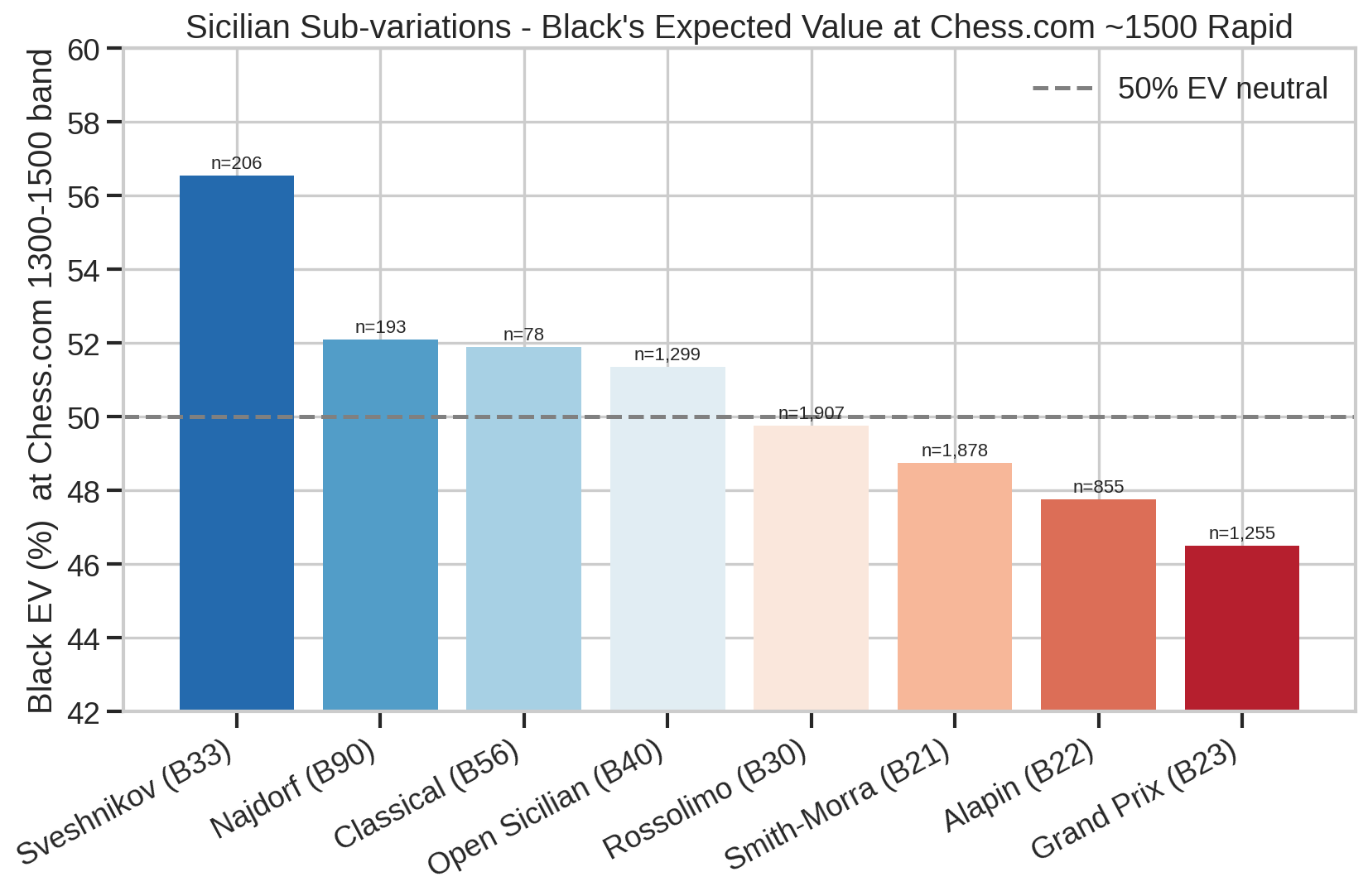
At the Chess.com 1300–1500 band, the Sveshnikov (B33) is the undisputed king, boasting an incredible EV of 56.5% for Black. The Sveshnikov forces White into highly specific, positional structures that intermediate players often mishandle.
The Najdorf (B90) and Classical (B56) also perform exceptionally well, both scoring around 52%.
Conversely, the Grand Prix Attack (B23) and the Alapin (B22)—systems typically chosen by White to avoid main-line theory—are highly effective at suppressing Black's EV, dragging it down to 46.5% and 47.8%, respectively.
4. Common Pitfalls: Visual Evidence
To understand why these numbers look the way they do, let's examine a few typical positions where 1500-level players go wrong.
The Najdorf Trap: Greed Over Development
In the Najdorf, after 6…a6, White players at this level often cannot resist the temptation to grab a pawn with 7.Nxe6?!.
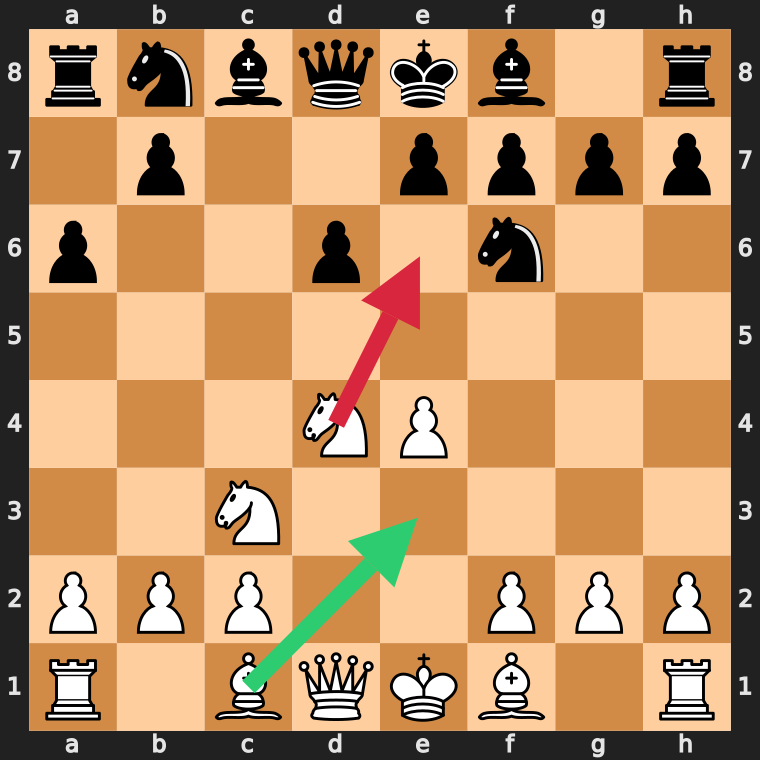
While material is material, the engine strongly prefers 7.Be3 (the English Attack). Grabbing the pawn on e6 allows Black to recapture with the f-pawn, opening the f-file and solidifying the center, leading to excellent long-term prospects for Black.
The Dragon: The Yugoslav Race
The Dragon variation is a race. White attacks on the kingside; Black attacks on the queenside.
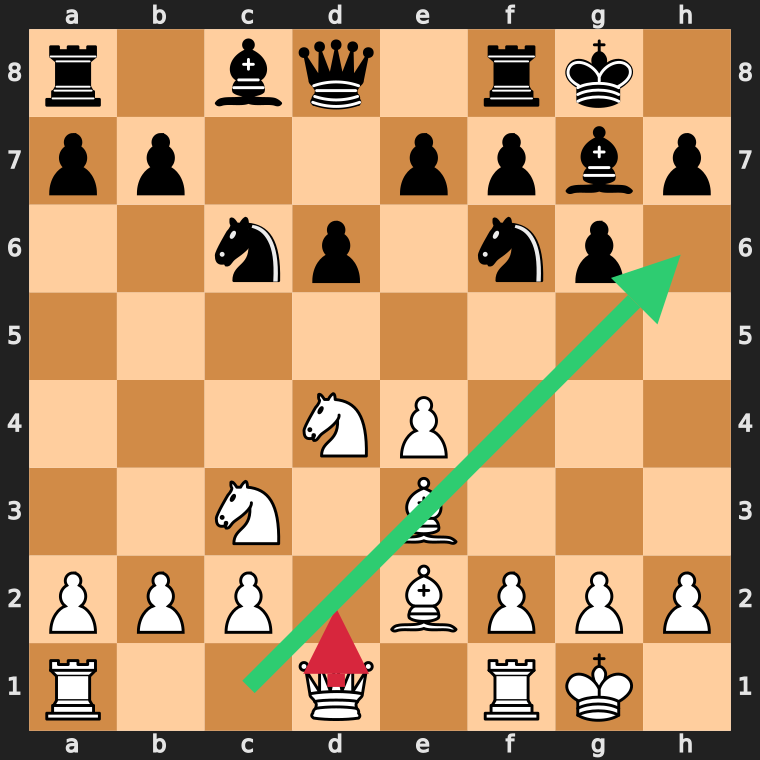
At 1500, Black players often castle into the Yugoslav Attack but fail to generate counterplay fast enough. White's simple plan of Qd2, Bh6, and h4-h5 is devastatingly effective, resulting in Black losing ~53% of these games.
The Alapin: Premature Aggression
When White plays the Alapin (2.c3), the engine's top choices for Black are 2…d5 or 2…Nf6 to immediately challenge the center.
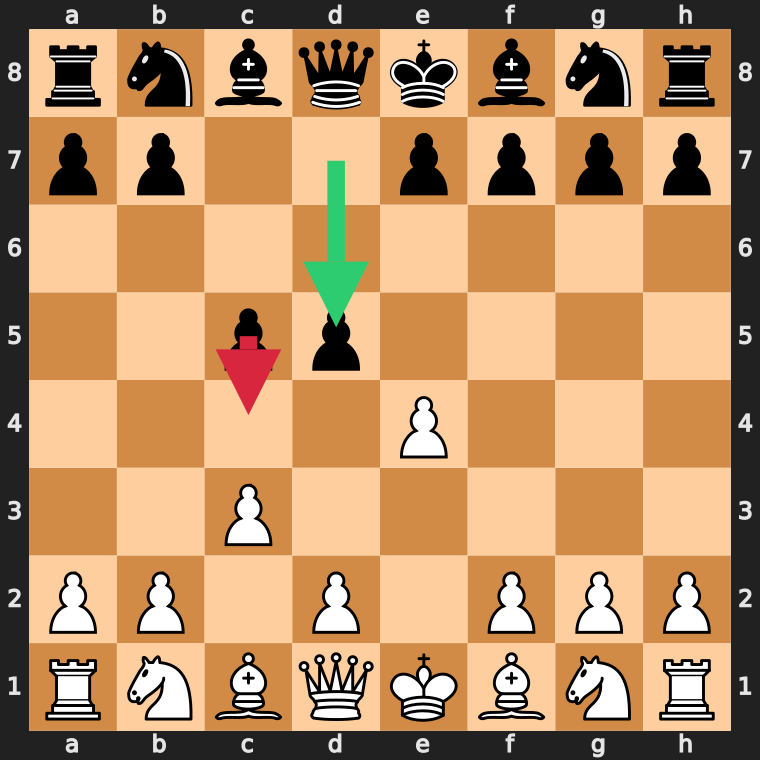
Instead, 1500-rated players frequently push 2…c4?!. This premature aggression releases the tension and allows White to comfortably develop with a +0.5 advantage.
5. Actionable Advice by Rating Band
Based on the data, here is a roadmap for integrating the Sicilian into your repertoire as you climb the ranks.
Chess.com 800–1000 (Beginner to Novice)
- The Verdict: Play it! The Sicilian is a statistical powerhouse here (EV ~51%).
- Actionable Advice: Don't worry about deep theory. Focus on basic principles: control d4, develop your knights, and look for early tactical blunders from White. The sheer unfamiliarity of the asymmetrical structure will win you games.
Chess.com 1000–1300 (Advanced Beginner)
- The Verdict: Still highly effective, but White is fighting back.
- Actionable Advice: White players here will start using Anti-Sicilians (like the Bowdler Attack or early Queen sorties). Learn one solid setup against early deviations. If you play the Dragon, understand that you must play actively on the queenside; passive defense will get you mated.
Chess.com 1300–1500 (Intermediate)
- The Verdict: The EV drops below 50%, but it remains superior to 1…e5.
- Actionable Advice: This is where sub-variation choice matters. If you want to maximize your EV, consider learning the Sveshnikov. White players at this level struggle against its unique positional demands. Be prepared for the Alapin and the Grand Prix, as White will use these to drag you out of your comfort zone.
Chess.com 1500+ (Club Level)
- The Verdict: The Sicilian is a serious commitment.
- Actionable Advice: At this level, the "Accuracy Tax" is real. Games are sharp, and 16% end in under 20 moves. You must know your theory, especially in critical lines like the Yugoslav Attack or the English Attack. The Sicilian is no longer a surprise weapon; it is a theoretical battleground.
Data and Methodology
This analysis was conducted using the Lichess API via the Grandmaster Guide MCP server. We analyzed a sample of 126,685 Rapid games.
Platform Calibration: Lichess Rapid ratings are generally higher than Chess.com Rapid ratings. We applied the following mapping to align the data with Chess.com bands:
- Lichess 700–900 ≈ Chess.com 500–700
- Lichess 900–1100 ≈ Chess.com 700–900
- Lichess 1100–1300 ≈ Chess.com 900–1100
- Lichess 1300–1500 ≈ Chess.com 1100–1300
- Lichess 1500–1800 ≈ Chess.com 1300–1500
- Lichess 1800–2000 ≈ Chess.com 1500–1700
Data Files: The underlying CSV data files generated for this analysis are attached for further review:
sicilian_by_band.csvsicilian_vs_openGame.csvsicilian_sub_variations_decay.csvfirst_move_stats.csvsicilian_vs_global_cpl.csv
Chess Coach
April 19, 2026