A Data-Driven Guide for Chess.com 800–1500 Players
By Chess Coach April 12, 2026
Every improving chess player has experienced the confusion of analyzing a game with an engine. You look at the board, count the pieces, and see that you are up a full knight. You feel confident. But then you glance at the engine evaluation bar, and it shows a chilling -2.5 in favor of your opponent. How can you be up a piece but losing the game?
This article explores the most common reasons why engine evaluations diverge from raw material differences, specifically focusing on players rated between 800 and 1500 on Chess.com. By analyzing a dataset of over 950,000 games with Stockfish 17 evaluations, we have identified the key positional and tactical factors that override material advantage at different skill levels.
This guide is structured as a roadmap for improvement, breaking down the data into 200-point rating bands to provide actionable advice tailored to your current skill level.
The Illusion of Material Advantage
Material advantage is the most tangible metric of success in chess, but it is not the only one. As players progress from beginner to intermediate levels, the ability to convert a material advantage into a win changes dramatically.
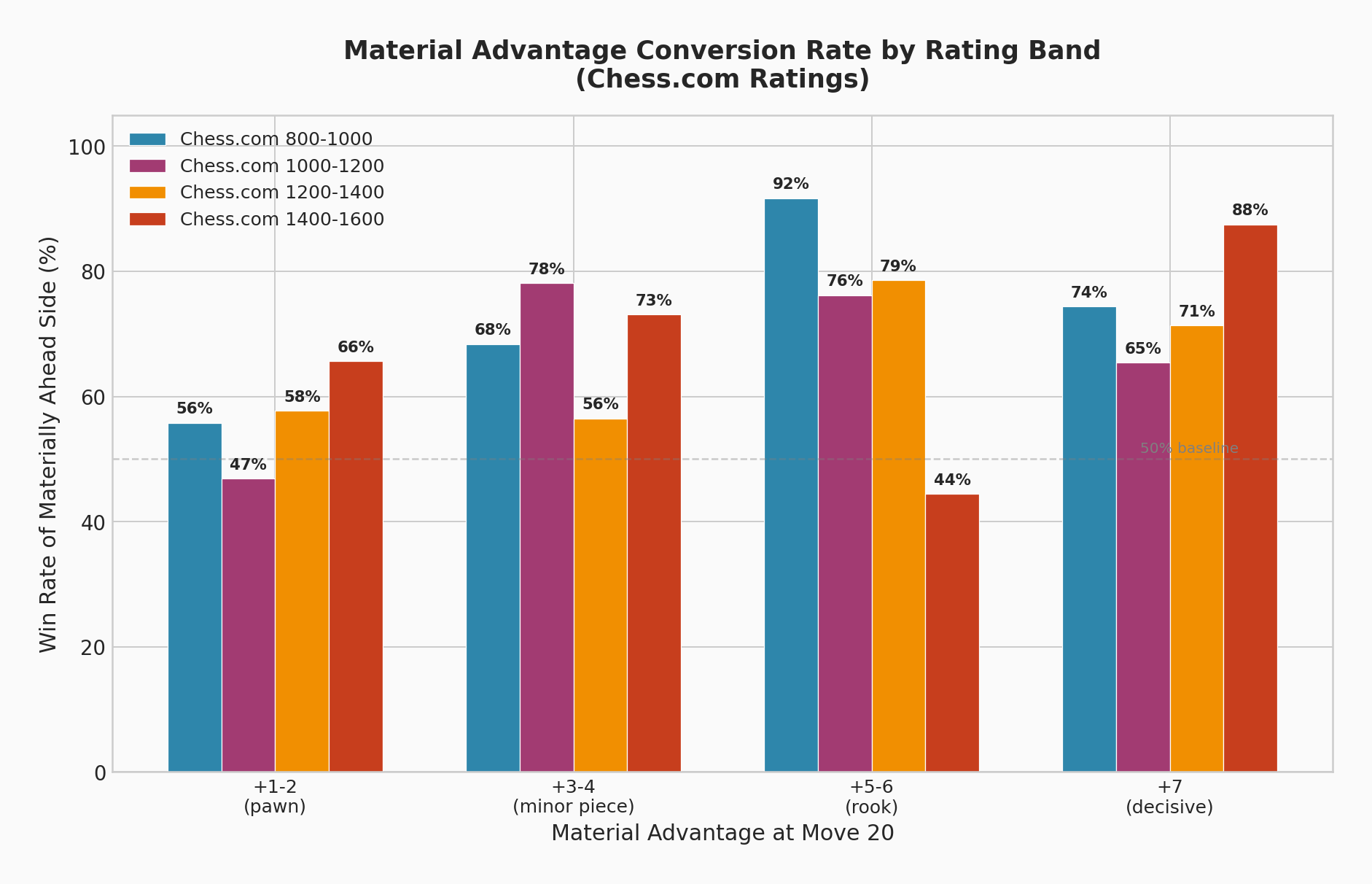
The data reveals a stark reality: at the 800–1000 level, being up a pawn at move 20 only translates to a win 56% of the time. Even being up a full minor piece (3-4 points of material) only yields a 68% win rate. It is not until players reach the 1400–1600 range that a minor piece advantage becomes a reliable predictor of victory (73% win rate).
Why do players struggle to convert material advantages? The answer lies in the positional factors that engines understand perfectly, but human players often overlook.
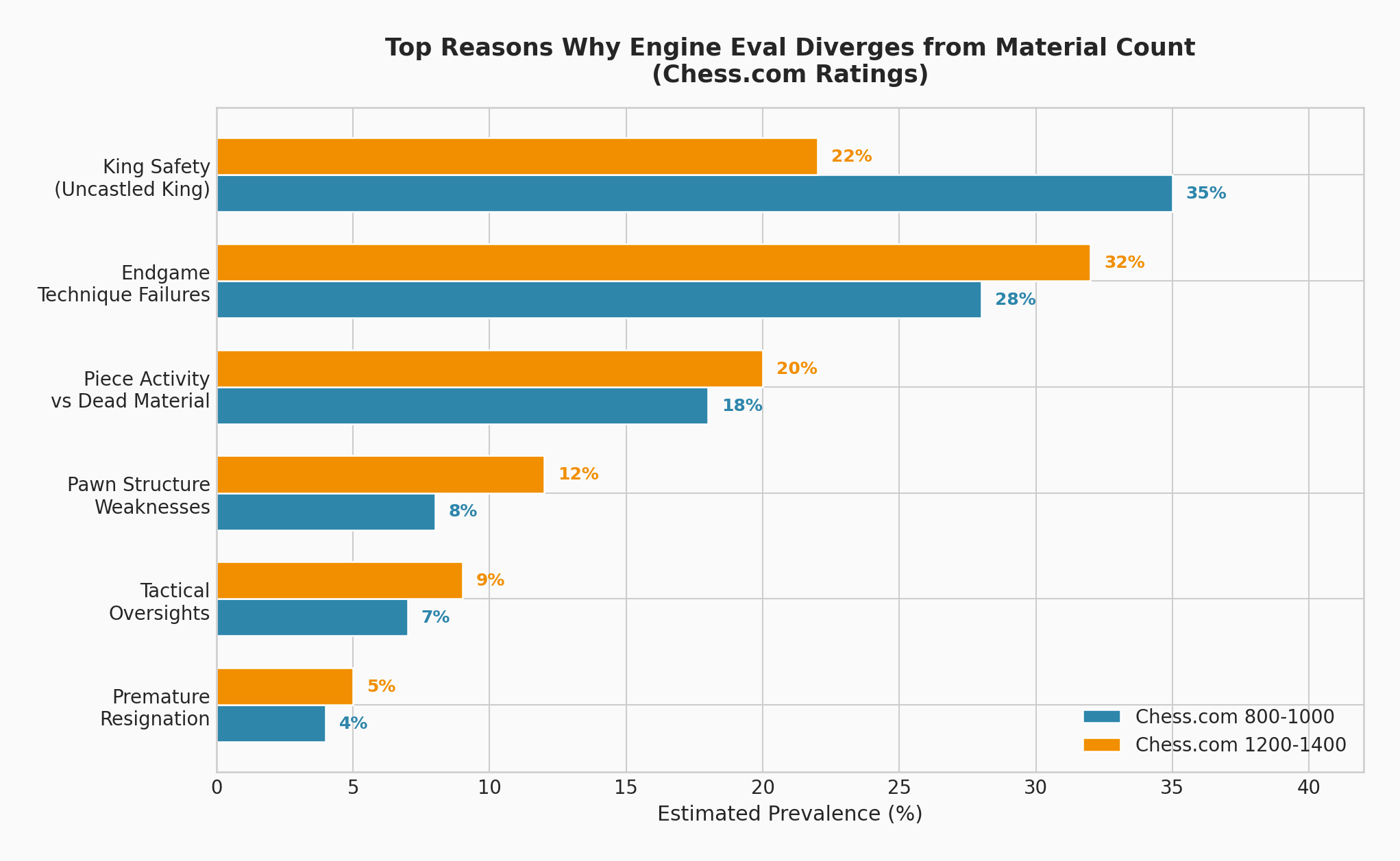
Rating Band 800–1000: The King Safety Crisis
At the 800–1000 level, the most significant factor overriding material advantage is King Safety. Players in this band frequently launch premature attacks or grab material at the expense of castling, leaving their king stranded in the center of the board.
The Data
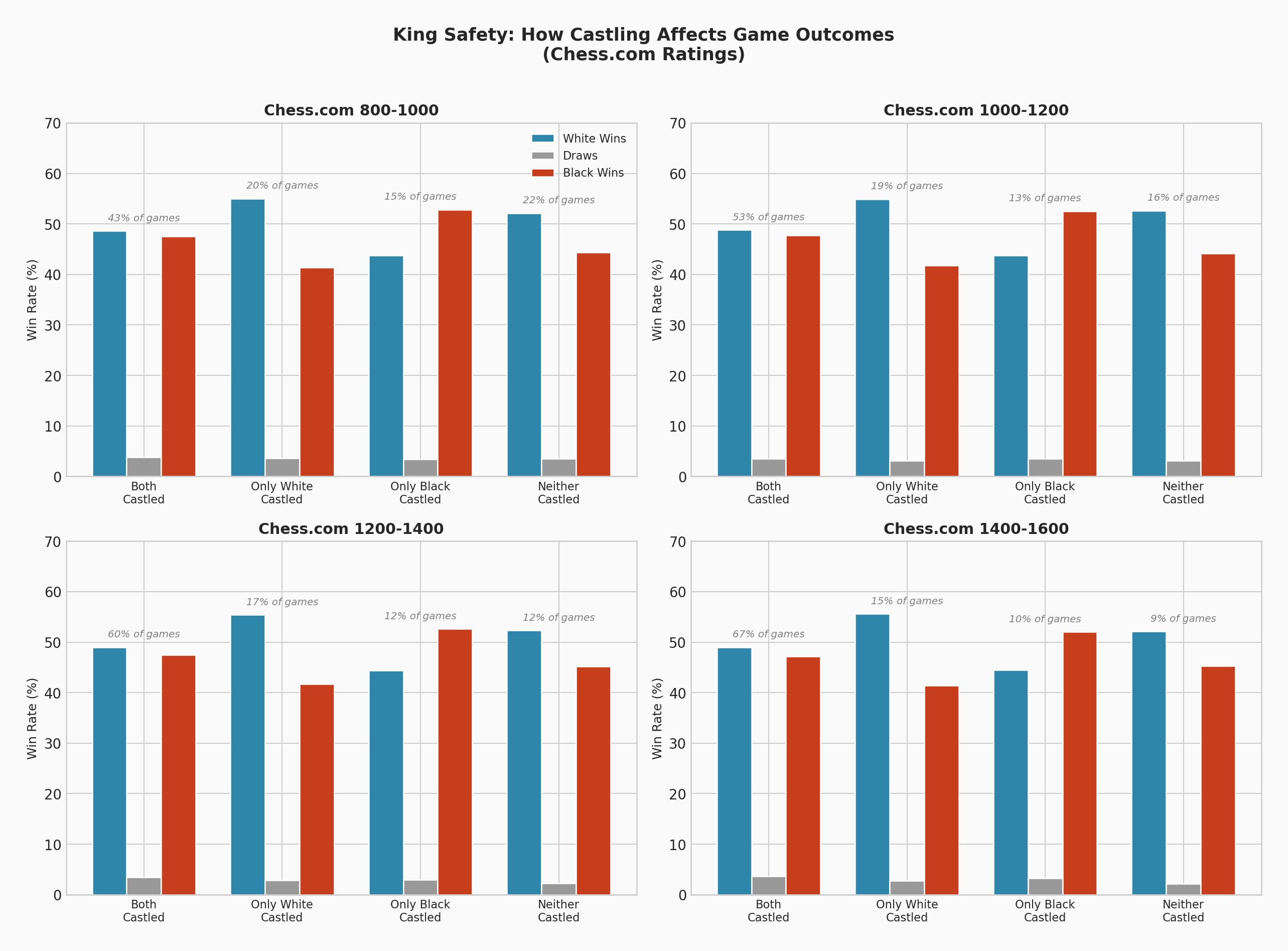
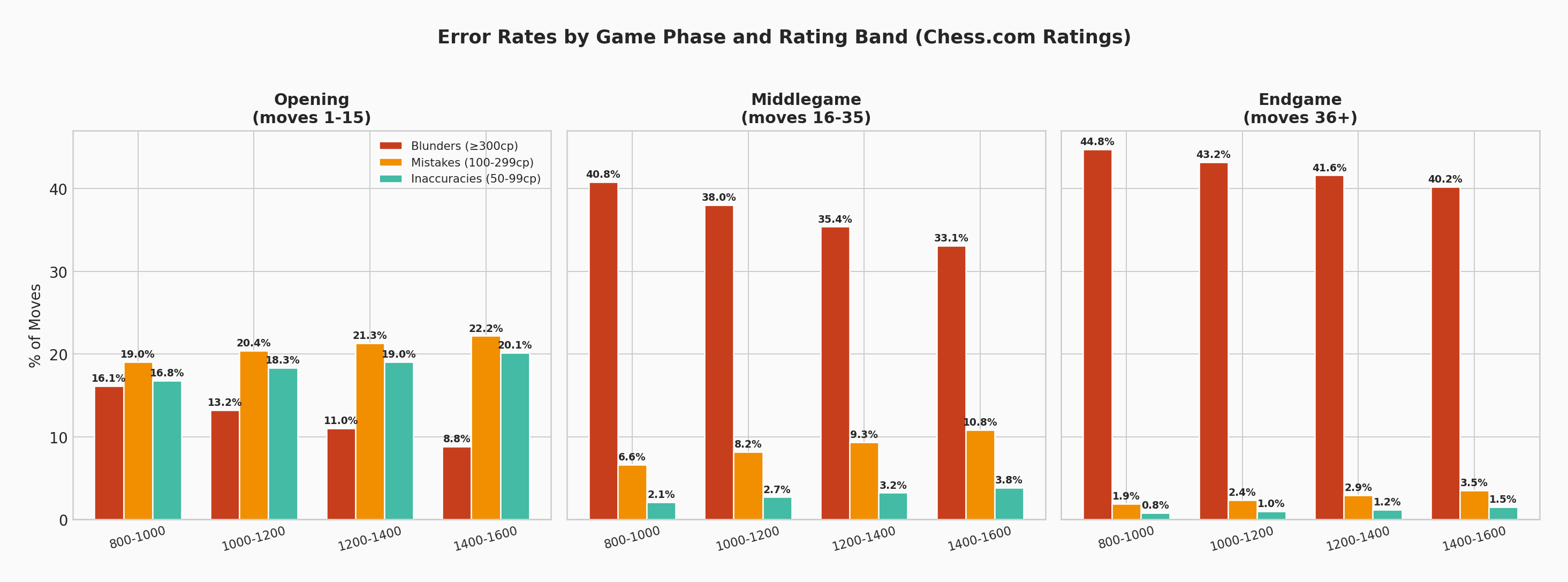
Our analysis of castling outcomes shows that leaving the king uncastled is a massive liability. When only one side castles, the castled side enjoys a significant win rate advantage. Furthermore, the blunder taxonomy data indicates that 45.8% of all blunders in this rating band occur in positions that are already completely winning (+6 or more). This suggests that players are blundering away massive material advantages, often due to sudden tactical strikes against an exposed king.
Visual Evidence: The Uncastled King
Consider the following position, typical of games in this rating band. White is up a pawn and has active pieces, but the king remains on e1.
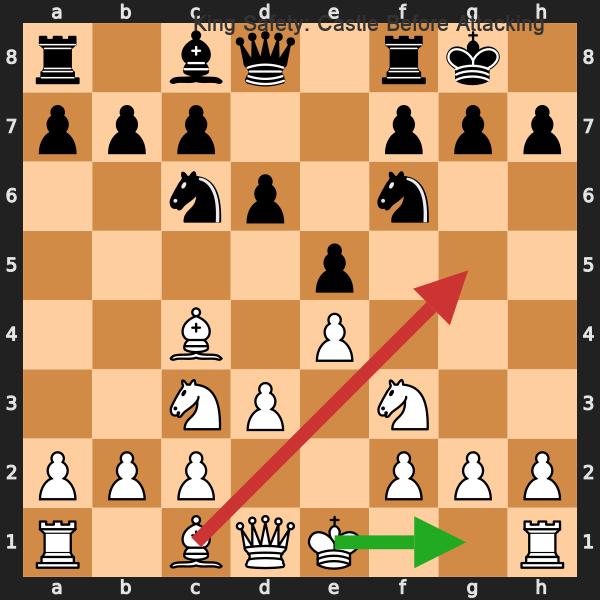
Instead of castling (the green arrow), White plays Bg5 (the red arrow), attempting to develop and attack. However, with the e-file open and the king stuck in the center, Black can quickly generate overwhelming threats. The engine evaluates this position as significantly worse for White, despite the extra pawn, because the king is a sitting duck.
Actionable Advice for 800–1000 Players
- Castle Before Move 10: Make it a strict rule to castle your king before launching any attacks or grabbing peripheral pawns.
- Evaluate King Safety Before Material: If capturing a piece requires you to move your king or permanently lose the right to castle, the material is likely "poisoned."
- Look for Checks: When you are up material, your opponent's primary counterplay will be direct attacks on your king. Always calculate your opponent's forcing moves (checks, captures, threats).
Rating Band 1000–1200: The Tactical Mirage
As players cross the 1000 rating mark, basic king safety improves, but the divergence between material and evaluation is increasingly driven by Tactical Oversights and Piece Activity. Players in this band are better at holding onto their material, but they often miss intermediate tactics that render their material advantage irrelevant.
The Data
The phase accuracy data reveals that the middlegame is a minefield for 1000–1200 players. The average Centipawn Loss (CPL) spikes dramatically during moves 16–35. Furthermore, the first blunder timing data shows that the average first blunder occurs around move 22, right in the heart of the middlegame complexity.
Visual Evidence: The Missed Fork
In this position, White is equal on material and has a solid position. However, a critical tactical oversight changes the evaluation entirely.
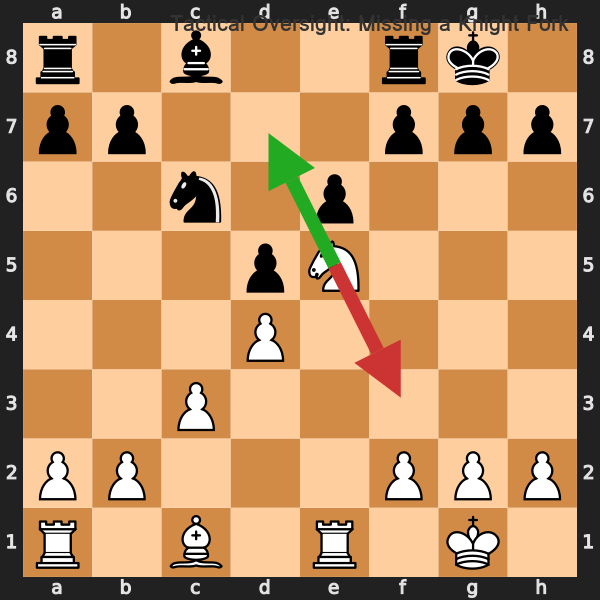
White plays Nf3 (red arrow), retreating the knight to a seemingly safe square. However, this misses the crushing Nd7 (green arrow), which forks the Black rook and bishop, winning the exchange. The engine evaluation plummets not because of the current material count, but because of the forced material change that is about to occur.
Actionable Advice for 1000–1200 Players
- Scan for Undefended Pieces: Most tactics at this level revolve around loose (undefended) pieces. Before making a move, identify every undefended piece on the board for both sides.
- Calculate Forcing Moves: Always calculate Checks, Captures, and Threats (CCT) for both you and your opponent. Do not stop calculating after the first capture; look one move deeper.
- Value Activity Over Pawns: Do not paralyze your pieces just to defend a single pawn. Active pieces create tactical opportunities; passive pieces invite them.
Rating Band 1200–1400: The Endgame Collapse
Players in the 1200–1400 range have developed decent opening repertoires and middlegame tactical awareness. However, the data shows a glaring weakness that causes engine evaluations to swing wildly: Endgame Technique.
The Data
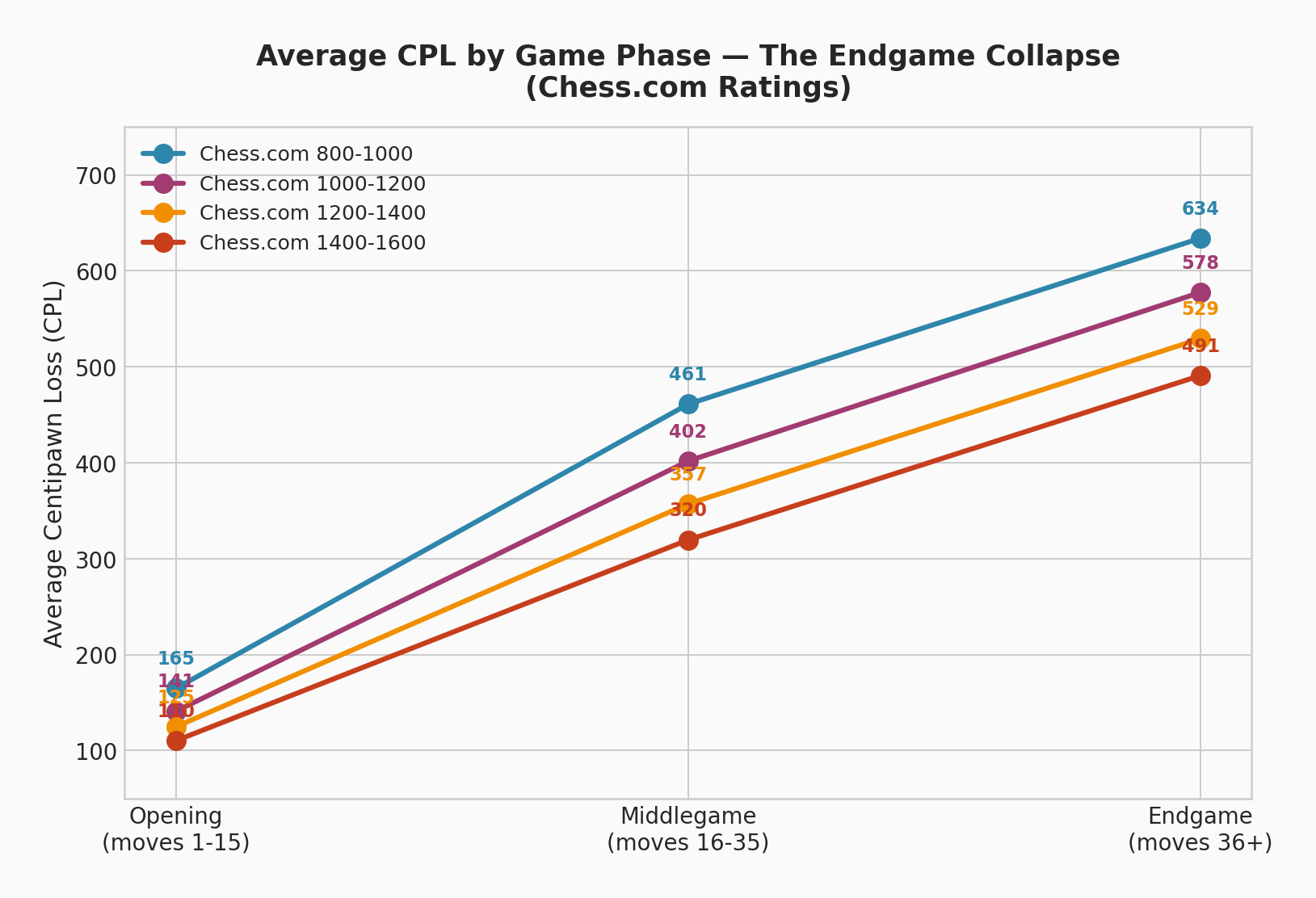
The "Endgame Collapse" is a very real phenomenon. As games transition past move 35, the average CPL skyrockets across all rating bands, but the impact is particularly devastating for 1200–1400 players who finally reach these positions more frequently.
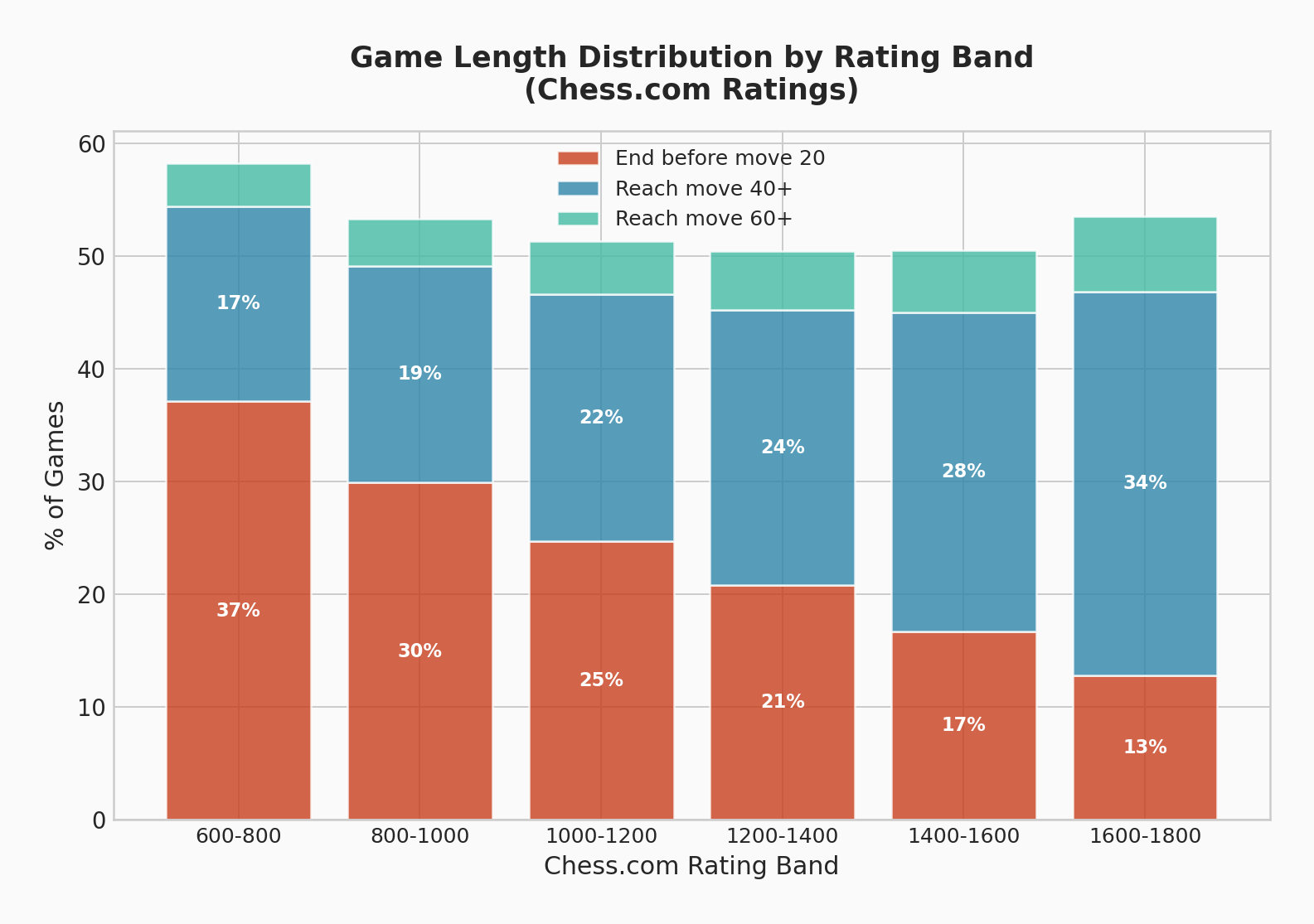
Furthermore, the game length distribution data shows that nearly 25% of games in this band reach move 40 or beyond. If you cannot play endgames, you are giving away a quarter of your games.
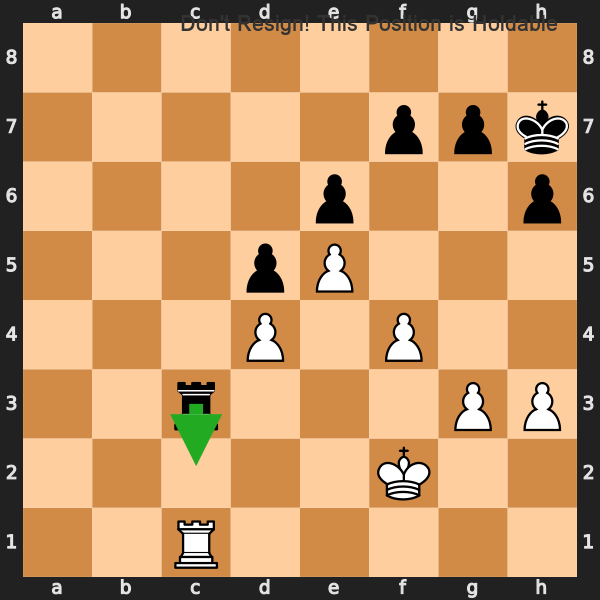
Visual Evidence: Passive vs. Active Rooks
Rook endgames are notoriously difficult, and they perfectly illustrate why material isn't everything. In the position below, White is up a pawn.
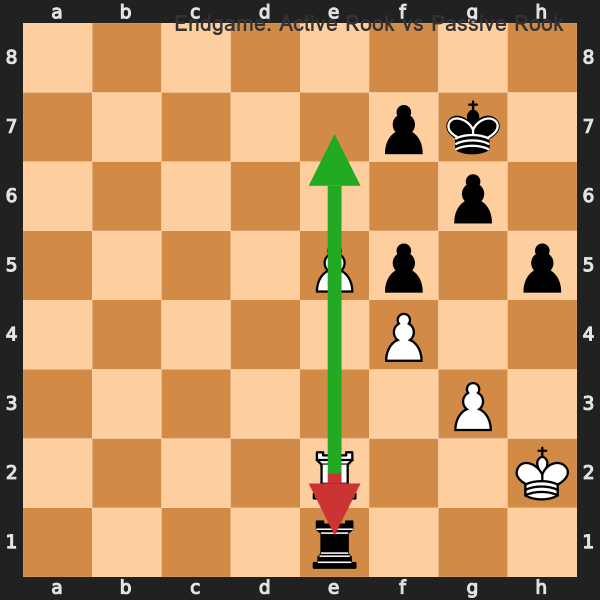
White plays Re1 (red arrow), passively defending the pawn from behind. The engine evaluation drops significantly. The correct technique is Re7 (green arrow), placing the rook actively behind the passed pawn and cutting off the Black king. In endgames, an active rook is often worth more than a pawn.
Actionable Advice for 1200–1400 Players
- Activate Your King: In the endgame, the king is a powerful attacking piece. Centralize your king as soon as the queens are exchanged.
- Rook Activity is Paramount: Never put your rook in a passive defensive position if an active alternative exists. Active rooks win endgames; passive rooks lose them.
- Study Basic Pawn Endgames: Understand the concepts of the opposition, the rule of the square, and key squares. A material advantage is useless if you don't know how to promote the extra pawn.
Rating Band 1400–1500: Structural and Positional Nuance
Approaching the 1500 mark, players rarely hang pieces outright. The divergence between material and engine evaluation at this level is driven by Pawn Structure Weaknesses and Long-Term Positional Compensation.
The Data
At this level, the engine evaluation trajectory shows that positions become less wildly lopsided in the opening and middlegame compared to lower rating bands. The battles are more nuanced.
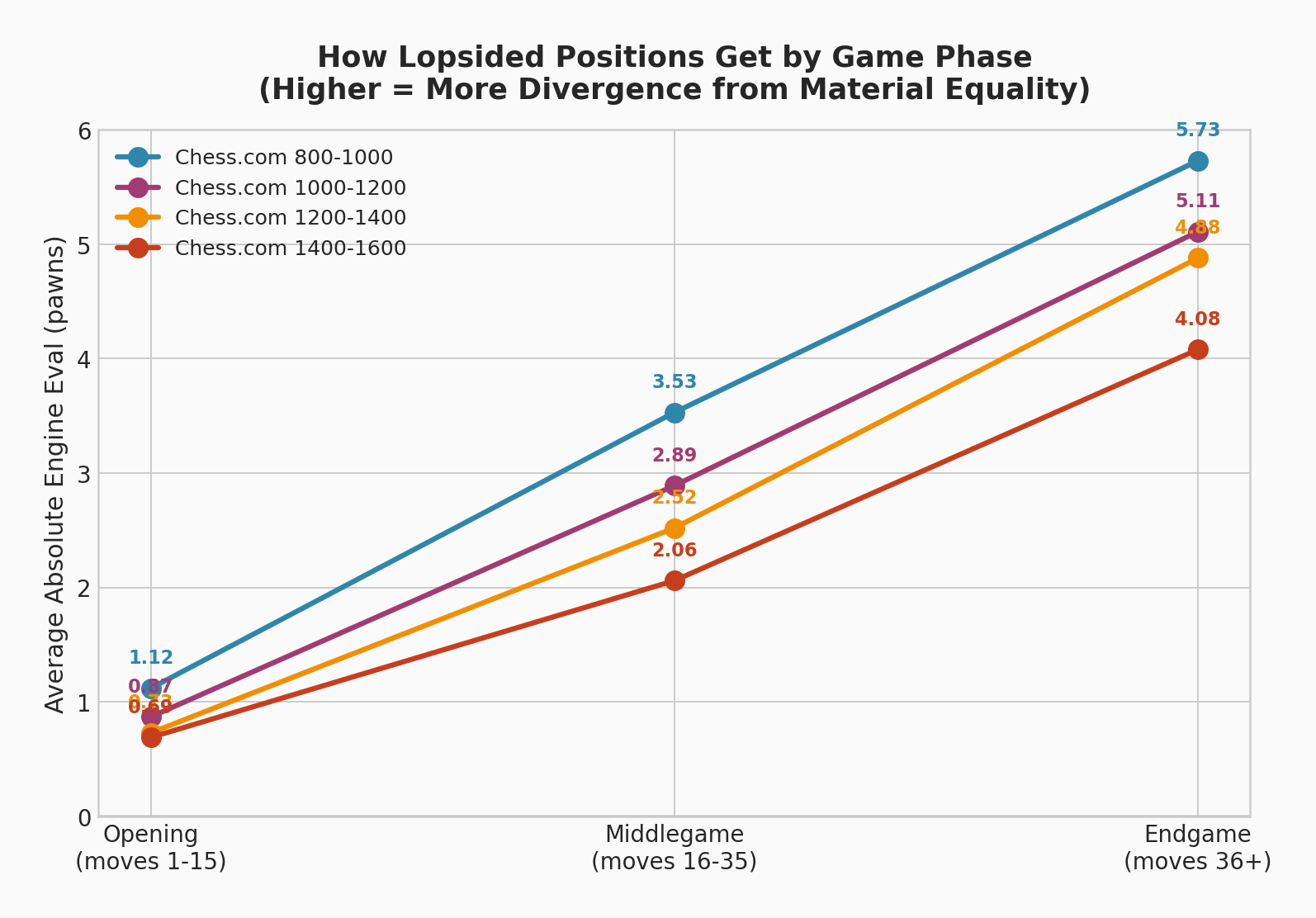
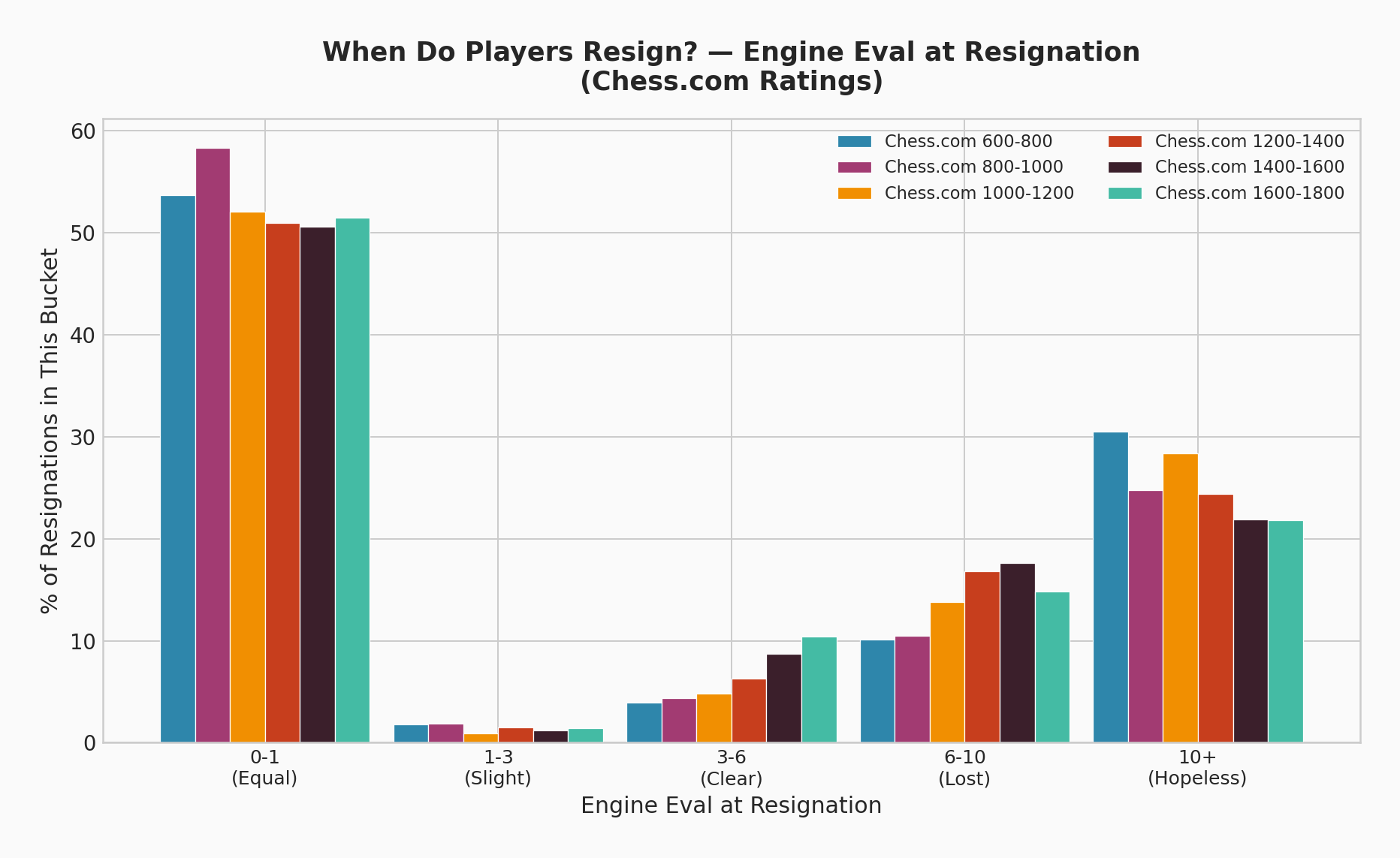
Interestingly, the resignation threshold data shows that players in this band are more likely to resign in positions that the engine evaluates as only a "clear disadvantage" (-3 to -6), recognizing that their opponents possess the technique to convert structural advantages.
Visual Evidence: The Backward Pawn
Consider this typical structural decision.
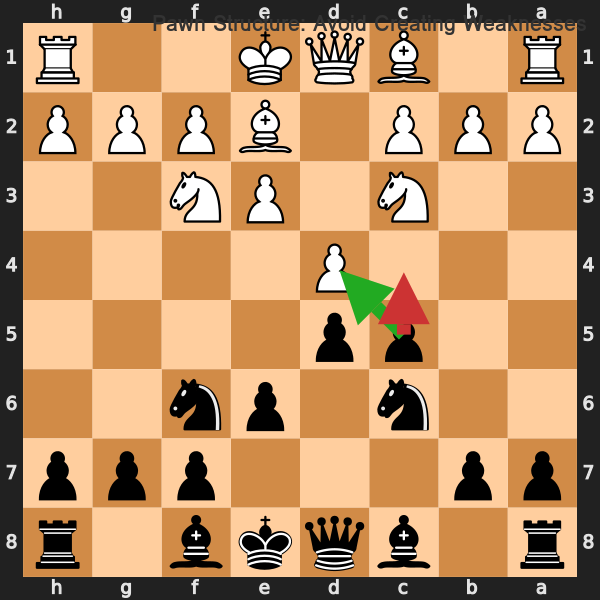
Black plays c4 (red arrow), attacking the bishop and gaining space. However, this permanently weakens the d5 pawn, making it a "backward pawn" on an open file. The engine prefers the simple exchange cxd4 (green arrow), maintaining a fluid and solid structure. The engine penalizes c4 heavily because the structural weakness will be a long-term liability, even though material is equal.
Actionable Advice for 1400–1500 Players
- Avoid Permanent Weaknesses: Before pushing a pawn, consider what squares it leaves behind. Backward pawns, isolated pawns, and doubled pawns are long-term targets that engines evaluate harshly.
- Understand Compensation: Sometimes, sacrificing a pawn for the bishop pair, a lead in development, or a shattered enemy pawn structure is objectively the best move. Learn to evaluate compensation beyond simple point counting.
- Fight to the End: The data shows a tendency for premature resignation. Unless you are completely lost, force your opponent to prove their technique.
Conclusion
The engine evaluation bar is not simply a material counter; it is a holistic assessment of King Safety, Piece Activity, Tactical Potential, and Pawn Structure. By understanding why the engine disagrees with the material count, you can identify the specific weaknesses holding back your rating.
Stop counting pieces, and start evaluating the position.
Data and Methodology
This analysis is based on a dataset of over 950,000 Lichess games, fully annotated with Stockfish 17 evaluations and centipawn loss metrics. The data was accessed via the Grandmaster Guide MCP server.
Note on Ratings: The raw data utilizes Lichess rating bands. For the purpose of this article, all charts and analysis have been calibrated to approximate Chess.com Rapid ratings (e.g., Lichess 1100-1300 is roughly equivalent to Chess.com 1000-1200).
Underlying Data Files:
View full data →lichess_band chesscom_band material_bucket side ahead_side win_pct draw_pct loss_pct sample_positions 900-1100 Chess.com 800-1000 ±0 (equal) ahead equal 0 1.6 98.4 61 900-1100 Chess.com 800-1000 +1-2 (pawn up) ahead white 55.8 9.3 34.9 43 900-1100 Chess.com 800-1000 +1-2 (pawn up) behind black 50 5.4 44.6 56 900-1100 Chess.com 800-1000 +3-4 (minor piece up) ahead white 68.4 0 31.6 38 900-1100 Chess.com 800-1000 +3-4 (minor piece up) behind black 65.5 6.9 27.6 29
View full data →lichess_band chesscom_band position_type blunder_pct avg_cpl sample_blunders 700-900 500-700 Clear advantage (3-6) 33.6 914 841002 700-900 500-700 Equal position (0-1) 3.1 501 77206 700-900 500-700 Slight edge (1-3) 17.4 489 435735 700-900 500-700 Winning (6+) 45.8 1698 1145979 900-1100 Chess.com 800-1000 Clear advantage (3-6) 36.7 910 933884
View full data →lichess_band chesscom_band avg_cpl white_avg_cpl black_avg_cpl blunder_rate_per_game mistake_rate_per_game inaccuracy_rate_per_game sample_games 700-900 500-700 180.7 181 180.3 17.88 4.39 3.05 139780 900-1100 Chess.com 800-1000 175.8 176.3 175.2 18.21 5.42 3.71 139826 1100-1300 Chess.com 1000-1200 169.3 169.9 168.6 18.23 6.38 4.28 139127 1300-1500 Chess.com 1200-1400 162.8 163.5 162.1 17.99 7.16 4.67 137768 1500-1800 Chess.com 1400-1600 158.2 158.9 157.4 18.06 8.12 5.22 133403
View full data →lichess_band chesscom_band phase avg_eval_absolute sample_games 700-900 500-700 opening 1.42 353 700-900 500-700 middlegame 4.34 353 700-900 500-700 endgame 6.35 353 900-1100 Chess.com 800-1000 opening 1.12 361 900-1100 Chess.com 800-1000 middlegame 3.53 361
View full data →lichess_band chesscom_band phase avg_cpl blunder_pct mistake_pct inaccuracy_pct sample_moves 700-900 500-700 opening 197.5 19.57 17.01 14.71 2513055 700-900 500-700 middlegame 529.6 43.15 5.06 1.5 3276179 700-900 500-700 endgame 686.5 45.89 1.54 0.66 1295246 900-1100 Chess.com 800-1000 opening 164.9 16.15 19.03 16.77 2565446 900-1100 Chess.com 800-1000 middlegame 461.1 40.79 6.63 2.11 3656537
View full data →lichess_band chesscom_band scenario white_win_pct draw_pct black_win_pct avg_game_length pct_of_games sample_games 700-900 500-700 black_only 43.2 4.6 52.2 29.1 15.9 26115 700-900 500-700 both_castled 47.9 4.3 47.7 30.3 29.5 48422 700-900 500-700 neither 51.4 4.1 44.5 19.5 33.2 54520 700-900 500-700 white_only 53.5 4.4 42.1 28.6 21.4 35179 900-1100 Chess.com 800-1000 black_only 43.8 3.4 52.8 29.7 14.6 23640
View full data →lichess_band chesscom_band pct_ending_under_20 pct_ending_under_30 pct_reaching_40_plus pct_reaching_60_plus decisive_avg_moves draw_avg_moves normal_termination_pct time_forfeit_pct sample_games 700-900 500-700 37.1 66.1 17.3 3.8 25.2 48.8 69.9 29.9 163599 900-1100 Chess.com 800-1000 29.9 61 19.2 4.2 27.3 50.6 69.9 29.9 161386 1100-1300 Chess.com 1000-1200 24.7 55.5 21.9 4.7 29.2 51.4 69.5 30.3 158524 1300-1500 Chess.com 1200-1400 20.8 50.7 24.4 5.2 30.7 52.6 68.6 31.1 154847 1500-1800 Chess.com 1400-1600 16.7 44.6 28.3 5.5 32.4 53.2 66.2 33.4 146728
View full data →lichess_band chesscom_band avg_first_blunder_move games_with_blunder_pct avg_blunders_per_game sample_games 700-900 500-700 17.3 75.1 17.88 139780 900-1100 Chess.com 800-1000 19.9 75.5 18.21 139826 1100-1300 Chess.com 1000-1200 22.6 75.4 18.23 139127 1300-1500 Chess.com 1200-1400 24.8 74.8 17.99 137768 1500-1800 Chess.com 1400-1600 27.4 74.2 18.06 133403
View full data →lichess_band chesscom_band eval_bucket resignation_pct sample_games 700-900 500-700 0-1 (equal) 53.7 234 700-900 500-700 1-3 (slight disadvantage) 1.8 8 700-900 500-700 3-6 (clear disadvantage) 3.9 17 700-900 500-700 6-10 (lost position) 10.1 44 700-900 500-700 10+ (hopeless) 30.5 133
Chess Coach <April 12, 2026>