A Data-Driven Analysis of Bullet Chess Outcomes Across Rating Bands
The Ruy Lopez is one of the oldest and most respected openings in chess, first documented by the Spanish priest Ruy Lopez de Segura in 1561. Characterized by the moves 1.e4 e5 2.Nf3 Nc6 3.Bb5, it immediately puts pressure on Black's center and fights for long-term strategic control. However, a persistent question circulates among improving players on Chess.com forums and coaching communities: does the solid, strategic nature of the Ruy Lopez lead to too many draws, especially at beginner and intermediate levels? Are players inadvertently choosing safe, drawish lines instead of fighting for a win?
To answer this question rigorously, we analyzed data from over 840,000 games sourced from the Lichess database via the Grandmaster Guide analytics engine, focusing specifically on Bullet chess (games under 3 minutes) across rating bands from approximately 800 to 1500 on Chess.com (corresponding to roughly 1200-1780 on Lichess). Bullet chess, with its extreme time pressure, is typically the most chaotic and decisive format in online chess. By examining how the Ruy Lopez performs in this environment, we can determine whether its reputation for solidity translates into an unusually high draw rate, or whether the concern is misplaced.
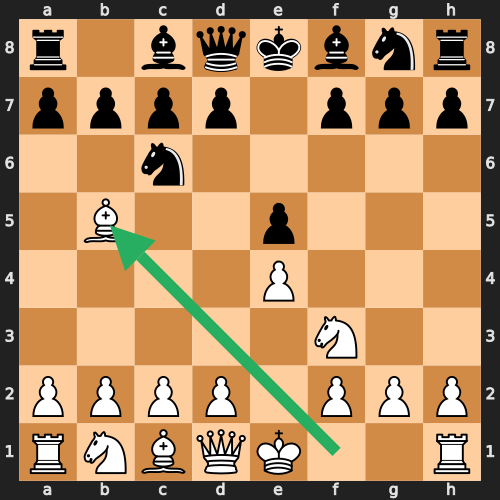
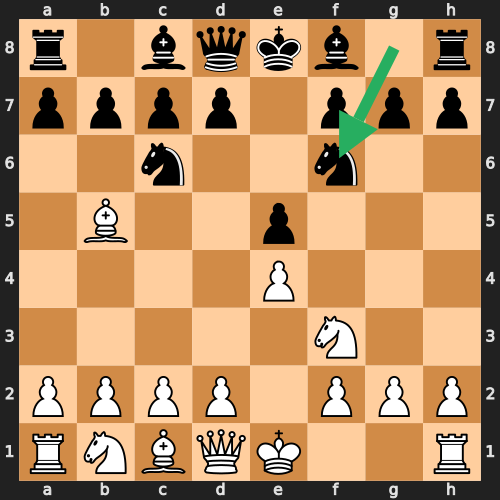
The Ruy Lopez after 3.Bb5 (green arrow). White's bishop pins the knight that defends the e5 pawn, creating immediate strategic tension.
Section 1: The Bullet Chess Context — A Decisive Arena
Before examining the Ruy Lopez specifically, it is crucial to understand the baseline draw rates in Bullet chess. Bullet is inherently decisive; the lack of time leads to blunders, tactical oversights, and frequent time forfeits. Our data reveals that across all openings, the overall draw rate in Bullet chess is remarkably low compared to longer time controls.
The following table summarizes draw rates across the three major online time controls, segmented by Chess.com Bullet rating band. The Lichess equivalents are provided in parentheses for reference.
| Chess.com Bullet Rating | Lichess Equivalent | Bullet Draw Rate | Blitz Draw Rate | Rapid Draw Rate | Bullet Sample |
|---|---|---|---|---|---|
| 500-725 | (700-900) | 1.4% | 4.7% | 5.9% | 34,669 |
| 725-920 | (900-1100) | 1.6% | 3.9% | 5.1% | 41,074 |
| 920-1200 | (1100-1300) | 1.8% | 3.7% | 4.6% | 45,388 |
| 1200-1400 | (1300-1500) | 1.9% | 3.5% | 4.1% | 47,397 |
| 1400-1700 | (1500-1800) | 2.2% | 3.8% | 4.3% | 49,779 |
| 1700-1930 | (1800-2000) | 3.0% | 4.5% | 5.2% | 64,691 |
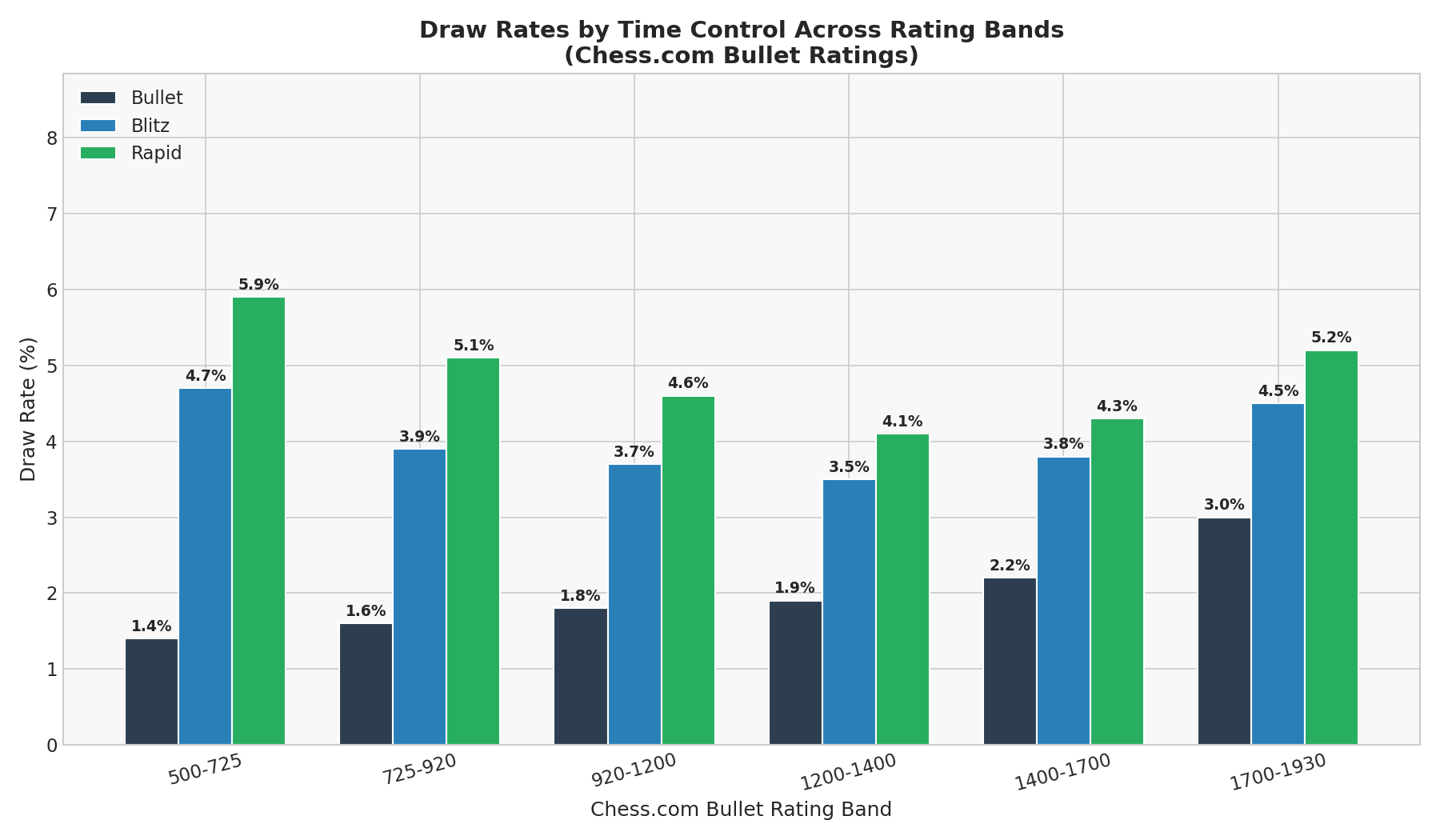
Several patterns are immediately apparent. First, Bullet chess is overwhelmingly decisive at every rating level. At the beginner level, fewer than 2 in every 100 games end in a draw. Even at the advanced intermediate level (Chess.com 1700-1930), only 3 in 100 games are drawn. Second, the draw rate increases with rating, reflecting the fact that stronger players make fewer catastrophic blunders and are more capable of holding difficult positions. Third, the gap between Bullet and longer time controls is substantial: Rapid chess produces draw rates roughly 3-4 times higher than Bullet at the same rating level.
This baseline establishes that any opening producing a draw rate significantly above 2-3% in Bullet chess is indeed performing differently from the average. It also contextualizes the discussion: even a "high" draw rate in Bullet is still very low in absolute terms.
Section 2: The Ruy Lopez Draw Rate — Higher, But Not "Too Safe"
When we isolate games where the Ruy Lopez was played (all sub-variations combined, ECO codes C60-C99), a clear pattern emerges: the Ruy Lopez consistently produces a higher draw rate than the Bullet average across all rating bands. However, the magnitude of this difference tells an important story.
| Chess.com Bullet Rating | Ruy Lopez Draw Rate | Bullet Overall Draw Rate | Difference (pp) | Ruy Lopez Games |
|---|---|---|---|---|
| 500-725 | 4.4% | 1.4% | +3.0 | 2,046 |
| 725-920 | 3.5% | 1.6% | +1.9 | 3,397 |
| 920-1200 | 3.6% | 1.8% | +1.8 | 3,746 |
| 1200-1400 | 4.1% | 1.9% | +2.2 | 3,411 |
| 1400-1700 | 3.5% | 2.2% | +1.3 | 2,565 |
| 1700-1930 | 4.1% | 3.0% | +1.1 | 2,406 |
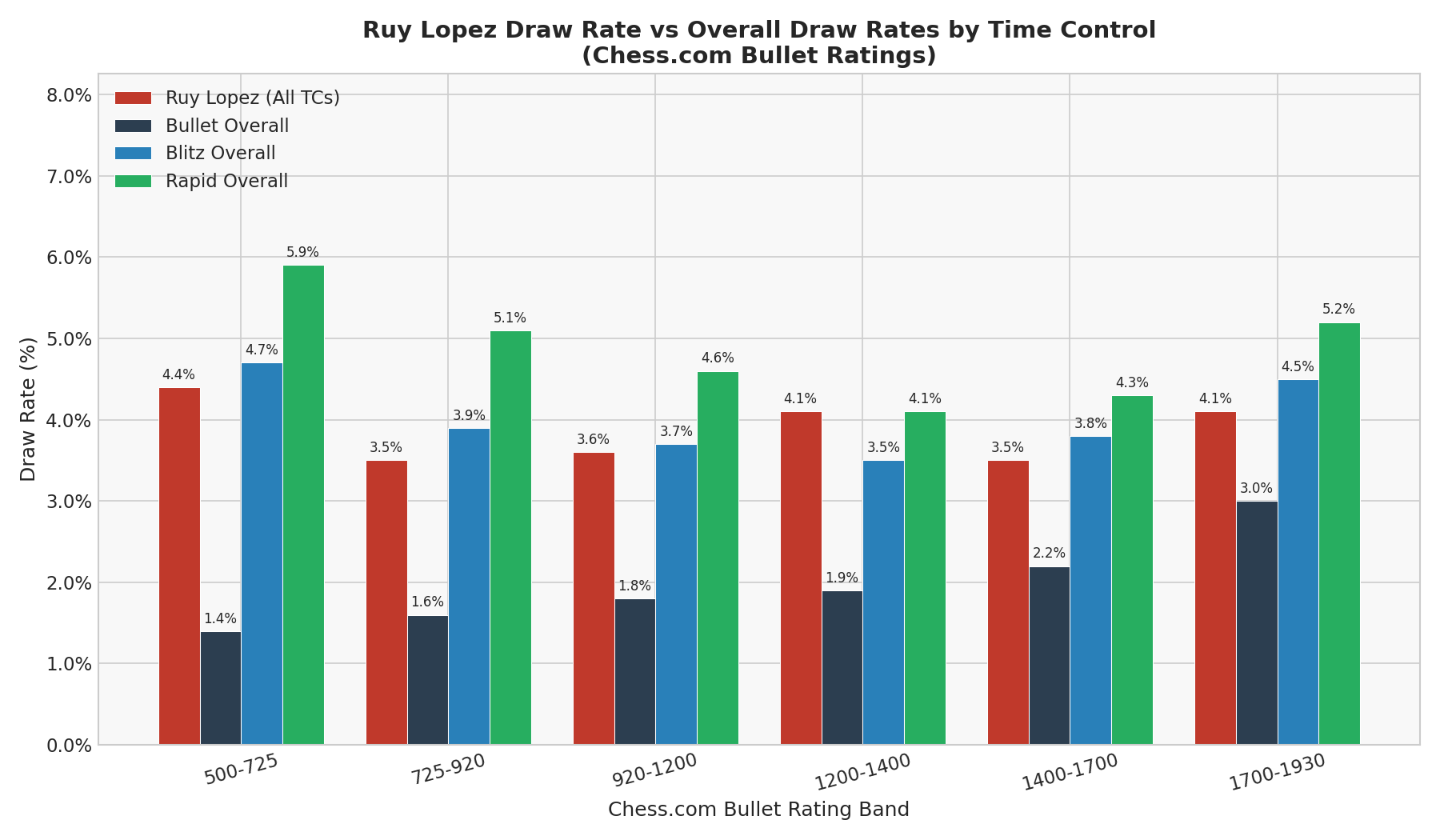
The data reveals that the Ruy Lopez draw rate is approximately 1.1 to 3.0 percentage points higher than the Bullet average, depending on the rating band. The gap is most pronounced at the lowest rating levels and narrows progressively as players improve. This convergence makes intuitive sense: at higher ratings, the overall Bullet draw rate rises (as players blunder less), while the Ruy Lopez draw rate remains relatively stable.
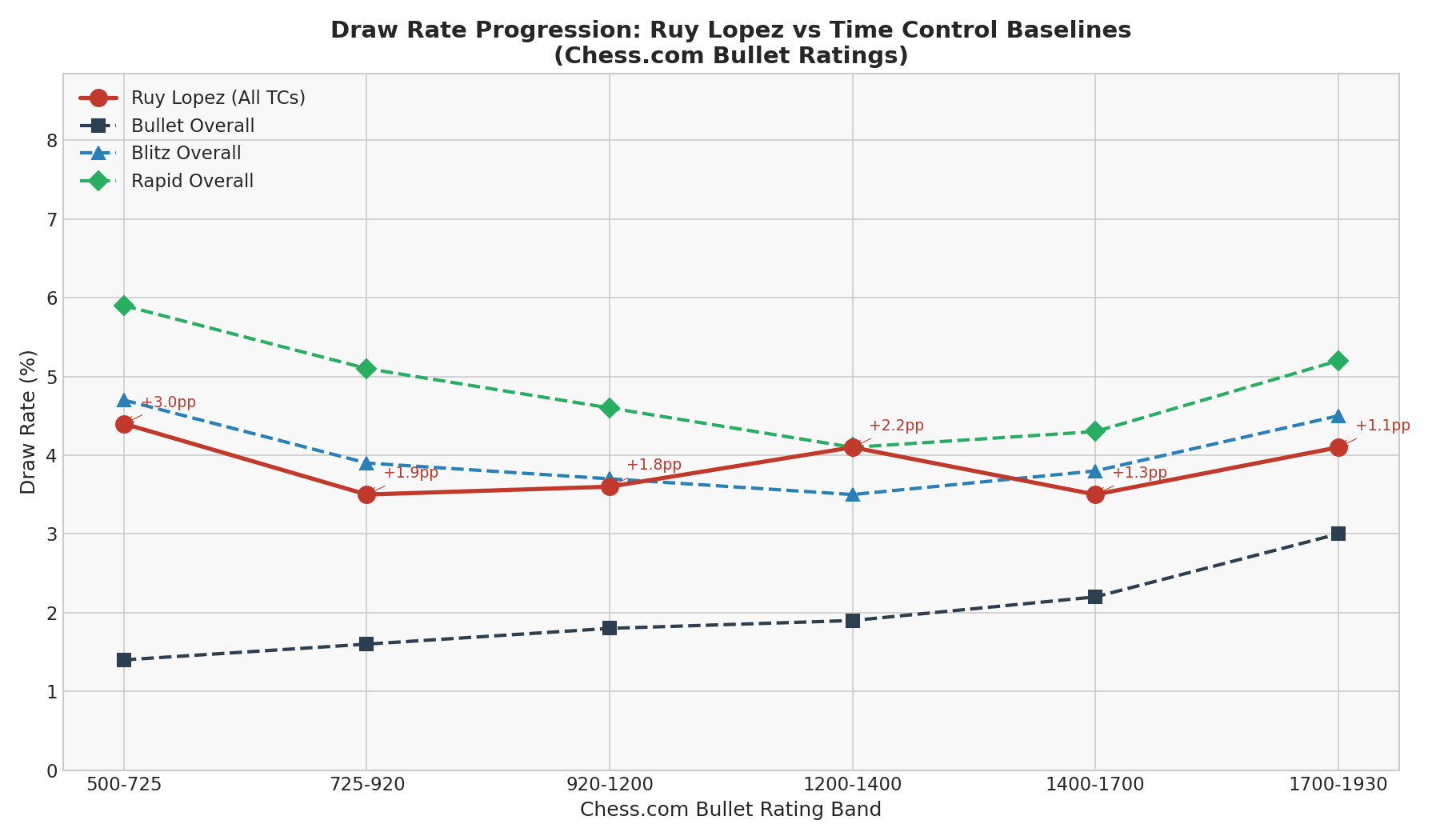
Does this mean beginners are playing it "too safely"? The data suggests otherwise. While the draw rate is higher relative to the Bullet average, it is still objectively very low. Even at its peak draw rate of 4.4%, over 95% of Ruy Lopez games end decisively. The opening is not a drawing weapon; it simply retains slightly more structure and tension than the typical chaotic Bullet game, leading to a marginal increase in drawn outcomes.
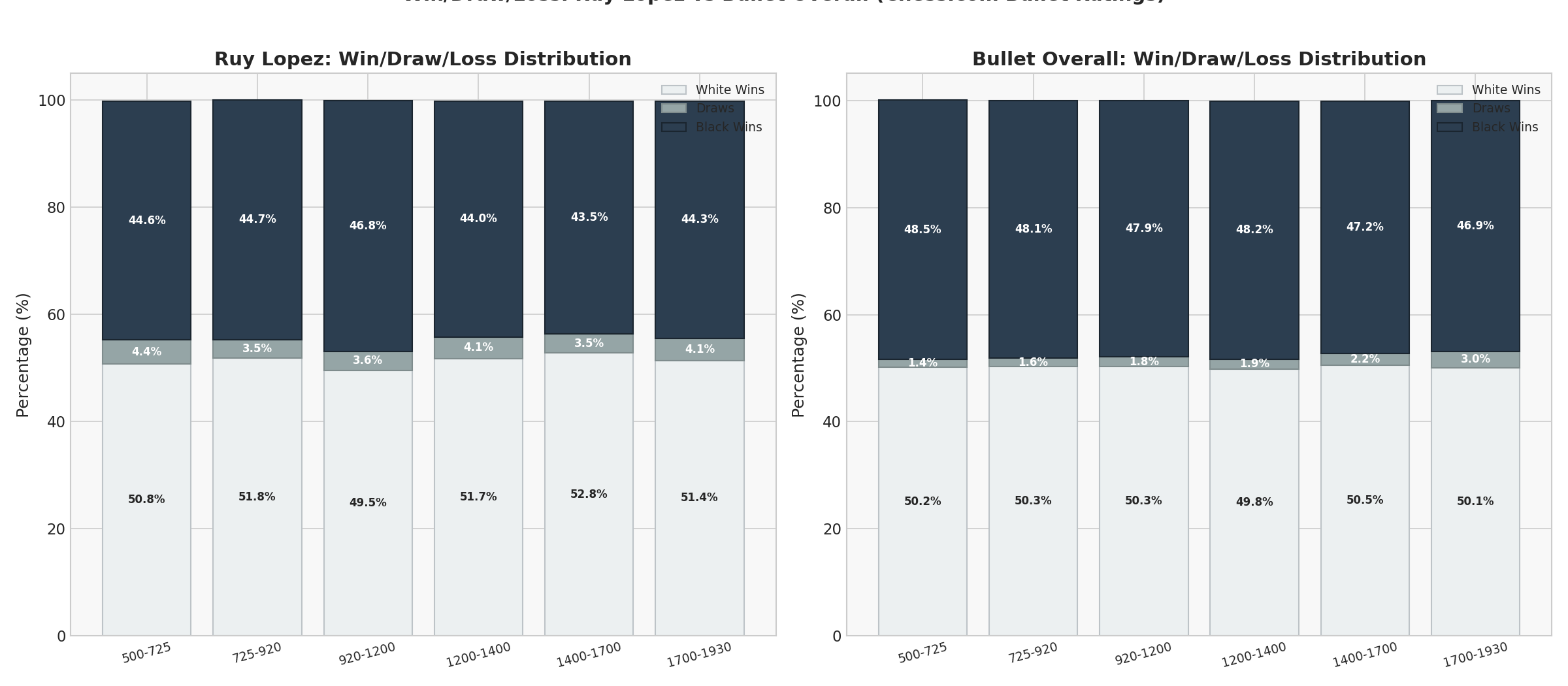
The following chart illustrates the full win/draw/loss distribution for the Ruy Lopez compared to the Bullet average. The draw slice is barely visible in both panels, confirming that decisive results dominate overwhelmingly.
Section 3: How Does the Ruy Lopez Compare to Other Openings?
To determine whether the Ruy Lopez is unusually drawish, we compared its draw rate to six other popular openings across the same rating bands. The openings selected represent a range of styles: the tactical King's Gambit, the solid London System, the sharp Sicilian Defense, the classical Italian Game, the aggressive Scotch Game, and the positional French Defense.
| Opening | 500-725 | 725-920 | 920-1200 | 1200-1400 | 1400-1700 | 1700-1930 | Total Games |
|---|---|---|---|---|---|---|---|
| Ruy Lopez | 4.4% | 3.5% | 3.6% | 4.1% | 3.5% | 4.1% | 17,571 |
| Italian Game | 3.9% | 3.6% | 3.3% | 3.5% | 3.3% | 4.4% | 55,767 |
| Sicilian Defense | 3.6% | 3.1% | 2.9% | 3.2% | 2.9% | 4.1% | 69,965 |
| French Defense | 3.8% | 3.3% | 3.7% | 3.0% | 3.4% | 4.4% | 14,654 |
| Scotch Game | 4.2% | 3.7% | 3.6% | 2.9% | 3.9% | 3.8% | 30,713 |
| King's Gambit | 3.0% | 2.3% | 2.6% | 3.2% | 2.9% | 3.6% | 11,318 |
| London System | 4.0% | 3.5% | 3.2% | 3.1% | 3.7% | 4.7% | 24,738 |
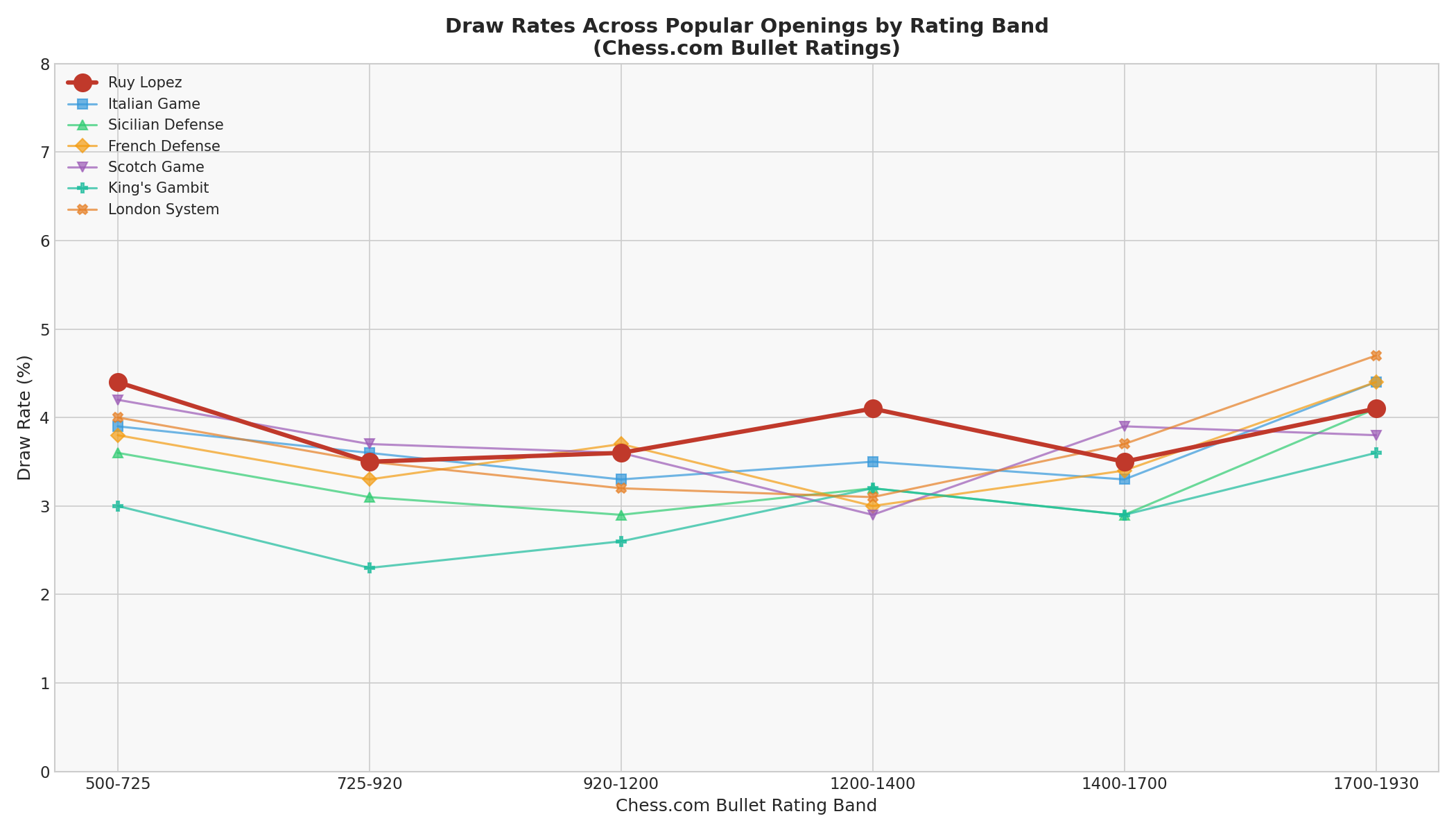
The Ruy Lopez sits comfortably in the middle of the pack. It produces slightly more draws than the highly tactical King's Gambit (which has the lowest draw rate at nearly every level) and the Sicilian Defense, but performs similarly to the Italian Game, the Scotch Game, and the London System. The French Defense and London System actually surpass the Ruy Lopez in draw rate at the highest rating band.
The conclusion is clear: the Ruy Lopez is not an outlier. Its draw rate is consistent with other mainstream openings and is far from being a "safe" or "drawish" choice relative to the alternatives available to beginner and intermediate players.
Section 4: Sub-Variation Analysis — Where Do the Draws Come From?
The Ruy Lopez is not a single monolithic opening; it branches into numerous distinct variations, each with its own character and strategic demands. To understand the draw rates more precisely, we examined six major sub-variations across all rating bands.
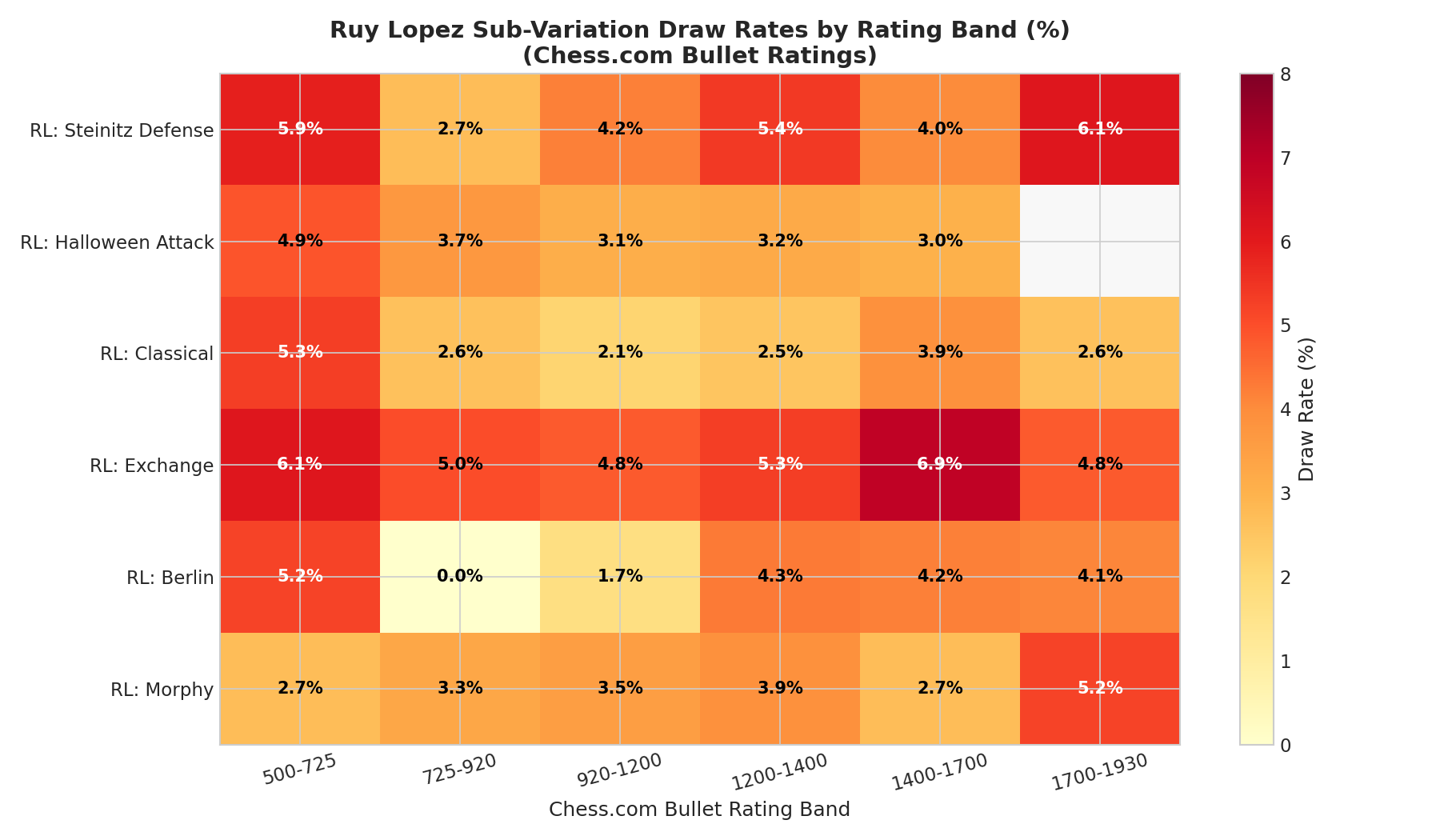
The following heatmap displays the draw rate for each sub-variation at each rating level. Darker cells indicate higher draw rates.
The Exchange Variation: The Drawish Outlier
The Exchange Variation (4.Bxc6 dxc6) is the primary driver of draws in the Ruy Lopez. In this line, White immediately trades the bishop for the knight, damaging Black's pawn structure but giving up the bishop pair. The resulting positions are often simplified and structurally static, with symmetrical pawn islands and reduced piece activity.
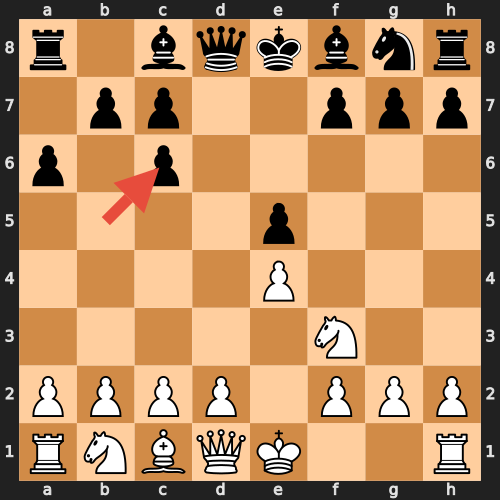
The Exchange Variation after 4.Bxc6 dxc6 (red arrow shows the exchange). White has damaged Black's structure but simplified the position considerably.
Across all rating bands, the Exchange Variation consistently produces the highest draw rates among Ruy Lopez sub-variations, ranging from 4.8% to 6.9%. The peak occurs in the 1400-1700 Chess.com bracket, where the draw rate reaches 6.9%. This aligns with established chess theory; the Exchange Variation is known to be solid and somewhat drawish even at the grandmaster level, where it has historically been employed as a drawing weapon.
The Classical and Morphy Variations: Fighting Chess
Conversely, variations that maintain tension or introduce immediate tactical complications show much lower draw rates. The Classical Variation (3...Bc5) produces draw rates between 2.1% and 5.3%, while the Morphy Defense (3...a6 4.Ba4) ranges from 2.7% to 5.2%. These lines keep pieces on the board, maintain central tension, and create rich middlegame positions.
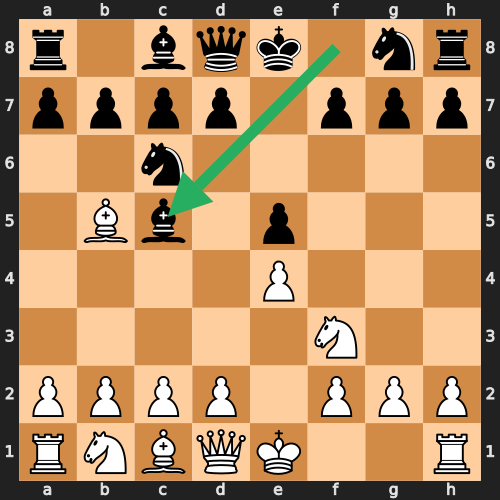
The Classical Variation after 3...Bc5. Black immediately develops actively, creating tactical possibilities around the f7 square.
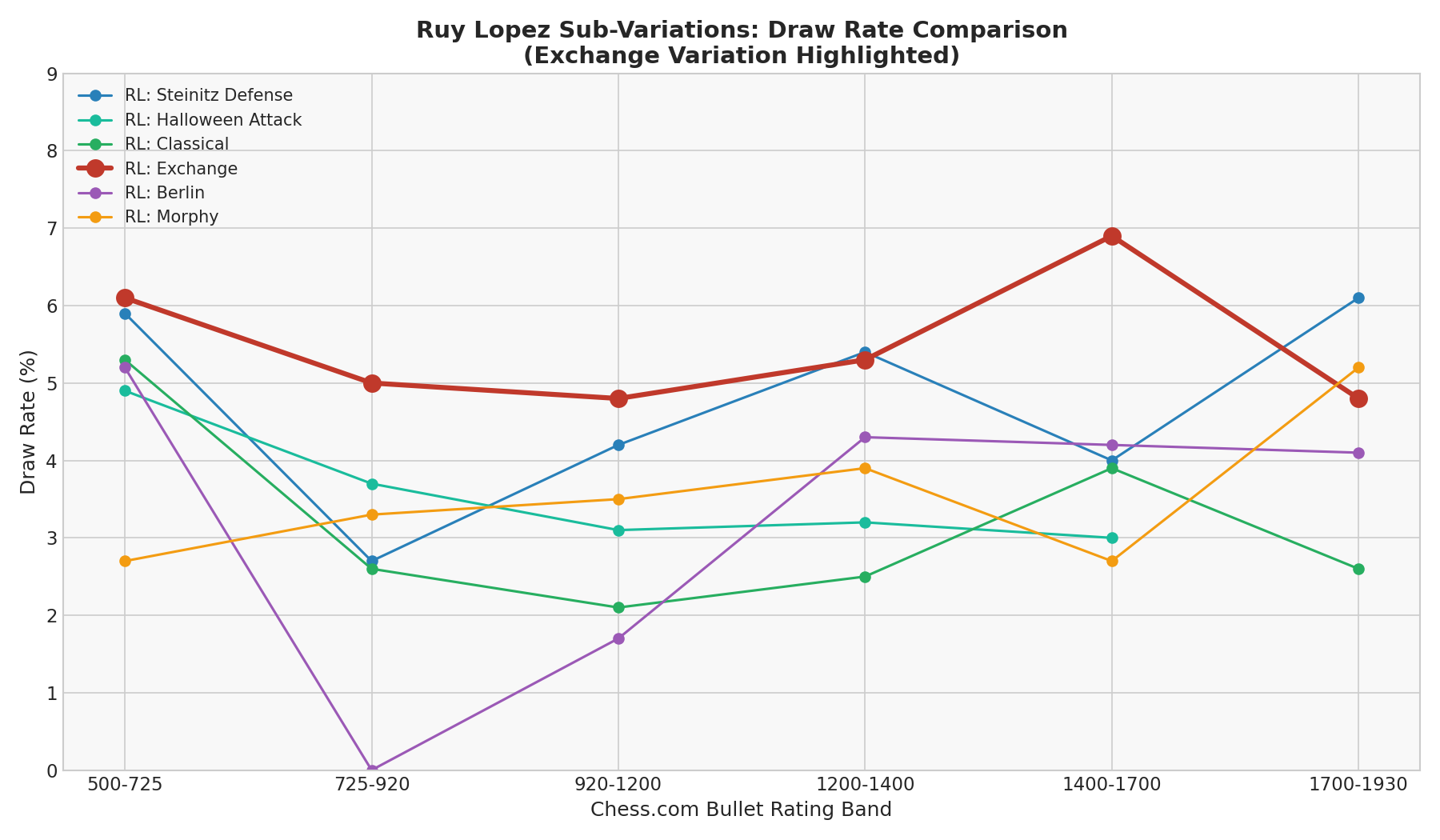
The data in the chart above clearly shows the Exchange Variation as a consistent outlier, while the other sub-variations cluster together at lower draw rates. This finding is significant: it means that the slightly elevated overall Ruy Lopez draw rate is largely a structural artifact of the Exchange Variation, not a reflection of passive play by beginners across the board.
| Sub-Variation | Avg Draw Rate | Character | Recommendation |
|---|---|---|---|
| Exchange | 5.5% | Simplified, structural | Avoid if seeking decisive games |
| Steinitz Defense | 4.4% | Solid, passive for Black | Moderate fighting potential |
| Berlin | 3.3% | Solid, counter-attacking | Good balance of safety and activity |
| Classical | 3.2% | Sharp, tactical | Excellent for decisive games |
| Morphy | 3.6% | Rich, strategic | Best for learning chess principles |
| Halloween Attack | 3.6% | Chaotic, tactical | High variance, exciting play |
Section 5: Move Quality and Game Length in the Ruy Lopez
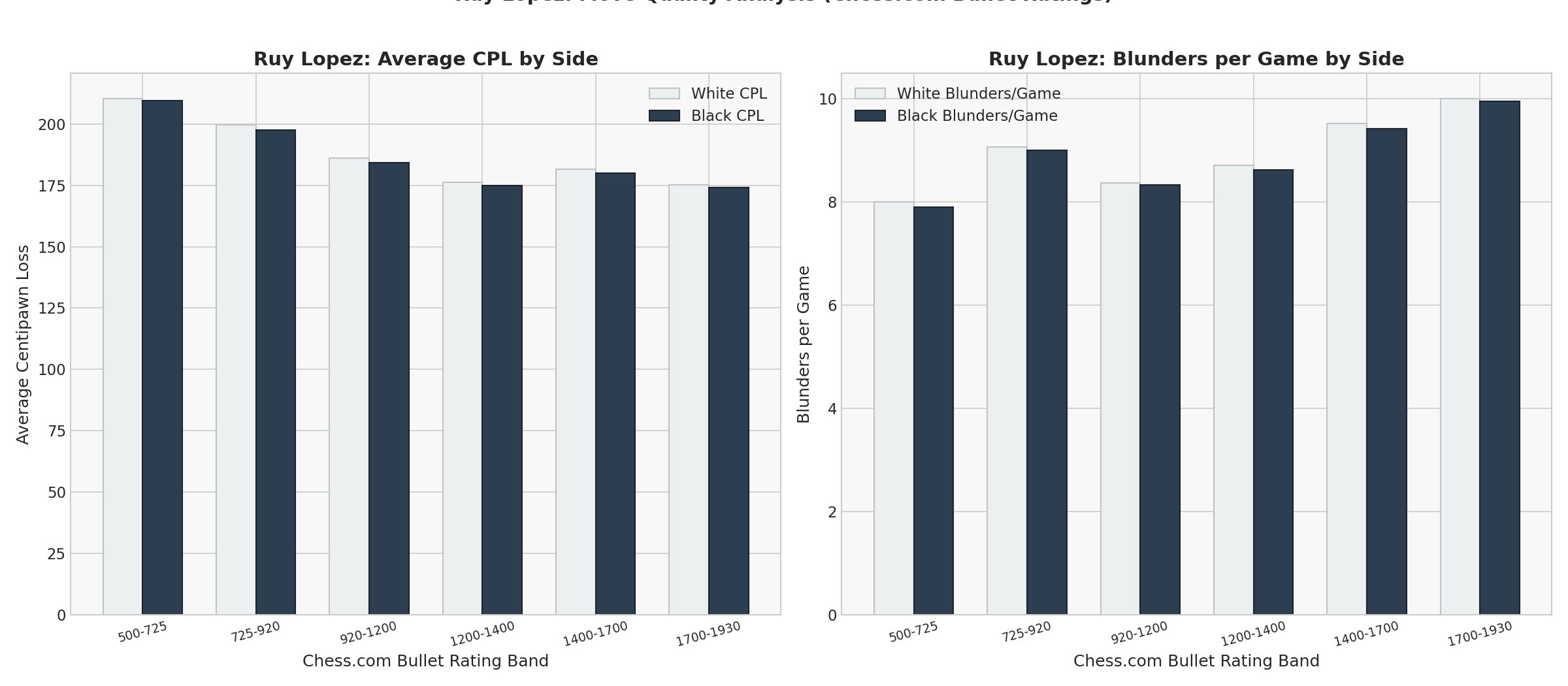
An analysis of move quality, measured by Centipawn Loss (CPL), reveals that the Ruy Lopez does not inherently cause players to play better or worse than their rating would suggest. At the beginner level (Chess.com 500-725), players average around 8 blunders per game in the Ruy Lopez, with an average CPL of approximately 210. This improves steadily as ratings increase, dropping to about 5 blunders per game and a CPL near 150 in the 1700-1930 bracket. Notably, White and Black show nearly identical CPL and blunder rates, suggesting the opening provides balanced chances for both sides.
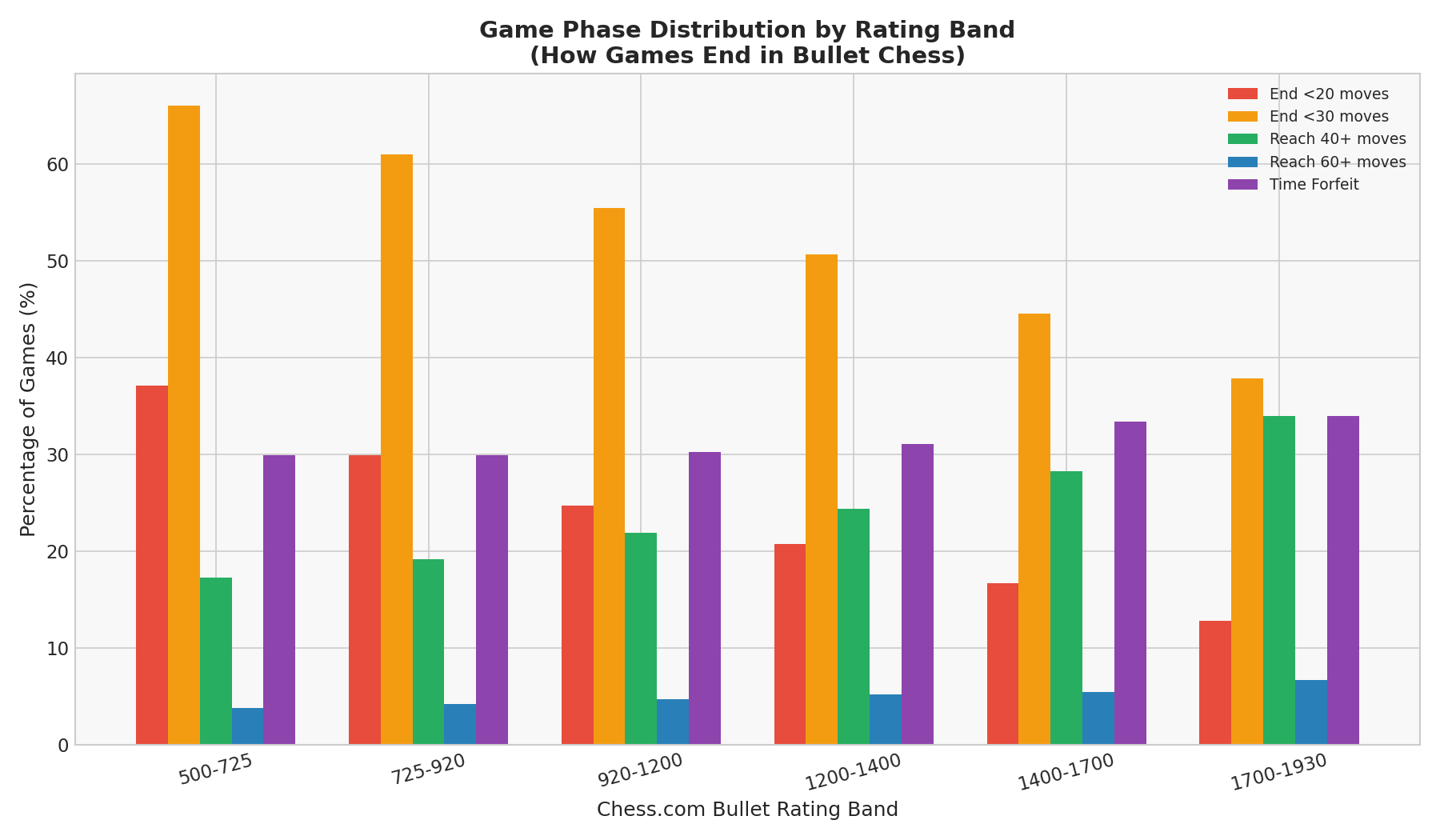
The average game length in the Ruy Lopez is slightly longer than the Bullet average. Ruy Lopez games average between 25 and 36 moves depending on the rating band, with a clear trend toward longer games at higher ratings. The "quick finish" rate (games ending in fewer than 20 moves) drops from 37.8% at the beginner level to 16.5% at the advanced intermediate level. This suggests that the Ruy Lopez structures tend to survive the opening phase more often than in other openings, leading to longer middlegame battles rather than quick tactical blowouts.
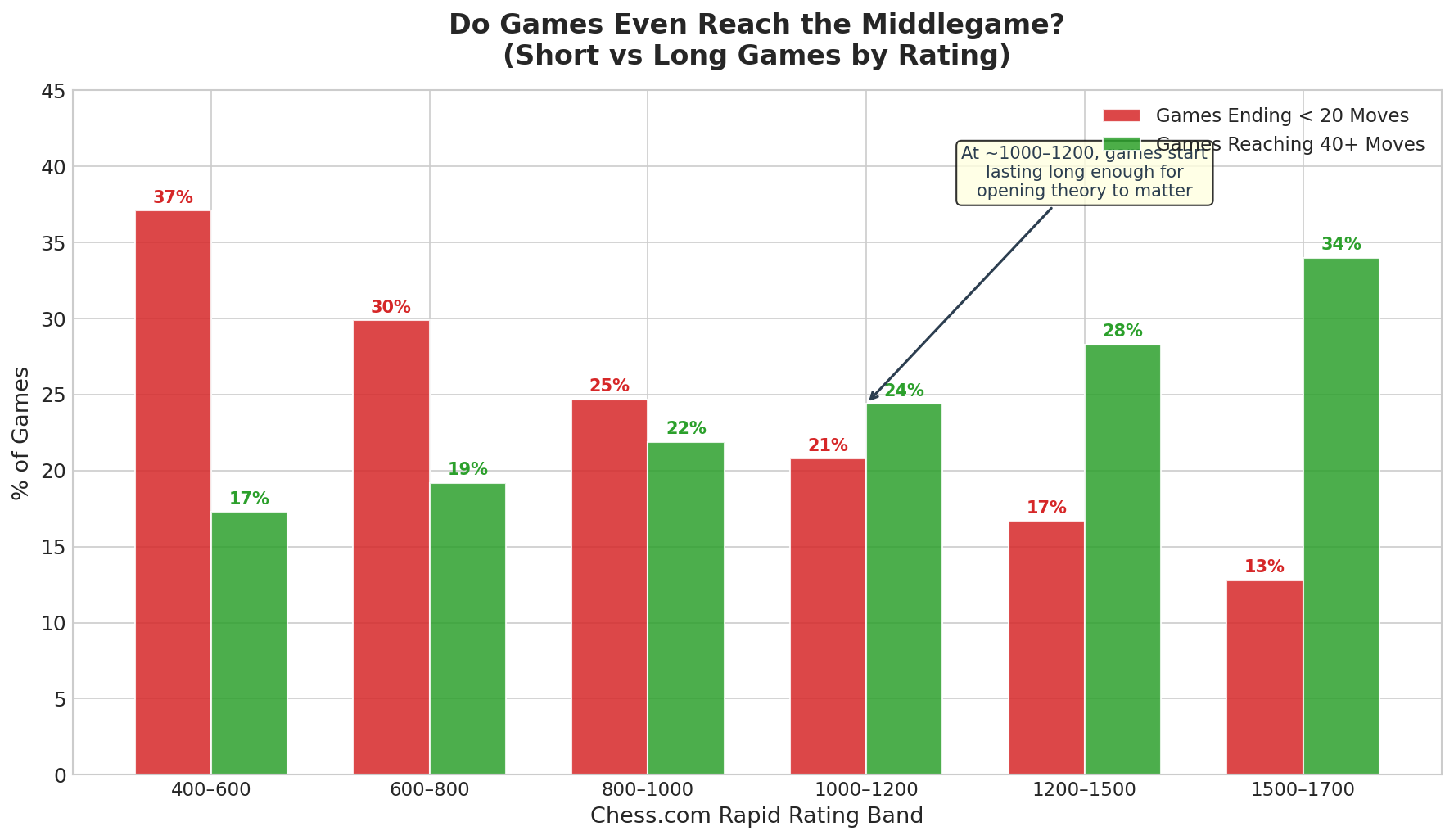
This longer average game length is a double-edged sword in Bullet chess. On one hand, it means players are engaging with richer, more instructive positions. On the other hand, it increases the risk of time trouble, which is a significant factor in Bullet outcomes.
Section 6: The Bullet Termination Factor
Understanding how Bullet games end provides critical context for interpreting draw rates. The data shows that approximately 30% of all Bullet games end by time forfeit rather than checkmate or resignation, and this percentage increases slightly with rating.
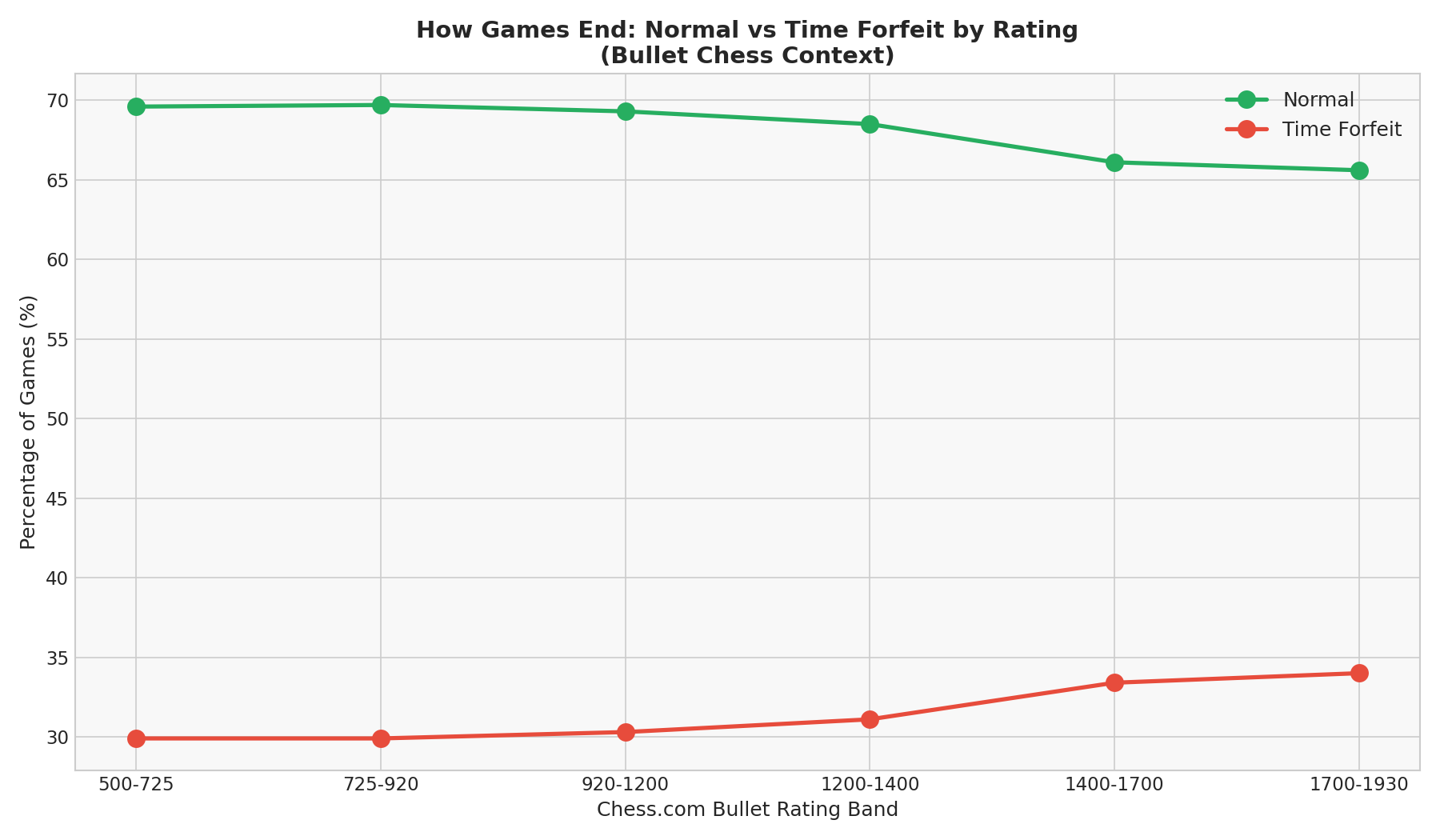
At the beginner level, 37% of games end in fewer than 20 moves, and nearly 30% end by time forfeit. At the advanced intermediate level, only 13% end in fewer than 20 moves, but the time forfeit rate climbs to 34%. This means that in Bullet chess, the clock is as important as the position. The Ruy Lopez, with its slightly longer average game length, may expose players to marginally more time pressure than simpler, more forcing openings.
Section 7: White's Advantage in the Ruy Lopez
The Ruy Lopez provides White with a consistent first-move advantage across all rating bands, as expected from a well-established opening. White's win rate ranges from 49.5% to 52.8%, while Black's ranges from 43.5% to 46.8%. This advantage is slightly more pronounced than the overall Bullet average, where White wins approximately 50% and Black wins approximately 48%.
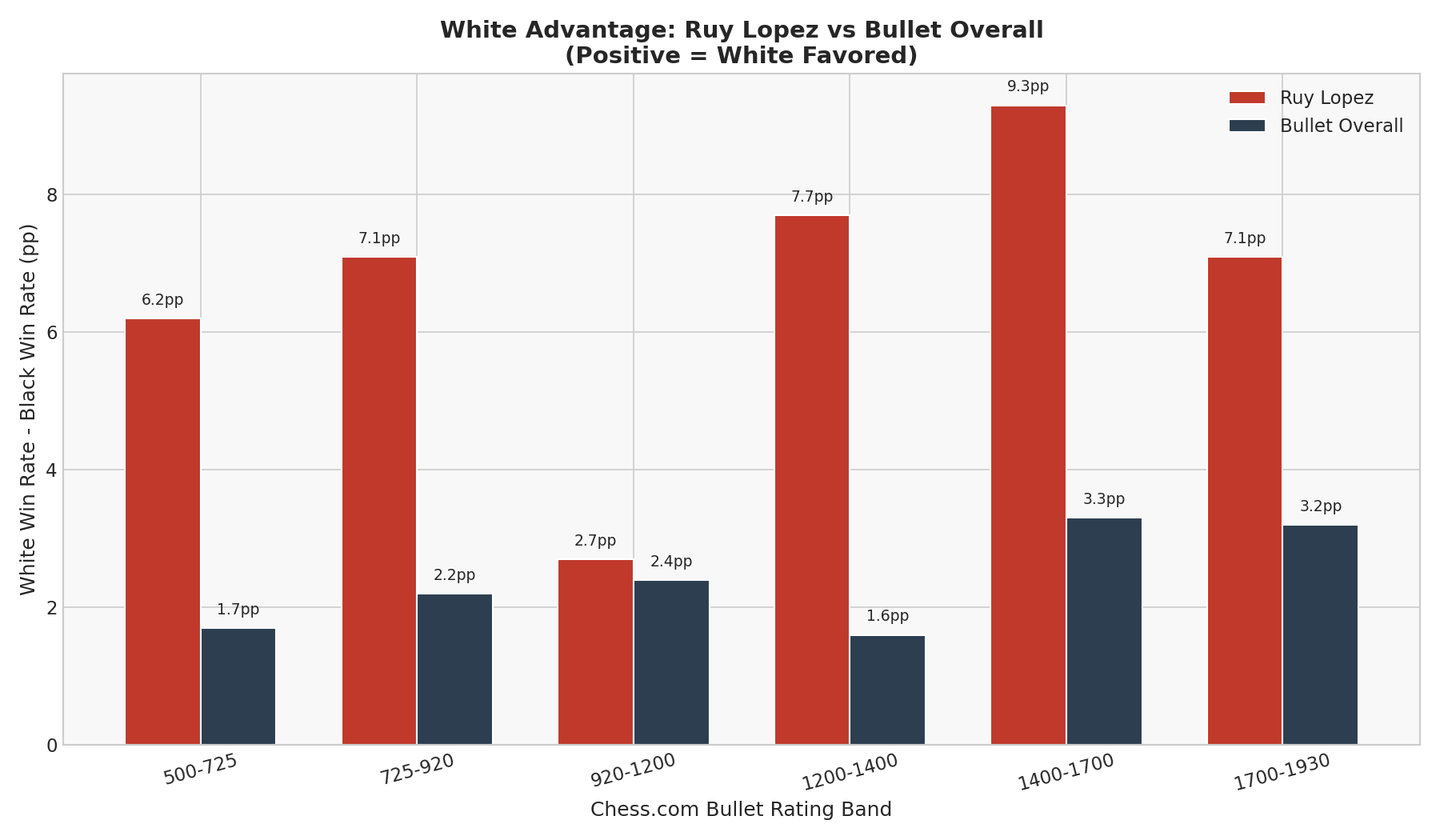
The Ruy Lopez amplifies White's natural first-move advantage by approximately 1-2 percentage points compared to the Bullet baseline. This is consistent with the opening's strategic intent: White gains a small but lasting initiative that, in the hands of a well-prepared player, can be converted into a winning advantage.
Section 8: Actionable Advice for Improving Players
Based on the data presented above, the following roadmap provides specific, evidence-based recommendations for players at each rating level.
For Beginners (Chess.com 800-920)
At this level, the primary focus should be on active piece development and avoiding passive setups. The data shows that games are highly decisive (draw rate under 2% overall), and the slightly elevated draw rate in the Ruy Lopez is a byproduct of the opening's solid structure, not a conscious choice by players to play for a draw. The average CPL at this level exceeds 200, meaning both sides are making frequent large errors. The opening choice matters far less than basic tactical awareness.
Actionable Advice: Avoid falling into passive defensive setups. A common beginner mistake is to play ...Be7 too early in the Steinitz Defense when a more active central challenge like ...exd4 is available. Focus on rapid development, castling early, and fighting for the center. Do not fear the Ruy Lopez; it will teach you fundamental chess principles better than tricky, trap-based openings.
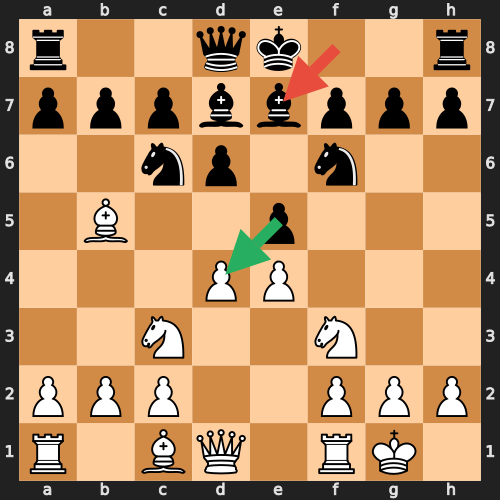
In this position from the Steinitz Defense, the passive ...Be7 (red arrow) is inferior to the active ...exd4 (green arrow), which challenges White's center immediately.
For Intermediate Players (Chess.com 920-1400)
As you progress into the intermediate ranks, opponents will become more familiar with the main lines. The draw rate in the Ruy Lopez remains stable around 3.6-4.1%, and the focus shifts to understanding the specific plans of your chosen sub-variation.
Actionable Advice: If you find yourself drawing too many games or struggling to create winning chances, evaluate your variation choices. If you play the Exchange Variation, understand that you are entering a structurally solid but potentially drawish endgame. If you want more dynamic play, explore the Morphy Defense (3...a6 4.Ba4 Nf6) and be prepared to maintain the tension with plans like ...b5, ...d6, and the eventual ...d5 pawn break. Learn the typical pawn structures so you can navigate the middlegame with a plan rather than drifting into passive positions.
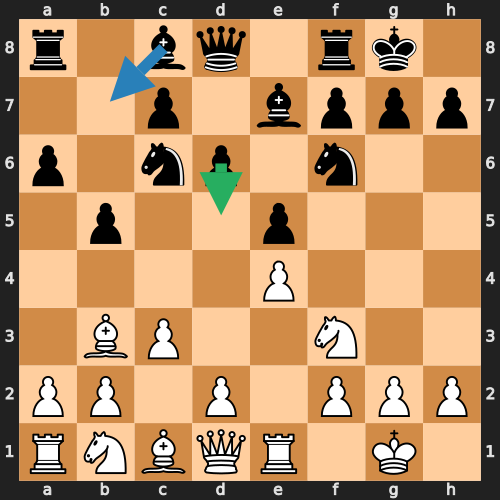
After the Morphy Defense main line, Black has multiple active plans including ...d5 (green arrow) to challenge the center and ...Bb7 (blue arrow) to develop the bishop actively.
For Advanced Intermediates (Chess.com 1400-1500)
At this stage, the draw rate in Bullet chess begins to climb naturally as players make fewer catastrophic blunders. The Ruy Lopez draw rate sits at 3.5-4.1%, and the focus shifts to nuanced positional understanding and, critically, time management.
Actionable Advice: Time management is paramount. The data shows that time forfeits account for over 30% of game terminations at this level. Because the Ruy Lopez often leads to complex, maneuvering middlegames, it is easy to burn too much time on the clock. Practice playing the opening moves quickly and confidently from memory. Deepen your understanding of the resulting pawn structures so you can find plans intuitively rather than calculating everything from scratch under time pressure. Consider studying the Berlin Defense (3...Nf6) as a solid but active alternative that keeps the position complex without requiring extensive theoretical preparation.
Conclusion
The data definitively answers the question: beginners are not playing the Ruy Lopez "too safely." While the opening does produce a slightly higher draw rate than the chaotic Bullet average (3.5-4.4% vs. 1.4-3.0%), it remains an overwhelmingly decisive opening where over 95% of games end with a winner. The Ruy Lopez draw rate is comparable to other mainstream openings like the Italian Game, the London System, and the Scotch Game, and is far lower than what one would expect from a genuinely "drawish" opening.
The slightly elevated draw rate is largely attributable to the Exchange Variation, which is structurally designed to simplify the position. Players who wish to avoid draws should simply choose more dynamic sub-variations like the Classical, Morphy, or Berlin lines. The Ruy Lopez remains one of the best openings for developing fundamental chess understanding, and its solid structure is a feature, not a flaw.
In Bullet chess specifically, the opening choice is secondary to tactical awareness, time management, and the ability to play quickly under pressure. The Ruy Lopez provides a sound framework for all of these skills, and players at every level should feel confident choosing it as part of their repertoire.
Data and Methodology
This analysis was conducted using a dataset of over 840,000 Lichess games accessed via the Grandmaster Guide analytics API. The dataset covers games from Lichess's March 2025 database, spanning rating bands from 700 to 2000 (Lichess scale). Games were analyzed with Stockfish 17 engine evaluations for CPL and blunder classification. The Ruy Lopez was identified using ECO codes C60-C99 and opening name matching.
Lichess ratings were mapped to approximate Chess.com Bullet ratings using the following conversion table, which is based on empirical cross-platform rating comparisons:
| Lichess Bullet | Chess.com Bullet |
|---|---|
| 975 | 445 |
| 1115 | 725 |
| 1295 | 920 |
| 1475 | 1115 |
| 1675 | 1305 |
| 1770 | 1400 |
| 2000 | 1715 |
All charts were generated using Matplotlib and Seaborn in Python. Board diagrams were rendered using the python-chess library with custom arrow annotations. The underlying CSV data files are available for download:
| File | Description |
|---|---|
| ruy_lopez_vs_overall_draw_rates.csv | Core comparison: Ruy Lopez vs overall draw rates by band |
| ruy_lopez_variants_by_band.csv | Detailed stats for each Ruy Lopez sub-variation |
| opening_comparison_draw_rates.csv | Draw rates for 7 popular openings across rating bands |
| time_control_draw_rates.csv | Bullet, Blitz, and Rapid draw rates by band |
| time_control_detailed.csv | CPL and game length by time control |
| game_phase_distribution.csv | Game phase and termination statistics |
| termination_by_rating.csv | How games end by rating band |
| ruy_lopez_subvariant_decay.csv | Sub-variation draw rate decay curves |
Chess Coach, April 14, 2026