Every chess coach repeats the same mantra to beginners: "Control the center, develop your pieces, and castle early." But in the chaotic, time-scrambled world of Bullet chess, where games are decided in seconds and every tempo counts, does this classical advice still hold true? Is spending a precious move to tuck your king away actually worth it, or is it better to launch an immediate attack?
To answer this endlessly debatable premise, we analyzed 1,362,602 Bullet games played on Lichess in March 2025. We categorized players into rating bands, mapped them to their Chess.com equivalents, and tracked exactly when—and if—they castled.
The data reveals a clear, undeniable truth: castling is not just a defensive luxury; it is a statistical necessity for winning. However, the way players castle, and the penalty for ignoring king safety, evolves dramatically as you climb the rating ladder.
This guide serves as a roadmap for improvement, breaking down the castling data across different skill levels and providing actionable advice to help you climb from the beginner ranks to advanced play.
The Universal Truth: Castling Wins Games
Before diving into the nuances of different rating bands, we must address the core question: Does castling improve your win rate?
The answer is a resounding yes. Across every single rating bracket, players who castle by move 10 win significantly more often than those who never castle.
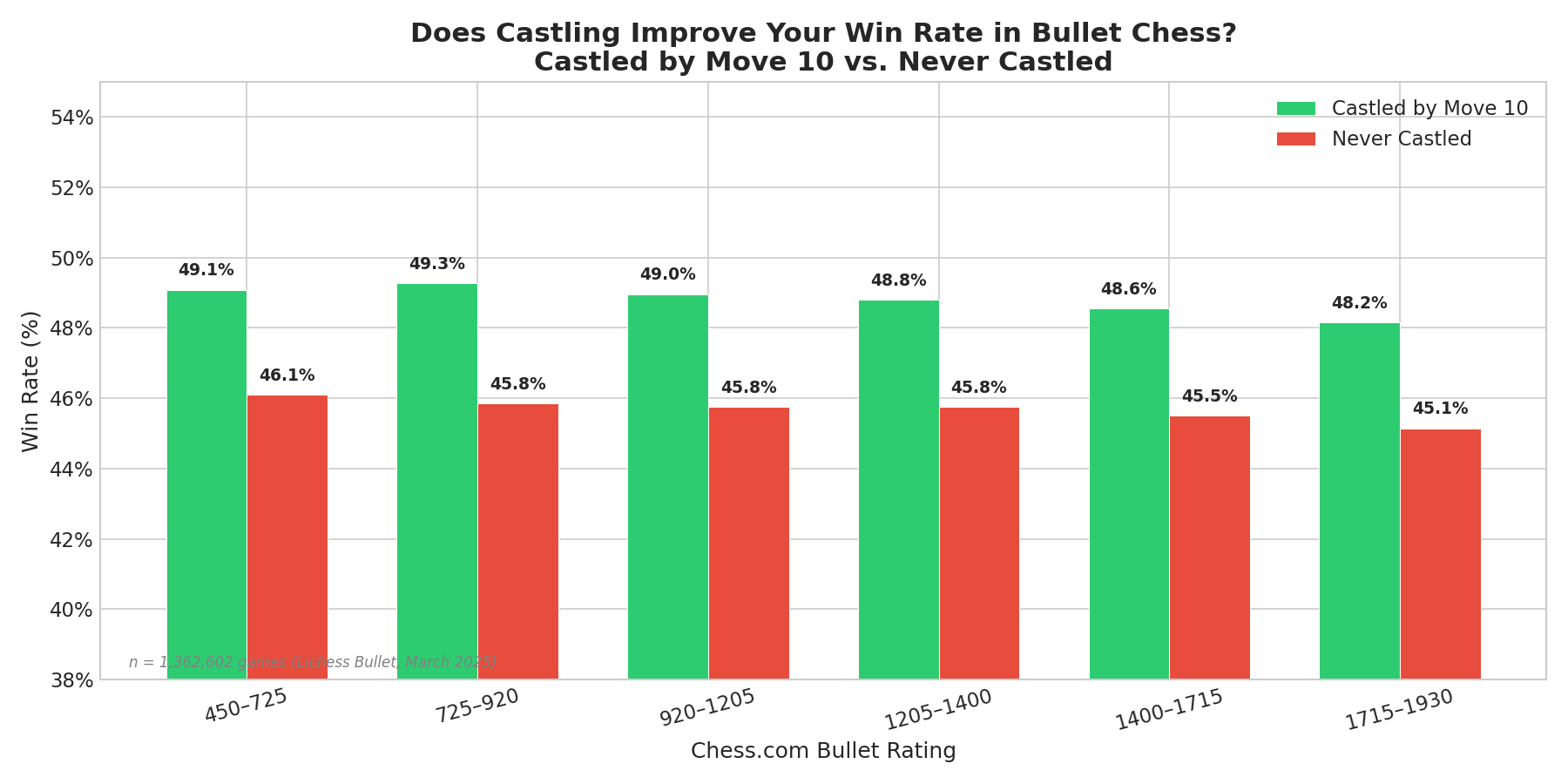
As the chart above demonstrates, castling early provides a consistent win rate of around 48% to 49% (from the perspective of the castling player, averaging White and Black). In contrast, players who never castle see their win rates plummet to 45% or 46%.
This might seem like a small difference, but in chess, a 3 to 4 percentage point advantage is massive. It is the difference between climbing the rating ladder and being stuck on a plateau.
The Penalty Curve: A Flat Tax on Bad Habits
One of the most surprising findings in our research was the shape of the "penalty curve." We hypothesized that the punishment for not castling would increase linearly with the opponent's rating—that stronger players would be more adept at exploiting an exposed king.
The data tells a different story.
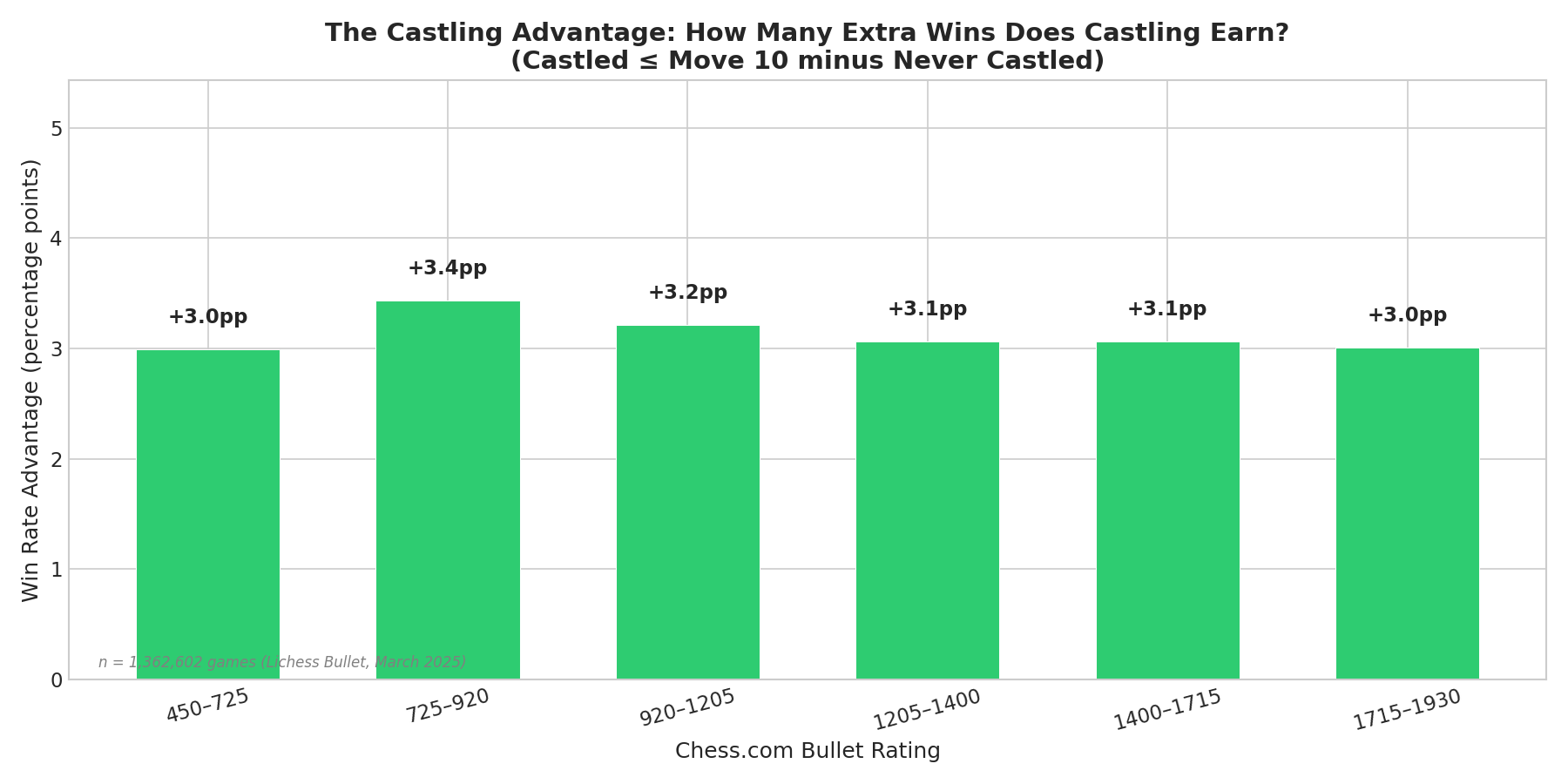
The advantage gained by castling (or the penalty for not castling) is remarkably flat across all skill levels. Whether you are rated 500 or 1800 on Chess.com, castling early earns you approximately 3.0 to 3.4 extra wins per 100 games.
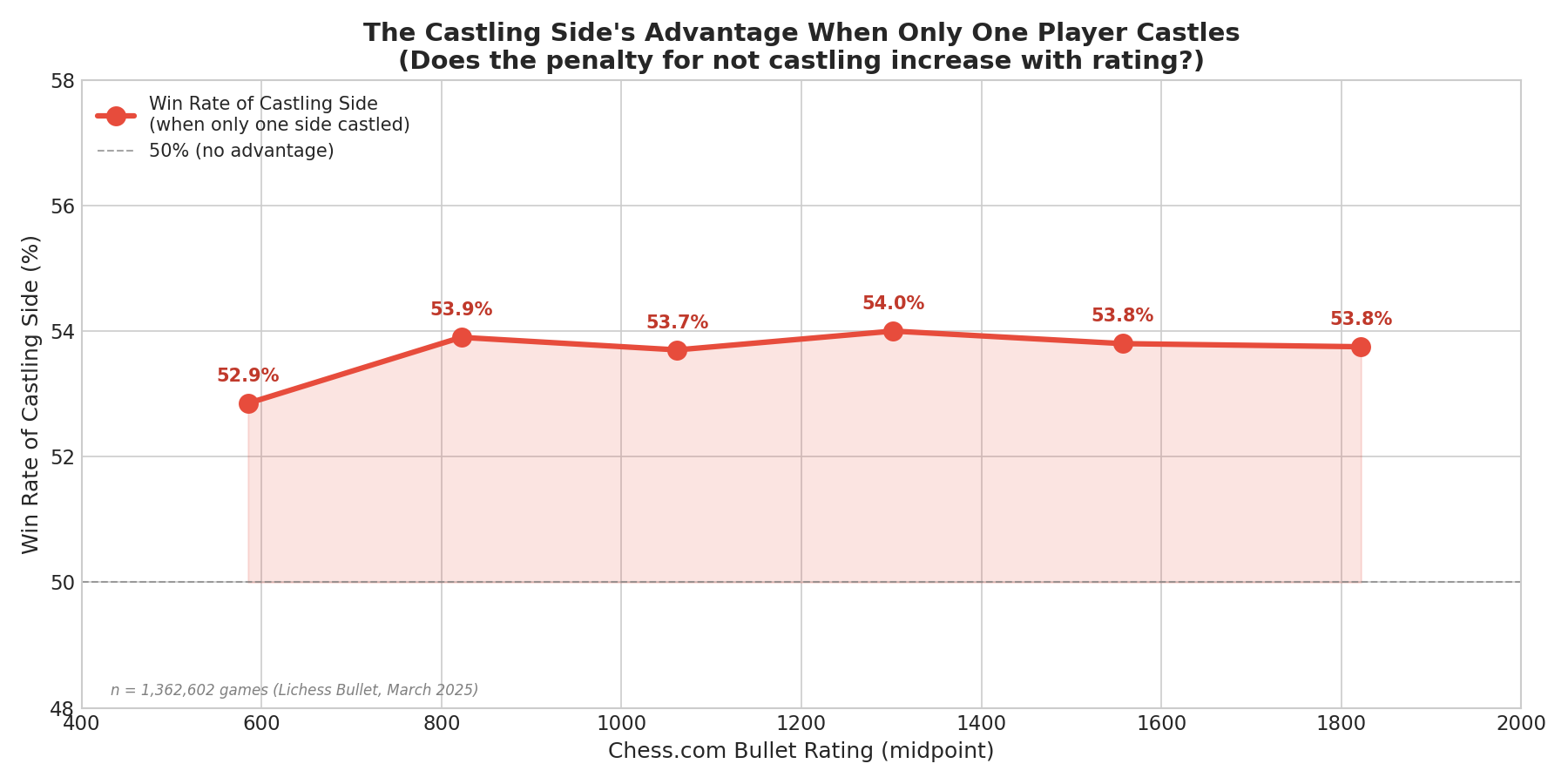
When we look at games where only one player castled, the castling side wins roughly 53% to 54% of the time, regardless of the rating band. This means that an exposed king is a universal liability. Beginners blunder their uncastled kings to simple tactics, while advanced players slowly squeeze uncastled opponents through positional pressure. The mechanism of defeat changes, but the statistical outcome remains identical.
Roadmap to Improvement: Rating Band Analysis
While the advantage of castling is constant, the frequency of castling changes drastically as players improve. Let us examine the data through the lens of different rating bands to understand how castling habits evolve.
The Beginner Ranks: Chess.com 450–920 (Lichess 700–1100)
In the beginner ranks, chaos reigns supreme. Games are often decided by one-move blunders, and fundamental opening principles are frequently ignored.
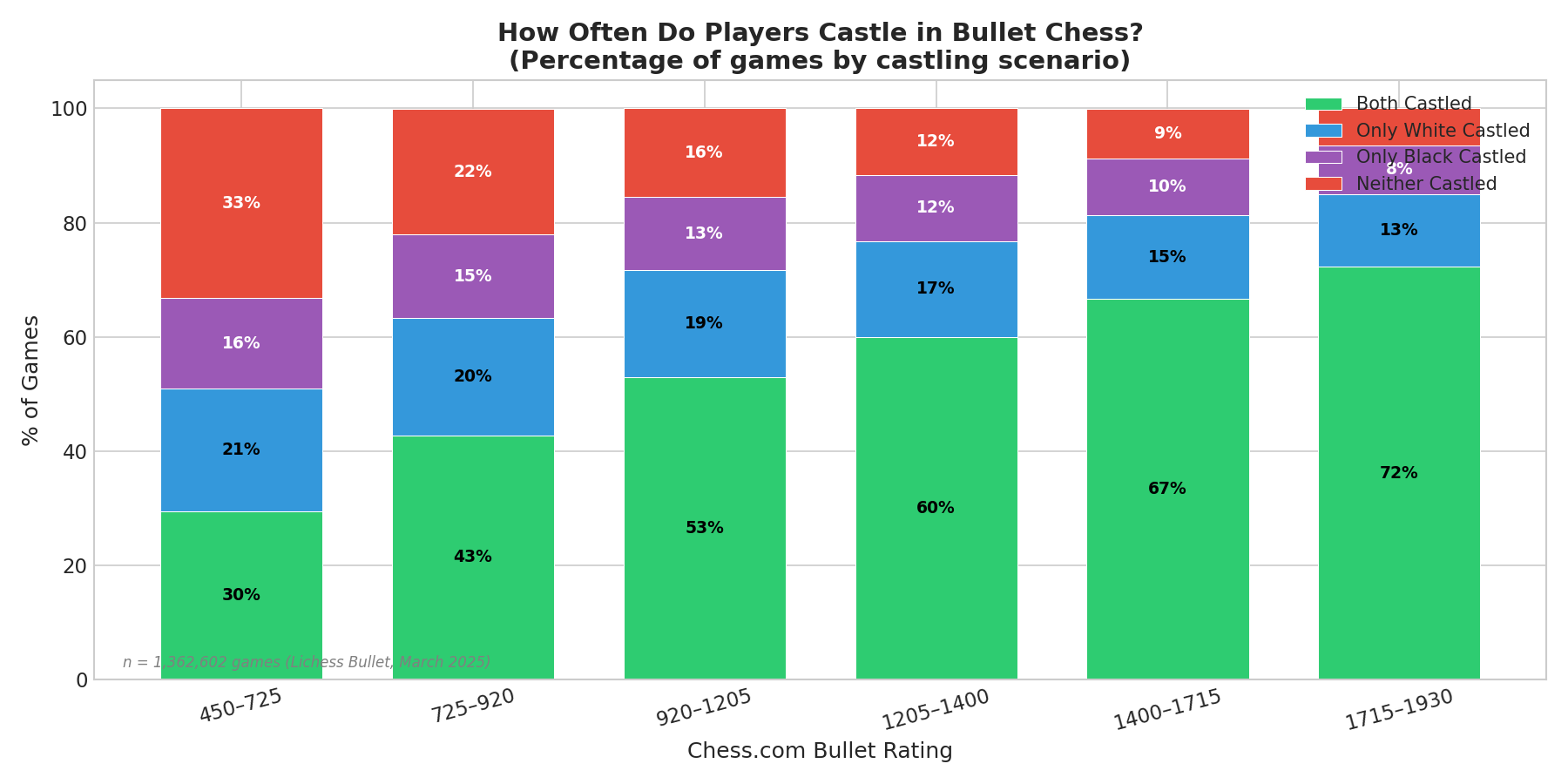
At the lowest rating band (Chess.com 450–725), only 30% of games see both players castle. A staggering 33% of games end with neither player castling. As players approach the 900 mark, the rate of mutual castling increases to 43%, but it remains a coin toss whether a game will feature two safe kings.
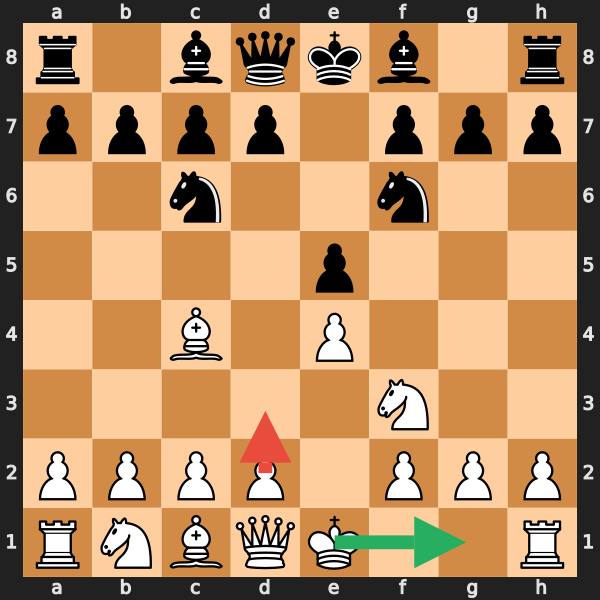
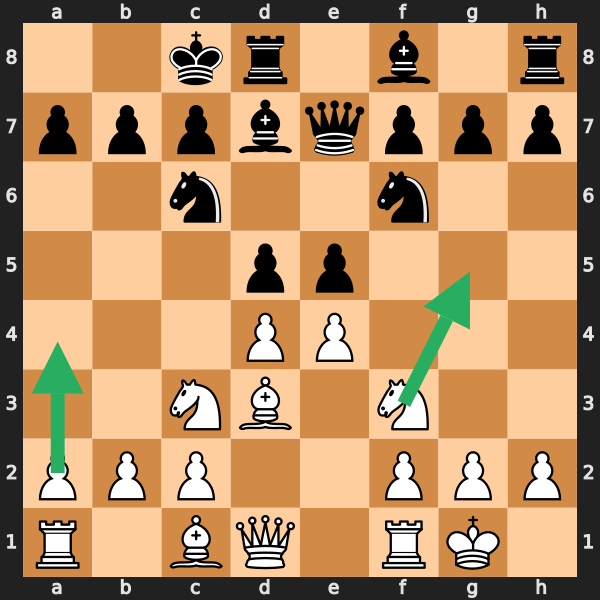
In positions like the one above, beginners often prioritize slow pawn moves (like d3) or premature attacks over king safety. This leads to early disasters.
Actionable Advice for 450–920: Make castling an automatic reflex. Do not calculate whether you need to castle; just do it. Your opponents at this level will frequently leave their kings in the center. By simply securing your king by move 10, you immediately gain a 3 percentage point statistical advantage over the field. Let them launch premature attacks while your king rests safely behind a wall of pawns.
The Intermediate Climb: Chess.com 920–1400 (Lichess 1100–1500)
As players cross the 1000 rating threshold, they begin to internalize opening principles. The data reflects this maturation.
By the time players reach the Chess.com 1205–1400 bracket, 60% of games feature both players castling, and the "neither castled" scenario drops to just 12%. Players at this level understand that the center will eventually open up, and a king left on e1 or e8 is a prime target.
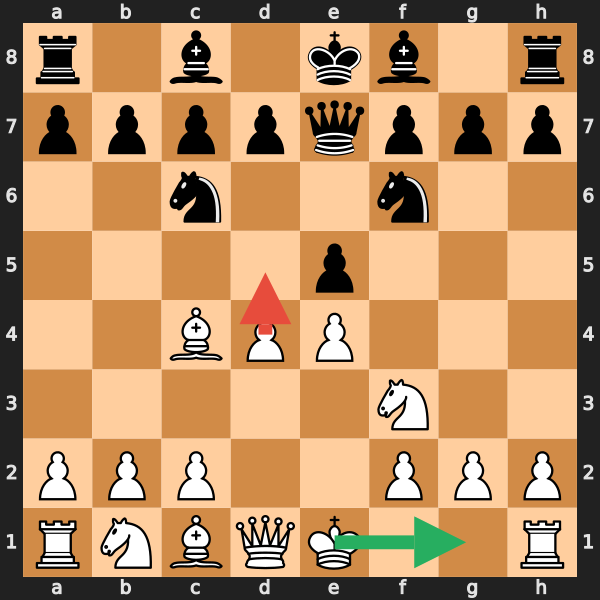
However, intermediate players often struggle with timing. They know they should castle, but they delay it to grab a pawn or create a threat.
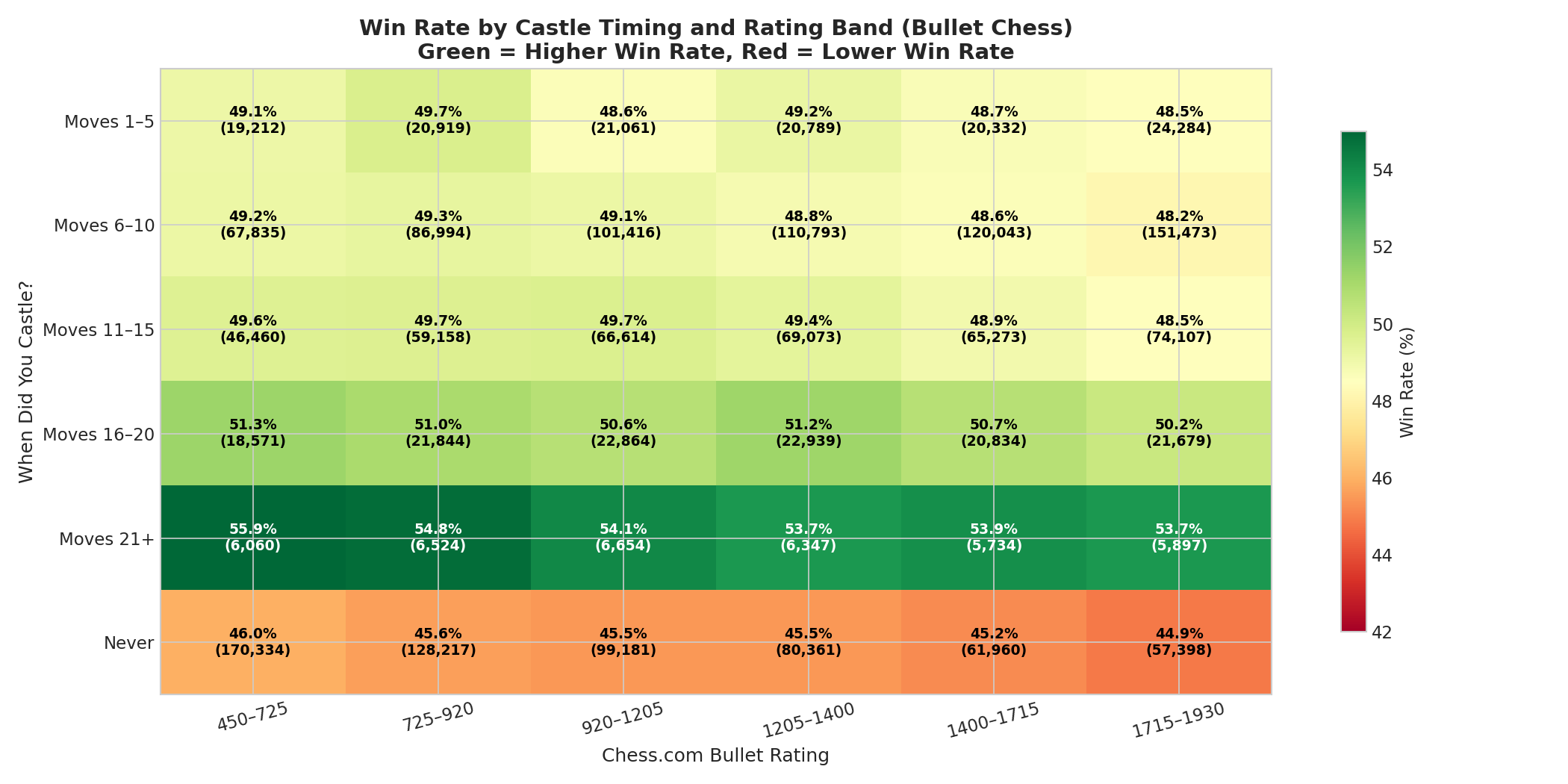
Our heatmap reveals a fascinating trend: the highest win rates actually belong to players who castle very late (move 21+). This is a classic example of survivorship bias. If you survive to move 21 without castling and then manage to castle, you were likely already winning the game. For standard play, castling between moves 6 and 15 provides the most reliable foundation for victory.
Actionable Advice for 920–1400: Focus on the efficiency of your development. It is not enough to eventually castle; you must castle before the central tension breaks. If your opponent delays castling to launch a flank attack, do not panic. Castle quickly, strike in the center, and use your superior king safety to pry open the position.
The Advanced Arena: Chess.com 1400–1930 (Lichess 1500–2000)
In the advanced brackets, castling is no longer a conscious decision; it is a prerequisite for playing the middlegame.
At the Chess.com 1715–1930 level, 72% of games see both players castle, and only 8% of games feature no castling at all. When a player does not castle at this level, it is rarely out of forgetfulness; it is usually because they were forced to move their king due to a tactical sequence or opening trap.
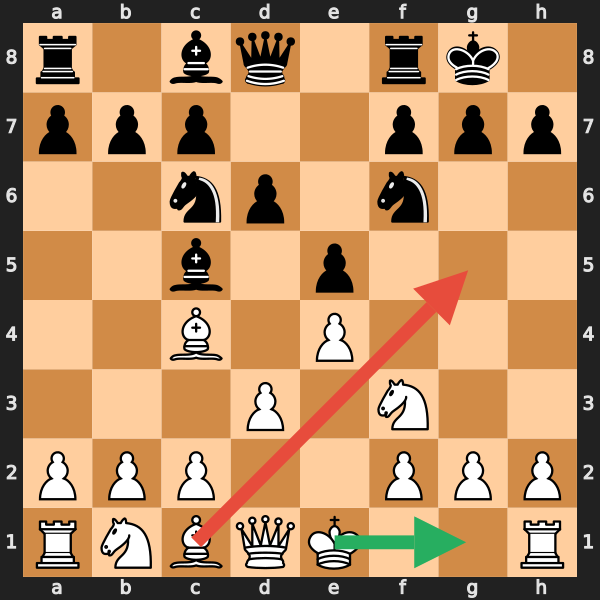
At these ratings, the debate shifts from whether to castle to where to castle.
Kingside vs. Queenside: What the Data Says
Does castling queenside lead to more decisive results? We analyzed a sample of games where castling occurred to compare Kingside (O-O) versus Queenside (O-O-O) castling.
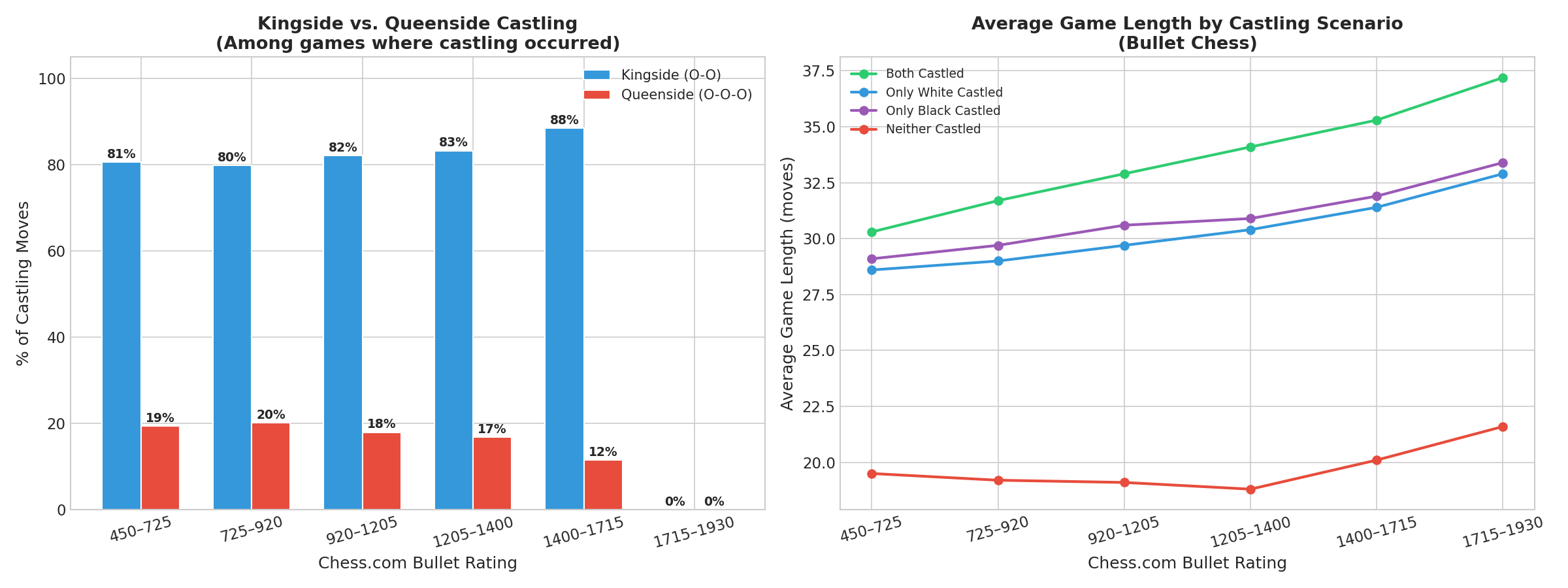
The data is overwhelming: Kingside castling is vastly more popular, accounting for roughly 85% to 90% of all castling moves across all rating bands.
Queenside castling is inherently riskier. It takes an extra move to clear the queenside (moving the queen), and the king often requires an additional move (Kb1 or Kb8) to reach true safety. In Bullet chess, where time is the most valuable resource, spending two extra tempi to secure the king is a luxury most players cannot afford.
When opposite-side castling does occur, games become highly tactical pawn races. While these games are exciting, the data suggests that the reliable, efficient Kingside castle is the statistically superior choice for consistent Bullet performance.
Actionable Advice for 1400–1930: At this level, your opponents will punish an exposed king with ruthless efficiency. If you find yourself frequently unable to castle, you need to review your opening repertoire. Avoid trappy lines that require you to sacrifice king safety for marginal material gains. Stick to solid, rapid development, and default to Kingside castling unless the position specifically demands otherwise.
The "Only I Castled" Advantage
Perhaps the most compelling evidence for the importance of castling comes from examining games where only one side castled. In these asymmetric scenarios, the castling side enjoys a substantial advantage.
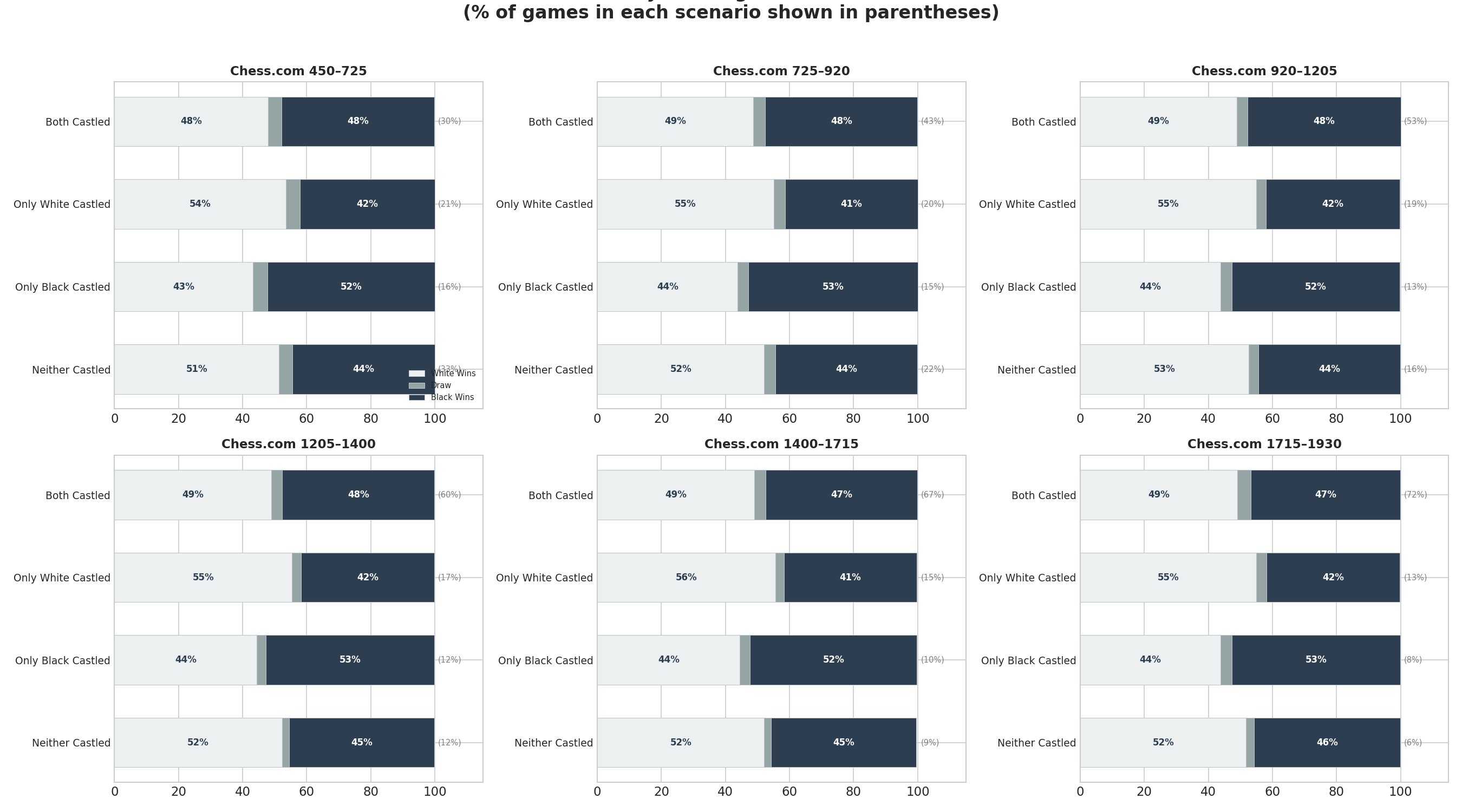
The table below summarizes the win rates across all six rating bands for each castling scenario. The pattern is unmistakable: when only one side castles, that side wins approximately 53% to 55% of the time.
| Scenario | White Win % | Draw % | Black Win % | Avg. Game Length |
|---|---|---|---|---|
| Both Castled | 48.5 | 3.8 | 47.4 | 33.6 |
| Only White Castled | 54.9 | 3.3 | 41.7 | 30.4 |
| Only Black Castled | 43.9 | 3.5 | 52.5 | 30.9 |
| Neither Castled | 52.1 | 3.1 | 44.9 | 19.7 |
Table: Average outcomes across all rating bands in Bullet chess. When only one side castles, that side wins roughly 53–55% of the time.
Notice that games where neither side castles are dramatically shorter (averaging only ~20 moves). These are the chaotic, tactical bloodbaths where the game is decided before either player even considers king safety. As players improve, these games become increasingly rare.
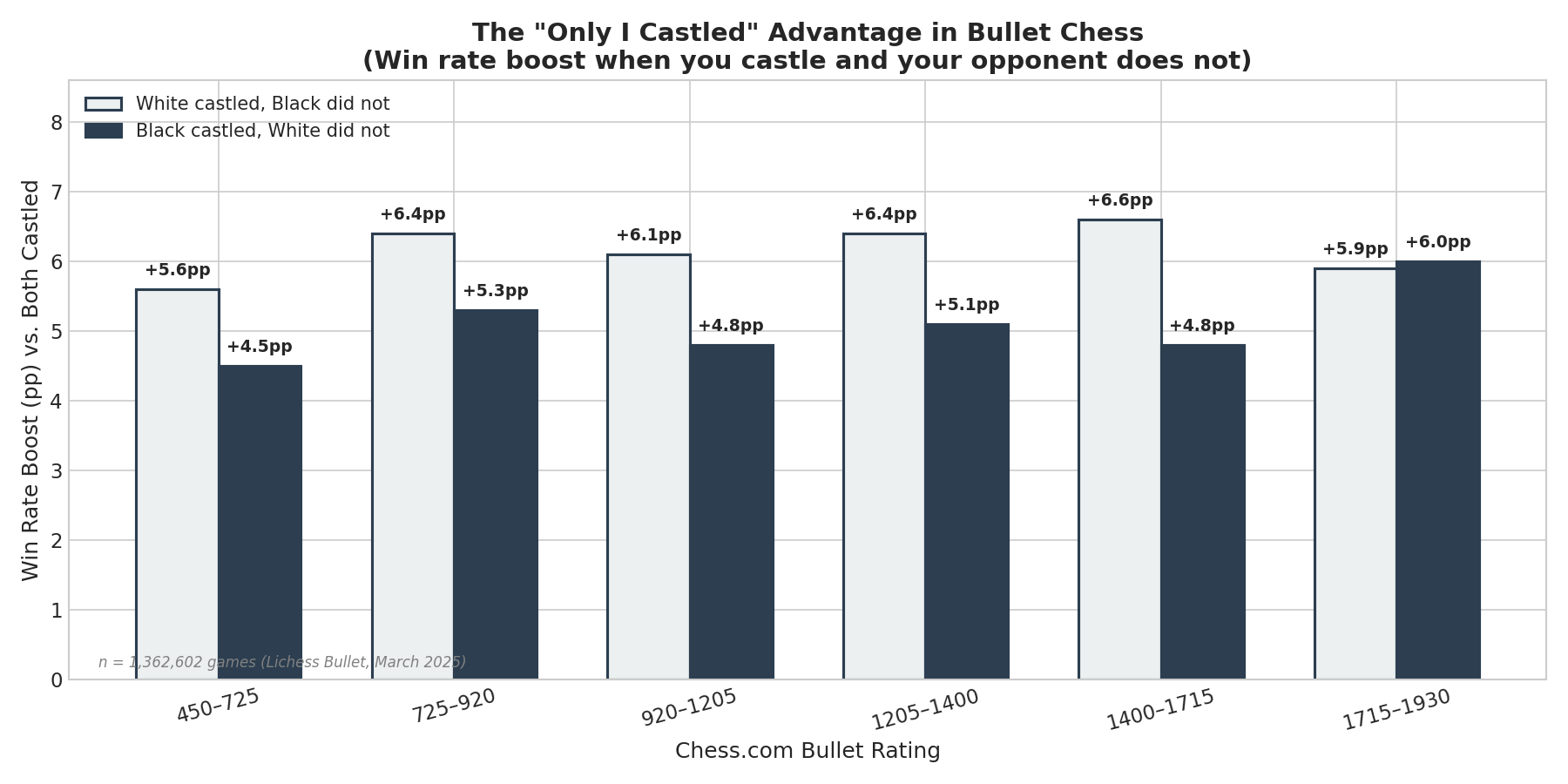
The "Only I Castled" advantage chart above shows the win rate boost (in percentage points) that a player receives when they castle and their opponent does not, compared to the baseline of both players castling. This boost ranges from +4.9 to +6.4 percentage points for White and +4.5 to +6.0 for Black, making it one of the single largest predictors of game outcome in our dataset.
Conclusion
The data has spoken. In the hyper-fast environment of Bullet chess, classical principles still reign supreme. Castling is not a waste of time; it is an investment that yields a consistent, measurable return across every rating band.
Whether you are a 600-rated beginner or an 1800-rated veteran, the rule remains the same: get your king to safety. The center of the board is no place for a monarch.
Data and Methodology
This analysis was conducted using a dataset of 1,362,602 Bullet chess games played on Lichess in March 2025. The data was accessed and processed using the Grandmaster Guide analytical tools.
- Rating Conversion: Lichess ratings were mapped to Chess.com Bullet ratings using the standard conversion table provided for this study. All charts and primary text references use the Chess.com equivalents.
- Castling Detection: Castling timing was determined by scanning the PGN movetext for standard algebraic notation (O-O and O-O-O).
- Win Rates: Win rates are calculated from the perspective of the player in the specified scenario, excluding draws from the numerator but including them in the denominator (Win / Total Games).
Underlying Data Files: The raw CSV data files generated for this analysis are attached to this report for further review:
castle_timing_bullet.csvcastle_outcome_bullet.csvdraw_rates_bullet.csvgame_phase_bullet.csvtermination_bullet.csvkingside_queenside_sample.csvanalysis_summary.csv
| Lichess Rating Band | Chess.com Bullet Equivalent | Castled ≤ Move 10 Win Rate | Never Castled Win Rate | Castling Advantage | Both Castled % |
|---|---|---|---|---|---|
| 700–900 | 450–725 | 49.1% | 46.1% | +3.0pp | 30% |
| 900–1100 | 725–920 | 49.3% | 45.8% | +3.4pp | 43% |
| 1100–1300 | 920–1205 | 49.0% | 45.8% | +3.2pp | 53% |
| 1300–1500 | 1205–1400 | 48.8% | 45.8% | +3.1pp | 60% |
| 1500–1800 | 1400–1715 | 48.6% | 45.5% | +3.1pp | 67% |
| 1800–2000 | 1715–1930 | 48.2% | 45.1% | +3.0pp | 72% |
Table: Complete summary of castling statistics across all rating bands.
Chess Coach, April 15, 2026