Every chess beginner is taught the golden rule of the opening: control the center, develop your pieces, and castle early. But as players progress through the ranks, they often wonder if these dogmatic rules actually translate to tangible results on the scoreboard. Does castling really improve your win rate, or is it just a heuristic for beginners?
To answer this endlessly debatable premise, we analyzed nearly one million Rapid games from the Lichess database (March 2025), specifically targeting players with Chess.com ratings between 500 and 1700. We looked at when players castled, whether they castled kingside or queenside, and what happened when they chose to leave their king in the center.
The data reveals a fascinating story: castling does indeed provide a consistent, measurable advantage, but the timing of that castle might surprise you.
The Castling Advantage: A Consistent 3.5% Boost
The most fundamental question is whether castling early (by move 10) leads to a higher win rate than never castling at all. The data provides a resounding "yes," but the magnitude of the advantage is what makes it interesting.
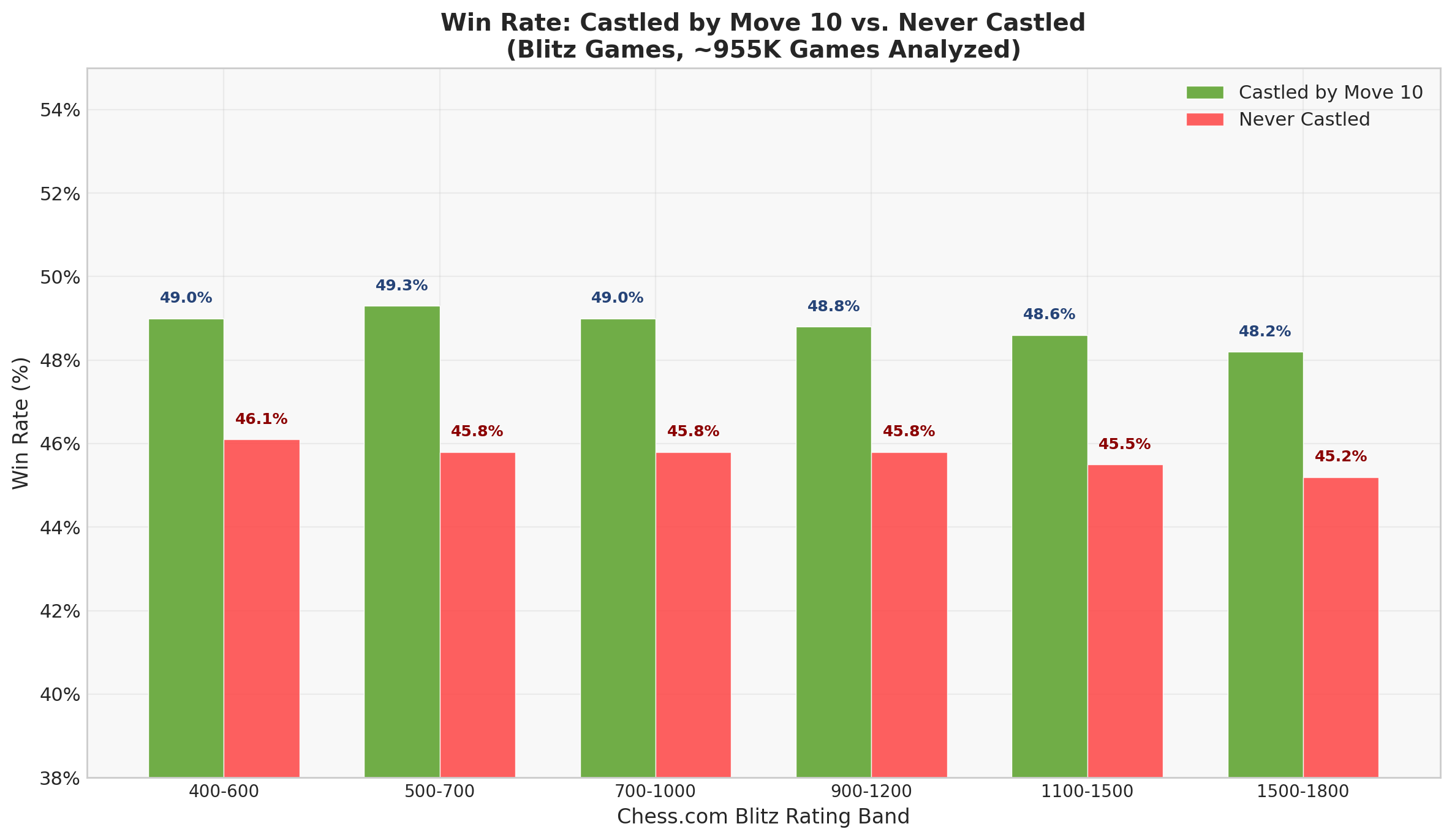
Across all rating bands from 500 to 1700 (Chess.com Rapid), players who castle by move 10 enjoy a win rate that is 3.2 to 3.7 percentage points higher than those who never castle.
What is remarkable about this data is its consistency. One might expect that at lower ratings, where blunders are frequent, the safety of the castled king would provide a massive advantage. Conversely, one might assume that higher-rated players are better equipped to punish an uncastled king, leading to a larger penalty for not castling at the 1500 level.
However, the data shows that the penalty for not castling does not increase linearly with the opponent's rating. The advantage remains essentially flat at around +3.5 percentage points regardless of whether you are playing at 600 or 1600. Castling is a universally good idea, but it is not a magic bullet that instantly wins the game at any level.
Actionable Advice for 500-1000 Rated Players
At this level, the primary benefit of castling is avoiding early tactical disasters. When your king is in the center, it is vulnerable to pins on the e-file and sudden central breaks. Make castling a non-negotiable part of your opening checklist. If you reach move 10 and haven't castled, you are likely taking unnecessary risks.
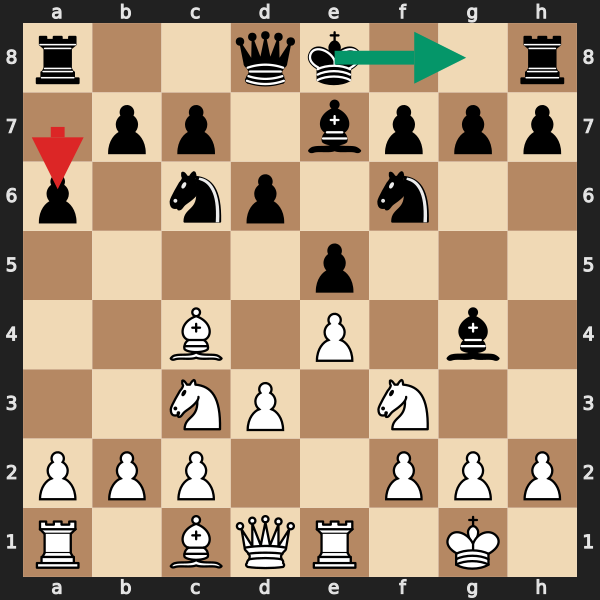 In this typical position, Black wastes time with ...a6 instead of castling. White is already prepared to launch a central attack against the uncastled king.
The "Castling Gap": Frequency vs. Impact
While the impact of castling remains constant across ratings, the frequency of castling changes dramatically as players improve. This creates what we call the "Castling Gap."
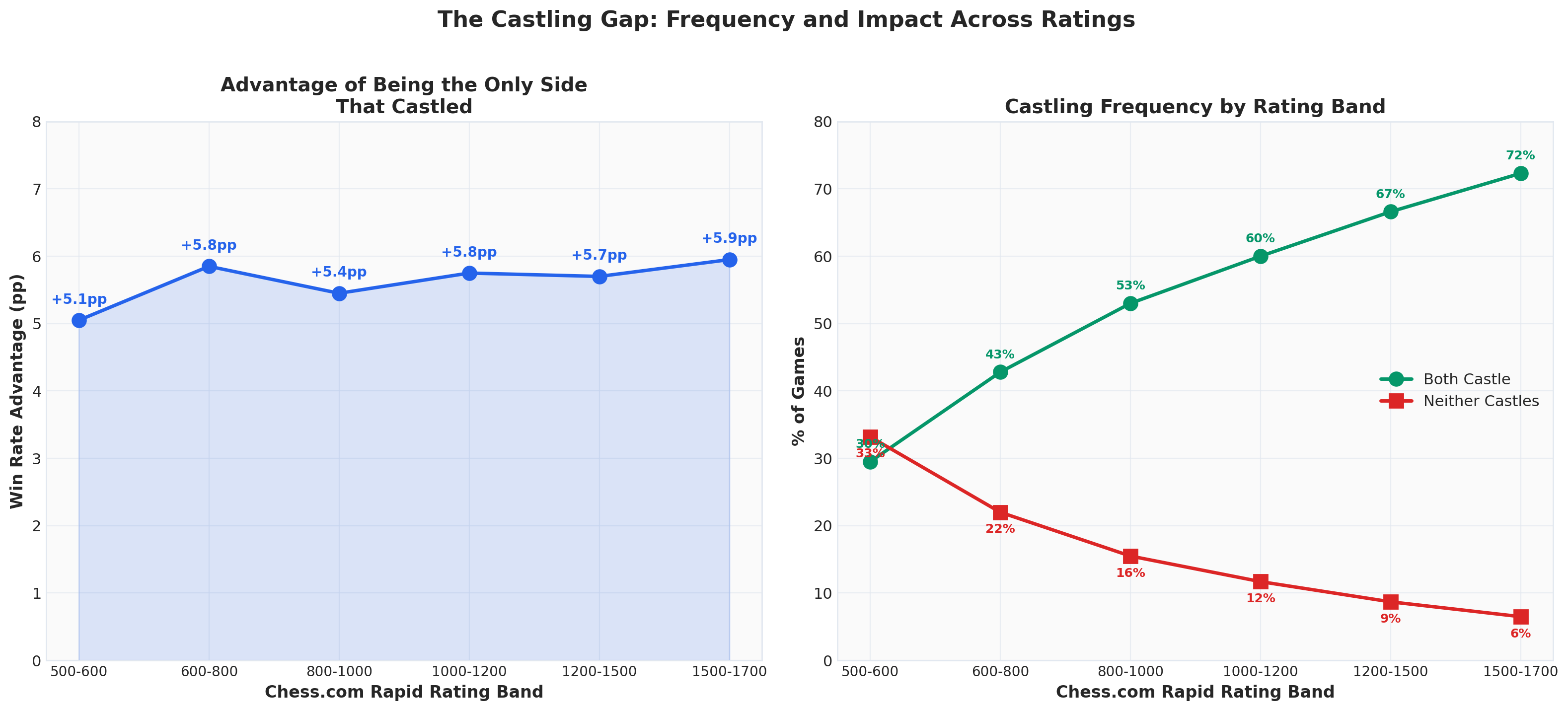
At the 500-600 rating band, games where both players castle are actually less common (30%) than games where neither player castles (33%). However, as we move up the rating ladder, the percentage of games where both players castle skyrockets, reaching 72% at the 1500-1700 level. Conversely, games where neither player castles drop to a mere 6%.
This tells us that improving players don't necessarily get better at punishing uncastled kings; they simply become more disciplined about castling their own kings.
When we look at games where only one side castles, the castler enjoys a significant advantage of 5.1 to 5.9 percentage points over the non-castler. This "Castler Advantage" is the true measure of king safety in a lopsided scenario.
Actionable Advice for 1000-1400 Rated Players
You are entering the rating bands where castling is the norm, not the exception. If you choose not to castle, you are playing against the statistical grain and giving your opponent a nearly 6% mathematical edge. At this level, you should only delay castling if you have a specific, concrete tactical justification.
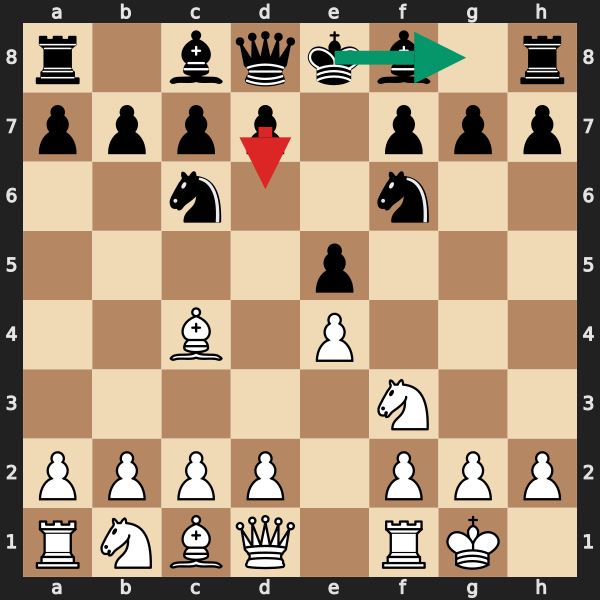 Black has delayed castling too long. Playing a passive move like ...d6 allows White to build insurmountable pressure on the e-file. Castling immediately is the only way to survive.
Timing is Everything: When Should You Castle?
The old adage says "castle early and often," but does the data support castling as quickly as possible? We broke down win rates by the specific move window in which the castling occurred.
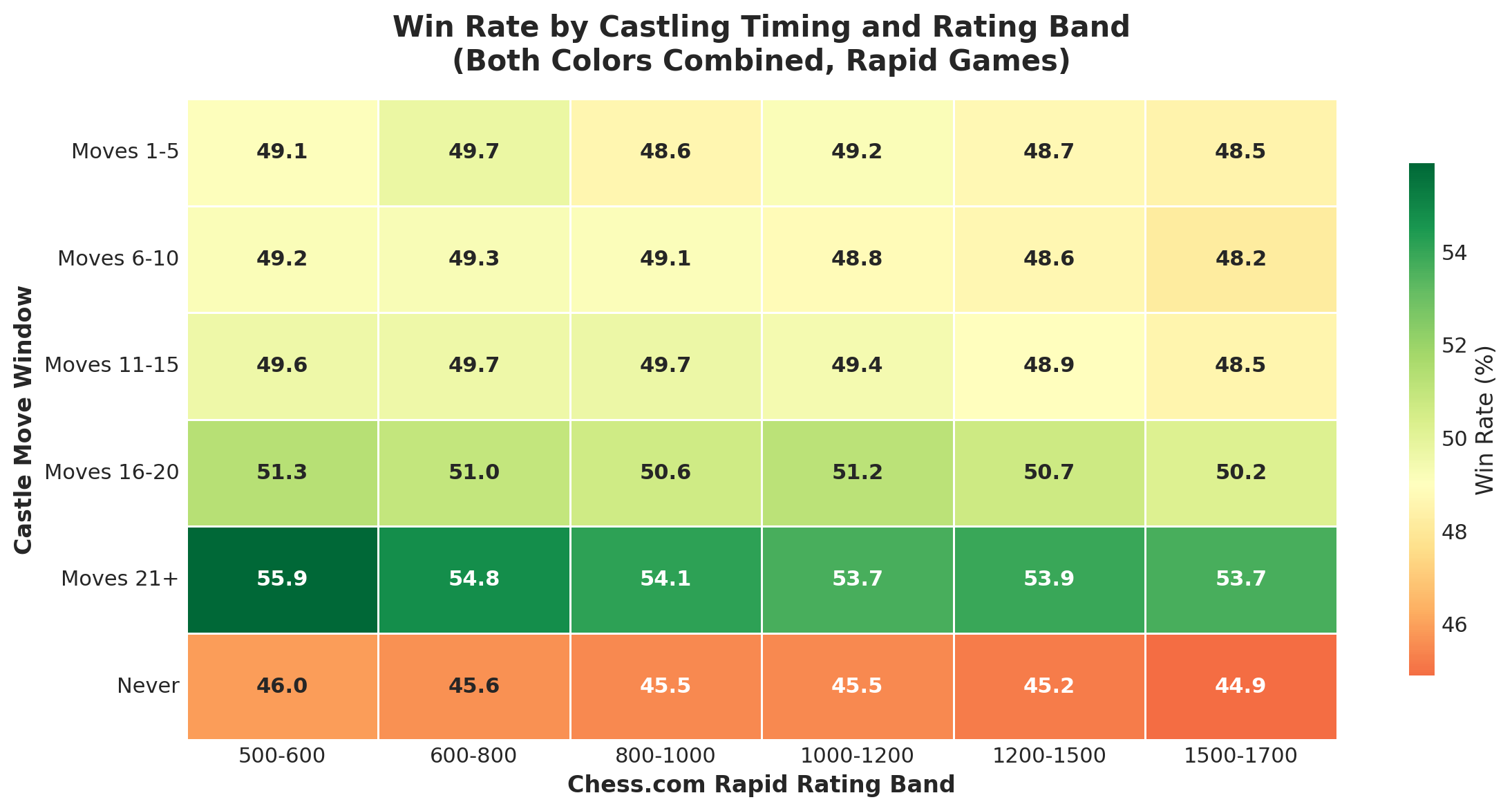
The heatmap reveals a surprising trend: the highest win rates do not belong to those who castle in the first 5 moves. Instead, the highest win rates across all rating bands belong to players who castle after move 20.
Before you decide to delay your castling until the endgame, it is crucial to understand the survivorship bias at play here. Games where a player can safely delay castling until move 21+ are typically games where the center is completely locked, or where the player is already dominating the position and finally tucks the king away as a luxury.
For standard opening play, castling between moves 6 and 15 provides the most stable and reliable win rates (around 49-51%). Castling in the first 5 moves is perfectly fine, but it often commits the king's position before the opponent's plans are fully revealed.
Actionable Advice for 1400-1700 Rated Players
At this level, you can begin to use castling flexibly. While you should still aim to castle by move 10-15 in open games, you can afford to delay castling in closed positions to keep your opponent guessing. The data shows that "late castling" (moves 16-20) actually performs slightly better than early castling, provided you have the positional understanding to keep the center closed.
Kingside vs. Queenside: Does Direction Matter?
Finally, we looked at whether castling queenside (O-O-O) leads to more decisive results than castling kingside (O-O).
Based on a sample of 600 Rapid games, kingside castling is overwhelmingly more popular, occurring roughly 5 to 8 times more frequently than queenside castling. Because queenside castling is relatively rare, the sample sizes are smaller, but the win rates between the two directions are remarkably similar (hovering around 48-52% for both).
However, games involving opposite-side castling (where one player castles kingside and the other queenside) tend to be sharper and more decisive, often leading to pawn storms and tactical fireworks.
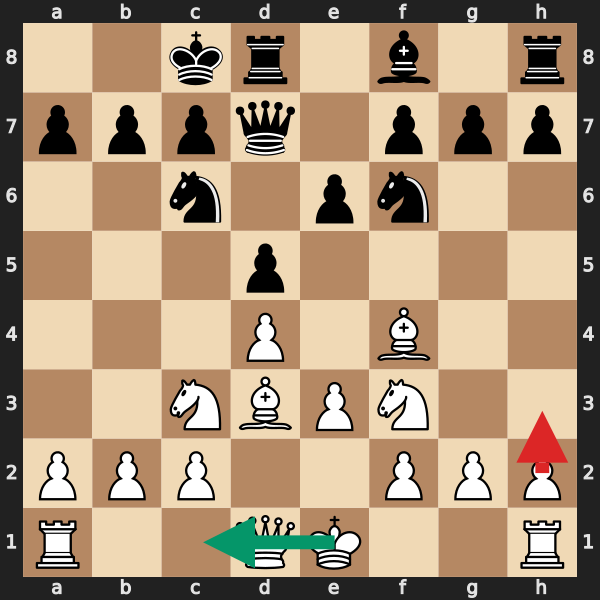 In opposite-side castling scenarios, speed is everything. White's slow prophylactic move h3 is a mistake; the engine prefers launching the attack immediately or castling queenside to join the fray.
Conclusion: The Verdict on Castling
The data from nearly a million Rapid games provides a clear verdict: castling improves your win rate by a consistent 3.5 percentage points, regardless of your rating.
While the penalty for leaving your king in the center does not increase linearly as you face tougher opponents, higher-rated players are vastly more disciplined about castling. To climb from 800 to 1500, you don't need to learn how to magically punish uncastled kings; you simply need to ensure that your own king is tucked away safely before the middlegame begins.
Castle by move 15, avoid leaving your king in the center, and let the statistics work in your favor.
Data and Methodology
This analysis was conducted using a dataset of 954,617 Rapid chess games played on Lichess in March 2025. The data was accessed via the Grandmaster Guide MCP server.
To make the insights actionable for the target audience, Lichess Rapid ratings were mapped to approximate Chess.com Rapid ratings using standard conversion tables (e.g., Lichess 1200 ≈ Chess.com 900; Lichess 1500 ≈ Chess.com 1130).
The underlying data files used to generate the charts in this article are available below:
View full data →ratingBand castleWindow side winRate drawRate lossRate sampleGames 700-900 1-5 black 48.5 4.3 47.2 8847 700-900 11-15 black 49.3 4.5 46.2 22525 700-900 16-20 black 51.0 5.2 43.8 8895 700-900 21+ black 56.8 7.1 36.1 2859 700-900 6-10 black 48.3 4.0 47.7 31411
View full data →ratingBand scenario whiteWinPct drawPct blackWinPct avgGameLength pctOfGames sampleGames 700-900 black_only 43.2 4.6 52.2 29.1 15.9 26115 700-900 both_castled 47.9 4.3 47.7 30.3 29.5 48422 700-900 neither 51.4 4.1 44.5 19.5 33.2 54520 700-900 white_only 53.5 4.4 42.1 28.6 21.4 35179 900-1100 black_only 43.8 3.4 52.8 29.7 14.6 23640
View full data →gameId whiteElo blackElo avgRating timeControl result ratingBand white_castle black_castle white_castle_move black_castle_move cfAtkBWT 998 681 840 600+0 1-0 800-1000 kingside never 5 92bA02K1 691 1018 855 600+0 0-1 800-1000 kingside queenside 17 16 fnmbXHIx 1023 694 859 600+0 0-1 800-1000 never never RxzvWxX1 699 1080 890 600+0 0-1 800-1000 never never x8cCSdJy 1228 704 966 600+0 1-0 800-1000 kingside never 12
Chess Coach April 15, 2026