A common piece of advice given to beginner chess players is: "Don't study endgames until you reach 1500; your games will be decided by blunders in the middlegame anyway." It sounds logical. If every game ends in a quick checkmate or a massive material blunder by move 25, why spend hours learning the Lucena position or Philidor's draw?
To test this assumption, we analyzed over 200,000 Rapid games played on Lichess, mapping the data to approximate Chess.com ratings [1]. We looked at game length, termination types, blunder rates by phase, and material conversion to answer a simple question: At what rating do you actually need to know how to play an endgame?
The data reveals a nuanced reality. While it is true that lower-rated games are chaotic and blunder-filled, a surprising percentage of them do reach the endgame phase. However, the nature of those endgames changes drastically as you climb the rating ladder.
Here is a data-driven roadmap for understanding when and how to study endgames, broken down by rating bands.
The Myth of the "Short Game" at Lower Ratings
The most striking finding from the data is that games at the 550-900 level are not significantly shorter than games at the 1600 level.
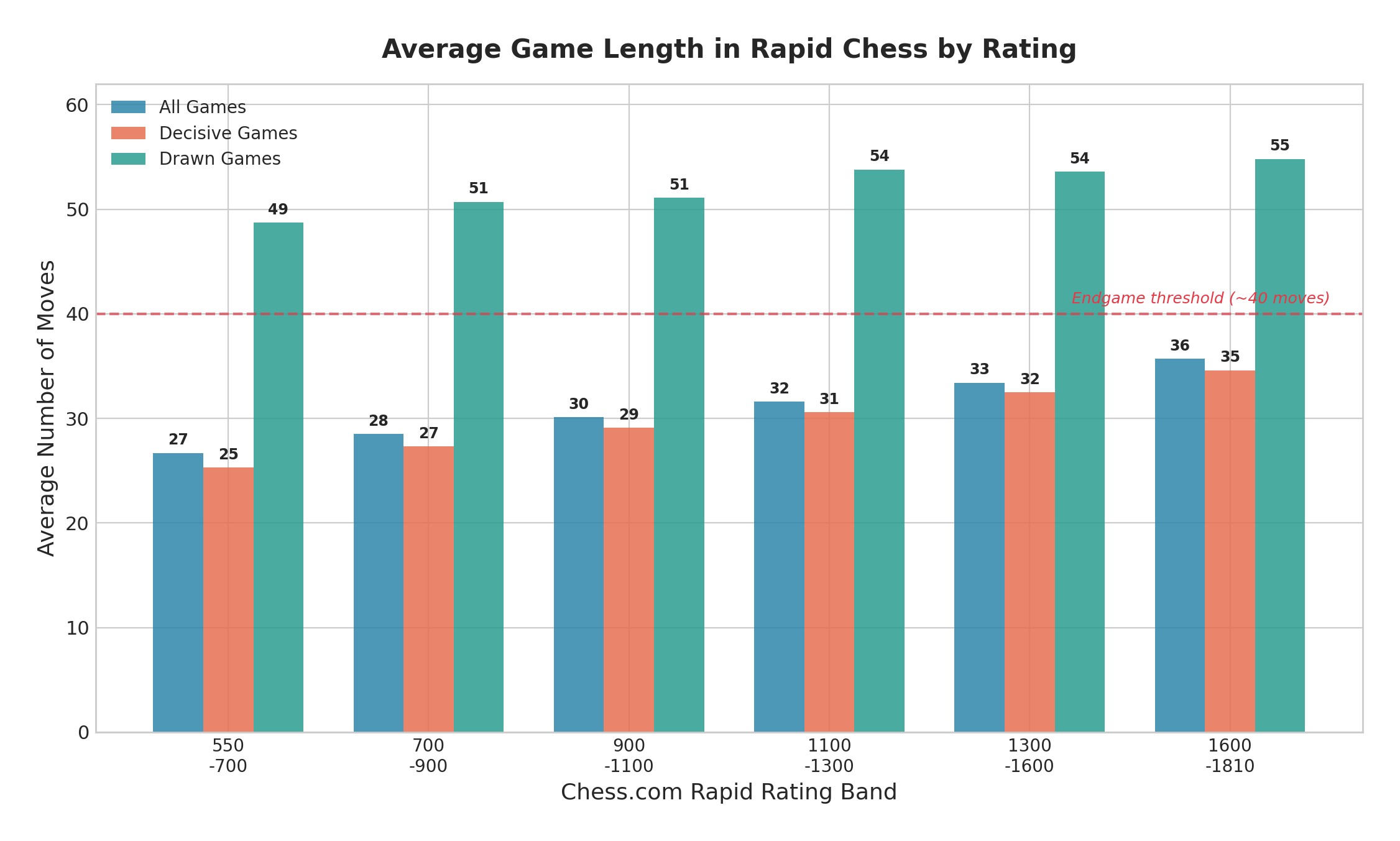
At the Chess.com 550-700 level, the average Rapid game lasts 26.7 moves. By the time you reach 1600-1810, the average game length only increases to 35.7 moves.
More importantly, look at the percentage of games that reach move 40 (a standard benchmark for entering the endgame phase):
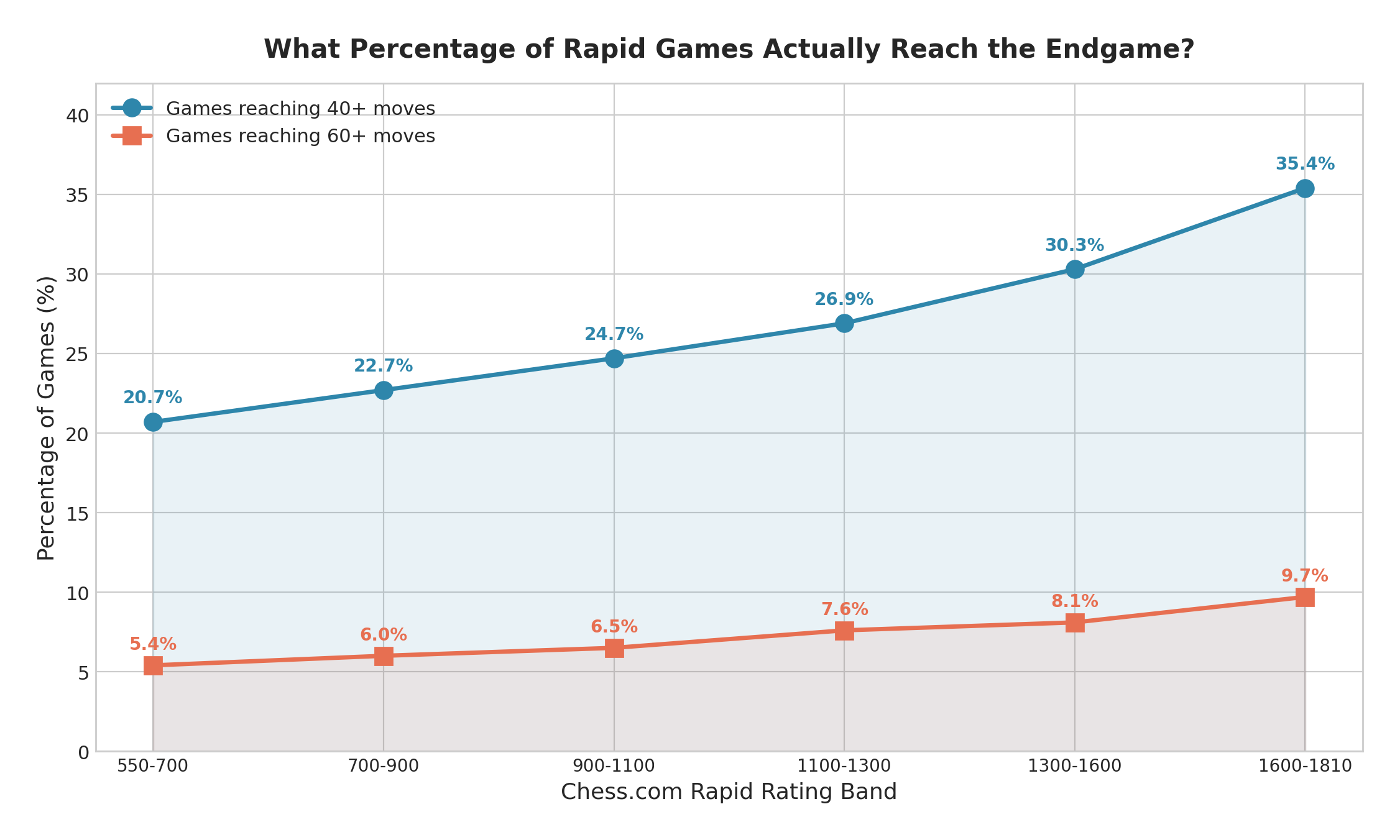
Even at the lowest rating band (550-700), over 20% of games reach move 40. By the 1100-1300 band, that number climbs to nearly 27%. This completely debunks the myth that beginners never reach endgames. One in five games at the 600 level goes deep enough to be considered an endgame.
So, if beginners are reaching endgames, why does the advice to ignore endgame study persist? The answer lies in how those endgames are played.
The Blunder Curve: Why Endgames at 800 Look Different
While lower-rated players reach endgames frequently, the quality of play in those endgames is vastly different from higher-rated play.
We analyzed the blunder rate (moves resulting in a centipawn loss of 300 or more) across the three phases of the game: Opening (moves 1-10), Middlegame (moves 11-30), and Endgame (moves 31+).
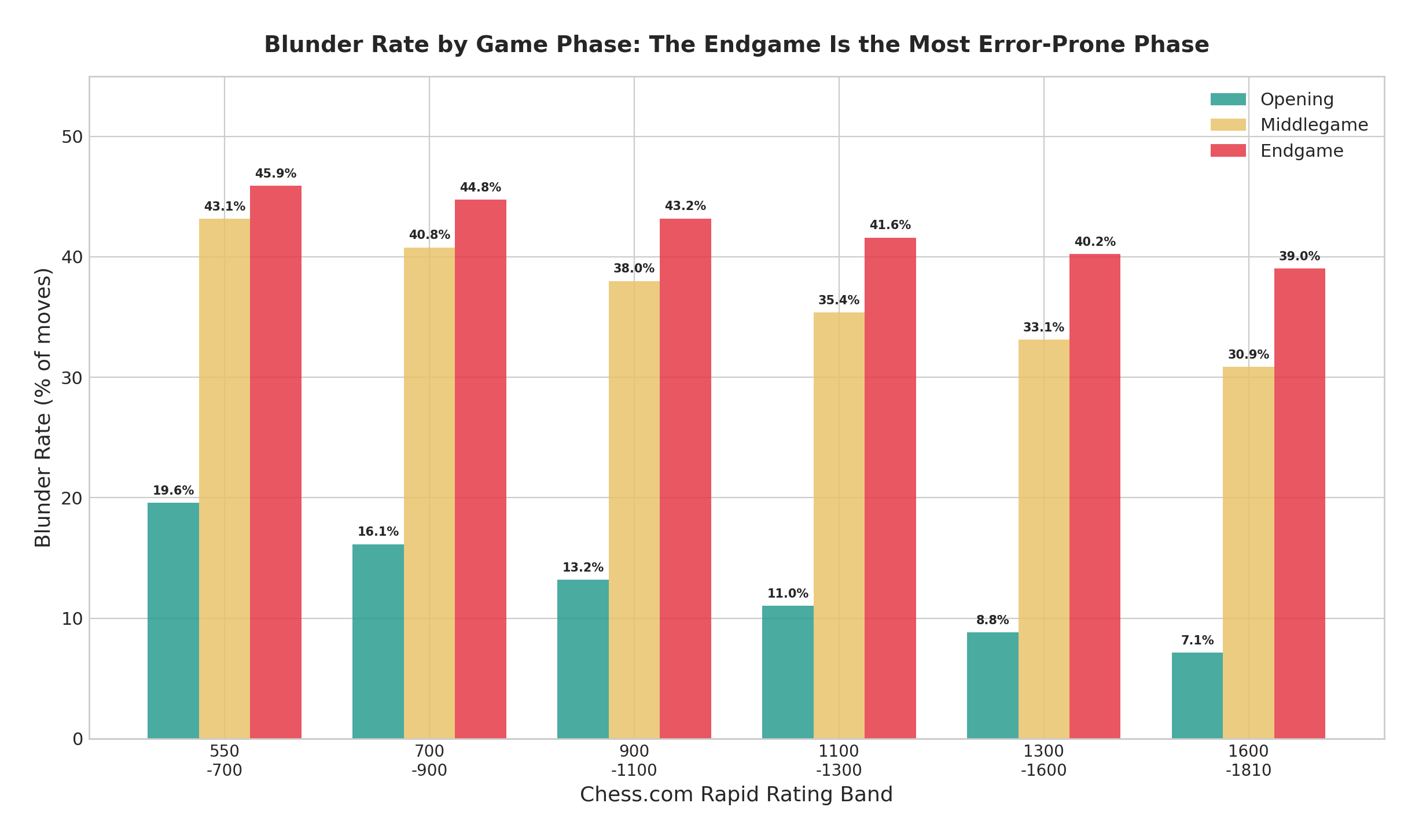
The data shows a fascinating trend: The endgame is the most error-prone phase of the game across all rating bands.
At the 550-700 level, a staggering 45.9% of all endgame moves are blunders. This means that nearly half the time a player touches a piece in the endgame, they are making a game-losing mistake. Even at the 1600-1810 level, the endgame blunder rate remains high at 39.0%.
This explains the paradox. Beginners do reach endgames, but those endgames are often decided by massive, unforced errors rather than subtle positional maneuvering.
Visual Evidence: The "Active Rook" Concept
Consider this typical rook endgame reached by players around the 1200 level:
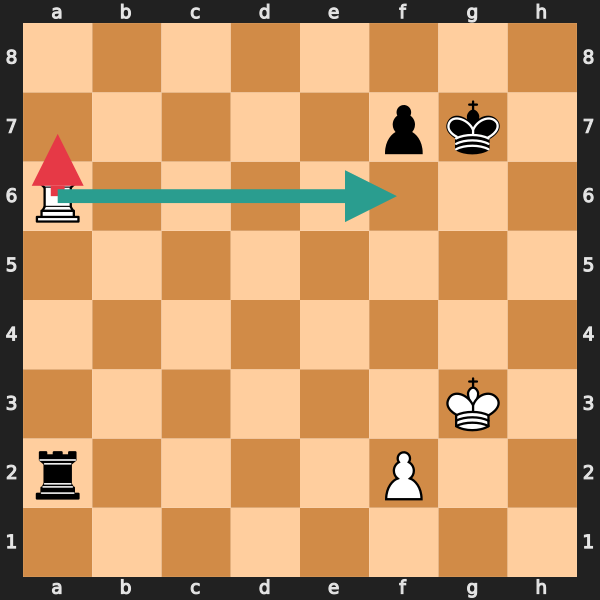 Example: A common rook endgame scenario where understanding activity is crucial.
In this position, White's rook is passively defending the a-pawn. The instinct for many lower-rated players is to keep the rook passive (red arrow). However, basic endgame principles dictate that rook activity is paramount. The correct approach is to activate the rook (green arrow), even at the cost of a pawn, to create counterplay. This lack of fundamental knowledge is why the blunder rate spikes in the endgame.
Material Conversion: When Does Being a Pawn Up Matter?
Another key aspect of endgame play is converting a material advantage. We looked at games where one side was ahead by exactly 1-2 pawns at move 20, and tracked the final outcome.
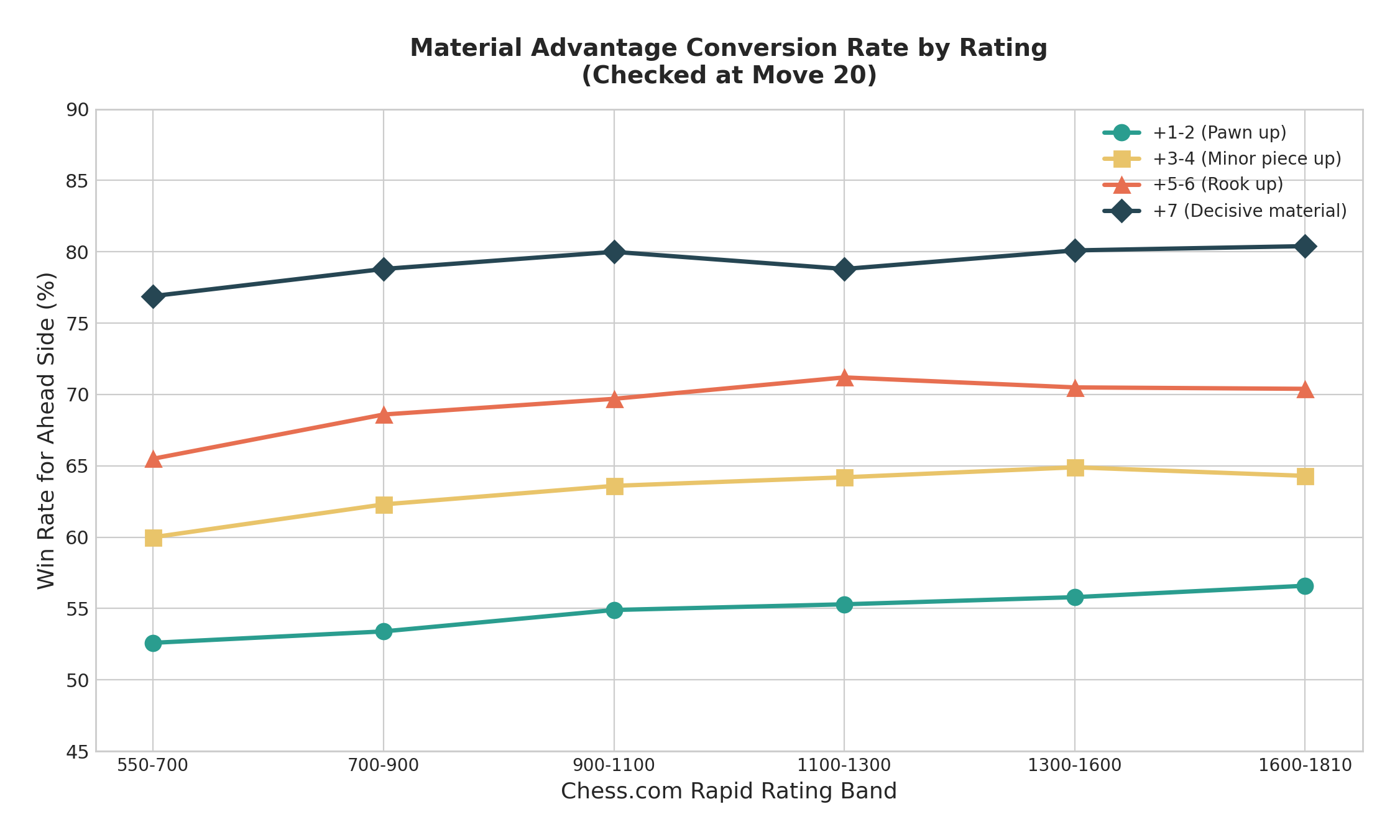
At the 550-700 level, being up a pawn at move 20 only translates to a win 52.6% of the time. It is essentially a coin flip. The player who is down a pawn still wins over 40% of the time, highlighting the chaotic nature of these games.
However, as ratings increase, the ability to convert small advantages improves steadily. By the 1600-1810 level, being up a pawn yields a 56.6% win rate. While this might not seem like a massive jump, it represents a significant increase in consistency and technique.
When the advantage grows to a minor piece (+3-4 points), the conversion rate jumps from 60.0% at the lowest band to 64.3% at the highest band.
The "Lopsided" Nature of Lower-Rated Games
To further understand the texture of these games, we looked at the average absolute engine evaluation by phase. A higher number indicates a more lopsided position (one side is clearly winning).
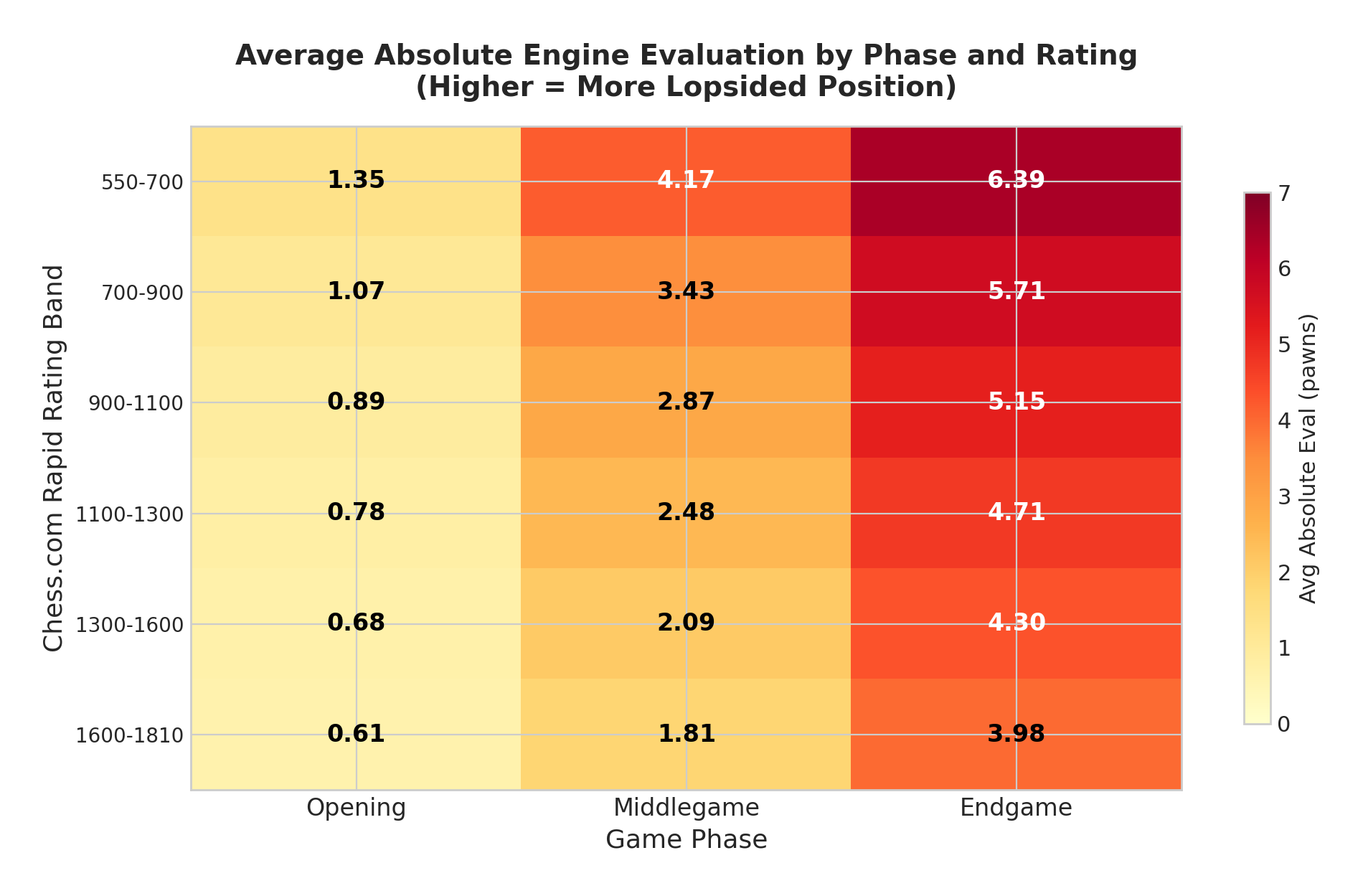
This heatmap tells a compelling story. At the 550-700 level, the average evaluation in the endgame is a massive 6.39 pawns. This means that when these players reach the endgame, one side is usually up a full rook or more.
Conversely, at the 1600-1810 level, the average endgame evaluation drops to 3.98. The games are tighter, the material is more balanced, and the endgames require more precision to win.
Actionable Advice by Rating Band
Based on this data, here is a roadmap for how you should approach endgame study as you climb the rating ladder.
Chess.com 550 - 900: The Survival Phase
- The Data: 20-22% of your games reach move 40. However, the average endgame evaluation is over +5.0, meaning most endgames are heavily lopsided. Your endgame blunder rate is over 44%.
- Actionable Advice: Do not study complex theoretical endgames (like Rook + Bishop vs Rook). Your primary goal is conversion of massive advantages. Practice mating with a King and Queen vs King, and King and Rook vs King. Learn how to push a passed pawn when you are up a full piece without stalemating your opponent.
Chess.com 900 - 1300: The Fundamentals Phase
- The Data: 24-27% of your games reach move 40. The average game length crosses 30 moves. Your ability to convert a 1-pawn advantage is still hovering around 54%.
- Actionable Advice: This is where basic endgame principles begin to matter. You will frequently reach endgames where you are up a pawn or an exchange. Focus on:
- King Activity: Learn the concept of the "Opposition" in King and Pawn endgames.
- Rook Activity: Understand that an active rook is often worth a pawn.
- Passed Pawns: Learn the "Rule of the Square" to know if a King can catch a passed pawn.
Chess.com 1300 - 1600: The Technique Phase
- The Data: 30% of your games reach move 40. The average endgame evaluation drops to 4.30, meaning games are closer. The draw rate begins to stabilize around 4.3%.
- Actionable Advice: Your opponents are blundering less frequently in the middlegame, forcing you to win in the endgame. You need to start studying specific theoretical positions.
- Rook Endgames: These are the most common. Learn the Lucena position (how to win) and the Philidor position (how to draw).
- Minor Piece Endgames: Understand the difference between good and bad bishops, and how knights perform in closed vs. open positions.
Chess.com 1600 - 1810+: The Precision Phase
- The Data: Over 35% of your games reach move 40. Nearly 10% go beyond move 60. The average endgame evaluation is under 4.0. Your endgame blunder rate drops below 40%.
- Actionable Advice: Endgames are now a primary battleground. You must be able to squeeze wins out of equal-looking positions and defend tenaciously when slightly worse. Deepen your knowledge of Rook endgames and start studying complex pawn endgames (e.g., corresponding squares, triangulation).
Conclusion
The advice to completely ignore endgames until you reach 1500 is flawed. Even at 600, one in five of your games will reach the endgame phase. However, the type of endgame study you need changes. Beginners need to focus on basic checkmates and avoiding stalemate when up massive material. Intermediate players need to learn fundamental principles like King activity and the Opposition. Advanced players need precise theoretical knowledge.
The data is clear: The endgame is the most error-prone phase of chess at every level. By dedicating even a small amount of time to endgame study appropriate for your rating, you can capitalize on the inevitable mistakes your opponents will make after move 40.
Data and Methodology
This analysis was conducted using the Lichess open database, accessed via the grandmaster-guide MCP server. The dataset includes over 200,000 Rapid games.
- Rating Calibration: Lichess ratings were mapped to approximate Chess.com ratings using established community conversion tables to make the insights more actionable for the target audience.
- Engine Evaluation: Centipawn loss (CPL) and blunder rates were calculated using Stockfish 17 evaluations at depth 18+. A "blunder" is defined as a move resulting in a CPL of 300 or more.
- Game Phases: Opening (moves 1-10), Middlegame (moves 11-30), Endgame (moves 31+).
Raw Data Files:
- Game Phase Distribution (CSV)
- Game Length Statistics (CSV)
- Draw Rates (CSV)
- Phase Accuracy / Blunder Rates (CSV)
- Eval Trajectory by Phase (CSV)
- Termination Types (CSV)
- Material Conversion Rates (CSV)
Chess Coach April 17, 2026
References
[1] Lichess Open Database. Accessed via grandmaster-guide MCP server. Rating conversion based on community consensus mapping Lichess Rapid to Chess.com Rapid.