A Data-Driven Guide to Evaluation Swings for Players Rated 800 to 1500
The transition from the opening to the middlegame is arguably the most treacherous phase in chess. Players leave the comfort of memorized theory and must suddenly formulate original plans, often while the board is full of tension and unresolved threats. This article explores the phenomenon of "evaluation swings"—the sudden shifts in engine evaluation that occur during this critical phase—using a massive dataset of Lichess Blitz games.
By analyzing millions of games and mapping the findings to Chess.com rating bands, we can uncover exactly when, why, and how players lose their grip on the position. More importantly, this data provides a clear roadmap for improvement, offering actionable advice tailored to specific rating levels.
The Anatomy of the Transition
To understand the opening-to-middlegame transition, we analyzed engine evaluations across three distinct game phases: the opening (plies 1-15), the middlegame (plies 16-35), and the endgame (plies 36+). The data reveals a stark reality: the middlegame is where equality goes to die.
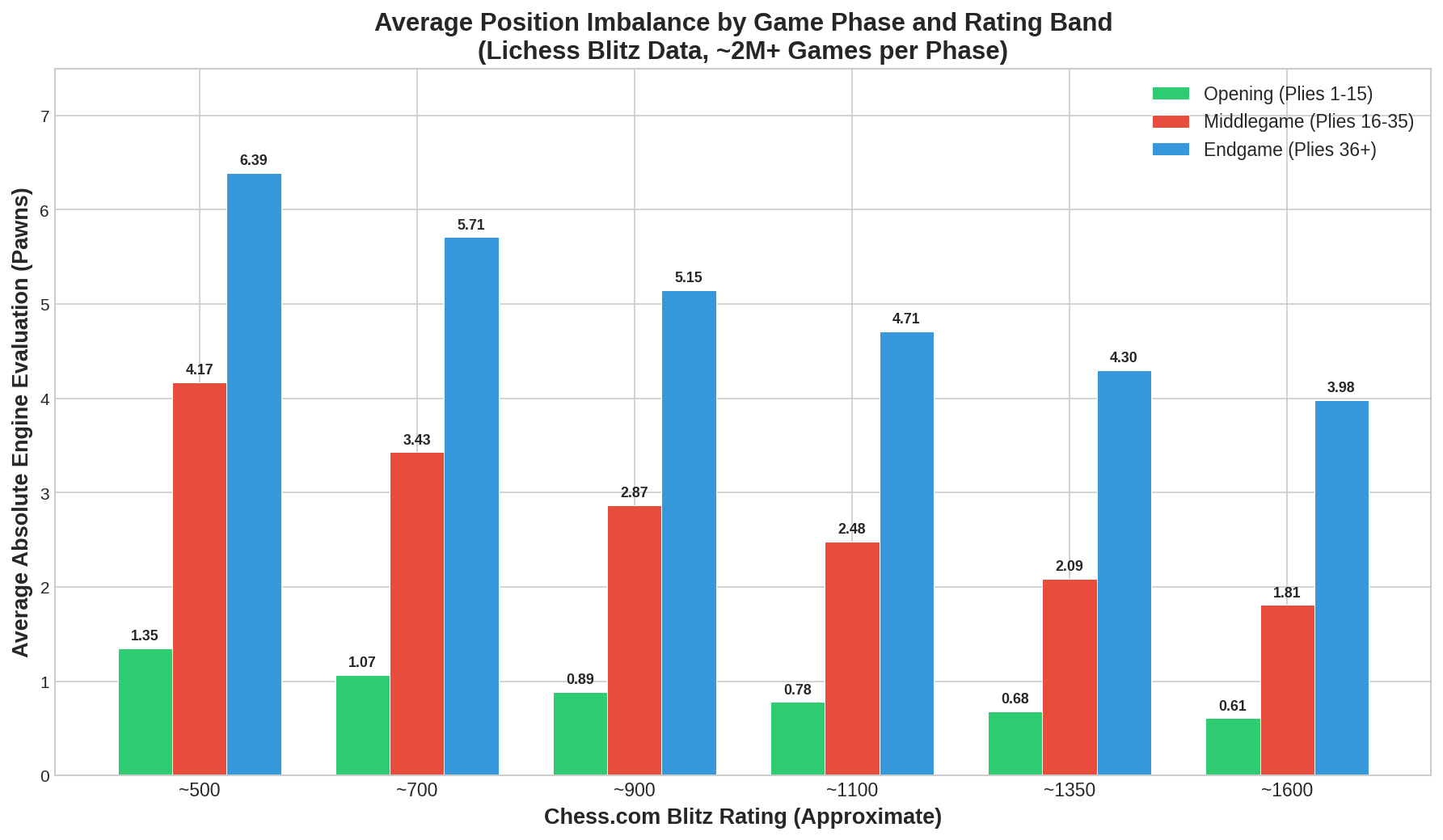
As the chart above illustrates, the average absolute engine evaluation—a measure of how imbalanced or decisive a position is—spikes dramatically as games enter the middlegame. For a player rated around 1100 on Chess.com (approximately 1300-1500 on Lichess), the average evaluation jumps from a relatively balanced 0.78 pawns in the opening to a much more decisive 2.48 pawns in the middlegame. This represents a staggering 218% increase in position imbalance.
This surge in evaluation is not merely a natural progression of the game; it is the direct result of mistakes and blunders. The transition phase forces players to make critical decisions about piece placement, pawn structure, and king safety, often under the ticking clock of a Blitz game.
The Blunder Spike: A Universal Phenomenon
One of the most striking findings from the data is the consistency of the "blunder spike" across all rating bands. When we look at the percentage of moves classified as blunders (a centipawn loss of 300 or more), the jump from the opening to the middlegame is remarkably uniform.
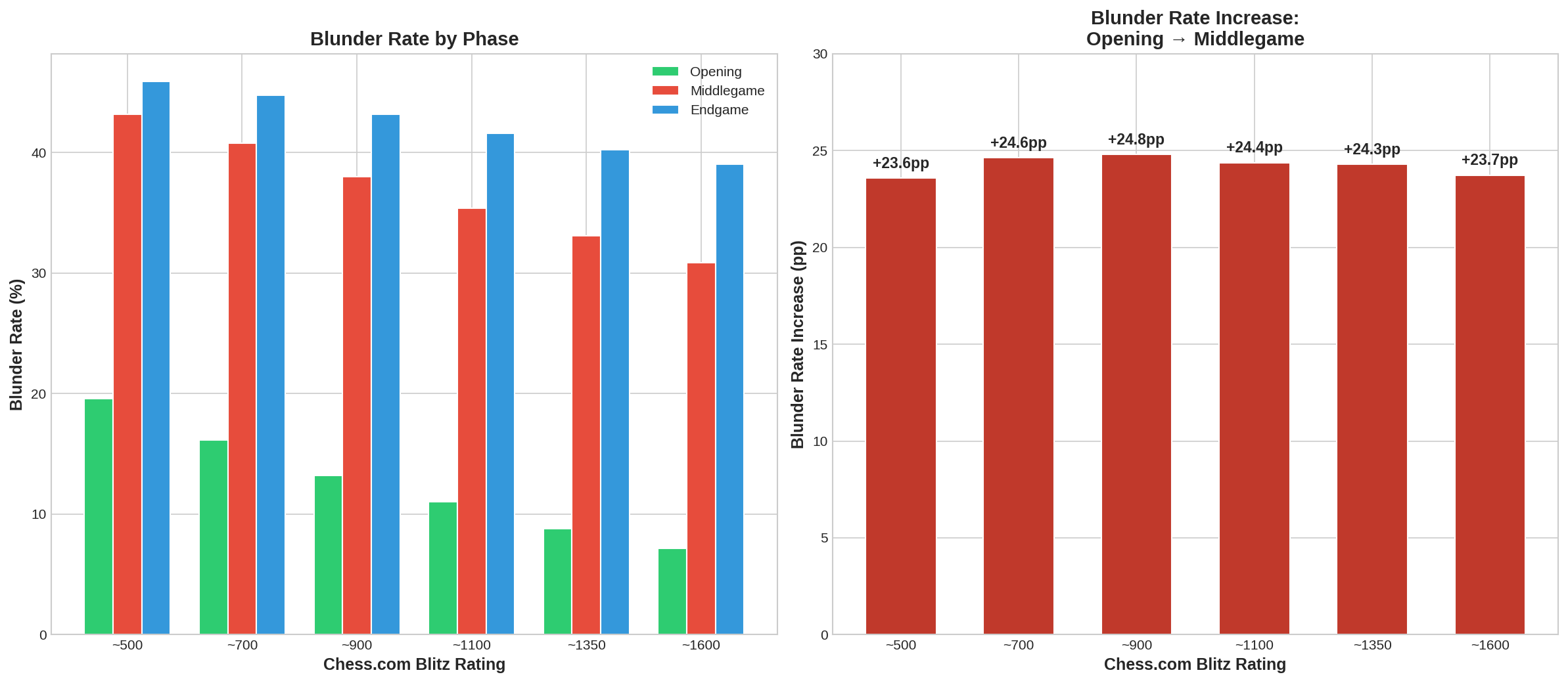
Whether you are rated 500 or 1600 on Chess.com, your likelihood of blundering increases by approximately 24 percentage points as you exit the opening. For a 900-rated player, the blunder rate leaps from 13.2% in the opening to 38.0% in the middlegame. This suggests that the cognitive load of the transition phase overwhelms players regardless of their skill level. The difference between a 900-rated player and a 1600-rated player is not that the stronger player avoids the transition spike entirely, but rather that their baseline blunder rate is lower to begin with.
Where Do Blunders Happen?
Understanding when blunders happen is only half the battle; we must also understand where they happen. The blunder taxonomy data reveals fascinating differences in how players of different strengths throw away games.
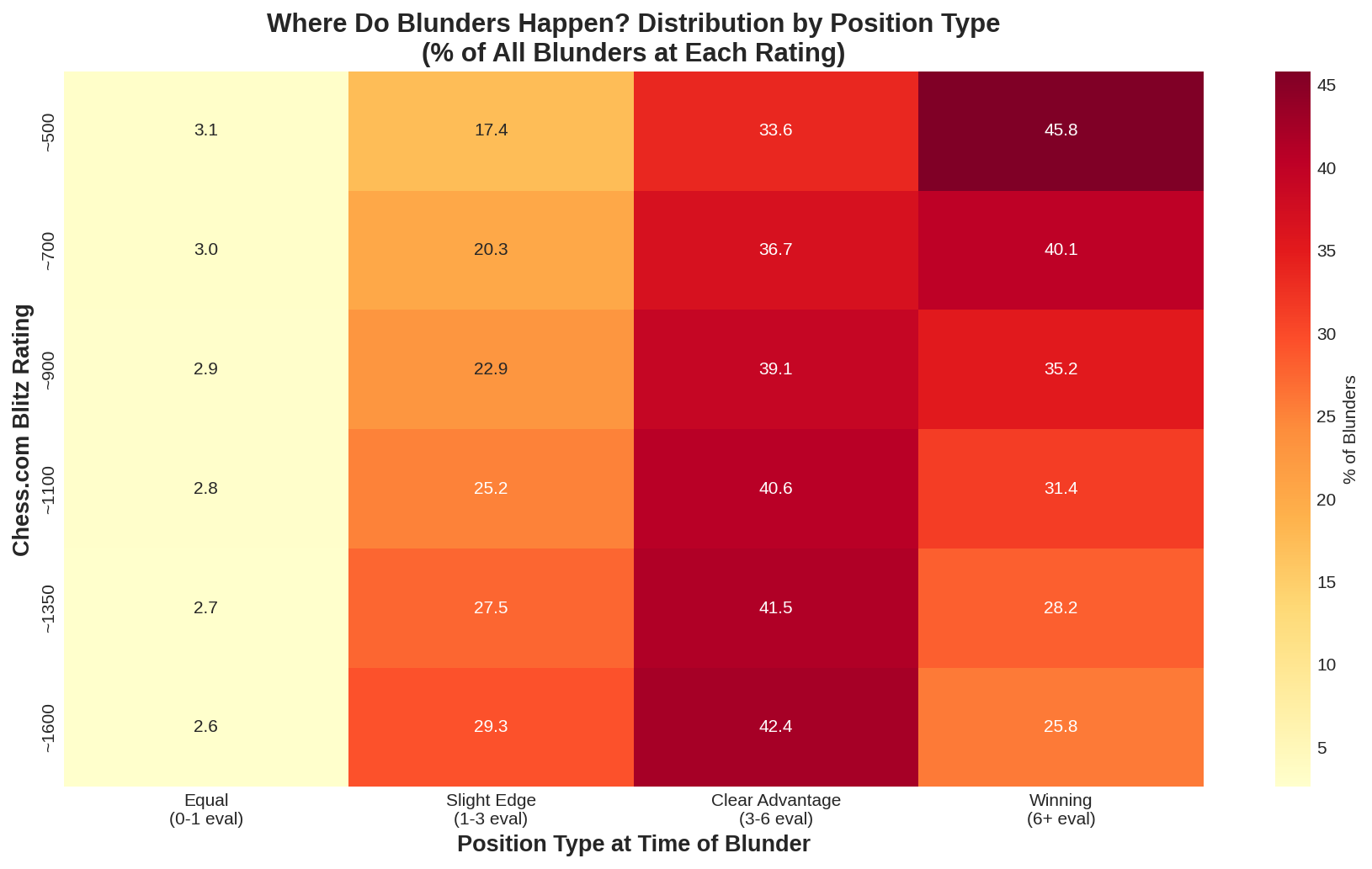
For players in the 500-900 Chess.com range, a massive 40-45% of all blunders occur in positions that are already completely winning (an evaluation of +6 or higher). This highlights a critical issue at lower ratings: the inability to convert winning advantages safely. Lower-rated players often relax when ahead, allowing their opponents back into the game through careless mistakes.
Conversely, as players approach the 1600 Chess.com mark, the proportion of blunders in winning positions drops significantly (to around 25%). Instead, their blunders are concentrated in positions with a "clear advantage" (an evaluation of +3 to +6). Stronger players are better at closing out completely won games, but they still struggle to navigate the complexities of positions where they have a significant, but not yet decisive, edge.
Visualizing the Transition Errors
To make these data points concrete, let us examine some typical transition errors that lead to massive evaluation swings.
The Premature Attack (Common at 800-1000)
Lower-rated players often feel compelled to launch immediate attacks as soon as their pieces are developed, neglecting king safety and central control.
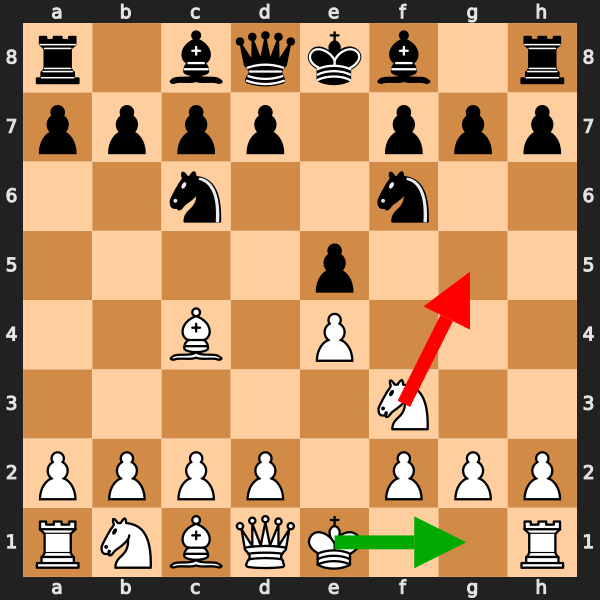
In this position, White has developed reasonably well but suddenly plays Ng5 (the red arrow). This premature attack is easily parried and wastes valuable time. The engine strongly prefers simply castling (the green arrow), completing development and securing the king before commencing operations. This type of impatience is a primary driver of the 261-centipawn swing seen at the 900 rating level.
The Structural Weakness (Common at 1000-1200)
As players improve, they begin to understand the importance of pawn breaks, but they often execute them poorly, creating permanent weaknesses.
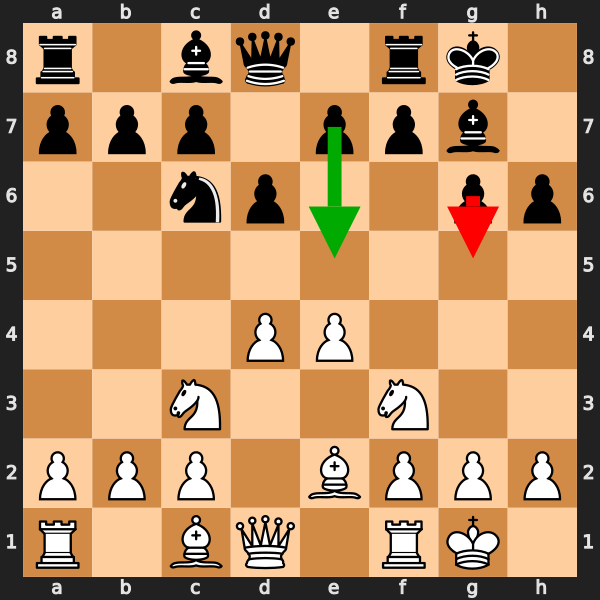
Here, Black plays the aggressive g5 (red arrow), attempting to dislodge White's pieces. However, this severely weakens the dark squares around the king and creates targets for White. The engine prefers the central break e5 (green arrow), which challenges White's control without compromising king safety. Misjudging pawn pushes during the transition is a classic source of evaluation swings in the 1100 rating band.
The Missed Tactic (Common at 1200-1500)
In the intermediate ranks, players are generally solid positionally but often miss sudden tactical opportunities that arise as the tension peaks.
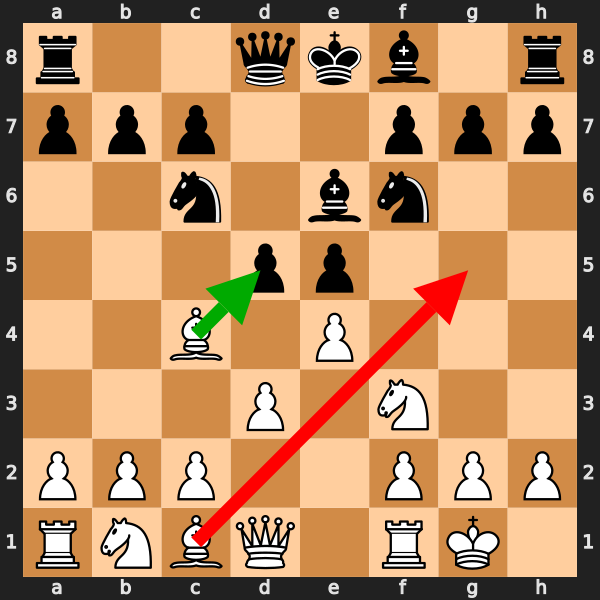
In this scenario, White plays the natural-looking developing move Bg5 (red arrow). While not a catastrophic blunder, it completely misses the tactical shot Bxd5 (green arrow), which wins a clean pawn due to the pin on the e-file. Failing to spot these fleeting tactical chances allows opponents to equalize or take the advantage, contributing to the 209-centipawn swing typical of the 1350 rating level.
The Clock Factor: Speed vs. Accuracy
Blitz chess adds the relentless pressure of the clock to the already difficult transition phase. Our analysis of move time efficiency reveals how players manage their time across different phases.
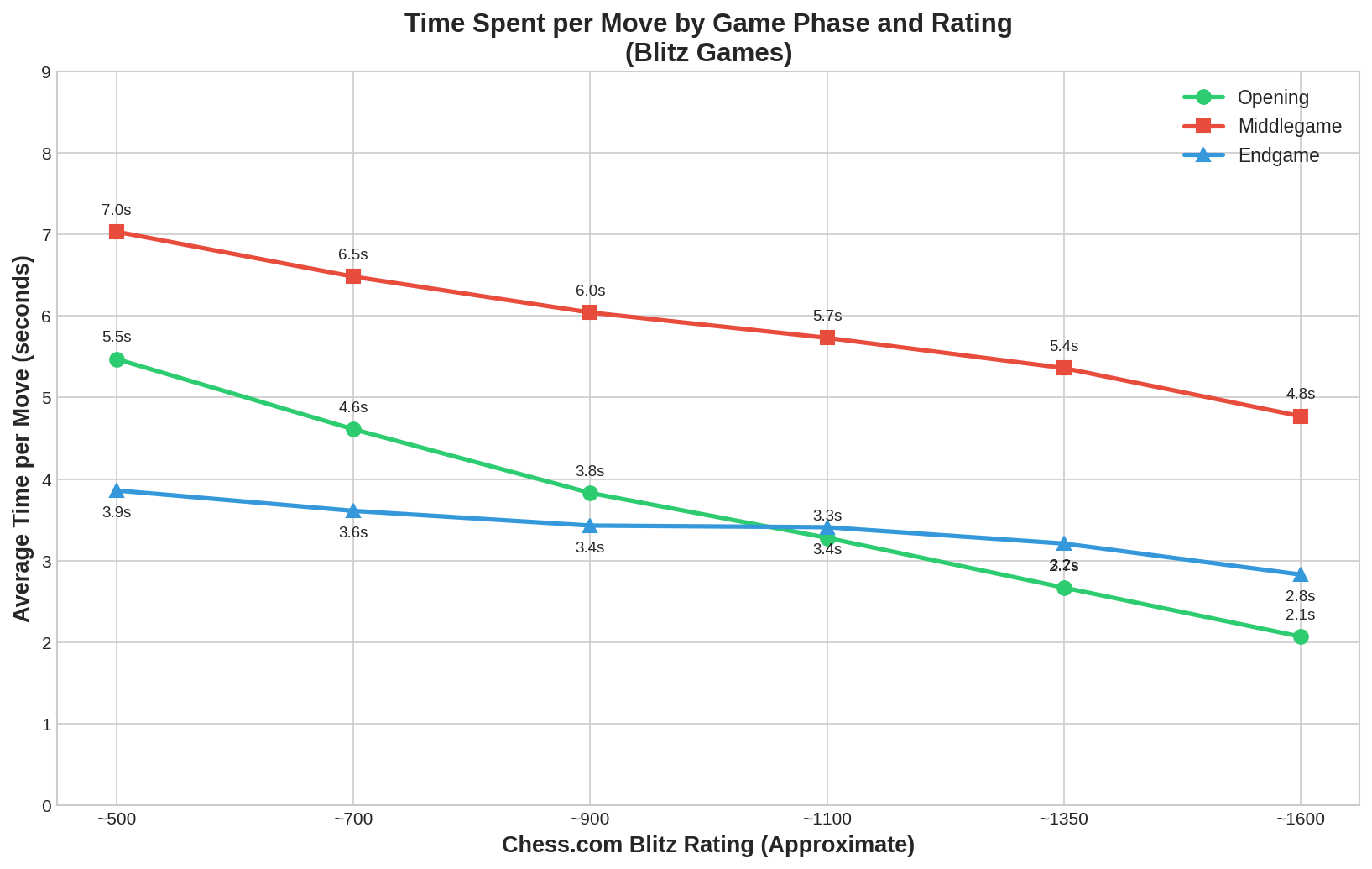
The data shows a clear pattern: higher-rated players spend significantly less time per move in the opening than lower-rated players. A 1600-rated player spends an average of 2.1 seconds per opening move, compared to 5.5 seconds for a 500-rated player. This efficiency allows stronger players to bank time for the critical middlegame transition.
However, even in the middlegame, stronger players remain faster. A 1600-rated player spends 4.8 seconds per middlegame move, while a 500-rated player spends 7.0 seconds. This indicates that stronger players rely on superior pattern recognition and intuition, rather than deep calculation, to navigate the complexities of Blitz middlegames.
Roadmap to Improvement: Actionable Advice by Rating Band
Based on the data, here is a targeted roadmap for minimizing evaluation swings and improving your play during the opening-to-middlegame transition.
The 800-1000 Bracket: Focus on Fundamentals
Players in this bracket experience massive evaluation swings (nearly 2 full pawns) and see their blunder rate skyrocket to 38% in the middlegame.
Actionable Advice:
- Prioritize King Safety: The data shows many blunders occur because kings are left exposed. Make castling your primary goal before launching any attacks.
- Check for Hanging Pieces: Before every move in the transition phase, perform a quick "blunder check." Ask yourself: "Does my move leave a piece undefended? Does my opponent's last move threaten an undefended piece?"
- Simplify When Winning: Since over 40% of blunders at this level happen in completely winning positions, focus on trading pieces (not pawns) when you have a material advantage. Simplify the position to reduce the cognitive load.
The 1000-1200 Bracket: Managing Tension
In this range, the evaluation swing is still significant (1.7 pawns), and the blunder rate jumps to 35.4% in the middlegame. Players here are better at basic development but struggle when the position becomes complex.
Actionable Advice:
- Develop with Purpose: Don't just put pieces on active squares; ensure they are coordinating toward a specific goal (e.g., controlling the center, preparing a pawn break).
- Avoid Premature Pawn Pushes: As seen in the visual examples, pushing pawns in front of your king or creating permanent weaknesses is a major source of transition errors. Only push pawns when necessary to challenge the center or open lines for your pieces.
- Improve Time Management: You are likely spending too much time in the opening (averaging 3.3 seconds per move). Work on your opening repertoire so you can play the first 10 moves quickly and confidently, saving precious seconds for the critical transition decisions.
The 1200-1500 Bracket: Tactical Awareness
Players approaching 1500 experience a smaller evaluation swing (1.4 pawns) and a lower middlegame blunder rate (33.1%). The focus here shifts from avoiding catastrophic blunders to seizing tactical opportunities.
Actionable Advice:
- Sharpen Tactical Vision: The transition phase is ripe with tactical shots. Dedicate time to solving puzzles that focus on pins, forks, and discovered attacks, as these are the most common motifs missed during the transition.
- Maintain the Tension: Don't rush to resolve central tension unless it clearly benefits you. Stronger players are comfortable navigating complex, unresolved positions. Practice calculating short variations to ensure your position remains solid under pressure.
- Focus on Conversion: The data shows that blunders in "clear advantage" positions are a major issue at this level. When you secure an advantage, don't relax. Play with the same intensity and focus on restricting your opponent's counterplay.
Conclusion
The opening-to-middlegame transition is the crucible of Blitz chess. The data clearly demonstrates that this phase is characterized by massive evaluation swings and a universal spike in blunder rates. By understanding the specific challenges of your rating band—whether it's hanging pieces, premature attacks, or missed tactics—you can tailor your training to navigate the danger zone more effectively. Remember, the goal is not to play perfectly, but to manage the complexity better than your opponent.
Data and Methodology
This research is based on a comprehensive analysis of Lichess Blitz games, utilizing the Grandmaster Guide MCP server for data extraction and processing. The dataset includes millions of games, providing a robust statistical foundation for the findings.
Rating Calibration: The raw data was categorized using Lichess rating bands. To make the insights actionable for the target audience, these bands were mapped to approximate Chess.com Blitz ratings using established conversion metrics (typically a 200-300 point differential in the relevant ranges).
Key Metrics:
- Evaluation Swings: Calculated as the difference in average absolute engine evaluation (in pawns) between the opening (plies 1-15) and the middlegame (plies 16-35).
- Centipawn Loss (CPL): A measure of move quality, representing the difference in evaluation between the played move and the engine's top choice.
- Blunder Rate: The percentage of moves resulting in a centipawn loss of 300 or more.
Underlying Data Files: The raw CSV data files generated during this analysis are attached for further review:
eval_trajectory_by_phase.csveval_swing_by_rating.csvcpl_by_phase.csvcpl_swing_opening_to_middlegame.csvcpl_by_rating_blitz.csvblunder_taxonomy.csvgame_phase_distribution.csvtime_control_comparison.csvmaterial_advantage_conversion.csv
Chess Coach, April 14, 2026