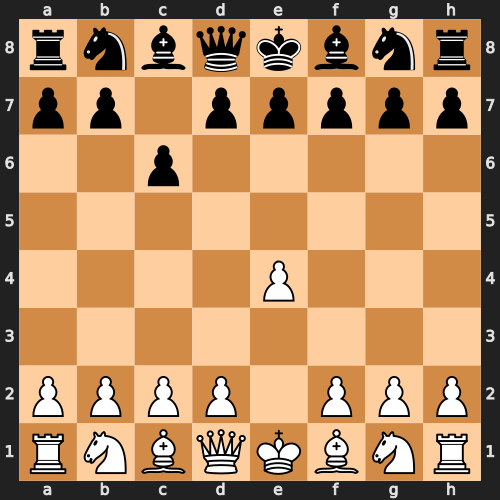
The Caro-Kann Defense (1.e4 c6) has long been a thorn in the side of 1.e4 players. Known for its solidity and resilience, it often frustrates attacking players who prefer the open, tactical battles of 1...e5 or the Sicilian Defense. For intermediate players—specifically those rated between 800 and 1500 on Chess.com—finding the right response to the Caro-Kann is a common challenge.
This article provides a comprehensive, data-driven roadmap to tackling the Caro-Kann. By analyzing over 42,000 Caro-Kann games from a massive dataset of ~847,000 Lichess games (March 2025), we have identified which variations actually win games at your rating level. We will explore the statistical performance of the most popular responses, examine how their effectiveness changes as you climb the rating ladder, and provide actionable advice for each rating segment.
The Critical Crossroads: What Does the Data Say?
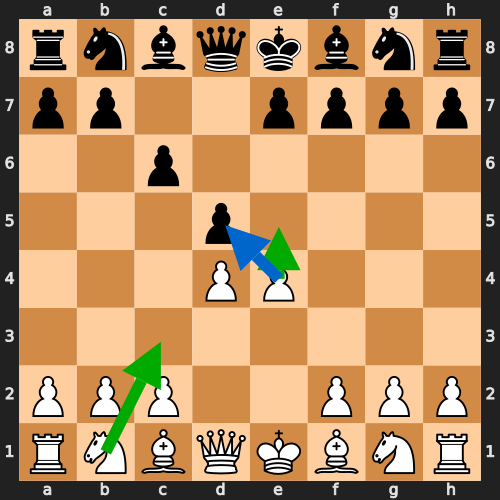
After the opening moves 1.e4 c6 2.d4 d5, White faces a critical decision. The three main paths are the Advance Variation (3.e5), the Exchange Variation (3.exd5), and the Classical/Main Line (3.Nc3 or 3.Nd2). However, at the intermediate level, other aggressive tries like the Two Knights Attack (2.Nc3 d5 3.Nf3) and the Panov Attack (3.exd5 cxd5 4.c4) are also highly popular.
To determine the best approach, we analyzed the win rates of these variations across different rating bands. Note that while our data is sourced from Lichess, all ratings discussed in this article have been calibrated to approximate Chess.com Rapid ratings for clarity [1].
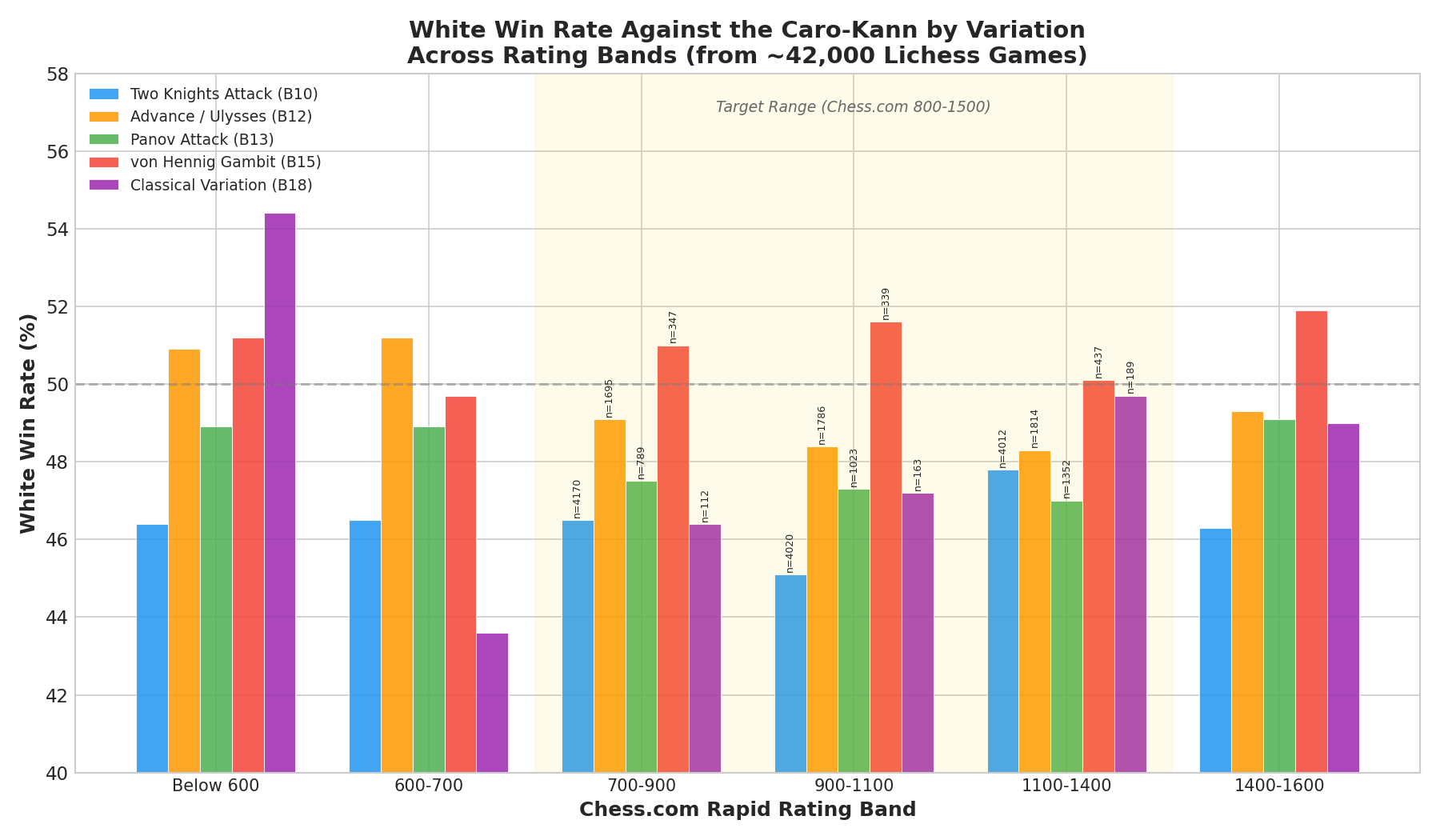
The data reveals a fascinating landscape. The von Hennig Gambit (B15) and the Advance Variation / Ulysses Gambit (B12) consistently offer White the highest win rates across almost all intermediate rating bands. Conversely, the highly popular Two Knights Attack (B10) and the Classical Variation (B18) often yield sub-50% win rates for White, meaning Black actually scores better in these lines.
Let's break down the performance of these variations and see how they fare from Black's perspective.
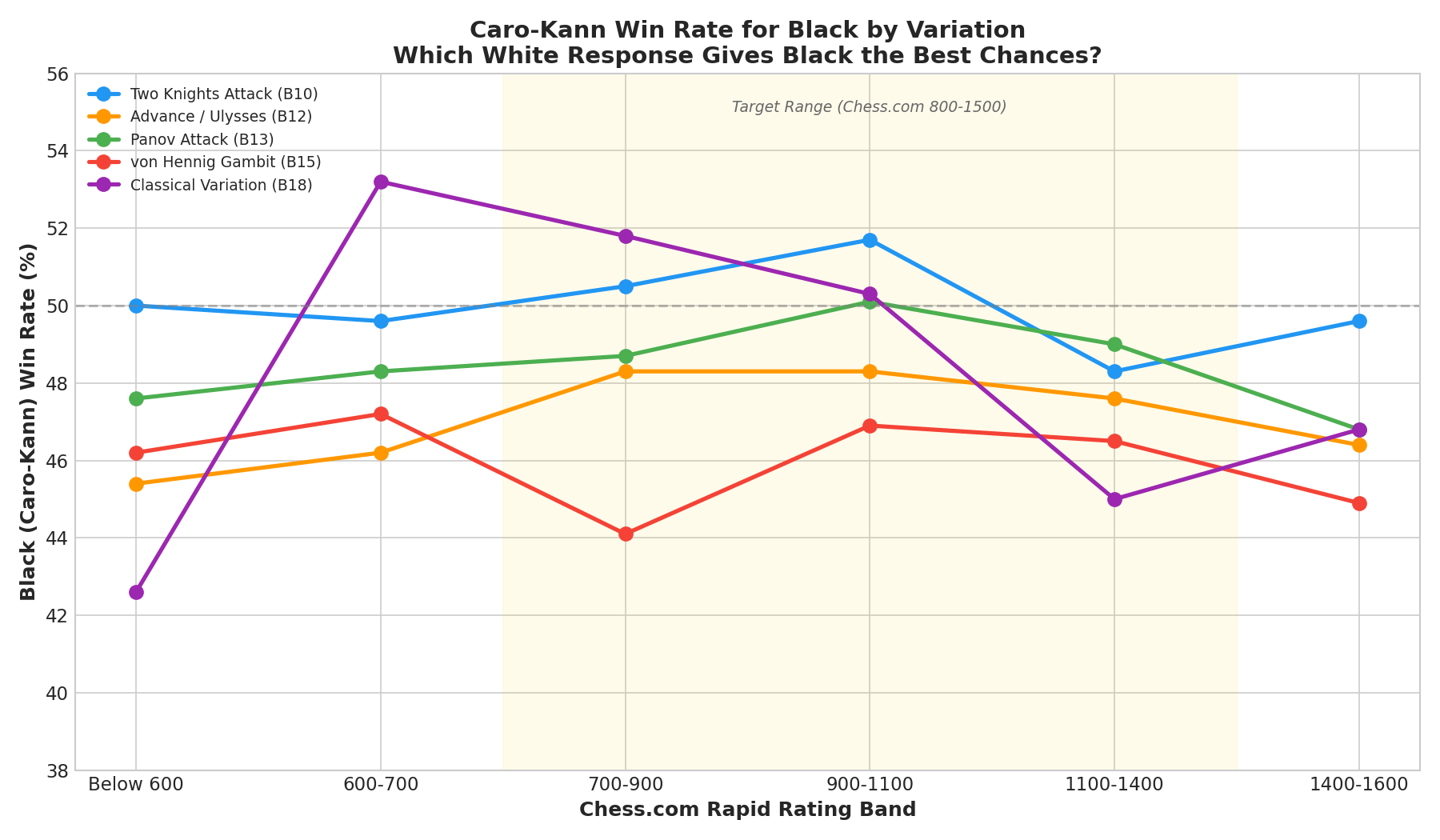
When we look at the win rates for the Caro-Kann player (Black), the story is confirmed. Black thrives against the Two Knights Attack and the Classical Variation, consistently scoring around 50% or higher. However, Black struggles significantly against the von Hennig Gambit and the Advance Variation, where their win rate drops to 45-47%.
The "Trappy" Lines: Do They Lose Effectiveness?
A common piece of chess wisdom is that "trappy" or highly tactical gambit lines work well at lower ratings but lose their sting as opponents get stronger and learn the theory. We tested this hypothesis by plotting a "Decay Curve" for the major anti-Caro-Kann lines.
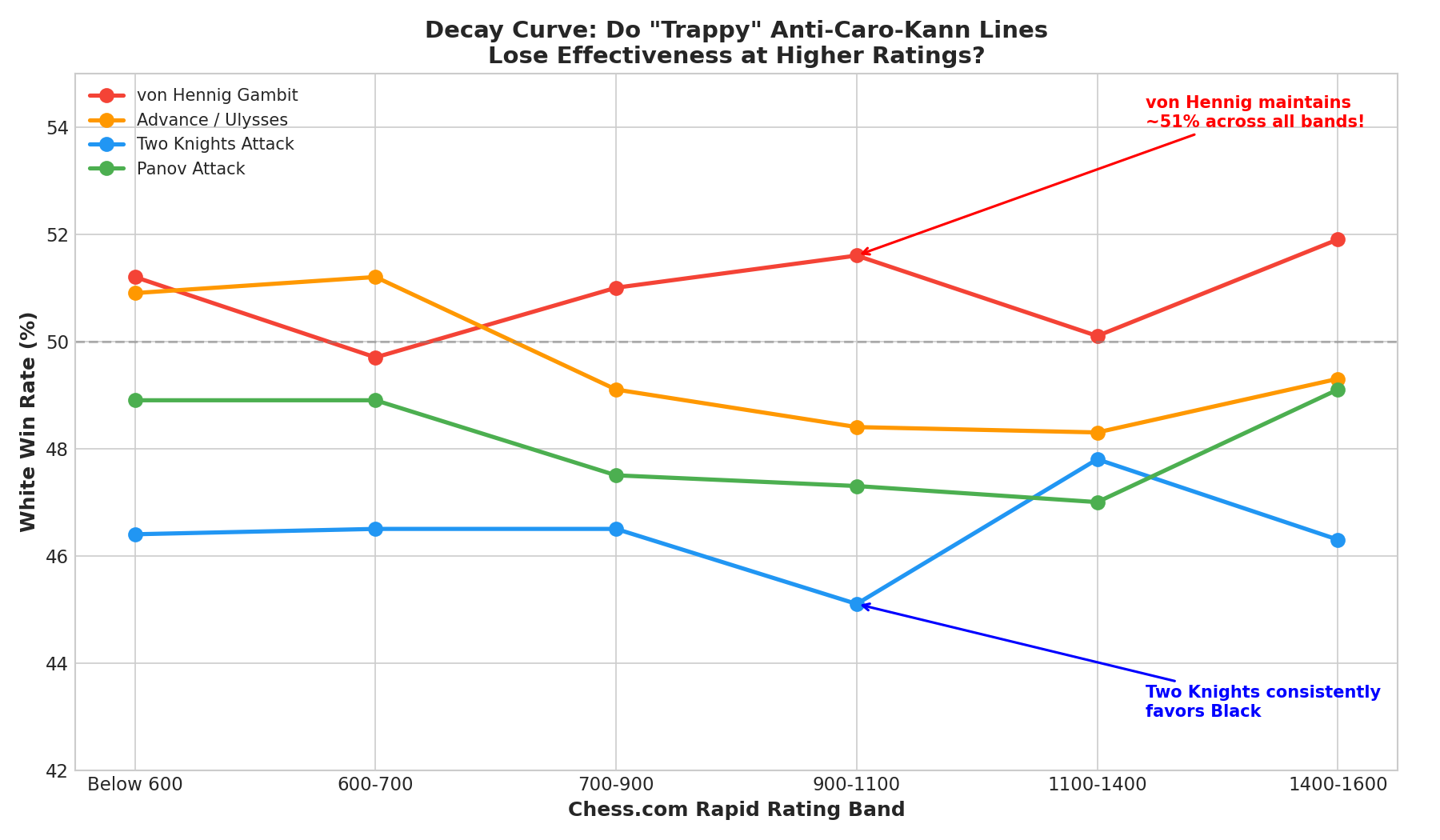
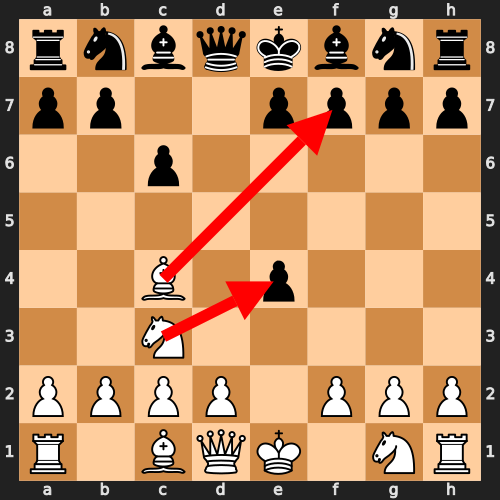
The results are surprising. The von Hennig Gambit (1.e4 c6 2.d4 d5 3.Nc3 dxe4 4.Bc4) is often considered a tricky, slightly dubious line. Yet, the data shows it maintains a robust ~51% win rate for White across all intermediate rating bands, from 800 all the way to 1500. It does not decay; it remains a potent weapon.
In contrast, the Two Knights Attack consistently underperforms, favoring Black across the entire intermediate spectrum. The Panov Attack, a fundamentally sound and aggressive system, hovers around a 47-49% win rate for White, indicating that intermediate Black players are generally well-prepared for the resulting isolated queen's pawn (IQP) structures.
Actionable Advice by Rating Segment
Based on the data, here is a roadmap for tackling the Caro-Kann as you climb the rating ladder.
The 800 - 1100 Bracket: Embrace the Chaos
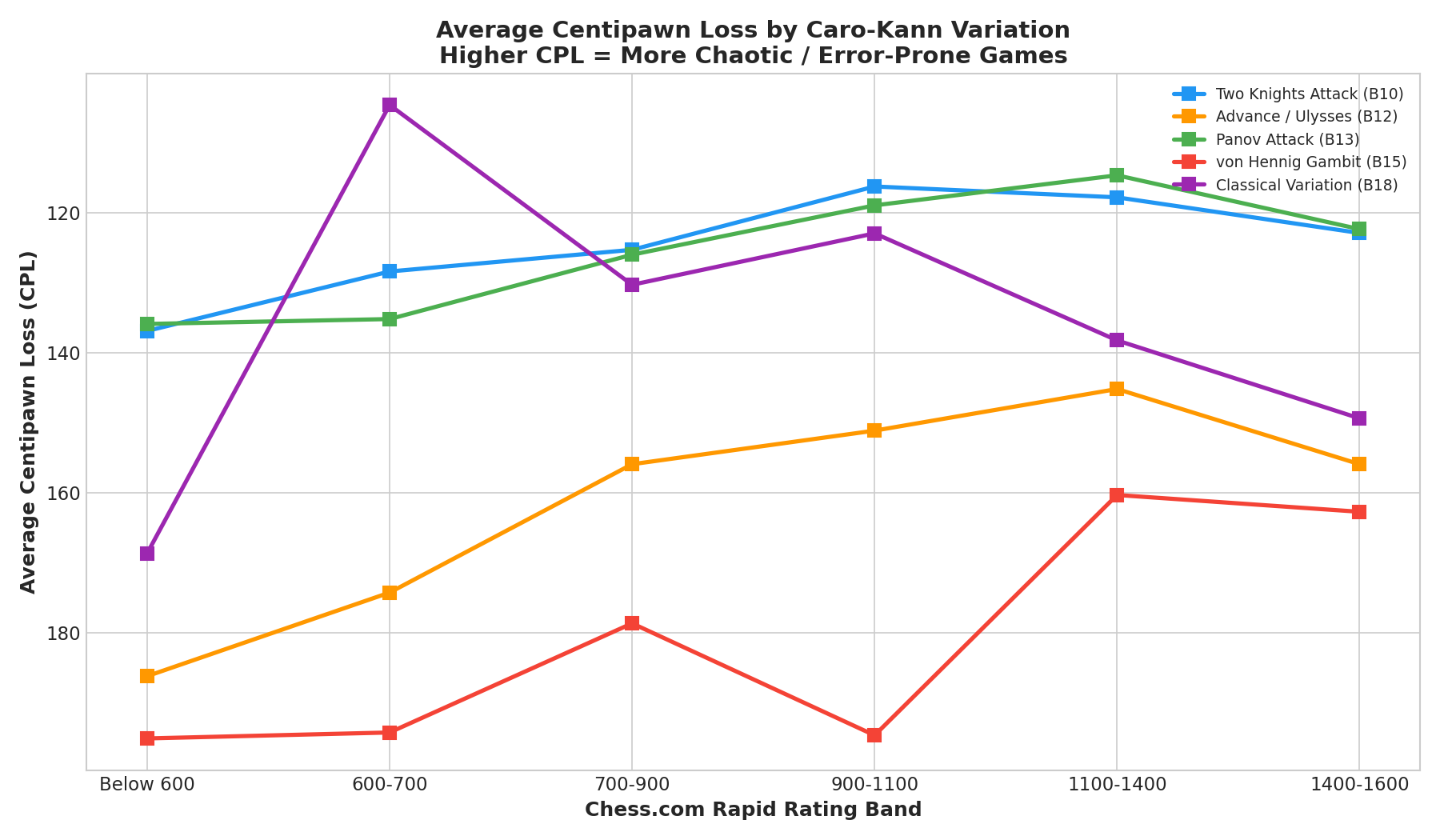
In this rating range, games are often decided by tactical oversights and blunders rather than deep strategic maneuvering. The data shows that the average Centipawn Loss (CPL) is high, indicating chaotic, error-prone games.
Actionable Advice: Play the von Hennig Gambit (3.Nc3 dxe4 4.Bc4) or the aggressive Ulysses Gambit lines in the Advance Variation.
At this level, the von Hennig Gambit yields a massive 51.2% win rate for White. The immediate pressure on the f7 square and the rapid development often overwhelm Caro-Kann players who are expecting a slow, positional struggle. The high CPL in these games (around 195) confirms that these positions are incredibly difficult for both sides to navigate perfectly, but the practical difficulties fall heavily on Black.
The 1100 - 1300 Bracket: The Transition to Structure
As players cross the 1100 mark, they begin to blunder less frequently and understand basic opening principles better. The data shows a noticeable drop in CPL across all variations.
Actionable Advice: Transition towards the Advance Variation (3.e5).
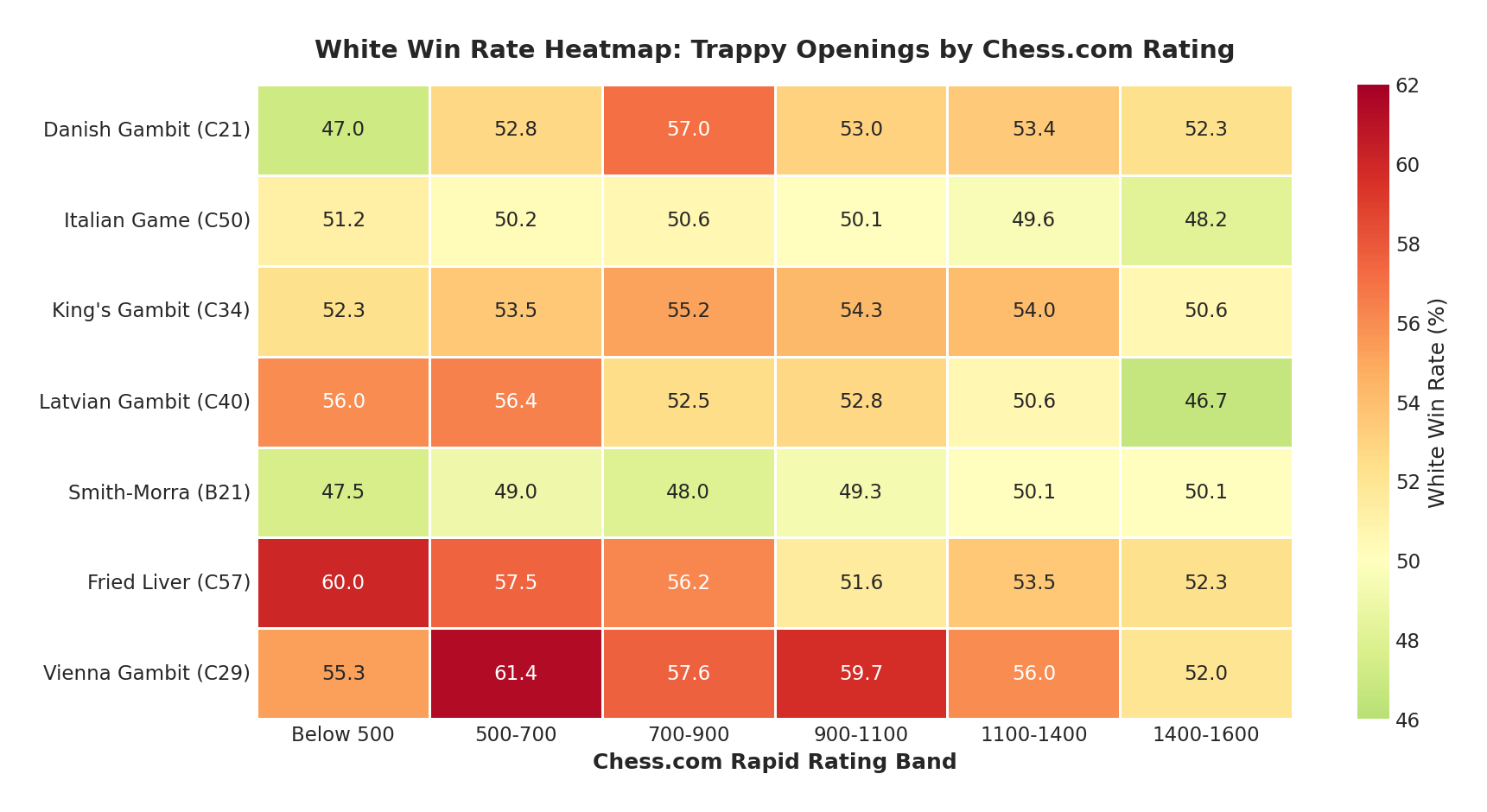
The Advance Variation (B12) remains highly effective here, offering a 49.1% win rate. By playing 3.e5, White immediately grabs space and restricts Black's development. A common mistake for Black at this level is developing the light-squared bishop to f5 too early without proper preparation, allowing White to launch a devastating kingside attack with moves like g4 (the Bayonet Attack).
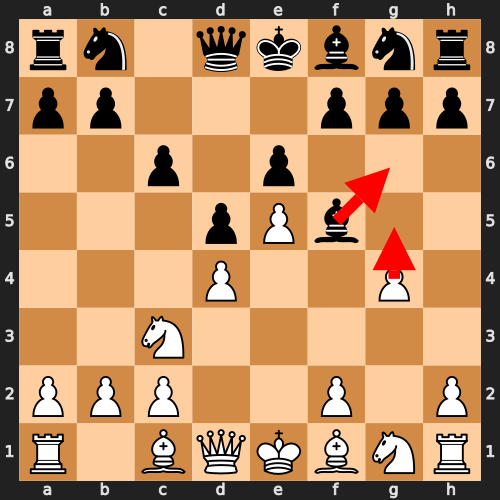
While the von Hennig Gambit still scores well (51.0%), relying solely on early traps becomes riskier as opponents improve their defensive skills. The Advance Variation provides a sounder strategic foundation while still offering excellent attacking chances.
The 1300 - 1500 Bracket: Mastering the Tension
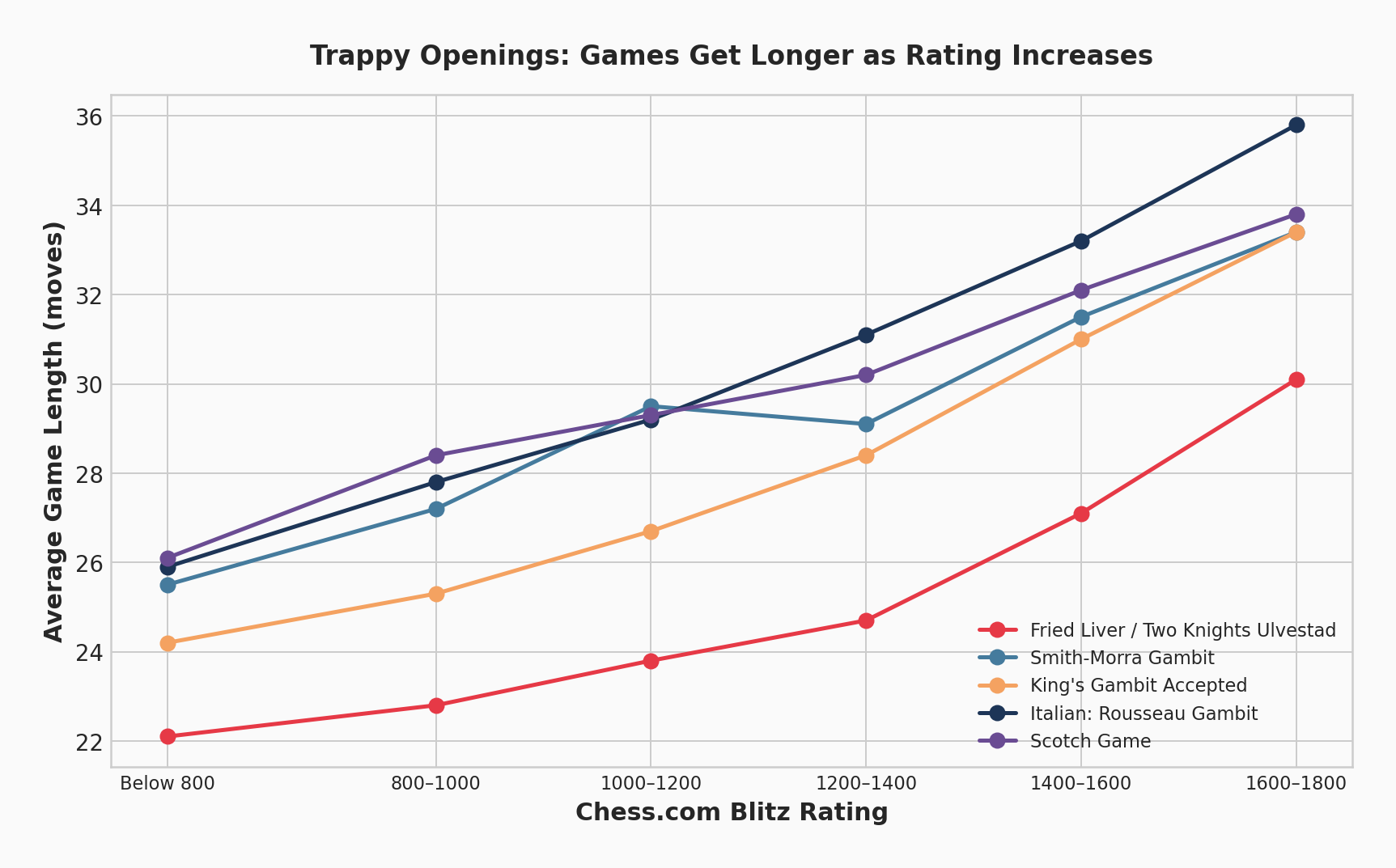
In the 1300-1500 range, players have a solid grasp of tactics and are beginning to understand positional concepts like pawn structures and piece activity. The games become longer and more complex.
Actionable Advice: Stick with the Advance Variation or learn the nuances of the Panov Attack.
The Advance Variation continues to be a reliable weapon (48.4% win rate). However, if you prefer open, dynamic positions, the Panov Attack (3.exd5 cxd5 4.c4) is a worthy addition to your repertoire.
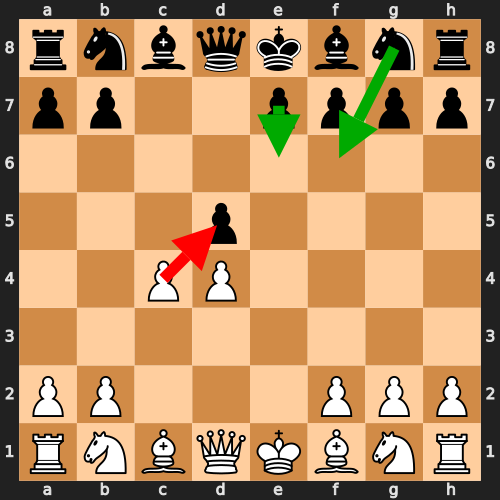
While the Panov's overall win rate is slightly lower (47.3%), it forces the Caro-Kann player out of their comfort zone. Instead of the solid, closed structures they desire, they must navigate the complexities of IQP positions. Mastering the attacking ideas in the Panov will not only improve your results against the Caro-Kann but also enhance your overall understanding of dynamic chess.
Avoid the Classical Variation (3.Nc3 dxe4 4.Nxe4 Bf5) unless you are prepared for a deep theoretical battle. The data shows that Black scores very well (50.3% win rate) in these lines at this level, as the resulting positions are exactly what the Caro-Kann player has studied and practiced extensively.
Conclusion
The Caro-Kann Defense is a tough nut to crack, but the data provides a clear path forward. For intermediate players, avoiding the main line Classical Variation and the Two Knights Attack is generally a wise choice, as Black performs exceptionally well in these setups.
Instead, embrace the space advantage of the Advance Variation or the tactical complexities of the von Hennig Gambit. By choosing lines that challenge the Caro-Kann player's expectations and force them into unfamiliar territory, you can turn the tables and secure a significant practical advantage.
Data and Methodology
This analysis is based on a dataset of approximately 847,000 rated games played on Lichess in March 2025, accessed via the grandmaster-guide MCP server. The subset of Caro-Kann games analyzed includes over 42,000 matches across various time controls, with a specific focus on the Rapid time control.
Lichess ratings were mapped to approximate Chess.com Rapid ratings using the following conversion [1]:
- Lichess 1100-1300 ≈ Chess.com 700-900
- Lichess 1300-1500 ≈ Chess.com 900-1100
- Lichess 1500-1800 ≈ Chess.com 1100-1400
- Lichess 1800-2000 ≈ Chess.com 1400-1600
The underlying CSV data files generated for this analysis are attached for further review:
caro_kann_variation_summary.csv: Comprehensive win/draw/loss rates, CPL, and game length by variation and rating band.caro_kann_rapid_summary.csv: Win rates specifically for the Rapid time control.caro_kann_best_response_ranking.csv: Ranked list of the best performing variations for White at each rating band.
Chess Coach April 14, 2026
References
[1] Chess Rating Comparison. (n.d.). Chess.com vs Lichess Rating Conversion.