Every chess player knows the feeling. You study openings, solve tactics, play regularly, and watch your rating climb steadily—until suddenly, it stops. Weeks turn into months, and despite your best efforts, your rating hovers around the same number. You have hit a plateau.
But are plateaus a universal experience? Do players get stuck at specific rating milestones more often than others? And most importantly, what does the data say about breaking through?
To answer these questions, we analyzed longitudinal rating histories for over 54,000 players and examined more than 160,000 engine-evaluated Rapid games. Our goal was to map the anatomy of a chess plateau, specifically focusing on the journey from Beginner to Intermediate (Chess.com Rapid ratings 800 to 1500).
Here is what the data reveals about where players get stuck, how long they stay there, and the statistical indicators that precede a breakthrough.
Defining the Plateau
Before diving into the numbers, we must define what constitutes a "plateau." Rating fluctuations are normal; a bad weekend can cost you 50 points, which you might win back the following week.
For this study, we defined a standard plateau as staying within a ±50 point rating band for at least three consecutive months. We also examined "extended plateaus" lasting six months or longer, and tested stricter (±30 points) and more relaxed (±75 points) definitions to ensure our findings were robust.
(Note: All ratings in this article refer to Chess.com Rapid. The underlying data was sourced from Lichess Rapid games, with ratings converted to their Chess.com equivalents using established community mapping formulas. For example, a Lichess Rapid rating of 1400 corresponds to approximately 1035 on Chess.com.)
The Stickiest Ratings: Where Do Players Get Stuck?
The data reveals that plateaus are not evenly distributed across the rating ladder. Some rating bands act as significant bottlenecks, trapping a higher percentage of players for longer periods.
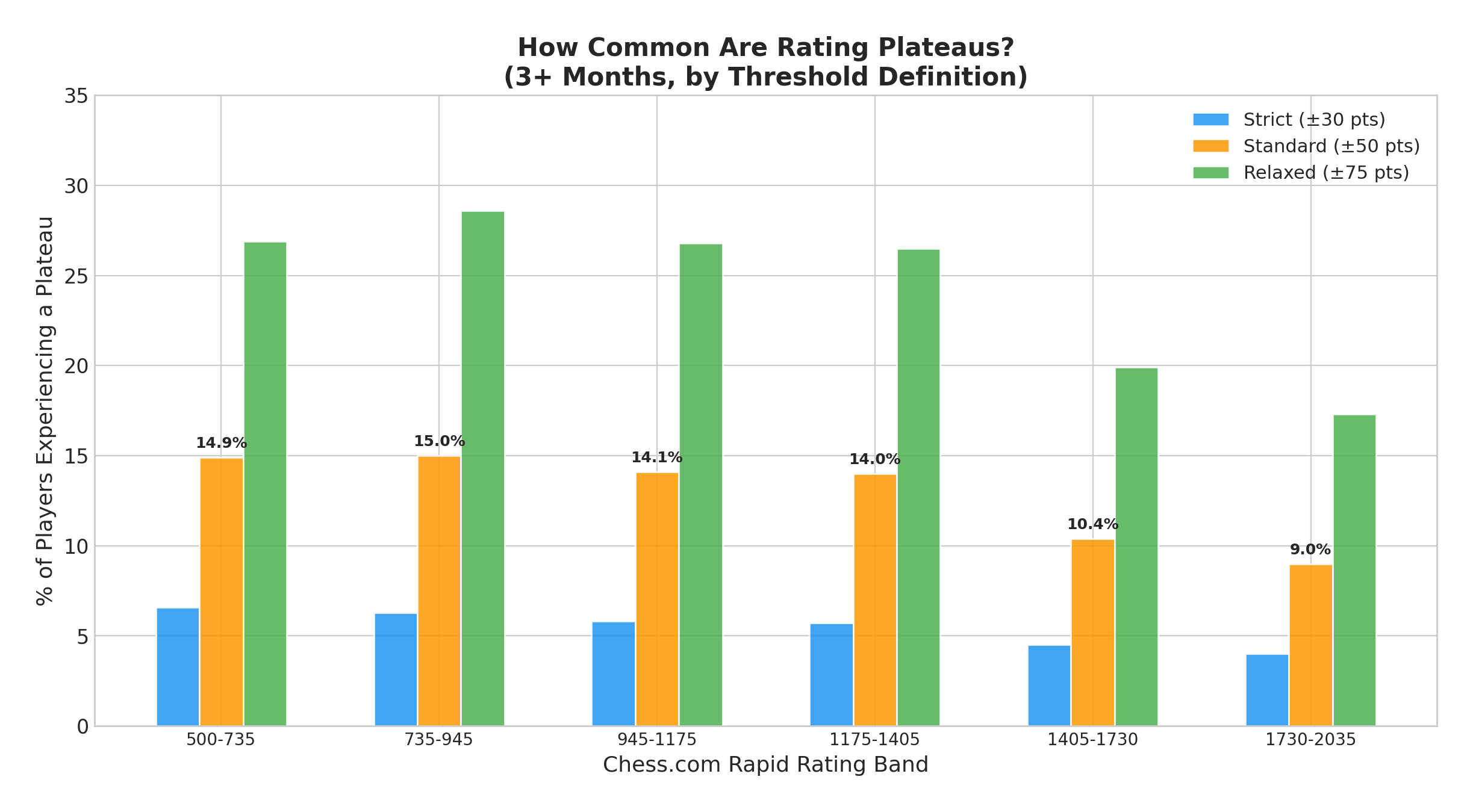
The most common place to get stuck is the 735–1175 range (roughly Lichess 900–1300). In the 735–945 band, exactly 15.0% of players experience a standard plateau (±50 points for 3+ months). This figure remains high at 14.1% in the 945–1175 band and 14.0% in the 1175–1405 band.
However, once players cross the 1400 threshold, the plateau rate drops significantly to 10.4%, and falls further to 9.0% for players approaching 2000.
This suggests a counterintuitive reality: It is more common to get stuck at 1000 than at 1600. The lower rating bands represent a fundamental transition phase where players must discard beginner habits (like one-move blunders) and adopt systematic thinking. This transition is often harder to make than the incremental refinements required at higher levels.
How Long Does a Plateau Last?
When you hit a wall, how long should you expect to stay there? The data provides a sobering answer.
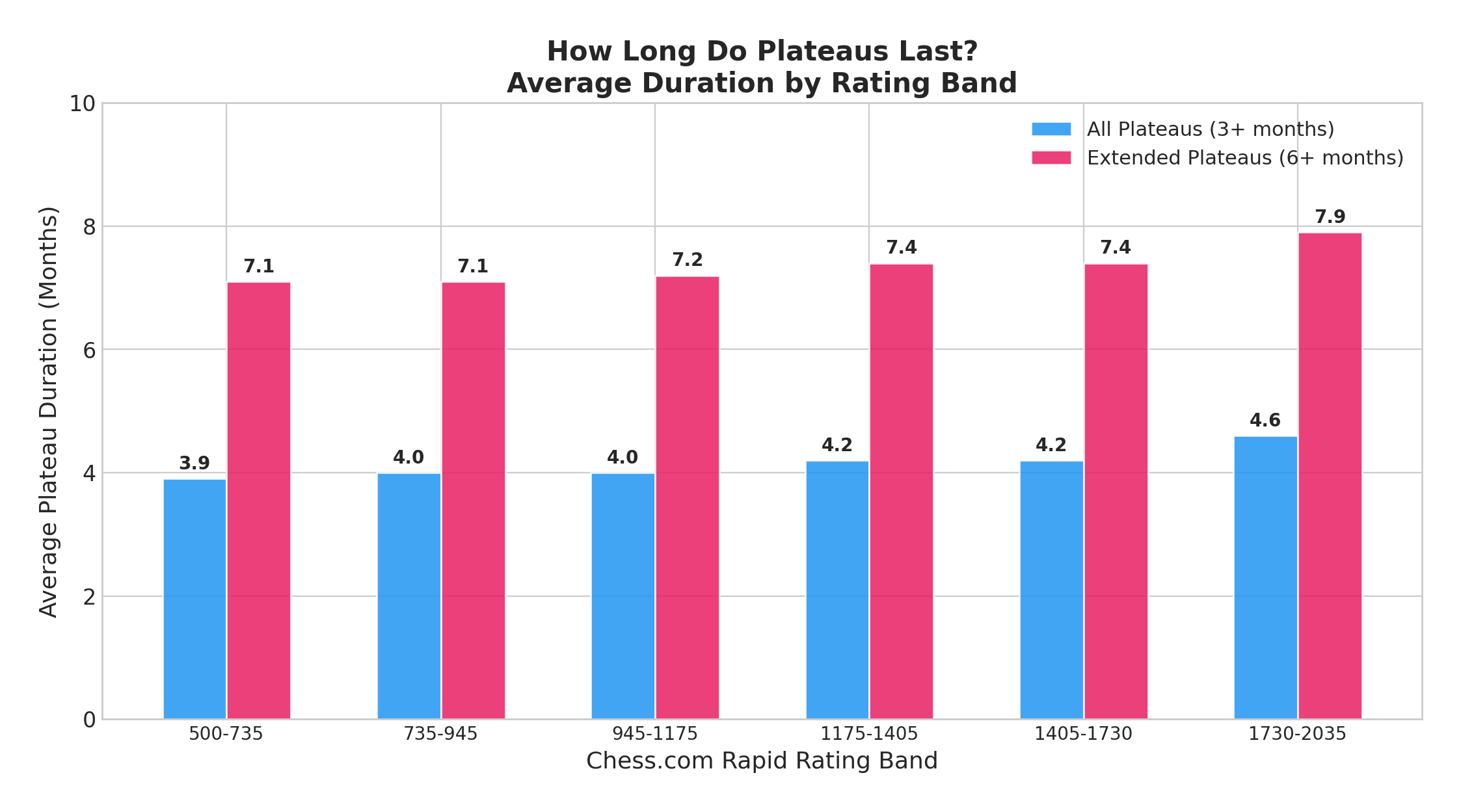
For players who experience a standard plateau, the average duration is remarkably consistent across the lower rating bands: approximately 4 months.
However, if you remain stuck for 6 months, you enter the territory of an "extended plateau." The average duration for these extended plateaus is over 7 months. Interestingly, while fewer high-rated players experience plateaus, those who do tend to stay stuck slightly longer (averaging 4.6 months for standard plateaus in the 1730–2035 band).
The Good News: Breakthrough Rates
If you are currently stuck at 1100, the most important question is: Will I ever break through?
To find out, we looked at the "Breakthrough Rate"—the percentage of players who experienced a 3-month plateau but successfully broke out of it before hitting the 6-month mark.
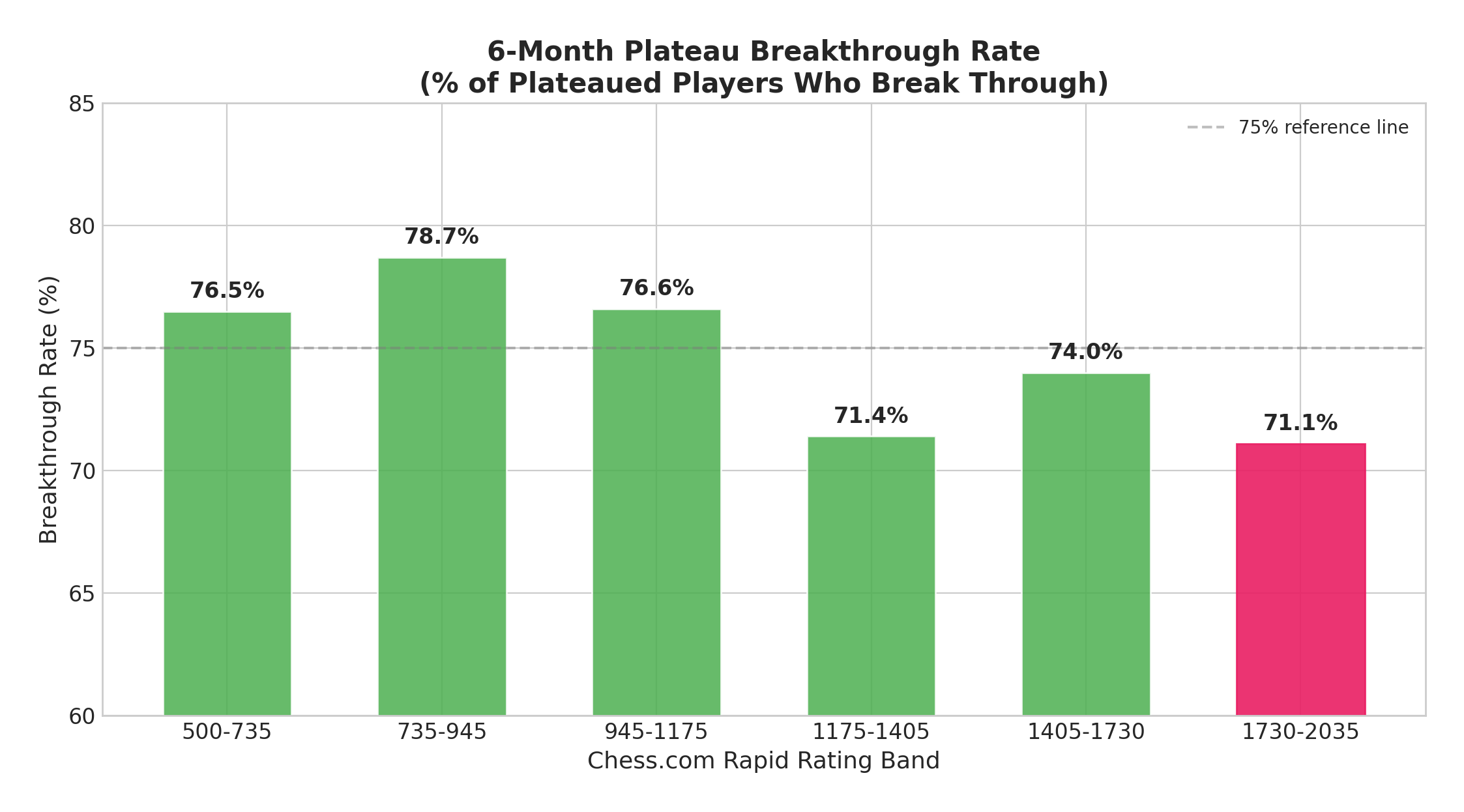
The data offers significant encouragement. Across all rating bands, the vast majority of players eventually break their plateau. In the 735–945 band, 78.7% of plateaued players break through within six months.
The hardest barrier to crack in our target range is the 1175–1405 band, where the breakthrough rate dips to 71.4%. This rating range (roughly Lichess 1300–1500) represents the transition from advanced beginner to intermediate. Breaking through this barrier requires more than just avoiding blunders; it demands basic positional understanding and endgame technique.
Roadmap to Improvement: What Changes When You Break Through?
If 75% of players eventually break their plateau, what are they doing differently? By analyzing the engine evaluations of over 160,000 games, we identified several statistical indicators that precede a rating breakthrough.
1. The Blunder Horizon Moves Back
The most defining characteristic of sub-1200 chess is the frequency and timing of blunders (defined as a move that worsens the evaluation by 300+ centipawns, or roughly 3 pawns).
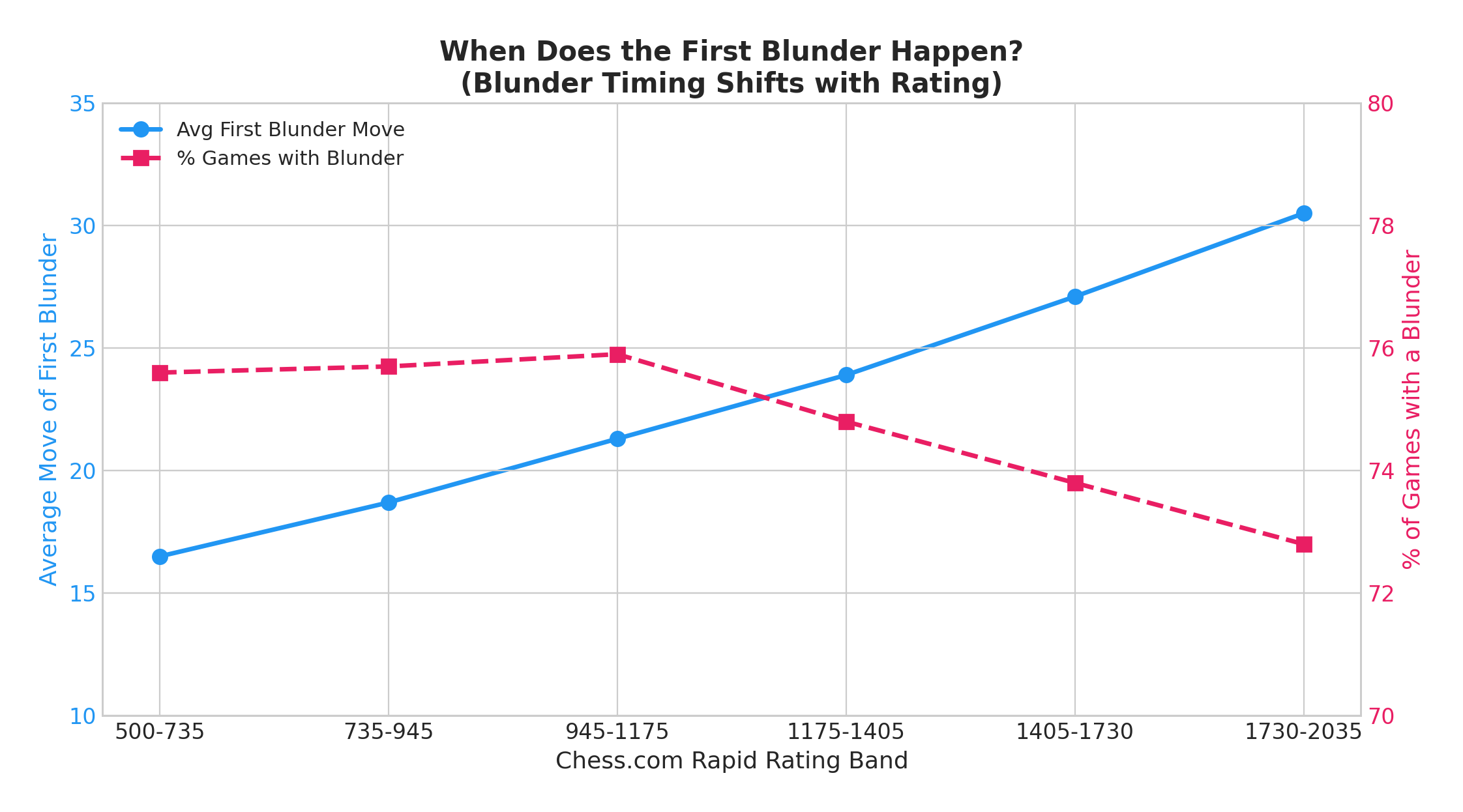
In the 735–945 band, the average first blunder occurs on move 18.7. By the time players reach the 1175–1405 band, they have pushed that horizon back to move 23.9.
Delaying your first major mistake by just five moves correlates with a rating increase of nearly 400 points. Players who break their plateaus do not necessarily play brilliant attacking chess; they simply survive the opening and early middlegame without giving away material.
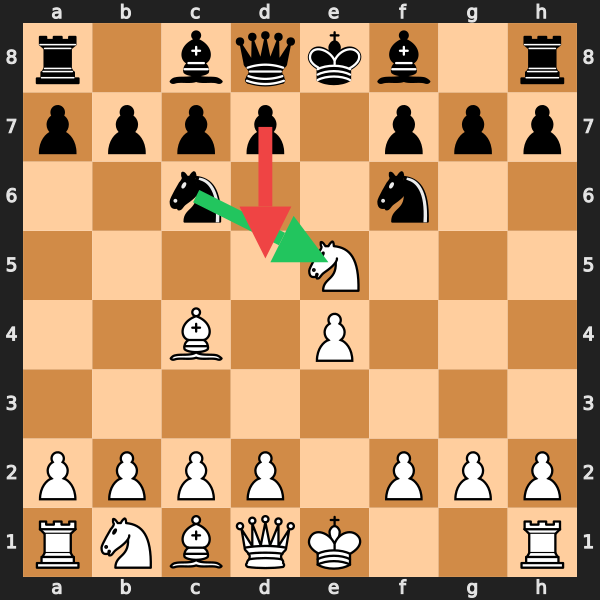 A classic 1000-rated scenario: White plays Ng5 (red arrow), launching a premature attack and hanging the knight to ...e5. The engine prefers simple development with d3 (green arrow).
2. Repertoire Diversification
A common piece of advice for beginners is to "play one opening and stick to it." While this is excellent advice for reaching 1000, our data suggests that breaking through intermediate plateaus requires diversification.
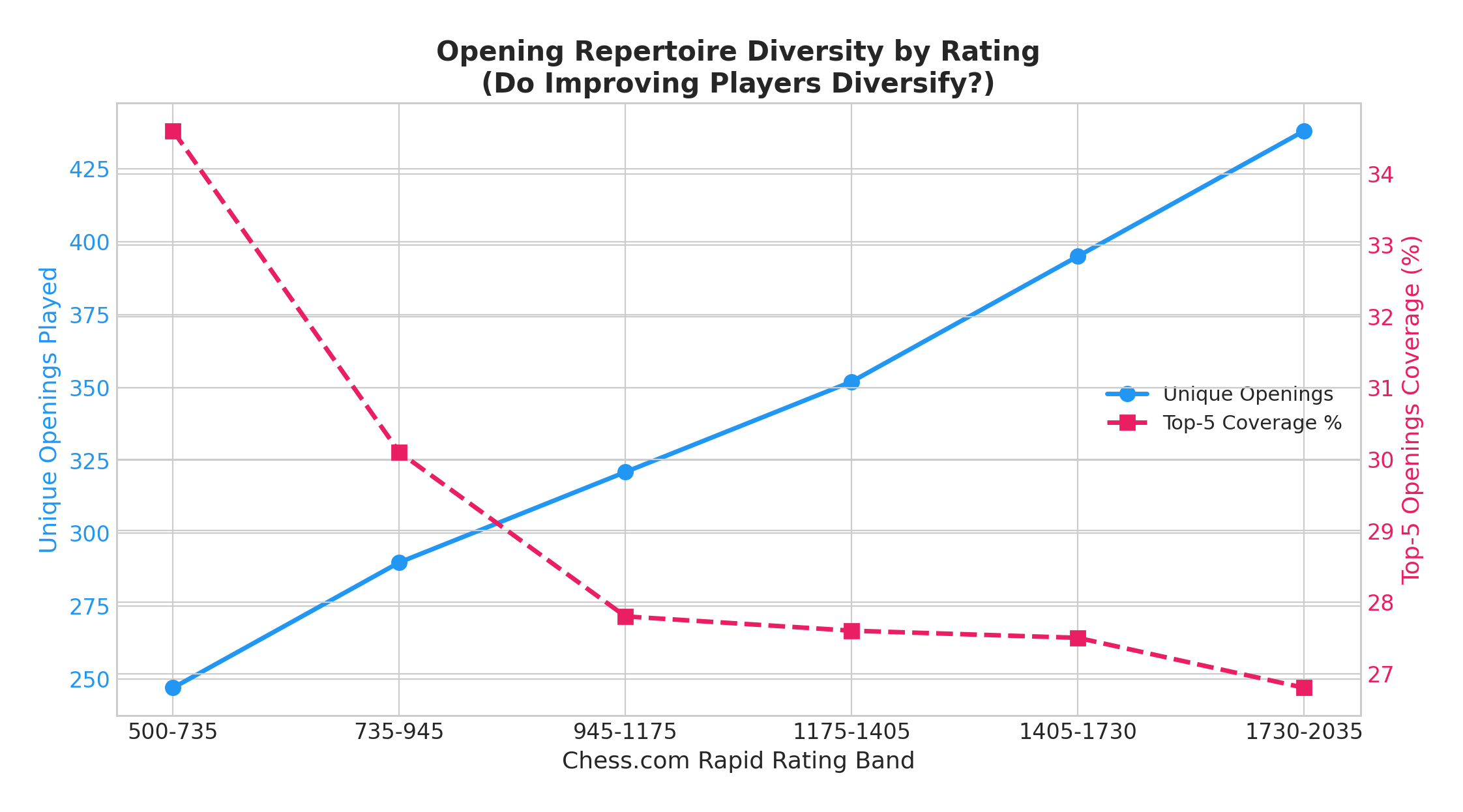
We measured opening diversity using the Herfindahl–Hirschman Index (HHI) and by looking at the percentage of games covered by a player's top 5 openings.
In the 735–945 band, players rely heavily on a narrow repertoire, with their top 5 openings accounting for 30.1% of all games. As ratings increase, this reliance drops steadily. By the 1405–1730 band, the top 5 openings cover only 27.5% of games, and the total number of unique openings played increases significantly.
Players who break the 1200 plateau often do so by expanding their repertoire, which exposes them to new pawn structures and middlegame plans, deepening their overall chess understanding.
3. Surviving the Tilt
Perhaps the most actionable finding in our dataset relates to the psychological aspect of the game: the "Tilt Effect."
We analyzed how losing streaks impact the probability of losing the next game. If chess outcomes were independent coin flips, the loss rate should remain around 50% regardless of previous results.
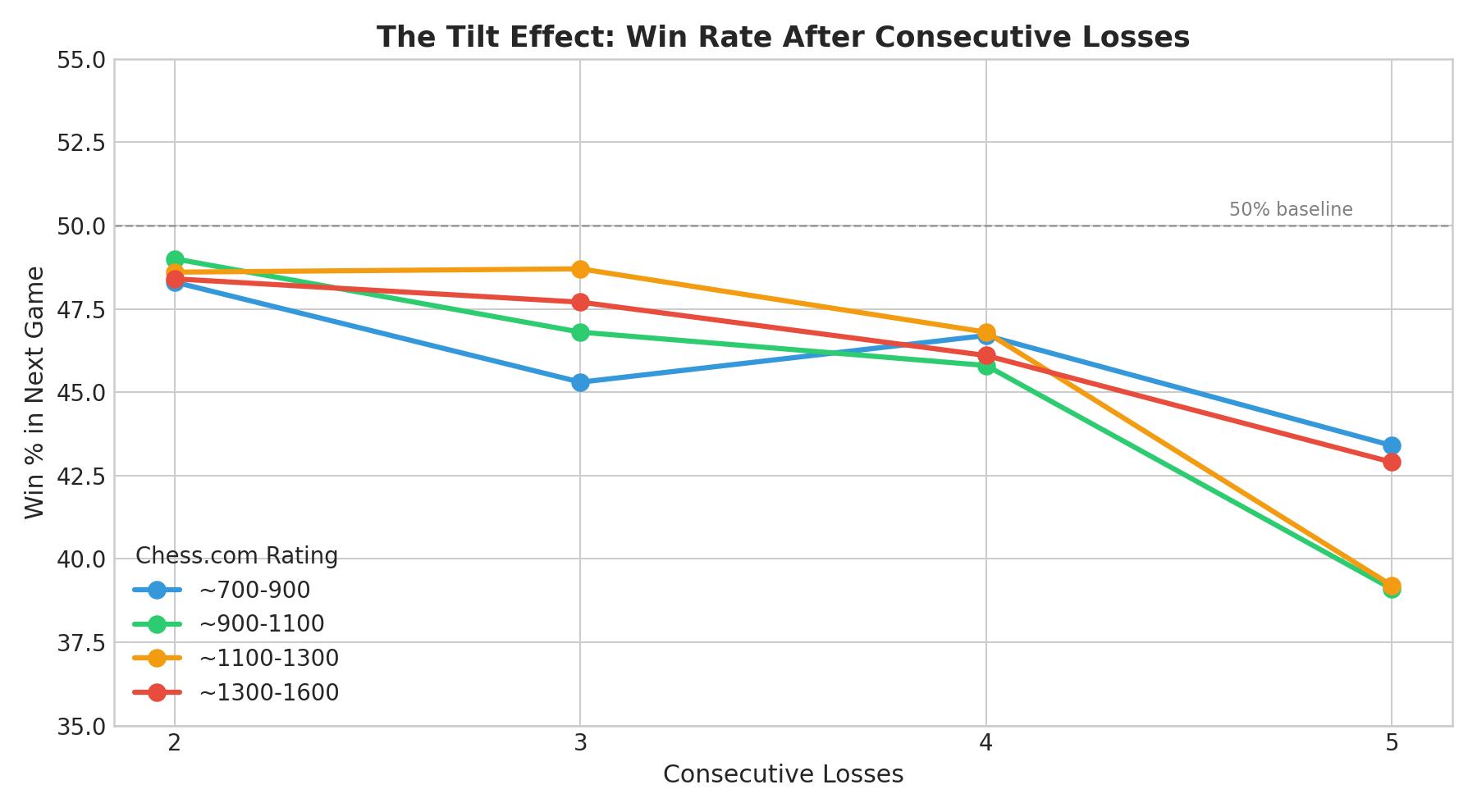
The data proves that tilt is real, measurable, and devastating to rating progress. After a 5-game losing streak, players in the 945–1175 band have a 58.3% chance of losing their next game—the highest tilt penalty of any rating group. Their average Centipawn Loss (CPL) also spikes significantly during these streaks.
Players who successfully navigate plateaus exhibit better "loss management." They stop playing when tilted, preventing a bad afternoon from erasing a month of progress.
4. The Endgame Deficit
When we break down accuracy by game phase, a glaring weakness emerges across all rating bands.
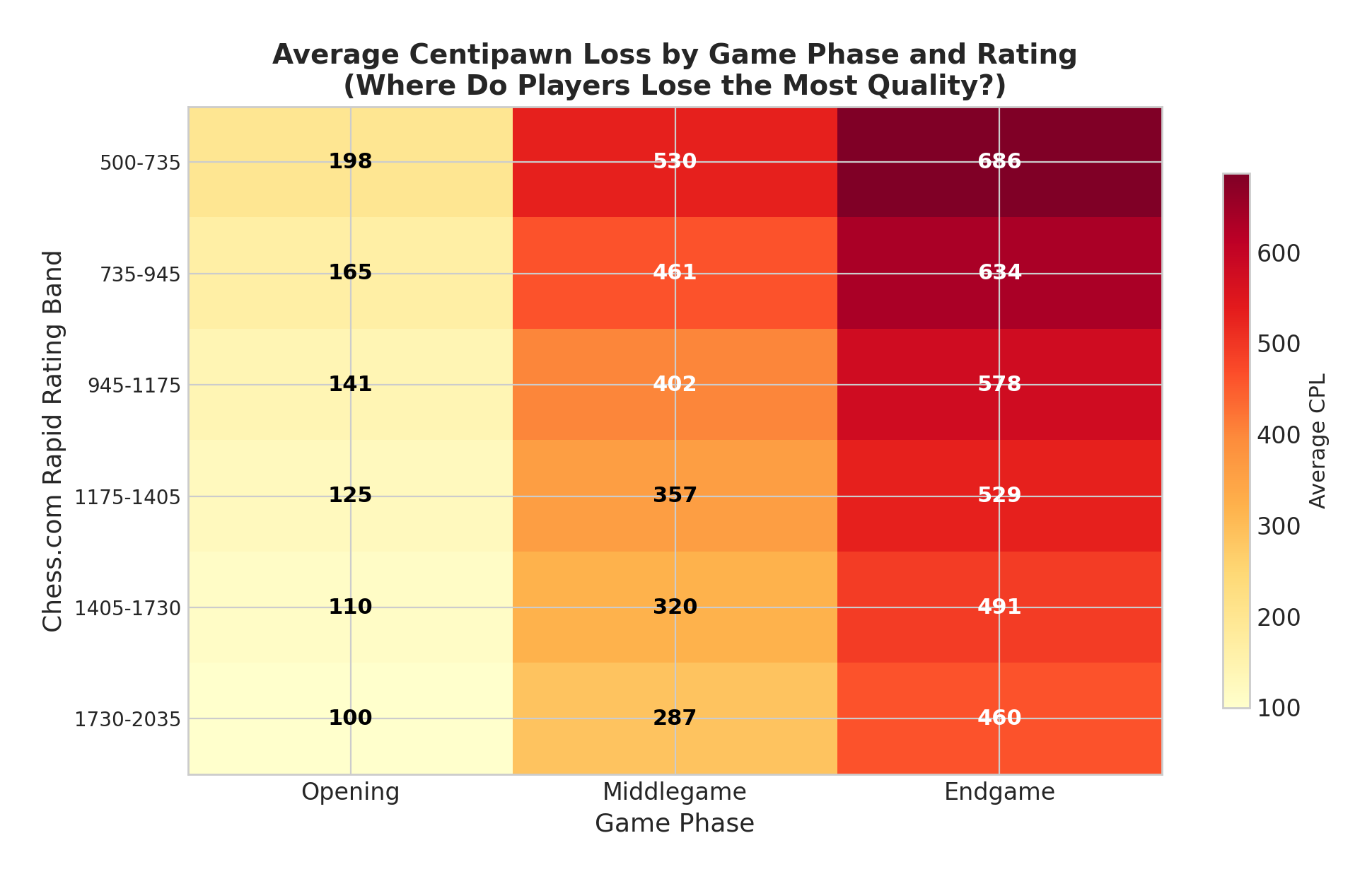
Players are generally most accurate in the opening (where theory guides them) and least accurate in the endgame. For a player in the 945–1175 band, their average CPL in the opening is 141. In the middlegame, it jumps to 402. In the endgame, it skyrockets to 578.
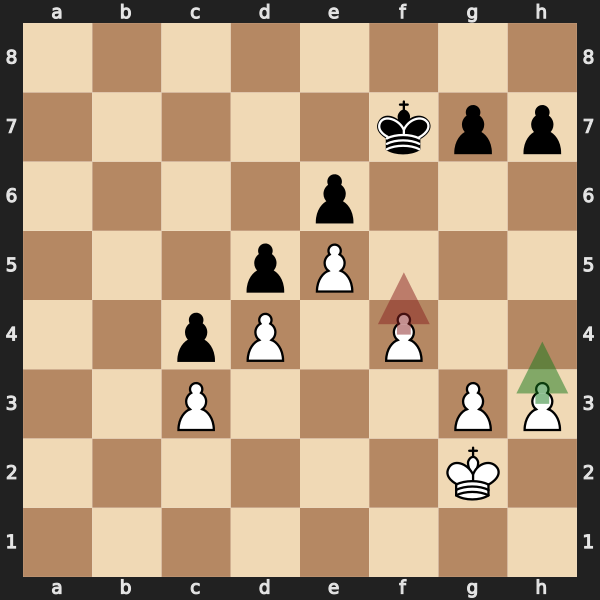 A typical 1200-rated endgame failure: White has an extra pawn but plays the passive Kf3 (red arrow). The winning technique requires active king marching with Kg4 (green arrow).
If you are stuck at a plateau, the fastest mathematical route to improvement is not memorizing more opening theory (where your CPL is already relatively low), but studying basic endgames.
Actionable Advice by Rating Band
Based on the data, here is a targeted roadmap for breaking your specific plateau:
Stuck at 800–1000 (Chess.com Rapid)
- The Data: 75.7% of games in this band feature a major blunder, typically occurring around move 18.
- The Fix: Focus entirely on board vision and blunder-checking. Before every move, ask: "Does this leave a piece undefended? Does my opponent's last move attack anything?" Do not worry about deep strategy; simply surviving to move 25 without hanging a piece will push you into the next rating band.
Stuck at 1000–1200 (Chess.com Rapid)
- The Data: This group suffers the most from the "Tilt Effect" (58.3% loss rate after a bad streak). Furthermore, 29.4% of games still end before move 20.
- The Fix: Implement strict session management. If you lose two games in a row, stop playing for the day. Tactically, focus on basic 2-3 move motifs (pins, forks, skewers). You are no longer hanging pieces in one move, but you are missing simple combinations.
Stuck at 1200–1400 (Chess.com Rapid)
- The Data: This is the hardest plateau to break in the intermediate range (only 71.4% breakthrough rate). Opening diversity begins to matter here, and endgame accuracy is a massive differentiator (CPL of 529).
- The Fix: It is time to diversify. Learn a new opening for Black to expose yourself to different middlegame structures. More importantly, dedicate 30% of your study time to endgames. Knowing how to convert a one-pawn advantage or draw a slightly worse rook endgame is the key to crossing 1400.
Conclusion
Rating plateaus are a frustrating but entirely normal part of chess improvement. If you have been stuck at the same rating for three months, you are in the company of roughly 15% of the active player base.
The data shows that breaking a plateau takes an average of four months, and nearly 80% of players eventually succeed. The key is recognizing that the skills required to reach your current rating are not the same skills required to leave it behind. By pushing your blunder horizon back, managing tilt, and finally opening that endgame manual, your next breakthrough is only a matter of time.
Data and Methodology
This analysis was conducted using a dataset of over 160,000 engine-evaluated Lichess Rapid games and longitudinal rating histories for 54,367 players. Lichess ratings were converted to Chess.com equivalents using community-standard interpolation mapping.
Engine evaluations were performed using Stockfish 17 at depth 18+. A "blunder" is defined as a move resulting in a centipawn loss (CPL) of 300 or greater.
The underlying data files generated for this analysis are available below:
View full data →ratingBand chesscomBand threshold minMonths avgPlateauMonths pctPlayersPlateauing samplePlayers 700-900 735-735 ±50 3 3.9 14.9 4573 900-1100 735-735 ±50 3 4.0 15.0 8107 1100-1300 735-882 ±50 3 4.0 14.1 10080 1300-1500 882-1118 ±50 3 4.2 14.0 10474 1500-1800 1118-1460 ±50 3 4.2 10.4 12597
View full data →fromRating toRating chesscomFrom chesscomTo label avgMonths medianMonths samplePlayers 800 1000 735 735 735-735 6.5 3 6991 1000 1200 735 735 735-735 8.0 4 8874 1200 1400 735 1035 735-1035 9.2 5 9634 1400 1600 1035 1215 1035-1215 10.5 6 8060 1600 1800 1215 1460 1215-1460 11.5 7 6823
View full data →ratingBand lichessBand chesscomBand pctPlateauing3m pctStillStuck6m breakthroughPct avgPlateauMonths3m avgPlateauMonths6m 700-900 700-900 735-735 14.9 3.5 76.5 3.9 7.1 900-1100 900-1100 735-735 15.0 3.2 78.7 4.0 7.1 1100-1300 1100-1300 735-882 14.1 3.3 76.6 4.0 7.2 1300-1500 1300-1500 882-1118 14.0 4.0 71.4 4.2 7.4 1500-1800 1500-1800 1118-1460 10.4 2.7 74.0 4.2 7.4
View full data →ratingBand chesscomBand avgCpl blunderRate mistakeRate inaccuracyRate sampleGames 700-900 735-735 183.1 18.93 3.91 2.92 40335 900-1100 735-735 178.7 19.32 4.77 3.5 34058 1100-1300 735-882 173.9 19.46 5.81 4.14 28546 1300-1500 882-1118 166.7 19.07 6.74 4.65 24070 1500-1800 1118-1460 157.8 18.33 7.98 5.42 19083
View full data →ratingBand chesscomBand hhi top5Pct top10Pct top20Pct uniqueOpenings totalGames 700-900 735-735 0.0399 34.6 55.7 76.0 247 164236 900-1100 735-735 0.0331 30.1 51.3 70.8 290 161828 1100-1300 735-882 0.0294 27.8 47.9 66.7 321 158895 1300-1500 882-1118 0.0273 27.6 45.3 63.2 352 155151 1500-1800 1118-1460 0.0251 27.5 42.3 58.7 395 147088
View full data →ratingBand chesscomBand avgFirstBlunderMove gamesWithBlunderPct avgBlundersPerGame sampleGames 700-900 735-735 16.5 75.6 18.93 40335 900-1100 735-735 18.7 75.7 19.32 34058 1100-1300 735-882 21.3 75.9 19.46 28546 1300-1500 882-1118 23.9 74.8 19.07 24070 1500-1800 1118-1460 27.1 73.8 18.33 19083
View full data →ratingBand chesscomBand phase avgCpl blunderPct 700-900 735-735 opening 197.5 19.57 700-900 735-735 middlegame 529.6 43.15 700-900 735-735 endgame 686.5 45.89 900-1100 735-735 opening 164.9 16.15 900-1100 735-735 middlegame 461.1 40.79
View full data →ratingBand chesscomBand phase avgEval 700-900 735-735 opening 1.35 700-900 735-735 middlegame 4.17 700-900 735-735 endgame 6.39 900-1100 735-735 opening 1.07 900-1100 735-735 middlegame 3.43
View full data →ratingBand chesscomBand pctEndingUnder20 pctReaching40Plus pctReaching60Plus decisiveAvgMoves 700-900 735-735 40.2 20.7 5.4 25.3 900-1100 735-735 34.8 22.7 6.0 27.3 1100-1300 735-882 29.4 24.7 6.5 29.1 1300-1500 882-1118 25.4 26.9 7.6 30.6 1500-1800 1118-1460 20.8 30.3 8.1 32.5
View full data →ratingBand chesscomBand streakLength subsequentWinPct subsequentLossPct avgCplChange 700-900 735-735 3 46.8 49.3 64.0 700-900 735-735 5 40.8 56.3 54.7 900-1100 735-735 3 45.3 51.4 55.1 900-1100 735-735 5 43.4 54.1 54.7 1100-1300 735-882 3 46.8 50.3 52.9
Chess Coach April 15, 2026