Every chess player knows the feeling. You study, you play, you analyze your games, and yet your rating refuses to budge. Weeks turn into months, and the number next to your username seems permanently etched in stone. You have hit a plateau.
But are plateaus a sign that you have reached your natural ceiling, or are they simply a necessary phase of consolidation before the next leap forward? To answer this, we analyzed the rating histories of 1,688 Blitz players, tracking 10,644 distinct plateaus across hundreds of thousands of games. By mapping this data to Chess.com Blitz ratings (specifically focusing on the 800 to 1500 range), we can finally quantify the plateau experience: where they happen, how long they last, and what statistical indicators predict a breakthrough.
This guide serves as a roadmap for players currently stuck in a rut, offering data-backed actionable advice for each rating segment to help you climb to the next level.
Where Do Plateaus Cluster?
A plateau is not merely a few days of bad form. For this study, we defined a plateau as a period of at least 60 days where a player's rating remained within a narrow 100-point band (±50 points from their median rating during that stretch), with active play occurring on at least 10 distinct days.
When we map the centers of these 10,644 plateaus, distinct clusters emerge.
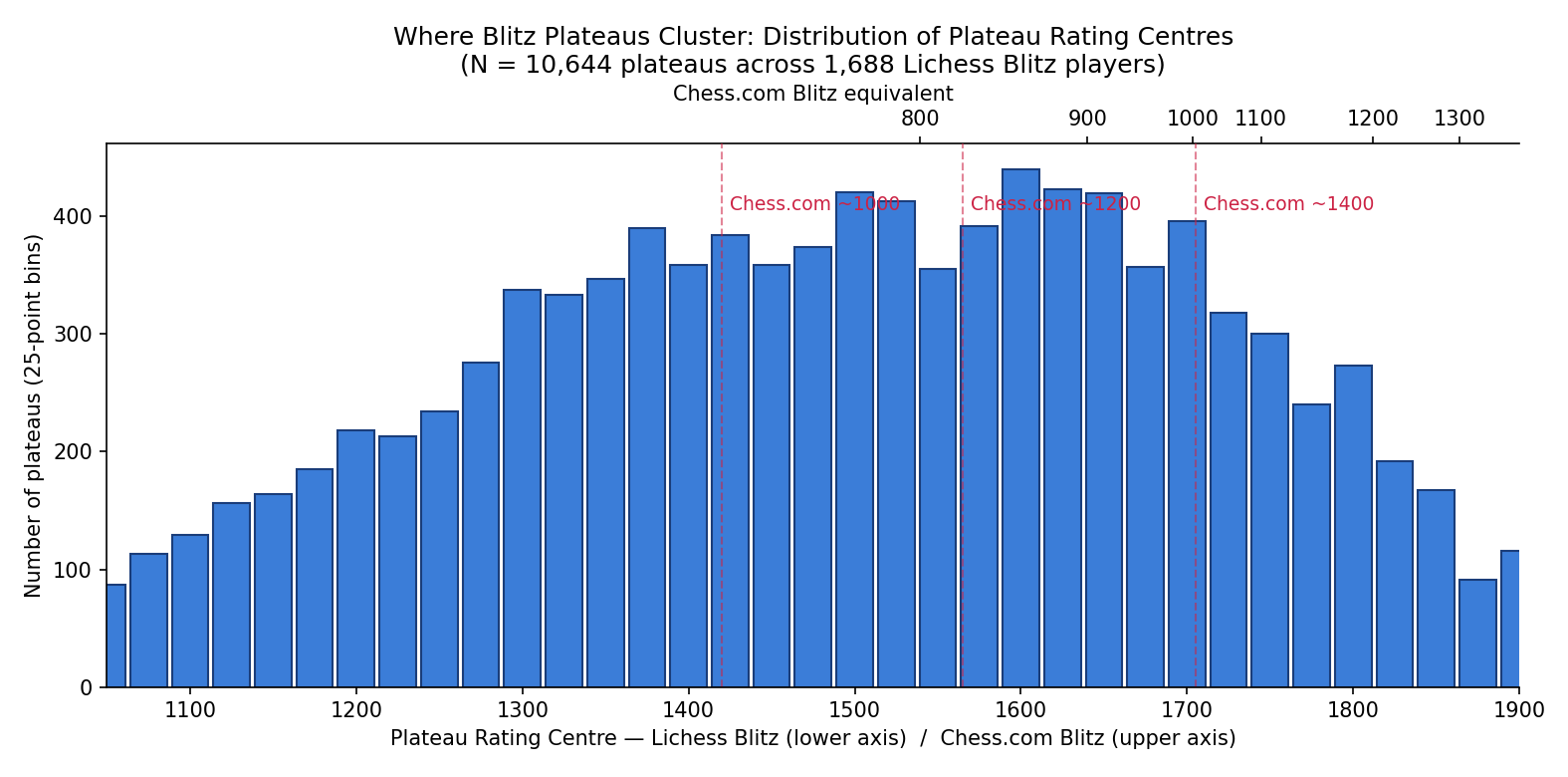
The data reveals significant bottlenecks around Chess.com 1000, 1200, and 1400. These are not arbitrary numbers; they represent distinct thresholds in chess understanding. Breaking through 1000 typically requires eliminating one-move blunders. Surpassing 1200 demands basic tactical vision and opening principles. Reaching 1400 necessitates positional awareness and the ability to formulate a middle-game plan. The clustering at these specific ratings suggests that players are getting stuck precisely when a new set of skills is required to progress.
How Long Does a Typical Plateau Last?
If you feel like you have been stuck forever, the data might offer some comfort: plateaus are genuinely long.
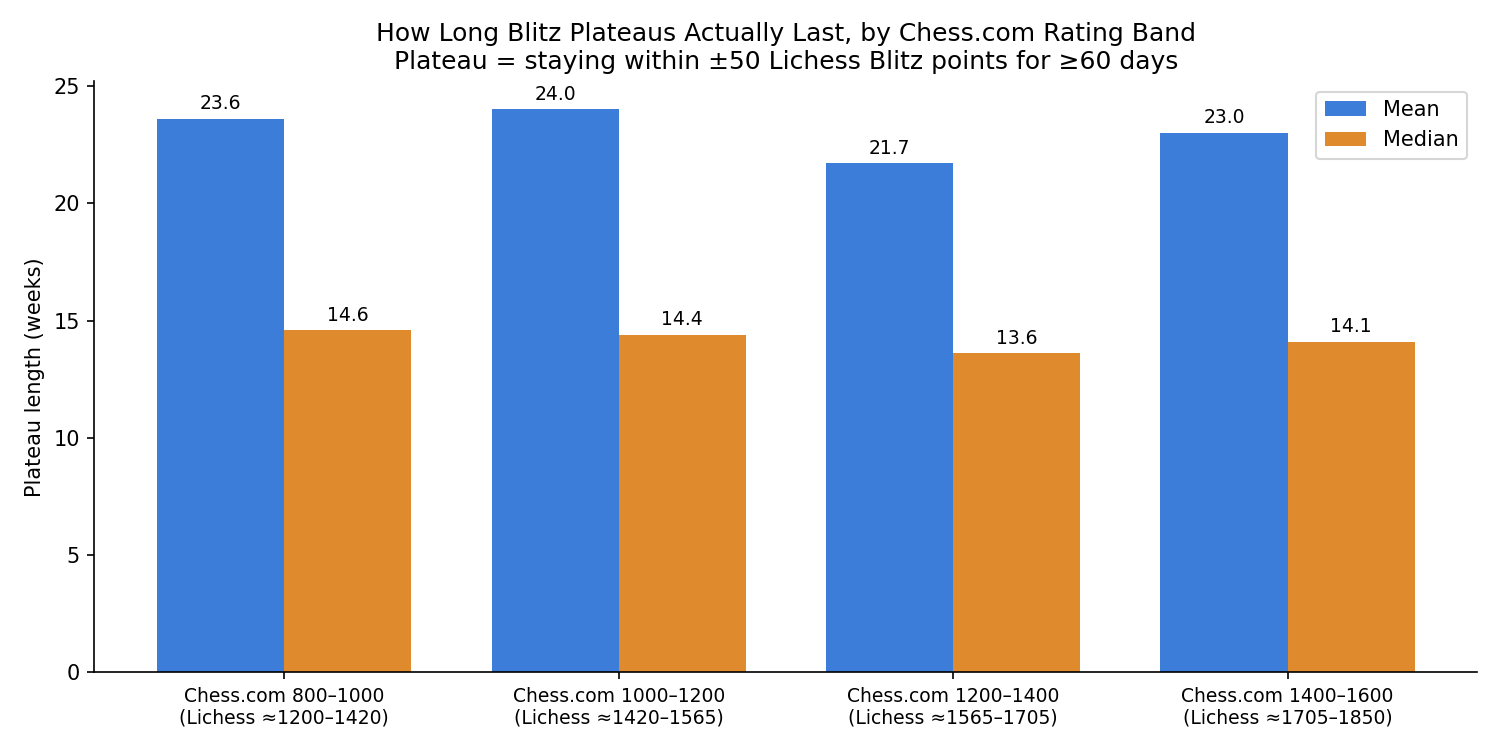
Across all bands from 800 to 1600, the median plateau lasts roughly 14 weeks (about three and a half months). However, the mean duration is significantly longer—between 21 and 24 weeks—indicating a long tail of players who remain stuck for half a year or more.
Time, however, is only one dimension. The effort invested during these periods is substantial.
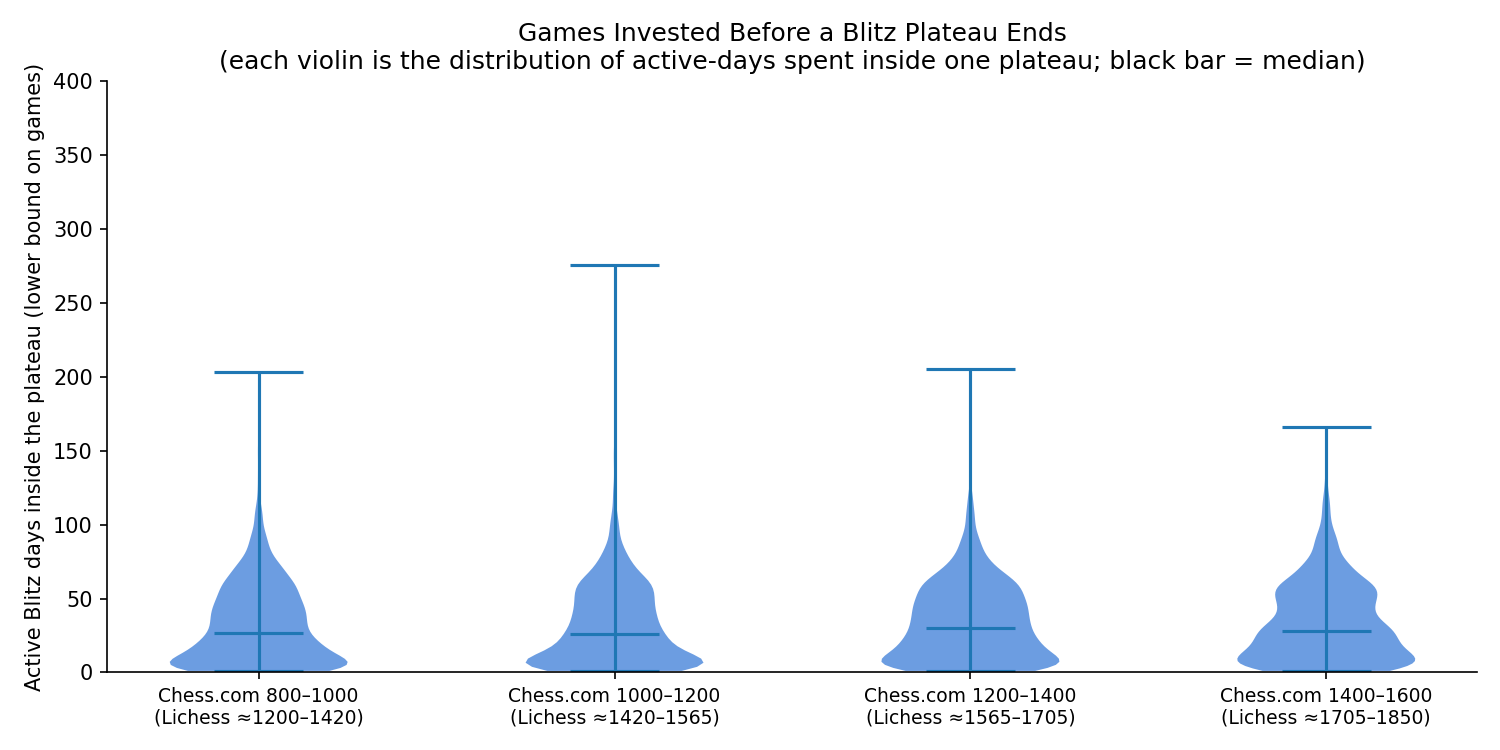
The median number of active Blitz days spent inside a single plateau is approximately 25 to 30. Given that players typically play multiple games per active day, this translates to hundreds of games played without any net rating gain. This phase of consolidation is where the foundational skills for the next rating band are forged through repetition and trial and error.
The Anatomy of a Breakthrough
What happens when a plateau finally ends? Does the player break through to new heights, or do they collapse under frustration?
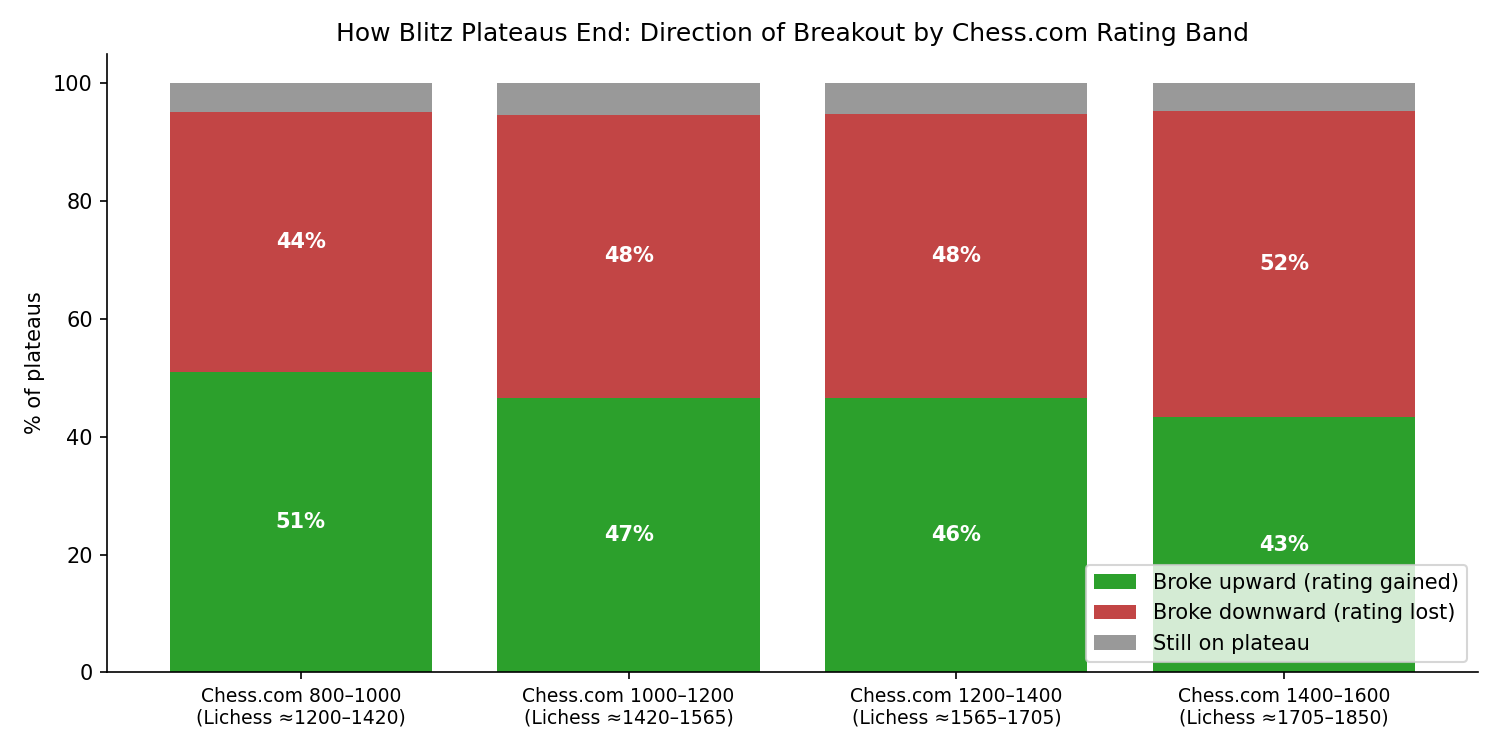
The good news is that plateaus are slightly more likely to end with an upward breakout (gaining rating) than a downward slide, particularly in the lower rating bands. At the Chess.com 800–1000 level, 51% of plateaus resolve upward. This ratio shifts slightly as ratings increase, reflecting the increasing difficulty of the opposition, but the upward path remains highly accessible.
Furthermore, plateaus are rarely permanent. When we isolate plateaus that have lasted for a grueling six months, the vast majority eventually break.
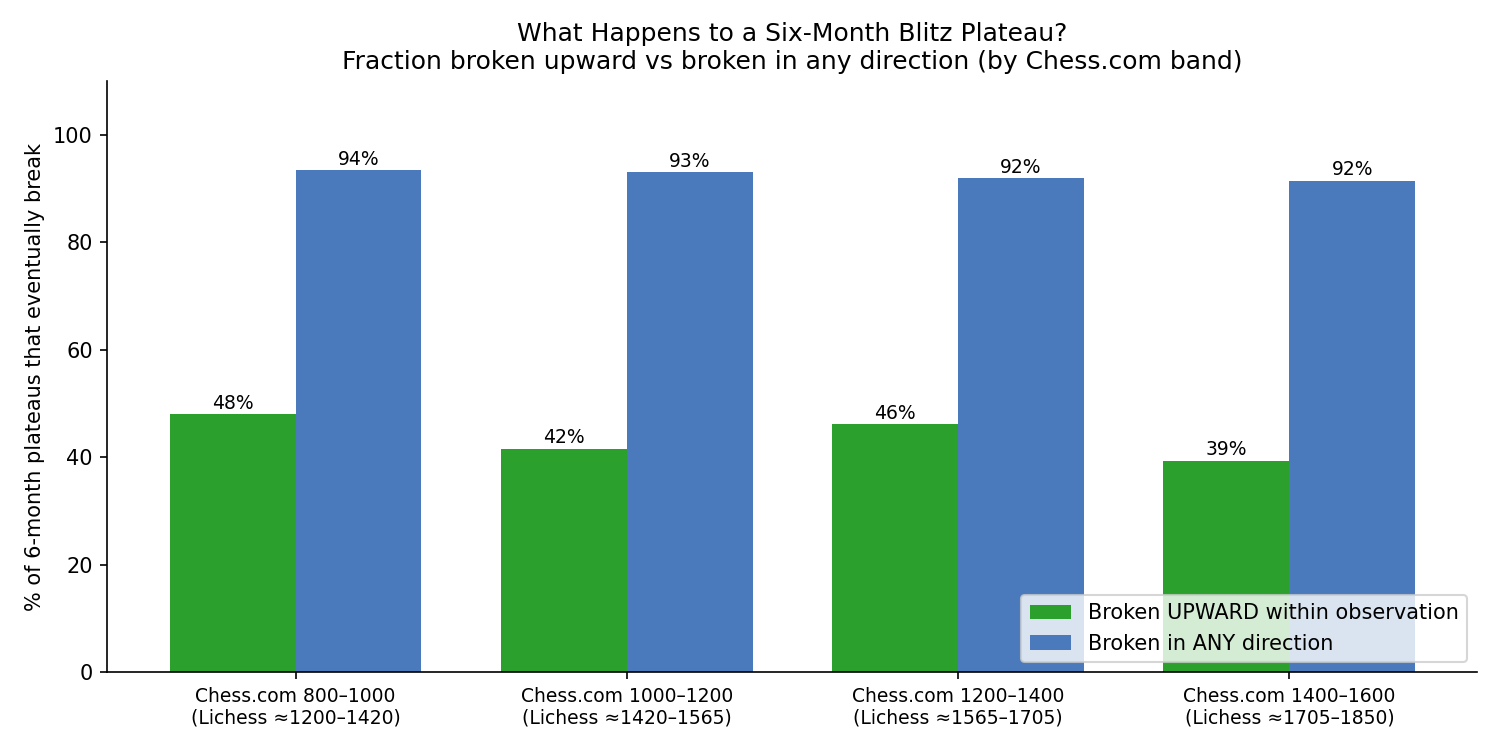
Over 90% of six-month plateaus eventually resolve. Crucially, between 39% and 48% of these long-term ruts end with the player breaking upward. If you have been stuck at the same rating for half a year, the statistical probability of eventually climbing higher remains strong, provided you continue to play and adapt.
Leading Indicators: What Predicts a Rating Jump?
If breaking a plateau is possible, what behaviors precede the jump? We analyzed several factors, including practice volume and opening repertoire changes, to identify the hallmarks of a breakthrough.
The Activity Uptick
One of the most consistent signals of an impending upward breakout is a sudden surge in playing volume.
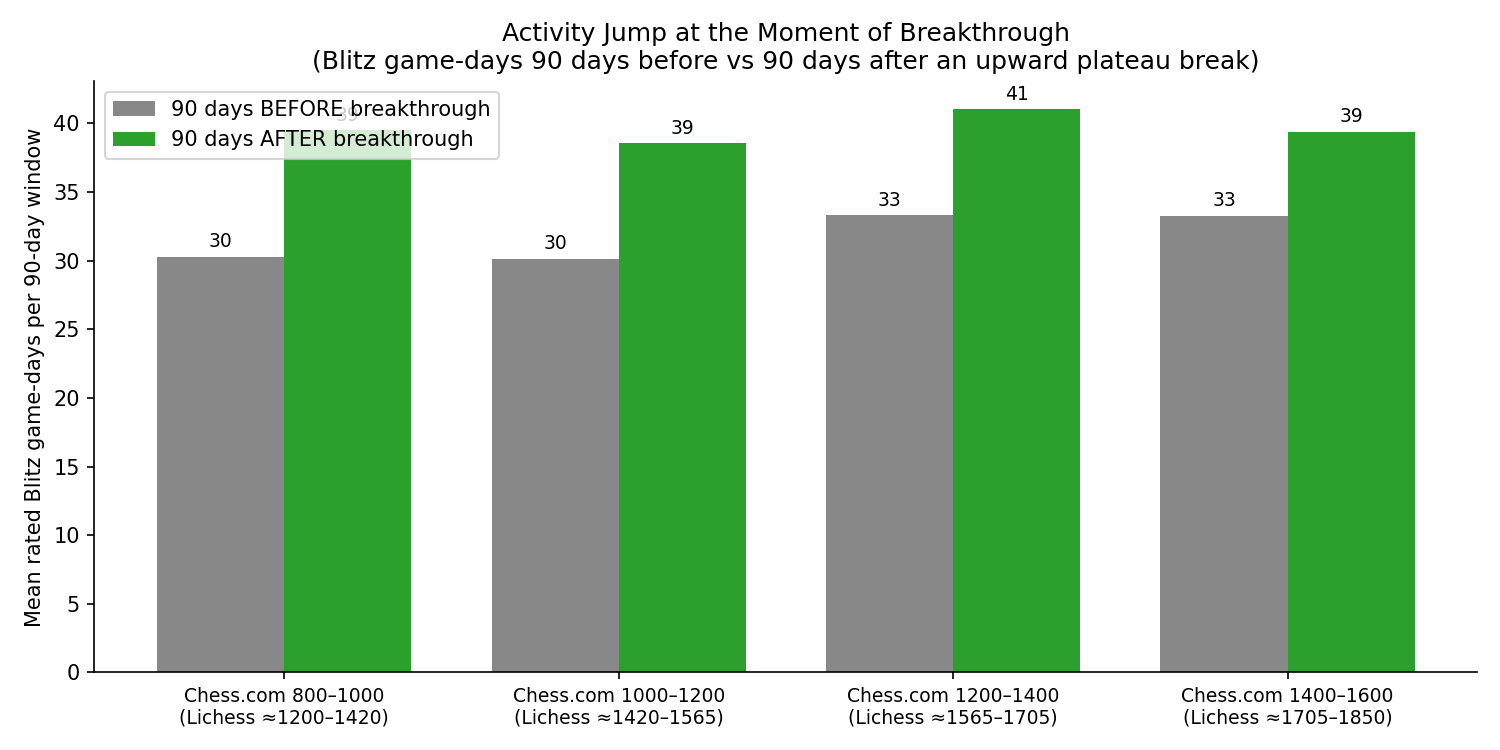
Across all rating bands, players who successfully broke their plateau upward exhibited a 20% to 30% increase in their playing frequency in the 90 days following the breakout compared to the 90 days prior. This suggests a mutual reinforcement cycle: breaking a plateau boosts confidence and motivation, leading to more play, which in turn solidifies the new rating level.
Practice Volume and Improvement
Does simply playing more games guarantee improvement? Data from over 26,000 player-months suggests a nuanced answer.
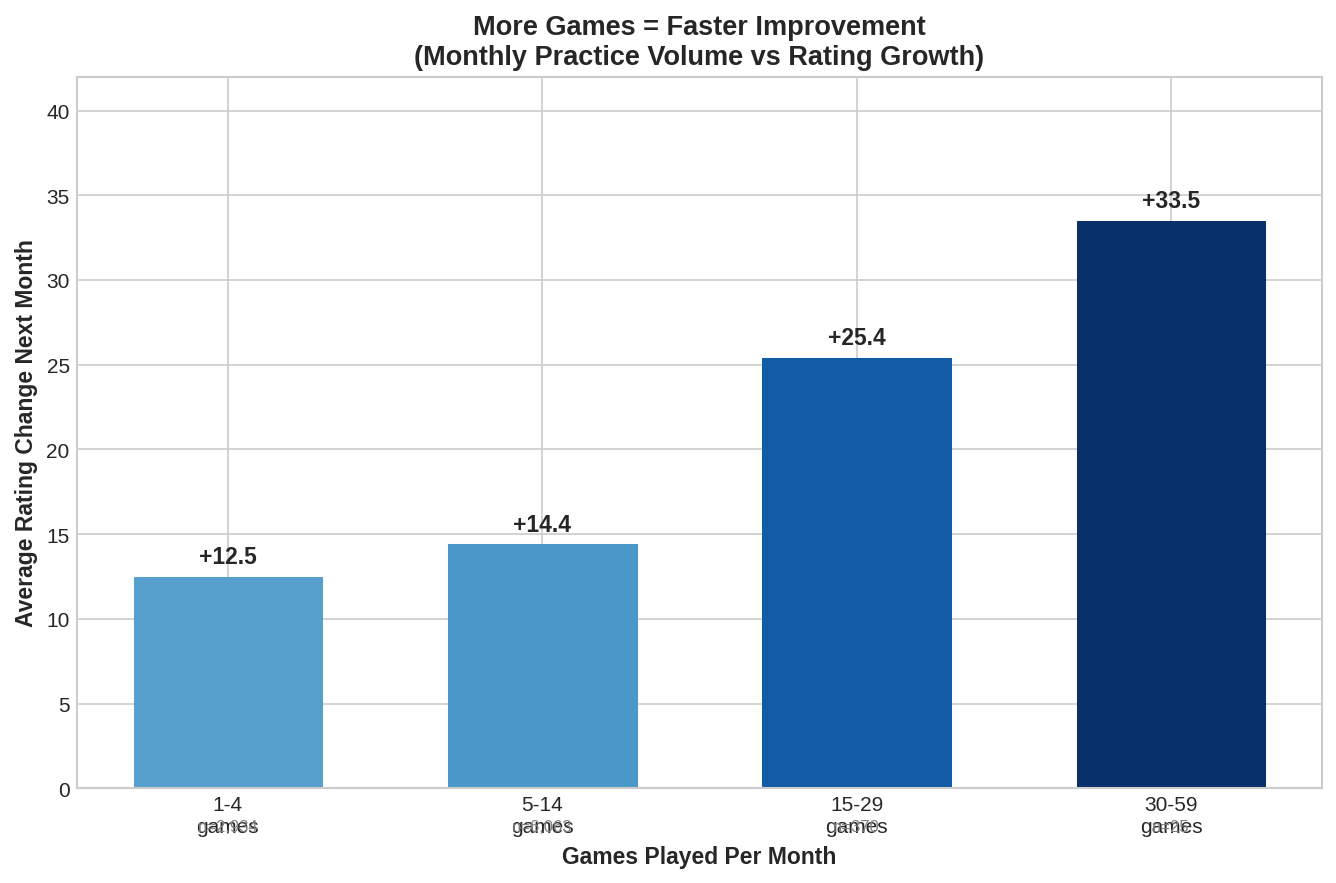
Playing more games does correlate with higher rating gains the following month, but the effect is not strictly linear. Moving from 1–4 games per month to 15–29 games yields a measurable increase in expected rating gain. However, the returns begin to diminish at extremely high volumes, suggesting that mindless grinding without study or analysis is less effective than a balanced approach.
Repertoire Churn and Opening Diversity
A common piece of advice for stuck players is to change their openings. Does the data support this?
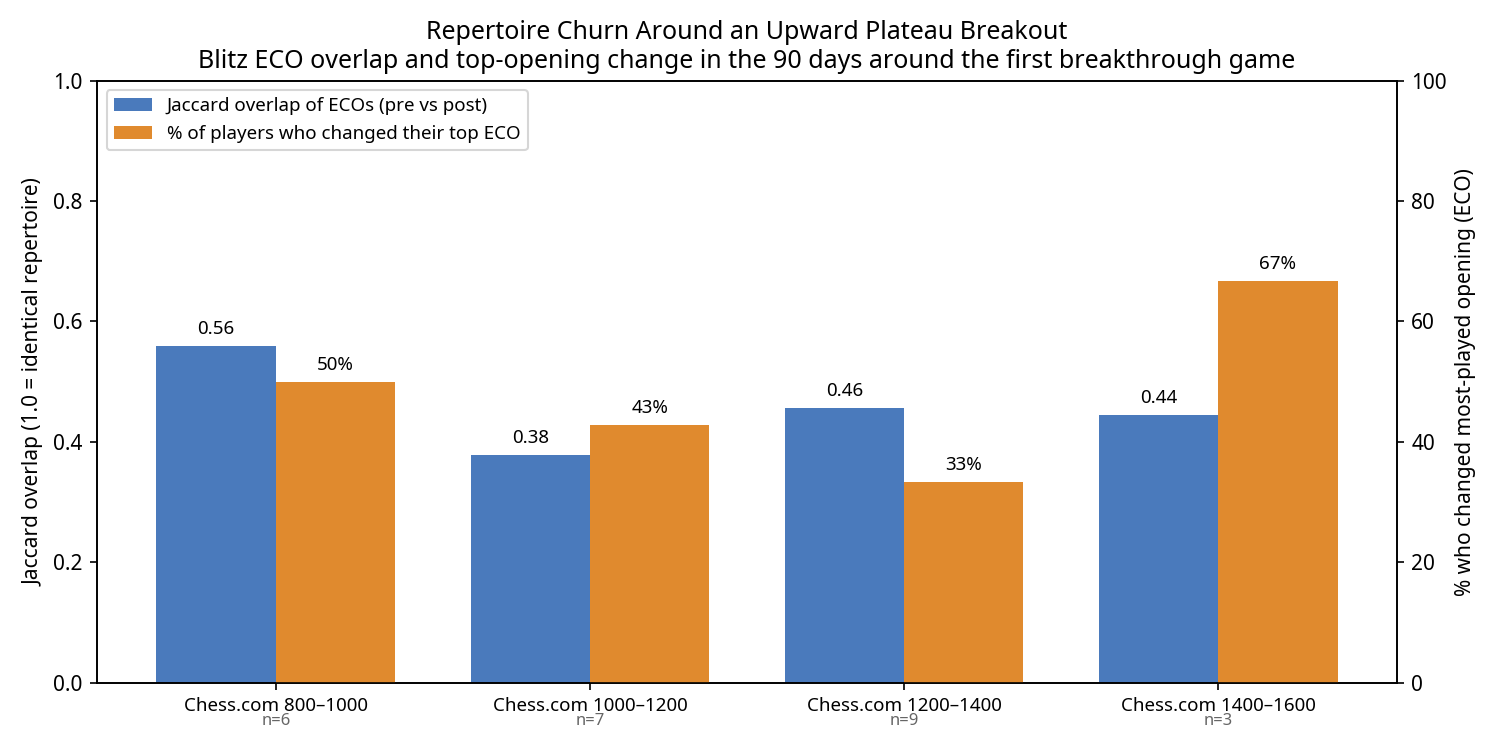
Our sample of players who successfully broke upward showed significant repertoire churn. On average, only about 46% of their opening repertoire (measured by ECO codes) remained identical in the 90 days after the breakout compared to the 90 days before. Furthermore, between 33% and 67% of these players completely changed their most frequently played opening.
This aligns with broader trends in opening diversity across rating bands.
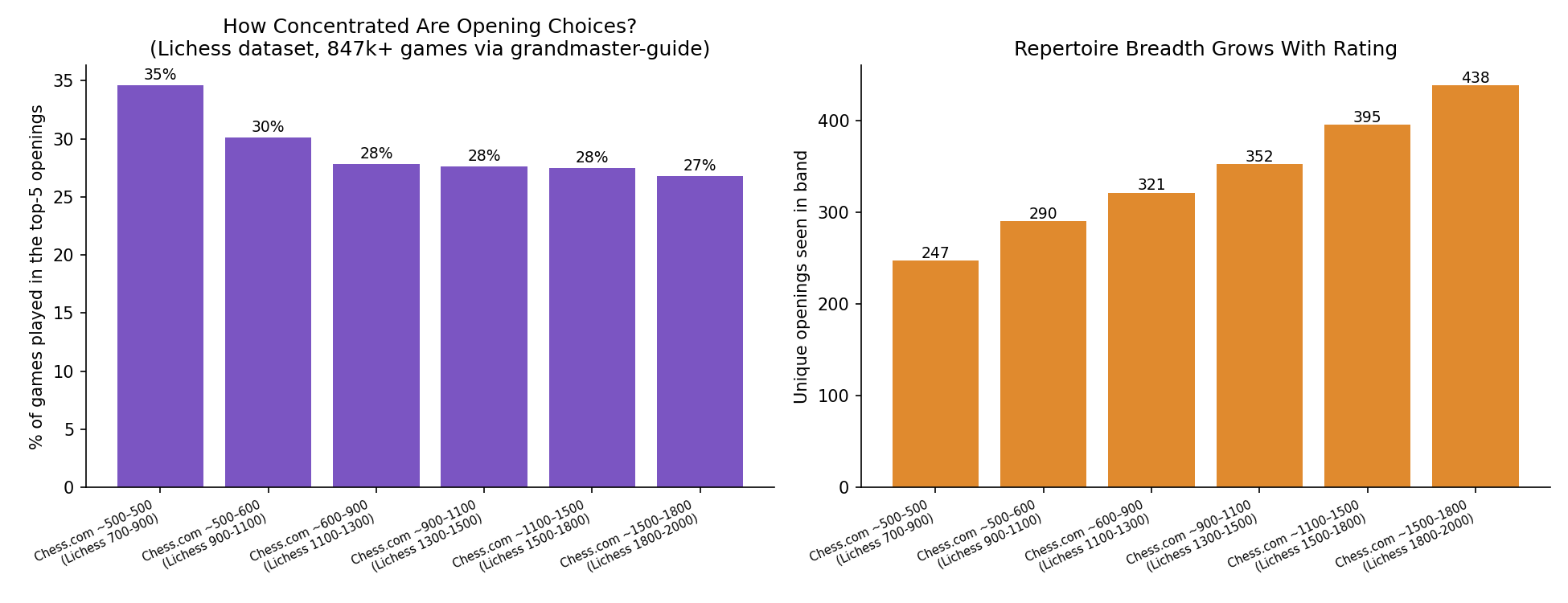
As players climb the rating ladder, their opening choices become less concentrated. The percentage of games played in a player's top five openings drops steadily from 35% at the lowest levels to 27% at higher levels, while the total number of unique openings encountered grows significantly. Breaking a plateau often requires expanding your chess vocabulary and stepping out of your comfort zone.
Actionable Advice by Rating Band
Based on the data, here is a roadmap for breaking through your specific plateau.
Chess.com 800–1000: The Tactical Foundation
At this level, plateaus are almost entirely dictated by one-move blunders and missed basic tactics. The data shows that 51% of plateaus here break upward, the highest of any band.
The Common Trap: Players at this level frequently fall for simple tactical oversights, such as hanging a piece to a basic fork or discovered attack.
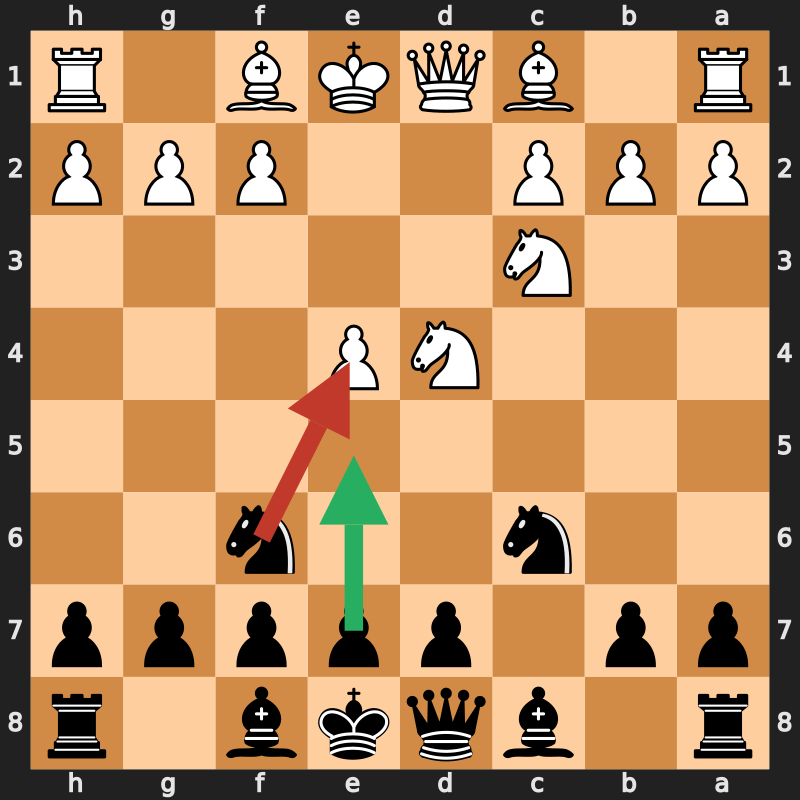
In this classic Open Sicilian position, Black frequently plays 5...Nxe4 (red arrow), immediately losing a piece to 6.Nxc6 or 6.Nxe4. The correct approach is to develop and control the center with moves like 5...e5 (green arrow) or 5...a6.
Actionable Advice:
- Stop hanging pieces: Before every move, perform a blunder check. Ask yourself, "Is the square I am moving to safe? Am I leaving another piece undefended?"
- Focus on basic tactics: Spend more time on puzzles (pins, forks, skewers) than on playing Blitz.
- Keep openings simple: Stick to fundamental principles—control the center, develop your pieces, and castle early. Do not worry about deep opening theory yet.
Chess.com 1000–1200: The Transition to Planning
This is a major clustering point for plateaus. Players here rarely hang pieces outright but struggle to formulate a coherent plan once the opening phase ends.
Actionable Advice:
- Learn basic endgames: A solid understanding of King and Pawn endgames, as well as basic Rook endgames, will win you countless games that your opponents misplay.
- Identify candidate moves: Stop playing the first move that looks okay. Force yourself to find at least two or three candidate moves before deciding.
- Review your losses: Use the engine to identify the critical moment where the evaluation swung against you. Understand why your move was a mistake, not just that it was one.
Chess.com 1200–1400: The Positional Awakening
Plateaus here are characterized by a lack of positional understanding. Players know tactics but often create long-term weaknesses in their own position.
Actionable Advice:
- Study pawn structures: Understand concepts like isolated pawns, doubled pawns, and backward pawns. Learn how to exploit these weaknesses in your opponent's camp and avoid creating them in your own.
- Improve piece coordination: Ensure your pieces are working together toward a common goal, rather than operating independently.
- Expand your repertoire: The data shows significant repertoire churn at this level. If you are stuck, try learning a new opening to expose yourself to different middle-game structures and ideas.
Chess.com 1400–1600: The Refinement Phase
Breaking through 1400 requires consistency and a deeper understanding of the nuances of the game. Plateaus here are long, and downward breaks become slightly more common as the competition stiffens.
Actionable Advice:
- Deepen opening knowledge: You need to know the plans and typical middle-game structures associated with your chosen openings, not just the first few moves.
- Master prophylactic thinking: Anticipate your opponent's plans and take steps to prevent them before they become dangerous.
- Manage your time: In Blitz, time management is critical. Avoid spending too much time on a single move early in the game, leaving yourself in severe time trouble later.
Conclusion
A rating plateau is not a life sentence; it is a crucible. The data clearly shows that plateaus are a normal, expected part of the chess journey, often lasting months and requiring hundreds of games to overcome. However, the statistics also offer a message of hope: the vast majority of plateaus eventually break, and a significant portion of those breaks are upward.
By understanding the specific challenges of your rating band, increasing your practice volume thoughtfully, and being willing to adapt your opening repertoire, you can turn your current plateau into the launching pad for your next rating milestone.
Keep playing, keep analyzing, and the breakthrough will come.
— Chess Coach, April 20, 2026
Data and Methodology
This research is based on the analysis of 1,688 Lichess Blitz players, yielding 10,644 distinct rating plateaus. The data was collected via the Lichess API and the grandmaster-guide MCP analytics database.
- Plateau Definition: A period of ≥60 days where the player's rating remained within ±50 Lichess points of the median rating for that period, with active play on ≥10 distinct days.
- Rating Mapping: Lichess Blitz ratings were mapped to Chess.com Blitz equivalents using the standard conversion table provided for this project (e.g., Lichess 1200 ≈ Chess.com 800; Lichess 1780 ≈ Chess.com 1500).
- Opening Diversity: Sourced from the grandmaster-guide MCP, analyzing over 847,000 games across various rating bands.
- Repertoire Churn: Based on a targeted sample of players who successfully broke an upward plateau, comparing their ECO opening choices in the 90 days pre- and post-breakout.
Underlying Data Files
The raw data and aggregated statistics used to generate the charts and insights in this article are available in the following CSV and JSON files:
band_stats.csv: Aggregated plateau duration and breakout direction statistics by rating band.plateaus_detected.csv: The raw dataset of all 10,644 detected plateaus.plateau_histogram.csv: Binned counts of plateau centers for distribution analysis.pre_post_breakout.csv: Activity levels (games played) 90 days before and after upward breakouts.games_during_plateau.csv: Active game-days spent inside each plateau.repertoire_change.csv: Jaccard overlap and top-ECO change metrics for the sampled breakout players.opening_diversity.json: Herfindahl index and unique opening counts by rating band.practice_blitz.json: Correlation between monthly games played and subsequent rating changes.users_summary.csv: Summary statistics for the 1,688 players analyzed.