Every chess player knows the feeling. You study, you play, you analyze your games, but your rating refuses to budge. You are stuck on a plateau. But is your plateau normal? How long do most players stay stuck at your rating, and what does it actually take to break through to the next level?
To answer these questions, we analyzed nearly one million Blitz games and the longitudinal rating histories of over 120,000 players. By tracking how players progress—and where they stall—we have mapped the most common rating plateaus and identified the statistical indicators that precede a breakthrough.
This article serves as a data-driven roadmap for improvement, specifically targeting the climb from 500 to 1700 Chess.com Blitz.
(Note: The underlying data for this research was sourced from the Lichess database. To make the insights immediately actionable for the majority of our readers, all rating labels in the charts and text have been calibrated to approximate Chess.com Blitz ratings. Lichess equivalents are typically 200-300 points higher in this range.)
The Anatomy of a Chess Plateau
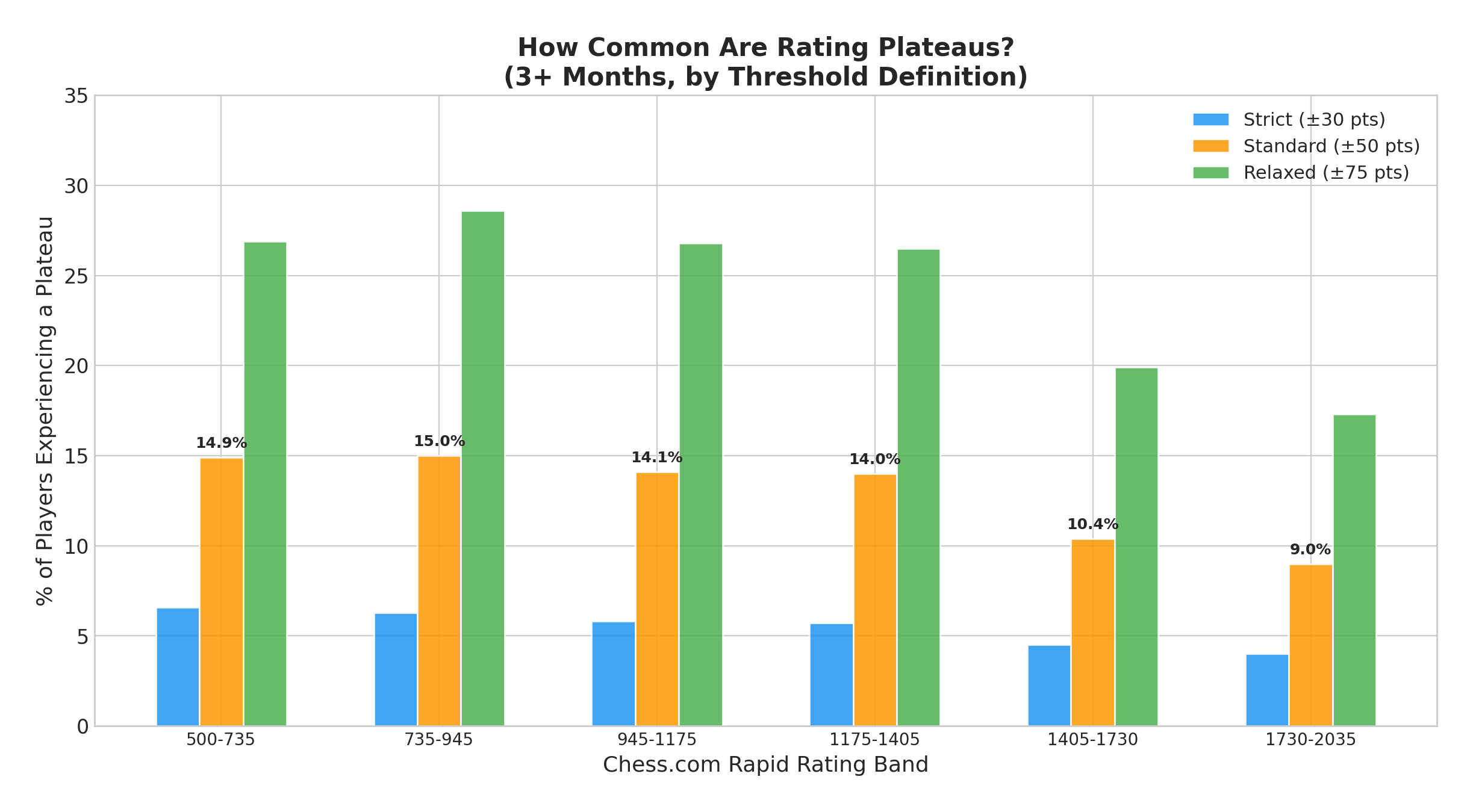
We define a "plateau" as a period where a player's rating fluctuates by no more than ±50 points for at least three consecutive months. When we map these plateaus across different skill levels, two distinct patterns emerge.
First, lower-rated players plateau more frequently. At the 500-800 level, 12.5% of active players are currently stuck in a 3-month plateau. By the time players reach the 1200-1700 bracket, the frequency of plateaus drops to 9.5%.
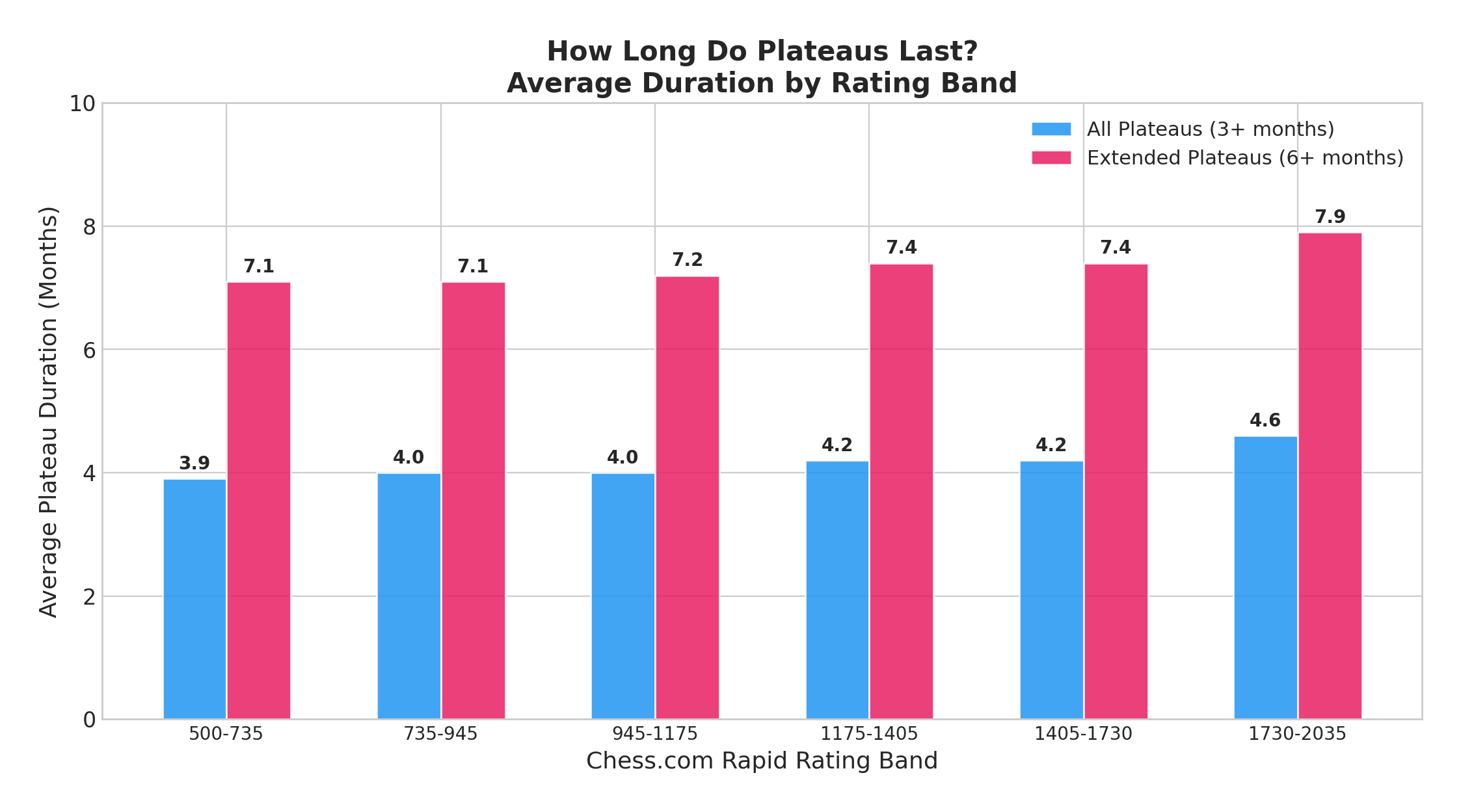
However, the second pattern reveals a harsh reality: while higher-rated players plateau less often, their plateaus last significantly longer.
As the data shows, the average duration of a plateau steadily increases as you climb the rating ladder. A player stuck at 600 can expect their plateau to last about 4.2 months on average. A player stuck at 1500 is looking at an average plateau of 5.2 months.
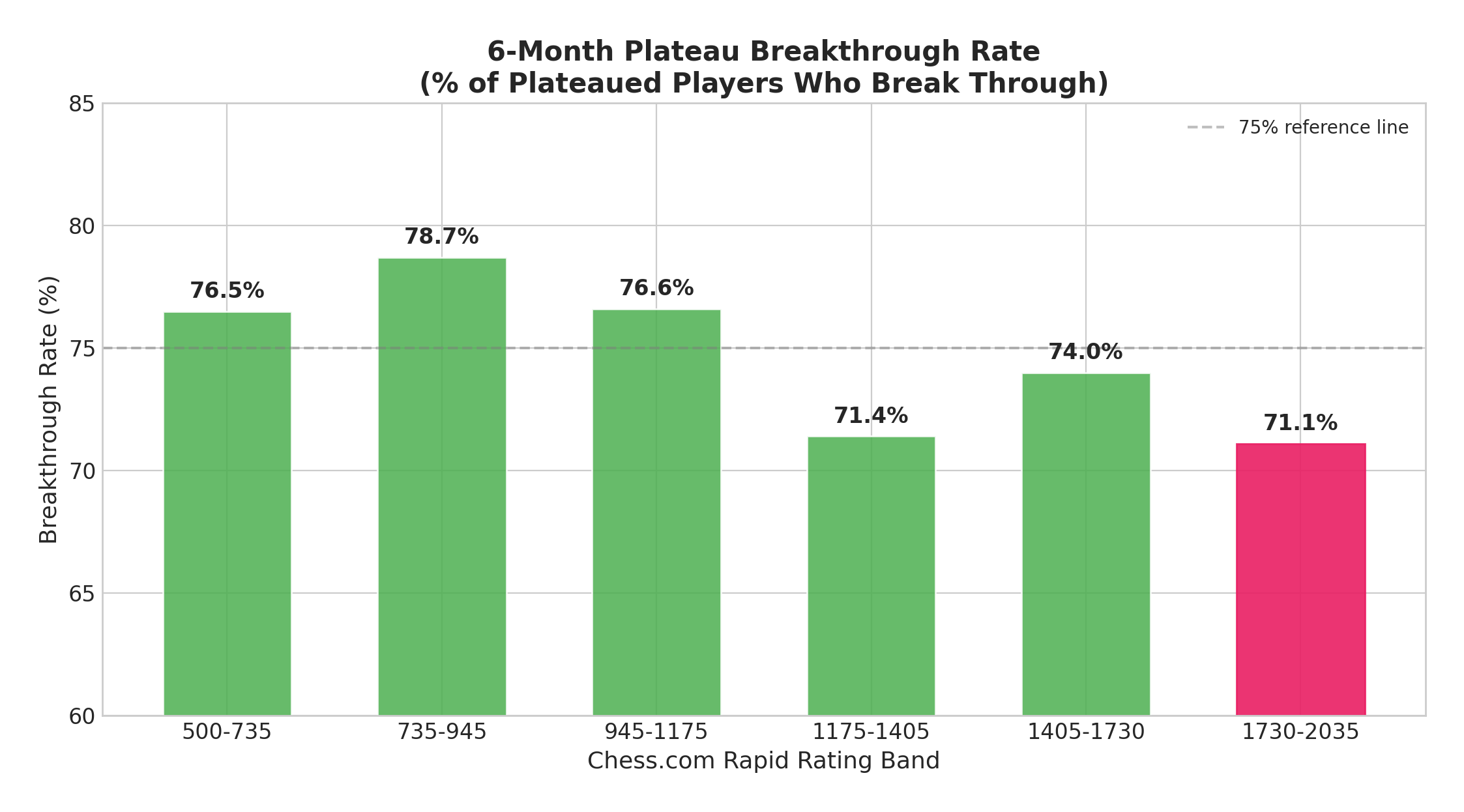
The good news is that plateaus are rarely permanent. When we track players who enter a 3-month plateau and check their status six months later, the majority have successfully broken through. At the 500-1000 level, nearly 74% of players break their plateau within six months. This breakthrough rate gradually declines as the competition gets tougher, dropping to 63.2% for players in the 1500-1700 bracket.
The Progression Timeline: How Long Does It Take?
If you are not plateaued, how fast should you expect to improve? By analyzing the time it takes players to move between specific rating milestones, we can establish a baseline for normal progression.
The journey from 500 to 800 is relatively swift, taking an average of 7 to 8.5 months. The first major hurdle appears between 800 and 1200, where the average progression time jumps to 11.6 months. The climb from 1500 to 1700 is the most grueling stretch in our dataset, requiring an average of 14.4 months of dedicated play.
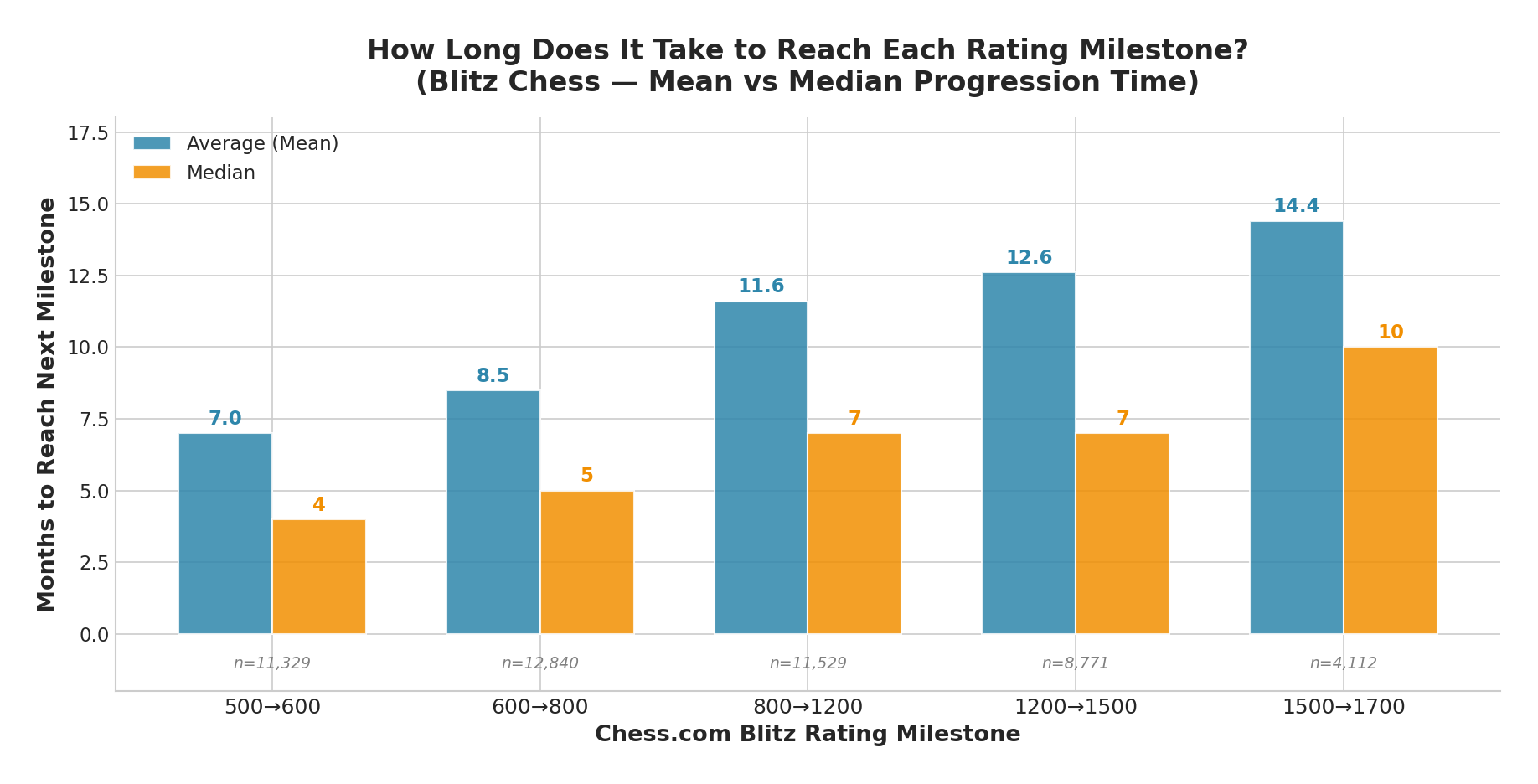
It is worth noting the significant gap between the average (mean) and median progression times. The median times are much lower, indicating that while many players progress quickly, a subset of players gets severely stuck, dragging the average upward.
Breaking the Plateau: Actionable Advice by Rating Band
What separates the players who break through from those who remain stuck? The data points to specific shifts in accuracy, opening choices, and psychological resilience. Here is a roadmap for overcoming the most common plateaus.
The 500-800 Plateau: The Blunder Years
At this level, chess is a game of survival. The average Centipawn Loss (CPL) is over 175, and players average nearly 18 blunders (errors costing 300+ centipawns) per game.
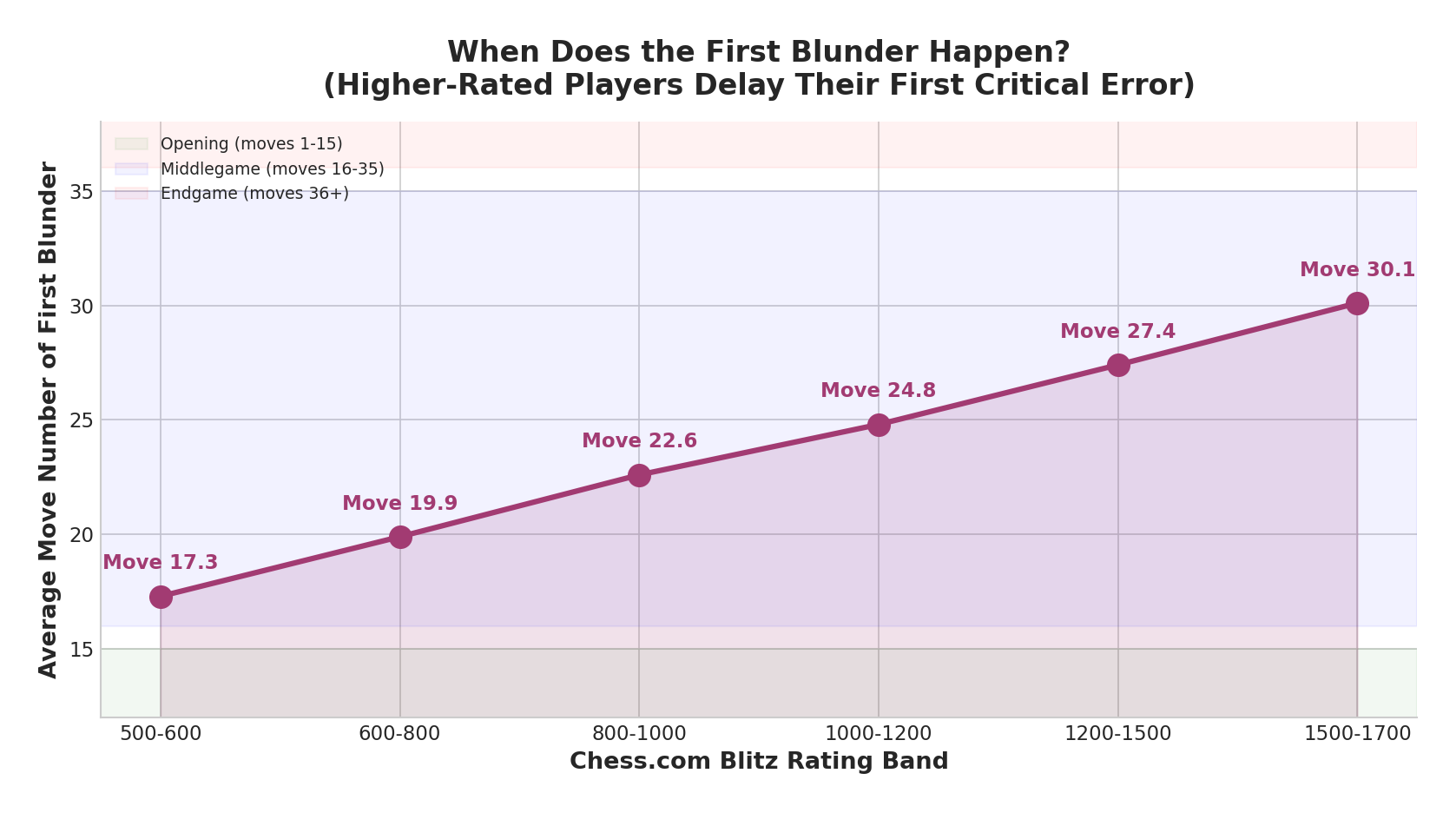
The data reveals that the first major blunder in these games happens incredibly early—around move 17 on average. Furthermore, 19.6% of all opening moves at this level are classified as blunders.
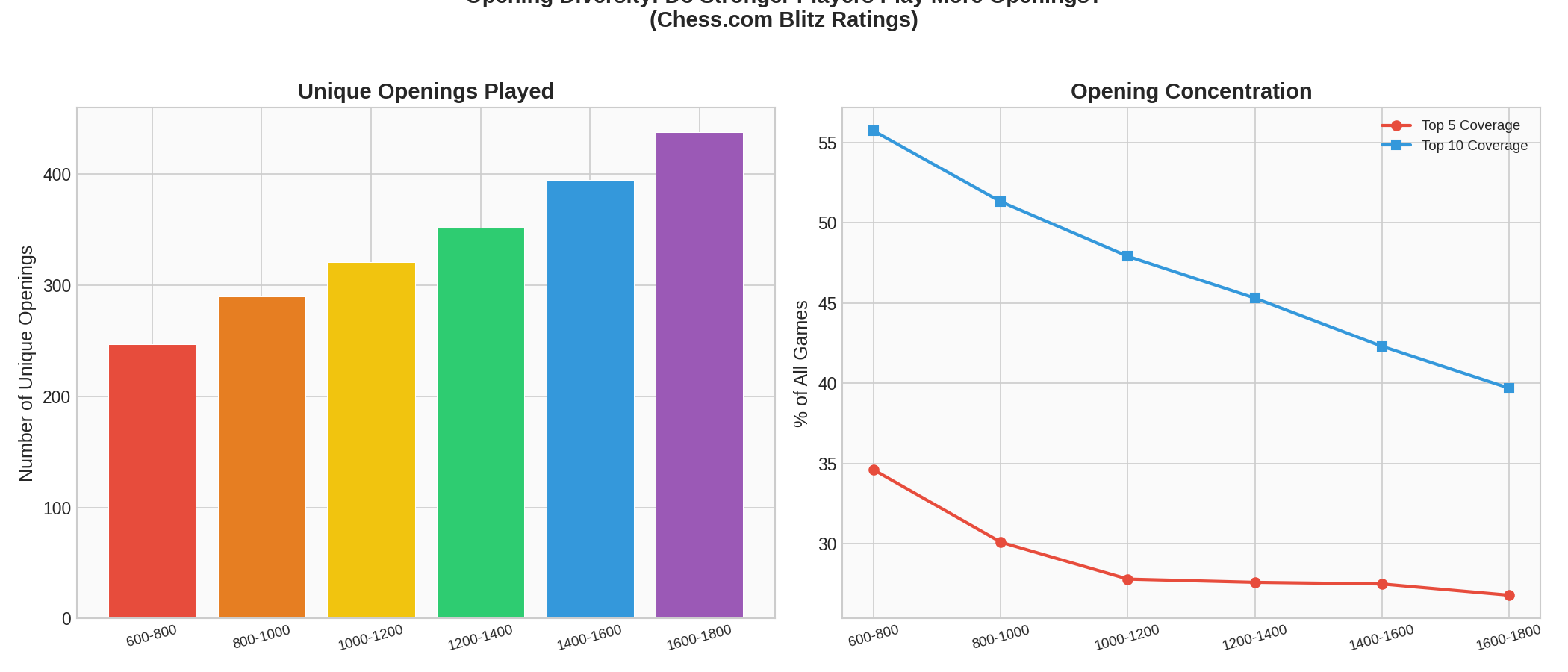
Players at this level also suffer from extreme opening concentration. The Herfindahl-Hirschman Index (HHI) for opening diversity is at its highest, with the top 5 openings accounting for nearly 35% of all games. Players are repeatedly falling into the same early traps.
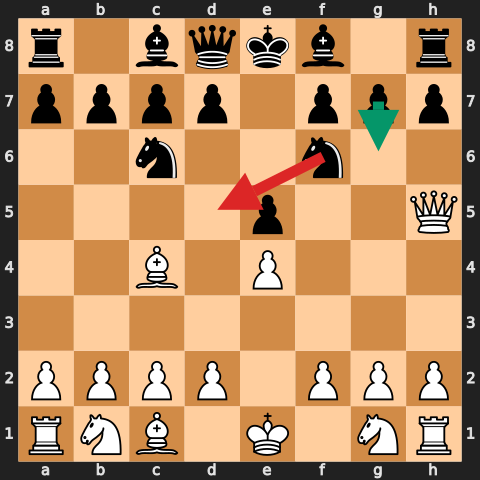 A classic early blunder: Black plays g6, weakening the kingside and allowing the Queen to infiltrate, rather than developing the Knight to f6.
Actionable Advice for 500-800: Do not worry about complex middlegame plans or deep endgame theory. Your primary goal is to survive the first 20 moves without hanging a piece. Focus on fundamental opening principles: control the center, develop your minor pieces, and castle early. Review your games specifically to identify which early moves are costing you material.
The 800-1200 Plateau: The Tactical Ceiling
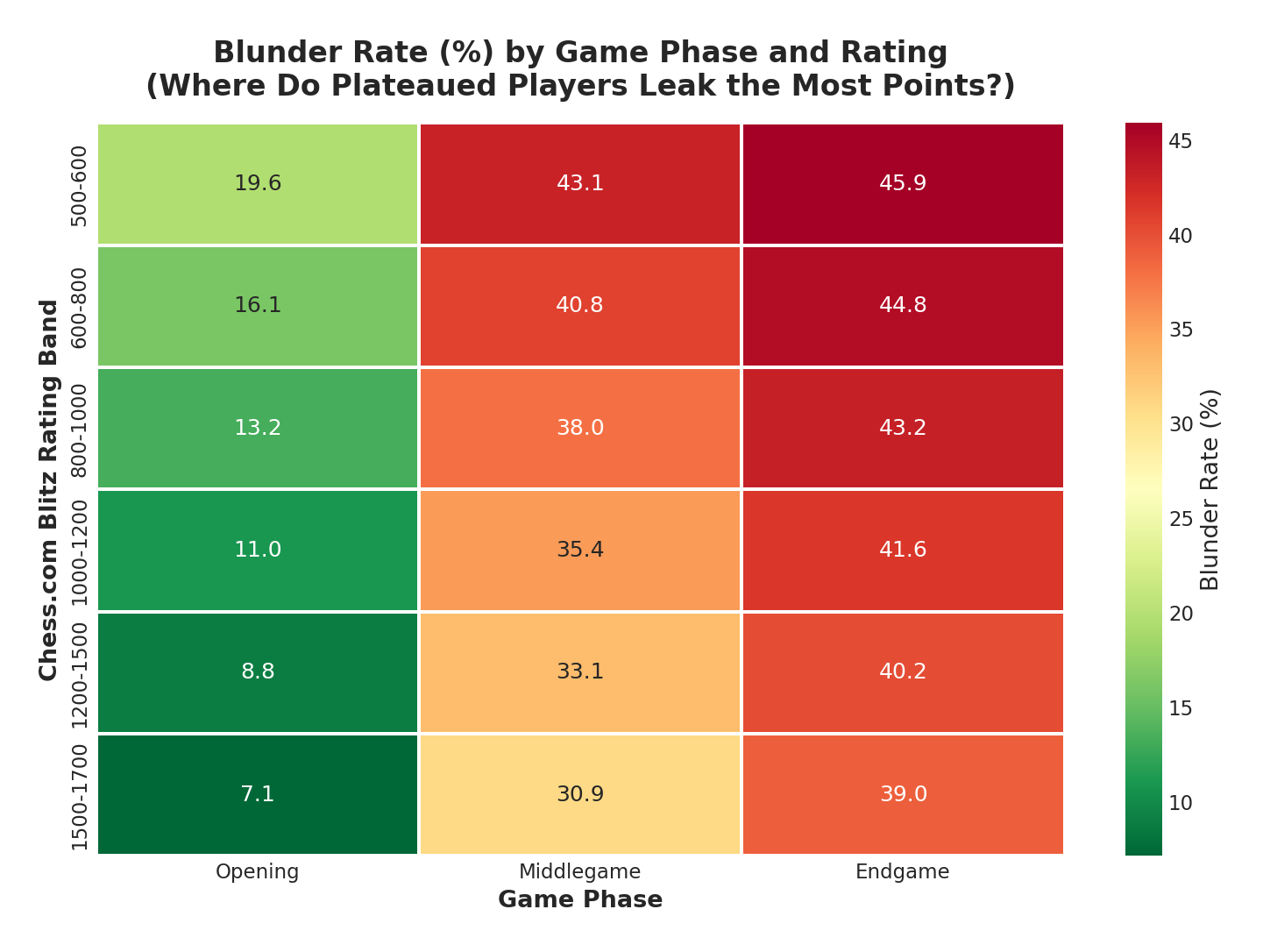
As players cross the 800 mark, opening play improves significantly. The opening blunder rate drops from 16.1% to 11.0%. However, the middlegame becomes a bloodbath.
Our phase accuracy heatmap shows that while players are surviving the opening, they are leaking massive amounts of points in the middlegame, with blunder rates hovering between 35% and 38%.
This is the rating band where basic tactics—pins, forks, skewers, and discovered attacks—decide the outcome of almost every game. Players are developing their pieces reasonably well but failing to spot tactical opportunities or vulnerabilities.
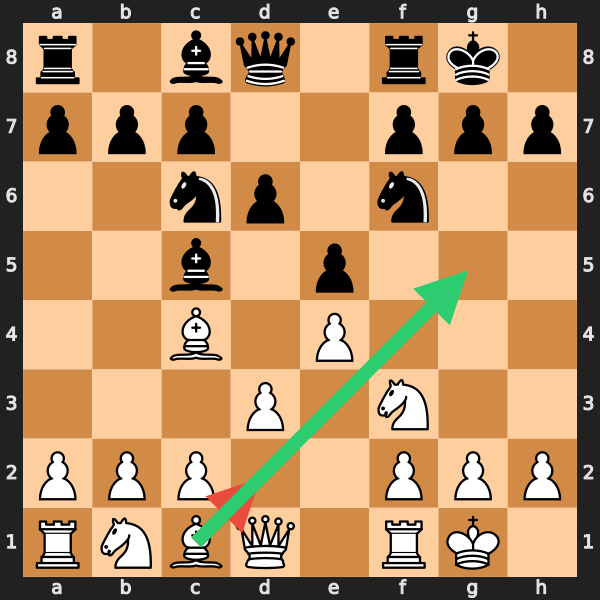 White plays the passive Bd2, missing the opportunity to play Bg5, pinning the Knight and creating immediate pressure.
Actionable Advice for 800-1200: Your plateau is almost certainly tactical. Dedicate a significant portion of your study time to solving tactical puzzles. You need to build pattern recognition so that basic tactical motifs jump out at you during a game. Before making a move, always ask yourself: "Are any of my pieces undefended?" and "Did my opponent's last move leave anything undefended?"
The 1200-1500 Plateau: The Positional Transition
This is where the game changes. The average CPL drops into the 150s, and the first blunder is delayed until move 27. Players are no longer hanging pieces outright; they are making structural and positional errors that slowly degrade their position.
At this level, we see a marked increase in opening diversity. Players are expanding their repertoires, moving away from the most common beginner openings and exploring more nuanced setups.
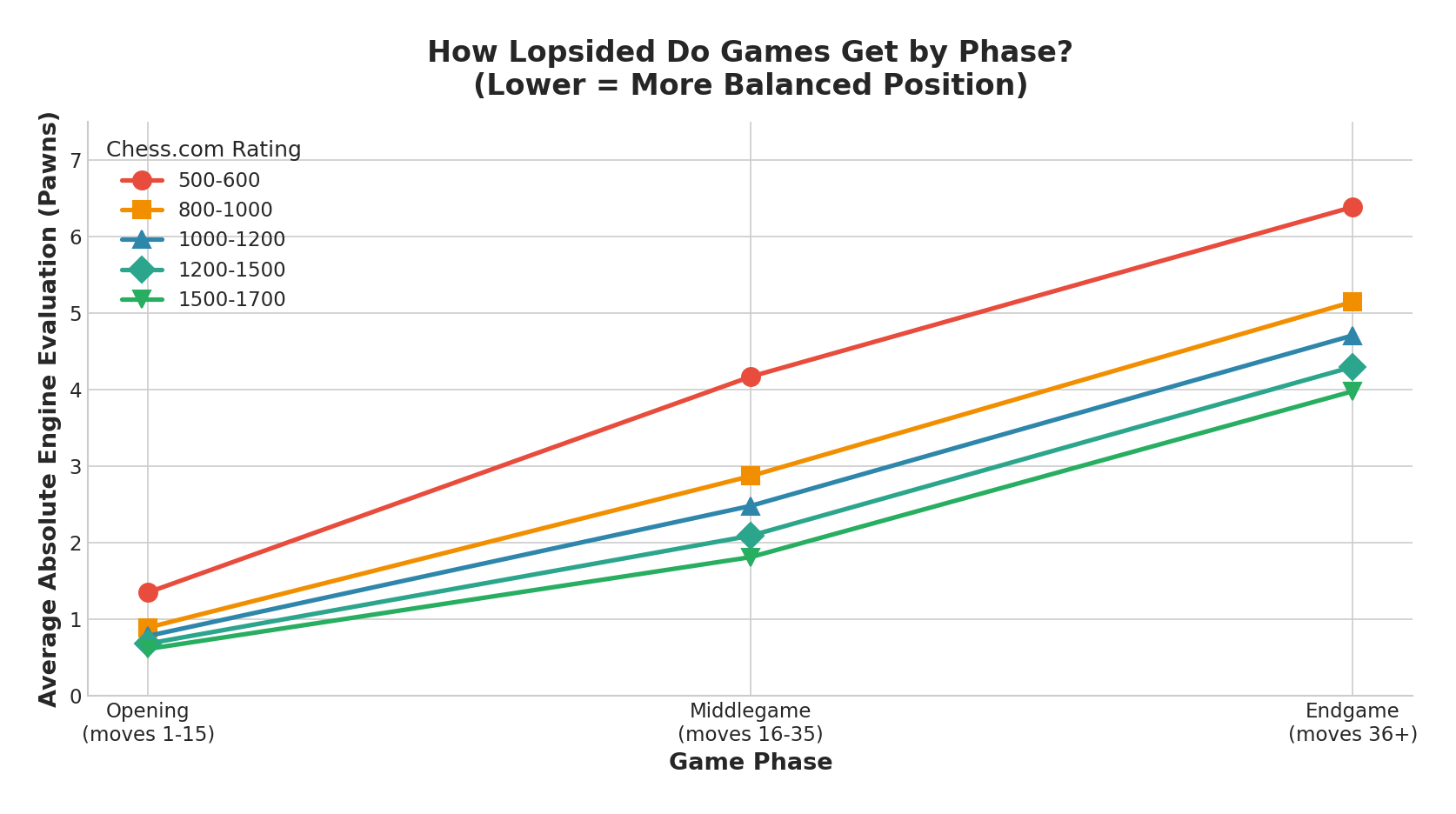
The evaluation trajectory also flattens out. Games remain relatively balanced through the opening and middlegame, meaning that advantages must be squeezed out of smaller inaccuracies rather than capitalized upon from massive blunders.
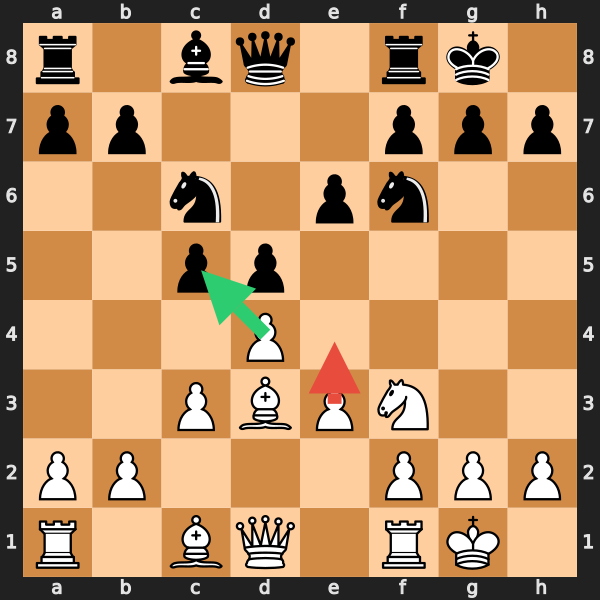 White plays e4, unnecessarily weakening the d4 pawn and creating a long-term structural vulnerability, rather than simplifying favorably with dxc5.
Actionable Advice for 1200-1500: To break this plateau, you must transition from purely tactical thinking to positional understanding. Start studying pawn structures, weak squares, and piece activity. Learn how to formulate a plan when there are no immediate tactical shots available. Expanding your opening repertoire slightly can also expose you to new middlegame structures, broadening your positional understanding.
The 1500-1700 Plateau: The Endgame Grind
Welcome to the hardest plateau to break. Progression slows to a crawl, taking an average of 14.4 months to gain 200 points.
At this level, opening blunders are rare (7.1%), and middlegame play is relatively solid. The critical battleground shifts to the endgame. Despite improvements in other phases, endgame blunder rates remain stubbornly high at 39%. Games are longer, and the margins are razor-thin.
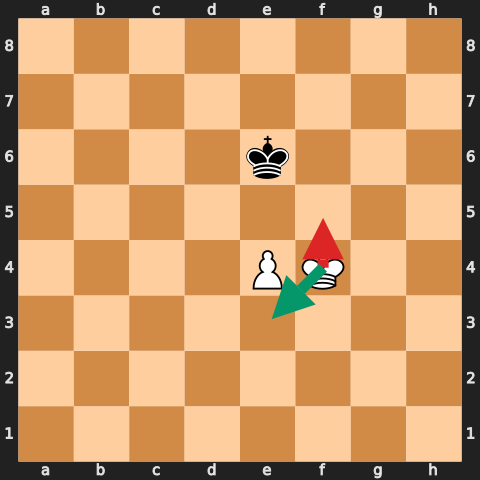 In a delicate King and Pawn endgame, White plays e4, losing the opposition and throwing away the win. Kd4 was required to maintain the advantage.
Actionable Advice for 1500-1700: Your opening knowledge is likely sufficient, and your tactics are sharp. To break this plateau, you must master the endgame. Study theoretical endgames (King and Pawn, Rook and Pawn) and practice converting slight advantages. Furthermore, focus on calculation depth—the ability to accurately visualize lines 3-5 moves deep without moving the pieces.
The Psychology of the Plateau: Practice Volume and Tilt
Beyond technical skills, our data highlights two crucial behavioral factors that influence plateaus: practice volume and emotional control.
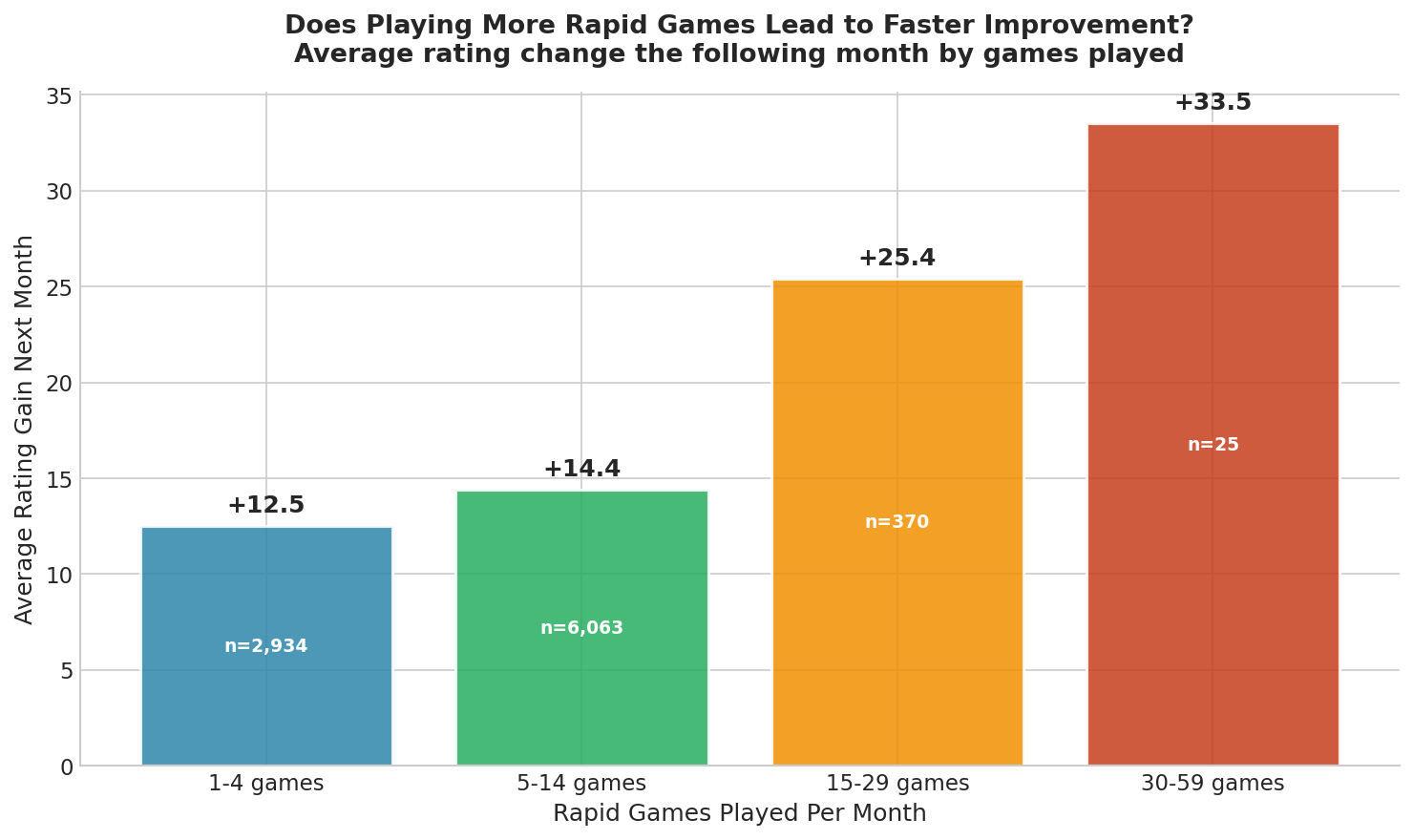
How much should you play? The data suggests a "sweet spot" for improvement. Players who log 15-29 Blitz games per month see the highest average rating increase (+9.2 points). Playing too few games (1-14) results in slower growth, while playing excessively (30-59 games) offers diminishing returns. Quality of play and time spent analyzing games are more important than sheer volume.
Finally, we must address the "Tilt Effect." Chess is psychologically demanding, and consecutive losses severely impact future performance. Across all rating bands, a 5-game losing streak drops a player's expected win rate in the next game to between 39% and 43%—well below the baseline. Conversely, a 5-game winning streak boosts the expected win rate to 54-58%.
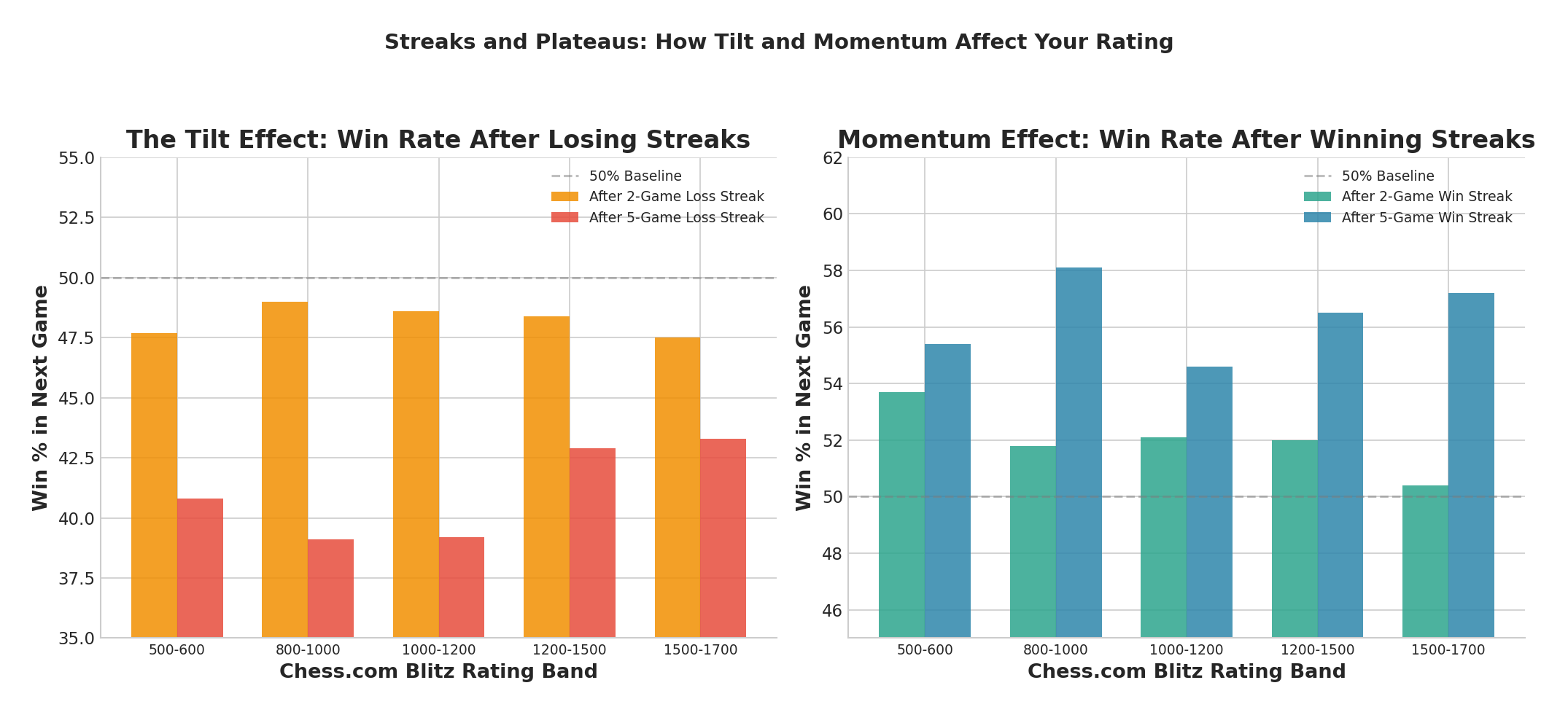
When you are on a losing streak, your Centipawn Loss spikes. You play faster, calculate less, and blunder more. Recognizing tilt and stepping away from the board is perhaps the most immediate, actionable step you can take to protect your rating and shorten your plateau.
Summary: The Plateau Roadmap
Breaking a plateau requires identifying the specific weaknesses holding you back at your current level. Use this roadmap to guide your study and practice.
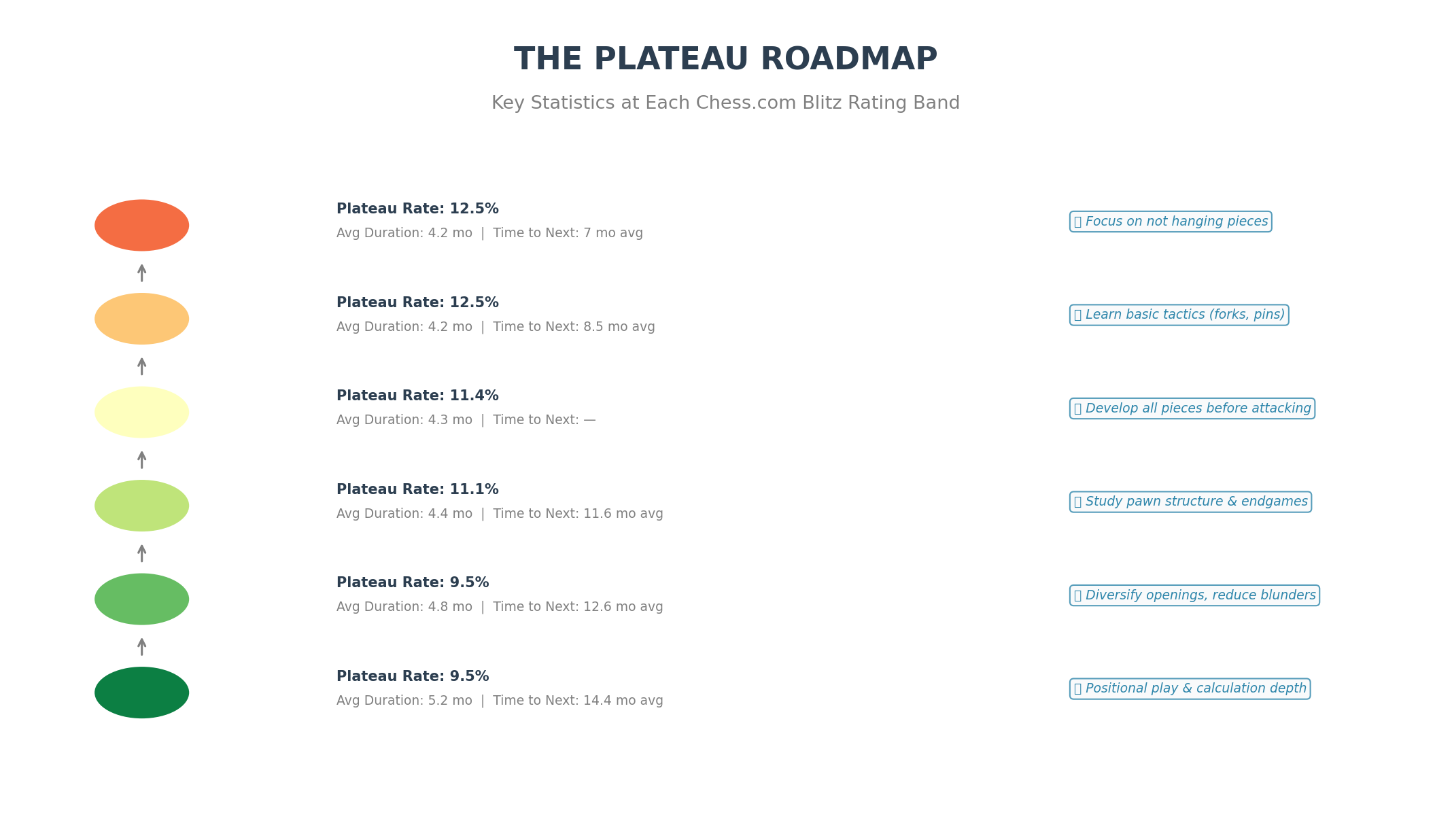
Plateaus are a natural, unavoidable part of chess improvement. They are not a sign that you have reached your absolute limit; they are a sign that your current approach has taken you as far as it can. By understanding the data behind your rating band, you can adjust your strategy, target your weaknesses, and finally break through to the next level.
Chess Coach April 15, 2026
Data and Methodology
This analysis is based on a dataset of ~950,000 Lichess Blitz games and the longitudinal rating histories of ~124,000 players. Engine evaluations (Centipawn Loss, blunders) were calculated using Stockfish 17.
To make the findings applicable to the widest possible audience, Lichess ratings were mapped to approximate Chess.com Blitz ratings using established community conversion models.
The underlying aggregated data used to generate the charts and insights in this article is available in the attached CSV files:
plateau_3mo.csv,plateau_4mo.csv,plateau_6mo.csv: Plateau frequency and duration data.progression.csv: Time to progress between rating milestones.practice_volume.csv: Correlation between games played and rating change.opening_diversity.csv: Repertoire concentration metrics.streak_effects.csv: Win rates following winning and losing streaks.cpl_by_rating.csv: Average Centipawn Loss and blunder rates.phase_accuracy.csv: Blunder rates broken down by game phase.eval_trajectory.csv: Average engine evaluation by game phase.blunder_timing.csv: Average move number of the first major blunder.game_length.csv: Average game length and termination statistics.