By Chess Coach April 15, 2026
When you start taking chess seriously, the expectation is simple: you study, you play, and your rating goes up. The line on your profile graph should look like a staircase leading to mastery. However, the reality of chess improvement is far more chaotic. It is a journey defined by sudden spikes, agonizing plateaus, and brutal regressions.
To understand what real chess improvement looks like, we analyzed over 320,000 data points from 825 Lichess Blitz player histories, supplemented by aggregate data from nearly 80,000 players via the Lichess API. We mapped these trajectories to their Chess.com equivalents to create a comprehensive roadmap for players navigating the 800 to 1500 rating range.
The data reveals a comforting truth: if your rating graph looks like a rollercoaster, you are not doing something wrong. You are simply experiencing the normal trajectory of a chess player.
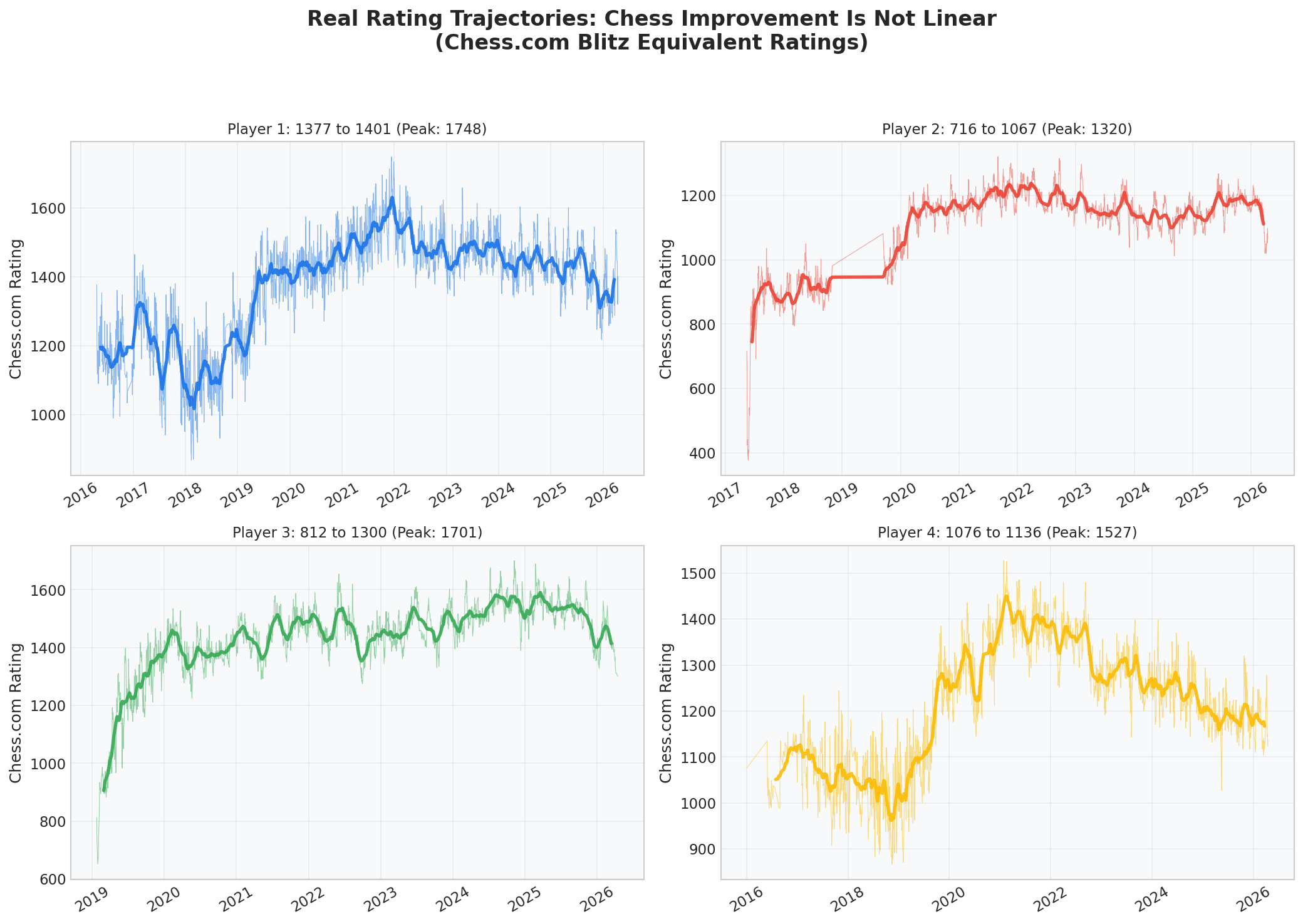
The Myth of the Steady Climb
Our analysis classified player trajectories into several distinct patterns. The "Steady Climb"—the smooth, upward curve most players expect—is actually quite rare. Instead, the vast majority of players experience what we call a "Volatile Climb" or a "Stable Plateau."
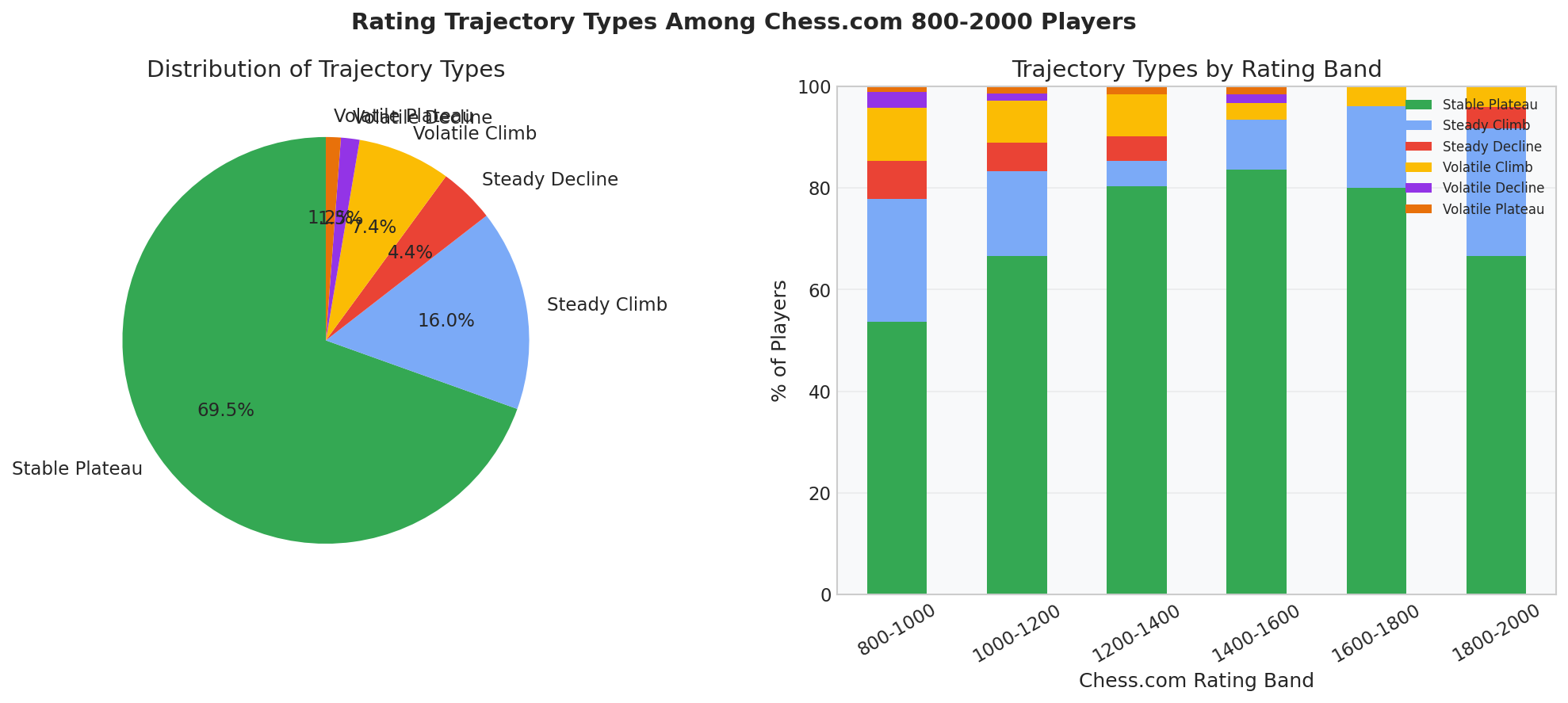
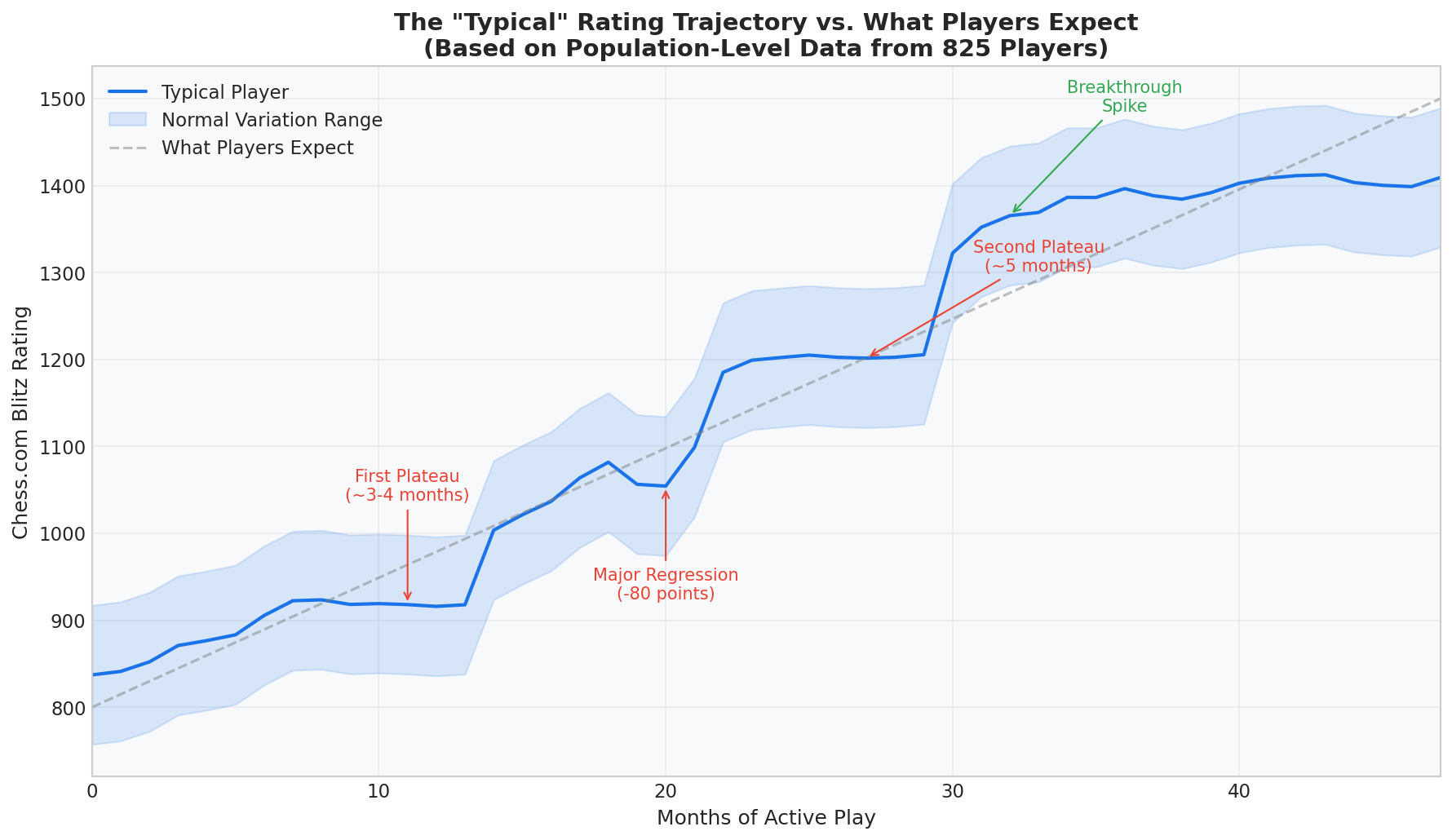
The typical player's journey from 800 to 1500 is characterized by long periods of stagnation punctuated by sudden breakthroughs, often followed by significant pullbacks. Understanding this pattern is the first step to managing the psychological toll of competitive chess.
The Reality of Regressions
Perhaps the most striking finding from our data is the sheer ubiquity of major rating drops. Among the players analyzed, a staggering 90.4% experienced at least one regression of 100 points or more during their chess journey.
These drops are not signs of lost skill; they are a normal part of the learning process. When you incorporate new concepts into your play—such as a new opening or a different strategic approach—your performance often dips before it improves. This is the "two steps forward, one step back" reality of chess.
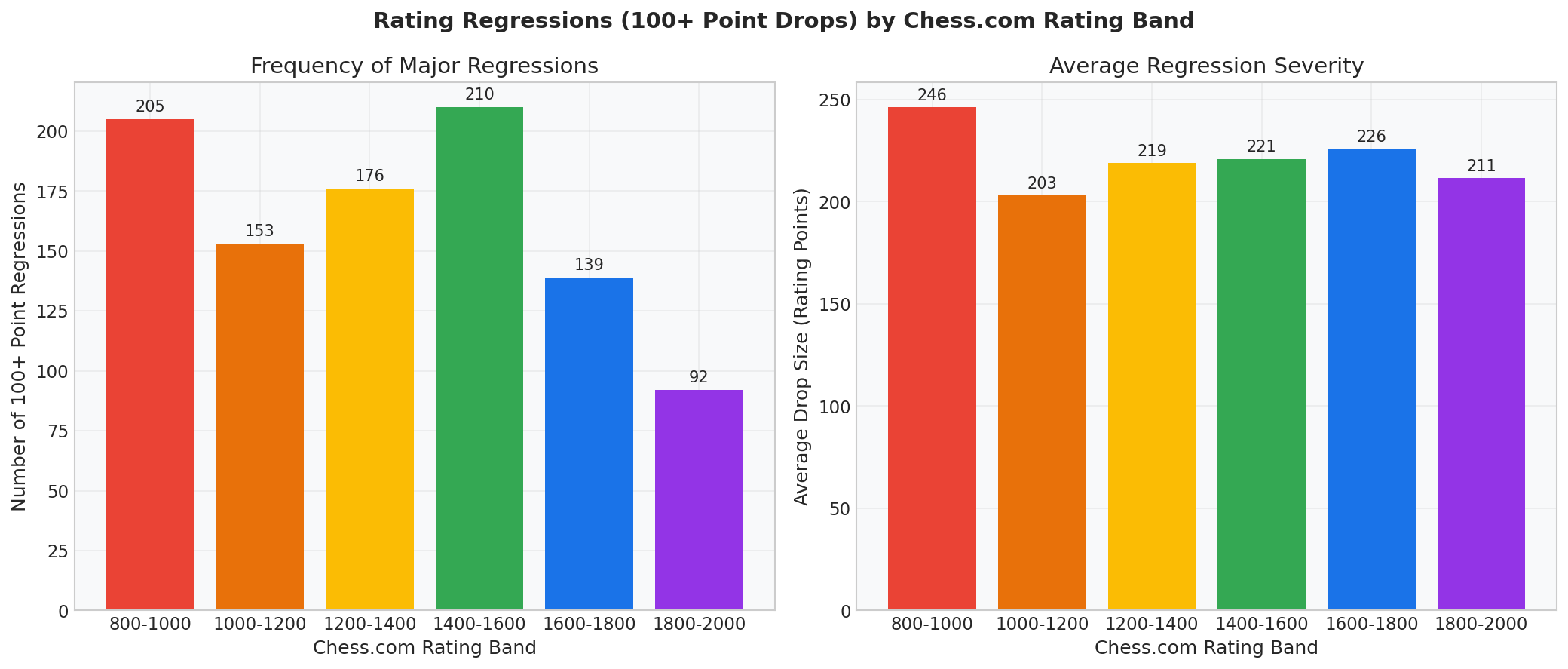
The severity of these regressions varies by rating band. Players in the 800-1000 range experience the largest average drops, often losing over 240 points during a severe slump. As players improve, the average drop size decreases, but the frequency of regressions remains high.
The Tilt Effect
A major driver of these regressions is "tilt"—the emotional response to losing that negatively impacts subsequent performance. Our analysis of streak effects shows a clear correlation between losing streaks and a decreased win probability in the next game.
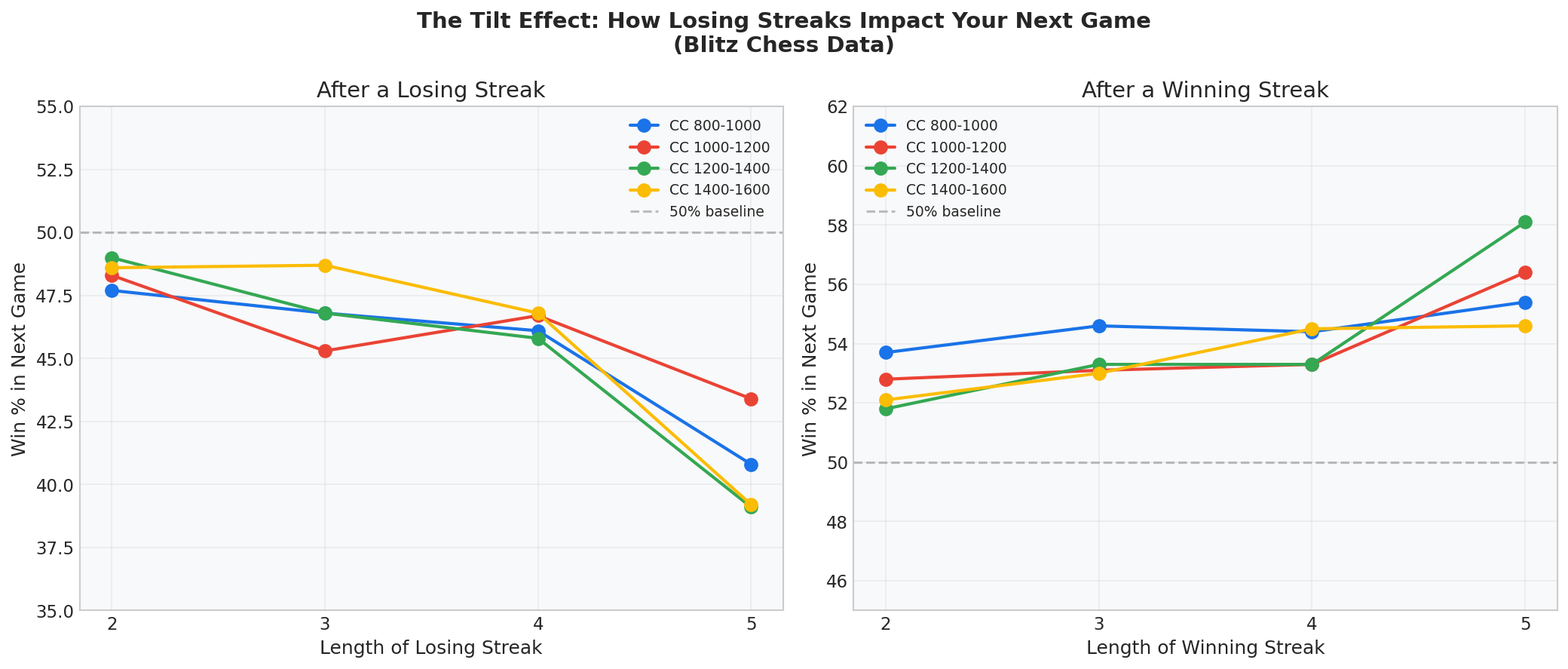
For players in the 1200-1400 range, a five-game losing streak drops their expected win rate in the next game to just 39.1%. Conversely, a five-game winning streak boosts their expected win rate to 58.1%. The data strongly supports the common advice: if you lose three games in a row, it is time to take a break.
The Anatomy of a Breakthrough
While regressions are common, so are sudden spikes in rating. We identified nearly 40,000 instances where players gained 100 or more points within a 30-day window. These breakthroughs typically occur after a long plateau, representing the moment when accumulated knowledge finally translates into board vision and execution.
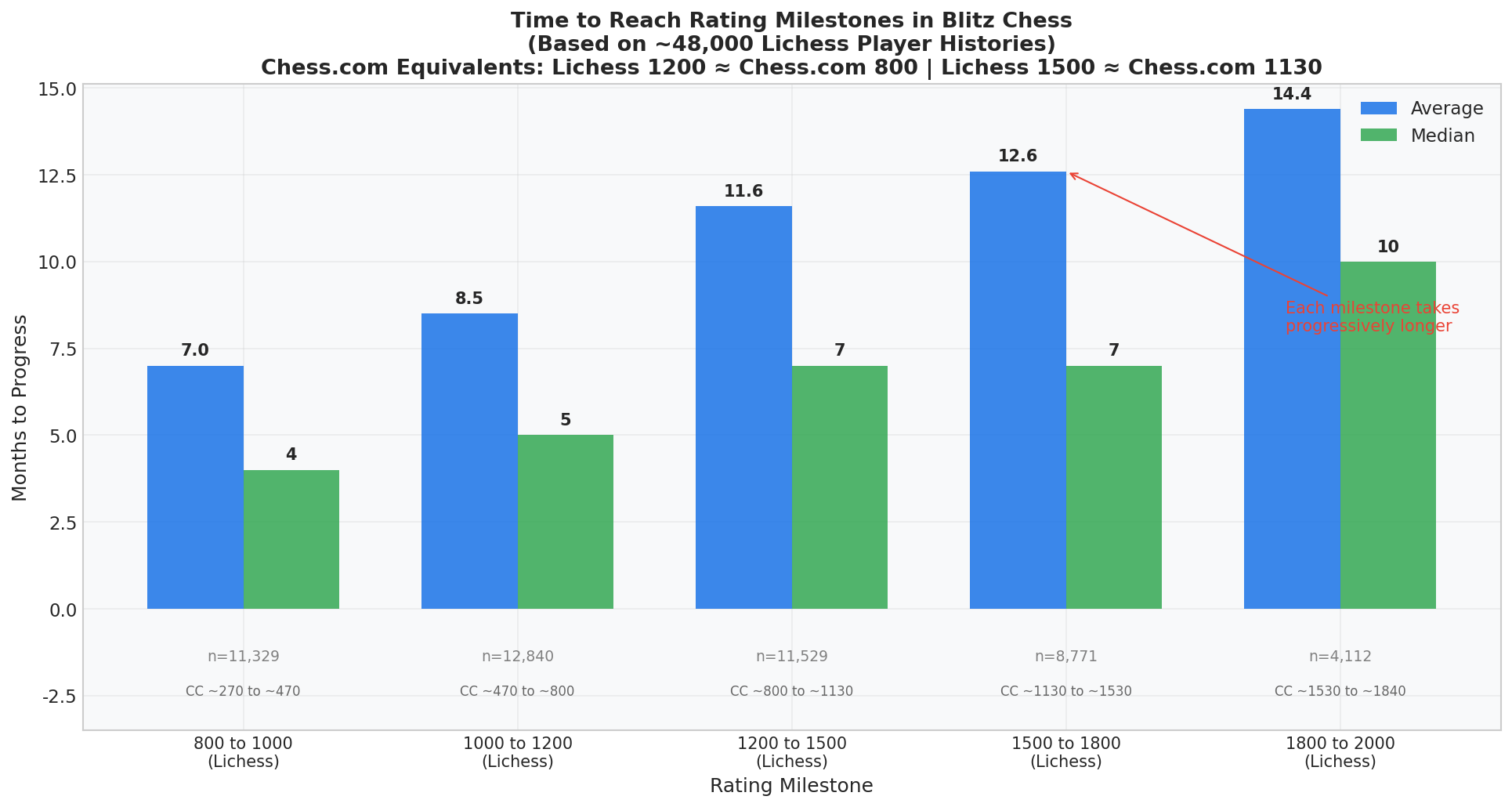
The time required to reach each new milestone increases progressively. Progressing from 800 to 1000 takes an average of 7 months, while moving from 1200 to 1500 takes nearly a year. Patience is not just a virtue in chess; it is a statistical necessity.
Roadmap to 1500: Actionable Advice by Rating Band
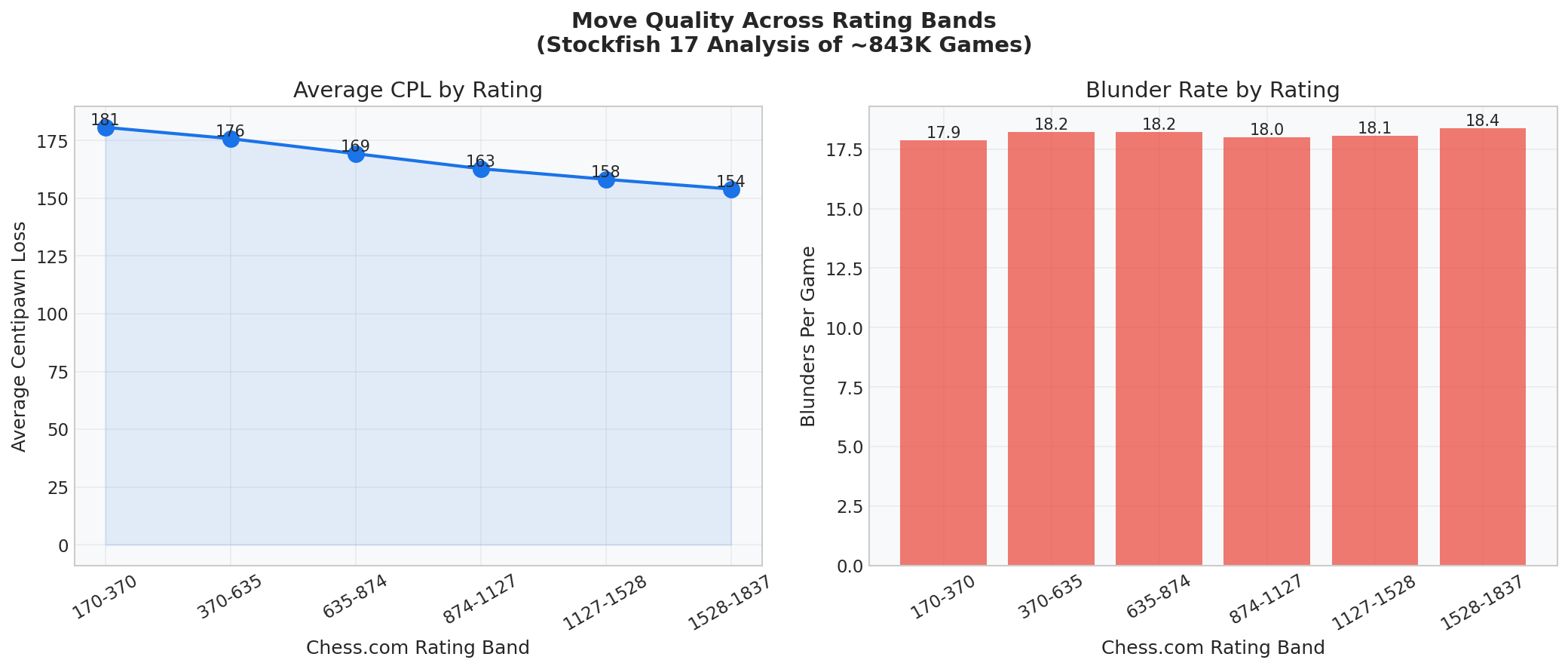
Based on our analysis of move quality (Centipawn Loss) and blunder rates, we have developed a data-driven roadmap for players at each stage of the journey.
The 800-1000 Range: Taming the Chaos
In this band (roughly equivalent to Lichess 1200-1420), the games are highly volatile. The average Centipawn Loss is high, and games are frequently decided by one-move blunders.
The Data Says: Players in this range experience the highest daily rating variance and the most severe regressions. The primary differentiator between an 800 and a 1000 player is not strategic depth, but board vision.
Actionable Advice:
- Prioritize Board Vision: Before every move, ask yourself, "Is my piece safe here?" and "Did my opponent just hang a piece?"
- Embrace the Swings: Expect your rating to fluctuate wildly. A 150-point drop does not mean you are getting worse; it is simply the statistical noise of this rating band.
- Focus on Tactics: Spend 80% of your study time on basic tactical motifs: pins, forks, and skewers.
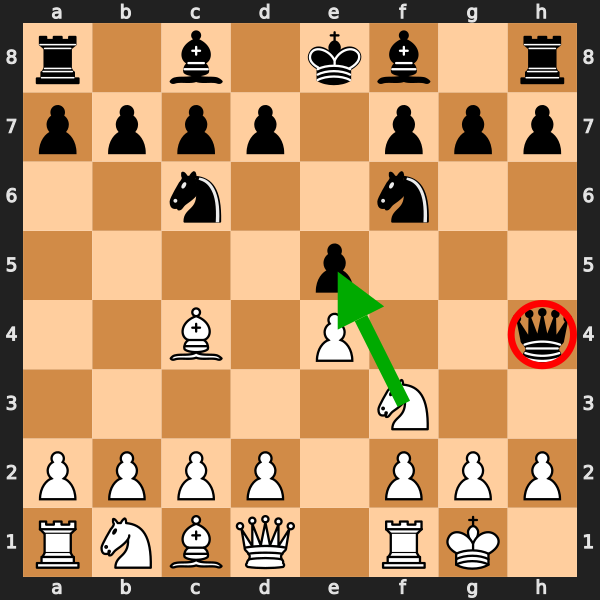 A typical blunder in this range: Black plays Qh4, exposing the queen to a discovered attack when White plays Nxe5.
The 1000-1200 Range: Building Consistency
As you cross the 1000 mark (Lichess ~1420), the frequency of outright piece blunders decreases, but players still struggle with consistency and basic endgame technique.
The Data Says: This is where players experience their first major plateaus, averaging 4.2 months of stagnation. The blunder rate remains relatively high, but the nature of the blunders shifts from hanging pieces to missing simple tactical sequences.
Actionable Advice:
- Master Basic Endgames: Learn how to checkmate with a King and Queen, and a King and Rook. Understand the rule of the square for pawn endgames.
- Develop a Repertoire: Choose one reliable opening for White and two for Black (one against e4, one against d4). Stick with them to build pattern recognition.
- Check for Threats: Develop a habit of identifying your opponent's most dangerous threat before formulating your own plan.
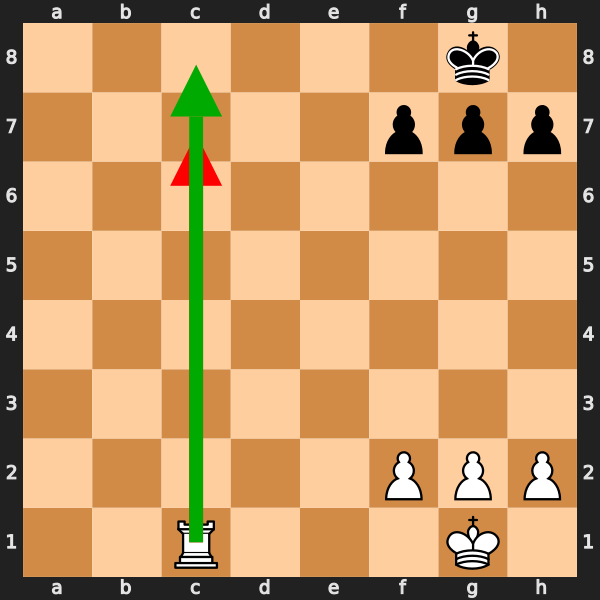 A common missed opportunity: White plays Rc7 instead of the immediate Rc8# checkmate.
The 1200-1400 Range: The Tactical Crucible
In this band (Lichess ~1565-1705), players have a solid grasp of the rules and basic tactics. Games are often decided by multi-move tactical sequences and positional errors.
The Data Says: Players here are highly susceptible to tilt. A losing streak in this band has the most devastating impact on subsequent win probability compared to any other group.
Actionable Advice:
- Implement a Tilt Protocol: Set a hard limit on consecutive losses. If you lose three games in a row, stop playing rated games for the day.
- Deepen Tactical Study: Move beyond basic motifs and practice calculating 2-3 moves deep. Focus on forcing moves: checks, captures, and threats.
- Analyze Your Games: You can no longer rely solely on playing more games to improve. You must analyze your losses to identify recurring patterns of error.
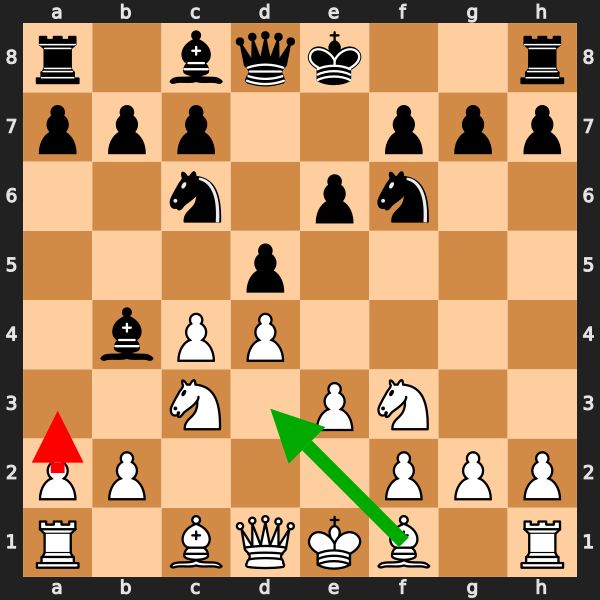 A classic tilt blunder: White hastily plays a3, completely missing that the c3 knight is hanging to the bishop on b4.
The 1400-1500 Range: The Positional Transition
Approaching 1500 (Lichess ~1705-1780), the game begins to shift. Tactical blunders still occur, but they are often the result of poor positional play that allows the opponent to create overwhelming pressure.
The Data Says: The time required to progress through this band increases significantly. Plateaus here average 4.4 months, and the daily rating variance tightens, meaning you have to grind harder for every point.
Actionable Advice:
- Study Pawn Structures: Understand how pawn chains dictate the flow of the game, where your pieces belong, and where the breaks are.
- Improve Piece Activity: Focus on placing your pieces on active squares where they control the center and restrict your opponent's options.
- Patience in the Middlegame: Learn to improve your position incrementally when there are no immediate tactical shots available.
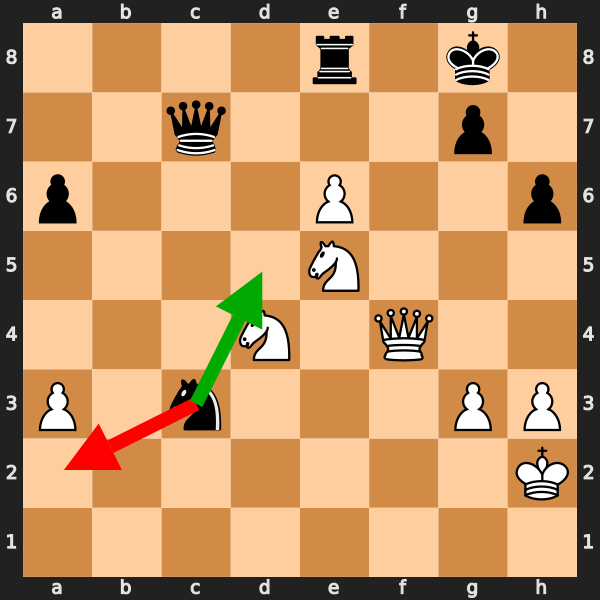 A breakthrough moment: Black finds the crushing Nd5 fork, demonstrating the tactical sharpness required to push past 1400.
Conclusion
Chess improvement is a messy, non-linear process. The data clearly shows that regressions, plateaus, and wild variance are not anomalies; they are the standard experience of the improving chess player.
By understanding these statistical realities, you can reframe your relationship with your rating. A 100-point drop is not a failure; it is a normal fluctuation. A four-month plateau is not the end of your potential; it is the consolidation phase before your next breakthrough.
Keep studying, manage your tilt, and trust the process. The staircase may be jagged, but it still leads upward.
Data and Methodology
This analysis was conducted using a combination of detailed player histories and aggregate statistics.
- Player Histories: We collected and analyzed the complete Blitz rating histories of 825 Lichess players, comprising over 320,000 individual data points. This dataset allowed us to track individual trajectories, regressions, and spikes over time.
- Aggregate Statistics: We utilized the Lichess API via the Grandmaster Guide MCP to gather aggregate data on plateaus, progression times, streak effects, and move quality (Centipawn Loss) from a sample of nearly 80,000 players and over 840,000 games.
- Rating Conversion: Because the primary data source was Lichess, we applied a conversion mapping to approximate Chess.com Blitz ratings for the article's narrative and visualizations. The mapping aligns Lichess 1200 with Chess.com 800, scaling up to Lichess 1780 for Chess.com 1500.
Underlying Data Files:
- Regressions by Band
- Spikes by Band
- Variance by Band
- Plateaus by Band
- Trajectory Types
- Recovery Times
- Monthly Changes
- Milestones
- Daily Changes
Chess Coach April 15, 2026