If you've ever felt frustrated by a sudden 100-point rating drop, or wondered why you've been stuck at the same rating for months despite playing every day, you are not alone. The journey to chess mastery is often depicted as a smooth, upward curve. However, an analysis of hundreds of thousands of Rapid games reveals a very different reality.
By examining the rating histories and game data of players across various skill levels, we can map the true anatomy of chess improvement. This guide breaks down what actually happens as players climb from 800 to 1500 (Chess.com Rapid ratings), highlighting the spikes, plateaus, and regressions that define the path to mastery.
(Note: The data in this study is sourced from Lichess Rapid games. To make the insights immediately applicable, all ratings discussed below have been converted to their approximate Chess.com Rapid equivalents, which typically run 200-300 points lower in this range.)
The Myth of the Smooth Climb
When we look at the rating trajectories of 341 real players, a striking pattern emerges: the "Steady Climber" is just one of many paths, and it's rarely as smooth as it seems.
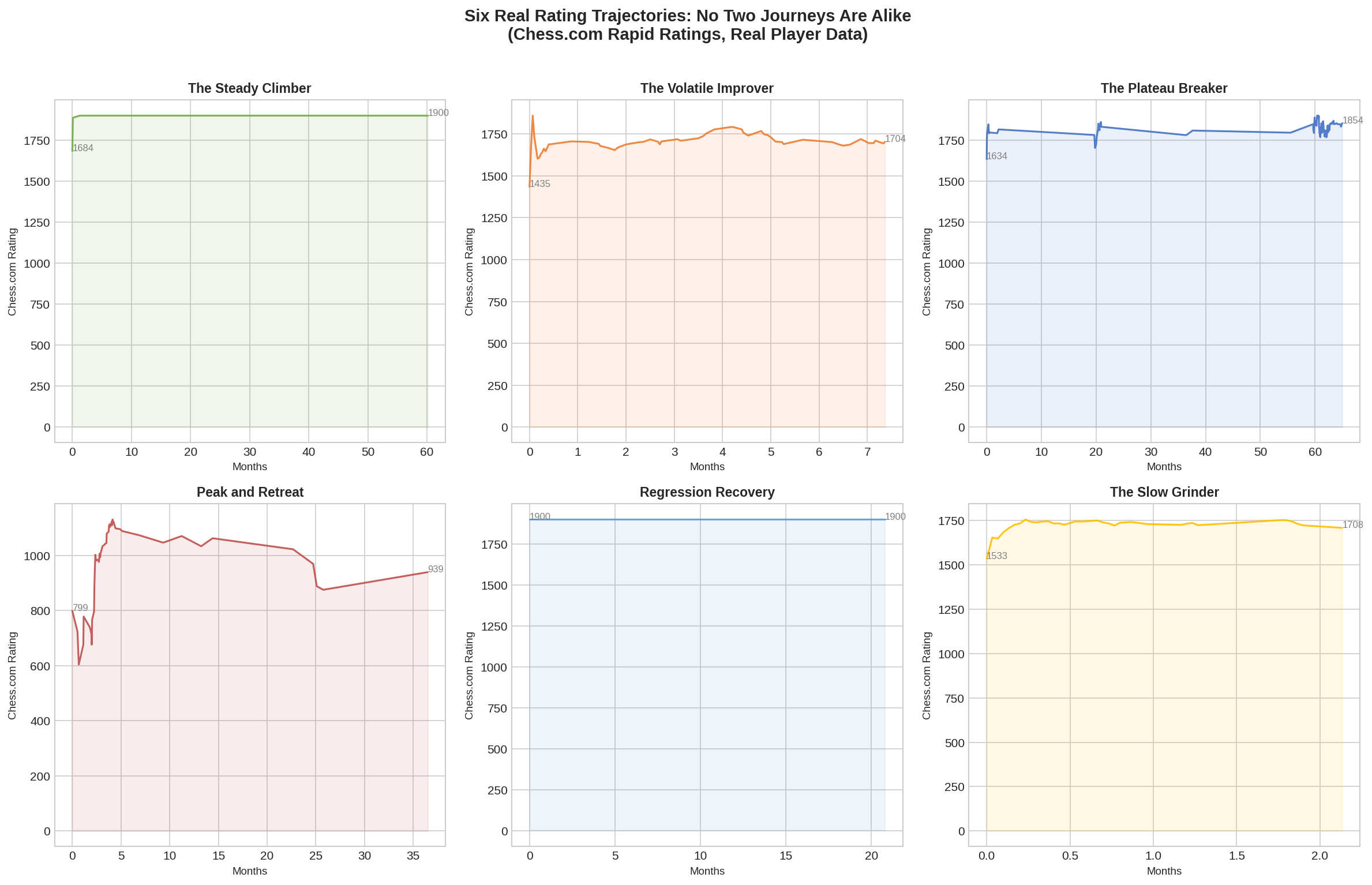
Our classification of player histories shows that nearly 55% of players experience significant volatility, long plateaus, or major regressions during their chess journey. The idea that you will gain a few points every week is a statistical anomaly. Instead, improvement happens in fits and starts.
How Long Does It Actually Take?
The data shows that the time required to reach the next milestone increases significantly as you climb the rating ladder.
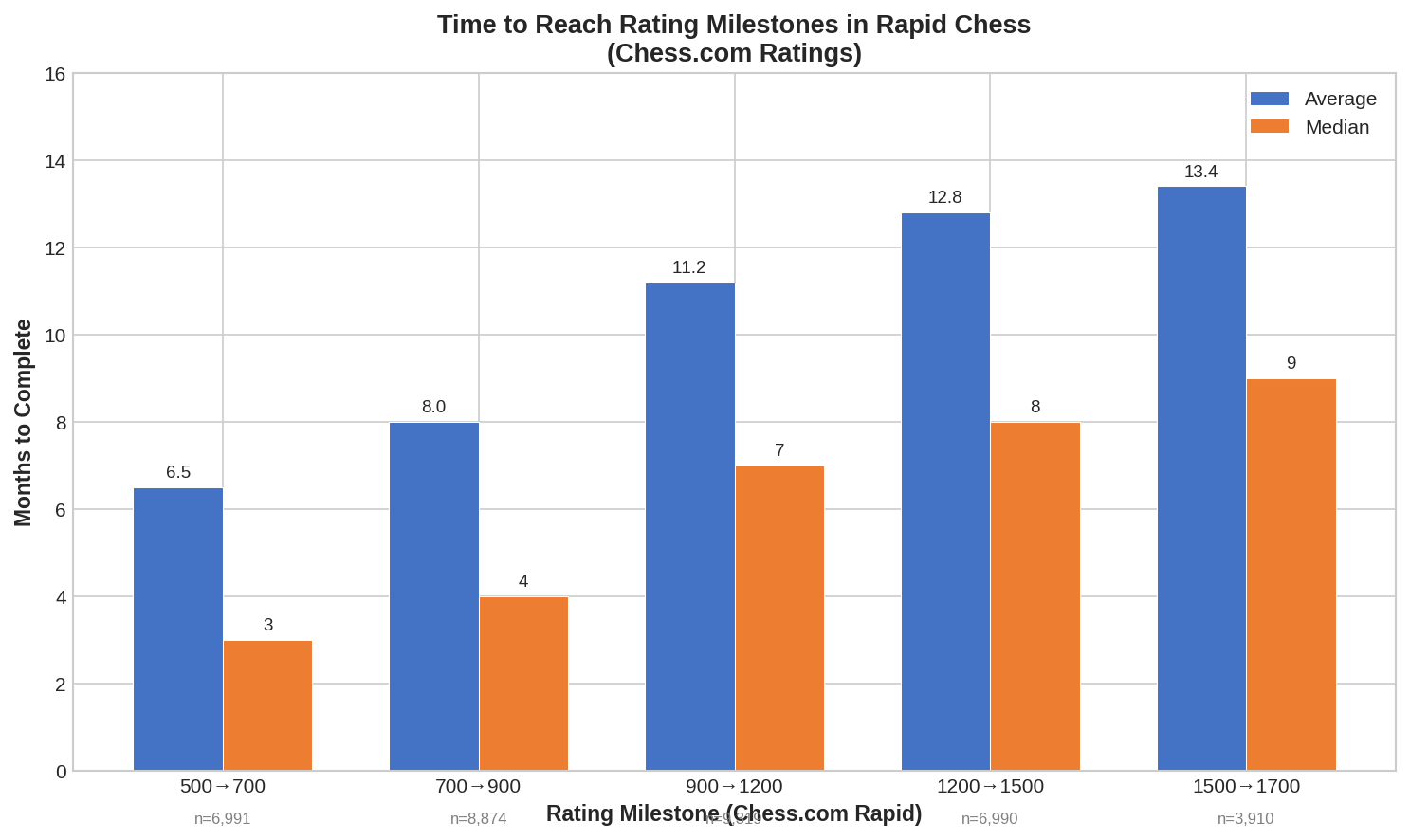
Moving from 500 to 700 takes the average player about 6.5 months, but the jump from 1200 to 1500 takes nearly a year (11.2 months). The median times are shorter, indicating that while some players progress quickly, a long tail of players takes much longer to break through.
The Anatomy of a Rating Spike
Improvement in chess rarely happens gradually. Instead, players typically experience "rating spikes"—sudden jumps in rating over a short period, usually following a breakthrough in understanding or the adoption of a new opening repertoire.
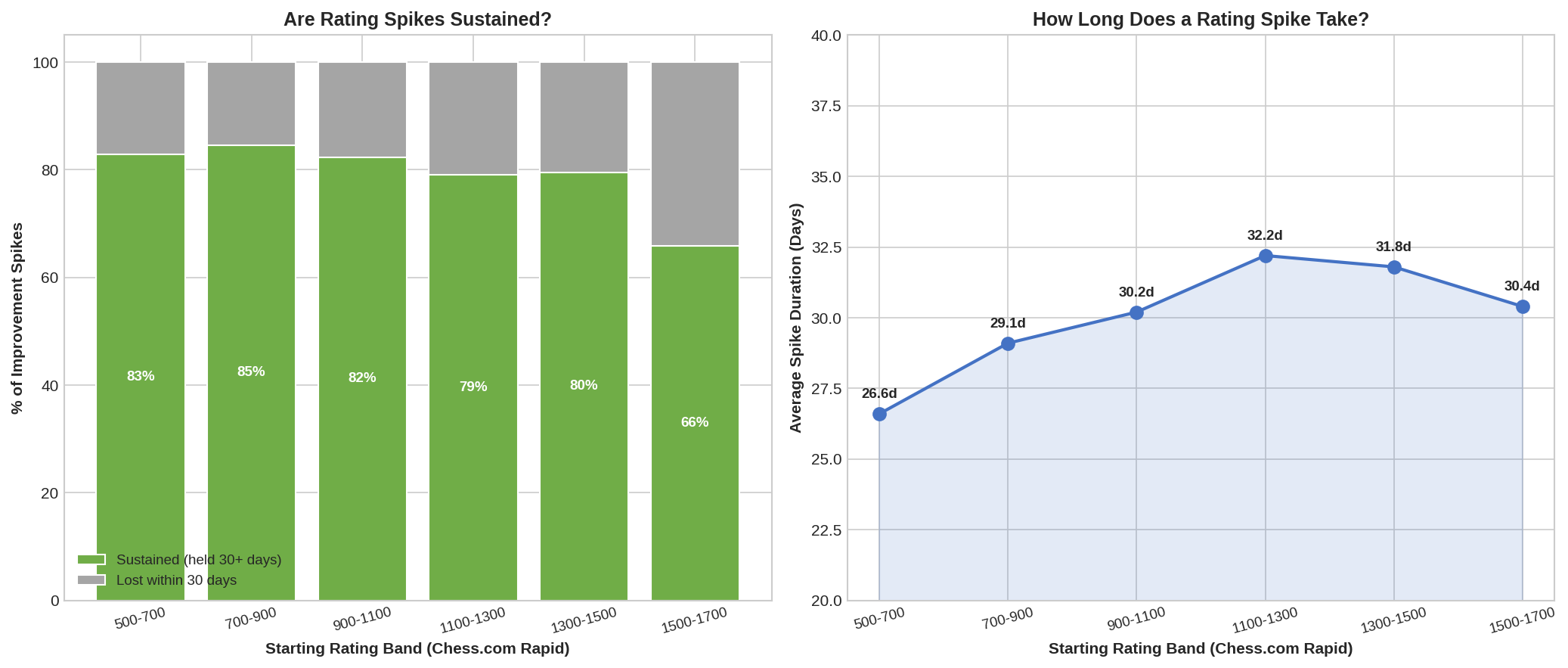
Across all rating bands, the average spike is remarkably consistent: a gain of about 110-115 points over a 30-day period. However, the critical question is whether these spikes are sustained.
The data reveals that roughly 80% of these spikes are sustained (meaning the player remains within 50 points of their new peak 30 days later). This suggests that when you experience a sudden rating jump, it usually represents a genuine increase in skill rather than just a lucky streak.
The Inevitability of Regressions
Perhaps the most comforting finding in the data is just how common massive rating drops are, even among players who are overall improving.
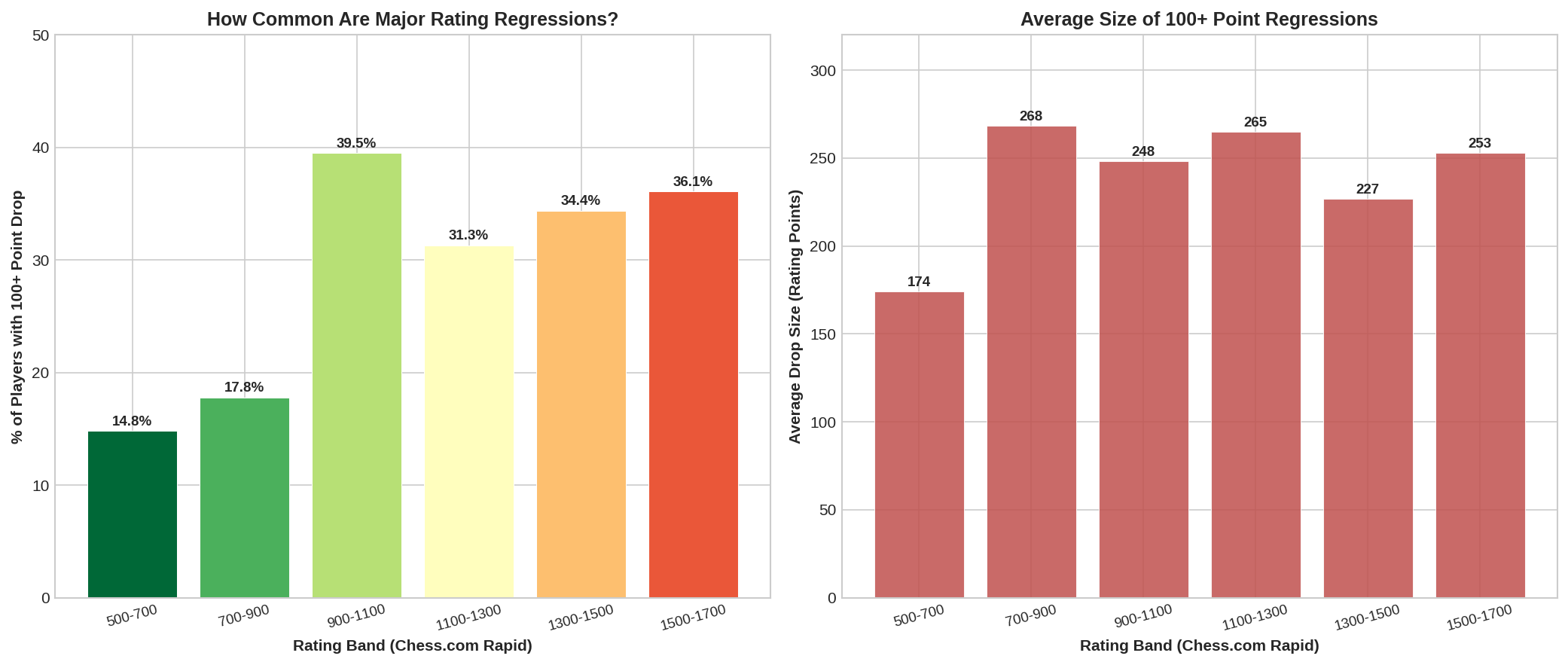
A staggering 30-40% of players between 900 and 1500 experience a peak-to-trough regression of 100 points or more. The average size of these drops is brutal: around 250 points.
If you've just lost 150 points over a bad weekend, the data shows this is a normal part of the process. More importantly, the recovery rate is exceptionally high. The vast majority of players who experience these drops eventually reclaim their peak rating, though it can take weeks or even months to do so.
The Tilt Effect
Why do these regressions happen? Often, it comes down to "tilt"—the psychological phenomenon where losing begets more losing.
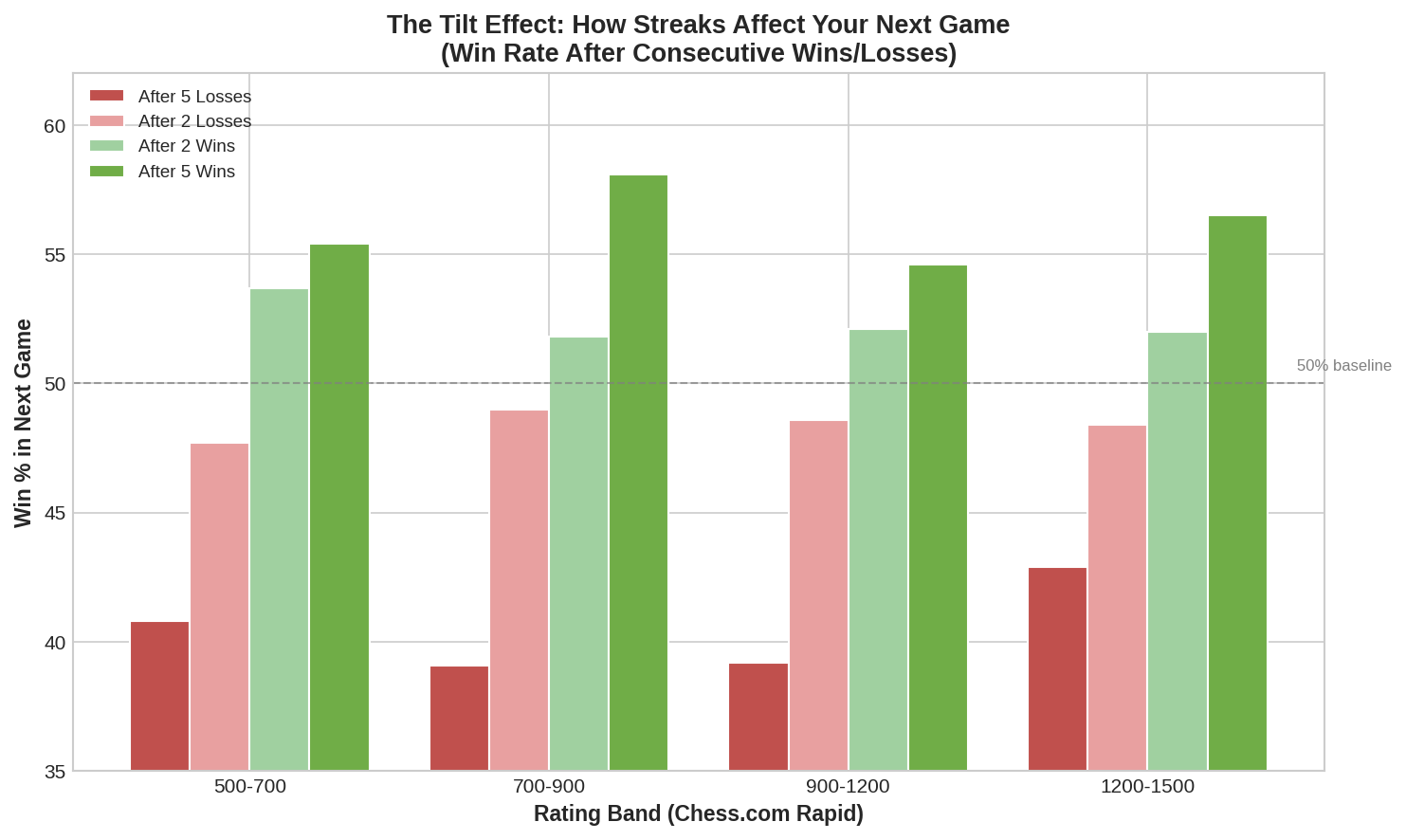
Our analysis of streak effects shows a clear pattern: after suffering 5 consecutive losses, a player's win rate in their next game drops significantly below the 50% baseline, hovering around 39-42%. Conversely, a 5-game winning streak boosts the subsequent win rate to 55-58%.
Actionable Advice: When you hit a 3-game losing streak, stop playing rated games for the day. The data proves that your objective playing strength drops significantly when you are tilted.
The Reality of Plateaus
If you aren't spiking or regressing, you are likely plateauing. A plateau is defined as staying within a narrow rating band (±50 points) for an extended period.
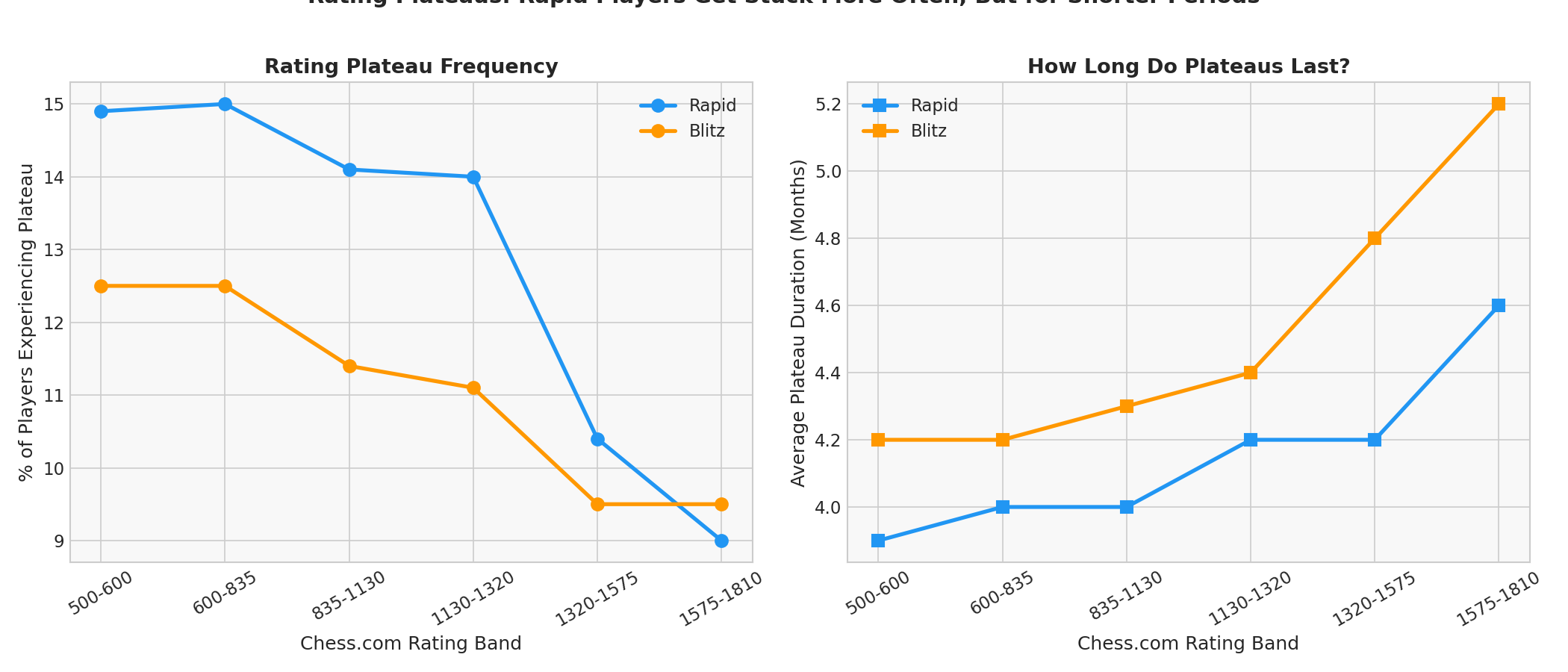
About 14-15% of players in the 700-1500 range are currently in a strict plateau (stuck for 3+ months). If we loosen the definition to ±100 points over 2 months, nearly half of all players are plateauing at any given time. The average duration of these plateaus is about 4 months.
Why Do We Plateau?
Plateaus occur when your current knowledge base is sufficient to beat lower-rated players but inadequate to challenge higher-rated ones. Breaking a plateau requires adding a new skill to your arsenal, not just playing more games with the same flawed understanding.
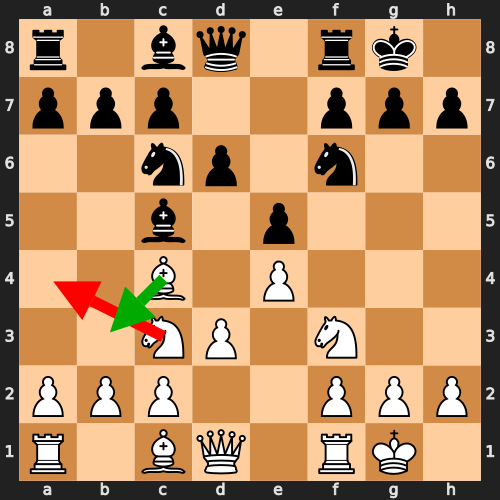 The Plateau Position: In closed, maneuvering positions like this Italian Game, lower-rated players often play passive moves like Na4 (red arrow). Breaking the plateau requires understanding tension and playing active, improving moves like Bb3 (green arrow).
The Evolution of Volatility
As you improve, your rating becomes more stable. The wild swings of the beginner phases gradually give way to a more measured progression.
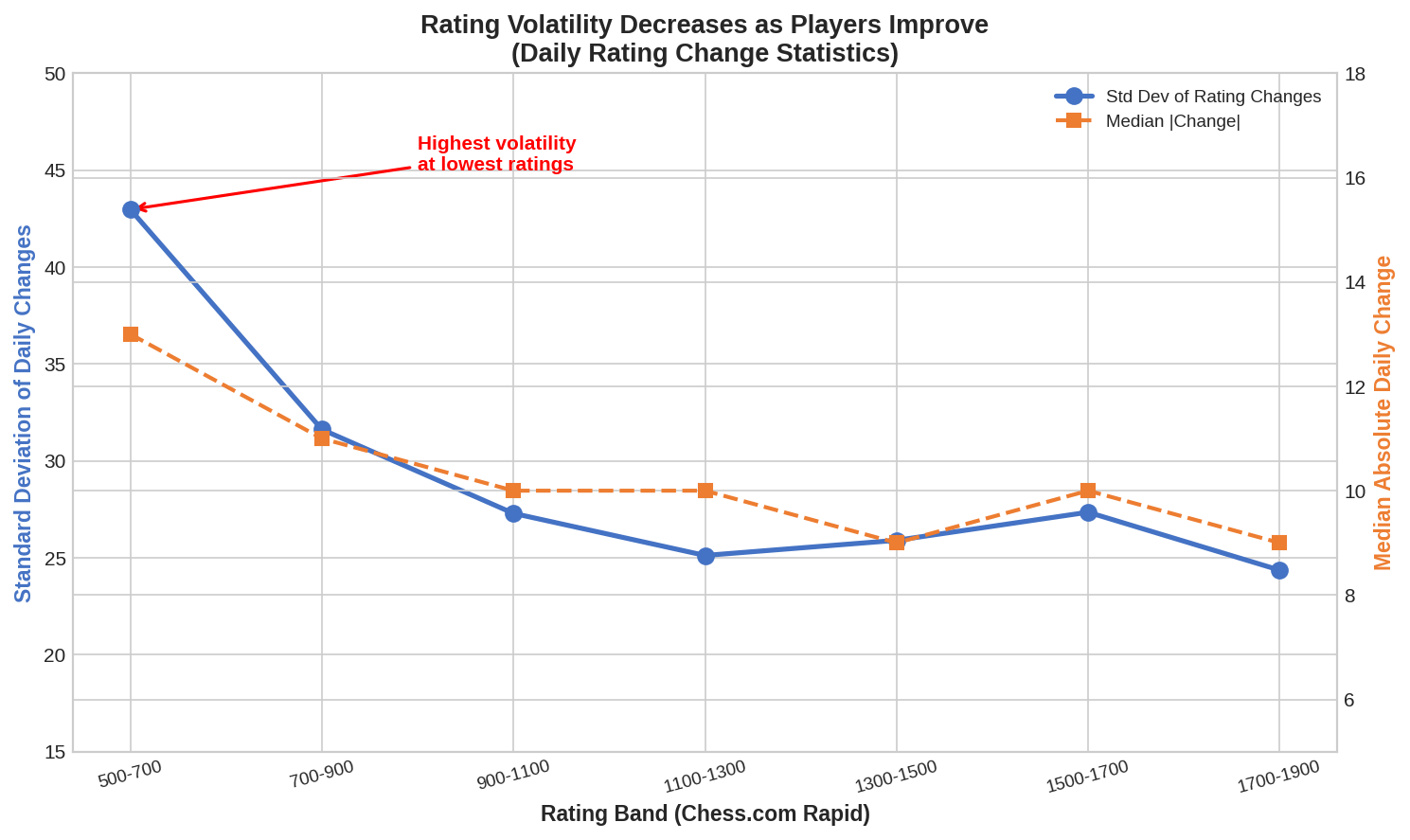
At the 500-700 level, the standard deviation of daily rating changes is massive (nearly 43 points). By the time a player reaches 1500, this volatility drops by almost half. This happens because higher-rated players are more consistent; they blunder less frequently and capitalize on their opponents' mistakes more reliably.
Roadmap for Improvement: 800 to 1500
Based on the data, here is a targeted roadmap for climbing through the rating bands.
The 800-1000 Band: The Blunder Years
At this level, games are decided almost entirely by one-move blunders. Our data shows that the average first major blunder (a mistake costing 3+ pawns in evaluation) happens around move 18.
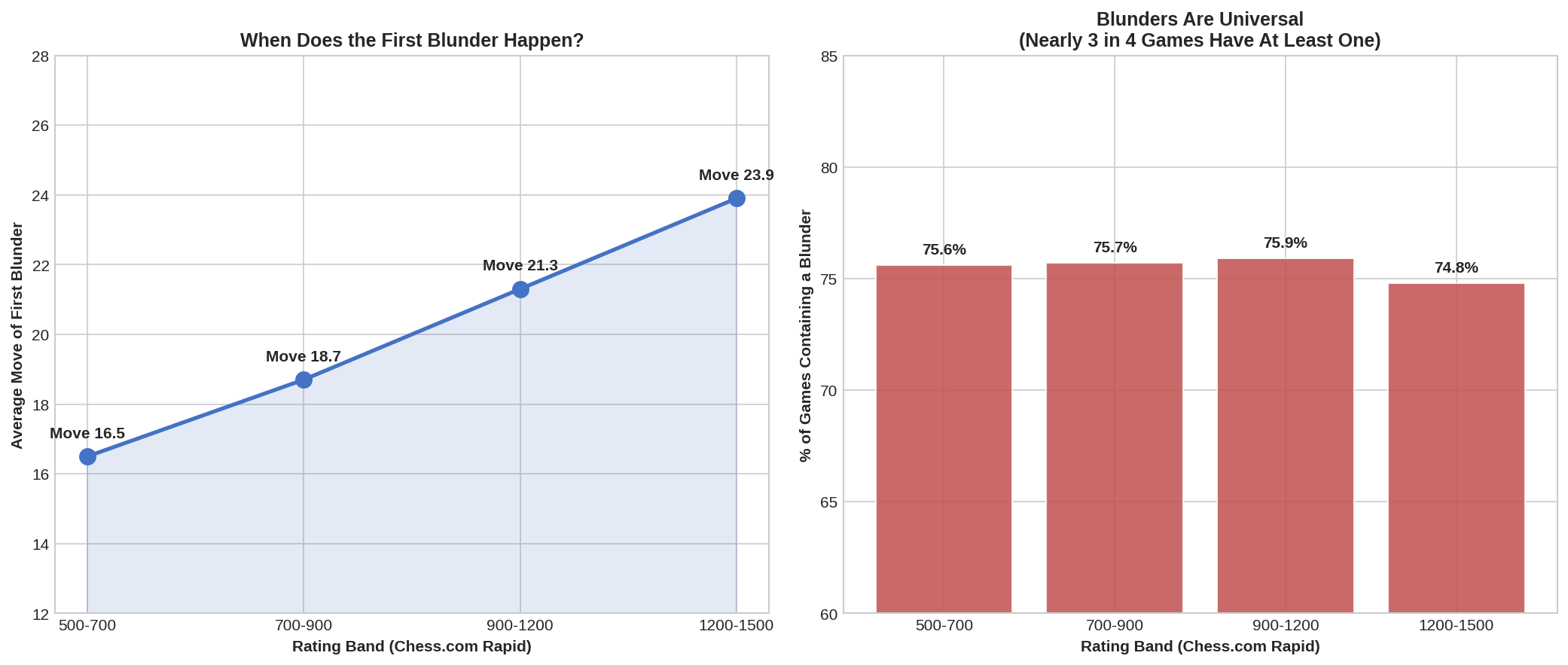
Nearly 76% of games at this level contain at least one massive blunder. The player who wins is simply the one who blunders last.
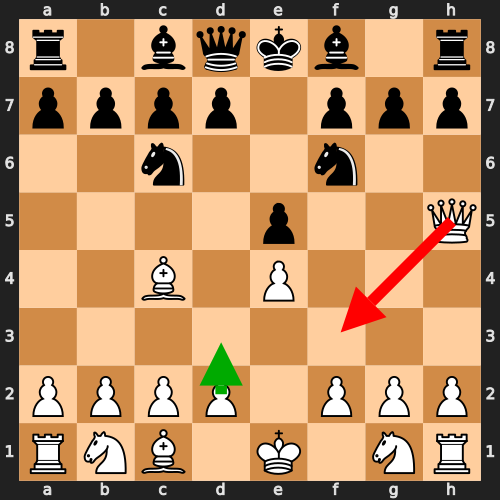 The Wrong Follow-Up: After 1.e4 e5 2.Qh5 Nc6 3.Bc4 Nf6, White often panics and retreats the queen to f3 (red arrow), blocking the knight and losing the initiative. Simply developing with d3 (green arrow) is much stronger.
Actionable Advice:
- Always Check for Checks, Captures, and Attacks: Before every move, ask yourself what your opponent's last move threatened, and what your intended move leaves undefended.
- Stop Playing Hope Chess: Don't play traps (like the Scholar's Mate) hoping your opponent will fall for them. When they don't, you are often left with a worse position.
The 1000-1200 Band: The Tactical Awakening
Players in this band have stopped hanging pieces in one move, but they still frequently miss two-move tactical sequences like forks, pins, and skewers.
 Missing the Tactic: Here, White plays Nxe5 (red arrow), grabbing a pawn but missing the devastating Bxf7+ (green arrow) which wins the queen after Kxf7 Nxe5+.
Actionable Advice:
- Do More Puzzles: Tactical vision is the primary differentiator at this level. Daily puzzle solving will train your brain to spot these patterns automatically.
- Learn Basic Endgames: Many games at this level reach the endgame, but players lack the technique to convert winning advantages.
The 1200-1500 Band: The Strategy Shift
This is where the game changes. Tactical blunders still happen, but they are less frequent. Games are increasingly decided by positional understanding, pawn structure, and endgame technique.
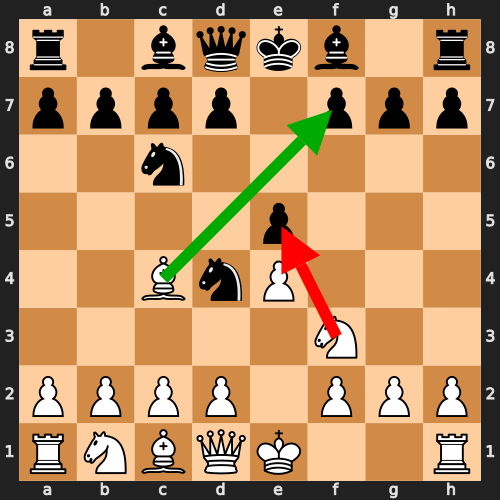
Notice how the average engine evaluation drops across all phases as rating increases. At 1200-1500, the opening and middlegame are much closer to equal than at lower levels. The decisive mistakes are pushed later into the game.
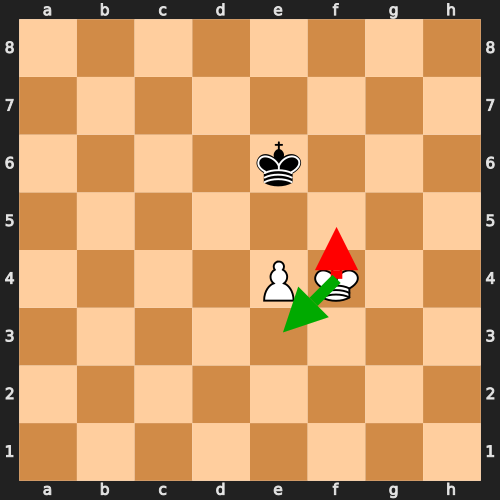 The Endgame Blunder: In this critical King and Pawn endgame, playing Kf5 (red arrow) allows Black to draw. White must play Ke3 (green arrow) to maintain the opposition and win.
Actionable Advice:
- Study Pawn Structures: Understand how your opening choices dictate the pawn structure, and what plans that structure demands.
- Master the Endgame: A solid understanding of King and Pawn, and basic Rook endgames will save you half-points in worse positions and secure full points in equal ones.
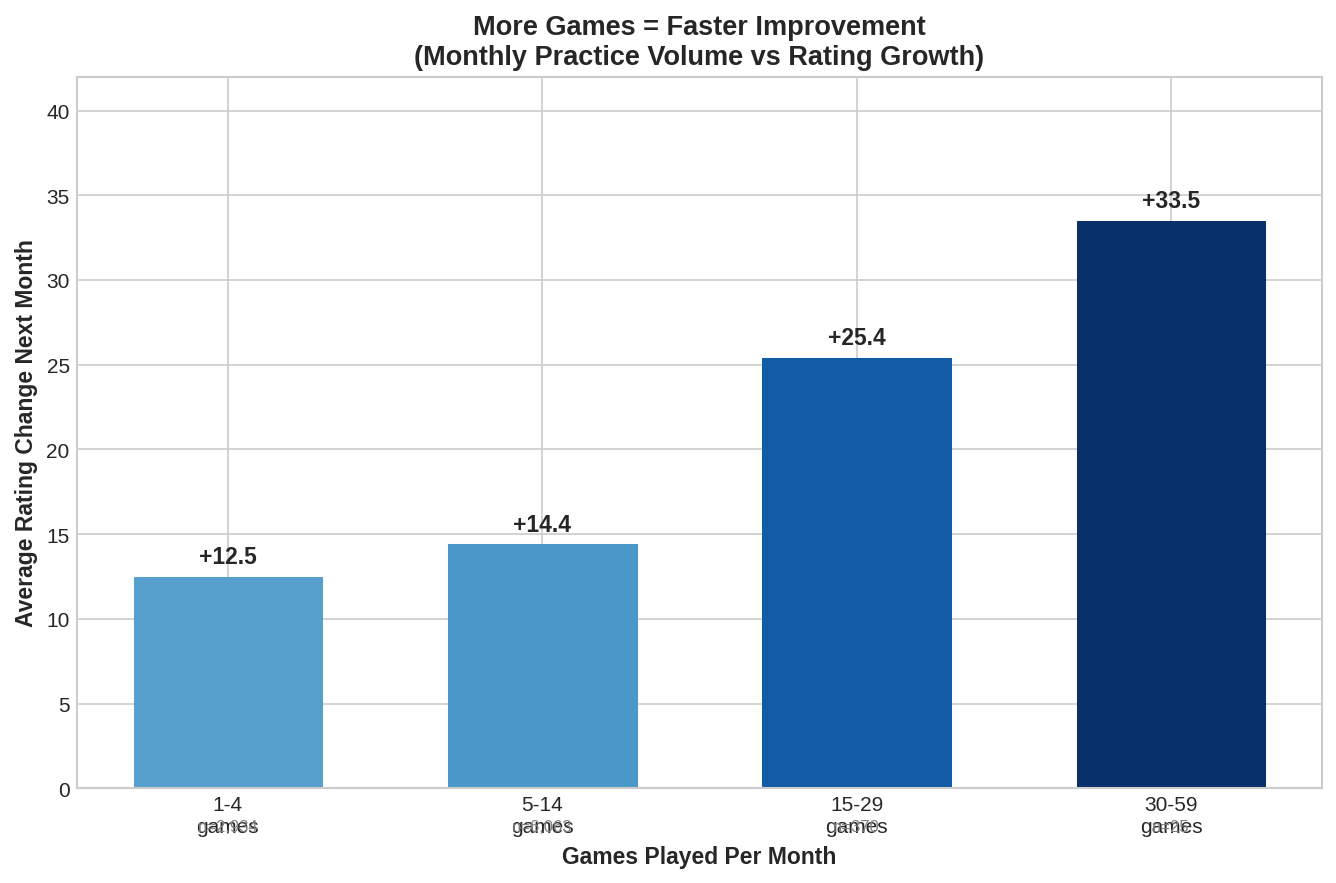
- Increase Practice Volume: The data shows a clear correlation between games played per month and rating growth. Players logging 15-30 Rapid games a month improve significantly faster than those playing fewer than 10.
Conclusion
Chess improvement is a messy, non-linear process. You will experience thrilling spikes, frustrating plateaus, and demoralizing regressions. The data proves that this is not a sign of failure, but the normal rhythm of learning a complex game.
When you hit a 150-point downswing, remember that 40% of your peers are going through the exact same thing, and the vast majority will recover. Focus on the process, study your weaknesses, and the rating will eventually follow.
Chess Coach April 15, 2026
Data and Methodology
This analysis is based on a dataset of over 950,000 Lichess Rapid games and the longitudinal rating histories of 341 active players.
- Rating Conversion: Lichess ratings were converted to approximate Chess.com equivalents using a standard mapping (e.g., Lichess 1500 ≈ Chess.com 1200).
- Engine Evaluation: Move quality and blunder statistics were derived from Stockfish 17 evaluations at depth 20+.
- Data Files: The underlying CSV data files generated for this analysis are attached for further review.
rating_histories.csvregression_details.csvspike_details.csvvariance_analysis.csvtrajectory_classification.csv