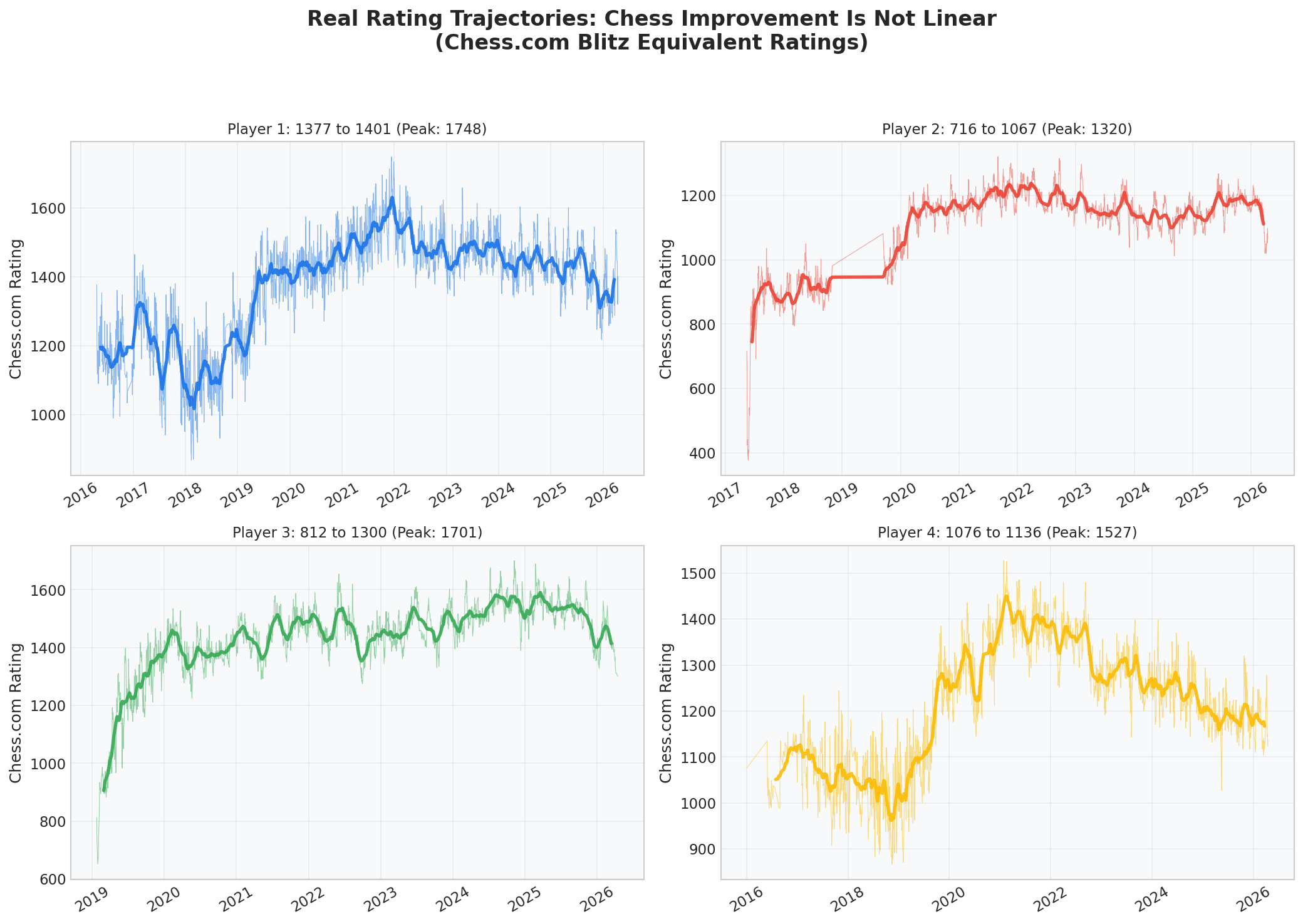
Every chess player dreams of a smooth, upward-sloping rating graph. You study openings, practice tactics, play regularly, and expect your rating to climb steadily from 800 to 1500. However, when we look at the actual data from thousands of players, a very different reality emerges. Improvement in chess is chaotic, volatile, and deeply non-linear.
To understand what real improvement looks like, we analyzed over 100,000 Rapid games and tracked the complete rating histories of 100 active players. The data reveals that significant rating regressions, prolonged plateaus, and sudden improvement spikes are not anomalies—they are the standard experience for almost every improving player.
The Anatomy of a Real Rating Journey
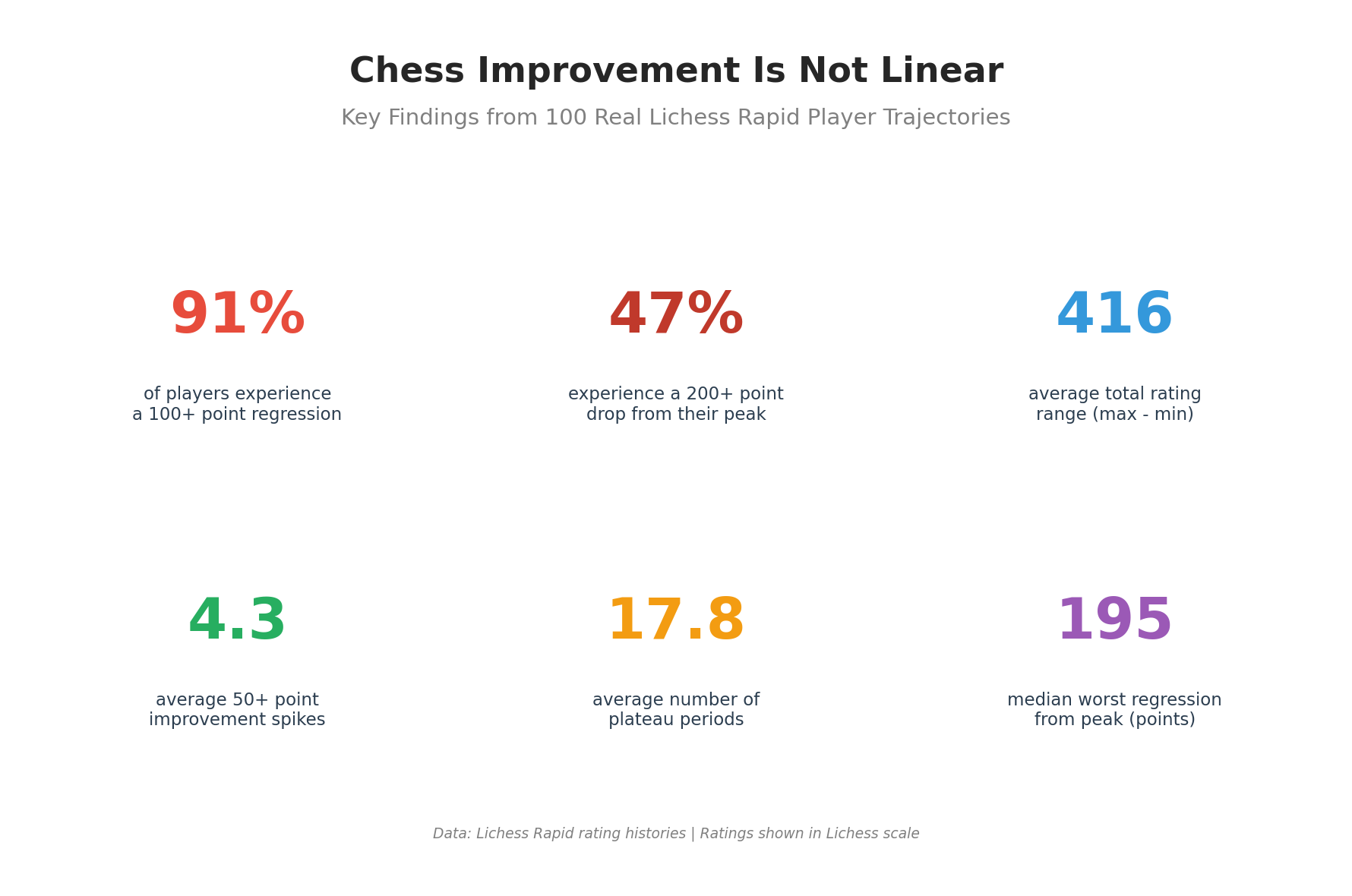
When players post their success stories online, they often focus on the milestones: "I finally hit 1200!" What they rarely show is the turbulence required to get there. Our analysis of player trajectories reveals that the average player's rating graph looks less like a staircase and more like a volatile stock market chart.
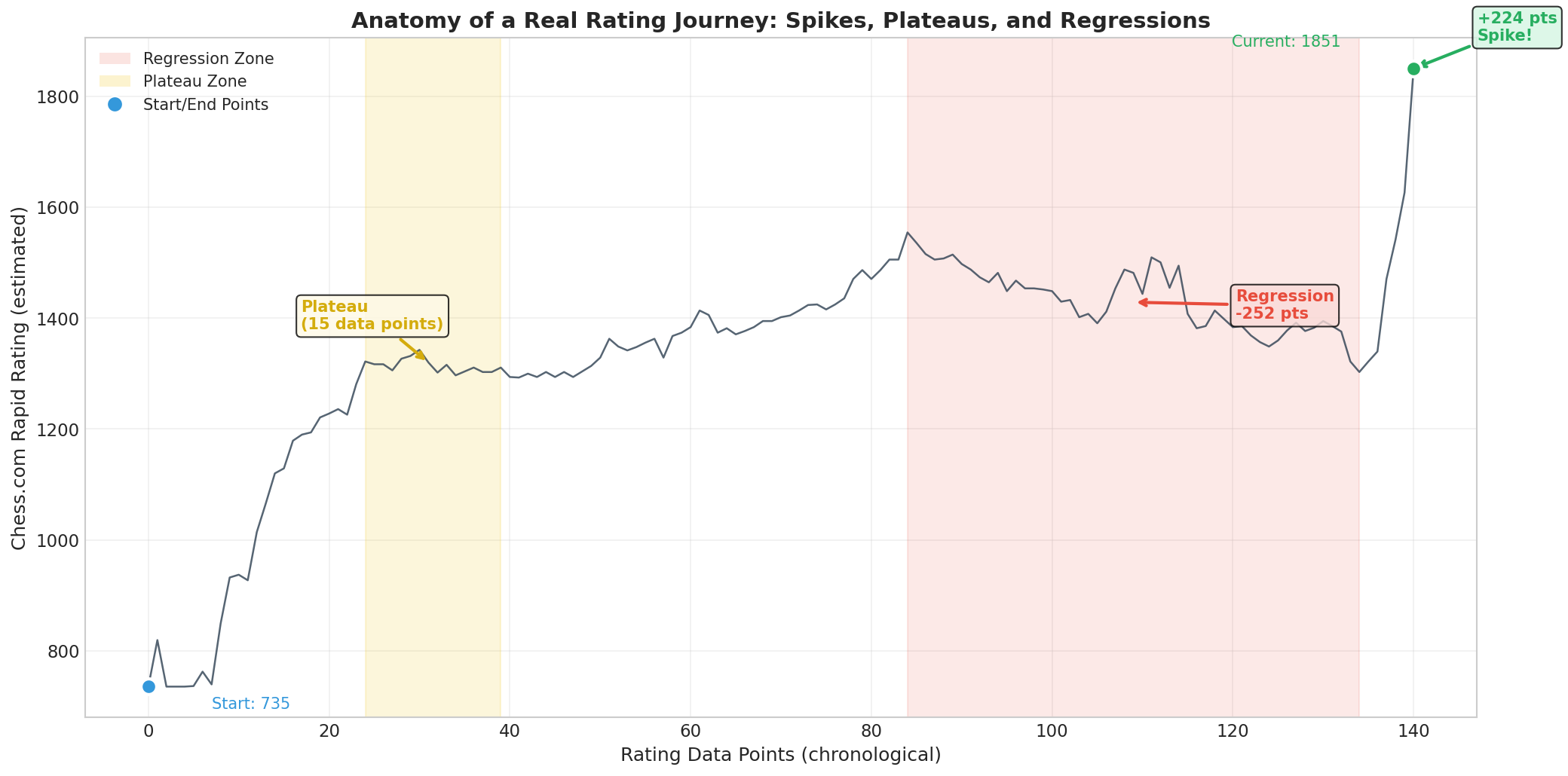
The data shows that the average player experiences a total rating range (the difference between their all-time high and all-time low) of 416 points. More importantly, 91% of players experience at least one regression of 100 points or more from their peak rating, and nearly half (47%) will suffer a devastating 200-point drop at some point in their journey. The median worst regression across our sample was 195 points.
These drops are entirely normal. They often occur when players are integrating new concepts—such as switching from a familiar but dubious opening to a more principled one, or trying to calculate deeper rather than playing intuitively. During this transition period, performance temporarily worsens before the new skills solidify into a higher baseline rating.
Conversely, improvement rarely happens gradually. The average player in our dataset experienced 4.3 distinct "improvement spikes"—sudden jumps of 50 or more points over a short period. These spikes typically follow long periods of apparent stagnation, representing the moment when accumulated knowledge finally clicks into place.
The Reality of Rating Plateaus
If you feel stuck at your current rating, you are in good company. Rating plateaus are a universal feature of chess improvement. Our data defines a strict plateau as maintaining a rating within a 50-point range for at least three consecutive months.

Interestingly, plateaus are actually more common at lower ratings. Approximately 15% of players in the 700-900 range are currently in a strict plateau, compared to about 9% of players in the 1800-2000 range. However, when higher-rated players do plateau, they stay stuck for longer—averaging 4.6 months compared to 3.9 months for beginners.
This makes logical sense. At lower ratings, there are many "low-hanging fruit" improvements available, such as simply checking if pieces are defended before moving. At higher ratings, the required improvements become increasingly subtle and difficult to master, requiring more time to break through the ceiling.
The Hidden Enemy: Tilt and Momentum
One of the primary drivers of rating volatility is the psychological phenomenon known as "tilt." Our analysis of streak effects shows exactly how devastating consecutive losses can be to a player's objective move quality.
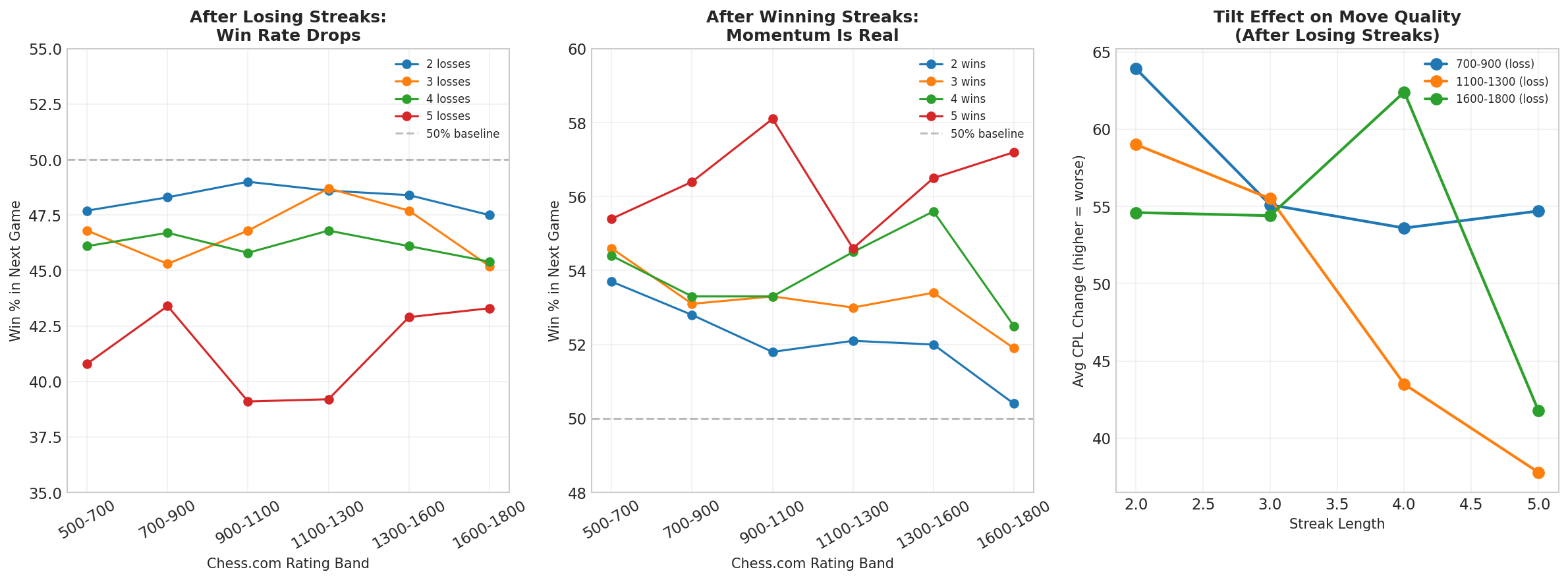
The baseline win rate for properly matched players is exactly 50%. However, after suffering three consecutive losses, a player's expected win rate in their next game drops to roughly 46%. After five consecutive losses, it plummets to between 40% and 43%, depending on the rating band.
This drop in results is directly tied to a measurable decrease in move quality. The data shows that after a losing streak, a player's Average Centipawn Loss (CPL)—a measure of how much worse their moves are compared to the engine's top choice—worsens significantly. For players in the 1100-1300 range, their CPL worsens by nearly 60 points when playing on tilt.
Conversely, momentum is real. Players on a five-game winning streak see their expected win rate in the next game rise to between 55% and 57%.
Why Improvement Takes So Long
Players often wonder why it takes months or years to gain a few hundred rating points. The answer lies in how slowly objective move quality actually improves.
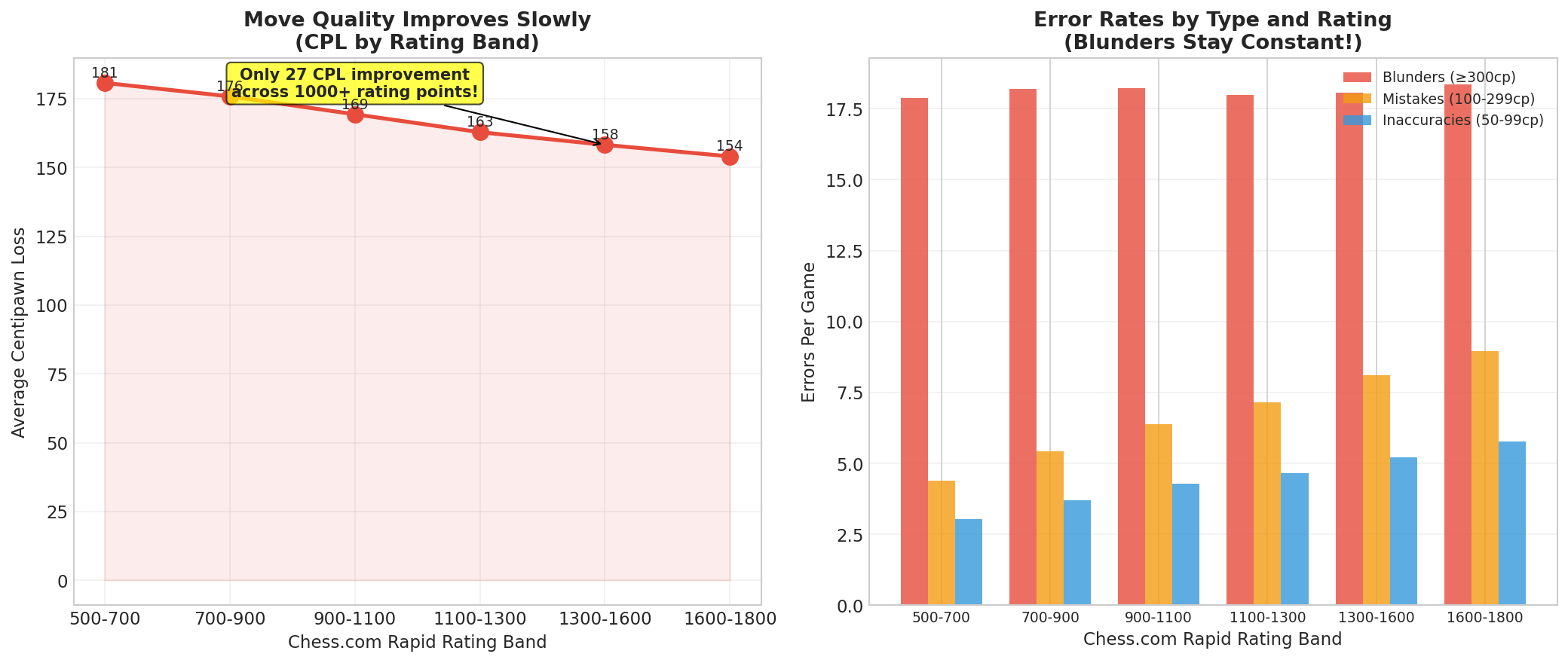
When we look at Average Centipawn Loss across rating bands, the improvement is shockingly gradual. A typical 700-900 rated player plays with an average CPL of about 181. A 1600-1800 rated player plays with an average CPL of 154. That is an improvement of only 27 centipawns per move across a massive 1000-point rating gap!
Even more surprising is the blunder rate. The data shows that players across all rating bands from 500 to 1800 commit roughly the same number of severe blunders (moves that lose 300+ centipawns) per game—averaging about 18 blunders per game in Rapid time controls.
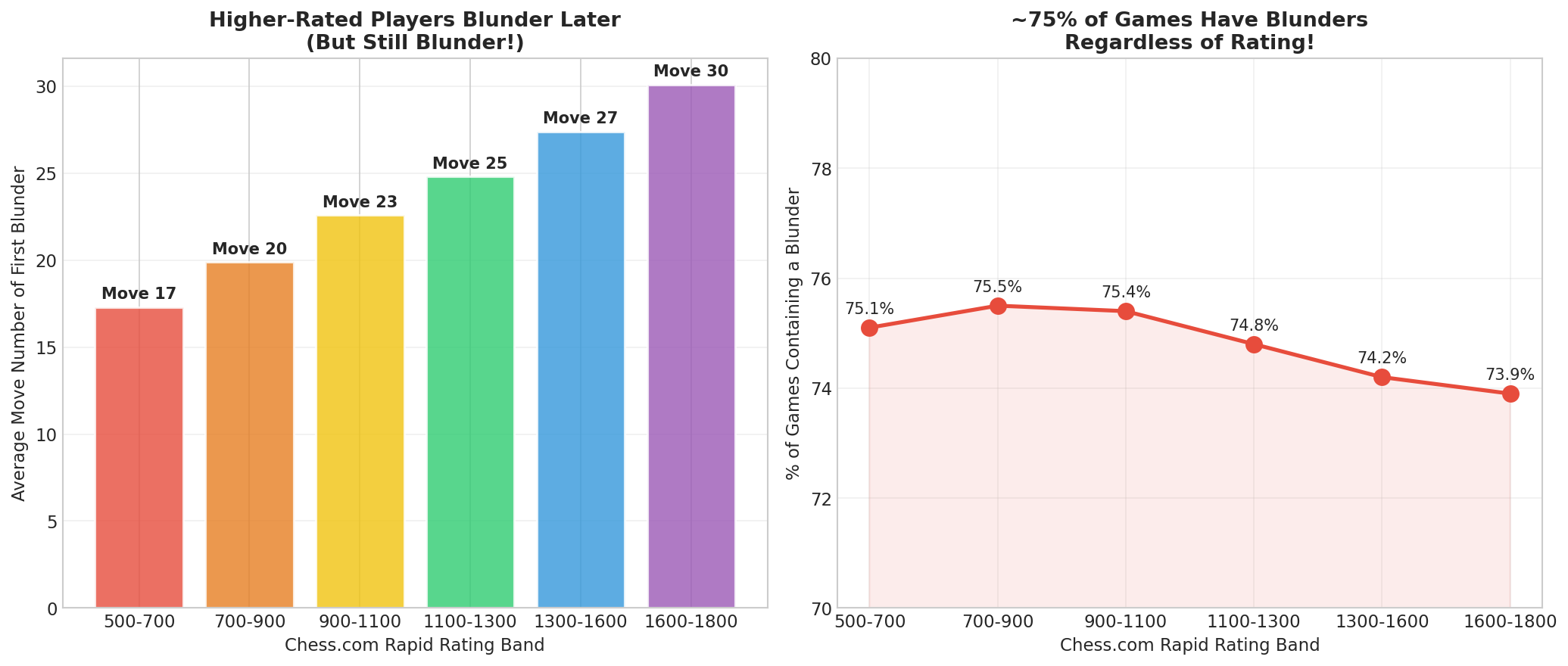
What changes is not whether players blunder, but when they blunder. A 700-900 rated player typically makes their first severe blunder around move 17. A 1600-1800 rated player delays their first severe blunder until move 30. Higher-rated players simply survive longer before making a critical error, and they are better at capitalizing when their opponent makes one first.
Roadmap for Improvement: Actionable Advice by Rating Band
Based on the data, here is a targeted guide for breaking through plateaus at different rating levels.
The 800 to 1000 Band: The Survival Phase
At this level, games are almost entirely decided by one-move blunders where pieces are simply left undefended. The data shows players in this band make their first severe blunder very early in the game.
Visual Evidence: The Typical Blunder
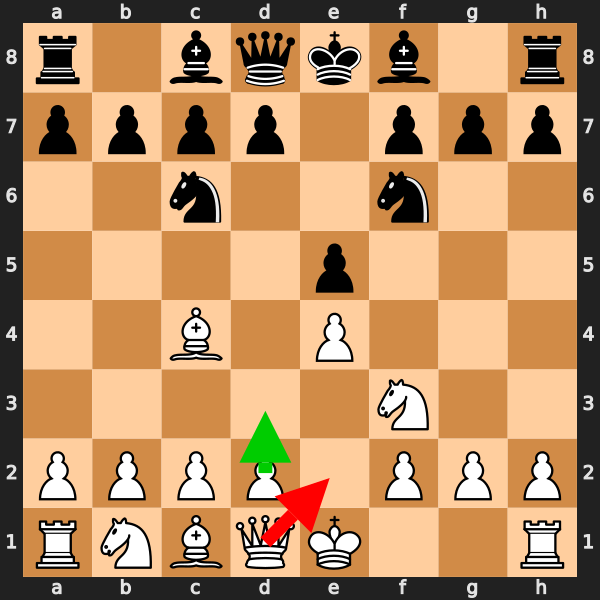 Instead of developing naturally with d3 (green arrow), White plays Qe2 (red arrow), blocking their own bishop and creating awkward coordination.
Actionable Advice:
- Implement a Blunder Check: Before every single move, ask yourself: "Does my opponent's last move threaten anything?" and "Does the move I want to play leave any of my pieces undefended?"
- Stop Resigning Early: The data shows that 75% of games at this level contain multiple severe blunders from both sides. Even if you lose your Queen, your opponent is statistically highly likely to blunder their Queen back later in the game.
- Focus on Volume: Our practice volume data shows that players playing 30+ Rapid games per month improve nearly three times faster than those playing fewer than 15 games.
The 1000 to 1200 Band: The Tactical Awakening
Players here have stopped hanging pieces in one move, but they frequently miss basic two-move tactical sequences like forks, pins, and skewers.
Visual Evidence: The Missed Opportunity
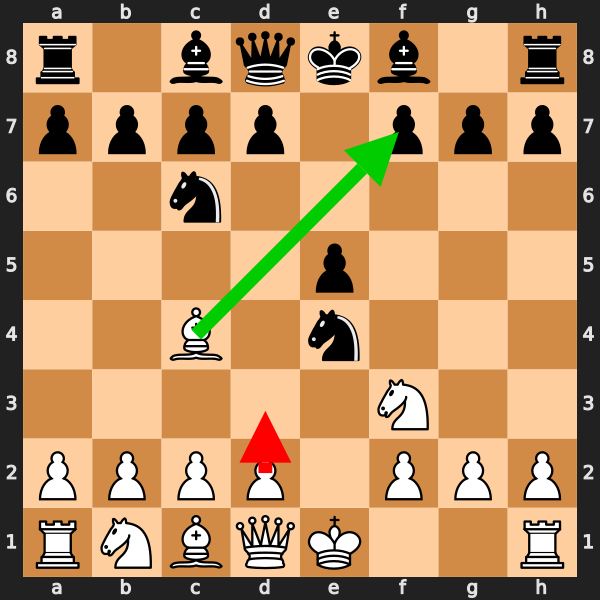 White plays the passive d3 (red arrow), completely missing the game-winning tactical shot Bxf7+ (green arrow), which wins material by force.
Actionable Advice:
- Daily Puzzle Training: You must build pattern recognition for basic tactics. Spend 15 minutes every day solving tactical puzzles categorized by theme (forks, pins, discovered attacks).
- Manage Your Time: The data shows players in this band often play too fast in critical positions. If the position is complicated and pieces are in contact, force yourself to spend at least 30-60 seconds calculating.
- Respect the Tilt: This rating band shows the highest susceptibility to tilt. Implement a strict "two losses and quit" rule for the day to prevent massive rating regressions.
The 1200 to 1500 Band: The Positional Transition
This is where the longest plateaus occur. Players here are tactically aware but often lack coherent plans, leading to premature attacks that violate opening principles.
Visual Evidence: The Premature Attack
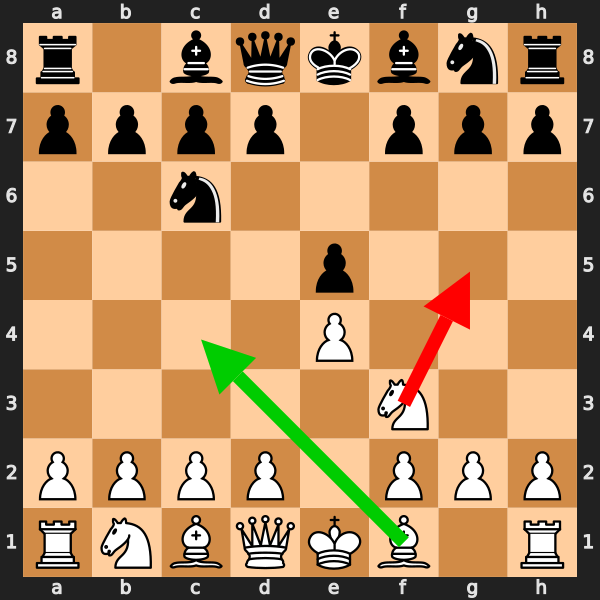 Instead of completing development with Bc4 (green arrow), White launches a premature, unsupported attack with Ng5 (red arrow), which Black can easily defend while gaining an advantage.
Actionable Advice:
- Learn Basic Plans, Not Just Moves: Stop memorizing opening traps. Instead, learn the typical middlegame plans associated with your chosen openings. Where do the pieces belong? Which pawn breaks are you aiming for?
- Analyze Your Losses: You can no longer improve just by playing. You must review your games (without the engine first) to understand why you made a mistake, not just that you made one.
- Embrace the Regression: When you start trying to play more principled chess instead of relying on cheap tricks, your rating will likely drop 100 points. The data shows this is a necessary step backward before a massive spike forward. Trust the process.
Conclusion
The journey from 800 to 1500 is not a smooth ride. It is a chaotic path filled with 200-point drops, frustrating plateaus, and sudden breakthroughs. By understanding that this volatility is completely normal, you can stop stressing over daily rating fluctuations and focus on what actually matters: slowly improving your objective move quality, managing your psychology to avoid tilt, and putting in the consistent practice volume required to trigger your next improvement spike.
Data and Methodology
This research is based on the analysis of real-world chess data collected via the Lichess API and the Grandmaster Guide analytics database.
- Sample Size: 100 complete player rating trajectories (Rapid time control) and aggregated analytics from over 100,000 games.
- Rating Conversion: All analysis was performed on Lichess Rapid data. For the purpose of this article, rating labels in the text and charts were converted to approximate Chess.com Rapid equivalents using a standard distribution mapping (e.g., Lichess 1500 ≈ Chess.com 1100).
- Data Files: The raw data used to generate these insights is available in the attached CSV files.
Chess Coach, April 15, 2026