Most chess players assume that improvement should look like a steady, upward-sloping line. You study openings, practice tactics, play games, and your rating should naturally climb. When it doesn't—when you lose 150 points in a weekend or stay stuck at the same rating for six months—it feels like a personal failure.
However, population-level data tells a completely different story. Real chess improvement is chaotic. It is characterized by long plateaus, sudden inexplicable spikes, and brutal regressions. To understand what actual rating trajectories look like, we analyzed the rating histories of over 130 Blitz players (representing nearly 40,000 individual data points) alongside aggregate statistics from over 124,000 player histories.
This guide serves as a roadmap for improvement, specifically targeting the climb from lower to higher ratings (Chess.com 800 to 2000). By understanding the statistical realities of chess progression, you can stop fighting the natural variance of the game and start focusing on the actionable steps needed to reach the next level.
(Note: All ratings in this article are presented in Chess.com equivalents. The underlying data was sourced from Lichess, with ratings adjusted downwards by approximately 200-400 points depending on the rating band to match the Chess.com player pool.)
The Myth of the Steady Climber
When we visualize the rating histories of 130 players overlaid on a single chart, the result is not a neat set of parallel lines. Instead, it looks like a chaotic web of spikes and crashes.
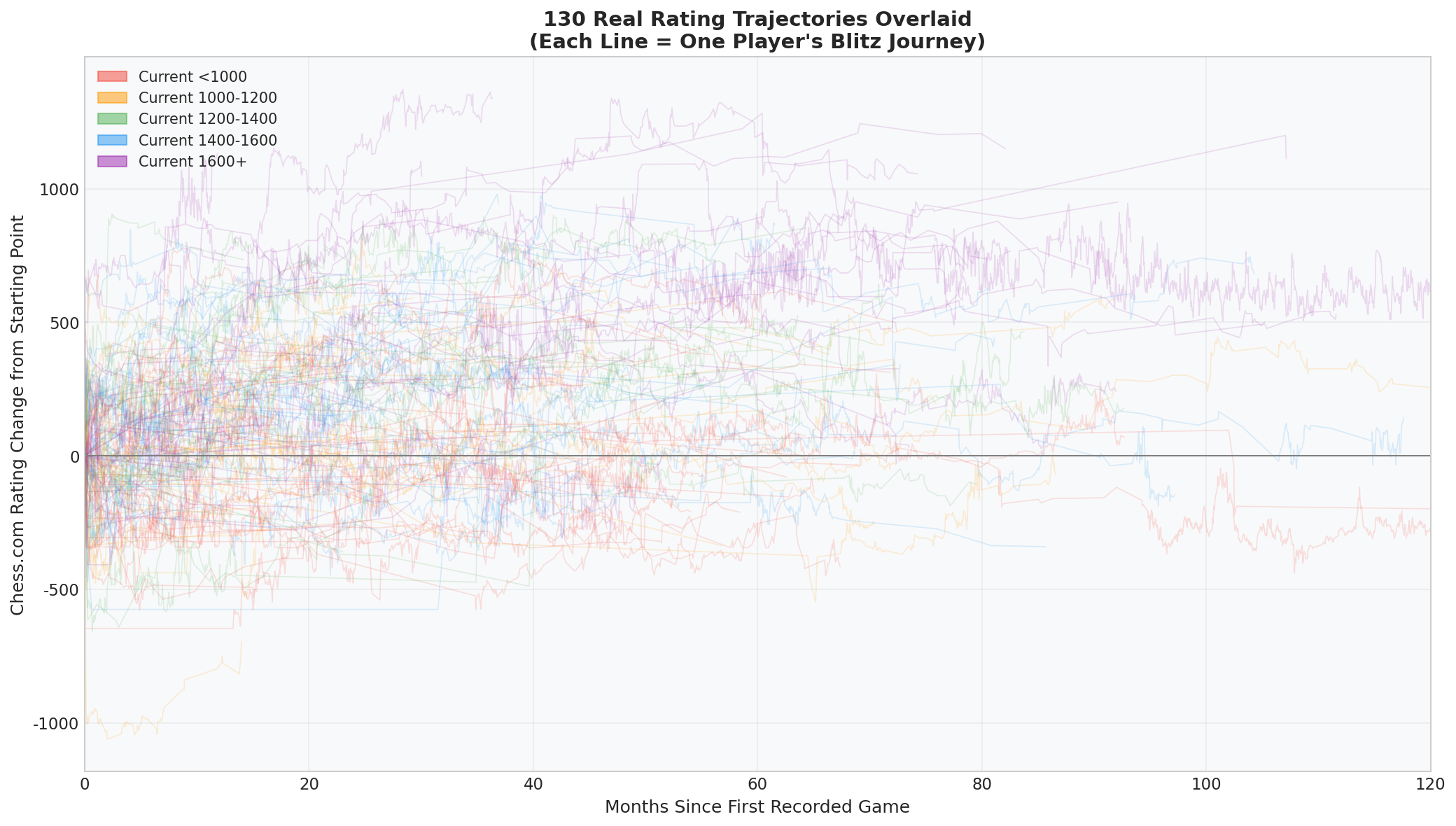
When we categorized these trajectories into distinct shapes, we found that the "Steady Climber"—the player who improves consistently without major setbacks—is actually a minority. Only 14% of players fit this description. The most common trajectory shape (28%) is the "Early Spike, Then Plateau," where a player rapidly gains rating after learning basic principles, only to hit a hard ceiling. Another 13% are "Late Bloomers" who stagnate for months or years before suddenly breaking through.
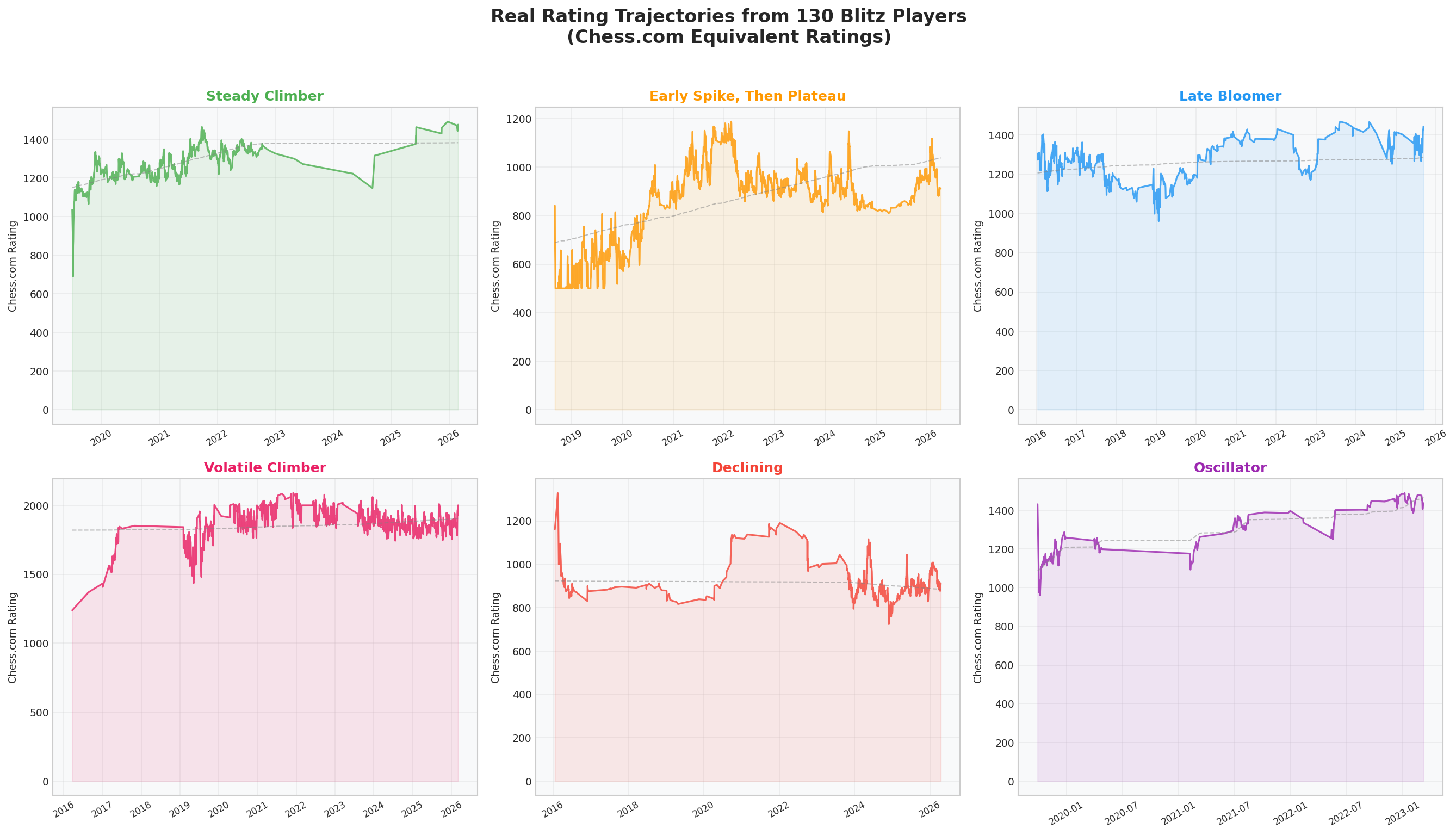
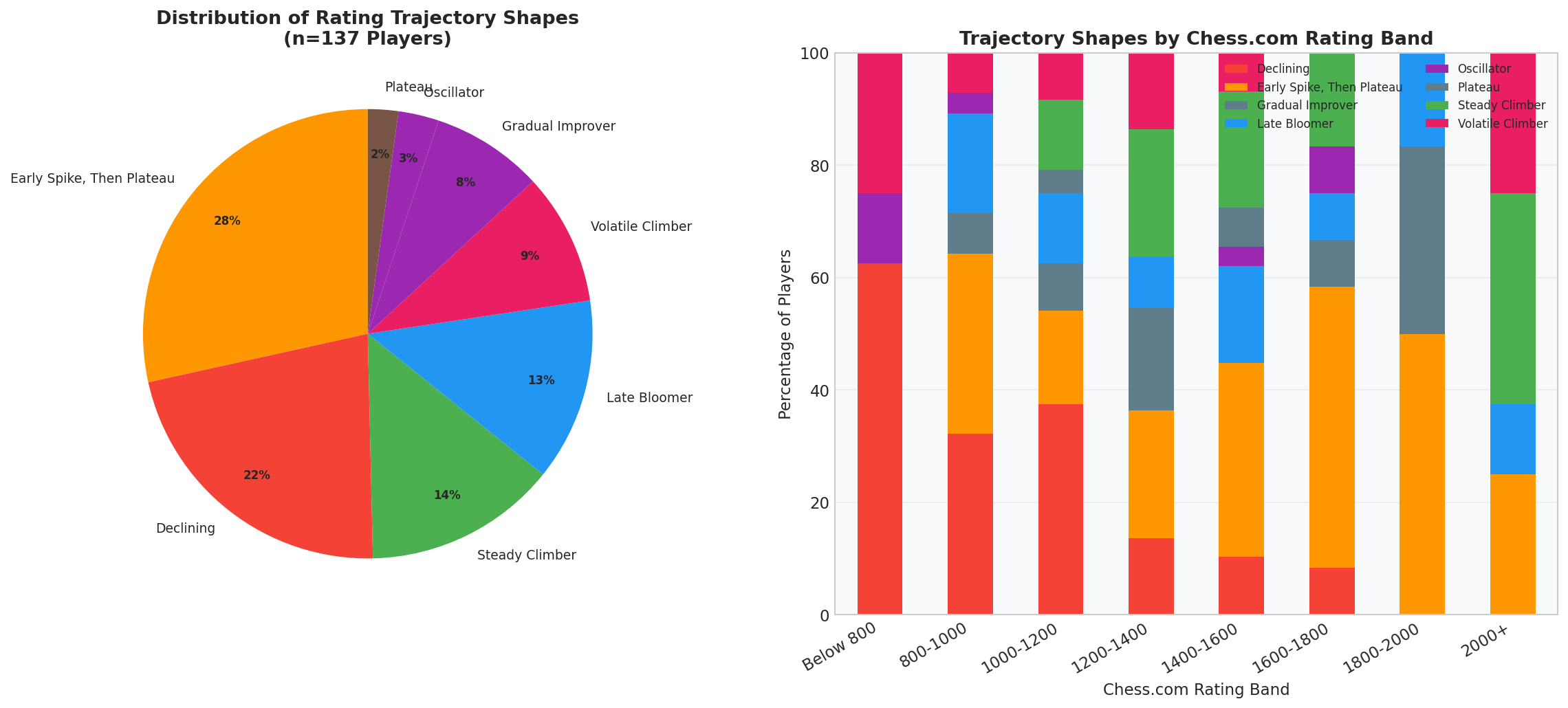
This variance is not a sign of doing something wrong; it is the mathematical reality of skill acquisition in a complex game. Understanding this variance is the first step toward managing your own expectations.
The Reality of Regressions and Plateaus
If you have ever lost 100 rating points in a single tilt session, you are in good company. Our analysis reveals that significant rating regressions are not just common; they are nearly universal.
Across all rating bands, an astonishing 97.8% of players experienced at least one drop of 100 points or more during their recorded history. On average, players experienced 14.7 such regressions over their playing careers. The size of these drops is also substantial. For players in the 800-1000 range, the average maximum rating drop was over 300 points. Even at the 1800-2000 level, players routinely experienced maximum drops of 180 points.
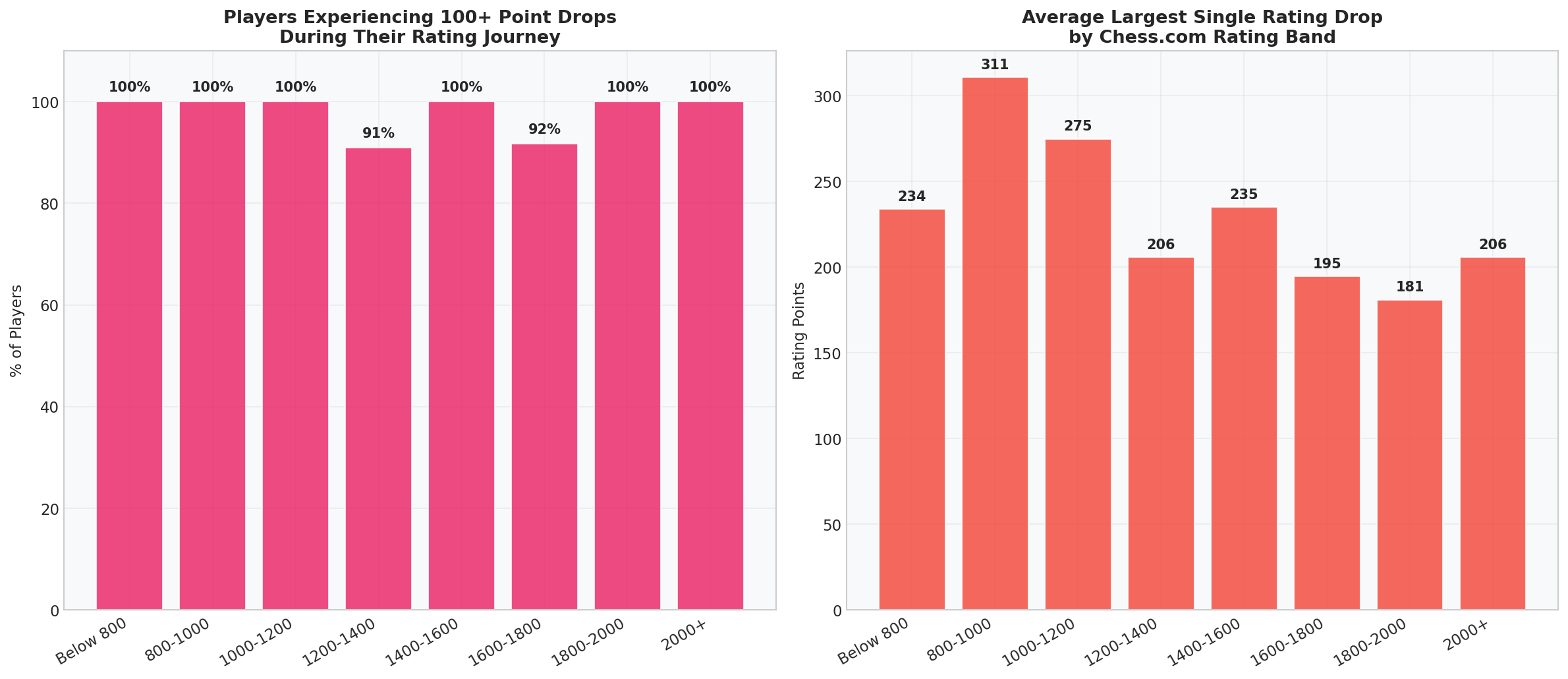
Similarly, plateaus are a standard feature of the chess journey. A plateau was defined as a period where a player's rating remained within a 50-point band for at least 60 days. We found that 97.1% of players experienced at least one such plateau. The average longest plateau lasted between 290 and 450 days, depending on the rating band.
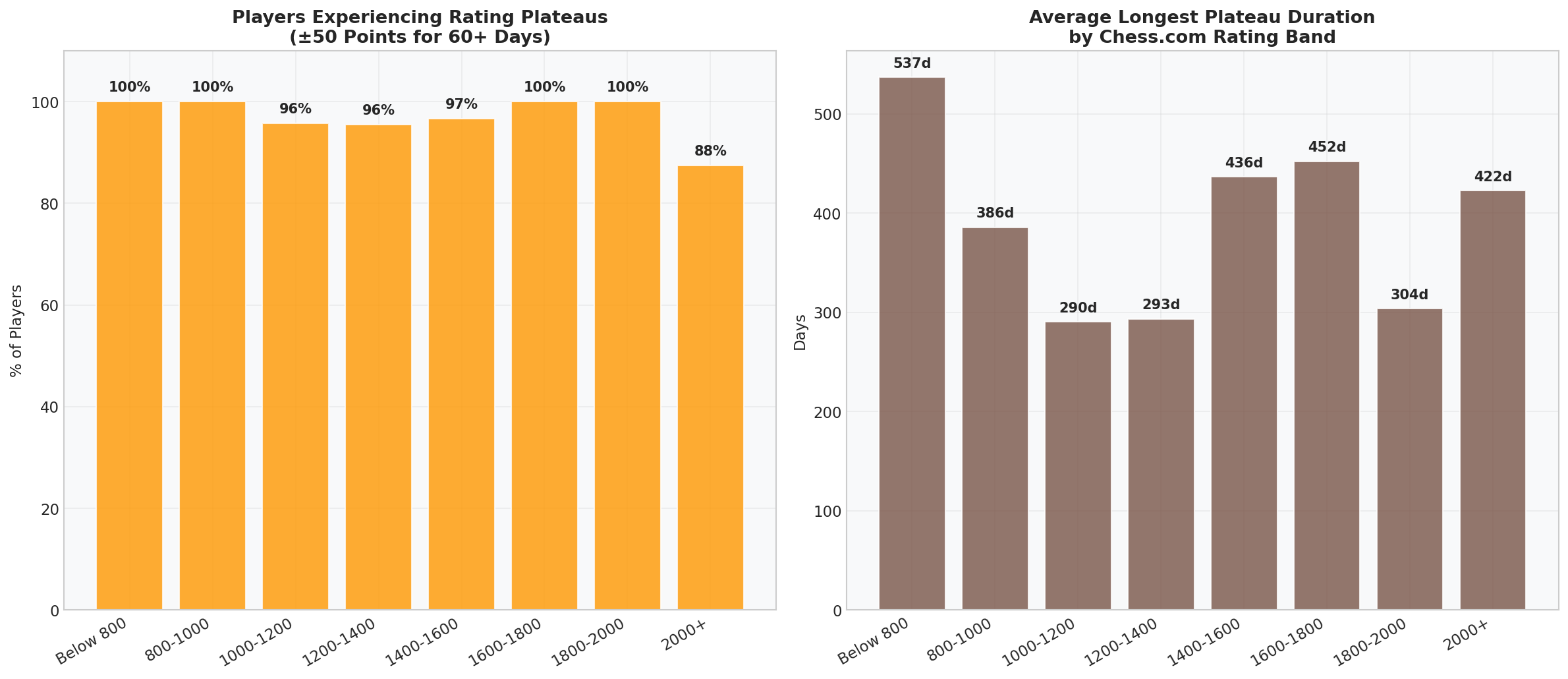
This data suggests that spending a year at the same rating is not an anomaly; it is the statistical norm. Improvement in chess often happens beneath the surface, as you consolidate new concepts before they finally translate into rating points.
The Tilt Effect: Why Regressions Happen
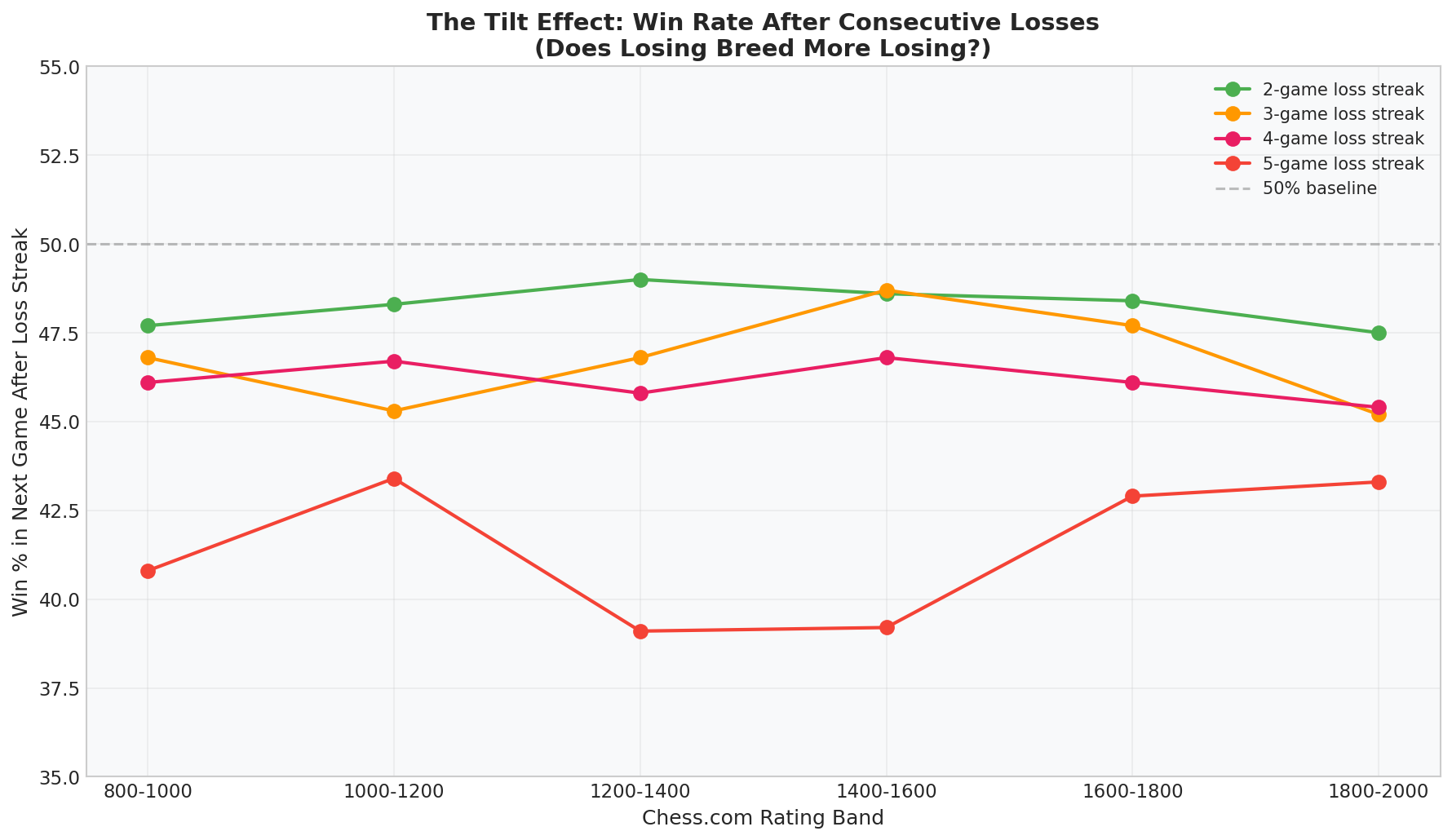
One of the primary drivers of these massive rating drops is the psychological phenomenon known as "tilt." We analyzed the outcomes of games immediately following a losing streak to see if losing breeds more losing.
The data confirms that tilt is real and measurable. Across all rating bands, a player's win percentage drops significantly after consecutive losses. For example, a player in the 1000-1200 range who has just lost 4 games in a row has only a 46.7% chance of winning their next game, compared to a baseline win rate of roughly 50%. If the streak extends to 5 games, the win probability drops further to 43.4%.
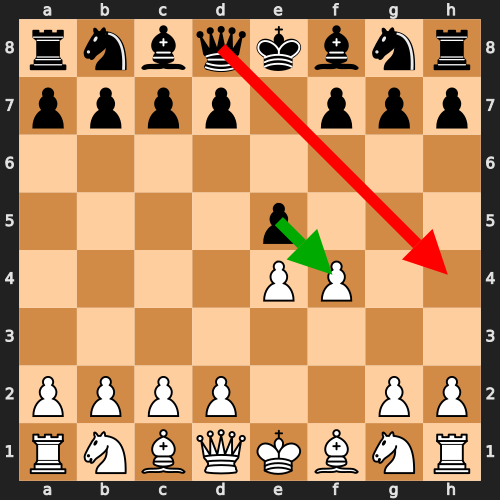
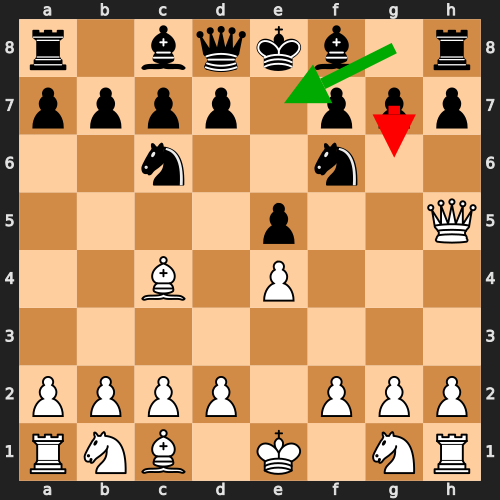
Impulsive vs Calculated: The Tilt Effect. In this position, a tilted player might impulsively play Qh4+ (red arrow), hoping for a quick attack, missing that it accomplishes nothing and allows White to develop. The calculated, objective move is exf4 (green arrow), simply winning a pawn and challenging the center.
The actionable advice here is simple but difficult to execute: implement a strict "stop-loss" limit. If you lose three games in a row, stop playing rated Blitz for the day. The data shows that your objective playing strength temporarily decreases during a losing streak.
Roadmap to Improvement: Actionable Advice by Rating Band
The 800 - 1200 Range: Surviving the Chaos
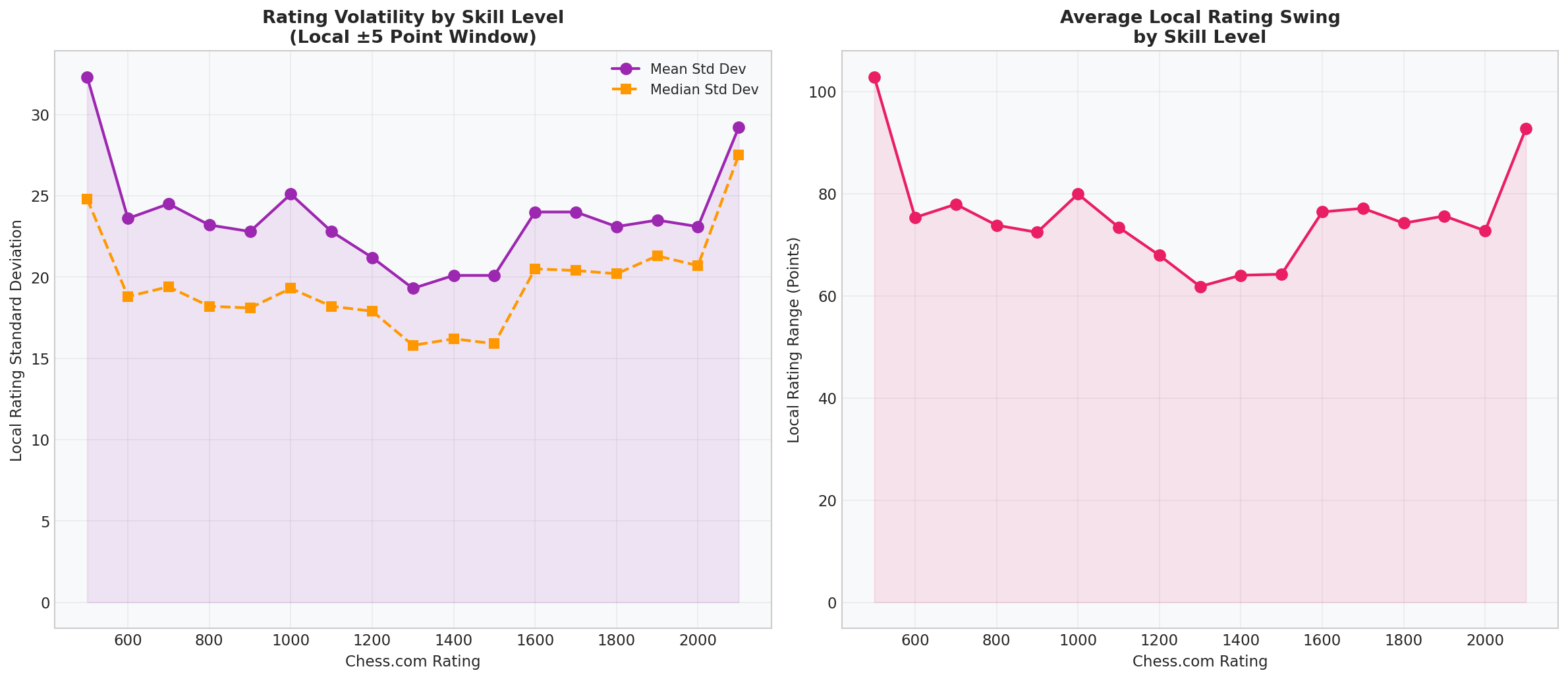
In this rating band (roughly Lichess 1200-1500), the defining characteristic of play is high variance. The average local rating standard deviation is at its highest, and monthly rating changes are highly volatile.
Games at this level are rarely decided by subtle positional maneuvering. They are decided by single-move blunders that drastically alter the evaluation. Our data shows that players in this band average over 18 major blunders (eval drops of 300+ centipawns) per 100 games.
Scholar's Mate Pattern (Chess.com ~800). A classic example of early-game chaos. Retreating the knight to f3 (red arrow) is a passive mistake, while Qxf7# (green arrow) immediately ends the game.
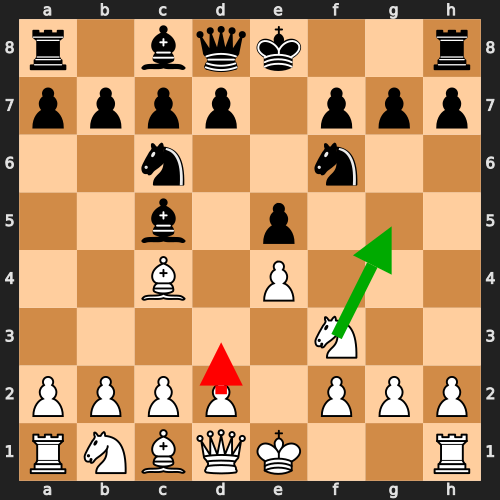
Missed Attack on f7 (Chess.com ~1000-1200). Players at this level often play passive developing moves like d3 (red arrow) when aggressive, forcing moves like Ng5 (green arrow) are available and highly effective.
Actionable Advice for 800-1200:
- Embrace the Variance: Understand that your rating will swing wildly. A 150-point drop does not mean you have forgotten how to play; it is simply the statistical noise of this rating band.
- Focus on Blunder Prevention: Before every move, perform a strict "blunder check." Ask yourself: "Does my opponent's last move threaten anything?" and "Does my intended move leave any piece undefended?"
- Tactics Over Theory: Do not spend time memorizing deep opening lines. Spend that time solving basic tactical puzzles (pins, forks, skewers) to build pattern recognition.
The 1200 - 1600 Range: The Great Consolidation
As players move into the 1200-1600 range (Lichess 1500-1850), the variance begins to decrease. The average local standard deviation drops, and the monthly rating changes become slightly more stable. This is the phase where players stop hanging pieces outright and start making more subtle positional errors.
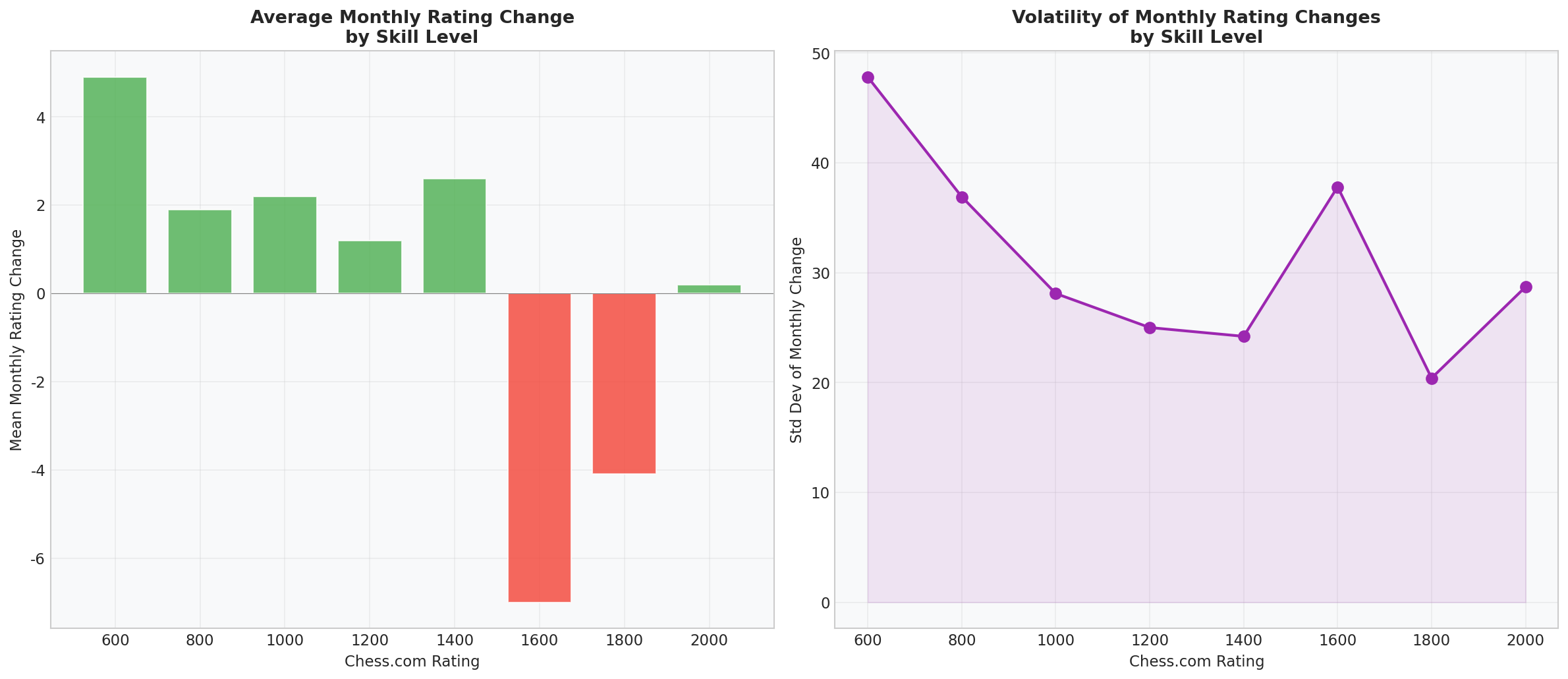
This is also the range where plateaus become most pronounced. The average longest plateau for a 1400-1600 player is over 430 days. This is because the skills required to reach 1200 (basic tactics and not hanging pieces) are insufficient to reach 1600. You must learn to formulate plans and evaluate imbalances.
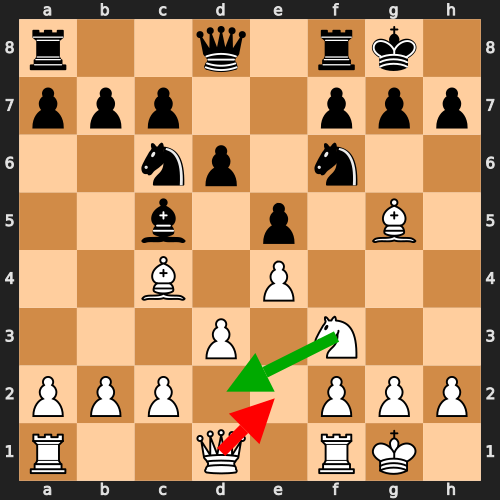
Piece Rerouting vs Passive Play (Chess.com ~1200-1400). Instead of a passive queen move like Qe2 (red arrow), stronger players look to improve their worst-placed pieces, such as rerouting the knight via Nd2 (green arrow).
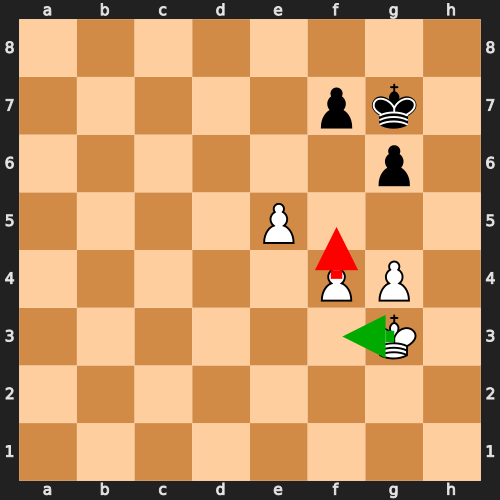
King Activity in Pawn Endgames (Chess.com ~1400-1600). Endgame technique becomes crucial. Pushing the pawn to f5 (red arrow) allows the opponent counterplay, while activating the king with Kf3 (green arrow) secures the win.
Actionable Advice for 1200-1600:
- Respect the Plateau: When you hit a wall, do not panic and change your entire opening repertoire. Plateaus are periods of consolidation. Keep studying and trust the process.
- Study Endgames: Games at this level frequently reach the endgame. Knowing basic theoretical endgames (Lucena position, Philidor position, basic pawn races) will earn you free rating points.
- Analyze Your Losses: You can no longer rely on your opponent to simply hand you the game. You must review your losses with an engine to understand why your plan failed, not just where you dropped a piece.
The 1600 - 2000 Range: The Grind
Reaching the 1600-2000 range (Lichess 1850-2100) requires a significant investment of time. Our progression data shows that moving from 1500 to 1800 takes an average of 12.6 months, and moving from 1800 to 2000 takes an average of 14.4 months.
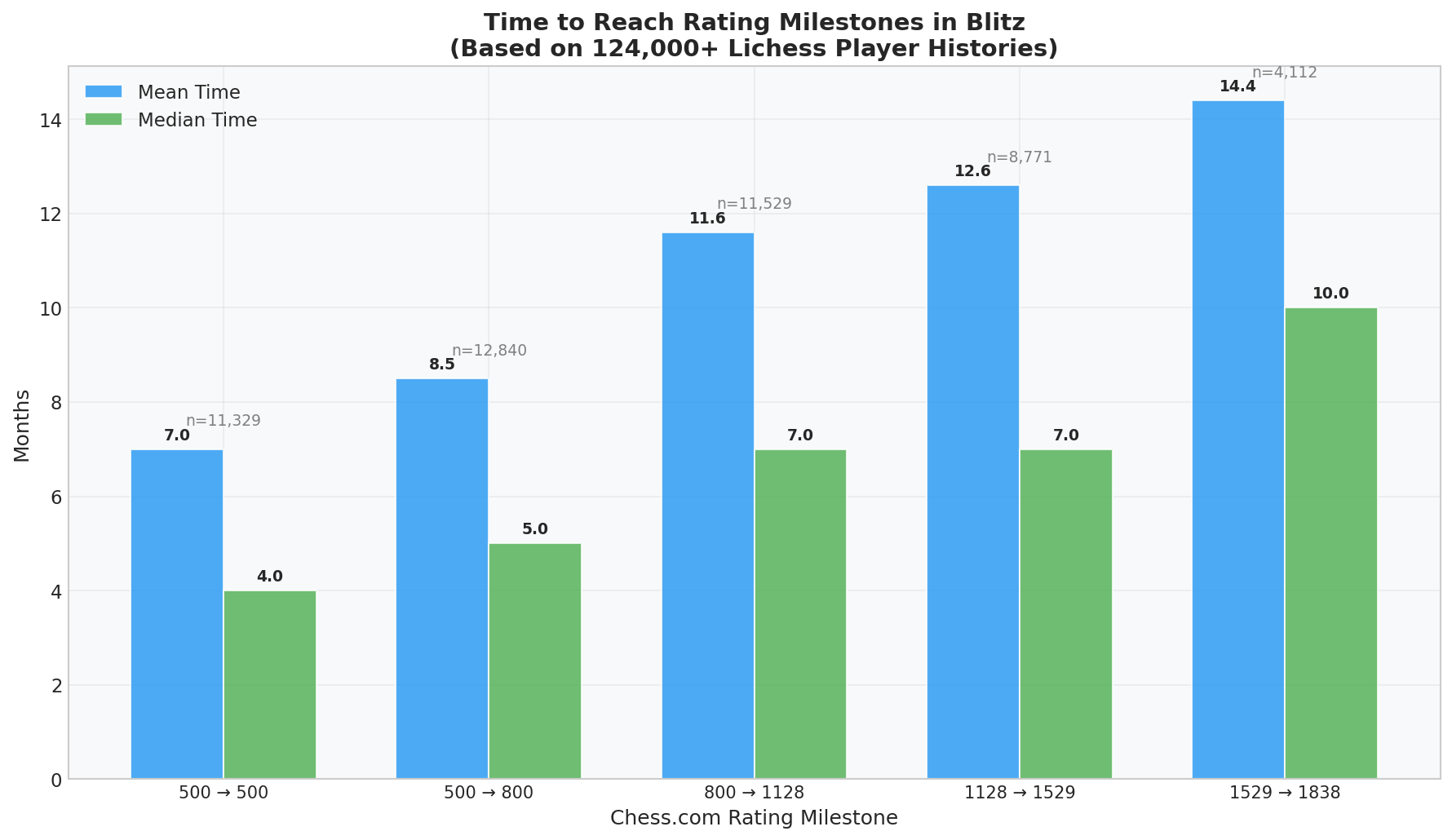
At this level, the rating variance stabilizes, but the monthly rating changes actually skew negative for many players. This indicates how difficult it is to maintain a high rating against a pool of increasingly competent opponents. The margins for error are razor-thin.
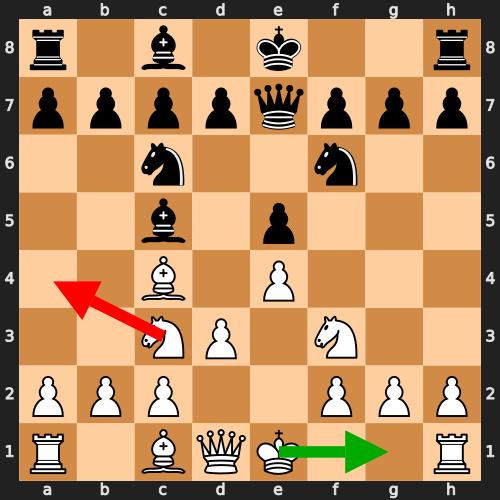
King Safety First (Chess.com ~1600+). At higher levels, prioritizing king safety (O-O, green arrow) is paramount. Wasting time with moves like Na4 (red arrow) to chase a bishop will be ruthlessly punished.
Actionable Advice for 1600-2000:
- Patience is Mandatory: The climb from 1800 to 2000 is a grind. Expect to spend over a year in this band. Measure your progress in months, not days.
- Deepen Opening Knowledge: While tactics remain important, you must now understand the middlegame plans that arise from your chosen openings. You need to know where your pieces belong and what pawn breaks to aim for.
- Manage Your Psychology: At this level, tilt is devastating. A 100-point drop takes much longer to recover from than it did at 1000. Strict session management and playing only when fully focused are essential.
Conclusion
The data is unequivocal: chess improvement is not a straight line. It is a volatile, frustrating, and ultimately rewarding journey characterized by sudden spikes, agonizing plateaus, and inevitable regressions.
By understanding the statistical realities of your rating band, you can stop judging yourself against an impossible standard of linear progression. Expect the drops, respect the plateaus, and focus on the specific, actionable skills required for your current level. The rating points will eventually follow.
Chess Coach April 15, 2026
Data and Methodology
This analysis was conducted using a dataset of over 130 Lichess Blitz player histories, comprising nearly 40,000 individual rating data points. Additional aggregate statistics were sourced from a database of over 124,000 Lichess player histories.
To align with the target audience, all Lichess ratings were converted to approximate Chess.com equivalents using a linear interpolation mapping based on established community comparisons (e.g., Lichess 1200 ≈ Chess.com 800; Lichess 2100 ≈ Chess.com 2000).
The underlying data files generated during this research are attached for reference:
rating_histories.csv: Raw time-series rating data for the sampled players.player_summary.csv: Summary statistics for each player in the sample.regression_analysis.csv&spike_analysis.csv: Detailed calculations of rating drops and gains.plateau_analysis.csv: Identification and duration of rating stagnation periods.trajectory_classification.csv: Categorization of player improvement shapes.