Every chess player knows the feeling. You study tactics, you learn a new opening, you feel like you are playing the best chess of your life, and your rating shoots up 100 points. You are convinced you have finally "figured it out." Then, over the next two weeks, you lose 120 points, dropping below where you started. You feel like you have forgotten how to play chess entirely.
Most players assume that improvement should look like a steady, upward-sloping line. When reality fails to match this expectation, frustration sets in. To understand what real improvement actually looks like, we analyzed the rating histories of hundreds of bullet chess players, comprising nearly 200,000 individual data points.
The data reveals a comforting truth: chess improvement is inherently chaotic. Significant rating regressions are not a sign that you are getting worse; they are a universal feature of getting better.
(Note: All ratings in this article are presented as approximate Chess.com Bullet ratings. The underlying data was collected from Lichess, and ratings have been converted using standard community mapping formulas. Lichess equivalents are roughly 300-500 points higher in these ranges.)
The Myth of the Straight Line
When we look at the rating graphs of players who have successfully climbed from beginner to intermediate levels, the most striking feature is the extreme volatility. The journey from 800 to 1500 is never a straight line.
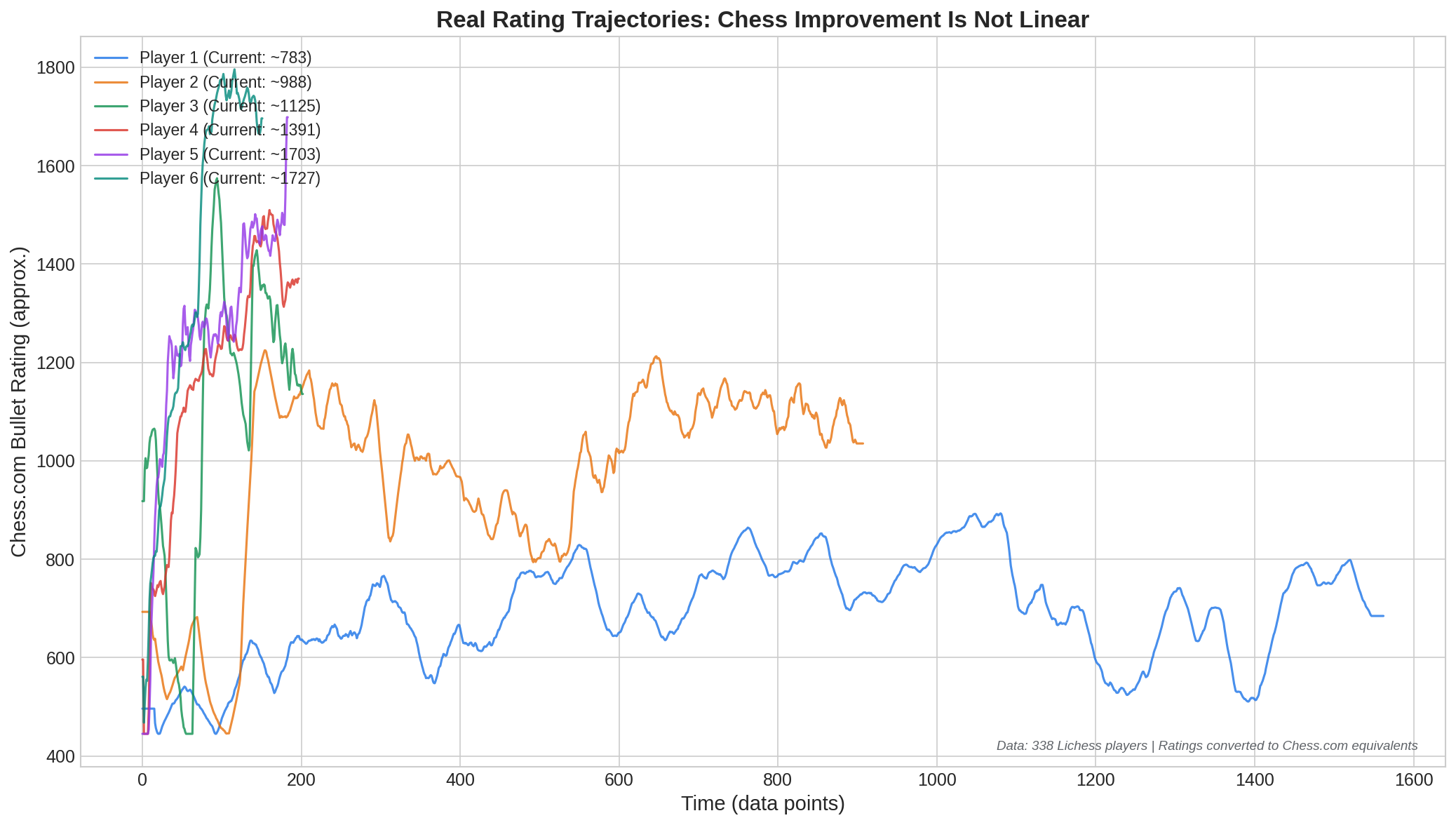
As the chart above demonstrates, even players who successfully gain hundreds of points over time experience massive swings along the way. A player might spend months oscillating within a 150-point range before suddenly breaking out, only to fall back down and consolidate at a new, slightly higher baseline.
This volatility is particularly pronounced in bullet chess, where the one-minute time control amplifies the impact of physical condition, focus, internet connection, and psychological momentum. However, the underlying pattern of spikes, plateaus, and regressions holds true across all time controls.
The Anatomy of a Rating Regression
How common is it to lose 100 points or more during an overall upward trajectory? The data shows that it is not just common; it is practically guaranteed.
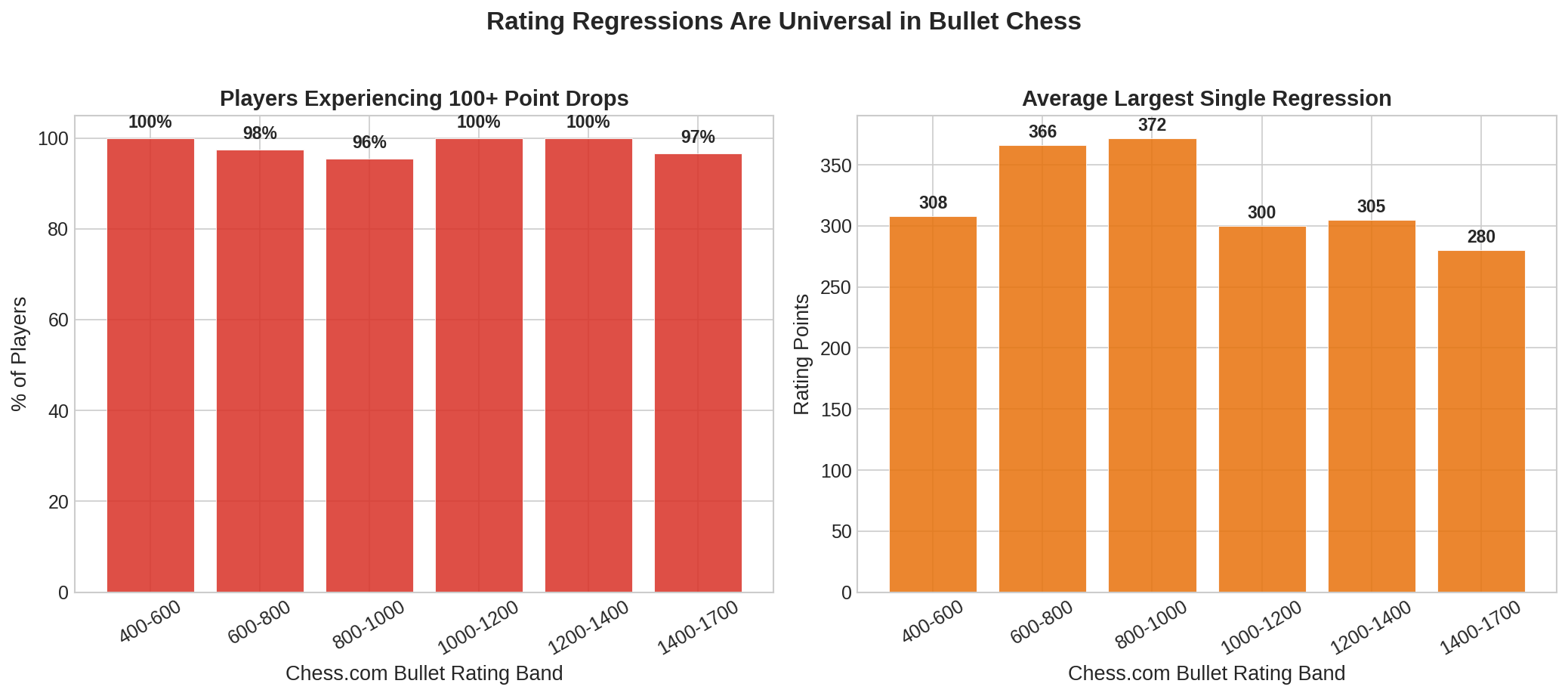
Across all rating bands from 400 to 1700, nearly 100% of players who successfully improved their rating experienced at least one regression of 100 points or more. In fact, the average player experiences multiple significant drops during their climb.
The size of these regressions tends to scale with the player's rating. A player in the 800-1000 range might experience a maximum drop of around 120 points, while a player in the 1400-1700 range frequently sees drops exceeding 150 points. This occurs because higher-rated players have higher baseline volatility; it takes more points to represent the same relative shift in performance.
Actionable Advice for Handling Regressions
When you experience a massive rating drop, the most important thing is to recognize it as a normal statistical variance rather than a collapse of your chess ability.
For the 800-1000 Player: At this level, regressions are almost entirely driven by tactical blindness and hanging pieces. When you drop 100 points, it is usually because you have temporarily stopped performing basic blunder checks. Stop playing bullet for the day, do 15 minutes of basic puzzle training to recalibrate your board vision, and return tomorrow.
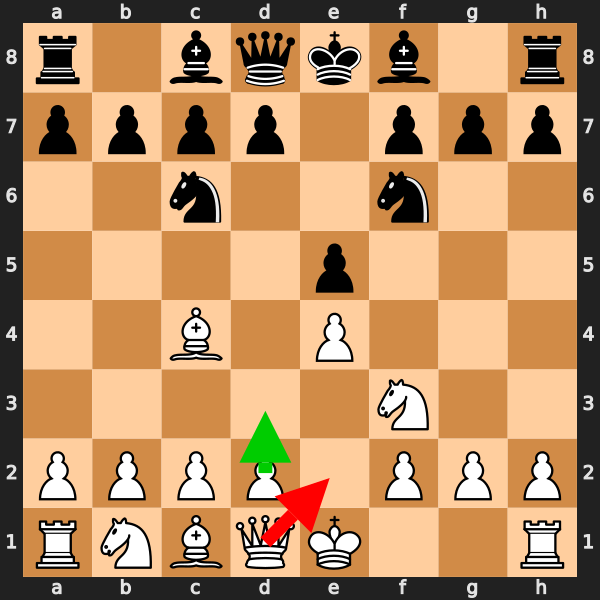 A classic 800-level regression trigger: Playing a habitual developing move (Nf6) without noticing it hangs a piece to a simple pawn push.
For the 1000-1200 Player: Regressions here often stem from "tilt" playing—continuing to queue up games while frustrated. The data shows that the deepest regressions happen in concentrated bursts of high-volume play. Implement a strict "lose three in a row and stop" rule for your bullet sessions.
The Reality of Rating Plateaus
If regressions are the sharp drops, plateaus are the long, frustrating flatlands. We define a plateau as a period where a player's rating stays within a narrow 30-point band for an extended number of games.
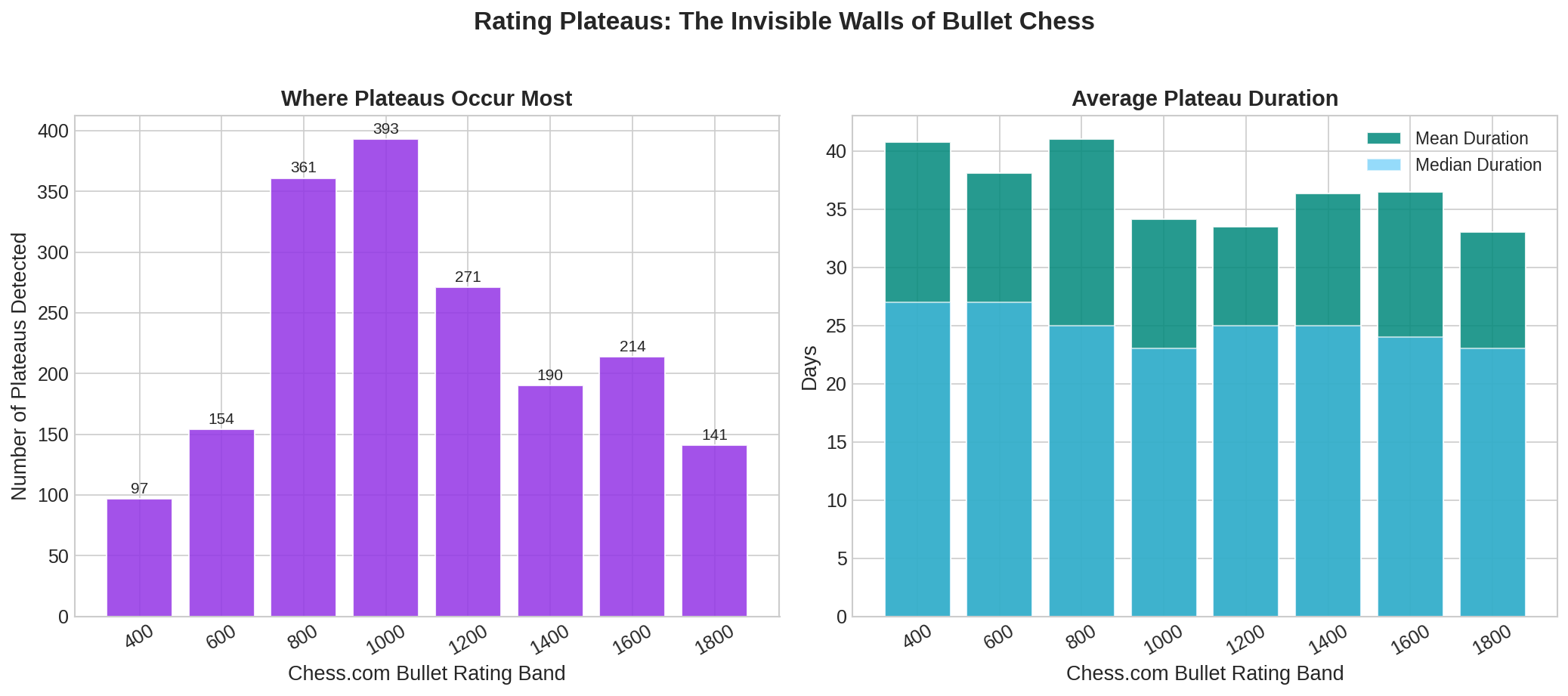
The data reveals that plateaus are most frequent in the 1200-1600 range. This makes intuitive sense: getting to 1200 primarily requires eliminating one-move blunders, a skill that can be drilled relatively quickly. Moving past 1200 requires developing positional understanding, better time management, and opening familiarity—skills that take much longer to acquire and integrate into one-minute games.
The average plateau lasts roughly 35 days, though the median is closer to 25 days. This means that if your rating has not moved in a month, you are experiencing a perfectly average plateau.
Actionable Advice for Breaking Plateaus
Breaking a plateau requires changing the inputs. If you continue doing exactly what you have been doing, you will remain exactly where you are.
For the 1200-1400 Player: You are likely plateauing because your opening repertoire is too predictable or too slow for bullet, or because you lack a plan in the middlegame.
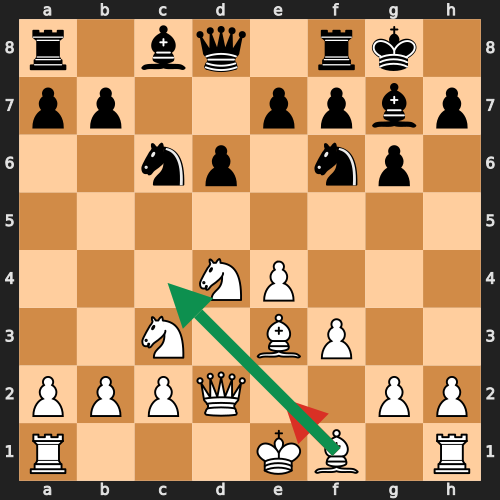 At 1300, players often plateau because they play passive, "safe" moves (like Be2) instead of active, challenging moves (like Bc4) that create immediate problems for the opponent in a fast time control.
To break this plateau, pick one specific area to change. Learn a sharp, aggressive opening system for White, or spend a week focusing entirely on improving your premove speed in the endgame.
The Anatomy of an Improvement Spike
When improvement does come, it rarely arrives as a slow trickle. Instead, it arrives in sudden, dramatic spikes.
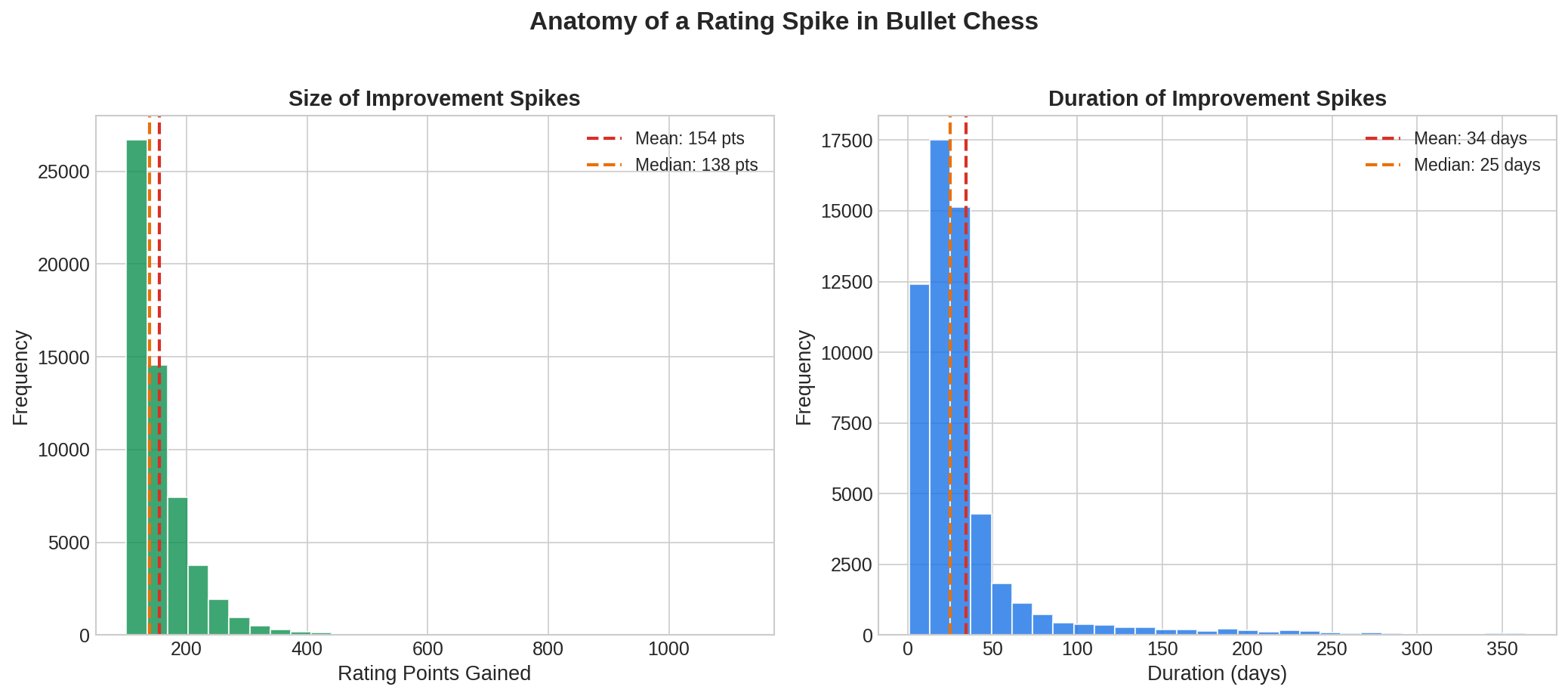
Our analysis identified over 50,000 distinct "improvement spikes"—periods where a player gained 100 or more points in a short timeframe. The average spike yields a gain of about 150 points and unfolds over the course of 25 to 50 days.
These spikes typically occur when a player successfully integrates a new skill into their unconscious competence. In bullet chess, you do not have time to consciously think about a new tactical pattern or opening trap. You only see the rating benefit once that pattern becomes automatic. The long plateau is the period of conscious learning; the spike is the result of that learning becoming unconscious.
Actionable Advice for Maximizing Spikes
When you feel a spike happening—when you are seeing tactics instantly and your rating is climbing—your goal should be to consolidate those gains rather than pushing until you collapse.
For the 1400-1600 Player: When you hit a new peak rating, your variance will naturally increase because you are facing stronger opponents who punish mistakes more severely.
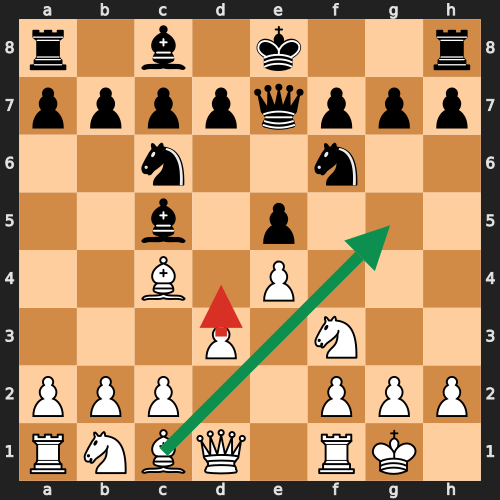 As you push past 1400, missing a simple pin (playing d4 instead of Bg5) will be instantly punished. The game speeds up, and tactical awareness must be sharper.
When you achieve a new peak, play fewer games per session. Protect your confidence and allow your brain to adjust to the speed and accuracy of the new rating bracket.
Bouncing Back: The Recovery Phase
Perhaps the most encouraging finding in the data is how players recover from massive regressions.
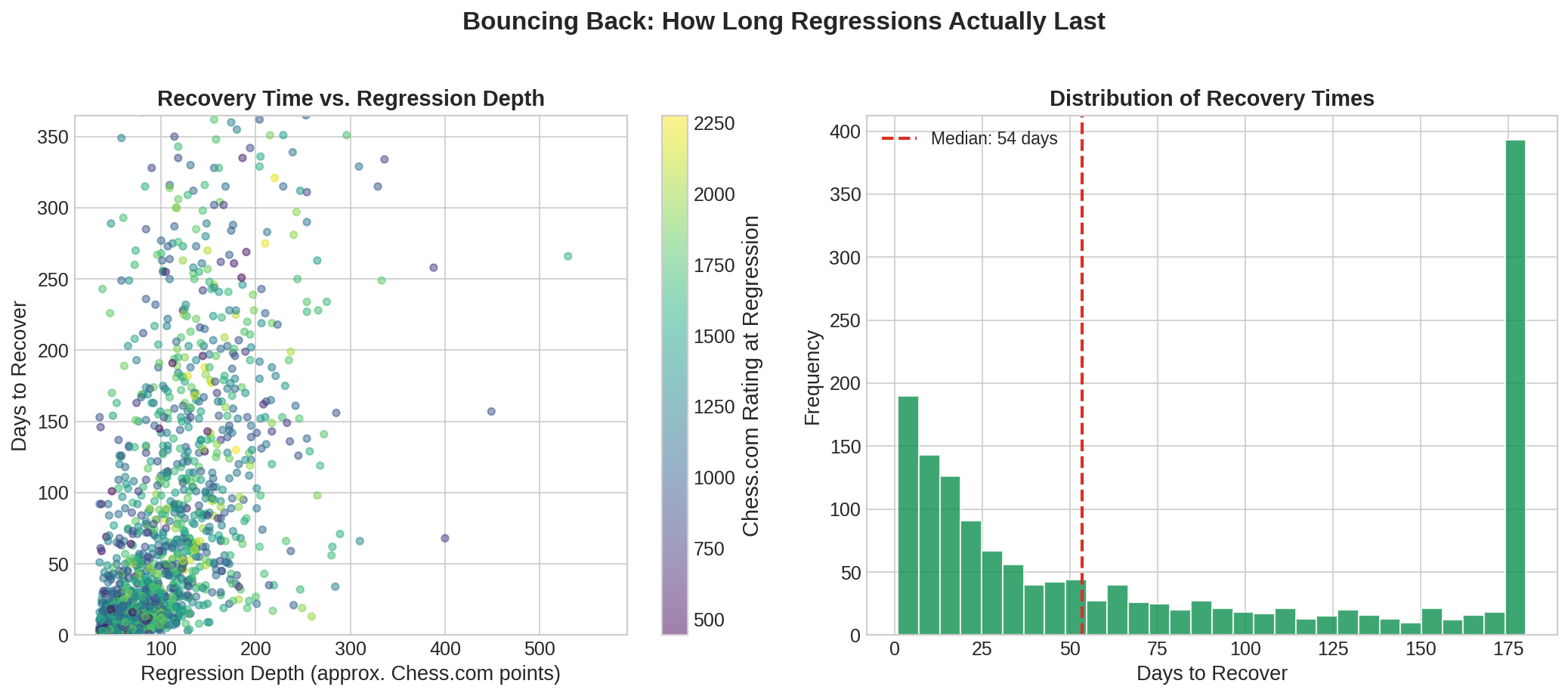
When a player drops 100 points or more from their peak, the median time to recover that lost rating is roughly 30 to 40 days. While this can feel like an eternity when you are in the middle of a slump, it confirms that the underlying skill has not been lost. The rating points will return once the temporary factors causing the slump (fatigue, tilt, distraction) are resolved.
Interestingly, the depth of the regression does not strongly correlate with the time it takes to recover. A 150-point drop often takes no longer to recover from than an 80-point drop, suggesting that once a player "snaps out" of their slump, they rapidly return to their true skill level.
Conclusion: Embrace the Chaos
If you are currently experiencing a 100-point rating drop, or if you have been stuck at the same rating for a month, the data offers a clear message: you are completely normal.
The journey from 800 to 1500 on Chess.com is not a gentle hike up a paved path. It is a chaotic scramble filled with sudden leaps forward, long periods of wandering in circles, and terrifying falls backward.
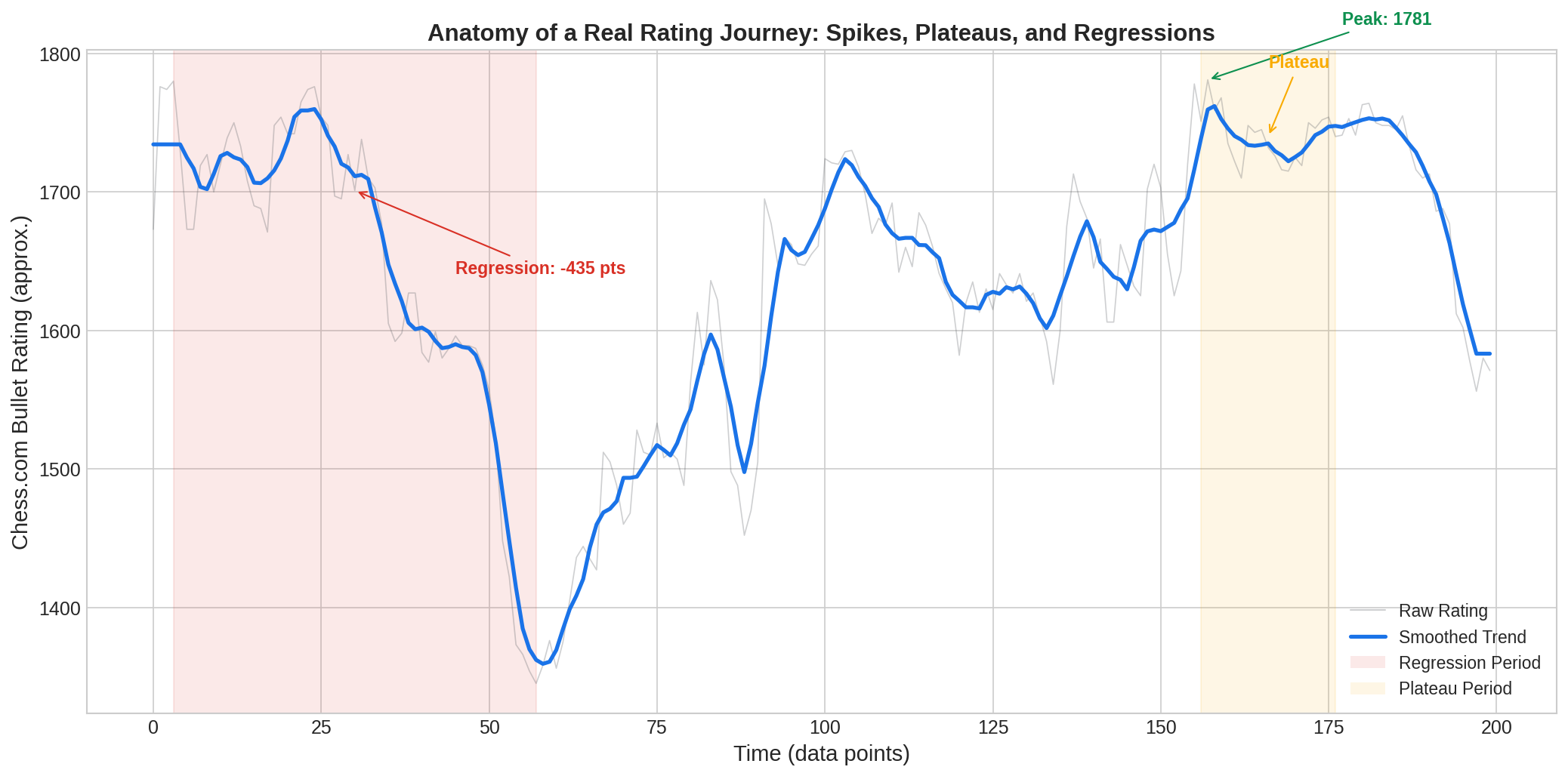
By understanding that volatility is a feature of improvement rather than a bug, you can detach your ego from your daily rating fluctuations. Focus on the underlying skills—tactical vision, time management, and positional understanding—and trust that the rating will eventually, chaotically, follow.
Data and Methodology
This analysis was conducted using a dataset of 338 Lichess bullet players, comprising 191,439 individual rating data points. Players were selected to represent a broad spectrum of skill levels, with a focus on the intermediate ranges.
Because the target audience for this article is Chess.com users, all Lichess ratings were converted to approximate Chess.com equivalents using standard community mapping formulas (e.g., a Lichess bullet rating of 1500 is roughly equivalent to a Chess.com bullet rating of 1150).
The raw data and summary statistics used to generate these insights are available in the attached CSV files:
player_summary.csv: High-level statistics for each player in the dataset.regression_summary.csv: Aggregated data on the frequency and size of rating drops by rating band.variance_analysis.csv: Data on daily rating volatility across different skill levels.plateau_analysis.csv: Statistics on the duration and frequency of rating stagnation periods.
Chess Coach April 15, 2026